Search This Blog

Sunday, 3 February 2013

Inequality for All – another Inconvenient Truth?


The powerful documentary Inequality for All was an unexpected hit at the recent Sundance film festival, arguing that US capitalism has fatally abandoned the middle classes while making the super-rich richer. Can its star, economist Robert Reich, do for economics what Al Gore did for the environment?

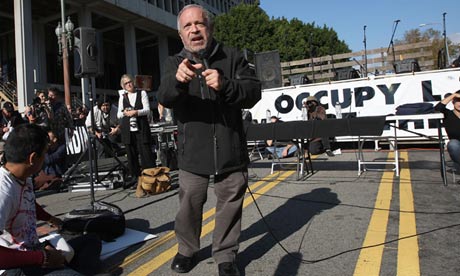
Robert Reich addresses Occupy rally
Former US labour secretary Robert Reich at an Occupy Los Angeles rally in 2011. Photograph: David Mcnew/Getty Images
In one sense, Inequality for All is absolutely the film of the moment. We are living through tumultuous times. The economy has tanked. Austerity has cut a swath through the country. We're on the verge of a triple-dip recession. And, in another, parallel universe, a small cohort of alien beings – or as we know them, bankers – are currently engaged in trying to figure out what to spend their multimillion-pound bonuses on. Who wouldn't want to know what's going on? Or how it happened? Or why? Or if it is really true that the next generation down is well and truly shafted?
And yet… what sucker would try to make a film about it? It's not exactly Skyfall. Where would you even start? Because there are some films that practically beg to be made. And then there's Inequality for All; the kind of film that you can't quite believe that anybody, ever, considered a good idea, let alone had the passion and commitment to give it two years of their life.
How did you even come up with the idea of making a film about economics? I ask the director Jacob Kornbluth. "I know! People would roll their eyes when I told them. They'd say it's a terrible idea for a film." On paper it is, indeed, a terrible idea. A 90-minutedocumentary on income inequality: or why the rich have got richer and the rest of us haven't (I say "us" because although it's focused on America, we're snapping at their heels) and which traces a line back to the 1970s, when things stopped getting better for the vast majority of ordinary working people and started getting worse.
"It always sounded so dry," says Kornbluth. "But then I'd tell people it's An Inconvenient Truth for the economy and they'd go, Ah!"
In fact, Inequality for All, which premiered at the Sundance film festival a fortnight ago, is anything but dry. It won not just rave reviews but also the special jury prize and a major cinema distribution deal, and while it owes an obvious debt to Al Gore's An Inconvenient Truth, it is, in many ways, a much better, more human and surprising film. Not least because, incredibly enough, it's actually pretty funny. And, in large part, this is down to its star, Robert Reich.
Reich is not a star in any obvious sense of the word. He's a 66-year-old academic. And he's been banging on about inequality for more than three decades. At one point in the film he looks quite downcast and says: "Sometimes I just feel like my life has been a total failure." An archive clip of him on CNN from 1991 looking fresh-faced and bushy-haired shows that he has literally been saying the same thing for decades upon decades. And yet, as he tells me cheerfully on the phone from his home in California, "It just keeps getting worse!"
These days he's a professor of public policy at the University of California at Berkeley and while he's not a figure we're familiar with in the UK, he's been part of American public life for years. At the start of the film, he introduces himself to a lecture hall full of students, telling them how he was secretary of labour under Bill Clinton. "And before that I was at Harvard. And before that I was a member of the Carter administration. You don't remember the Carter administration, do you?" The students remain silent. "And before that," says Reich with impeccable comic timing, "I was a special agent for Abraham Lincoln." He shakes his head. "Those were tough times."
Reich's books and ideas have been at the forefront of Democratic party thinking for a generation. He is an intellectual heavyweight, a veteran policymaker, a seasoned political hand, and yet he also has the delivery of a standup comedian. His ideas were the basis for Bill Clinton's 1992 election campaign slogan, "Putting People First" (they were both Rhodes scholars and he met Clinton on board the boat to England; he once dated Hillary too, though he only realised this when a New York Times journalist rang him up and reminded him). And they were still there at the heart of President Obama's inaugural address last month. America could not succeed, said Obama, "when a shrinking few do very well and a growing many barely make it". What Reich, basically, has been saying since the year dot.
What's extraordinary is how, somehow, these ideas have been translated into a narrative that shows every sign of being this year's hit documentary film. It certainly shocked Reich. He says he was amazed when Kornbluth first pitched the idea of a film. "He came and said that he'd read my book, Aftershock, and that he loved it and wanted to do a movie about it. And I honestly didn't know what he meant. How could you make a movie out of it?"
But Kornbluth has made a movie out of it. A really astonishingly good movie that takes some big economic ideas and how these relate to the quality of everyday life as lived by most ordinary people. The love and care and artistic flair that Kornbluth brought to it is evident in every frame. It was really really hard work, he tells me, to make something look that simple. But then "I grew up poor. So I've always been very aware of who has what in society." His father had a stroke when Kornbluth was five and died six years later. And his mother, who didn't work because she was raising three children, died when he was 18.
Any synopsis of the film runs the risk of making it seem dry again, but essentially it describes how the middle classes have come to have a smaller and smaller portion of the economic pie. And how, since 70% of the economy is based on the middle classes buying stuff, if they don't have any money to buy this stuff, it cannot grow. Meanwhile, the government has allowed the super-rich, the "one per cent", to take more of the nation's wealth. Half of the US's total assets are now owned by just 400 people – 400! – and, Reich contests that this is not just a threat to the economy, but also to democracy.

Kornbluth tells me that he initially had the idea of casting Reich in a feature film. "I'd seen him on TV and I just thought he'd make a great tax inspector in this film I was making. Although, actually, it turned out he was a terrible actor. But we hit it off. And I discovered that he and I share a sense of humour. I'm not a documentarian. My background is comedy. Yet I just thought that this could be an amazingly riveting film. To me it's the most important story of our time. And nobody was telling it. I kept on reading the papers and watching the news and I really wanted a story. I craved it. I just knew that to do it, we would have to make it as funny and human as possible."
And it's this, the gentle humour at the heart of the film, and the lightness of its direction, that are its winning ingredients, disguising what is, in fact, incredibly powerful. Because at heart Inequality for All is a revolutionary film. Or, at least, its dearest desire is to precipitate a revolution in the way that we think about economic matters. As Reich tells me, "the economy is not like the weather". It's not inevitable. It's not determined. "An economy does not exist in nature. We don't have to settle." And, crucially, it can be changed.
But the film's main stroke of brilliance is to put Reich, the unlikely hero, at the centre. "I had never done anything political before," says Kornbluth. "I didn't consider myself political. But seeing his example, the way that he has fought this fight for so many years has been an absolute inspiration to me. I see it in his students, they really do walk out of his lectures and want to change the world."
As in An Inconvenient Truth – or "the most lucrative PowerPoint presentation in history", as one critic called it – the film is structured around a lecture, or rather series of lectures: Reich's incredibly popular wealth and poverty class at Berkeley. But it is only loosely used as a vehicle. There are also news clips and interviews and stylised graphics and archive footage.
And what the film tries to do is thread together evidence that many people know about – the increasing struggle of the middle classes to just get by, the way that the top 1% of society has unshackled itself from the rest of us and has seen its income increase exponentially, and the ever-increasing cost of the traditional avenues of improvement, such as higher education – and weave it into a cohesive and convincing narrative. It is, in some respects, a theory of everything. Reich charts the three decades of increasing median income after the second world war, a period he calls "the great prosperity" and then examines what happened in the late 1970s to put an end to it. The economy didn't falter. It kept on growing. But wages didn't.
The figures that Reich supplies are simply gobsmacking. In 1978, the typical male US worker was making $48,000 a year (adjusted for inflation). Meanwhile the average person in the top 1% was making $390, 000. By 2010, the median wage had plummeted to $33,000, but at the top it had nearly trebled, to $1,100,000.
"Something happened in the late 1970s," we hear him tell his Berkeley class. And much of the rest of the film is working out what happened.
Some inequality is inevitable, he says. Even desirable. It's what makes capitalism tick. But at what point does it become a problem? When the middle classes (in its American sense of the 25% above and below the median wage) have so little of the economic pie that it affects not just their lives but the economy as a whole.
Reich's thesis is that since the 1970s a combination of anti-union legislation and deregulation of the markets contrived to create a situation in which the economy boomed but less of the wealth trickled down. Though for a while, nobody noticed. There were "coping mechanisms". More women entered the workforce, creating dual-income families. Working hours rose. And increasing house prices enabled people to borrow.
And then, in 2007, this all came crashing to a halt. "We have exhausted all the options," he says. There's nowhere else left to go. It's crunch time.
It's crunch time that so many working families understand too well. They may not be familiar with the theory of income inequality but they haven't been able to avoid noticing that they've got less money in their pockets. "I've always thought that kitchen-table economics is the most important topic to most people," says Reich. "Their wages, their jobs, getting by. I've always tried to relate economics to where people live. That's why I was so excited about the film."
The human stories of working American families struggling to cope are at the emotional centre of the film. At a Q&A after the Sundance screening, a third of the audience admitted that they'd cried during the film at some point.
There's Erika and Robert Vaclav, for example, who pay $400 a week to keep their daughter in after-school care so that Erika can work on the checkout at Costco. "And I'm trying to work out if I should get her a phone so that she can walk home from school alone, and I know she's OK, or if I should continue paying the money." They lost their house when Robert was made redundant from his job as a manager at the now defunct electrical retailer Circuit City. And, it gradually transpires, that he's a student in Reich's wealth and poverty class at Berkeley.
"How much money do you have in your checking account?" Kornbluth asks Erika from off camera as she drives her daughter to school. "$25," she says and her voice starts to crack and waver.
One of Reich's greatest sources of humour is himself. In the opening shots of the film, the camera follows him walking to his car, a Mini Cooper. "I sort of identify with it," he says. "It's pretty little. I feel we are in proportion. Me and my car. We are together facing the rest of the world."
Later he takes a box out of the back of his car. "I always travel with my box," he says and explains that he suffers from a rare genetic condition – Fairbanks disease – that led to him only growing to 4ft 10in in height. The box is what he always takes to public-speaking events so that he can reach the podium.
He was bullied as a child "because that's just what happens when you're small" and repeatedly beaten up. His grandmother consoled him by telling him that when he was 10, 11 or 12 he'd shoot up. He never did. "It's never been a conscious thing on my part but that feeling of being bullied, and feeling vulnerable, has stayed with me. And maybe it's because of that that I can empathise with poor people. Because they are the most vulnerable. There is no one to protect them."
In the film, he tells how he made strategic alliances with older boys who could protect him. And years later, he discovered that one of them had travelled down to Mississippi to register voters and had been tortured and then murdered. "That changed my life," he says.
"He has never cashed in," says Kornbluth. "He's an incredibly smart guy and he could have found a way to correlate that into money as so many people do. But he never has. He has absolute integrity. It's almost shocking now for someone not to do that. I mean one of the film-makers I admire is Mike Leigh. And he does McDonald's commercials and I was like 'Whoa!' when I found out but I can't hold it against him. You can't hold it against anybody who's trying to make a living. But it makes Rob all the more amazing. He doesn't sit on boards. Or on thinktanks. He draws a modest salary. He has this absolute moral compass. And he's still trying to change the world."
In the 60s and 70s, this wasn't such a surprising thing. Reich recounts how he grew up "in a time of giants". His first job was working for Bobby Kennedy. Changing the world was what everyone wanted to do.
The world has changed. Just not in the way many thought it would. We fell victim to what Reich calls "the huge lie". That the free market is good. And government is bad. Government makes the rules, Reich keeps on reminding us, over and over. And it decides who benefits from those rules, and who is harmed. And increasingly, that boils down to the rich and the poor.
Perhaps the most surprising voice in the film is Nick Hanauer's. He's just your ordinary, everyday billionaire. One of the 1%. Except that he believes – like Warren Buffett – that he doesn't pay enough tax. And that hammering the middle class, the ones who buy actual stuff, who create demand, which in turn creates jobs and more taxes, is simply bad for the economy. "I mean, I drive the fanciest Audi around, but it's still only one of them… Three pairs of jeans a year, that will just about do me."
The system simply isn't working, he says. It's put the millionaires and the billionaires, the Nick Hanauers and the Mitt Romneys – the people that Republican rhetoric describes as job creators – at the centre of the economic universe, rather than what Hanauer calls the true job creators – the middle classes.
The problem is, he says, is that they've been attacked from every side. He was one of the initial investors in Amazon, a business of which he's "incredibly proud", but he points out that on revenues in the last three months of 2012 of $21bn (£13bn), Amazon employs just 65,600 people. "If it was a mom and pop retailer, it would be 600,000 people, or 800,000 or a million."
Globalisation and technology have played their role. But so has the government. For decades, under both Republicans and Democrats the highest rate of tax didn't dip below 70%. Now, Hanauer says he pays 11% on a six-figure income. Hanauer believes that if he was taxed more, he would be better off, because his company – he's a venture capitalist and his family own a pillow factory – would sell more products, and he would, therefore, make more money.
This is inequality imposed from the top. Reich's charts show that for years, chief executives' earnings kept in step with other employees. And then in 2000-03 "It went kerbluey", by which he means off the charts.
Which is where it still is. In the UK, Royal Bank of Scotland, having covered itself in glory in the Libor interest-rate fixing scandal, is currently contemplating bonuses for its investment banking division of £250m, according to reports last week. This, to put it another way, is the annual wage bill for at least 12,500 of its call-centre workers. Because this isn't just an American problem. It's a British one too.
"If there was upward mobility it would be OK," says Reich in the film. "But 42% of children born in poverty in the USA will stay there. In Denmark it's 24%. Even in Great Britain, where they still have an aristocracy, it's 30%."
It's probably a shocking statistic for Americans to hear. The problem is that by every index you can measure, inequality is worsening in Britain. There are fewer opportunities to overcome the barriers of your birth in the UK than in any other country in Europe. One of the most chilling moments in Inequality for All for a British audience is that how, faced with the same choices that America had in the 70s, we have, in the last year or so, taken the same path.
One of the key moments for Reich was the underinvestment in education, particularly higher education in the 70s. This was when America introduced tuition fees and its workforce started to fall behind the rest of the world's. When opportunities for those from low- and middle-income backgrounds began shrinking: precisely where the UK is today.
It's not just that wages have remained flat in America – as they have in the UK – it's that the expenses of everyday life have soared, in particular education and healthcare.
Last October, an independent commission in the UK led by the Resolution Foundationpredicted that in 2020 wages for low- to middle-income families would be the same as they were in 2000. And yet everything else will have gone up. We too are facing the crunch.
In December, the Office for National Statistics found that richest 10% of people in Britain own 40% of the national wealth. In London and the south-east, one in eight households has almost £1m of assets. The bottom half of the country has no net property wealth and only £4,000 in pensions savings. For them, there is just rising prices. And the ever diminishing possibility of things ever being different for them or their children.
"Where America leads, sadly the rest of the world follows. This same thing is affecting people all over the world," says Reich. "If nothing is done to reverse this trend, Britain will find itself in exactly the same place as America in just a few years' time."
Earlier in the week, I notice that he'd tweeted: "Britain's austerity economics is complete disaster. Its economy shrinking." And pasted a link to the Wall Street Journal in which the head of the IMF took George Osborne to task. When I ask him about it, he calls our austerity economics "a cruel hoax". Cruel because "it hurts people who have been hurt enough". And a hoax because, "It simply doesn't work. Look at the figures."
It should be our crunch time too. We have more people living in poverty who have jobs than those who don't, according to Oxfam. The average British citizen – the average – is three pay cheques away from destitution. And with the entire country poised on the brink of a triple-dip recession.
Perhaps the unlikeliest thing about Robert Reich is how very chipper he is. Even though, by every measure, inequality has got worse in the United States since he started preaching his doctrine. He doesn't seem to let it get to him.
There are clips of him from the 90s when he used to be a regular pundit on Fox News, but as American politics has moved to the right, he has found himself cast as a dangerous leftie. "Robert Reich?" says a pundit on one news clip. "He's a communist. A socialist." It's not a coincidence that he makes a point of saying in the film that he is not, and never has been, a member of the Communist party. And he and Kornbluth go to extraordinary lengths not to mention the word "Sweden" or "Japan" and barely even "Germany".
No good will come of telling the American people what funny foreigners get up to. It is, instead, rather gently subversive, the aesthetic opposite of any film by Michael Moore. It tries to politely prod its viewers into looking at the world differently rather than beating them around the head with a heavy wooden bat marked "polemic".
But American politics has become so polarised, so ideologically vicious, that it's only a matter of time before it's attacked by the right as Stalinist propaganda. "But I'm used to that," he says. "I've been attacked at a personal level for the last 30 years. I'm just excited that this might trigger a debate. Though I'm trying not to get my hopes up."
Crunch time in the US is looking ugly. Reich believes that both the Tea Party and Occupy movements spring from the same sense of anger and frustration that people fear. That politics will become more polarised, more extreme, more hate-filled.
One of the key pieces of research that Reich cites is a study of tax data by Emmanuel Saez and Thomas Piketty which shows that the years of peak income inequality in America were in 1928 and 2007. Right before both crashes. "The parallels are striking," he says. It's also striking what happened in the years after 1928. How in Germany, to take a random example, worldwide depression also led to a vicious polarisation of right and left. And certain other outcomes.
Could that happen in America? "Oh good heavens, I hope not!" he says. "Though when you go into periods of economic insecurity with widening inequality which puts the middle class under stress, you create fertile ground for demagogues from left or right. The politics of hate. The politics of fear. We're already seeing that."
And yet, despite, it all, he remains hopeful. "Change has always been difficult," he says. It's why he teaches. If he can't change the world, maybe his students will. Or people who watch the film? I ask and get a classic, understated, deadpan but not entirely unoptimistic Reichian reply. "I'm trying to keep my expectations in check."
Saturday, 2 February 2013

Upper caste scams v Lower caste scams


How Some Gather Silver In The Fog
There are two types of scam, upper caste and lower caste. The latter kind is more visible.


When a Balwa orchestrates a scam, you don’t know how much money was made. Even the Comptroller & Auditor General’s (CAG) accountants are confused about how to value the loss to the exchequer. The payoff is legally offered in the form of a Rs 200 crore loan to the Karunanidhi family. Is it a bribe? Tough to say. The Balwas are from the Gujarati mercantile caste, mostly Muslim, called Cheliyas. They are superb businessmen and the equal of Hindu merchant castes in running hotels and managing retail.

When a Vadra commits a scam, one isn’t even sure whether it was actually a scam, though the numbers are clear on the balancesheet. People are not advanced money without security to get into the construction business. What was the payoff for? Nobody really knows. Vadras, or Vadheras, are Khatris, the great Punjabi trading caste which dominates business in Delhi.

When an Adani (a Jain Baniya) is arrested in a scam, the motive is not to be found. The unbelievable allegation is that he evaded Rs 80 lakh worth of customs duty for a company worth Rs 26,000 crore. When an Ambani (a Modh Vaniya) does a scam, even the victim is not to be found. Was the state duped of billions of dollars in natural resources? Apparently not.

When a Jindal (Baniya) does a scam, he isn’t accused of impropriety, though his own party has allotted to him, without auction, thousands of crores in mineral deposits. When a Goel (Aggarwal Baniya) asks for Rs 100 crore as blackmail, he can coolly deflect it though the evidence is on tape. Even his employees, caught red-handed, keep their jobs.
 
 
If scams by SC/STs or OBCs tend to stand out, it’s because the transactions are pretty simple, the exchange open.


When a Dalit Mayawati does a scam, she hands over land to developers near the Taj Mahal and is caught. When a tribal Koda does a scam, he hands over land to miners and is caught. He loses his chief ministership and goes to jail. When a peasant Lingayat does a scam, he gives over land to his sons and is caught. He loses his chief ministership and goes to jail. When a peasant Reddy does a scam, he hands over land and his son goes to jail. When a peasant Yadav does a scam, he dips into money for cattle fodder and is caught. He loses chief ministership and goes to jail.

There is absolutely nothing wrong in Ashis Nandy’s observation about caste and corruption. It is accurate and obvious, unless one is blind to what is around. Nandy said, “...the fact is that most of the corrupt come from the OBC, the Scheduled Castes and now increasingly Scheduled Tribes, and as long as it was the case, the Indian Republic would survive”. He gave this example. “The state of least corruption is West Bengal. In the last 100 years, nobody from the backward classes and the SC and ST groups have come anywhere near power in West Bengal. It is an absolutely clean state.”

What he meant is obvious enough, but subtlely is not our strong suit. We are all corrupt, and this is the true meaning of Nandy’s remarks, but some castes are seen as more corrupt. Why is this so? The fact is that SC/ST and OBC scams tend to stand out as scams to us because of the nature of the transaction.

Upper-caste scams are different from lower-caste scams. The former tend to be complex, less likely to provoke anger, and therefore, more easily forgotten. Scams involving the lower castes tend to be straightforward. No fancy paperwork and an uncomplicated payoff. Cash is to be delivered in India, not Switzerland.

There is a reason for this. Those who are familiar with the process of democracy in India will tell you that over 50 per cent of the money a politician spends on elections is given to the voter. Salman Rushdie accurately defined Indian democracy as “one man, one bribe”. My speculation is that SC/ST corruption is actually more democratic, though it is seen by the middle-class with more revulsion.

What angers middle-class Indians—they will be surprised to know this—is not corruption. It is actually bribery, which is the exchange of money for favour. The correct word for this is rishwatkhori, not bhrashtachar. What is corrupted (made ‘bhrasht’) by this act of bribery is the office. It is the office, and the edifice of the state, that is corrupted. But this isn’t something that we are particularly upset by. If we were, the corruption by the upper caste’s scams would anger us more than the bribery of the lower caste scams.

But it doesn’t. What offends us is the making of money. And what really upsets us is that “those people”, and not we, are the ones making it.

Another Country


Many of those who govern us do not in their hearts belong here. They belong to a different culture, a different world, which knows as little of its own acts as it knows of those who suffer them


Those whom the gods love die young: are they trying to tell me something? Due to an inexplicable discontinuity in space-time, on Sunday I turned 50. I have petitioned the relevant authorities, but there’s nothing they can do.

So I will use the occasion to try to explain the alien world from which I came. To understand how and why we are now governed as we are, you need to know something of that strange place.

I was born into the third tier of the dominant class: those without land or capital, but with salaries high enough to send their children to private schools. My preparatory school, which I attended from the age of eight, was a hard place, still Victorian in tone. We boarded, and saw our parents every few weeks. We were addressed only by our surnames and caned for misdemeanours. Discipline was rigid, pastoral care almost non-existent. But it was also strangely lost.

A few decades earlier, the role of such schools was clear: they broke boys’ attachment to their families and re-attached them to the instititions – the colonial service, the government, the armed forces – through which the British ruling class projected its power. Every year they released into the world a cadre of kamikazes, young men fanatically devoted to their caste and culture.

By the time I was eight those institutions had either collapsed (in the case of colonial service), fallen into other hands (government), or were no longer a primary means by which British power was asserted (the armed forces). Such schools remained good at breaking attachments, less good at creating them.

But the old forms and the old thinking persisted. The school chaplain used to recite a prayer which began “let us now praise famous men”. Most of those he named were heroes of colonial conquest or territorial wars. Some, such as Douglas Haig and Herbert Kitchener, were by then widely regarded as war criminals. Our dormitories were named after the same people. The history we were taught revolved around topics such as Gordon of Khartoum, Stanley and Livingstone and the Black Hole of Calcutta. In geography, the maps still showed much of the globe coloured red.

My second boarding school was a kinder, more liberal place. But we remained as detached from the rest of society as Carthusian monks. The world, when we were released into it, was unrecognisable. It bore no relationship to our learning or experience. The result was cognitive dissonance: a highly uncomfortable state from which human beings will do almost anything to escape. There were two principal means. One – the more painful – was to question everything you held to be true. This process took me years: in fact it has not ended. It was, at first, highly disruptive to my peace of mind and sense of self.

The other, as US Republicans did during the Bush presidency, is to create your own reality. If the world does not fit your worldview, you either shore up your worldview with selectivity and denial, or (if you have power) you try to bend the world to fit the shape it takes in your mind. Much of the effort of conservative columnists and editors and of certain politicians and historians appears to be devoted to these tasks.

In the Origins of Totalitarianism, Hannah Arendt explains that the nobles of pre-revolutionary France “did not regard themselves as representative of the nation, but as a separate ruling caste which might have much more in common with a foreign people of the same society and condition than with its compatriots.”(1) Last year the former Republican staffer Mike Lofgren wrote something very similar about the dominant classes of the US: “the rich elites of this country have far more in common with their counterparts in London, Paris, and Tokyo than with their fellow American citizens … the rich disconnect themselves from the civic life of the nation and from any concern about its well being except as a place to extract loot. Our plutocracy now lives like the British in colonial India: in the place and ruling it, but not of it.”(2)

Secession from the concerns and norms of the rest of society characterises any well-established elite. Our own ruling caste, schooled separately, brought up to believe in justifying fairytales, lives in a world of its own, from which it can project power without understanding or even noticing the consequences. A removal from the life of the rest of the nation is no barrier to the desire to dominate it. In fact it appears to be associated with a powerful sense of entitlement.

So if you have wondered how the current government can blithely engage in the wholesale transfer of wealth from the poor to the rich, how its front bench can rock with laughter as it truncates the livelihoods of the poorest people of this country, why it commits troops to ever more pointless post-colonial wars, here, I think, is part of the answer. Many of those who govern us do not in their hearts belong here. They belong to a different culture, a different world, which knows as little of its own acts as it knows of those who suffer them.

Friday, 1 February 2013

Are Footballers cleverer than PhD students? Think again


Ability is dictated by what we need to succeed. A chimp would fare better than me in a jungle – that doesn't make it smarter
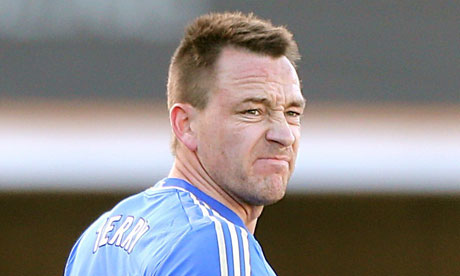
John Terry
'How can a test accurately measure something when there is no certainty as to what is being measured?' Photograph: Nick Potts/PA
A recent study has shown that footballers can perform better than PhD students on certain cognitive tasks. This is being interpreted in the mainstream media as evidence that footballers are smarter than PhD students. While this is something of a considerable extrapolation, it is a perfect example of how our views and ideas about what counts as "intelligence" are a lot more flexible than most would think.
Scientifically, there is no real consensus per se on what intelligence can be accurately defined as. IQ tests may seem like an obvious way to assess intelligence, but in psychology their use remains controversial. How can a test accurately measure something when there is no certainty as to what is being measured? When you've got demonstrating that intelligence is dependent on working memory capacity, or arguing whether it's supported by singular or multiple processes, you need to be reasonably intelligent to keep up with the varying theories about what that even means.
Intelligence is also strongly influenced by culture. What's considered smart in one culture could well be considered foolish in another. We are all guilty of this bias to some extent. In the UK, a detailed knowledge of science is considered intelligent by many, whereas a detailed knowledge of football usually isn't. But there's nothing to say someone's football knowledge isn't just as or more complex and diverse than someone's knowledge of science. But football is everywhere, you don't need a degree to know about it, children play it all the time – so an in-depth knowledge of it is, perhaps unfairly, not considered an achievement.
Of course, knowing a lot of detailed information about something is only part of intelligence. It's also important to consider how this information is used. This division is referred to by some as crystallised and fluid intelligence, or information you retain and your ability to use it, respectively. Think of it like a computer: you've got your hard drive (data storage) and your processor (data usage); you need both to create a truly useful device.
This is reflected in changes to the structure of the brain, as the brain adapts and dedicates more resources to this constantly occurring demand. Therefore, it shouldn't be surprising that professional footballers would be better at certain mental abilities than non-footballers.
Whatever you think of the sport, a professional football match is undoubtedly a challenging context to be in. With so many variables to consider in a constantly changing scenario, it would be hard enough to keep on top of without thousands of people screaming at you for various reasons. Footballers have to be able to do this if they wish to get to the top of their field, so of course they'd perform better in tests that assess rapid thinking, attention and any other ability that isn't so crucial for other disciplines.
Footballers are stereotyped as being a bit thick, based on their unrefined behaviour and lack of social/cultural awareness. But these things haven't exactly held them back, so why would they have learned otherwise? Our abilities and skills are largely dictated by what we need to do in order to succeed. A chimpanzee would be far better equipped than I to survive in the jungle and would undoubtedly perform better than me in tests that assessed this. Still, I wouldn't let one fill in my tax return.
Perhaps intelligence is the wrong term to use, perhaps it would be fairer to say footballers and PhD students have differing mental abilities. But which of these abilities is considered "intelligent" seems to be a lot more subjective than most people realise.

Wednesday, 30 January 2013

Green Books, red herring and the LoC war


PRAVEEN SWAMI
  
FOCUS: India must become aware that a more muscular response to Pakistani aggression on the LoC will come with a price that probably isn’t worth paying. The picture is of commanders of the Indian and Pakistani Armies at a flag meeting in Poonch recently.
Photo: PTIFOCUS: India must become aware that a more muscular response to Pakistani aggression on the LoC will come with a price that probably isn’t worth paying. The picture is of commanders of the Indian and Pakistani Armies at a flag meeting in Poonch recently.
Pakistan’s military literature makes clear that its generals are seeking to provoke a crisis. India is pushing itself into their trap
Late one night in the summer of 2009, four improvised 107-millimetre rockets arced over the Pul Kanjari border outpost in Punjab, and exploded in the fields outside the village of Attari. For the first time since the war of 1971, there was an attack across the India-Pakistan border. In September that year, four more rockets were fired; then, in January 2010, there was a third assault.
Now, as Indian and Pakistani troops trade fire along the Line of Control (LoC), it is more important than ever to understand the significance of those events. The rocket attacks, believed to have been carried out by the Tehreek-e-Taliban Pakistan, represented a glimpse into a grim future that India’s policy of strategic restraint has been designed to avert — a war of attrition waged by jihadists that would turn India’s western frontiers into a kind of nuclear-fuelled Lebanon.
Ever since January 2008, two months after General Pervez Ashfaq Kayani took over as chief of the Pakistan Army, clashes along the LoC have escalated. India reported 28 ceasefire violations in 2009, 44 in 2010, 60 in 2011, and 117 last year. The traditional explanation — that these clashes are linked to terrorist infiltration across the LoC — borne out by the data: during this period, Jammu and Kashmir has become significantly less violent, not more.
New doctrine
Pakistan’s military literature provides some insight into what is going on. The country’s generals, it shows, hope heightened tensions with India will help rebuild their legitimacy, extricate themselves from a domestic insurgency they are losing, and push jihadist groups now ranged against the Pakistani state to turn their energies eastwards. India, driven by a barrage of ill-conceived war polemic, is pushing itself into this trap.
Earlier this month, reports emerged that Pakistan had amended its doctrinal manual, called the Green Book, to include a chapter identifying internal insurgent forces as the country’s principal national security threat. No one, though, has quoted as much as a single line from the Green Book in question — one of several reasons to suspect it might just be a red herring. Pakistani Prime Minister Raja Pervez Ashraf, in a January 4 address at the National Defence University, called on the armed forces to “redesign and redefine our military doctrine” to fight terrorism. It seems reasonable to infer that, on that date, he at least was unaware of a new doctrine.
C. Christine Fair, a Georgetown University scholar who is the preeminent authority on the Pakistan Army’s internal doctrinal literature — and the first to bring the Green Book series to light — is in little doubt that is the case. “This talk of a new doctrine is rubbish,” says Dr. Fair, “I think a lot of people who really ought know better have let themselves be talked into buying snake-oil.”
The Green Book isn’t, in fact, a doctrinal testament — or even, in fact, one book. For the last two decades, as first reported in The Hindu in 2011, the Pakistan Army’s general headquarters has published collections of essays by senior officers, with the name assigned to the series. The 2010 Green Book, on information warfare, only became available last year; the next in the biennial series only became available in 2011.
Suspicions of India
From the very first essay in the current Green Book, it becomes clear the Pakistani officer corps’ maniacal suspiciousness of India hasn’t stilled. Brigadier Umar Farooq Durrani’s “Treatise on Indian-backed Psychological Warfare Against Pakistan,” asserts that the Research and Analysis Wing “funds many Indian newspapers and even television channels, such as Zee Television, which is considered to be its media headquarters to wage psychological war.” The “creation of [the] South Asian Free Media Association a few years back,” Brigadier Farooq claims, “was a step in the same direction.” Even the eminent scholar Ayesha Siddiqa’s work, he insists, is “a classical example of psychological war against Pakistan.”
The most subtle form” of this psychological war, the Brigadier states, “is found in movies where Muslim and Hindu friendship is screened within [sic.] the backdrop of melodrama. Indian soaps and movies are readily welcomed in most households in Pakistan. The effects desired to be achieved through this is to undermine the Two National Theory [as] being a person obsession of [Muhammad Ali] Jinnah.”
Had the Green Books not been official publications, none of this ought to have been a cause of worry. There is, after all, no shortage of delusional paranoiacs on the eastern side of the India-Pakistan border either, in and outside the armed forces.
From the Pakistan Army chief himself, though, we know ideas like those of Brigadier Durrani are considered worthy of serious consideration. In his foreword to the 2010 edition, General Kayani asserts that the essays provide “an effective forum for the leadership to reflect on, identity and define the challenges faced by the Pakistan army, and share possible ways of overcoming them.”
The eastern enemy
Language of the kind that runs through the 2010 Green Book pervades earlier editions too. In 2002, as Pakistan faced up to the looming war between its armed forces and their one-time jihadist allies, theGreen Book focussed on low-intensity warfare. Brigadier Shahid Hashmat, typically, argued that the “threat of low-intensity conflicts should be considered as the most serious matter at [the] national level.” Thus, he went on, “all national agencies and resources must be directed concurrently for launching an effective and robust response against this threat.”
The blame for the crisis imposed on Pakistan by religious sectarian groups and jihadists, though, is firmly placed on India. Lieutenant-Colonel Inayatullah Nadeem Butt, using ideas near-identical to those in the current Green Book, asserted that “India has been aggressively involved in subverting the minds of youth through planned propaganda and luring them towards subversive activities.”
Even as they considered how to fight religious sectarian groups and revolutionary jihadists, the officers who contributed to the 2002 Green Book thus focussed on imposing punitive costs on India. Brigadier Muhammad Zia, for example, noted that “India is highly volatile on its internal front due to numerous vulnerabilities which, if agitated, accordingly could yield results out of proportion to the efforts put in.” In similar vein, Major Ijaz Ahmad advocated “that [the] Inter-Services Intelligence should launch low profile operations in Indian-held Kashmir and should not allow the freedom movement to die down.” “Linguistic, social, religious and communal diversities in India,” the officer continued, “should be exploited carefully and imaginatively.”
Put another way, even as they considered tactics to defeat insurgents in Pakistan, the officer corps also discussed sponsoring insurgencies in India, to tie down their arch-adversary. General Pervez Musharraf described the 2002 Green Book, as a “valuable document for posterity”; he was right.
Tough challenge
Like all forms of madness, the texts in the Green Book aren’t without method: crisis with India is, after all, a precondition for ensuring the Pakistan Army’s preeminent position in the country’s power structure. 26/11, it is surprisingly little remarked upon, almost did pay off for Pakistan’s Army. Less than a week after the attack, a senior Army commander was reported as calling the jihadist chief Baitullah Mehsud a “patriot.” The officer said the army’s war with the Taliban leaders like Mehsud was merely the result of minor “misunderstandings.”
There is plenty of evidence that jihadists in Pakistan are growing more powerful — and that organisations like the Tehreek-e-Taliban are seriously considering expanding their operations eastwards. “The practical struggle for a shari’a system that we are carrying out in Pakistan,” its deputy chief Maulana Wali-ur-Rahman said in a recently-released video, “the same way we will continue it in Kashmir, and the same way we will implement the shari’a system in India.”
It is self-evident that preventing a rapprochement between jihadists and the generals is in India’s best interest — one reason why Prime Ministers Atal Behari Vajpayee and Manmohan Singh proved willing to pay the political price for a policy of strategic restraint. That the will to continue doing so is fraying in the build-up to the General Election is evident. India has, so far, punished Pakistani aggression with a variety of means, conventional and covert — but the seduction of grandiose gestures is growing. Indians must become aware, though, that a more muscular response to Pakistani aggression on the LoC, like all instant gratification, will come with a price that probably isn’t worth paying.
praveen.swami@thehindu.co.in

Locked in U.N. files, 15 years of bloodletting at LoC


PRAVEEN SWAMI 

SHARE  ·   COMMENT   ·   PRINT   ·   T+  
Complaints by Pakistan of executions, beheadings in secret cross-border raids by Indian forces
In classified protests to a United Nations watchdog that have never been disclosed till now, Pakistan has accused Indian soldiers of involvement in the torture and decapitation of at least 12 Pakistani soldiers in cross-Line of Control raids since 1998, as well as the massacre of 29 civilians.

The allegations, laid out in confidential Pakistani complaints to the United Nations Military Observer Group in India and Pakistan (UNMOGIP), suggest that Indian and Pakistani troops stationed on the Line of Control remain locked in a pattern of murderous violence, despite the ceasefire both armies entered into in November 2003. Earlier this month, bilateral relations were severely damaged after a series of LoC skirmishes, which culminated in thebeheading and mutilation of two Indian soldiers Lance-Naik Hemraj Singh and Lance-Naik Sudhakar Singh.

The Ministry of Defence did not respond to an e-mail from The Hindu, seeking comment on the alleged decapitation of Pakistani civilians and troops reported to UNMOGIP. However, a military spokesperson said the issue had “not been raised by Pakistan in communications between the two Directors-General of Military Operations.”

The Ministry of External Affairs also said the UNMOGIP complaints had not been raised in diplomatic exchanges between the two countries.

“Ever since 9/11,” a senior Pakistan army officer told The Hindu, “we have sought to downplay these incidents, aware that a public backlash [could] push us into a situation we cannot afford on the LoC, given that much of our army is now committed to our western borders. Each of these incidents has been protested by us on both military and UNMOGIP channels.”
UNMOGIP, set up after the India-Pakistan war of 1947-1948 to monitor ceasefire violations, does not conduct criminal investigations, or assign responsibility for incidents. The reports of its ceasefire monitors are sent to the organisation’s headquarters in New York, and forwarded to the Ministry of Defence in New Delhi.

Ever since 1972, India has responded to UNMOGIP queries with a standard-form letter, saying it believes the organisation has lost its relevance following the demarcation of the LoC. Earlier this month, India argued in the United Nations that the organisation ought to be wound-up.

Massacre for massacre

The most savage cross-LoC violence Indian forces are alleged to have participated in was the killing of 22 civilians at the village of Bandala, in the Chhamb sector, on the night of November 26-27, 1998. The bodies of two civilians, according to Pakistan’s complaint to UNMOGIP, were decapitated; the eyes of several others were allegedly gouged out by the attackers. The Pakistani military claimed to have recovered an Indian-made watch from the scene of the carnage, along with a hand-written note which asked, “How does your own blood feel”?

First reported by The Hindu’s sister publication Frontline in its June 19, 1998 issue, the Bandala massacre is alleged to have been carried out by irregulars backed by Indian special forces in retaliation for the massacre of 29 Hindu villagers at Prankote, in Jammu and Kashmir, by the Lashkar-e-Taiba. The LeT attackers slit the throats of their victims, who included women and children.

No Indian investigation of the Bandala killings has ever been carried out. However, an officer serving in the Northern Command at the time said the massacre was “intended to signal that communal massacres by jihadists, who were after all trained and equipped by Pakistan’s military, were a red line that could not be crossed with impunity.”

The Lashkar, however, continued to target Hindu villagers in the Jammu region; 10 were killed at Deesa and Surankote just days later, on May 6, 1998. In 2001, 108 people were gunned down in 11 communal massacres, and 83 people were killed in five incidents in 2002 — a grim toll that only died out after the 2003 ceasefire.

Brutal retaliation

Even though the large-scale killings of civilians did not take place again, Pakistan continued to report cross-border attacks, involving mutilations, to UNMOGIP.

Six months after the Kargil war, on the night of January 21-22, 2000, seven Pakistani soldiers were alleged to have been captured in a raid on a post in the Nadala enclave, across the Neelam River. The seven soldiers, wounded in fire, were allegedly tied up and dragged across a ravine running across the LoC. The bodies were returned, according to Pakistan’s complaint, bearing signs of brutal torture.
“Pakistan chose to underplay the Nadala incident,” a senior Pakistani military officer involved with its Military Operations Directorate told The Hindu, “as General Pervez Musharraf had only recently staged his coup, and did not want a public outcry that would spark a crisis with India.”

Indian military sources told The Hindu that the raid, conducted by a special forces unit, was intended to avenge the killing of Captain Saurabh Kalia, and five soldiers — sepoys Bhanwar Lal Bagaria, Arjun Ram, Bhika Ram, Moola Ram and Naresh Singh — of the 4 Jat Regiment. The patrol had been captured on May 15, 1999, in the Kaksar sector of Kargil. Post mortem revealed that the men’s bodies had been burned with cigarette-ends and their genitals mutilated.

Less detail is available on the retaliatory cycles involved in incidents that have taken place since the ceasefire went into place along the LoC in 2003 — but Pakistan’s complaints to UNMOGIP suggest that there has been steady, but largely unreported, cross-border violence involving beheadings and mutilations.

Indian troops, Pakistan alleged, killed a JCO, or junior commissioned officer, and three soldiers in a raid on a post in the Baroh sector, near Bhimber Gali in Poonch, on September 18, 2003. The raiders, it told UNMOGIP, decapitated one soldier and carried his head off as a trophy.

Near-identical incidents have taken place on at least two occasions since 2008, when hostilities on the LoC began to escalate again. Indian troops, Pakistan’s complaints record, beheaded a soldier and carried his head across on June 19, 2008, in the Bhattal sector in Poonch. Four Pakistani soldiers, UNMOGIP was told, died in the raid.

The killings came soon after a June 5, 2008 attack on the Kranti border observation post near Salhotri village in Poonch, which claimed the life of 2-8 Gurkha Regiment soldier Jawashwar Chhame.

Finally, on August 30, 2011, Pakistan complained that three soldiers, including a JCO, were beheaded in an Indian raid on a post in the Sharda sector, across the Neelam river valley in Kel. The Hindu had first reported the incident based on testimony from Indian military sources, who said two Pakistani soldiers had been beheaded following the decapitation of two Indian soldiers near Karnah. The raid on the Indian forward position, a highly placed military source said, was carried out by Pakistani special forces, who used rafts to penetrate India’s defences along the LoC.

Fragile ceasefire

Part of the reason why the November 2003 ceasefire failed to end such savagery, government sources in both India and Pakistan told The Hindu, is the absence of an agreed mechanism to regulate conflicts along the LoC. Though both sides have occasional brigade-level flag meetings, and local post commanders exchange communications, disputes are rarely reported to higher authorities until tensions reach boiling point. Foreign offices in both countries, diplomats admitted, are almost never briefed on crises brewing on the LoC.

In October last year, highly placed military sources said, Pakistan’s Director-General of Military Operations complained about Indian construction work around Charunda, in Uri. His Indian counterpart, Lieutenant-General Vinod Bhatia, however, responded that India’s works were purely intended to prevent illegal border crossings. The unresolved dispute led to exchanges of fire, which eventually escalated into shelling and the killings of soldiers on both sides.

The November 2003 ceasefire, Indian diplomatic sources say, was based on an unwritten “agreement,” which in essence stipulated that neither side would reinforce its fortifications along the LoC — a measure first agreed to after the 1971 war. In 2006, the two sides exchanged drafts for a formal agreement. Since then, the sources said, negotiations have stalled over differing ideas on what kind of construction is permissible. “In essence,” a senior government official said, “we accept that there should be no new construction, but want to be allowed to expand counter-infiltration measures and expand existing infrastructure.”

India insists that it needs to expand counter-infiltration infrastructure because of escalating operations by jihadist groups across the LoC. Pakistan argues that India’s own figures show a sharp decline in operations by jihadists in Jammu and Kashmir. Last year, according to the Indian government, 72 terrorists, 24 civilians and 15 security personnel, including police, were killed in terrorist violence in the State — lower, in total, than the 521 murders recorded in Delhi alone. In 2011, the figures were, respectively, 100, 40 and 33; in 2010, 232, 164 and 69.

“You can’t say that you need more border defences to fight off jihadists when you yourself say there is less and less jihadist violence,” a Pakistani military official said. “The only reason there are less jihadists,” an Indian military officer responded, “is because we’ve enhanced our defences.”
Indian and Pakistani diplomats last met on December 27 to discuss the draft agreement, but could make no headway.

Families face battle with GSK over dangerous diabetes drug


Exclusive: Pharmaceutical giant resists claims despite settlement with victims in US
Avandia pill bottle
GlaxoSmithKline has agreed to payouts in US lawsuits alleging Avandia pills could cause heart attacks. Photograph: Bloomberg/Getty Images
Thousands of families in the UK could be deprived of compensation for the death or harm of a relative caused by the diabetes drug Avandia, even though the British maker has agreed to pay billions of dollars to settle similar claims in the US.
The licence for Avandia was revoked in Europe, in September 2010, because of evidence that it could cause heart failure and heart attacks. The drug can still be prescribed in the US, but not to patients at risk of heart problems.
A scientist with the Food and Drug Administration estimated that Avandia could have been responsible for 100,000 heart attacks in the US.
The manufacturer, GlaxoSmithKline, has admitted concealing data about the damaging side-effects of the drug, and there is evidence of the drug's harmful effects. But, despite this, GSK is not prepared to settle claims in the UK without a court fight.
The history of drug litigation in the UK suggests that families might not easily get  compensation.
Daniel Slade, with the Express company of solicitors in Manchester, has 19 cases on his books and has begun proceedings against GSK in four of them.
The pharmaceutical firm has told the solicitors that it will contest the cases. In just one of the cases it has indicated a willingness to spend £600,000 on its defence, which, the solicitor says, would be a fraction of what the claim is worth.
"It is very disappointing," said Slade. "We anticipate that these claims do have a good prospect of success, but they still have to prove their case in the UK with suitable evidence. They are tasked with having to produce that evidence, including medical expert opinion. It is a burden one would have thought they might not have to go through."
He expected that, if GSK fought in the courts rather than settled outside, as it had done in the US, it would take years for bereaved relatives, or those who have been harmed, to get any sort of payment.
A spokesman for GSK said: "We have every sympathy for people with complications associated with diabetes and those who care for them, but unfortunately we are unable to comment on individual legal cases. We continue to believe that the company acted appropriately and responsibly in its management of Avandia."
Liz Thomas, policy manager at the patient safety charity Action against Medical Accidents, said it had "become increasingly difficult in the UK to challenge large corporations such as pharmaceutical companies, an incredibly expensive form of litigation".
Corporations have a vast amount of money at their disposal to contest legal cases, butlegal aid is about to cease for medical negligence cases.
The Avandia cases in Manchester will be fought on a "no win, no fee" basis by Express solicitors.
The cases in the US were settled by GSK extremely quickly, said Thomas. "I would hope they would not take advantage [in Britain] of the inequality of arms."
Avandia was first introduced in the NHS in July 2000. It was given to people with type 2 diabetes whose glucose levels were no longer being properly controlled by the standard drugs – metformin and a sulphonylurea drug. Avandia could be prescribed with those drugs or on its own.
The drug, which generically is known as rosiglitazone, was designed to lessen the body's resistance to insulin. It was available as a standalone drug – Avandia – or in a combination with metformin, and known as Avandamet.
When both drugs were withdrawn by the European Medicines Agency, there were about 90,000 people taking them in the UK.
The first warnings of trouble with Avandia came in 2007, when a prominent US scientist, Steve Nissen, published data from a review of 42 clinical trials which had been carried out on the drug. The trials involved 28,000 patients, and showed that Avandia could cause heart attacks. Further trials, the results of which were published in 2010, found people on Avandia were 27% more likely to have a stroke, 25% more likely to have heart failure, and 14% more likely to die, than patients on an alternative diabetes drug.
Potentially yet more damaging for GSK was its guilty plea to federal charges of concealing data about the drug's side effects. Most of the data on the drug comes from GSK's own trials. In November 2011 GSK agreed to pay $3bn to the US government over the Avandia issue and to end investigations into its marketing of the antidepressants Paxil (Seroxat in the UK) and Wellbutrin.
"This is a significant step toward resolving difficult, long-standing matters which do not reflect the company that we are today," Andrew Witty, chief executive of GlaxoSmithKline, said at the time.
GSK is also still defending cases in the UK from people who claim to have been badly affected by Seroxat. A group action, involving people who say they suffered severe withdrawal problems when they tried to stop the drug, has been going on for years though many claims have been settled in the US.
The same is true of Vioxx, made by Merck, the painkiller that was withdrawn after it emerged eight years ago that it doubled the risk of a heart attack.