Search This Blog

Thursday, 22 May 2014

The corrida of uncertainty


There is much to admire in the rhythm and timing of a batsman's leave-alone, which at times resembles the quintessentially Iberian art of bullfighting
Scott Oliver
May 21, 2014
 

When Jack Russell left the ball alone he could have been pulling back a curtain © Getty Images
There's something elemental, almost sacramental, about early-season cricket in England. Rested up over winter, their muscles twanged into readiness in nets and gyms, seamers are ready to come thundering out of dressing rooms and into the arena, near-frenzied by the scent of batsmen's blood.
They have been trained for this moment, and understand that April and May is their time. Meanwhile, faced with such coiled energy and focused menace, and with a dangerous projectile force, the opening batsman's job is to draw the sting from the bowler, to wear him down - conceding now, the better to conquer later.
It may not seem immediately obvious, but there is much in that quintessentially English early-season choreography that resembles the quintessentially Iberian art of bullfighting. Indeed, just as the aficionado's appreciation of the corrida lies mainly in the poise and refinement of the passes, each perhaps more daring and intimate than the last, so the cricketing connoisseur can be equally enthralled by a dexterous and graceful leave-alone.
It may well be passé in the T20 era to eulogise the prosaic skills of defensive batting, but Mike Hussey allowing the ball to pass over his stumps and under his eyes with a raising of the hands as measured and rhythmical as a windscreen wiper was a thing of esoteric beauty. And should the bowler have speed and aggression to add to his movement, the batsman will need nimbleness and, above all, cojones.
 
 
Kumar Sangakkara once left a Warne wrong'un, pitching middle, with such gorgeous disdain that it was a wonder the leggie didn't fall to his knees, broken
 
Where the valiant torero squeezes those cojones into his "suit of lights", the opening batsman will slip into an equally figure-hugging suit of lightweight protective material. Thereafter, stood typically in rigid profile, proud and unyielding, the batsman-torero will, with a sweep of the arms and swing of the back hip, allow the darting, rearing ball/bull to pass by stomach or snout, smelling its leathery exterior but not allowing his fear to be smelled in turn.
For the first half of this elegant veronica - the basic pass named after the saint who wiped the face of Christ on the way to Golgotha - the batsman's eyes will be fixed on the ball/bull until the deadly force of the snorteris dissipated by a smart thwack into the keeper's gloves. At its most refined, the rhythm and timing of the leave-alone embodies the bullfighting concept of templar: tempering the attack of the bull by moving the cape so that the bull never quite touches it, but not so early that he seeks another target - such as the torero, say! You might even say that the bullfighter is the only one in this death's edge dance that should be touching cloth.
Much as the bullfighter lures the bull in with his capote, so the batsman, through his judicious leaving of the ball, will hope to entice the bowling into his scoring areas, eventually driving him to distraction before administering the kill. However, where the bullfighter's art has evolved from movement to stillness - its great innovator Juan Belmonte, cover star of Time in 1925, said: "My theory was: You stand there, and the bull does not move you... if you know how to fight" - that of the batsman seems to have gone in the opposite direction.
In the corrida, it's the cape that moves and attracts the bull, the man being the ultimate target (the bull, of course, initially failing to realise it); in cricket, the immobile stumps are the bowler's ultimate target - certainly, if the batsman is leaving well (although he will also receive the counter-intuitive instruction not to get "too straight") - while a moving batsman can distract the bowler, entice him to another line. Making a similar conceptual leap to Belmonte, that sometime cape-wearing innovative genius Kevin Pietersen would often play Makhaya Ntini - bowling from the very edge of the return crease - with a quicksilver skip out toward mid-off that took lbw out of the game while simultaneously covering his stumps, enabling him to work Ntini's line into his favoured legside. Ungainly, perhaps, but effective.

Spanish matador David Galan performs a pass to a bull, Madrid, May 15, 2014
In bullfighting, aesthetics is paramount © Getty Images 
Enlarge
In bullfighting, of course, aesthetics is paramount. It is to this day covered in the Arts and Culture sections of newspapers, while the three-tier scoring system - one ear, two ears, two ears and tail - is determined by the matador's faena ("display") as judged by the president of the plaza de toros in "dialogue" with the petitioning crowd and their handkerchiefs.
There is no hard-headed getting-the-job-done in an arena where even the most graceful faena can be ruined by a clumsy kill. In cricket, by contrast, pragmatism is all. Think of Jack Russell's "pulling back the curtain", a veronica seen many times at that famous cricketing bullring, the Wanderers in Johannesburg, when his unbeaten 29 from 235 deliveries helped Atherton tame a bullocking Pollock and Donald.
No, cricket's leave-alone is not about aesthetics. Indeed, the roundheads will tell you there are only two types of leave: good and bad. But that isn't strictly true. Just as certain passes are designed to show mastery of the bull, so some leave-alones can be as much about demoralising the opponent as immediate survival. Kumar Sangakkara once left a Warne wrong'un, pitching middle, with such gorgeous disdain - hands alongside the back hip in a classic torero's pose before a tellingly delayed one-handed shadow-drive swooshed the blade through as two very different types of smile were kept from the adversaries' faces - that it was a wonder the leggie, with something of the bull's heft back then, didn't fall to his knees, broken. ¡Olé!
And yet the "moment of truth" must eventually come for the bowler - a Death in the Afternoon anatomised in Ernest Hemingway's celebrated book on bullfighting, "the only art in which the artist is in danger of death and in which the degree of brilliance in the performance is left to the fighter's honour". If not the afternoon, then later in the season, perhaps, when high sun has sapped life from limb and demons from pitch.
But April 20 to May 21 is truly the bull's time, and in that moment of passing peril - the ball in its ballistic destruction, the bull in its instinctual aggression - there is the shared thrill of proximate death that unites the matador's and the opener's art.
Wednesday, 21 May 2014

Cricket must confront the magnitude of fixing


The first step towards the solution is to appreciate the scale of the problem, something cricket still seems to be struggling to do
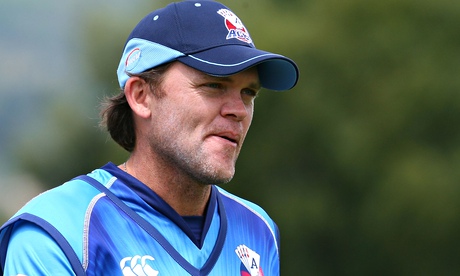
Former New Zealand international Lou Vincent
Former New Zealand international Lou Vincent. Photograph: Teaukura Moetaua/Getty Images
The sad truth is that the most recent spot-fixing revelations bring to mind nothing so much as Captain Renault’s line as he shuts down Rick’s Café in Casablanca: “I’m shocked, shocked, to find that gambling is going on in here.” What was it, exactly, about the evidence accrued in recent years that fixing has been committed in international and domestic cricket across all three formats by a mix of players, umpires, and administrators from across the Test-playing nations that has left us so startled by the allegations made by Lou Vincent?
Was the guilt of Salman Butt, Mohammad Asif, Mohammad Amir, Mervyn Westfield, Shariful Haque, Gurunath Meiyappan, Danish Kaneria, the Sri Lankan umpires Sagara Gallage and Maurice de la Zilwa not all the confirmation that was needed? Were the approaches reported by Shane Watson, Mashrafe Mortaza, Paul Nixon and so many others insufficient proof? Or is it that cricket, the community around the sport, is still in denial about the extent of the problem it is facing?
The allegations made by Vincent have, it is reported, been corroborated by at least three people, one a county player, another a friend in New Zealand, and the last involved in cricket but not as a playerMal LoyeBrendon McCullum and Iain O’Brien have all said that they knew what Vincent was up to. Which rather begs the question as to why Vincent was allowed to go on playing top-level cricket for the Mid West Rhinos, Auckland, and the Khulna Royal Bengals long after he was trying to fix matches.
It is not just Vincent. The Anti-Corruption and Security Unit says it is monitoring more than 100 individuals around the world who it suspects of involvement in fixing. Depressing and distressing as it is to admit, this means that if you have been watching a lot of cricket and you have not been wondering whether at least some of what you have seen may have been fixed, you are either wilfully innocent or unwittingly naive. If that seems excessively cynical, then remember that as Sir Humphrey had it, that is only the label an idealist gives to a realist.
Time was when I would have thought differently. In the 2011 World Cup I was at Pallekele for a group match – almost a dead rubber – between New Zealand and Pakistan, which was illuminated by a spectacular century by Ross Taylor. It was all the more unexpected because he had been in such dismal form for so long, and had not scored a hundred in his last 48 ODI innings. This, though, was his lucky day. Kamran Akmal dropped him twice in his first full over at the crease. Thus reprieved, Taylor resolved to make the most of his good fortune and ground his way to 68 from 105 balls.
In the 46th over, bowled by Shoaib Akhtar, Taylor clicked. He hit a four past point, followed it with three sixes and another four. With two wides, the over cost 28. The 48th, bowled by Abdul Razzaq, was dearer still. It went for 30, and again there were a couple more wides in among it all. Taylor hit 62 off the final 16 deliveries he faced and, together with Nathan McCullum and Jacob Oram, scored 114 runs in the last six overs of the innings.
Startled journalists, long since snapped out of the torpor induced by the stifling heat, turned to each other, incredulous, exhilarated. And then an email arrived in my inbox, sent by a colleague who is not especially keen on cricket but who has an excellent eye for a news story. It said, simply, “Do we think this is legit?”
Pop. A pinprick to a party balloon. It had not even occurred to me to ask whether I was watching anything other than wonderful batting against some woeful bowling. The elation I felt seeped away and, in my irritation, I snapped back a short reply. The thing is, though I did not admit it at the time, he was right to ask. Only six months before, three Pakistan players had been caught spot-fixing in the Lord’s Test. Rumours, unsubstantiated, still swirled around some of their players. I knew all that, but in the excitement of the moment l preferred to suspend my disbelief, which is, after all, what we want to do when watching sport. I was thrilled by the fact that what I had seen seemed almost unbelievable. My colleague was only suggesting that it might be exactly that.
There is no evidence to suggest that any aspect of that match between Pakistan and New Zealand, least of all Taylor’s performance, was fixed. But the unpalatable question put to me is one that those of us who love cricket should be asking ourselves, and each other, far more often than we tend to do. Especially when you think that the sport we support has such a long history of fixing and cheating, and that, as Ian Chappell has just written, its administrators have so often sought to soft-soap the offences have come to light.
Later in 2011, I switched across to cover the athletics circuit in the run-up to the 2012 Olympics. The small band of British athletics writers are a convivial lot but as sceptical as any group I’d ever worked with. And understandably so. Some of them had been on the beat since the early 1980s and, until Usain Bolt, of seven winners over nearly 30 years of men’s 100 metres finals only Donovan Bailey, successful in 1996, made it to retirement without his medal getting at least figuratively tarnished. A lifetime spent lionising athletes who are later found to have cheated is enough to disabuse even the most misty-eyed of us of our romantic notions.
On the athletics circuit, I learned, when something is celebrated as being too good to be true, the first thing to ask is, in private, if not in public, is whether it really is. Bitter experience means fans and journalists feel compelled to ask awkward questions. Similar thinking informed the remarks made by the US swim coach John Leonard about the Chinese swimmer Ye Shiwen during the London Olympics. Leonard remembered the 1976 Olympics, when the East German women’s team, who were later found to have been doping, swept the swimming events. He had his suspicions, but said nothing about them, and regretted his silence ever after. So he decided that the next time he had misgivings about a performance, he would speak out about his doubts, which turned out to be unfounded.
Switch back to cricket, where there seems to be a striking lack of such scepticism – partly because the offences can be so subtle, and so similar to the inadvertent actions of innocent players. But even the more ham-fisted examples, like Amir’s infamous no-ball in the Lord’s Test of 2010, seem to provoke little suspicion. Amir was, as Cricinfo’s ball-by-ball commentator put it at the time, “a good half metre over the line”. Cricket fans, journalists too, simply weren’t, and perhaps still aren’t, attuned to the possibility that a player may be cheating. Sequences of no-balls, strikingly soft dismissals, sudden de-accelerations in the scoring rate, incongruously stodgy batting, these things should all raise red flags. Was a player involved in the ICL, or one of the teams implicated in fixing in the BPL, IPL, or county cricket? Are there whispers about him on the circuit? Is the match being televised in India? Are there curious betting patterns around the match online? Combinations of these criteria make it reasonable to ask “is this legit?” even if, as is likely, you do not know the answer.
The trouble is, of course, that you risk being paralysed by a paranoia that prevents you from being able to enjoy the sport. The idea that spectators and media will be forced to think this way is anathema to the authorities. The alternative, what they would have us do, is choose to believe wholeheartedly in what we see and leave them to make their investigations. These would be the same authorities, in the ICC’s case, who are about to appoint N Srinivasan as chairman even though he has been suspended from the BCCI by the supreme court of India while investigations are held into his conduct regarding allegations of spot-fixing in relation to his son-in-law and involving the team he owns, the Chennai Super Kings.
As is so often the case, the first step towards the solution is to confront the magnitude of the problem, something cricket still seems to be struggling to do.

Only a teenage virgin could be so certain about sex

Those of more mature years know that the heart is a fickle organ and that desire does not necessarily recede with the gums


Rowan Pelling in The Telegraph

It takes a brave 18-year-old boy not just to admit he’s a virgin, but to broadcast the fact to his entire school. Wellington College sixth-former Phin Lyman took a stand against casual sex in the school magazine, writing: “Once you have had sex with someone, you’re connected to them emotionally and physically. If you tear that bond, the rip leaves open scars where the glue once was.”
I applaud young Lyman’s idealism, while feeling nostalgic for his depth of certainty. Will any of us ever see the world so sharply, so well defined in black and white, as we did when we were teenagers? At that age there are few worse crimes than getting off with your best friend’s ex, and you would happily jail half the parents you know for their pathetic, unoriginal transgressions.
I remember peddling much the same line as Lyman when I was 18. No gormless teen boy was going to pluck my virginity in a bout of teen fumbling: I wanted my first time to be beautiful and meaningful. It didn’t occur to me then that the two scenarios weren’t necessarily mutually exclusive. And obviously I wasn’t going to admit that fear of my own ineptitude was a stronger prophylactic than moral certainty.
But what can you know about sex when you’ve never had it? It’s akin to posing as a sommelier when you haven’t ever tasted alcohol. Furthermore, the ingénue who sips sweet lambrusco may grow to like pinot noir. Eighteen years on from when I took up the editor’s chair at the Erotic Review, I laugh at the naive conviction of my earliest articles. Did I really once declare that spanking was not a turn-on? What about the millions of women who lapped up 50 Shades of Grey, let alone the grown-up schoolboys who have fond memories of matron’s chastisements? No wonder the late great Auberon Waugh leant over the table at a contributors’ lunch and told me kindly: “No one knows anything about sex until they’re 40.”
Just as good store managers believe “the customer is always right”, so the wisest sex writers know desire brooks few arguments. You can’t discount other people’s proclivities, just because you don’t share them. I may still feel sex without love is an empty experience, but I bear in mind Woody Allen’s retort in Love and Death: “But as empty experiences go, it’s one of the best.” 
The fact is some people flee from strong emotion, preferring fleeting encounters to the perils of overwhelming intimacy, with its attendant fear of loss. Consider 96-year-old Diana Athill’s account of her acute distress after her pilot fiancé jilted her. She wrote that for many years afterwards, “I could only be at ease in a relationship which I knew to be trivial. If I fell in love it was with a fatalistic expectation of disaster, and disaster followed.”
But then only the elderly have earned the right to be wise about love and sex. They know the heart is a fickle organ and that desire does not necessarily recede with the gums. I recently heard – via an eminent gynaecologist – of a 90-something woman who was embroiled with a “toyboy” in his eighties. She wouldn’t let him move in, as it would “spoil the mystery”. I’m not sure whether this counts as casual sex, or loving sex, but who would begrudge them their pleasure?
Meanwhile, I’ll follow Phin Lyman’s progress with interest and all the more so for being married to an old Wellingtonian. Indeed, the first time I glimpsed my husband was when he appeared on a BBC Everyman documentary about celibacy, where he declared himself happy to take extended breaks from relationships. Now there’s nothing most women like more than a challenge, and as I watched the programme I thought: “I’ll break that man.” I bet scores of schoolgirls are having similar thoughts about the handsome sixth-former.

Tuesday, 20 May 2014

How much talent does the difficult player need?


Exceptionally gifted but unreliable players are often given lots of rope by management, but far too many seem to believe themselves to be deserving of that leeway
Ed Smith
May 20, 2014
 

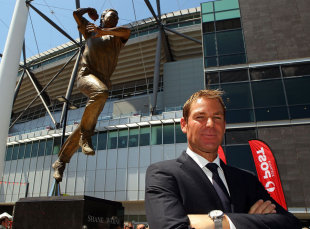
Shane Warne poses with a statue of himself unveiled at Melbourne Cricket Ground, December 22, 2011
It's no surprise that Shane Warne was able to criticise Australia coach John Buchanan and not be dropped for it © Getty Images 
Enlarge
 
It's been a mixed week for sportsmen out of love with the authorities. Michael Carberry, overlooked after the Ashes tour, publicly stated his frustrations about a lack of communication from the selectors. Many assumed that Carberry, aged 33, had signed his own death warrant and would never play for England again. But the selectors have made a shrewd decision in recalling him. He is a decent, understated man; the England management now looks magnanimous in overlooking a few surprising quotes in a newspaper.
No such luck for Samir Nasri, the wonderfully gifted but moody French footballer. He has been left out of France's World Cup squad. France's coach, Didier Deschamps, explained his decision with bracing honesty: "He's a regular starter at Manchester City. That's not the case today with the France team. And he also said he's not happy when he's a substitute. I can tell you that you can feel it in the squad." Deschamps went further, anticipating his critics by conceding that Nasri was more talented than some players he had selected: "It's not necessarily the 23 best French players, but it's the best squad in my eyes to go as far as possible in this competition."
Talent v unity: an old story.
Rugby union, though, has also brought two mavericks back into the fold. Gavin Henson, Wales' troubled but mercurial playmaker, looks set to return to the red jersey. And England's Danny Cipriani, another flair player who has never found a happy home wearing national colours, has been thrown a lifeline. A last chance that both Henson and Cipriani cannot afford to miss? I bet they have heard that before. And then been handed just one final, last chance. That's often the way with rare talent: different rules apply.
As always, these debates have generally descended into an argument about abstract principles. Pundits have rushed to say that French football has a problem with finding a home for left-field characters. Other have bridled at Deschamps' logic: who should be happy being put on the bench anyway? It is the job of managers, we are often told, to finesse and handle talented but unconventional personalities. Indeed, with a moment's reflection, anyone can produce a list of world-beating players who didn't conform to a coach's template for a model professional - from Diego Maradona to Andrew Flintoff.
Such a list, sadly, proves absolutely nothing. Because it is just as easy to find examples of teams that began a winning streak by leaving out a talented but unreliable star player. The French team that won the World Cup in 1998 left out both David Ginola and Eric Cantona, just as the current side have now omitted Nasri.
In the popular imagination, the argument about dropping and recalling star players revolves around the juicy, gossipy questions: how difficult are they, how does their awkwardness manifest itself, has anyone tried to talk them round? This is naturally intriguing stuff. But the other half of the question - the crucial half - is too often ignored. Quite simply, how much better are they than the next guy?
 
 
When mavericks slide from outright brilliance to mere high competence they find patience runs out alarmingly quickly. There is a lot of high competence around. It is replaceable. Not so genuine brilliance
 
If you are a lot better, it is amazing how forgiving sports teams can be. Luis Suarez was banned for eight games for racially abusing Patrice Evra. He then served another ten-match ban for biting a Chelsea player. Obviously Liverpool sacked him instantly on the grounds that he was bringing the club into disrepute and becoming a distraction from the task of winning football matches? No, they didn't do anything of the kind. They calculated that Suarez was the best chance, their only chance, of mounting a challenge for trophies. If Suarez had been Liverpool's sixth- or seventh-best player, rather than their star man, he would have been kicked out years ago.
In other words, the best protection from being dropped for being "difficult" is to be brilliant. Even as a young man, England midfielder Paul Gascoigne was a heavy drinker and an unreliable man. But he was a sensational footballer. Coaches put up with him because they calculated it was in their own and the team's rational self-interest. By the latter stages of his career, Gascoigne was still a heavy drinker and an unreliable man, but he was now only occasionally an excellent footballer. Glenn Hoddle felt Gascoigne was too unfit to play at the 1998 World Cup. The glass was half-empty.
When mavericks slide from outright brilliance to mere high competence they find patience runs out alarmingly quickly. There is a lot of high competence around. It is replaceable. Not so genuine brilliance. That is why Shane Warne was able to criticise Australia coach John Buchanan and (nearly) always stay in the team. Any rational man who asked himself the question: "Are Australia a better team with Warne in it?" came to the unavoidable conclusion: "Yes, definitely."
Here's the central point. At this exalted level of elite sport, a great number of players have an epic degree of self-belief. Being convinced of their own greatness is an aspect of their magic. They back themselves to shape the match, to determine its destiny - especially the big matches. Instead of seeing themselves as just one of a number of exceptionally talented players, in their own minds they are men apart, special cases.
They aren't always right, though. So the question becomes: how good, how difficult? They are two aspects of the same equation, a calculation that is being made every day by coaches all over the world - on the school pitch, in the reserves squad, all the way to the World Cup final.
A player, too, must make his own calculation. Would pretending to be someone else - a more compliant, easy-going man - centrally detract from my performances? Must I play on my own terms, behaving as I like? But this question must coexist with another, less comfortable one: am I good enough to get away with it?
Not many. Fewer, certainly, than the number who think they can.

I'd vote yes to rid Scotland of its feudal landowners

The scoured, scorched Highlands could be brought to life – maybe an independent nation will have the courage to act
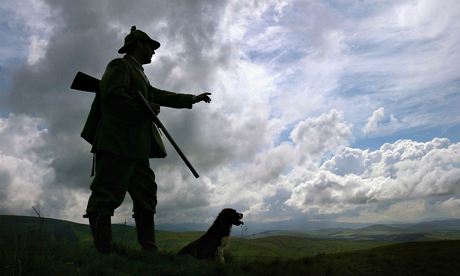
Grouse shooting in Scotland
‘It is astonishing, in the 21st century, that people are still allowed to burn mountainsides for any purpose, let alone blasting highland chickens out of the air.' Photograph: Christopher Furlong/Getty

Power's ability to resist change: this is the story of our times. Morally bankrupt, discredited, widely loathed? No problem: whether it's neoliberal economics, tax avoidance, coal burning, farm subsidies or the House of Lords, somehow the crooked system creeps along.
Legally, feudalism in Scotland ended in 2004. In itself, this is an arresting fact. But almost nothing has changed. After 15 years of devolution the nation with the rich world's greatest concentration of land ownership remains as inequitable as ever.
The culture of deference that afflicts the British countryside is nowhere stronger than in the Highlands. Hardly anyone dares challenge the aristocrats, oligarchs, bankers and sheikhs who own so much of this nation, for fear of consequences real or imagined. The Scottish government makes grand statements about land reform, then kisses the baronial boot. The huge estates remain untaxed and scarcely regulated.
You begin to grasp the problem when you try to discover who owns them. Fifty per cent of the private land in Scotland is in the hands of 432 people – but who are they? Many large estates are registered in the names of made-up companies in the Caribbean. When the Scottish minister Fergus Ewing was challenged on this issue, he claimed that obliging landowners to register their estates in countries that aren't tax havens would risk "a negative effect on investment". William Wallace rides again.
Scotland's deer-stalking estates and grouse moors, though they are not agricultural land, benefit from the outrageous advantages that farmers enjoy. They are exempt from capital gains tax, inheritance tax and business rates. Landowners seek to justify their grip on the UK by rebranding themselves as business owners. The Country Landowners' Association has renamed itself the Country Land and Business Association. So why do they not pay business rates on their land? As Andy Wightman, author of The Poor Had No Lawyers, argues, these tax exemptions inflate the cost of land, making it impossible for communities to buy.
Though the estates pay next to nothing to the exchequer, and though they practise little that resembles farming, they receive millions in farm subsidies. The new basic payments system the Scottish government is introducing could worsen this injustice. Wightman calculates that the ruler of Dubai could receive £439,000 for the estate in Wester Ross he owns; the Duke of Westminster could find himself enriched by £764,000 a year; and the Duke of Roxburgh by £950,000.
With the help of legislators and taxpayers, the owners of the big estates are ripping apart the fabric of the nation. The hills in many parts look as if they have been camouflaged against military attack, as they have been burned in patches for grouse shooting. It is astonishing, in the 21st century, that people are still allowed to burn mountainsides – destroying their vegetation, roasting their wildlife, vaporising their carbon, creating a telluric eczema of sepia and grey blotches – for any purpose, let alone blasting highland chickens out of the air. Where the hills aren't burnt for grouse they are grazed to the roots by overstocked deer, maintained at vast densities to give the bankers waddling over the moors in tweed pantaloons a chance of shooting one.
Hanging over the nation is the shadow of Balmoral, whose extreme and destructive management – clearing, burning, overgrazing – overseen by Prince Philip, president emeritus of the World Wide Fund for Nature, is mimicked by the other landowners. Little has changed there since Victoria and Albert adopted an ersatz version of the clothes and customs of the people who had just been cleared from the land. This balmorality is equivalent to Marie Antoinette dressing up as a milkmaid while the people of France starved; but such is Britain's culture of deference that we fail to see it. Today they mix the tartans with the fancy dress of Edwardian squires, harking back to the last time Britain was this unequal.
But despite this lockdown, there is, if not quite a Highland spring, the beginnings of something different: on one side of me, here in Boat of Garten, is the bare, black misery of the Monadhliath mountains; on the other, the great rewilding that is quickly but quietly spreading through the north-west of the Cairngorms national park. Across 100,000 hectares, the RSPB, the Forestry Commission, the National Trust and Wildland Ltd (owned by the Danish textiles billionaire Anders Holch Povlsen) are seeking to reverse the destruction, reduce the deer to reasonable numbers, and get trees back on the braes. On Povlson's estates the area of woodland has doubled (to 1,400 hectares, or 3,450 acres) since 2006, solely through the control of deer. It's not land reform, but it's the best that can be done with the current, dire model of Scottish ownership.
The forests at the moment are bright with birdsong. In some places, looking down on lochans surrounded by marshes and regenerating pines, you almost expect to see a moose emerging from the trees. Trees are racing up the denuded hillsides: in Glenmore I've come across young pines, birch and rowan growing at 800 metres. Already people are talking about reintroducing lynx here within 20 years.
As the return of the ospreys to the lakes and forests in this part of the park shows, the potential for ecotourism, which spreads income and employment through the economy, is vast. The contrast with the scorched and scoured grouse moors of the east side of the national park, which employ hardly anyone, concentrate wealth in tax havens and are unmysteriously devoid of most birds of prey, could not be greater.
It doesn't reverse the other injustices, but it begins to undo the centuries of physical destruction. I would vote yes in September if I lived here, on the grounds that it presents an opportunity to do something new, and I furiously hope, despite the evidence, that an independent Scottish government will take it.
It should list all the beneficial owners of the land; impose the taxes Westminster refuses to levy; ensure that only farmers get subsidies and cap them at £30,000 a head; ban burning; control deer numbers; and turn Scotland into a land where you can actually see green shoots of recovery. On Friday the Land Reform Review Group, set up by the government at Holyrood, will publish its report, and it's likely to be devastating. Will Scotland get off its knees at last?

Sunday, 18 May 2014

Pakistan's Imran Khan - Hero or Zero

Hero or Zero?

Najam Sethi
Najam Sethi  TFT Issue: 16 May 2014


Hero or Zero?


Once General Pervez Musharraf was Imran Khan’s great hero because he expected to get the top berth from the general. But when Musharraf chose Zafarullah Jamali and then Shaukat Aziz as prime minister, Imran Khan changed Musharraf’s status to a big zero.
Once the Geo/Jang Group was Imran’s great hero because it was supporting him to the hilt before the elections. But after the elections, when Geo became critical of Imran’s policies and positions, it was reduced to a big bloated zero.
Once the former Chief Justice of Pakistan Iftikhar Mohammad Chaudhry was Imran’s great hero for constantly knocking down the PPP. But after Chaudhry didn’t buy into Imran’s election petitions, he was blasted as a big treacherous zero.
Once Chief Election Commissioner Fakhruddin G Ibrahim was Imran’s great hero. But when Ibrahim couldn’t deliver on Imran’s great expectations, he was charged with being a big incompetent zero.
Imran Khan’s blossoming political alliances are also noteworthy. The MQM was once his pet-hate, now his stunning silence is a prelude to a budding alliance for mid-term elections. Much the same sort of bonhomie is beginning to tell between Imran and the Chaudhrys of Gujrat. Once they were allegedly Musharraf’s partners in crime because they refused to give him any electoral leverage in Punjab during the 2002 elections. Now they are comrades-in-arms in the joint struggle to destabilize, weaken and eventually get rid of Nawaz Sharif.
Imran’s relationship with the “Angels” (Pakistan Army and ISI) is another fascinating subject for research. He has unfailingly whipped up public sentiment in their favour whenever they have been cross with elected civilian governments: on Rehman Malik’s attempt to bring the political wing of the ISI under his boot; on the “objectionable” clauses in the Kerry-Lugar-Berman aid to Pakistan bill; on the May 2nd Osama bin Laden debacle; on Memogate; on the “state within the state” accusation by the then prime minister, Yousaf Raza Gilani; on the blockage of NATO supplies following Salala; and now most vociferously on the Geo/Jang/ISI confrontation (he is silent on the Musharraf case which is a very big concession to them). An Ex-DGISI’s attempt to pressurise assorted politicians to join the PTI in 2012 is well known.
Indeed, it is this dubious relationship that helps to explain the induction of several key politicians into Imran Khan’s fold despite the lofty “lota” credentials of some of them. Sheikh Rashid, who has a ringside seat in the inner circle of IK advisors, is a self-claimed GHQ man who was once Nawaz Sharif’s and then Musharraf’s federal minister. Asad Omar is the son of an army general and hails from an “army family”; Shah Mahmood Qureshi jumped the PPP ship when nudged by the Angels on the Raymond Davis affair; Jehangir Tareen was Musharraf’s blue-eyed boy; Shafqat Mahmood served in Musharraf’s Punjab cabinet in 2000; Khurshid Kasuri was Musharraf’s Foreign Minister; and so on.
More significantly, Imran’s decision to launch a “movement” on May 11 is clearly aimed at destablising the Sharif regime. It has been followed up by a vicious attack on the Geo/Jang Group and a stinging denunciation of the ex-CJP and judiciary. This betrays the perennial objective of the Angels to keep every civilian government in a hunkered down defensive posture vis a vis the military establishment. In 1998 Benazir Bhutto was lumped with President Ishaq Khan and Foreign Minister Sahibzada Yaqub Khan while Aitzaz Ahsan was swiftly cut down to size for being soft on India, later she was sacked. In 1990, Nawaz Sharif was lumped with President Ishaq and Gen Waheed Kakar and shown the door in 1993. In 1997, when Nawaz Sharif got too big for his boots after easing out both President Farooq Leghari and COAS Gen Jehangir Karamat, he was ousted by a military coup. President Asif Zardari was hounded on one pretext or the other by the Angels from 2008-13, in alliance with the media and judiciary. Now Nawaz Sharif is in trouble over his attempt to try Musharraf for treason and to seize control of national security and foreign policy.
Some people say the Angels are planning another Islami Jamhoori Ittehad a la the late 1980s with Imran Khan as their opening batsman like they did with Nawaz Sharif earlier. The problem with this theory is that the Angels had to contend with only one popular force in 1988. Now there will be two, PPP and PMNL, covering both Sindh and Punjab, which will make it very difficult to play such a game. More likely, the Angels are only seeking to rap Nawaz Sharif on the knuckles and teach him to stay in his place on key issues like national security, foreign policy and the “sacred cow” status of the military rather than putting their faith in Imran Khan to lead Pakistan next. In order words, they are “using” Imran Khan for their own political goals just as they have used other politicians in the past. Therefore who will be hero and who will be zero remains to be seen.

Saturday, 17 May 2014

Cricket fixing scandal: The day I confronted Lou Vincent


We in the New Zealand team knew without a shadow of doubt that our ex-colleague was cheating

Lou Vincent, the former New Zealand batsman and itinerant T20 cricketer was known by his team-mates to be too good a player to bat so poorly in an ICL game
Fixer: New Zealand players watched Lou Vincent score one from nine balls in the ICL and smelt a rat Photo: GETTY IMAGES

“Did you?” “Huh?” “Did you, you know, do some dumb things while you were playing?” I was sitting across from Lou Vincent, the ex-New Zealand cricketer and ex-team-mate of mine. We were in a curry house, not far from the HAC Ground in London, where we had both just played in a charity Twenty20. It was Aug 30, 2012 and I hadn’t seen Lou for a long time; in a lot of ways, intentionally. I didn’t really want to be seen with him, associated with him or considered a mate of his.
We did, and do have, one thing in common; we both suffer with mental illness. That was the basis for a lot of what we talked about that day.
Lou had been touring in a camper van spreading his story of MI and raising awareness. What he was doing seemed great, but what he had been doing wasn’t.
I knew he had been up to no good. It becomes evident, as a player, that what you see is not always real. That moment you learn that wrestling on TV isn’t real. It is acting. It is hard to believe at first and then, when you have watched a lot, or been around it endlessly, you see it for what it really is. There is no going back.
On a Test tour of Bangladesh, 2008, we, the New Zealand team watched a lot of the Indian Cricket League; the ‘rebel’ T20 competition in its first year. We watched some of the most unbelievable cricket. Unbelievable in a way that we could not believe how obvious what was going on: leaving and or padding up to straight ones, run outs by massive distances in curious circumstances, batsmen playing out maidens, no-balls and wides just too big and too often to be natural mistakes. It looked a shambles. 
And this included Lou Vincent. He had walked away from a New Zealand contract to take part in a lucrative league. We knew what was going on.
Without a shadow of doubt Lou was fixing. From our Bangladesh telephone sims (when touring, typically, we buy or are provided with a local sim), players who had Lou’s number would text him with some rather unpleasant messages about what he was doing. He was called a “fixer”, a “cheat” and many more unprintable things.
Lou denied any involvement. I asked him again if he had “fixed”, if he had been a part of it. He straight out rejected my line of questions. I showed him a scorecard from a game I had watched live. I had the scorecard saved as a bookmark on my phone browser so that we could talk specifics. I showed it to him. He put his one run from nine balls, playing out a first-over maiden, to just good bowling. I called that “rubbish”.
Lou is a quality player. For a fix he promised to score, 30 inside three overs. He failed, but a player with that quality does not score one from nine balls. I have not spoken to Lou since.
It happens here, in the UK. More than in just the matches we have read about from Lou’s accounts.
I was commentating on a match at Chelmsford and Danish Kaneria, the Essex and Pakistan leggie, bowled one of the biggest wides I have ever seen. It was the first ball of a spell. In the box we were flabbergasted at how flagrant it was.
In the previous two World Twenty20s I watched a highly respected player swap his bat, make sure that the cameras caught it by taking a long time to complete the act, on three occasions. A wicket fell in the next over, either him or his partner. A coincidence? I don’t think so. A change of bat can be a sign to a bookie that the fix is on.
I have seen others too. The ones outlined by Vincent. I watched the Sussex v Kent game which we now know contained spot-fixing and I sensed something was up.
The issue is, knowing and proving. Should I, as an ex-player and now commentator, be reporting suspect activity to the Anti-Corruption and Security Unit? Maybe I should.
But, I feel it is so rife that they would get overrun by what I see as suspect actions which have become so blatant that it is hard to believe they even care about our game anymore.
Iain O’Brien played 22 Tests for New Zealand and now works as a BBC commentator based in the UK

Friday, 16 May 2014

Here's what you can learn by living on £1 a day

Rowan Williams in The Independent

When Christian Aid asked me to take up the Live Below the Line challenge by living on just £1 a day for five days, I readily accepted. Well, fairly readily. But I felt it was something I had to step up to – a unique chance to learn and to enlarge my horizons.
There’s the thing about testing yourself: what do I actually need, what can I genuinely do without? 
But more simply, there’s learning a little bit about the experience of around 1.2 billion people around the world, not completely unlike you and me, who every day face the challenge of living on the tightest of budgets, and will still probably go hungry.   
On the face of it, it’s simple – spend no more than £1 a day on all your food and drink, in solidarity with those who live on less in the developing world.
As a Christian, I’d got a bit of experience of fasting in Lent and so on. The lack of treats, or giving up my favourite muesli in the morning didn’t seem so terrible.
The first thing that hit me, and it hit me quite hard, was just how expensive fresh fruit and vegetables are if you’re starting from £1 a day. The five-a-day goal (let alone more recent recommendations of seven or ten) was more or less impossible.
This really brought home what so many people in the UK, as well as overseas, struggle with on a daily basis - the basic issue not just of satisfying hunger but about proper nutrition.
I’d been vaguely aware of this in theory, but the reality is that it isn’t just a matter of eating cheaply and cheerfully. I hadn’t appreciated how difficult it would be to plan and put together meals that were nutritionally balanced. How on earth do you manage a balanced diet on such a limited budget?
In prosperous bits of Britain we live in a fast-paced, consumer-friendly world where planning an evening meal involves a quick stop at the local supermarket to pick up something tasty and often already prepared.
But that is not how it works when you’re on £1 day. You have to put aside time to prepare, time to think about your options and to work out how you can make this small sum stretch to something resembling three meals a day.
If you’re doing this challenge, you’re forced to think about what it’s like relying all the time on cheap staples. It is not just about giving up luxuries; having the freedom to choose nutritionally sensible food, whatever the price, is not to be taken for granted.
And then there is the monotony. Relying on cheap food probably means a lack of variation and flavour. Quite simply, eating becomes far less of a pleasure, not so much an experience to savour but something just to keep you going.
One of the items I bought was a very cheap can of tomato soup so that I could decant a spoonful or two into my otherwise plain meals. The tedium can be tough, and you will likely feel tired or headachy as a result.
Still, learning that you can live without certain things is a positive experience. With the treats we have to get us through the day you think to yourself, "I don’t actually depend on that, I can think again about whether I need to buy this or that in future".
Fasting or giving up some of your luxuries can be liberating - which is one of the reasons it is common across many faiths. But it doesn’t take much to forget that while you have a choice about this, most don’t. 
Liberation for them is having the possibility of security about their food and some guarantees of nutritional quality.
I found it difficult to do this challenge alone. Watching your family tuck in to a tasty-looking feast while you’re eating your routine dish of rice and vegetables is not a great deal of fun. 
But at the same time, you know that for once you’re sharing a little of the challenge faced by millions around the world who live in this way all or most of the time.
Every moment during the five days I was acutely aware that I could walk away and pack it in whenever I wanted. I chose to take up the challenge and I only had to live through it for a finite period. 
For me, it was much more of a spiritual exercise rather than something imposed. But most people who have to live on £1 or less every day can’t walk away.
Doing this may bring a sense of unity that’s spiritually positive; just remember that it’s not so spiritually positive if you haven’t chosen it.
Practical advice for anyone taking up the challenge? Keep reasonably busy. If, like me, you have a rather sedentary job there’s more of a temptation to think about food, to get frustrated and to listen to your stomach rumbling. 
If you deliberately walk around and vary your position, it’s easier to keep going. And if you close your eyes, a cup of boiled water can go some way to convincing you that you’re having a nice cup of tea! 
It can be done; and you’ll learn what nothing else can teach you – about yourself and the world you live in.
Live Below the Line is a fundraising initiative which challenges the public to live on just £1 a day for five days. Participants can take on the challenge until 30 June 2014, and all money raised will support the work of 33 charities including Christian Aid and Global Poverty Project.

If anything's amoral in our education system, it's the state of private school elitism

Chloe Hamilton in The Independent

As a loud and proud state school alumnus, I was left in open-mouthed horror after reading the comments made by the chairman of the Independent Schools Association, which claimed state educated children leave school without a moral compass.
Apparently, my poor, harangued teachers were simply too busy teaching me, and I quote, “the basics” (we’re not too sharp, us state school kids) to spend time lecturing me on right and wrong.
Chairman Richard Walden says the sports teams and debating societies much loved by private school students ensure they leave education well-rounded individuals.
State schools, which seemingly don’t provide extra-curricular activities, are too preoccupied by league tables to provide children with the rounded and enriching education that will give them the moral compass they need for life.
There is so much wrong with Walden’s comments that I won’t spend too much time pointing out the school backgrounds of the current cabinet show state schools certainly have no cartel on the production of amoral people.
But it’s worth remembering David Cameron, Nick Clegg, George Osborne and Jeremy Hunt, to name but a few, all went through the private sector. I’ll leave you to dwell on that.
Firstly, I take issue with Walden’s suggestion that privately educated children leave school well-rounded individuals. How can a student who interacts only with people of his own class and tax bracket be considered a balanced individual?
A system which thrives on elitism cannot be relied upon to teach sound morals. State schools, populated as they are with children from every background imaginable, teach tolerance and understanding. As a result, a state school student is more likely to graduate with a proper understanding of the world around them than someone who spends years debating with fellow Tarquins and Beatrices.
Also, and this is coming from someone who studied ethics at degree level, I’m dubious about whether morals can be taught in the classroom. Morality is, in some respects, learned behaviour, picked up from parents and peers, as well as from teachers.
The day I first walked through the gates of my state primary school, I knew that pushing someone over in the playground was mean and helping someone who had been pushed over was kind. My parents, like many others before them, had instilled in me the basic principles of right and wrong before I started school.
Morals are not tangible things that can be acquired simply through study. They require practice and experience, both inside and beyond the school gates.  
But my main issue with Walden is not that he’s incorrect, but that he implies morals are things that can be bought; that students whose parents can’t afford to purchase a gold-plated moral compass for upwards of £30,000 a year will leave education amoral beasts, sent out into the world with no concept of what is right and wrong.
Just as I believe education cannot, and should not, be bought, I think putting a price on a child’s morality contradicts every decent principle we try teach them.
Private schools do not have a monopoly on morality and the notion that everything has a monetary value is what makes the sector itself so defunct of morals.