Anxiety about losing your job to technology is both a rational and growing fear. Andy Haldane, the chief economist at the Bank of England, recently estimated that 15m jobs in the UK were threatened by automation. Technology is reaching such levels of sophistication that it is capable not only of manual tasks but cognitive ones too, putting a wide range of jobs are at risk. The areas most vulnerable include driving and administrative work. But according to a report from Oxford University that looked at over 700 areas of work, teaching at all levels across the educational spectrum is a safe bet.
Yet the apparent safety of teaching as a profession doesn’t quite square with the boom in online courses. From the comfort of my sofa I can watch lectures from prestigious universities around the world, join the hundreds of millions of people who have enrolled on a Khan Academy course, enrol in a Mooc – a massive online open course – or upskill and change my career with a course from Lynda and many other education providers.
A lot of these courses are free, but those with accreditation attached tend to charge. The appeal for educational institutions is simple: you can pay a teacher once to deliver a lecture to an unlimited amount of students without having to pay for all the overheads it takes to run a building. Students are offered flexibility and can learn at a time and location that suits them. However, drop-out rates for these courses are extremely high and they present no real threat to education as we know it. It seems students still prefer a real classroom.

FacebookTwitterPinterest ‘The act of teaching isn’t just imparting what’s in your head to a captive audience.’ Photograph: Alamy Stock Photo
So why not replace teachers in classroom with technology? To understand why teachers’ careers are safe we need to ask two questions: what do teachers do all day and where does technology fall short?
A quick survey of teacher friends answers the first question: teachers provide pastoral care, direct the Christmas play, recognise and assist vulnerable pupils, cover break-time duty, mentor new teachers, collate data about pupils’ attendance and behaviour, mark homework, rig lights and dress sets for school performances, order resources such as textbooks and classroom equipment, write newsletters, take school trips, assess pupil attainment, meet parents, spot potential terrorists (ahem) in accordance with the government’s Prevent guidelines, lead assemblies, make endless photocopies, and appraise other members of staff. This list is incomplete and already sounds like a lot for a piece of technology to cover. But if you’re looking for an easy and long-term job, this isn’t it: almost a third of teachers quit within five years.
It’s likely that some of the administrative tasks that teachers do will be conducted by technology in the future, just as in other sectors, but what about the actual teaching? The act of teaching isn’t just imparting what’s in your head to a captive audience. Teaching is a performance, it’s reading the room and working it. This is where technology really falls short. Empathy is a key area of difficulty for technology and automation. Are the kids at the back of the classroom bored because you’re talking about something they find too difficult, because they know it already, or because you’re not presenting the information in a meaningful way? Human beings are able to pick up on a multitude of contextual clues to determine and respond to the emotional states of others. Technology can’t detect emotional states, let alone adapt its behaviour to cater accordingly.
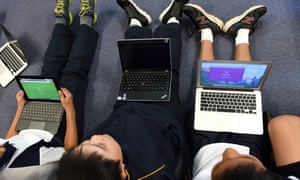
‘The best teachers will use technology in the classroom as part of an expanding toolkit.’ Photograph: Paul Miller/AAP
Another area of difficulty for technology that is key to teaching is quick thinking. Any number of things can and do go wrong on a school day: a guest speaker cancels, the whiteboard freezes, buses are delayed or – the ultimate horror – the photocopier breaks. Human beings are able to think on their feet and reformulate their plans to adapt to new circumstances. Machines aren’t able to do this. Thinking on the spot is a key skill of teachers, and many cite the variety of the job as a reason for entering the profession in the first place.
We know what technology can’t do for students and teachers, but there are some reasons to be optimistic about the role of technology in education. Teachers in the UK often complain about the administration workload interfering with the actual work of teaching. Technology could aid data-gathering significantly, freeing up teachers’ time and allowing them to focus on more important aspects of their work. And internationally, technology has the potential to reach those who don’t have access to a classroom. In 2015 the British Council used Skype to deliver teacher training in Libya; and as far back as 1999 Sugata Mitra created “Hole in the Wall” schools by placing computers in slums in Delhi.
The best teachers will use technology in the classroom as part of an expanding toolkit, and hopefully they’ll see the benefits of smarter technology in the form of reduced clerical work. Classrooms will continue to change shape, but it’s safe to assume that there will be a human teacher at the front of them for a long time yet.


