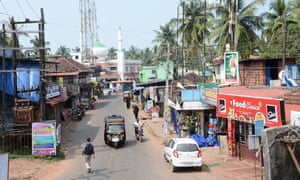
Padanna in Kerala is the home town to at least six young men who are believed to have left to join the Islamic State Photograph: Sasi Kollikal for the Guardian
Residents of Kerala like to call their lush south Indian state, “God’s own country”. Hafizuddin Hakim disagreed.
The 23-year-old left his wife and family in June, telling them he was headed to Sri Lanka to pursue his Islamic studies. Around the same time, 16 others slipped out of his district, Kasargod, and another four from neighbouring Palakkad.
The next anyone heard from the missing 21 was an encrypted audio recording sent from an Afghan number. “We reached our destination,” it said. “There is no point in complaining to police ... We have no plans to return from the abode of Allah.”
The mass disappearance of the group, widely believed – but not confirmed– to have joined Islamic State, is one of a number of incidents this year that have raised fears that India, so far unscathed by the terrorist group, might be seeing increased activity.
India’s Muslim population, the third largest in the world, has so far contributed negligible numbers to Isis – fewer than 90 people, according to most estimates. “More have gone from Britain, even from the Maldives, than India,” says Vikram Sood, a former chief of India’s foreign spy agency.
But growing concern over the group’s influence was made official this month, when the US embassy in Delhi issued its first Isis-related warning, of an “increased threat to places in India frequented by Westerners, such as religious sites, markets and festival venues”.
However, it is not India’s harsh, dry north, nor Kashmir, the site of a burning Islamic insurgency, where Isis has found most appeal. The group’s unlikely recruiting ground is Kerala, one of India’s wealthiest, most diverse and best-educated states.
Minarets and palm trees intersperse the skyline along Kerala’s Malabar coast, a verdant region of paddies and waterways that weave between villages like veins.
Padanna, in the north of the state, is a typical backwater town: orderly, lined with oversized houses, and made rich by remittances from its share of the nearly 2.5m Keralites who work in the Arab gulf.
It is also from where a dozen people, including Hakim, vanished in June. “He was a carefree, easy-going boy,” recalls his uncle, Abdul Rahim. “He used to indulge in all kinds of activities, smoking, drinking. He was not that religious.”
Hakim had worked in the United Arab Emirates in his late teens, returning to Padanna two years ago. A little aimless, he fell in with a new crowd, centred around an employee of the local Peace International School, an education franchise that adheres to a hardline Salafi Muslim ideology (but which has denied any involvement in the group’s disappearance).
Residents of Kerala like to call their lush south Indian state, “God’s own country”. Hafizuddin Hakim disagreed.
The 23-year-old left his wife and family in June, telling them he was headed to Sri Lanka to pursue his Islamic studies. Around the same time, 16 others slipped out of his district, Kasargod, and another four from neighbouring Palakkad.
The next anyone heard from the missing 21 was an encrypted audio recording sent from an Afghan number. “We reached our destination,” it said. “There is no point in complaining to police ... We have no plans to return from the abode of Allah.”
The mass disappearance of the group, widely believed – but not confirmed– to have joined Islamic State, is one of a number of incidents this year that have raised fears that India, so far unscathed by the terrorist group, might be seeing increased activity.
India’s Muslim population, the third largest in the world, has so far contributed negligible numbers to Isis – fewer than 90 people, according to most estimates. “More have gone from Britain, even from the Maldives, than India,” says Vikram Sood, a former chief of India’s foreign spy agency.
But growing concern over the group’s influence was made official this month, when the US embassy in Delhi issued its first Isis-related warning, of an “increased threat to places in India frequented by Westerners, such as religious sites, markets and festival venues”.
However, it is not India’s harsh, dry north, nor Kashmir, the site of a burning Islamic insurgency, where Isis has found most appeal. The group’s unlikely recruiting ground is Kerala, one of India’s wealthiest, most diverse and best-educated states.
Minarets and palm trees intersperse the skyline along Kerala’s Malabar coast, a verdant region of paddies and waterways that weave between villages like veins.
Padanna, in the north of the state, is a typical backwater town: orderly, lined with oversized houses, and made rich by remittances from its share of the nearly 2.5m Keralites who work in the Arab gulf.
It is also from where a dozen people, including Hakim, vanished in June. “He was a carefree, easy-going boy,” recalls his uncle, Abdul Rahim. “He used to indulge in all kinds of activities, smoking, drinking. He was not that religious.”
Hakim had worked in the United Arab Emirates in his late teens, returning to Padanna two years ago. A little aimless, he fell in with a new crowd, centred around an employee of the local Peace International School, an education franchise that adheres to a hardline Salafi Muslim ideology (but which has denied any involvement in the group’s disappearance).

The Keralan backwaters are a pretty network of lakes, rivers and canals stretching almost half the length of the state. Photograph: Oyster Opera Resort
“All of a sudden he became a recluse,” Rahim says. He grew a wispy beard, cut the TV cable to his home and one day, stopped driving his car. “He said it was taken on loan, and a loan was anti-Islam.”
Salafism is not new to southern India, but an influx of Saudi Arabian money in the past decades – partly detailed in Saudi diplomatic cables released by Wikileaks – has produced a harder-edged Islam in the region, says Ashraf Kaddakal, a professor at the University of Kerala.
“It is a very narrow, very rigid, very reactionary kind of ideology,” he says. “And it has attracted many youngsters, especially students.
“These youngsters have detached from their [orthodox Sunni] leaders and started following the online Islam, the preaching and sermons of these Saudi and other Salafi scholars,” he says. “They indoctrinated many through these internet preachings.”
Kadakkal himself has tried to counsel dozens of young people, whose parents fear their children’s increasingly rigid faith. “My counselling has been a total failure”, he admits. “They blindly follow their masters. They get their fatwas from the internet.”
Whatever threat Isis poses to India is fundamentally different, and probably less pressing, than that which most occupies the minds of Indian security officials.
“For us the major fear is from groups such as Lashkar-e-Taiba or Jaish-e-Mohammed,” says Sood, the former intelligence chief. “That is where the real, organised, state-sponsored threat lies.”
In contrast, those arrested so far on suspicion of Isis links or sympathies, numbering 68 people, have largely been self-starters, operating in small, unskilled networks.
“And they were almost all well-short of coming close to actually carrying out anything resembling a lethal operation,” says Praveen Swami, an author and journalist who specialises in strategic issues.
Still, the militant group has explicitly tried to ignite fervour among Indians. Its propaganda wing released a video in May featuring interviews with Indian recruits, including members of an existing jihadi group, the Indian Mujahideen, that pledged allegiance to Isis in 2014.
According to a National Intelligence Agency charge-sheet issued against 16 alleged extremists in July, authorities also believe Shafi Armar, a notorious Indian Mujahideen member believed to be in Syria, has been actively trying to groom recruits back home.
As well, Subahani Haja Moideen, one of six members of an alleged extremist cell arrested in northern Kerala in October, is believed to have actually returned from fighting with Isis in Iraq, where he reportedly met with some of the alleged organisers of the Paris terror attacks, according to Indian news agencies.
On the numbers, overall – and like al-Qaida before it – the group has so far failed to make deep roots in India.
Kadakkal suggests India’s idiosyncratic religious culture just doesn’t blend well with Isis’ highly orthodox worldview. “Indian soil is not right for this kind of extremism,” he says.
Sood agrees: “There is a lot of laissez faire in India, much more than in the more ordered societies of the modern world. We let things be, and that’s terrible when it comes to driving, but otherwise ... it has upsides.”
But the fault-line between Hindus and Muslim in India is a deep one, and the symbolic power of a successful attack could far outweigh any toll of casualties.
“I guess that is the real fear,” Swami says. “If even this small Isis thing succeeds in carrying out large acts of violence, the political and knock-on consequences could create serious trouble.”
Salafism is not new to southern India, but an influx of Saudi Arabian money in the past decades – partly detailed in Saudi diplomatic cables released by Wikileaks – has produced a harder-edged Islam in the region, says Ashraf Kaddakal, a professor at the University of Kerala.
“It is a very narrow, very rigid, very reactionary kind of ideology,” he says. “And it has attracted many youngsters, especially students.
“These youngsters have detached from their [orthodox Sunni] leaders and started following the online Islam, the preaching and sermons of these Saudi and other Salafi scholars,” he says. “They indoctrinated many through these internet preachings.”
Kadakkal himself has tried to counsel dozens of young people, whose parents fear their children’s increasingly rigid faith. “My counselling has been a total failure”, he admits. “They blindly follow their masters. They get their fatwas from the internet.”
Whatever threat Isis poses to India is fundamentally different, and probably less pressing, than that which most occupies the minds of Indian security officials.
“For us the major fear is from groups such as Lashkar-e-Taiba or Jaish-e-Mohammed,” says Sood, the former intelligence chief. “That is where the real, organised, state-sponsored threat lies.”
In contrast, those arrested so far on suspicion of Isis links or sympathies, numbering 68 people, have largely been self-starters, operating in small, unskilled networks.
“And they were almost all well-short of coming close to actually carrying out anything resembling a lethal operation,” says Praveen Swami, an author and journalist who specialises in strategic issues.
Still, the militant group has explicitly tried to ignite fervour among Indians. Its propaganda wing released a video in May featuring interviews with Indian recruits, including members of an existing jihadi group, the Indian Mujahideen, that pledged allegiance to Isis in 2014.
According to a National Intelligence Agency charge-sheet issued against 16 alleged extremists in July, authorities also believe Shafi Armar, a notorious Indian Mujahideen member believed to be in Syria, has been actively trying to groom recruits back home.
As well, Subahani Haja Moideen, one of six members of an alleged extremist cell arrested in northern Kerala in October, is believed to have actually returned from fighting with Isis in Iraq, where he reportedly met with some of the alleged organisers of the Paris terror attacks, according to Indian news agencies.
On the numbers, overall – and like al-Qaida before it – the group has so far failed to make deep roots in India.
Kadakkal suggests India’s idiosyncratic religious culture just doesn’t blend well with Isis’ highly orthodox worldview. “Indian soil is not right for this kind of extremism,” he says.
Sood agrees: “There is a lot of laissez faire in India, much more than in the more ordered societies of the modern world. We let things be, and that’s terrible when it comes to driving, but otherwise ... it has upsides.”
But the fault-line between Hindus and Muslim in India is a deep one, and the symbolic power of a successful attack could far outweigh any toll of casualties.
“I guess that is the real fear,” Swami says. “If even this small Isis thing succeeds in carrying out large acts of violence, the political and knock-on consequences could create serious trouble.”