Robert Fisk in The Independent
The Saudis step deeper into trouble almost by the week. Swamped in their ridiculous war in Yemen, they are now reeling from an extraordinary statement issued by around two hundred Sunni Muslim clerics who effectively referred to the Wahhabi belief – practiced in Saudi Arabia – as “a dangerous deformation” of Sunni Islam. The prelates included Egypt’s Grand Imam, Ahmed el-Tayeb of al-Azhar, the most important centre of theological study in the Islamic world, who only a year ago attacked “corrupt interpretations” of religious texts and who has now signed up to “a return to the schools of great knowledge” outside Saudi Arabia.
This remarkable meeting took place in Grozny and was unaccountably ignored by almost every media in the world – except for the former senior associate at St Antony’s College, Sharmine Narwani, and Le Monde’s Benjamin Barthe – but it may prove to be even more dramatic than the terror of Syria’s civil war. For the statement, obviously approved by Vladimir Putin, is as close as Sunni clerics have got to excommunicating the Saudis.
Although they did not mention the Kingdom by name, the declaration was a stunning affront to a country which spends millions of dollars every year on thousands of Wahhabi mosques, schools and clerics around the world.
Wahhabism’s most dangerous deviation, in the eyes of the Sunnis who met in Chechenya, is that it sanctions violence against non-believers, including Muslims who reject Wahhabi interpretation.Isis, al-Qaeda and the Taliban are the principal foreign adherents to this creed outside Saudi Arabia and Qatar.
The Saudis, needless to say, repeatedly insist that they are against all terrorism. Their reaction to the Grozny declaration has been astonishing. “The world is getting ready to burn us,” Adil Al-Kalbani announced. And as Imam of the King Khaled Bin Abdulaziz mosque in the Saudi capital of Riyadh, he should know.
As Narwani points out, the bad news kept on coming. At the start of the five-day Hajj pilgrimage, the Lebanese daily al-Akhbarpublished online a database which it said came from the Saudi ministry of health, claiming that up 90,000 pilgrims from around the world have died visiting the Hajj capital of Mecca over a 14-year period. Although this figure is officially denied, it is believed in Shia Muslim Iran, which has lost hundreds of its citizens on the Hajj. Among them was Ghazanfar Roknabadi, a former ambassador and intelligence officer in Lebanon. Iran’s supreme leader, Ali Khamenei, has just launched an unprecedented attack on the Saudis, accusing them of murder. “The heartless and murderous Saudis locked up the injured with the dead in containers...” he said in his own Hajj message.
A Saudi official said Khameni’s accusations reflected a “new low”. Abdulmohsen Alyas, the Saudi undersecretary for international communications, said they were “unfounded, but also timed to only serve their unethical failing propaganda”.
Yet the Iranians have boycotted the Hajj this year (not surprisingly, one might add) after claiming that they have not received Saudi assurances of basic security for pilgrims. According to Khamenei, Saudi rulers “have plunged the world of Islam into civil wars”.
However exaggerated his words, one thing is clear: for the first time, ever, the Saudis have been assaulted by both Sunni and Shia leaders at almost the same time.
The presence in Grozny of Grand Imam al-Tayeb of Egypt was particularly infuriating for the Saudis who have poured millions of dollars into the Egyptian economy since Brigadier-General-President al-Sissi staged his doleful military coup more than three years ago.
What, the Saudis must be asking themselves, has happened to the fawning leaders who would normally grovel to the Kingdom?
“In 2010, Saudi Arabia was crossing borders peacefully as a power-broker, working with Iran, Syria, Turkey, Qatar and others to troubleshoot in regional hotspots,” Narwani writes. “By 2016, it had buried two kings, shrugged off a measured approach to foreign policy, embraced ‘takfiri’ madness and emptied its coffers.” A “takfiri” is a Sunni who accuses another Muslim (or Christian or Jew) of apostasy.
Kuwait, Libya, Jordan and Sudan were present in Grozny, along with – you guessed it – Ahmed Hassoun, the grand mufti of Syria and a loyal Assad man. Intriguingly, Abu Dhabi played no official role, although its policy of “deradicalisation” is well known throughout the Arab world.
But there are close links between President (and dictator) Ramzan Kadyrov of Chechenya, the official host of the recent conference, and Mohamed Ben Zayed al-Nahyan, the Abu Dhabi Crown Prince. The conference itself was opened by Putin, which shows what he thinks of the Saudis – although, typically, none of the Sunni delegates asked him to stop bombing Syria. But since the very meeting occurred against the backcloth of Isis and its possible defeat, they wouldn’t, would they?
That Chechenya, a country of monstrous bloodletting by Russia and its own Wahhabi rebels, should have been chosen as a venue for such a remarkable conclave was an irony which could not have been lost on the delegates. But the real questions they were discussing must have been equally apparent.
Who are the real representatives of Sunni Muslims if the Saudis are to be shoved aside? And what is the future of Saudi Arabia? Of such questions are revolutions made.
Friday, 23 September 2016
Thursday, 22 September 2016
Why bad science persists?
From The Economist
IN 1962 Jacob Cohen, a psychologist at New York University, reported an alarming finding. He had analysed 70 articles published in the Journal of Abnormal and Social Psychology and calculated their statistical “power” (a mathematical estimate of the probability that an experiment would detect a real effect). He reckoned most of the studies he looked at would actually have detected the effects their authors were looking for only about 20% of the time—yet, in fact, nearly all reported significant results. Scientists, Cohen surmised, were not reporting their unsuccessful research. No surprise there, perhaps. But his finding also suggested some of the papers were actually reporting false positives, in other words noise that looked like data. He urged researchers to boost the power of their studies by increasing the number of subjects in their experiments.
Wind the clock forward half a century and little has changed. In a new paper, this time published in Royal Society Open Science, two researchers, Paul Smaldino of the University of California, Merced, and Richard McElreath at the Max Planck Institute for Evolutionary Anthropology, in Leipzig, show that published studies in psychology, neuroscience and medicine are little more powerful than in Cohen’s day.
They also offer an explanation of why scientists continue to publish such poor studies. Not only are dodgy methods that seem to produce results perpetuated because those who publish prodigiously prosper—something that might easily have been predicted. But worryingly, the process of replication, by which published results are tested anew, is incapable of correcting the situation no matter how rigorously it is pursued.
The preservation of favoured places
First, Dr Smaldino and Dr McElreath calculated that the average power of papers culled from 44 reviews published between 1960 and 2011 was about 24%. This is barely higher than Cohen reported, despite repeated calls in the scientific literature for researchers to do better. The pair then decided to apply the methods of science to the question of why this was the case, by modelling the way scientific institutions and practices reproduce and spread, to see if they could nail down what is going on.
They focused in particular on incentives within science that might lead even honest researchers to produce poor work unintentionally. To this end, they built an evolutionary computer model in which 100 laboratories competed for “pay-offs” representing prestige or funding that result from publications. They used the volume of publications to calculate these pay-offs because the length of a researcher’s CV is a known proxy of professional success. Labs that garnered more pay-offs were more likely to pass on their methods to other, newer labs (their “progeny”).
Some labs were better able to spot new results (and thus garner pay-offs) than others. Yet these labs also tended to produce more false positives—their methods were good at detecting signals in noisy data but also, as Cohen suggested, often mistook noise for a signal. More thorough labs took time to rule these false positives out, but that slowed down the rate at which they could test new hypotheses. This, in turn, meant they published fewer papers.
In each cycle of “reproduction”, all the laboratories in the model performed and published their experiments. Then one—the oldest of a randomly selected subset—“died” and was removed from the model. Next, the lab with the highest pay-off score from another randomly selected group was allowed to reproduce, creating a new lab with a similar aptitude for creating real or bogus science.
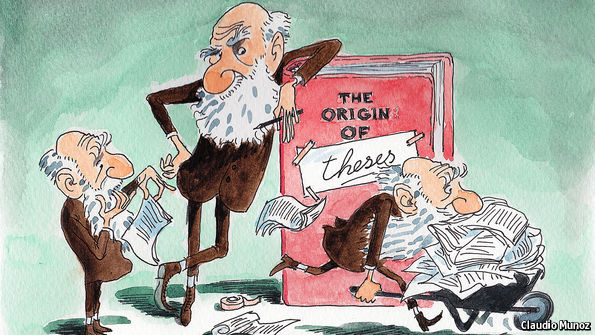
Sharp-eyed readers will notice that this process is similar to that of natural selection, as described by Charles Darwin, in “The Origin of Species”. And lo! (and unsurprisingly), when Dr Smaldino and Dr McElreath ran their simulation, they found that labs which expended the least effort to eliminate junk science prospered and spread their methods throughout the virtual scientific community.
Their next result, however, was surprising. Though more often honoured in the breach than in the execution, the process of replicating the work of people in other labs is supposed to be one of the things that keeps science on the straight and narrow. But the two researchers’ model suggests it may not do so, even in principle.
Replication has recently become all the rage in psychology. In 2015, for example, over 200 researchers in the field repeated 100 published studies to see if the results of these could be reproduced (only 36% could). Dr Smaldino and Dr McElreath therefore modified their model to simulate the effects of replication, by randomly selecting experiments from the “published” literature to be repeated.
A successful replication would boost the reputation of the lab that published the original result. Failure to replicate would result in a penalty. Worryingly, poor methods still won—albeit more slowly. This was true in even the most punitive version of the model, in which labs received a penalty 100 times the value of the original “pay-off” for a result that failed to replicate, and replication rates were high (half of all results were subject to replication efforts).
The researchers’ conclusion is therefore that when the ability to publish copiously in journals determines a lab’s success, then “top-performing laboratories will always be those who are able to cut corners”—and that is regardless of the supposedly corrective process of replication.
Ultimately, therefore, the way to end the proliferation of bad science is not to nag people to behave better, or even to encourage replication, but for universities and funding agencies to stop rewarding researchers who publish copiously over those who publish fewer, but perhaps higher-quality papers. This, Dr Smaldino concedes, is easier said than done. Yet his model amply demonstrates the consequences for science of not doing so.
Wind the clock forward half a century and little has changed. In a new paper, this time published in Royal Society Open Science, two researchers, Paul Smaldino of the University of California, Merced, and Richard McElreath at the Max Planck Institute for Evolutionary Anthropology, in Leipzig, show that published studies in psychology, neuroscience and medicine are little more powerful than in Cohen’s day.
They also offer an explanation of why scientists continue to publish such poor studies. Not only are dodgy methods that seem to produce results perpetuated because those who publish prodigiously prosper—something that might easily have been predicted. But worryingly, the process of replication, by which published results are tested anew, is incapable of correcting the situation no matter how rigorously it is pursued.
The preservation of favoured places
First, Dr Smaldino and Dr McElreath calculated that the average power of papers culled from 44 reviews published between 1960 and 2011 was about 24%. This is barely higher than Cohen reported, despite repeated calls in the scientific literature for researchers to do better. The pair then decided to apply the methods of science to the question of why this was the case, by modelling the way scientific institutions and practices reproduce and spread, to see if they could nail down what is going on.
They focused in particular on incentives within science that might lead even honest researchers to produce poor work unintentionally. To this end, they built an evolutionary computer model in which 100 laboratories competed for “pay-offs” representing prestige or funding that result from publications. They used the volume of publications to calculate these pay-offs because the length of a researcher’s CV is a known proxy of professional success. Labs that garnered more pay-offs were more likely to pass on their methods to other, newer labs (their “progeny”).
Some labs were better able to spot new results (and thus garner pay-offs) than others. Yet these labs also tended to produce more false positives—their methods were good at detecting signals in noisy data but also, as Cohen suggested, often mistook noise for a signal. More thorough labs took time to rule these false positives out, but that slowed down the rate at which they could test new hypotheses. This, in turn, meant they published fewer papers.
In each cycle of “reproduction”, all the laboratories in the model performed and published their experiments. Then one—the oldest of a randomly selected subset—“died” and was removed from the model. Next, the lab with the highest pay-off score from another randomly selected group was allowed to reproduce, creating a new lab with a similar aptitude for creating real or bogus science.
Sharp-eyed readers will notice that this process is similar to that of natural selection, as described by Charles Darwin, in “The Origin of Species”. And lo! (and unsurprisingly), when Dr Smaldino and Dr McElreath ran their simulation, they found that labs which expended the least effort to eliminate junk science prospered and spread their methods throughout the virtual scientific community.
Their next result, however, was surprising. Though more often honoured in the breach than in the execution, the process of replicating the work of people in other labs is supposed to be one of the things that keeps science on the straight and narrow. But the two researchers’ model suggests it may not do so, even in principle.
Replication has recently become all the rage in psychology. In 2015, for example, over 200 researchers in the field repeated 100 published studies to see if the results of these could be reproduced (only 36% could). Dr Smaldino and Dr McElreath therefore modified their model to simulate the effects of replication, by randomly selecting experiments from the “published” literature to be repeated.
A successful replication would boost the reputation of the lab that published the original result. Failure to replicate would result in a penalty. Worryingly, poor methods still won—albeit more slowly. This was true in even the most punitive version of the model, in which labs received a penalty 100 times the value of the original “pay-off” for a result that failed to replicate, and replication rates were high (half of all results were subject to replication efforts).
The researchers’ conclusion is therefore that when the ability to publish copiously in journals determines a lab’s success, then “top-performing laboratories will always be those who are able to cut corners”—and that is regardless of the supposedly corrective process of replication.
Ultimately, therefore, the way to end the proliferation of bad science is not to nag people to behave better, or even to encourage replication, but for universities and funding agencies to stop rewarding researchers who publish copiously over those who publish fewer, but perhaps higher-quality papers. This, Dr Smaldino concedes, is easier said than done. Yet his model amply demonstrates the consequences for science of not doing so.
Is the Indian economy on Autopilot?
Pulapre Balakrishnan in The Hindu
The Modi government had inherited an economy with quite rapidly accelerating growth and steadily declining inflation. It has barely managed to maintain this scenario
As the Narendra Modi government inches towards its halfway mark, its economic philosophy stands revealed. This appears to consist of aiming at some ideal institutional architecture while leaving economic forces to play out on their own. The criterion of macroeconomic stability, defined mainly by inflation kept within a range, completes the picture. Underpinning such an approach is the premise that the potential of the economy, reflecting the chosen acts of private agents, not only cannot be improved upon by the government but its realisation could actually be stymied by intervention. This is a well-known position in the canon of Anglo-American economics tending towards the view that market outcomes are the best. The maxim ‘minimum government is maximum governance’ could legitimately claim to be its progeny.
Life in the slow lane
How, it may be asked, has this philosophy served the economy? We could start with growth. Since May 2014, growth has accelerated but at a much slower rate than that it already had commenced upon in 2013-14. India today is the world’s fastest growing economy but this we owe to the fact that China has slowed more than India has. India has not exactly surged to number one position. But more importantly, the government has not so far been able to achieve the substantial quickening of the economy that Mr. Modi had promised at election time. The government has on occasion extolled its record in maintaining macroeconomic stability. This is indeed correct. Inflation has declined but this only reflects a downward trend that had started in 2013-14. The government would also no doubt like to take credit for sticking to the pre-announced fiscal consolidation path. The fiscal deficit has steadily declined since May 2014. The Finance Minister’s public statements suggest that he treats this as a significant achievement of his government. Actually, it typifies the search for the ideal architecture without sufficient concern for outcomes. The truth is that this government had inherited an economy with quite rapidly accelerating growth and steadily declining inflation. It has barely managed to maintain this scenario. The promised resurgence has not materialised.
It is with respect to investment that the government’s record is uninspiring. Far from having been able to instil confidence among private investors, the government has been unable to stem a decline in capital formation — as a share of output — in progress for at least half a decade. On its part the government takes recourse to the figures on foreign direct investment (FDI) to signal the effectiveness of its policies. Data from the Department of Industrial Policy and Promotion show that in the year just passed, the economy attracted increased FDI up to 29 per cent in dollar terms. While this is impressive, and to be welcomed, it is important to have a sense of what it amounts to. In the year 2014-15, FDI amounted to a mere 4 per cent of total capital formation in India. So, while FDI is to be encouraged, its ability to make a significant contribution to growth is limited. On the other hand, over 75 per cent of capital formation is undertaken by the domestic private sector. Any significant change in the investment scenario would depend upon the actions of this segment.
Sticking to fiscal consolidation
Right now private investment is very likely being restrained by the weak balance sheet of firms. The flip side of this is the high level of non-performing assets (NPAs) of the public commercial banks. Forcing these banks to lend would be poor policy. But it is not clear whether everything that can be done to lower the lending rate is being done. After all, consumer price index (CPI) inflation, the Reserve Bank of India’s (RBI) preferred inflation index, is trending downward and there is a case for lowering lending rates. But the RBI has now been put into the straitjacket of inflation targeting and can no longer respond to considerations of output. This leaves fiscal policy as the only instrument with the government.
The government, however, is reluctant to use it to increase aggregate demand for fear of deviating from its fiscal consolidation path. It is of course possible to step up public investment by trimming subsidies. Here the National Democratic Alliance government’s approach is cravenly political, and no different from that of its predecessor, the United Progressive Alliance. It is reluctant to be seen as cutting subsidies even when it is clear that a rupee-for-rupee swap in certain subsidies for public capital formation is likely to be beneficial for both growth and welfare. The fertilizer subsidy presents the most obvious instance. It has done little to stem the rise in food prices while continuing to take up precious fiscal space. There is a strong case for reviewing its continuation, at least in the present form. Well-designed empirical research alone can settle the matter of its desirability, and one hopes the government will provide this in time for its third annual Budget.
Looking for inspiration
An object of this government’s admiration has been revealed to us in the choice of speaker for the first NITI Aayog Lecture on Transforming India. It chose Tharman Shanmugaratnam, the Deputy Prime Minister of Singapore who was earlier its Finance Minister for close to a decade. A trained economist with considerable international exposure, Mr. Shanmugaratnam typifies the Singapore model, which recognises the value of high human capital in its leadership, something that India has not seen since the time of Jawaharlal Nehru. Prime Minister Modi is right to have invited this global leader to participate in a brainstorming on how to transform India, thus drawing much-needed attention to the achievements of Singapore. Though its cultural policies may not be to everyone’s taste, the economic transformation that this tiny state has so quickly wrought is most impressive indeed. There is an astounding presence there of public capital in the form of infrastructure, the most egregious of which is public housing which hosts over 80 per cent of the population. Along with its approach to political freedoms, Singapore’s record is closer to that of socialist planning rather than free-market capitalism. Its government has not hesitated to intervene in the economy but its interventions have been made with a finesse that has yielded substantial returns. It is ironic that a government that had so ceremoniously replaced the Planning Commission must simultaneously seek clues from the history of a country transformed by economic planning.
There is one specific area in which our own government may learn from the Singapore experience. The government there had instituted a provident fund to which all workers and employees have had to contribute. These contributions ensured a rise in the saving rate which in turn was a source of funding for public investment. In the muddled discourse on fiscal policy in India today, the reigning argument appears to be that a fixed private saving rate sets the limit for the attainable fiscal deficit. This overlooks the possibility of raising the private saving rate, which is precisely what the Singapore government had done early in its history, enabling it to achieve a scale of public capital formation that truly distinguishes it from India. All indications are that the present government of India is striving to replicate Singapore’s institutional architecture, as in laws governing business, rather than the transformative role of public investment that turned a fishing village into a global destination for FDI. What other conclusion can be drawn from the fact that in the Budget for 2016-17 the increase in the allocation for capital expenditure amounted to a mere 2.3 per cent, with inflation running at around 4 per cent per annum?
Bleak agricultural landscape
A sector that is unlikely to be well served by the philosophy than an economy left to its own devices will achieve its potential is agriculture. Three of the past five years in India have been years of poor agricultural performance, reflected in persistent food price inflation. We are very likely witnessing creeping climate change with direct consequences for production. The advisory from most funds in the financial sector is that the economic outlook this year will depend upon the monsoon. It is surprising that the imperative of drought-proofing an increasingly vulnerable Indian agriculture hardly figures in the public discourse on the economy when it is of no less importance than rolling out the Goods and Services Tax. Nothing short of a transformation akin to the Green Revolution can achieve this, and the States would have to be on board. The present government has had little to say on the matter so far. By disbanding the Planning Commission, the Centre has lost a long-standing conduit to the States whose planning boards did have at least a titular connection to the former.
The Modi government had inherited an economy with quite rapidly accelerating growth and steadily declining inflation. It has barely managed to maintain this scenario
As the Narendra Modi government inches towards its halfway mark, its economic philosophy stands revealed. This appears to consist of aiming at some ideal institutional architecture while leaving economic forces to play out on their own. The criterion of macroeconomic stability, defined mainly by inflation kept within a range, completes the picture. Underpinning such an approach is the premise that the potential of the economy, reflecting the chosen acts of private agents, not only cannot be improved upon by the government but its realisation could actually be stymied by intervention. This is a well-known position in the canon of Anglo-American economics tending towards the view that market outcomes are the best. The maxim ‘minimum government is maximum governance’ could legitimately claim to be its progeny.
Life in the slow lane
How, it may be asked, has this philosophy served the economy? We could start with growth. Since May 2014, growth has accelerated but at a much slower rate than that it already had commenced upon in 2013-14. India today is the world’s fastest growing economy but this we owe to the fact that China has slowed more than India has. India has not exactly surged to number one position. But more importantly, the government has not so far been able to achieve the substantial quickening of the economy that Mr. Modi had promised at election time. The government has on occasion extolled its record in maintaining macroeconomic stability. This is indeed correct. Inflation has declined but this only reflects a downward trend that had started in 2013-14. The government would also no doubt like to take credit for sticking to the pre-announced fiscal consolidation path. The fiscal deficit has steadily declined since May 2014. The Finance Minister’s public statements suggest that he treats this as a significant achievement of his government. Actually, it typifies the search for the ideal architecture without sufficient concern for outcomes. The truth is that this government had inherited an economy with quite rapidly accelerating growth and steadily declining inflation. It has barely managed to maintain this scenario. The promised resurgence has not materialised.
It is with respect to investment that the government’s record is uninspiring. Far from having been able to instil confidence among private investors, the government has been unable to stem a decline in capital formation — as a share of output — in progress for at least half a decade. On its part the government takes recourse to the figures on foreign direct investment (FDI) to signal the effectiveness of its policies. Data from the Department of Industrial Policy and Promotion show that in the year just passed, the economy attracted increased FDI up to 29 per cent in dollar terms. While this is impressive, and to be welcomed, it is important to have a sense of what it amounts to. In the year 2014-15, FDI amounted to a mere 4 per cent of total capital formation in India. So, while FDI is to be encouraged, its ability to make a significant contribution to growth is limited. On the other hand, over 75 per cent of capital formation is undertaken by the domestic private sector. Any significant change in the investment scenario would depend upon the actions of this segment.
Sticking to fiscal consolidation
Right now private investment is very likely being restrained by the weak balance sheet of firms. The flip side of this is the high level of non-performing assets (NPAs) of the public commercial banks. Forcing these banks to lend would be poor policy. But it is not clear whether everything that can be done to lower the lending rate is being done. After all, consumer price index (CPI) inflation, the Reserve Bank of India’s (RBI) preferred inflation index, is trending downward and there is a case for lowering lending rates. But the RBI has now been put into the straitjacket of inflation targeting and can no longer respond to considerations of output. This leaves fiscal policy as the only instrument with the government.
The government, however, is reluctant to use it to increase aggregate demand for fear of deviating from its fiscal consolidation path. It is of course possible to step up public investment by trimming subsidies. Here the National Democratic Alliance government’s approach is cravenly political, and no different from that of its predecessor, the United Progressive Alliance. It is reluctant to be seen as cutting subsidies even when it is clear that a rupee-for-rupee swap in certain subsidies for public capital formation is likely to be beneficial for both growth and welfare. The fertilizer subsidy presents the most obvious instance. It has done little to stem the rise in food prices while continuing to take up precious fiscal space. There is a strong case for reviewing its continuation, at least in the present form. Well-designed empirical research alone can settle the matter of its desirability, and one hopes the government will provide this in time for its third annual Budget.
Looking for inspiration
An object of this government’s admiration has been revealed to us in the choice of speaker for the first NITI Aayog Lecture on Transforming India. It chose Tharman Shanmugaratnam, the Deputy Prime Minister of Singapore who was earlier its Finance Minister for close to a decade. A trained economist with considerable international exposure, Mr. Shanmugaratnam typifies the Singapore model, which recognises the value of high human capital in its leadership, something that India has not seen since the time of Jawaharlal Nehru. Prime Minister Modi is right to have invited this global leader to participate in a brainstorming on how to transform India, thus drawing much-needed attention to the achievements of Singapore. Though its cultural policies may not be to everyone’s taste, the economic transformation that this tiny state has so quickly wrought is most impressive indeed. There is an astounding presence there of public capital in the form of infrastructure, the most egregious of which is public housing which hosts over 80 per cent of the population. Along with its approach to political freedoms, Singapore’s record is closer to that of socialist planning rather than free-market capitalism. Its government has not hesitated to intervene in the economy but its interventions have been made with a finesse that has yielded substantial returns. It is ironic that a government that had so ceremoniously replaced the Planning Commission must simultaneously seek clues from the history of a country transformed by economic planning.
There is one specific area in which our own government may learn from the Singapore experience. The government there had instituted a provident fund to which all workers and employees have had to contribute. These contributions ensured a rise in the saving rate which in turn was a source of funding for public investment. In the muddled discourse on fiscal policy in India today, the reigning argument appears to be that a fixed private saving rate sets the limit for the attainable fiscal deficit. This overlooks the possibility of raising the private saving rate, which is precisely what the Singapore government had done early in its history, enabling it to achieve a scale of public capital formation that truly distinguishes it from India. All indications are that the present government of India is striving to replicate Singapore’s institutional architecture, as in laws governing business, rather than the transformative role of public investment that turned a fishing village into a global destination for FDI. What other conclusion can be drawn from the fact that in the Budget for 2016-17 the increase in the allocation for capital expenditure amounted to a mere 2.3 per cent, with inflation running at around 4 per cent per annum?
Bleak agricultural landscape
A sector that is unlikely to be well served by the philosophy than an economy left to its own devices will achieve its potential is agriculture. Three of the past five years in India have been years of poor agricultural performance, reflected in persistent food price inflation. We are very likely witnessing creeping climate change with direct consequences for production. The advisory from most funds in the financial sector is that the economic outlook this year will depend upon the monsoon. It is surprising that the imperative of drought-proofing an increasingly vulnerable Indian agriculture hardly figures in the public discourse on the economy when it is of no less importance than rolling out the Goods and Services Tax. Nothing short of a transformation akin to the Green Revolution can achieve this, and the States would have to be on board. The present government has had little to say on the matter so far. By disbanding the Planning Commission, the Centre has lost a long-standing conduit to the States whose planning boards did have at least a titular connection to the former.
Wednesday, 21 September 2016
Am I a socialist?
Zoe Williams in The Guardian
Every day millions of internet users ask Google life’s most difficult questions, big and small. Our writers answer some of the commonest queries

This question has gained extra piquancy this week, with two investigations – one, Dispatches, undercover and rather underhand – into Momentum, the grassroots organisation that sprang up in support of Jeremy Corbyn. The question put, insistently, is: are Corbyn’s supporters real socialists or hard-left entryists? If we accept that some of them are real socialists, are they having their arms twisted by Trotskyists?
I know from the ferocity of the debate that it will be taken for insincerity when I say this, but nevertheless, I mean it: I find it difficult to identify the concrete principles that separate the acceptable socialist from the unacceptable outrider. Often the criteria are quite loose and temporally free range: you are no longer a socialist if you’ve shared a platform with a revolutionary, or been involved with Stop the War (the jury is still out as to whether going on a Stop the War march counts), or ever espoused anything other than parliamentary democracy, even if it was the 90s and you were drunk.
Proxy issues – usually Trident and Palestine – are used as tests of the boundary between socialism and radicalism, even though neither issue could be rationally situated on the left or right, one being fundamentally a techno-military question of what modern warfare will look like, the other a foreign policy matter in which the supposedly “lefter” side has plenty of support among conservatives. There is nothing unsocialist – indeed, nothing more socialist – than to have been involved in the miners’ strike, yet if it put you in contact with the Alliance for Worker’s Liberty, which it probably did, that made you a communist.
‘In the early part of this decade, Ed Miliband called himself a socialist.’ Photograph: Oli Scarff/AFP/Getty Images
There is a school of thought that says, just as George Osborne would never call himself a free-market fundamentalist, rather, a man of good sense, so a socialist shouldn’t wrestle too much with self-definition. Yet I have the feeling, in the absence of clarity, of a taboo closing in, so that one day soon we will wake up unable to remember whether socialism is an acceptable position at all, or whether it opens you up for some abstruse historical reason to the accusation of “palling around with terrorists”.
It is helpful to return to the pre-Corbyn consensus, by which I mean, any time up to last September; how could you describe yourself, before you made Andrew Neil even redder, or Evan Davis’s eyebrows shoot up, or in some other way put yourself beyond the pale of common sense?
You were a socialist if you believed in nationalising industries and/or utilities, if you believed in raising wages through collective pay bargaining rather than post-hoc redistribution, if you cleaved to a fair day’s pay for a fair day’s work – a living wage. Free healthcare at the point of use is properly understood as a socialist principle, and is described as such by American commentators, but has never counted because British opinion is united in support of it: a tacit understanding of our politics is that once something has majority support, it ceases to be socialistic – it’s an OK position so long as it remains niche, and it is easier to turn a blind eye to the socialism inherent in a popular position than it is to admit that socialism is often popular.
Likewise, a belief in equality has now reached the status of platitude, with politicians from every party espousing it, whereas in fact, it remains socialist rather than capitalist: only a creed that considers equality an actionable goal, rather than a utopian idea you scramble towards by giving extra nursery hours to insufficiently aspirational toddlers, can realistically claim to believe in it.
In the early part of this decade, Ed Miliband called himself a socialist, without much catcalling.

‘If you wanted to sound like a West Wing leftie you would call yourself a liberal egalitarian.’ Photograph: NBCUPhotobank/Rex Features
Those who wanted to signal their discontinuity with the Blair years, while not sounding too radical, would call themselves democratic socialists – that is, they believed in socialism but were happy to trust a sensible, non-socialist majority to democratically overrule them.
If you wanted to sound like a West Wing leftie – like a British leftie, only better looking, wearing cashmere, more likely to win, and even losing, less likely to be a crank – you would call yourself a liberal egalitarian.
There were questions to which Miliband-style socialism had no answers: it was not against private property, indeed, socialism has never been rigid on this point. So if you saw the growth of a landlord class and the return to a rentier society as the inevitable result of housing being priced as an asset (exchange value) rather than a necessity (use value), that would put you in Marxist territory, whereupon you would have to park a perfectly demonstrable economic theory while you quickly apologised for gulags.
It is fascinating, to me at least, to see a younger generation on the left reclaim “communism” – now in the shape of fully-automated luxury communism, which fuses the aims of egalitarianism with the inevitability of a robotised future. Lefties over 40 will never call themselves communists because the inevitable conversation about whether or not Stalin was evil is just too tedious. It is a glimpse of what it feels like to be seen, if a Muslim, as an apologist for Isis, but only a glimpse.
To get to the fundamental distinctions between socialism and communism, without going via Stalin, Mao and Kim Jong-un, it is useful to return to the source of both terms – Paris in the 1830s – when secret political societies sprang up to finish what the revolution had left undone. These groups were mainly discursive, though occasionally spilled out into street protest, dismissed at the time – this will be familiar – as mainly middle-class intellectuals. It’s a bizarre and, even more bizarrely, effective rightwing accusation: “Your movement is stupid because its proponents are too clever.”
It was often hard to disentangle one belief from the other since the words waxed and waned in popularity, were often used interchangeably, and both believed in revolution. However, very broadly, the socialists wanted central direction of industry but weren’t opposed to markets, while communists wanted to see an end of markets and money, with all endeavour freely chosen and paid for by coupon. Socialists weren’t against private property, though they were in favour of the common ownership of goods, and obviously there’s space in there to quibble about what can and can’t be legitimately held in common.
Communists believed in universal free education, and so did some socialists. There were societies fusing socialism and communism that preached class war, on the basis that the aristocracy was a cancer on the body politic and as dangerous to man as was the tiger to other animals; and thought, furthermore, the aristocracy of money was as bad as the aristocracy of blood.
However, by a process of self-sorting and vigorous infighting, the communists ended up the more trenchant on this killing-enemies point, while socialism by the mid-1800s was shot through with a much softer vision, in which science and the best of humanity would unite to create paradise on Earth through peaceful means. The Comtean Positivist Religion of Humanity, resting on the twin blessings of brotherly love and the natural goodness of mankind, was probably what finally did it for the socialists’ allegiance with the communists, who found them saccharine.
‘Karl Marx would roll in his grave.’ Photograph: Popperfoto
To put that in perspective, even by 1846, the first two items on the agenda of the Communist Correspondence Committee were: “1. An examination must be made of the Communist party. 2. This can be achieved by criticising the incompetent and separating them from the sources of money.” If you know you’re a socialist because it takes a lot of evenings, you know you’re communist when you hate the other people at your meeting worse than the devil (this is no longer the case with fully automated luxury communists, FYI).
Just as a new technological context has allowed a generation to re-imagine communism, so the tectonic movements in democracy, energy, climate, land, finance, money and work throw up questions to which the socialism of the 1830s, 1930s or 1980s could not possibly have the answers. How do you reconnect a socialist party to a grassroots movement in the absence of mass trade union membership? How do you bring energy back into common ownership? Is there any point in nationalising fossil fuels, or is the right to a common stake in a viable future more important? (In that case, only renewables are socialist). How do you arrest the concentration of land into the hands of the few, when it’s moving so fast? Is profit un-socialist by definition, or is it the legitimate result of a good decision, so long as the investment is accessible and pro-social? Indeed, is finance inherently capitalistic or can it be democratised and thereby socialised? (Mark Davis at the Bauman Institute releases a report on this on Thursday).
Come to that, now we understand money as a social resource – a marker of trust between people and institutions, with no innate value – should we socialise its creation? How do you build solidarity that doesn’t rely on work or a workplace? Probably the only solid socialist answer to any of these questions is that it’s within the wit of science and the innate goodness of the species to figure them all out. There are certainly no fixed lines, here, no spaces where a classic socialist could not possibly be flexible to the demands of the future, where a would-be socialist finds him or herself confronted with an idée fixe. Marx would roll in his grave.
You could question the value in using old principles to solve new problems: I would counter that those principles – common ownership, equality, fellowship, innovation, a belief that everyone’s welfare is everyone else’s business and that a better future for the next generation is the sine qua non – are universal and need no updating, for all that they don’t point in one obvious direction.
Finally, you could argue about the wisdom of returning to an old term when it risks derailing the quest for new answers. Yet the stigma around it is lifting. In the 90s and noughties, it was a shorthand for a person who didn’t understand modernity and couldn’t find political energy with a canary and a pit helmet. The fact that it’s being reclaimed, with pride, is probably the beginning of a very short answer: if you can ask, “Am I a socialist?” and not mind getting a “Yes”, then you probably are one, or at the very least, know some.
Every day millions of internet users ask Google life’s most difficult questions, big and small. Our writers answer some of the commonest queries
‘There is nothing unsocialist – indeed, nothing more socialist – than to have been involved in the miners’ strike.’ Photograph: Steve Eason/Getty Images
This question has gained extra piquancy this week, with two investigations – one, Dispatches, undercover and rather underhand – into Momentum, the grassroots organisation that sprang up in support of Jeremy Corbyn. The question put, insistently, is: are Corbyn’s supporters real socialists or hard-left entryists? If we accept that some of them are real socialists, are they having their arms twisted by Trotskyists?
I know from the ferocity of the debate that it will be taken for insincerity when I say this, but nevertheless, I mean it: I find it difficult to identify the concrete principles that separate the acceptable socialist from the unacceptable outrider. Often the criteria are quite loose and temporally free range: you are no longer a socialist if you’ve shared a platform with a revolutionary, or been involved with Stop the War (the jury is still out as to whether going on a Stop the War march counts), or ever espoused anything other than parliamentary democracy, even if it was the 90s and you were drunk.
Proxy issues – usually Trident and Palestine – are used as tests of the boundary between socialism and radicalism, even though neither issue could be rationally situated on the left or right, one being fundamentally a techno-military question of what modern warfare will look like, the other a foreign policy matter in which the supposedly “lefter” side has plenty of support among conservatives. There is nothing unsocialist – indeed, nothing more socialist – than to have been involved in the miners’ strike, yet if it put you in contact with the Alliance for Worker’s Liberty, which it probably did, that made you a communist.
‘In the early part of this decade, Ed Miliband called himself a socialist.’ Photograph: Oli Scarff/AFP/Getty Images
There is a school of thought that says, just as George Osborne would never call himself a free-market fundamentalist, rather, a man of good sense, so a socialist shouldn’t wrestle too much with self-definition. Yet I have the feeling, in the absence of clarity, of a taboo closing in, so that one day soon we will wake up unable to remember whether socialism is an acceptable position at all, or whether it opens you up for some abstruse historical reason to the accusation of “palling around with terrorists”.
It is helpful to return to the pre-Corbyn consensus, by which I mean, any time up to last September; how could you describe yourself, before you made Andrew Neil even redder, or Evan Davis’s eyebrows shoot up, or in some other way put yourself beyond the pale of common sense?
You were a socialist if you believed in nationalising industries and/or utilities, if you believed in raising wages through collective pay bargaining rather than post-hoc redistribution, if you cleaved to a fair day’s pay for a fair day’s work – a living wage. Free healthcare at the point of use is properly understood as a socialist principle, and is described as such by American commentators, but has never counted because British opinion is united in support of it: a tacit understanding of our politics is that once something has majority support, it ceases to be socialistic – it’s an OK position so long as it remains niche, and it is easier to turn a blind eye to the socialism inherent in a popular position than it is to admit that socialism is often popular.
Likewise, a belief in equality has now reached the status of platitude, with politicians from every party espousing it, whereas in fact, it remains socialist rather than capitalist: only a creed that considers equality an actionable goal, rather than a utopian idea you scramble towards by giving extra nursery hours to insufficiently aspirational toddlers, can realistically claim to believe in it.
In the early part of this decade, Ed Miliband called himself a socialist, without much catcalling.
‘If you wanted to sound like a West Wing leftie you would call yourself a liberal egalitarian.’ Photograph: NBCUPhotobank/Rex Features
Those who wanted to signal their discontinuity with the Blair years, while not sounding too radical, would call themselves democratic socialists – that is, they believed in socialism but were happy to trust a sensible, non-socialist majority to democratically overrule them.
If you wanted to sound like a West Wing leftie – like a British leftie, only better looking, wearing cashmere, more likely to win, and even losing, less likely to be a crank – you would call yourself a liberal egalitarian.
There were questions to which Miliband-style socialism had no answers: it was not against private property, indeed, socialism has never been rigid on this point. So if you saw the growth of a landlord class and the return to a rentier society as the inevitable result of housing being priced as an asset (exchange value) rather than a necessity (use value), that would put you in Marxist territory, whereupon you would have to park a perfectly demonstrable economic theory while you quickly apologised for gulags.
It is fascinating, to me at least, to see a younger generation on the left reclaim “communism” – now in the shape of fully-automated luxury communism, which fuses the aims of egalitarianism with the inevitability of a robotised future. Lefties over 40 will never call themselves communists because the inevitable conversation about whether or not Stalin was evil is just too tedious. It is a glimpse of what it feels like to be seen, if a Muslim, as an apologist for Isis, but only a glimpse.
To get to the fundamental distinctions between socialism and communism, without going via Stalin, Mao and Kim Jong-un, it is useful to return to the source of both terms – Paris in the 1830s – when secret political societies sprang up to finish what the revolution had left undone. These groups were mainly discursive, though occasionally spilled out into street protest, dismissed at the time – this will be familiar – as mainly middle-class intellectuals. It’s a bizarre and, even more bizarrely, effective rightwing accusation: “Your movement is stupid because its proponents are too clever.”
It was often hard to disentangle one belief from the other since the words waxed and waned in popularity, were often used interchangeably, and both believed in revolution. However, very broadly, the socialists wanted central direction of industry but weren’t opposed to markets, while communists wanted to see an end of markets and money, with all endeavour freely chosen and paid for by coupon. Socialists weren’t against private property, though they were in favour of the common ownership of goods, and obviously there’s space in there to quibble about what can and can’t be legitimately held in common.
Communists believed in universal free education, and so did some socialists. There were societies fusing socialism and communism that preached class war, on the basis that the aristocracy was a cancer on the body politic and as dangerous to man as was the tiger to other animals; and thought, furthermore, the aristocracy of money was as bad as the aristocracy of blood.
However, by a process of self-sorting and vigorous infighting, the communists ended up the more trenchant on this killing-enemies point, while socialism by the mid-1800s was shot through with a much softer vision, in which science and the best of humanity would unite to create paradise on Earth through peaceful means. The Comtean Positivist Religion of Humanity, resting on the twin blessings of brotherly love and the natural goodness of mankind, was probably what finally did it for the socialists’ allegiance with the communists, who found them saccharine.
‘Karl Marx would roll in his grave.’ Photograph: Popperfoto
To put that in perspective, even by 1846, the first two items on the agenda of the Communist Correspondence Committee were: “1. An examination must be made of the Communist party. 2. This can be achieved by criticising the incompetent and separating them from the sources of money.” If you know you’re a socialist because it takes a lot of evenings, you know you’re communist when you hate the other people at your meeting worse than the devil (this is no longer the case with fully automated luxury communists, FYI).
Just as a new technological context has allowed a generation to re-imagine communism, so the tectonic movements in democracy, energy, climate, land, finance, money and work throw up questions to which the socialism of the 1830s, 1930s or 1980s could not possibly have the answers. How do you reconnect a socialist party to a grassroots movement in the absence of mass trade union membership? How do you bring energy back into common ownership? Is there any point in nationalising fossil fuels, or is the right to a common stake in a viable future more important? (In that case, only renewables are socialist). How do you arrest the concentration of land into the hands of the few, when it’s moving so fast? Is profit un-socialist by definition, or is it the legitimate result of a good decision, so long as the investment is accessible and pro-social? Indeed, is finance inherently capitalistic or can it be democratised and thereby socialised? (Mark Davis at the Bauman Institute releases a report on this on Thursday).
Come to that, now we understand money as a social resource – a marker of trust between people and institutions, with no innate value – should we socialise its creation? How do you build solidarity that doesn’t rely on work or a workplace? Probably the only solid socialist answer to any of these questions is that it’s within the wit of science and the innate goodness of the species to figure them all out. There are certainly no fixed lines, here, no spaces where a classic socialist could not possibly be flexible to the demands of the future, where a would-be socialist finds him or herself confronted with an idée fixe. Marx would roll in his grave.
You could question the value in using old principles to solve new problems: I would counter that those principles – common ownership, equality, fellowship, innovation, a belief that everyone’s welfare is everyone else’s business and that a better future for the next generation is the sine qua non – are universal and need no updating, for all that they don’t point in one obvious direction.
Finally, you could argue about the wisdom of returning to an old term when it risks derailing the quest for new answers. Yet the stigma around it is lifting. In the 90s and noughties, it was a shorthand for a person who didn’t understand modernity and couldn’t find political energy with a canary and a pit helmet. The fact that it’s being reclaimed, with pride, is probably the beginning of a very short answer: if you can ask, “Am I a socialist?” and not mind getting a “Yes”, then you probably are one, or at the very least, know some.
Subscribe to:
Comments (Atom)