Mark Steel in The Independent
It’s marvellous how they manage it, but every week the people running the Labour Party election perform a stunt even more spectacular than the last.
Next week Margaret Hodge will kidnap John McDonnell, which she will claim is in accordance with the Labour Party Constitution, Rule 457. (Shadow Chancellor Chained to a Radiator in the Basement Clause (14 B iii).) Peter Mandelson will reveal he has met Vladimir Putin to request he cuts off the oil supply to Jeremy Corbyn’s office, and Hilary Benn will announce he has hired a fleet of Tornados to bomb a Momentum branch meeting in Exeter.
Labour must be bold and ambitious, and never before can an organisation have illegally banned its own members from voting in an election it promised them a vote in, then spent the money it took from those members on appealing to the High Court to try and keep the ban.
The argument of those who brought in the ban was that, although the new members were promised a vote in Labour elections, they didn’t mean the next election, but at some unspecified one in the future.
What a boost this method would be if it was adopted by British business. Comet would never have gone bankrupt if anyone buying a washing machine handed over their money and was then told they wouldn’t actually be given a washing machine, but the money they had paid would be used on appealing to the High Court for the company’s right to not hand over a washing machine.
And this is from the wing of the Labour Party that insists it can be trusted on the economy.
It would be entertaining if it ran the country like this: Angela Eagle would announce: “We’ve spent the education budget wisely, on an appeal to the High Court that no one in Wales should be allowed to eat bananas.”
Because Labour must be modern, and to prove how modern it is, the plotters are furious at how democratic they are ordered to be by High Court judges. Maybe this is how it plans to win a General Election – by appealing to the High Court to only allow someone to vote if they’re called Kinnock or Eagle.
But these extreme measures are essential because, as Tom Watson explained, the Labour election has been undermined by “Trotsky entryists twisting arms of young members”. This explains why Corbyn is expected to win again, because the 300,000 new members of Labour are powerless before the arm-twisting might of Britain’s 50 Trotsky entryists.
Some people may wonder why these arm-twisters never overturned Tony Blair during the 15 years he was leader. That is because the Trotsky entryists were living in a city under the ground guarded by men in yellow boiler suits, perfecting their evil arm-twisting machine, cackling “soon we will unleash our power on Ipswich Constituency Labour Party then nothing can stop us… mwahaha”.
Now the worry is what other votes they are influencing by arm-twisting. We should watch out for this year’s Strictly Come Dancing, when Will Young comes second to Alf Barnshaw, the central committee member of the Trotsky Entryist group the Revolutionary Movement for Extremely Violent Workers’ Anger.
The whole strategy of the anti-Corbyn plotters appears to be random fury. Every vote that goes against them is a result of “bullying”, and one MP, Conor McGinn, told the press that Corbyn “threatened to call my Dad”. This suggests their aim to win a general election is to go after the toddler vote. They are going to campaign for the voting age to be reduced to three, then issue a manifesto that goes: “It’s not faIr becoos I wozent doing anyfink and Treeza MAy kAlld my daD just like jErmY and thats wie I want to b pie minister.”
But they don’t appear to have any desire to work out what might be taking place. Because, like a married couple who scream at each other for hours about who left the ironing board in the wrong place, clearly there is something more to this disagreement than the rows they have about who sent a nasty message on Twitter.
The anti-Corbyn plotters complain Corbyn’s policies make him unelectable, so their strategy appears to be to have no policies at all. They make no effort to explain why the support for Corbyn is an English version of what has happened across Europe and America. Presumably they think Bernie Sanders won millions of supporters because he borrowed Corbyn’s arm-twisting machine, and the SNP won in Scotland because Nicola Sturgeon threatened to call Ed Miliband’s dad.
And none of them attempt to assess why thousands turn out to hear Corbyn in town centres. They must be the only people in political history to see huge crowds coming into the streets to support their party and think “We’ll ban that lot for a start”.
So Owen Smith’s campaign insists he will continue with many of Corbyn’s radical ideas but do it more competently. If you were cynical you might wonder how strongly he backs Corbyn’s ideas, when the people backing Smith most fervently are Peter Mandelson and Alastair Campbell, and everyone else who hates everything Corbyn stands for. It is like standing for the General Synod of the Anglican Church when your campaign manager is Richard Dawkins.
The result is their campaign amounts to a series of unconnected exasperated attempts to force him to stand down, by all resigning or appealing to a High Court for the right to rig the vote, making them look like Wile E Coyote chasing the Road Runner.
Next week, at a Corbyn rally, Stephen Kinnock will hide above him waiting to drop an ACME piano, but the balcony he is on will collapse and he will land on Laura Kuenssberg.
Then Tom Watson will try to shoot him through a hole in a tree, but the gun will bend back through another hole and he will shoot himself in the face, so he will issue a statement that this proves Corbyn must stand down – he simply isn’t competent.
Friday, 12 August 2016
Nigel Farage or National Front or NF
A former friend of Nigel Farage in The Independent
Dear Nigel,
I won’t give my name – my family isn’t even aware I’m writing this and I wish to protect them. But I have a funny feeling you’ll know who I am.
At school, at Dulwich College in the late Seventies, we were close friends in our teenage years. I stayed at your house once – your mother did do a fantastic great British breakfast for us.
I remember the way you enchanted people at school, senior teachers and fellow pupils alike. Your English project on fishing enthralled everyone. I remember mine being particularly boring. You were and are a great speaker, for sure.
But I also remember other, darker things about you. There was a time when I used to look back and dismiss much of them as the amusing naughtiness of teenagers as we were, much like our old headmaster David Emms did.
I haven’t chosen to write before, but I simply have to now. I now wonder if there is a connection between you at 16 and you at 52. I don’t believe you have fascist sympathies now, but there are things that tell me your views might not have changed that much despite the many years.
I think there comes a time – however difficult it may be – when enough is enough. I remember those school days in the UK. As you know, teachers were concerned. You’ll remember being confronted three years ago by journalists who had a letter from the school teacher Chloe Deakin to Mr Emms. You’ll remember she was concerned about “fascist views”. Other teachers also had concerns, but none of them would have known you like your own peers, the friends you used to spend time with.
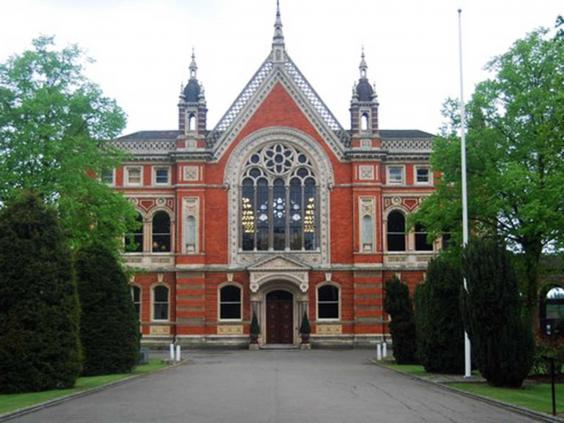
Nigel Farage attended Dulwich College in the late Seventies (Creative Commons)
We hear much of “due diligence” in today's financial world, but had the teachers and headmaster of Dulwich investigated the concerns around your appointment as a prefect with your peers - as they would hopefully today in similar circumstances - they might have made a very different decision. They might not have brushed them under the carpet; they might have made you think a little more about your rhetoric; history might be a little different today.
For I vividly recall the keen interest you had in two initials of your name written together as a signature and the bigoted symbol that represents from the many doodles over your school books. Nigel Farage, NF, National Front. I remember watching you draw it. Just a laugh, eh, Nigel?
As the son of an immigrant family, your frequent cry of “Send em home” and mention of the name Oswald Mosley didn’t mean much to me either until much later when I learnt of the British Fascists.

The former friend says he saw Nigel Farage draw a version of the National Front logo on his college books
I remember you spending hours with spit and polish producing what were unquestionably the brightest pair of CCF (Combined Cadet Force) army boots in school. I also remember your snuff tobacco that you kept hidden from unwitting teachers.
But I also remember something altogether more alarming: the songs you chanted at school. In her letter Chloe Deakin mentioned reports of you singing Hitler Youth songs, and when you were confronted by that, you denied it.
But I do remember you singing the song starting with the words “gas them all, gas ‘em all, gas them all”. I can’t forget the words. I can’t bring myself to write the rest of it for it is more vile that anything the teachers at Dulwich would ever have been aware of.
I too think that things can be in the past and that people grow up from being naughty schoolchildren. Heaven help us if they didn’t, let's face it, but heaven help us if we believe all children do.
As someone wanting the EU to be challenged more robustly, I found myself thinking “Good on Nigel” for the amusement your speeches in the European Parliament gave us. Let's face it, mass migration and its management by the EU has been a consistent mess of mixed messages. You’re absolutely right to challenge the EU – it’s just people need to see the full picture — before aligning themselves to strangers, however charming their messages are.
From being a real fan, I found myself thinking more and more with every appearance of yours on television that we must be aware of false prophets. Notably, the image of a desperate line of refugees, photographed not even in England, showed me that Nigel Farage has perhaps not changed that much.
These people were used as live currency to further your cause to represent Britain being at breaking point from European immigrants – although those people were from outside of Europe. The imagery of a loss of control, hopelessness, of our own politicians not caring for us is the stuff of two world wars. I can hear you say “useless” in the way you used to.
As I have said, the immigration issue surely needs fixing, but you have shamefully used this picture.
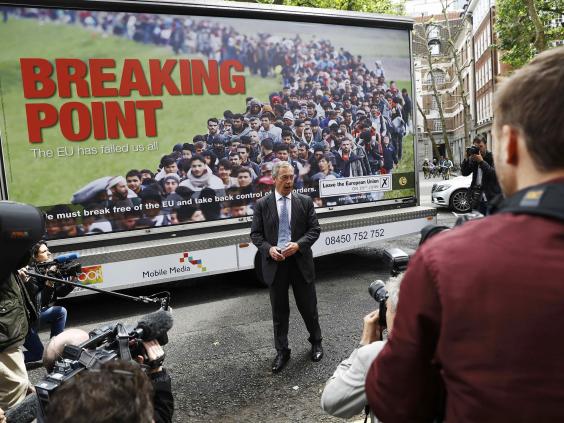
Ex-Ukip leader Nigel Farage's use of refugees in the Breaking Point poster appalled his former friend (Reuters)
Seeing your gloating display post-referendum at the European Parliament just rammed home the point: it seemed here we had a bit of the Nigel I knew at school. Yes, you’ve fought 20 years and no one took you seriously – but let us have some humility. We now learn you will start touring other EU countries, beginning in Athens in September, to encourage them to follow your lead. I’m sure the neo-Nazis in Golden Dawn in Greece will cheer you loudly. The people of Greece, beware.
Oh, for the record, I’m not a blind Remainer. I’m more a 51 per cent reluctant Remainer. Yes, I see the many 21st century challenges with which the EU has failed to deal – immigration and “over-involvement” being the most obvious.
Who cannot see that having no common policy to deal with hundreds of thousands of immigrants is going to strain the most robust of institutions to its limits? Who cannot see that criminal elements within those hundreds of thousands are not going to use the cover of desperate people for their own personal gain or distorted beliefs?
But then again, don’t some politicians use the cover of people’s strife for their own gain or beliefs? Would we as a nation not be alarmed if we were to find out that a Muslim politician or teacher for example had made reference to forced repatriation or joked about beheading all non-Muslims as a teenager at school? Let’s hope schools are now taking action on the kind of comments you made at school.
But let me indulge you in a story. On a recent trip to Berlin, I found myself in a wonderful park in Spandau on the banks of the Havel. It was a windy day and a chap next to me was meticulously laying out some papers on a bench. But then a gust of wind sent them a few metres, happily straight into my hands.
He was incredibly grateful and strangely offered me some orange juice and a banana. I felt a little embarrassed.
And then I realised the papers on the bench were in fact asylum papers and the orange juice and banana in a park in Berlin meant more to him than I could ever imagine. He was a teacher of physics or something similar; it was the only thing I could deduce from his broken English.
I tried a little German but to this he just shrugged his shoulders and gave a hopelessly lost smile. He was a Syrian filling out papers for his family and, had my appointment contact not have arrived a few minutes later, I could have spent all day right there.
Perhaps he was in that infamous Leave poster you exploited to such effect? It’s easy to tar everyone with the same brush just because of a few criminals.
But neither am I someone with rose-tinted spectacles. Although this meeting in Berlin was a wake-up moment for me, I also know there are serious issues for Europe to solve. We really have been let down by our European leaders.
Perhaps people found no other way to represent their dissatisfaction with Europe and the very many things that need fixing other than embracing you? Is it our fault? No, sorry, there’s never an excuse for whipping up some racial animosity as a means to an end.
I think you’re a troublemaker. You were at school, you are now. But we need to beware of what’s whipped up.
In April 1981, we had the Brixton riots. They happened just up the road from our school. The images of rioting people, many of them from the racial minorities, made it easy to discriminate; many people did back then. The National Front was hugely popular by comparison to today. So, turbulent times back then… but have you not moved on?
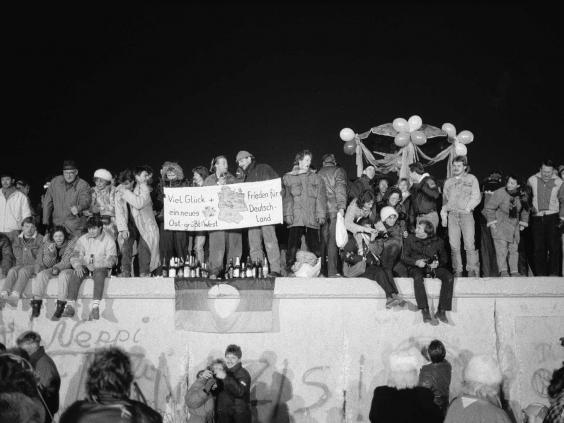
Nigel Farage's schoolfriend believes East Germans celebrating the fall of the Berlin Wall in 1989 was true 'independence' (Getty Images)
I agree with you there are historic dates that change lives. I stood on the Berlin Wall on that wonderful day in 1989 and have 8mm ciné film I took that never fails to choke me: the images of euphoria, loud noise and waving flags of all colours. Those are real celebrations – and for good reason. I congratulate the German people on their achievement in integrating two by then divergent cultures. It has taken decades rather than the few years Helmut Kohl predicted, but from mutual animosity and envy on both sides, today the country bears little evidence of physical or societal difference.
After the referendum vote, you called for an “independence day” to mark the result. It’s an insult those good people in the real world who have died fighting real struggles for independence. I hope the nation sees just as I do that we have allowed ourselves to be enchanted by the charismatic and populist against plainly obvious EU failings without any real thought as to the background and objectives of the people delivering the messages.
Déjà vu, I'm afraid.
Dear Nigel,
I won’t give my name – my family isn’t even aware I’m writing this and I wish to protect them. But I have a funny feeling you’ll know who I am.
At school, at Dulwich College in the late Seventies, we were close friends in our teenage years. I stayed at your house once – your mother did do a fantastic great British breakfast for us.
I remember the way you enchanted people at school, senior teachers and fellow pupils alike. Your English project on fishing enthralled everyone. I remember mine being particularly boring. You were and are a great speaker, for sure.
But I also remember other, darker things about you. There was a time when I used to look back and dismiss much of them as the amusing naughtiness of teenagers as we were, much like our old headmaster David Emms did.
I haven’t chosen to write before, but I simply have to now. I now wonder if there is a connection between you at 16 and you at 52. I don’t believe you have fascist sympathies now, but there are things that tell me your views might not have changed that much despite the many years.
I think there comes a time – however difficult it may be – when enough is enough. I remember those school days in the UK. As you know, teachers were concerned. You’ll remember being confronted three years ago by journalists who had a letter from the school teacher Chloe Deakin to Mr Emms. You’ll remember she was concerned about “fascist views”. Other teachers also had concerns, but none of them would have known you like your own peers, the friends you used to spend time with.
Nigel Farage attended Dulwich College in the late Seventies (Creative Commons)
We hear much of “due diligence” in today's financial world, but had the teachers and headmaster of Dulwich investigated the concerns around your appointment as a prefect with your peers - as they would hopefully today in similar circumstances - they might have made a very different decision. They might not have brushed them under the carpet; they might have made you think a little more about your rhetoric; history might be a little different today.
For I vividly recall the keen interest you had in two initials of your name written together as a signature and the bigoted symbol that represents from the many doodles over your school books. Nigel Farage, NF, National Front. I remember watching you draw it. Just a laugh, eh, Nigel?
As the son of an immigrant family, your frequent cry of “Send em home” and mention of the name Oswald Mosley didn’t mean much to me either until much later when I learnt of the British Fascists.
The former friend says he saw Nigel Farage draw a version of the National Front logo on his college books
I remember you spending hours with spit and polish producing what were unquestionably the brightest pair of CCF (Combined Cadet Force) army boots in school. I also remember your snuff tobacco that you kept hidden from unwitting teachers.
But I also remember something altogether more alarming: the songs you chanted at school. In her letter Chloe Deakin mentioned reports of you singing Hitler Youth songs, and when you were confronted by that, you denied it.
But I do remember you singing the song starting with the words “gas them all, gas ‘em all, gas them all”. I can’t forget the words. I can’t bring myself to write the rest of it for it is more vile that anything the teachers at Dulwich would ever have been aware of.
I too think that things can be in the past and that people grow up from being naughty schoolchildren. Heaven help us if they didn’t, let's face it, but heaven help us if we believe all children do.
As someone wanting the EU to be challenged more robustly, I found myself thinking “Good on Nigel” for the amusement your speeches in the European Parliament gave us. Let's face it, mass migration and its management by the EU has been a consistent mess of mixed messages. You’re absolutely right to challenge the EU – it’s just people need to see the full picture — before aligning themselves to strangers, however charming their messages are.
From being a real fan, I found myself thinking more and more with every appearance of yours on television that we must be aware of false prophets. Notably, the image of a desperate line of refugees, photographed not even in England, showed me that Nigel Farage has perhaps not changed that much.
These people were used as live currency to further your cause to represent Britain being at breaking point from European immigrants – although those people were from outside of Europe. The imagery of a loss of control, hopelessness, of our own politicians not caring for us is the stuff of two world wars. I can hear you say “useless” in the way you used to.
As I have said, the immigration issue surely needs fixing, but you have shamefully used this picture.
Ex-Ukip leader Nigel Farage's use of refugees in the Breaking Point poster appalled his former friend (Reuters)
Seeing your gloating display post-referendum at the European Parliament just rammed home the point: it seemed here we had a bit of the Nigel I knew at school. Yes, you’ve fought 20 years and no one took you seriously – but let us have some humility. We now learn you will start touring other EU countries, beginning in Athens in September, to encourage them to follow your lead. I’m sure the neo-Nazis in Golden Dawn in Greece will cheer you loudly. The people of Greece, beware.
Oh, for the record, I’m not a blind Remainer. I’m more a 51 per cent reluctant Remainer. Yes, I see the many 21st century challenges with which the EU has failed to deal – immigration and “over-involvement” being the most obvious.
Who cannot see that having no common policy to deal with hundreds of thousands of immigrants is going to strain the most robust of institutions to its limits? Who cannot see that criminal elements within those hundreds of thousands are not going to use the cover of desperate people for their own personal gain or distorted beliefs?
But then again, don’t some politicians use the cover of people’s strife for their own gain or beliefs? Would we as a nation not be alarmed if we were to find out that a Muslim politician or teacher for example had made reference to forced repatriation or joked about beheading all non-Muslims as a teenager at school? Let’s hope schools are now taking action on the kind of comments you made at school.
But let me indulge you in a story. On a recent trip to Berlin, I found myself in a wonderful park in Spandau on the banks of the Havel. It was a windy day and a chap next to me was meticulously laying out some papers on a bench. But then a gust of wind sent them a few metres, happily straight into my hands.
He was incredibly grateful and strangely offered me some orange juice and a banana. I felt a little embarrassed.
And then I realised the papers on the bench were in fact asylum papers and the orange juice and banana in a park in Berlin meant more to him than I could ever imagine. He was a teacher of physics or something similar; it was the only thing I could deduce from his broken English.
I tried a little German but to this he just shrugged his shoulders and gave a hopelessly lost smile. He was a Syrian filling out papers for his family and, had my appointment contact not have arrived a few minutes later, I could have spent all day right there.
Perhaps he was in that infamous Leave poster you exploited to such effect? It’s easy to tar everyone with the same brush just because of a few criminals.
But neither am I someone with rose-tinted spectacles. Although this meeting in Berlin was a wake-up moment for me, I also know there are serious issues for Europe to solve. We really have been let down by our European leaders.
Perhaps people found no other way to represent their dissatisfaction with Europe and the very many things that need fixing other than embracing you? Is it our fault? No, sorry, there’s never an excuse for whipping up some racial animosity as a means to an end.
I think you’re a troublemaker. You were at school, you are now. But we need to beware of what’s whipped up.
In April 1981, we had the Brixton riots. They happened just up the road from our school. The images of rioting people, many of them from the racial minorities, made it easy to discriminate; many people did back then. The National Front was hugely popular by comparison to today. So, turbulent times back then… but have you not moved on?
Nigel Farage's schoolfriend believes East Germans celebrating the fall of the Berlin Wall in 1989 was true 'independence' (Getty Images)
I agree with you there are historic dates that change lives. I stood on the Berlin Wall on that wonderful day in 1989 and have 8mm ciné film I took that never fails to choke me: the images of euphoria, loud noise and waving flags of all colours. Those are real celebrations – and for good reason. I congratulate the German people on their achievement in integrating two by then divergent cultures. It has taken decades rather than the few years Helmut Kohl predicted, but from mutual animosity and envy on both sides, today the country bears little evidence of physical or societal difference.
After the referendum vote, you called for an “independence day” to mark the result. It’s an insult those good people in the real world who have died fighting real struggles for independence. I hope the nation sees just as I do that we have allowed ourselves to be enchanted by the charismatic and populist against plainly obvious EU failings without any real thought as to the background and objectives of the people delivering the messages.
Déjà vu, I'm afraid.
For Muslim women life had been getting better. No longer
Yasmin Alibhai Brown in The Guardian
Muslim women are the most economically disadvantaged group in Britain. They are three times more likely than other women to be unemployed or looking for work, and twice as likely to be economically inactive (ie, not looking for work). Those who have the same educational qualifications and skills as white Christian women are 71% more likely to be jobless.
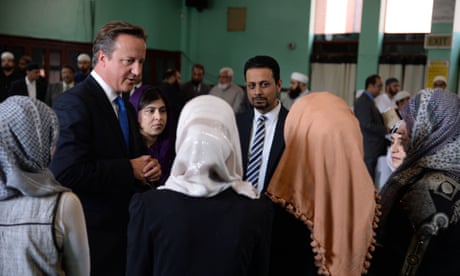
Cameron 'stigmatising Muslim women' with English language policy
These bleak findings appear in an MPs’ report published today. This is bad news for Muslims, feminists, anti-racists and for the nation. Britain cannot be highly productive, functional, inventive, internationally competitive or properly meritocratic while so much human potential remains dormant or suppressed. Families and communities with unemployed women cannot escape poverty and hopelessness. So why is this happening?
British Muslim women have come a long way since the 1980s. In 1984 the study Black and White Britain was published by the Policy Studies Institute. The author, Colin Brown, is now my husband. He found that though vastly fewer Asian women than black or white women were in the workforce, among those Asian women in employment only 18% were Muslim. Today eight Muslim women are in parliament, and several are peers. More British Muslim women than men are getting degrees.
I am a part-time professor at Middlesex University, where many of my students are feisty young Muslim women. One of them, Saira (not her real name), told me recently: “My mother can’t read or write. They got her married at 12, when she was a child. But she pushed me and my five sisters, stopped my father arranging our marriages. She is like a lioness.” Sharmin was a young, incredibly bright Bangladeshi mum in Bethnal Green. I used to teach her English. After her husband left her and married a younger wife, she enrolled at a further education college. She is now a social worker.
Some Muslim leaders have been calling for these transformative developments for a very long time. Back in 1924, our worldwide imam, the Aga Khan, instructed his believers to educate daughters because they would then go on to raise educated children and, in time, prepare congregations for a future they could not even imagine. As a child in the 60s, I remember the first time I saw women doctors in our mosque surgery in Kampala, Uganda, and teachers clip-clopping in high heels in our schools.
According to the parliamentary report, “the impact of Islamophobia cannot be underestimated” and there is now a “chill factor” stopping women applying for jobs and promotion. What a blow that must be. All that faith, all that education, for what turns out to be a false promise, a chimera. They face a triple penalty: they are female, of minority background and Muslim.
One recommendation in the report is name-blind recruitment. This would help, but not that much. Women who sound “British” and believe they are, turn up at interviews where visceral hostility comes at them. I have experienced it several times in my own life. I started to apply with just “Brown” as my surname, but then felt the air freeze when I arrived at the interview.
Despite these barriers, 45% more Muslim women are in work than were in 2011. That is a remarkable figure. Yet just when things were getting better, they got worse. Attitudes towards migrants, minorities and refugees have noticeably hardened since Ukip and other rightwing politicians moved from the fringes to the heart of British politics.
Jihadi terror cells undeniably have some support from British Muslims. Muslim self-segregation is also an evident and serious issue. So too Pakistani grooming gangs, whose heinous activities were kept hidden for too long. Needless to say, this is not what most Muslims do or approve of. But these behaviours play into the narratives of racists and have also turned fair-minded people against Islam and Muslims.
The most “integrated” of us are insulted, abused or attacked. Muslims can’t fly, walk, talk, or use public transport or public spaces without fear of being seen as a terrorist. Since the late 60s, when the first race relations laws were passed, most white Brits accepted the need to protect minorities against discrimination. Not any more, it seems. TheCommission for Racial Equality was abolished a decade ago and its notional replacement, the Equality and Human Rights Commission, is moribund. Race equality has been kicked off the agenda while racism goes up.
However, the report’s authors are completely right when they say the discrimination Muslim women experience “is exacerbated by the pressures that some women feel from parts of their communities to fulfil a more traditional role”. It’s clear that self-segregation is increasing within some communities.Farhat Hashmi, who gained her PhD from Glasgow University, is one of the most influential internet female proselytisers. She orders middle-class women to stay at home and give in to men’s demands.
I receive countless letters from young women. They and my acquaintances tell about oppressive practices now being imposed by their brothers, not their fathers.
Yasmin Weaver of the gender equality group Inspire says that addressing unemployment among Muslims is a priority for government and must be a priority for Muslim communities too. This, I fear, is where we fall flat. Weaver believes strongly that anti-discrimination measures need to go hand in hand with a reform of cultural, parental and religious practices and beliefs.
The parliamentary report recognises that both discrimination and internal oppression keep Muslim women in their airless, hopeless places. Governments can tackle the first, but who in a liberal society would dare challenge the second?
Muslim women are the most economically disadvantaged group in Britain. They are three times more likely than other women to be unemployed or looking for work, and twice as likely to be economically inactive (ie, not looking for work). Those who have the same educational qualifications and skills as white Christian women are 71% more likely to be jobless.
Cameron 'stigmatising Muslim women' with English language policy
These bleak findings appear in an MPs’ report published today. This is bad news for Muslims, feminists, anti-racists and for the nation. Britain cannot be highly productive, functional, inventive, internationally competitive or properly meritocratic while so much human potential remains dormant or suppressed. Families and communities with unemployed women cannot escape poverty and hopelessness. So why is this happening?
British Muslim women have come a long way since the 1980s. In 1984 the study Black and White Britain was published by the Policy Studies Institute. The author, Colin Brown, is now my husband. He found that though vastly fewer Asian women than black or white women were in the workforce, among those Asian women in employment only 18% were Muslim. Today eight Muslim women are in parliament, and several are peers. More British Muslim women than men are getting degrees.
I am a part-time professor at Middlesex University, where many of my students are feisty young Muslim women. One of them, Saira (not her real name), told me recently: “My mother can’t read or write. They got her married at 12, when she was a child. But she pushed me and my five sisters, stopped my father arranging our marriages. She is like a lioness.” Sharmin was a young, incredibly bright Bangladeshi mum in Bethnal Green. I used to teach her English. After her husband left her and married a younger wife, she enrolled at a further education college. She is now a social worker.
Some Muslim leaders have been calling for these transformative developments for a very long time. Back in 1924, our worldwide imam, the Aga Khan, instructed his believers to educate daughters because they would then go on to raise educated children and, in time, prepare congregations for a future they could not even imagine. As a child in the 60s, I remember the first time I saw women doctors in our mosque surgery in Kampala, Uganda, and teachers clip-clopping in high heels in our schools.
According to the parliamentary report, “the impact of Islamophobia cannot be underestimated” and there is now a “chill factor” stopping women applying for jobs and promotion. What a blow that must be. All that faith, all that education, for what turns out to be a false promise, a chimera. They face a triple penalty: they are female, of minority background and Muslim.
One recommendation in the report is name-blind recruitment. This would help, but not that much. Women who sound “British” and believe they are, turn up at interviews where visceral hostility comes at them. I have experienced it several times in my own life. I started to apply with just “Brown” as my surname, but then felt the air freeze when I arrived at the interview.
Despite these barriers, 45% more Muslim women are in work than were in 2011. That is a remarkable figure. Yet just when things were getting better, they got worse. Attitudes towards migrants, minorities and refugees have noticeably hardened since Ukip and other rightwing politicians moved from the fringes to the heart of British politics.
Jihadi terror cells undeniably have some support from British Muslims. Muslim self-segregation is also an evident and serious issue. So too Pakistani grooming gangs, whose heinous activities were kept hidden for too long. Needless to say, this is not what most Muslims do or approve of. But these behaviours play into the narratives of racists and have also turned fair-minded people against Islam and Muslims.
The most “integrated” of us are insulted, abused or attacked. Muslims can’t fly, walk, talk, or use public transport or public spaces without fear of being seen as a terrorist. Since the late 60s, when the first race relations laws were passed, most white Brits accepted the need to protect minorities against discrimination. Not any more, it seems. TheCommission for Racial Equality was abolished a decade ago and its notional replacement, the Equality and Human Rights Commission, is moribund. Race equality has been kicked off the agenda while racism goes up.
However, the report’s authors are completely right when they say the discrimination Muslim women experience “is exacerbated by the pressures that some women feel from parts of their communities to fulfil a more traditional role”. It’s clear that self-segregation is increasing within some communities.Farhat Hashmi, who gained her PhD from Glasgow University, is one of the most influential internet female proselytisers. She orders middle-class women to stay at home and give in to men’s demands.
I receive countless letters from young women. They and my acquaintances tell about oppressive practices now being imposed by their brothers, not their fathers.
Yasmin Weaver of the gender equality group Inspire says that addressing unemployment among Muslims is a priority for government and must be a priority for Muslim communities too. This, I fear, is where we fall flat. Weaver believes strongly that anti-discrimination measures need to go hand in hand with a reform of cultural, parental and religious practices and beliefs.
The parliamentary report recognises that both discrimination and internal oppression keep Muslim women in their airless, hopeless places. Governments can tackle the first, but who in a liberal society would dare challenge the second?
Thursday, 11 August 2016
How the World Bank’s biggest critic became its president
Andrew Rice in The Guardian
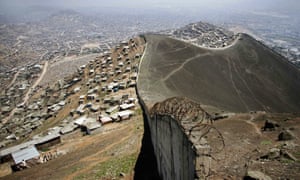
In a shanty town perched in the hilly outskirts of Lima, Peru, people were dying. It was 1994, and thousands of squatters – many of them rural migrants who had fled their country’s Maoist guerrilla insurgency – were crammed into unventilated hovels, living without basic sanitation. They faced outbreaks of cholera and other infectious diseases, but a government austerity program, which had slashed subsidised health care, forced many to forgo medical treatment they couldn’t afford. When food ran short, they formed ad hoc collectives to stave off starvation. A Catholic priest ministering to a parish in the slum went looking for help, and he found it in Jim Yong Kim, an idealistic Korean-American physician and anthropologist.
In his mid-30s and a recent graduate of Harvard Medical School, Kim had helped found Partners in Health, a non-profit organisation whose mission was to bring modern medicine to the world’s poor. The priest had been involved with the group in Boston, its home base, before serving in Peru, and he asked Kim to help him set up a clinic to aid his flock. No sooner had Kim arrived in Lima, however, than the priest contracted a drug-resistant form of tuberculosis and died.
Kim was devastated, and he thought he knew what to blame: the World Bank. Like many debt-ridden nations, Peru was going through “structural adjustment”, a period of lender-mandated inflation controls, privatisations and government cutbacks. President Alberto Fujimori had enacted strict policies, known collectively as “Fujishock”, that made him a darling of neoliberal economists. But Kim saw calamitous trickledown effects, including the tuberculosis epidemic that had claimed his friend and threatened to spread through the parish.
So Kim helped organise a conference in Lima that was staged like a teach-in. Hundreds of shanty town residents met development experts and vented their anger with the World Bank. “We talked about the privatisation of everything: profits and also suffering,” Kim recalls. “The argument we were trying to make is that investment in human beings should not be cast aside in the name of GDP growth.” Over the next half-decade, he would become a vociferous critic of the World Bank, even calling for its abolition. In a 2000 book, Dying for Growth, he was lead author of an essay attacking the “capriciousness” of international development policies. “The penalties for failure,” he concluded, “have been borne by the poor, the infirm and the vulnerable in poor countries that accepted the experts’ designs.”
Kim often tells this story today, with an air of playful irony, when he introduces himself – as the president of the World Bank. “I was actually out protesting and trying to shut down the World Bank,” Kim said one March afternoon, addressing a conference in Maryland’s National Harbor complex. “I’m very glad we lost that argument.”
In a shanty town perched in the hilly outskirts of Lima, Peru, people were dying. It was 1994, and thousands of squatters – many of them rural migrants who had fled their country’s Maoist guerrilla insurgency – were crammed into unventilated hovels, living without basic sanitation. They faced outbreaks of cholera and other infectious diseases, but a government austerity program, which had slashed subsidised health care, forced many to forgo medical treatment they couldn’t afford. When food ran short, they formed ad hoc collectives to stave off starvation. A Catholic priest ministering to a parish in the slum went looking for help, and he found it in Jim Yong Kim, an idealistic Korean-American physician and anthropologist.
In his mid-30s and a recent graduate of Harvard Medical School, Kim had helped found Partners in Health, a non-profit organisation whose mission was to bring modern medicine to the world’s poor. The priest had been involved with the group in Boston, its home base, before serving in Peru, and he asked Kim to help him set up a clinic to aid his flock. No sooner had Kim arrived in Lima, however, than the priest contracted a drug-resistant form of tuberculosis and died.
Kim was devastated, and he thought he knew what to blame: the World Bank. Like many debt-ridden nations, Peru was going through “structural adjustment”, a period of lender-mandated inflation controls, privatisations and government cutbacks. President Alberto Fujimori had enacted strict policies, known collectively as “Fujishock”, that made him a darling of neoliberal economists. But Kim saw calamitous trickledown effects, including the tuberculosis epidemic that had claimed his friend and threatened to spread through the parish.
So Kim helped organise a conference in Lima that was staged like a teach-in. Hundreds of shanty town residents met development experts and vented their anger with the World Bank. “We talked about the privatisation of everything: profits and also suffering,” Kim recalls. “The argument we were trying to make is that investment in human beings should not be cast aside in the name of GDP growth.” Over the next half-decade, he would become a vociferous critic of the World Bank, even calling for its abolition. In a 2000 book, Dying for Growth, he was lead author of an essay attacking the “capriciousness” of international development policies. “The penalties for failure,” he concluded, “have been borne by the poor, the infirm and the vulnerable in poor countries that accepted the experts’ designs.”
Kim often tells this story today, with an air of playful irony, when he introduces himself – as the president of the World Bank. “I was actually out protesting and trying to shut down the World Bank,” Kim said one March afternoon, addressing a conference in Maryland’s National Harbor complex. “I’m very glad we lost that argument.”
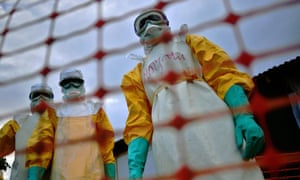
Medical staff treat people with Ebola in Kailahun, Sierra Leone, 2014. Photograph: Carl de Souza/AFP/Getty Images
The line always gets a laugh, but Kim uses it to illustrate a broader story of evolution. As he dispenses billions of development dollars and tees off at golf outings with Barack Obama – the US president has confessed jealousy of his impressive five handicap – Kim is a long way from Peru. The institution he leads has changed too. Structural adjustment, for one, has been phased out, and Kim says the bank can be a force for good. Yet he believes it is only just awakening to its potential – and at a precarious moment.
Last year, the percentage of people living in extreme poverty dropped below 10% for the first time. That’s great news for the world, but it leaves the World Bank somewhat adrift. Many former dependents, such as India, have outgrown their reliance on financing. Others, namely China, have become lenders in their own right. “What is the relevance of the World Bank?” Kim asked me in a recent interview. “I think that is an entirely legitimate question.”
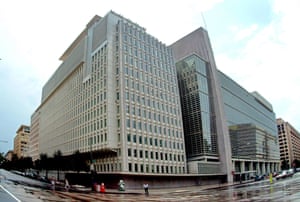
Kim believes he has the existential answers. During his four years at the bank’s monumental headquarters on H Street in Washington, he has reorganised the 15,000-strong workforce to reflect a shift from managing country portfolios to tackling regional and global crises. He has redirected large portions of the bank’s resources (it issued more than $61bn in loans and other forms of funding last year) toward goals that fall outside its traditional mandate of encouraging growth by financing infrastructure projects – stemming climate change, stopping Ebola, addressing the conditions driving the Syrian exodus.
Yet many bank employees see Kim’s ambitions as presumptuous, even reckless, and changes undertaken to revitalise a sluggish bureaucracy have shaken it. There have been protests and purges, and critics say Kim’s habit of enunciating grandiose aspirations comes with a tendency toward autocracy. The former bank foe now stands accused of being an invasive agent, inflicting his own form of shock therapy on his staff. “The wrong changes have been done badly,” says Lant Pritchett, a former World Bank economist.
Pritchett argues that, beyond issues of personality and style, Kim’s presidency has exposed a deep ideological rift between national development, which emphasises institution-building and growth, and what Pritchett terms “humane” development, or alleviating immediate suffering. Kim, however, sees no sharp distinction: he contends that humane development is national development – and if the bank persists in believing otherwise, it could be doomed to obsolescence.
Kim likes to say that as a doctor with experience of treating the poor, his humanitarian outlook is his strongest qualification for his job – an opinion that probably vexes critics who point out that he knew little about lending before arriving at the bank. “Finance and macroeconomics are complicated, but you can actually learn them,” he says. “The hardest thing to learn is mud-between-your-toes, on-the-ground development work. You can’t learn that quickly. You can’t learn that through trips where you’re treated like a head of state. You have to have kind of done that before.”
Kim talks fast and he walks fast. Following him – a lithe, balding 56-year-old surrounded by a deferential, suited entourage – you can easily imagine him in a white coat as a physician making his rounds. He has a doctor’s diagnostic mindset too; he talks about ascertaining “the problem”, or what public-health experts call the “cause of the causes”. He thinks of poverty as an ailment and is trying to devise a “science of delivery”. It’s a philosophy built on a life-long interest in the intersection of science and humanities. Born in Seoul in 1959 to parents displaced by the Korean war, Kim emigrated to the US with his family when he was a child, eventually ending up in Muscatine, Iowa. His was one of two Asian families in the small town. His mother was an expert in Confucian philosophy, his father a dentist. Kim excelled at his studies while playing quarterback in high school. He attended Brown University in Providence, Rhode Island, where he studied human biology. His father wanted him to be a doctor, but he gravitated toward anthropology. Because Harvard let him pursue a medical degree and a PhD simultaneously, he landed there. Kim struck up a friendship with Paul Farmer, a fellow student, over shared interests in health and justice. In 1987, they formed Partners in Health.
The two came of age when the World Bank’s influence was arguably at its most powerful and controversial. Conceived along with the International Monetary Fund at the 1944 Bretton Woods conference, the bank was meant to rebuild Europe. However, it found its central mission as a source of startup capital for states emerging from the demise of colonial empires. The bank could borrow money cheaply in the global markets, thanks to the creditworthiness of its shareholders (the largest being the US government), then use that money to finance the prerequisites for economic growth – things such as roads, schools, hospitals and power plants. Structural adjustment came about in response to a series of debt crises that culminated in the 1980s. The Bretton Woods institutions agreed to bail out indebted developing states if they tightened their belts and submitted to painful fiscal reforms.
The line always gets a laugh, but Kim uses it to illustrate a broader story of evolution. As he dispenses billions of development dollars and tees off at golf outings with Barack Obama – the US president has confessed jealousy of his impressive five handicap – Kim is a long way from Peru. The institution he leads has changed too. Structural adjustment, for one, has been phased out, and Kim says the bank can be a force for good. Yet he believes it is only just awakening to its potential – and at a precarious moment.
Last year, the percentage of people living in extreme poverty dropped below 10% for the first time. That’s great news for the world, but it leaves the World Bank somewhat adrift. Many former dependents, such as India, have outgrown their reliance on financing. Others, namely China, have become lenders in their own right. “What is the relevance of the World Bank?” Kim asked me in a recent interview. “I think that is an entirely legitimate question.”
Kim believes he has the existential answers. During his four years at the bank’s monumental headquarters on H Street in Washington, he has reorganised the 15,000-strong workforce to reflect a shift from managing country portfolios to tackling regional and global crises. He has redirected large portions of the bank’s resources (it issued more than $61bn in loans and other forms of funding last year) toward goals that fall outside its traditional mandate of encouraging growth by financing infrastructure projects – stemming climate change, stopping Ebola, addressing the conditions driving the Syrian exodus.
Yet many bank employees see Kim’s ambitions as presumptuous, even reckless, and changes undertaken to revitalise a sluggish bureaucracy have shaken it. There have been protests and purges, and critics say Kim’s habit of enunciating grandiose aspirations comes with a tendency toward autocracy. The former bank foe now stands accused of being an invasive agent, inflicting his own form of shock therapy on his staff. “The wrong changes have been done badly,” says Lant Pritchett, a former World Bank economist.
Pritchett argues that, beyond issues of personality and style, Kim’s presidency has exposed a deep ideological rift between national development, which emphasises institution-building and growth, and what Pritchett terms “humane” development, or alleviating immediate suffering. Kim, however, sees no sharp distinction: he contends that humane development is national development – and if the bank persists in believing otherwise, it could be doomed to obsolescence.
Kim likes to say that as a doctor with experience of treating the poor, his humanitarian outlook is his strongest qualification for his job – an opinion that probably vexes critics who point out that he knew little about lending before arriving at the bank. “Finance and macroeconomics are complicated, but you can actually learn them,” he says. “The hardest thing to learn is mud-between-your-toes, on-the-ground development work. You can’t learn that quickly. You can’t learn that through trips where you’re treated like a head of state. You have to have kind of done that before.”
Kim talks fast and he walks fast. Following him – a lithe, balding 56-year-old surrounded by a deferential, suited entourage – you can easily imagine him in a white coat as a physician making his rounds. He has a doctor’s diagnostic mindset too; he talks about ascertaining “the problem”, or what public-health experts call the “cause of the causes”. He thinks of poverty as an ailment and is trying to devise a “science of delivery”. It’s a philosophy built on a life-long interest in the intersection of science and humanities. Born in Seoul in 1959 to parents displaced by the Korean war, Kim emigrated to the US with his family when he was a child, eventually ending up in Muscatine, Iowa. His was one of two Asian families in the small town. His mother was an expert in Confucian philosophy, his father a dentist. Kim excelled at his studies while playing quarterback in high school. He attended Brown University in Providence, Rhode Island, where he studied human biology. His father wanted him to be a doctor, but he gravitated toward anthropology. Because Harvard let him pursue a medical degree and a PhD simultaneously, he landed there. Kim struck up a friendship with Paul Farmer, a fellow student, over shared interests in health and justice. In 1987, they formed Partners in Health.
The two came of age when the World Bank’s influence was arguably at its most powerful and controversial. Conceived along with the International Monetary Fund at the 1944 Bretton Woods conference, the bank was meant to rebuild Europe. However, it found its central mission as a source of startup capital for states emerging from the demise of colonial empires. The bank could borrow money cheaply in the global markets, thanks to the creditworthiness of its shareholders (the largest being the US government), then use that money to finance the prerequisites for economic growth – things such as roads, schools, hospitals and power plants. Structural adjustment came about in response to a series of debt crises that culminated in the 1980s. The Bretton Woods institutions agreed to bail out indebted developing states if they tightened their belts and submitted to painful fiscal reforms.
A wall dividing shanty towns and rich neighbourhoods in Lima, Peru, where Kim’s journey to the World Bank began. Photograph: Oxfam/EPA
To Kim and Farmer, the moral flaw in the bank’s approach was that it imposed mandates with little concern for how cutting budgets might affect people’s health. They thought that “the problem” in global health was economic inequality, and in Haiti Partners in Health pioneered a grassroots methodology to tackle it: improve the lives of communities by training locals to provide medical care (thus creating jobs) and by expanding access to food, sanitation and other basic necessities. Though hardly insurgents – they were based at Harvard, after all – the friends passionately argued that policy discussions in Geneva and Washington needed to be informed by ground truths, delivered by the people living them.
Farmer’s impressive work ethic and pious demeanour made him famous – and the subject of Tracy Kidder’s acclaimed book Mountains Beyond Mountains – but Kim was the partner with systemic ambitions. “For Paul, the question is, ‘What does it take to solve the problem of giving the best care in the world to my patients?’” Kim says. “But he doesn’t spend all his time thinking about, ‘So how do you take that to scale in 188 countries?’” (Both men, who remain close friends, have wonMacArthur Foundation “genius grants” for their work.)
Kim’s desire to shape policy landed him at the World Health Organisation (WHO) in 2003, overseeing its HIV/Aids work. The job required him to relocate to Geneva with his wife – a paediatrician he had met at Harvard – and a son who was just a toddler. (They now have two children, aged 16 and seven.) In the vigorously assertive style that would become his hallmark – going where he wants to go even if he’s not sure how to get there – Kim pledged to meet an audacious goal: treating three million people in the developing world with antiretroviral drugs by 2005, a more than sixfold increase over just two years. The strategy, in Kim’s own words, was, “Push, push, push.” The “three-by-five pledge,” as it was known, ended up being impossible to reach, and Kim publicly apologised for the failure on the BBC. But the world got there in 2007 – a direct result, Kim says, of the pledge’s impact on global-health policymaking: “You have to set a really difficult target and then have that really difficult target change the way you do your work.”
Kim left the WHO in 2006. After a stopover at Harvard, where he headed a centre for health and human rights, he was hired to be president of Dartmouth College in New Hampshire. He arrived in 2009, with little university management experience but characteristically high hopes. With the global recession at its zenith, however, Kim was forced to spend much of his time focused on saving Dartmouth’s endowment.
He hardly knew the difference between hedge funds and private equity, so a venture capitalist on the college’s board would drive up from Boston periodically to give him lessons, scribbling out basic financial concepts on a whiteboard or scratch paper. His tenure soon turned stormy as he proposed slashing $100m from the school’s budget and clashed with faculty members who complained about a lack of transparency. Joe Asch, a Dartmouth alumnus who writes for a widely read blog about the university, was highly critical of Kim. “He is a man who is very concerned about optics and not so concerned about follow-through,” Asch says now. “Everyone’s sense was that he was just there to punch his ticket.” Soon enough, a surprising opportunity arose.
The way Kim tells it, the call came out of the blue one Monday in March 2012. Timothy Geithner, another Dartmouth alumnus who was then the US treasury secretary, was on the line asking about Kim’s old nemesis. “Jim,” Geithner asked, “would you consider being president of the World Bank?”
When the government contacted him, Kim confesses, he had only the foggiest notion of how development finance worked. He had seen enough in his career, however, to know that running the bank would give him resources he scarcely could have imagined during his years of aid work. Instead of agonising over every drop of water in the budgetary bathtub, he could operate a global tap. “When I really saw what it meant to be a bank with a balance sheet, with a mission to end extreme poverty,” Kim says, “it’s like, wow.” His interest was bolstered by the bank’s adoption, partly in response to 1990s-era activists, ofstringent “safeguards”, or lending rules intended to protect human rights and the environment in client states.
To Kim and Farmer, the moral flaw in the bank’s approach was that it imposed mandates with little concern for how cutting budgets might affect people’s health. They thought that “the problem” in global health was economic inequality, and in Haiti Partners in Health pioneered a grassroots methodology to tackle it: improve the lives of communities by training locals to provide medical care (thus creating jobs) and by expanding access to food, sanitation and other basic necessities. Though hardly insurgents – they were based at Harvard, after all – the friends passionately argued that policy discussions in Geneva and Washington needed to be informed by ground truths, delivered by the people living them.
Farmer’s impressive work ethic and pious demeanour made him famous – and the subject of Tracy Kidder’s acclaimed book Mountains Beyond Mountains – but Kim was the partner with systemic ambitions. “For Paul, the question is, ‘What does it take to solve the problem of giving the best care in the world to my patients?’” Kim says. “But he doesn’t spend all his time thinking about, ‘So how do you take that to scale in 188 countries?’” (Both men, who remain close friends, have wonMacArthur Foundation “genius grants” for their work.)
Kim’s desire to shape policy landed him at the World Health Organisation (WHO) in 2003, overseeing its HIV/Aids work. The job required him to relocate to Geneva with his wife – a paediatrician he had met at Harvard – and a son who was just a toddler. (They now have two children, aged 16 and seven.) In the vigorously assertive style that would become his hallmark – going where he wants to go even if he’s not sure how to get there – Kim pledged to meet an audacious goal: treating three million people in the developing world with antiretroviral drugs by 2005, a more than sixfold increase over just two years. The strategy, in Kim’s own words, was, “Push, push, push.” The “three-by-five pledge,” as it was known, ended up being impossible to reach, and Kim publicly apologised for the failure on the BBC. But the world got there in 2007 – a direct result, Kim says, of the pledge’s impact on global-health policymaking: “You have to set a really difficult target and then have that really difficult target change the way you do your work.”
Kim left the WHO in 2006. After a stopover at Harvard, where he headed a centre for health and human rights, he was hired to be president of Dartmouth College in New Hampshire. He arrived in 2009, with little university management experience but characteristically high hopes. With the global recession at its zenith, however, Kim was forced to spend much of his time focused on saving Dartmouth’s endowment.
He hardly knew the difference between hedge funds and private equity, so a venture capitalist on the college’s board would drive up from Boston periodically to give him lessons, scribbling out basic financial concepts on a whiteboard or scratch paper. His tenure soon turned stormy as he proposed slashing $100m from the school’s budget and clashed with faculty members who complained about a lack of transparency. Joe Asch, a Dartmouth alumnus who writes for a widely read blog about the university, was highly critical of Kim. “He is a man who is very concerned about optics and not so concerned about follow-through,” Asch says now. “Everyone’s sense was that he was just there to punch his ticket.” Soon enough, a surprising opportunity arose.
The way Kim tells it, the call came out of the blue one Monday in March 2012. Timothy Geithner, another Dartmouth alumnus who was then the US treasury secretary, was on the line asking about Kim’s old nemesis. “Jim,” Geithner asked, “would you consider being president of the World Bank?”
When the government contacted him, Kim confesses, he had only the foggiest notion of how development finance worked. He had seen enough in his career, however, to know that running the bank would give him resources he scarcely could have imagined during his years of aid work. Instead of agonising over every drop of water in the budgetary bathtub, he could operate a global tap. “When I really saw what it meant to be a bank with a balance sheet, with a mission to end extreme poverty,” Kim says, “it’s like, wow.” His interest was bolstered by the bank’s adoption, partly in response to 1990s-era activists, ofstringent “safeguards”, or lending rules intended to protect human rights and the environment in client states.
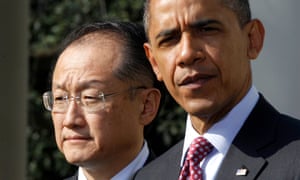
Barack Obama nominates Kim for the presidency of the World Bank, Washington DC, 2012. Photograph: Charles Dharapak/AP
By custom, the World Bank had always been run by an American, nominated by the US president for a five-year term. But in 2012 there was a real international race for the post. Some emerging-market nations questioned deference to the United States, and finance experts from Nigeria and Colombia announced their candidacies. After considering political heavyweights such as Susan Rice, John Kerry and Hillary Clinton – who were all more interested in other jobs – Obama decided he needed an American he could present as an outsider to replace the outgoing president, Robert Zoellick, a colourless former Goldman Sachs banker and Republican trade negotiator. Clinton suggested Kim and “championed Jim as a candidate”, says Farmer. (Partners in Health works with the Clinton Foundation.)
Embedded within the dispute over superpower prerogatives was a larger anxiety about what role the World Bank should play in the 21st century. Extreme poverty had dropped from 37% in 1990 to just under 13% in 2012, so fewer countries needed the bank’s help. With interest rates at record lows, the states that needed aid had more options for borrowing cheap capital, often without paternalistic ethical dictates. New competitors, such as investment banks, were concerned mainly with profits, not safeguards. As a result, whereas the World Bank had once enjoyed a virtual monopoly on the development-finance market, by 2012 its lending represented only about 5% of aggregate private-capital flows to the developing world, according to Martin Ravallion, a Georgetown University economist. And while the bank possessed a wealth of data, technical expertise and analytical capabilities, it was hampered by red tape. One top executive kept a chart in her office illustrating the loan process, which looked like a tangle of spaghetti.
At Kim’s White House interview, Obama still needed some convincing that the global-health expert could take on the task of reinvigorating the bank. When asked what qualified him over candidates with backgrounds in finance, Kim cited Obama’s mother’s anthropology dissertation, about Indonesian artisans threatened by globalisation, to argue that there was no substitute for on-the-ground knowledge of economic policies’ impact. Two days later, Obama unveiled his pick, declaring that it was “time for a development professional to lead the world’s largest development agency”.
Kim campaigned for the job with the zeal of a convert. In an interview with the New York Times, he praised the fact that, unlike in the 1990s, “now the notion of pro-poor development is at the core of the World Bank”. He also embarked on an international “listening tour” to meet heads of state and finance ministers, gathering ideas to shape his priorities in office. Because votes on the bank’s board are apportioned according to shareholding, the US holds the greatest sway, and Obama’s candidate was easily elected. Kim took office in July 2012, with plans to eradicate extreme poverty. Farmer cites a motto carved at the entry to the World Bank headquarters – “Our dream is a world free of poverty” – that activists such as Kim once sniggered at. “Jim said, ‘Let’s change it from a dream to a plan, and then we don’t have to mock it.’”
Kim still had to win over another powerful constituency: his staff. Bank experts consider themselves an elite fraternity. Presidents and their mission statements may come and go, but the institutional culture remains largely impervious. “The bank staff,” says Jim Adams, a former senior manager, “has never fully accepted the governance.” When Robert McNamara expanded the bank’s mission in the late 1960s, doing things such as sending helicopters to spray the African black fly larvae that spread river blindness, many staffers were “deeply distressed to see the institution ‘running off in all directions’”, according to a history published in 1973. When James Wolfensohn arrived in the mid-1990s with plans to move away from structural adjustment and remake the bank like a consulting firm, employees aired their gripes in the press. “Shake-up or cock-up?” asked an Economist headline. Paul Wolfowitz, whose presidency was marred by leaks, was pushed out in 2007 after accusations of cronyism resulted in a damning internal investigation.
Recognising this fraught history, Kim went on a second listening tour: he met representatives of every bank department and obtained what he describes, in anthropologist-speak, as “almost a formal ethnography” of the place. What he lacked in economic knowledge, he made up for in charm. “Dr Kim is personable, Dr Kim is articulate, Dr Kim looks very moved by what he has to say,” says Paul Cadario, a former bank executive who is now a professor at the University of Toronto.
By custom, the World Bank had always been run by an American, nominated by the US president for a five-year term. But in 2012 there was a real international race for the post. Some emerging-market nations questioned deference to the United States, and finance experts from Nigeria and Colombia announced their candidacies. After considering political heavyweights such as Susan Rice, John Kerry and Hillary Clinton – who were all more interested in other jobs – Obama decided he needed an American he could present as an outsider to replace the outgoing president, Robert Zoellick, a colourless former Goldman Sachs banker and Republican trade negotiator. Clinton suggested Kim and “championed Jim as a candidate”, says Farmer. (Partners in Health works with the Clinton Foundation.)
Embedded within the dispute over superpower prerogatives was a larger anxiety about what role the World Bank should play in the 21st century. Extreme poverty had dropped from 37% in 1990 to just under 13% in 2012, so fewer countries needed the bank’s help. With interest rates at record lows, the states that needed aid had more options for borrowing cheap capital, often without paternalistic ethical dictates. New competitors, such as investment banks, were concerned mainly with profits, not safeguards. As a result, whereas the World Bank had once enjoyed a virtual monopoly on the development-finance market, by 2012 its lending represented only about 5% of aggregate private-capital flows to the developing world, according to Martin Ravallion, a Georgetown University economist. And while the bank possessed a wealth of data, technical expertise and analytical capabilities, it was hampered by red tape. One top executive kept a chart in her office illustrating the loan process, which looked like a tangle of spaghetti.
At Kim’s White House interview, Obama still needed some convincing that the global-health expert could take on the task of reinvigorating the bank. When asked what qualified him over candidates with backgrounds in finance, Kim cited Obama’s mother’s anthropology dissertation, about Indonesian artisans threatened by globalisation, to argue that there was no substitute for on-the-ground knowledge of economic policies’ impact. Two days later, Obama unveiled his pick, declaring that it was “time for a development professional to lead the world’s largest development agency”.
Kim campaigned for the job with the zeal of a convert. In an interview with the New York Times, he praised the fact that, unlike in the 1990s, “now the notion of pro-poor development is at the core of the World Bank”. He also embarked on an international “listening tour” to meet heads of state and finance ministers, gathering ideas to shape his priorities in office. Because votes on the bank’s board are apportioned according to shareholding, the US holds the greatest sway, and Obama’s candidate was easily elected. Kim took office in July 2012, with plans to eradicate extreme poverty. Farmer cites a motto carved at the entry to the World Bank headquarters – “Our dream is a world free of poverty” – that activists such as Kim once sniggered at. “Jim said, ‘Let’s change it from a dream to a plan, and then we don’t have to mock it.’”
Kim still had to win over another powerful constituency: his staff. Bank experts consider themselves an elite fraternity. Presidents and their mission statements may come and go, but the institutional culture remains largely impervious. “The bank staff,” says Jim Adams, a former senior manager, “has never fully accepted the governance.” When Robert McNamara expanded the bank’s mission in the late 1960s, doing things such as sending helicopters to spray the African black fly larvae that spread river blindness, many staffers were “deeply distressed to see the institution ‘running off in all directions’”, according to a history published in 1973. When James Wolfensohn arrived in the mid-1990s with plans to move away from structural adjustment and remake the bank like a consulting firm, employees aired their gripes in the press. “Shake-up or cock-up?” asked an Economist headline. Paul Wolfowitz, whose presidency was marred by leaks, was pushed out in 2007 after accusations of cronyism resulted in a damning internal investigation.
Recognising this fraught history, Kim went on a second listening tour: he met representatives of every bank department and obtained what he describes, in anthropologist-speak, as “almost a formal ethnography” of the place. What he lacked in economic knowledge, he made up for in charm. “Dr Kim is personable, Dr Kim is articulate, Dr Kim looks very moved by what he has to say,” says Paul Cadario, a former bank executive who is now a professor at the University of Toronto.
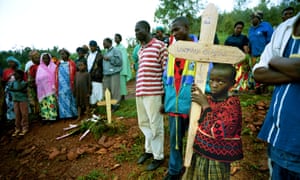
The funeral of a woman who died of Aids on the outskirts of Kigali, Rwanda. Photograph: Sean Smith for the Guardian
The initial goodwill, however, vanished when Kim announced his own structural adjustment: a top-to-bottom reorganisation of the bank. It wasn’t so much the idea of change that riled up the staff. Even before Kim took office, respected voices were calling for a shakeup. In 2012, a group of bank alumni published a report criticising an “archaic management structure”; low morale was causing staff turnover, and there was an overreliance on consultants, promotion on the basis of nationality, and a “Balkanisation of expertise”. Where Kim went awry, opponents say, was in imposing his will without first garnering political support. “One famous statement is that the World Bank is a big village,” says Cadario, now a Kim critic. “And if you live in a village, it is a really bad idea to have enemies.”
The bank had been designed around the idea that local needs, assessed by staff assigned to particular countries and regions, should dictate funding; cooperation across geographical lines required internal wrangling over resources. So Kim decided to dismantle existing networks. He brought in the management consulting firm McKinsey & Co, which recommended regrouping the staff into 14 “global practices”, each of which would focus on a policy area, such as trade, agriculture or water. Kim hired outsiders to lead some departments and pushed out several formerly powerful officials with little explanation. To symbolise that he was knocking down old walls, he had a palatial, wood-panelled space on the World Bank’s executive floor retrofitted as a Silicon Valley-style open-plan office, where he could work alongside his top staff.
Kim also announced that he would cut $400m in administrative expenses, and eliminate about 500 jobs – a necessary measure, he said, because low interest rates were cutting into the bank’s profits. Kim says he “made a very conscious decision to let anyone who wanted… air their grievances.” His opponents detected no such tolerance, however, and their criticisms turned ad hominem. Around Halloween in 2014, a satirical newsletter circulated among the staff, depicting Kim as Dr Frankenstein: “Taking random pieces from dead change management theories,” it read, “he and his band of external consultants cobble together an unholy creature resembling no development bank ever seen before.” Anonymous fliers attacking Kim also began to appear around bank headquarters.
Kim portrayed internal dissent as a petty reaction to perks such as travel per diems being cut. “There’s grumbling about parking and there’s grumbling about breakfast,” he told the Economist. Meanwhile, bank staffers whispered about imperial indulgences on Kim’s part, such as chartering a private jet. (Kim claims this is a longstanding practice among bank presidents, which he only uses when there are no other options.)
A French country officer named Fabrice Houdart emerged as a lead dissenter, broadcasting his frustrations with Kim in a blog on the World Bank’s intranet. In one post, he questioned whether “a frantic race to show savings… might lead to irreversible long-term damages to the institution.” (This being the World Bank, his sedition was often illustrated with charts and statistics.) The staff went into open rebellion after Houdart revealed that Bertrand Badré, the chief financial officer, whom Kim had hired and who was in charge of cutting budgets, had received a nearly $100,000 bonus on top of his $379,000 salary. Kim addressed a raucous town hall meeting in October 2014, where he told furious staffers, “I am just as tired of the change process as all of you are.”
A few months later, Houdart was demoted after being investigated for leaking a privileged document. The alleged disclosure was unrelated to Kim’s reorganisation – it had to do with Houdart’s human rights advocacy, for which he was well known at the bank – and Kim says the investigation began before Houdart’s denunciations of his presidency. Critics, however, portray it as retaliatory. “Fabrice has become a folk hero,” Cadario says, “because he was brave enough to say what many of the people within the bank are thinking.” (Houdart is currently disputing his demotion before an internal administrative tribunal.)
“It’s never fun when large parts of the organisation are criticising you personally,” Kim admits. Yet he maintains that his tough decisions were necessary. “In order to do a real change, you have to put jobs at risk,” he says. “And completely understandably, people hate that.”
In the heat of the staff revolt, Kim was devoting attention to a very different crisis: Ebola. In contrast with the bank’s historically cautious, analytical approach, Kim was pushing it to become more involved in emergency response. He committed $400m to confront the epidemic immediately, a quarter of which he pushed out in just nine days. He dispatched bank employees to afflicted west African countries and reproached the head of the WHO for the organisation’s lack of urgency. “Rather than being tied up in bureaucracy, or saying, ‘We don’t do those things,’ Jim is saying that if poor people’s lives are at risk… then it is our business,” says Tim Evans, whom Kim hired to run the bank’s new global practice for health.
Some bank veterans disagreed, vehemently. Nearly two years on, they still worry that in trying to save the day, Kim runs the risk of diverting the bank from its distinct mission. “Pandemic response is important – but it’s not the WHO, it’s the World Bank,” says Jean-Louis Sarbib, a former senior vice-president who now runs a nonprofit development consultancy. “I don’t think he understands the World Bank is not a very large NGO.” Referencing Kim’s work with Partners in Health, Sarbib adds, “The work of the World Bank is to create a system so that he doesn’t need to come and create a clinic in Haiti.”
In reply to this critique, Kim likes to cite a study co-written by a former World Bank economist, Larry Summers, that found that 24% of full-income growth in developing countries between 2000 and 2011 was attributable to improved public health. Put simply, Kim says, pandemics and other health deficits represent enormous threats to economic development, so they should be the World Bank’s business. The same goes for climate change, which the bank is fighting by funding a UN initiative to expand sustainable energy. As for violent conflicts, rather than waiting until the shooting has stopped and painstakingly preparing a post-conflict assessment – as the bank has done in the past – Kim wants to risk more capital in insecure zones.
“We… bought into this notion that development is something that happens after the humanitarian crisis is over,” Kim said at a recent event called the Fragility Forum, where he sat next to representatives of various aid groups and the president of the Central African Republic in the World Bank’s sun-soaked atrium. “We are no longer thinking that way.”
After the forum, amid a whirlwind day of meetings and speeches, Kim stopped at a hotel cafe with me to unwind for a few minutes. As a counterweight to his life’s demands, he practices Korean Zen-style meditation, but he also seems to blow off steam by brainstorming aloud. Goals and promises came pouring out of him like a gusher. Besides eliminating extreme poverty, which he has now promised will be done by 2030, Kim wants to raise incomes among the bottom 40% of the population in every country. He also wants to achieve universal access to banking services by 2020.
Long past our allotted interview time, Kim told me he had just one more idea: “Another huge issue that I want to bring to the table is childhood stunting.” At the Davos World Economic Forum this year, he explained, everyone was chattering about a “fourth industrial revolution”, which will centre on artificial intelligence, robotics and other technological leaps. But Kim thinks whole countries are starting out with a brainpower deficit because of childhood malnutrition. “These kids have fewer – literally fewer – neuronal connections than their non-stunted classmates,” he said. “For every inch that you’re below the average height, you lose 2% of your income.”
“This is fundamentally an economic issue,” he continued. “We need to invest in grey-matter infrastructure. Neuronal infrastructure is quite possibly going to be the most important infrastructure.”
To World Bank traditionalists, addressing nutrition is an example of the sort of mission creep that makes Kim so maddening. Despite its name and capital, the bank can’t be expected to solve all the world’s humanitarian problems. (“We are not the UN,” is an informal mantra among some staffers.) Poor countries may well prefer the bank to stick to gritty infrastructural necessities, even if Kim and his supporters have splashier goals. “The interests of its rich-country constituencies and its poor-country borrowers are diverging,” Pritchett says. “It’s like the bank has a foot on two boats. Sooner or later, it’s going to have to jump on one boat or the other, or fall in the water. So far, Jim Kim is just doing the splits.”
The initial goodwill, however, vanished when Kim announced his own structural adjustment: a top-to-bottom reorganisation of the bank. It wasn’t so much the idea of change that riled up the staff. Even before Kim took office, respected voices were calling for a shakeup. In 2012, a group of bank alumni published a report criticising an “archaic management structure”; low morale was causing staff turnover, and there was an overreliance on consultants, promotion on the basis of nationality, and a “Balkanisation of expertise”. Where Kim went awry, opponents say, was in imposing his will without first garnering political support. “One famous statement is that the World Bank is a big village,” says Cadario, now a Kim critic. “And if you live in a village, it is a really bad idea to have enemies.”
The bank had been designed around the idea that local needs, assessed by staff assigned to particular countries and regions, should dictate funding; cooperation across geographical lines required internal wrangling over resources. So Kim decided to dismantle existing networks. He brought in the management consulting firm McKinsey & Co, which recommended regrouping the staff into 14 “global practices”, each of which would focus on a policy area, such as trade, agriculture or water. Kim hired outsiders to lead some departments and pushed out several formerly powerful officials with little explanation. To symbolise that he was knocking down old walls, he had a palatial, wood-panelled space on the World Bank’s executive floor retrofitted as a Silicon Valley-style open-plan office, where he could work alongside his top staff.
Kim also announced that he would cut $400m in administrative expenses, and eliminate about 500 jobs – a necessary measure, he said, because low interest rates were cutting into the bank’s profits. Kim says he “made a very conscious decision to let anyone who wanted… air their grievances.” His opponents detected no such tolerance, however, and their criticisms turned ad hominem. Around Halloween in 2014, a satirical newsletter circulated among the staff, depicting Kim as Dr Frankenstein: “Taking random pieces from dead change management theories,” it read, “he and his band of external consultants cobble together an unholy creature resembling no development bank ever seen before.” Anonymous fliers attacking Kim also began to appear around bank headquarters.
Kim portrayed internal dissent as a petty reaction to perks such as travel per diems being cut. “There’s grumbling about parking and there’s grumbling about breakfast,” he told the Economist. Meanwhile, bank staffers whispered about imperial indulgences on Kim’s part, such as chartering a private jet. (Kim claims this is a longstanding practice among bank presidents, which he only uses when there are no other options.)
A French country officer named Fabrice Houdart emerged as a lead dissenter, broadcasting his frustrations with Kim in a blog on the World Bank’s intranet. In one post, he questioned whether “a frantic race to show savings… might lead to irreversible long-term damages to the institution.” (This being the World Bank, his sedition was often illustrated with charts and statistics.) The staff went into open rebellion after Houdart revealed that Bertrand Badré, the chief financial officer, whom Kim had hired and who was in charge of cutting budgets, had received a nearly $100,000 bonus on top of his $379,000 salary. Kim addressed a raucous town hall meeting in October 2014, where he told furious staffers, “I am just as tired of the change process as all of you are.”
A few months later, Houdart was demoted after being investigated for leaking a privileged document. The alleged disclosure was unrelated to Kim’s reorganisation – it had to do with Houdart’s human rights advocacy, for which he was well known at the bank – and Kim says the investigation began before Houdart’s denunciations of his presidency. Critics, however, portray it as retaliatory. “Fabrice has become a folk hero,” Cadario says, “because he was brave enough to say what many of the people within the bank are thinking.” (Houdart is currently disputing his demotion before an internal administrative tribunal.)
“It’s never fun when large parts of the organisation are criticising you personally,” Kim admits. Yet he maintains that his tough decisions were necessary. “In order to do a real change, you have to put jobs at risk,” he says. “And completely understandably, people hate that.”
In the heat of the staff revolt, Kim was devoting attention to a very different crisis: Ebola. In contrast with the bank’s historically cautious, analytical approach, Kim was pushing it to become more involved in emergency response. He committed $400m to confront the epidemic immediately, a quarter of which he pushed out in just nine days. He dispatched bank employees to afflicted west African countries and reproached the head of the WHO for the organisation’s lack of urgency. “Rather than being tied up in bureaucracy, or saying, ‘We don’t do those things,’ Jim is saying that if poor people’s lives are at risk… then it is our business,” says Tim Evans, whom Kim hired to run the bank’s new global practice for health.
Some bank veterans disagreed, vehemently. Nearly two years on, they still worry that in trying to save the day, Kim runs the risk of diverting the bank from its distinct mission. “Pandemic response is important – but it’s not the WHO, it’s the World Bank,” says Jean-Louis Sarbib, a former senior vice-president who now runs a nonprofit development consultancy. “I don’t think he understands the World Bank is not a very large NGO.” Referencing Kim’s work with Partners in Health, Sarbib adds, “The work of the World Bank is to create a system so that he doesn’t need to come and create a clinic in Haiti.”
In reply to this critique, Kim likes to cite a study co-written by a former World Bank economist, Larry Summers, that found that 24% of full-income growth in developing countries between 2000 and 2011 was attributable to improved public health. Put simply, Kim says, pandemics and other health deficits represent enormous threats to economic development, so they should be the World Bank’s business. The same goes for climate change, which the bank is fighting by funding a UN initiative to expand sustainable energy. As for violent conflicts, rather than waiting until the shooting has stopped and painstakingly preparing a post-conflict assessment – as the bank has done in the past – Kim wants to risk more capital in insecure zones.
“We… bought into this notion that development is something that happens after the humanitarian crisis is over,” Kim said at a recent event called the Fragility Forum, where he sat next to representatives of various aid groups and the president of the Central African Republic in the World Bank’s sun-soaked atrium. “We are no longer thinking that way.”
After the forum, amid a whirlwind day of meetings and speeches, Kim stopped at a hotel cafe with me to unwind for a few minutes. As a counterweight to his life’s demands, he practices Korean Zen-style meditation, but he also seems to blow off steam by brainstorming aloud. Goals and promises came pouring out of him like a gusher. Besides eliminating extreme poverty, which he has now promised will be done by 2030, Kim wants to raise incomes among the bottom 40% of the population in every country. He also wants to achieve universal access to banking services by 2020.
Long past our allotted interview time, Kim told me he had just one more idea: “Another huge issue that I want to bring to the table is childhood stunting.” At the Davos World Economic Forum this year, he explained, everyone was chattering about a “fourth industrial revolution”, which will centre on artificial intelligence, robotics and other technological leaps. But Kim thinks whole countries are starting out with a brainpower deficit because of childhood malnutrition. “These kids have fewer – literally fewer – neuronal connections than their non-stunted classmates,” he said. “For every inch that you’re below the average height, you lose 2% of your income.”
“This is fundamentally an economic issue,” he continued. “We need to invest in grey-matter infrastructure. Neuronal infrastructure is quite possibly going to be the most important infrastructure.”
To World Bank traditionalists, addressing nutrition is an example of the sort of mission creep that makes Kim so maddening. Despite its name and capital, the bank can’t be expected to solve all the world’s humanitarian problems. (“We are not the UN,” is an informal mantra among some staffers.) Poor countries may well prefer the bank to stick to gritty infrastructural necessities, even if Kim and his supporters have splashier goals. “The interests of its rich-country constituencies and its poor-country borrowers are diverging,” Pritchett says. “It’s like the bank has a foot on two boats. Sooner or later, it’s going to have to jump on one boat or the other, or fall in the water. So far, Jim Kim is just doing the splits.”
The World Bank headquarters in Washington. Photograph: Lauren Burke/AP
Kim’s defenders insist the bank hasn’t abandoned its core business. In fact, as private investment in emerging markets has contracted recently, due to instability in once-booming economies such as Brazil, countries have found more reasons to turn to the World Bank. Its primary lending unit committed $29.7bn in loans this fiscal year, nearly doubling the amount from four years earlier. “There is so much need in the world that I’m not worried we’re going to run out of projects to finance,” Kim says. He also hopes the worst of the tumult within the bank is over. A few elements of his reorganisation have been scaled back; after the new administrative structure proved unwieldy, the 14 global practices were regrouped into three divisions. Some of his more polarising hires have also left.
A five-year term, Kim says, is hardly sufficient to implement his entire agenda, and he has conveyed his desire to be reappointed in 2017. Though internal controversies have been damaging, and America’s domination of the bank remains a source of tension, the next US president (quite possibly Kim’s friend Hillary Clinton) will have a strong say in the matter. If he keeps his job, Kim wants to show that the World Bank can serve as a link between great powers and small ones, between economics and aid work – retaining its influence as old rules and boundaries are erased and new ones are scribbled into place.
Kim thinks he can succeed, so long as he keeps one foot rooted in his experiences as a doctor with mud between his toes. But he also wants to share his revelations about capital with his old comrades. “I really feel a responsibility to have this conversation with development actors who, like me 10 years ago, didn’t really understand the power of leverage,” Kim says with a guileless air.
“God,” he adds, “it is just such a powerful tool.”
Kim’s defenders insist the bank hasn’t abandoned its core business. In fact, as private investment in emerging markets has contracted recently, due to instability in once-booming economies such as Brazil, countries have found more reasons to turn to the World Bank. Its primary lending unit committed $29.7bn in loans this fiscal year, nearly doubling the amount from four years earlier. “There is so much need in the world that I’m not worried we’re going to run out of projects to finance,” Kim says. He also hopes the worst of the tumult within the bank is over. A few elements of his reorganisation have been scaled back; after the new administrative structure proved unwieldy, the 14 global practices were regrouped into three divisions. Some of his more polarising hires have also left.
A five-year term, Kim says, is hardly sufficient to implement his entire agenda, and he has conveyed his desire to be reappointed in 2017. Though internal controversies have been damaging, and America’s domination of the bank remains a source of tension, the next US president (quite possibly Kim’s friend Hillary Clinton) will have a strong say in the matter. If he keeps his job, Kim wants to show that the World Bank can serve as a link between great powers and small ones, between economics and aid work – retaining its influence as old rules and boundaries are erased and new ones are scribbled into place.
Kim thinks he can succeed, so long as he keeps one foot rooted in his experiences as a doctor with mud between his toes. But he also wants to share his revelations about capital with his old comrades. “I really feel a responsibility to have this conversation with development actors who, like me 10 years ago, didn’t really understand the power of leverage,” Kim says with a guileless air.
“God,” he adds, “it is just such a powerful tool.”
Subscribe to:
Posts (Atom)