Search This Blog

Sunday, 26 June 2016

The EU will treat Britain like Greece


Matthew Holehouse The Telegraph

I arrived in Brussels as the Daily Telegraph’s correspondent in early June, 2015. A fortnight later, Alexis Tsipras snubbed Brussels, and called a referendum on the third bailout that was designed to save the Eurozone from collapse.

The terms he was later given - €50bn of assets sold and a de facto control of economic policy surrendered - were so harsh they were later denounced as a "coup".

It taught me two things: that in the cause of its salvation the European Union can be profoundly flexible and exceptionally brutal, and that events can swiftly take a momentum that is hard to control.

Nothing of that experience gives me hope for the years that now await our country.

Britain is almost certainly out the European Union

As far as Brussels is concerned, Britain has left.

At home on Friday morning, Britons were dumbstruck, agog at the result, or chuffed at having taught Brussels a lesson.

We now see street protests to overturn the result, internet petitions, suggestions that the UK or Scottish Parliament could revoke it or somehow make it go away. Westminster is occupied by Labour coups and Tory successions. Few seem to believe we are going.

In Brussels, they have been ready to say goodbye for a long time. Britain had been half-way out the door for forty years. David Cameron had announced this referendum in January 2013. He had won an election on the back of it, and many expected him to lose it. He, and they, repeated many times that it was final and binding. Patience is exhausted.

On Friday there was grave sadness, but no panic. The timetable for the talks was announced days before the vote. Martin Schulz, the president of the Parliament, spoke at dawn; Donald Tusk, the president of the Council, delivered a statement at 07.40 GMT. The founding members' foreign ministers met on Saturday; sherpas for the 27 remaining states will meet today to sketch out the months ahead.

Leaders have demanded Article 50 is activated immediately, to create certainty. Realistically, Mr Cameron has until Christmas.

Scotland is ready to quit, and diplomats are quite open to welcoming them into the EU club.

The treaties say that all Britain’s rights and obligations must remain for two years once Article 50 is activated. But Lord Hill, Britain’s commissioner, quit yesterday, and Downing Street said it had no plans to replace him, and Jean-Claude Juncker told Ukip MEPs to pack their bags. Is the legal order fragmenting? What other clauses in the treaties - which protect British expats on the continent, among other things - will now be ignored without consequence?

Can it be halted?

The European Council has offered a narrow window, saying that Britain has not left until Article 50 is activated formally by the Prime Minister, “if it is indeed the intention of the British government.”

Mr Cameron has left it to his successor to activate it. Mrs Merkel is in no hurry. Senior EU sources say they can wait until Christmas, but prevarication would trash Britain's credit-worthiness.

There are two problems. Firstly, to not activate Article 50 would be a rejection of democracy on a scale that could only be described as a coup, and would poison British public life for generations.

Secondly, a wave of movements demanding referendums on the terms of membership, given a huge boost by Mr Cameron, is tearing across Europe – in France, Denmark, the Netherlands, Slovakia, Italy, Hungary. Marine Le Pen could well run rampant in French elections in the spring.

Leaders anticipated that Boris Johnson would pursue a 'vote leave for a better deal' strategy, and ruled it out from February, precisely to prevent this scenario.

Jean-Claude Juncker said on Friday: “The repercussions of the British referendum could quickly put a stop to such crass rabble-rousing, as it should soon become clear that the UK was better off inside the EU.” Britain simply has to go, on bad terms, pour encourager les autres.

Britain has very few friends

In European eyes, David Cameron has had a remarkably generous lot: already out the euro, ever closer union, justice and home affairs obligations and Schengen, he was offered an enhanced deal that confirmed the perks of membership with scant obligations.

Yet he attacked Brussels for years for domestic advantage. Mr Cameron campaigned hard against his appointment. Stories about Mr Juncker's alleged drinking and the war record of his father, a conscript in the Wehrmacht, emerged. Yet Juncker offered an olive branch by giving Jonathan Hill the financial services portfolio Mr Cameron craved, in order to preserve the City. He is profoundly angry.

In his brutal negotiation, Alexis Tsipras had a number of cards to play. There was the “solidarity” that EU states are obliged to show each other, the pity and guilt at the plight of the Greek people who had been punished through no fault of their own, and the €83 billion of German taxpayer cash in Greek banks that risked going up in smoke. Their referendum had been hasty, the question unclear, Mr Juncker said; Greeks made plain they wanted to remain Europeans.

No such goodwill exists for Britain, now an ex-member. Mr Johnson, the possible next prime minister, caused genuine and grave offence by likening the European project to the ambitions of Hitler. His declarations that Brexit will trigger events that unravel the entire project is, in effect, a declaration of war that must be met.

Recall how inflexible European leaders were during Mr Cameron’s attempted renegotiation, when he put a gun to their heads and threatened to leave unless they submitted to his demands. He has fired that gun in the air, and locked himself out the room. Britain’s only leverage is how much damage a messy Brexit would inflict on European economies.


Time is not on our side

Once Article 50 is activated, events will move frighteningly fast. It took Mr Cameron seven full months to secure his meagre renegotiation. He will have just two years to get an exit deal covering every facet of British life, and a trade deal that will do the least harm to the fragile, debt-laden economy.

The government is in disarray, the Labour party in meltdown, and the imminent exit of Scotland means it will be unclear with who or what, exactly, the EU is negotiating with. The French foreign minister yesterday implored Cameron to find a successor to take charge.

A ban issued from Downing Street on Brexit preparations – lest it boost the leave campaign – meant Britain’s most senior officials were permitted to “think” about a Brexit, but not allowed to write anything down.

Several take their guide from Flexcit, a book by a blogger Richard North that advocates a Norway-style deal as a half-way house under a “soft” exit. The crucial weeks ahead of polling day were spent in purdah, tending the garden.

The UK has next to no trade negotiators, and will need hundreds, to replicate the market access it currently has with 50 states around the world .

But the EU is ready. Talks in Jean-Claude Juncker’s in house think-tank began months ago. Foreign ministries have been preparing position papers. Lawyers are busy: Brussels has had 70 years of practice in writing treaties, signing trade talks, fixing accessions and bailouts, making and breaking nations.

We don't get to be Norway

The Leavers’ best hope – a Norway deal that means EEA status, retained rights for the City and immigration - is almost certainly off the table.

Britain has made clear it doesn’t want free movement – and so any deal on those grounds would be so impossibly fragile as to be a waste of time. Frankfurt and Paris would certainly like our banks. Mr Juncker is determined to undo Britain's attempt to create a multi-currency union, meaning clearing houses that trade in Euros and generate billions for the Exchequer will have to be domiciled in the Eurozone.

Leaders have made clear, before and after the vote, that Britain is not getting access to the single market.

“Out is out,” said Wolfgang Schaeuble, the German finance minister, some weeks ago.

“There will certainly be no cherry picking,” confirmed Mr Juncker, saying it will be a "clean" divorce.

More likely is a Canadian-style trade deal, that will set tariffs on imports and exports. That may be fine for German manufacturers. But Britain’s service economy will be cut up like an old car. British graduates are about to learn what it's like to use an Australian-style points system.

We do not control this process

Article 50 is designed so that it leaves any state that activates it is a supplicant.

The remaining EU states will negotiate between themselves and deal with the UK as one, just as they would for Albania or Turkey.

If a deal covering trade arrangements isn’t struck once the two-year period expires, Britain is simply released from the EU treaties and left on crippling WTO terms - something the Treasury terms a "severe shock scenario" and which it envisages would likely result in a cut in GDP of six per cent and increase unemployment by 800,000, not including the risks presented by emergency spending cuts, or the "tipping points" presented by the crystallisation of financial stability risks.

It means the government will effectively be forced to take any fait accompli presented at the last minute, or face ruin.

Even then, any further trade deal will require ratification by EU parliaments, meaning Belgian MPs, amongst others, can veto it.

The Leave campaign is fond of a quote attributed to Churchill: “Each time we have to choose between Europe and the open sea, we shall always choose the open sea.”

Oh, hear us when we cry to Thee, For those in peril on the sea.
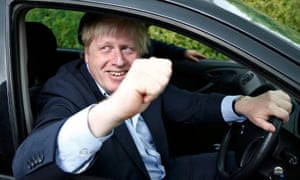
There are liars and then there’s Boris Johnson and Michael Gove

Nick Cohen in The Guardian


The Brexit figureheads had no plan besides exploiting populist fears and dismissing experts who rubbished their thinking


‘Prospered by treating public life as a game’: Boris Johnson leaves his home in Oxfordshire on Saturday. Photograph: Peter Nicholls/Reuters


Where was the champagne at the Vote Leave headquarters? The happy tears and whoops of joy? If you believed Boris Johnson and Michael Gove, the Brexit vote was a moment of national liberation, a day that Nigel Farage said our grateful children would celebrate with an annual bank holiday.

Johnson and Gove had every reason to celebrate. The referendum campaign showed the only arguments that matter now in England are on the right. With the Labour leadership absent without leave and the Liberal Democrats and Greens struggling to be heard, the debate was between David Cameron and George Osborne, defending the status quo, and the radical right, demanding its destruction. Johnson and Gove won a dizzying victory with the potential to change every aspect of national life, from workers’ rights to environmental protection.

Yet they gazed at the press with coffin-lid faces and wept over the prime minister they had destroyed. David Cameron was “brave and principled”, intoned Johnson. “A great prime minister”, muttered Gove. Like Goneril and Regan competing to offer false compliments to Lear, they covered the leader they had doomed with hypocritical praise. No one whoops at a funeral, especially not mourners who are glad to see the back of the deceased. But I saw something beyond hypocrisy in those frozen faces: the fear of journalists who have been found out.

The media do not damn themselves, so I am speaking out of turn when I say that if you think rule by professional politicians is bad wait until journalist politicians take over. Johnson and Gove are the worst journalist politicians you can imagine: pundits who have prospered by treating public life as a game. Here is how they play it. They grab media attention by blaring out a big, dramatic thought. An institution is failing? Close it. A public figure blunders? Sack him. They move from journalism to politics, but carry on as before. When presented with a bureaucratic EU that sends us too many immigrants, they say the answer is simple, as media answers must be. Leave. Now. Then all will be well.

Johnson and Gove carried with them a second feature of unscrupulous journalism: the contempt for practical questions. Never has a revolution in Britain’s position in the world been advocated with such carelessness. The Leave campaign has no plan. And that is not just because there was a shamefully under-explored division between the bulk of Brexit voters who wanted the strong welfare state and solid communities of their youth and the leaders of the campaign who wanted Britain to become an offshore tax haven. Vote Leave did not know how to resolve difficulties with Scotland, Ireland, the refugee camp at Calais, and a thousand other problems, and did not want to know either.

It responded to all who predicted the chaos now engulfing us like an unscrupulous pundit who knows that his living depends on shutting up the experts who gainsay him. For why put the pundit on air, why pay him a penny, if experts can show that everything he says is windy nonsense? The worst journalists, editors and broadcasters know their audiences want entertainment, not expertise. If you doubt me, ask when you last saw panellists on Question Time who knew what they were talking about.

Naturally, Michael Gove, former Times columnist, responded to the thousands of economists who warned he was taking an extraordinary risk with the sneer that will follow him to his grave: “People in this country have had enough of experts.” He’s being saying the same for years.

If sneers won’t work, the worst journalists lie. The Times fired Johnson for lying to its readers. Michael Howard fired Johnson for lying to him. When he’s cornered, Johnson accuses others of his own vices, as unscrupulous journalists always do. Those who question him are the true liars, he blusters, whose testimony cannot be trusted because, as he falsely said of the impeccably honest chairman of the UK Statistics Authority, they are “stooges”.

The Vote Leave campaign followed the tactics of the sleazy columnist to the letter. First, it came out with the big, bold solution: leave. Then it dismissed all who raised well-founded worries with “the country is sick of experts”. Then, like Johnson the journalist, it lied.

I am not going to be over-dainty about mendacity. Politicians, including Remain politicians lie, as do the rest of us. But not since Suez has the nation’s fate been decided by politicians who knowingly made a straight, shameless, incontrovertible lie the first plank of their campaign. Vote Leave assured the electorate it would reclaim a supposed £350m Brussels takes from us each week. They knew it was a lie. Between them, they promised to spend £111bn on the NHS, cuts to VAT and council tax, higher pensions, a better transport system and replacements for the EU subsidies to the arts, science, farmers and deprived regions. When boring experts said that, far from being rich, we would face a £40bn hole in our public finances, Vote Leave knew how to fight back. In Johnsonian fashion, it said that the truth tellers were corrupt liars in Brussels’ pocket.

Now they have won and what Kipling said of the demagogues of his age applies to Michael Gove, Boris Johnson and Nigel Farage.


I could not dig; I dared not rob:
Therefore I lied to please the mob.
Now all my lies are proved untrue
And I must face the men I slew.
What tale shall serve me here among
Mine angry and defrauded young?


The real division in Britain is not between London and the north, Scotland and Wales or the old and young, but between Johnson, Gove and Farage and the voters they defrauded. What tale will serve them now? On Thursday, they won by promising cuts in immigration. On Friday, Johnson and the Eurosceptic ideologue Dan Hannan said that in all probability the number of foreigners coming here won’t fall. On Thursday, they promised the economy would boom. By Friday, the pound was at a 30-year low and Daily Mail readers holidaying abroad were learning not to believe what they read in the papers. On Thursday, they promised £350m extra a week for the NHS. On Friday, it turns out there are “no guarantees”.

If we could only find a halfway competent opposition, the very populist forces they have exploited and misled so grievously would turn on them. The fear in their eyes shows that they know it.

How Corbyn could checkmate Farage and Johnson's Brexit plans

Paul Mason in The Guardian

In the progressive half of British politics we need a plan to put our stamp on the Brexit result – and fast.

We must prevent the Conservative right using the Brexit negotiations to reshape Britain into a rule-free space for corporations; we need to take control of the process whereby the rights of the citizen are redefined against those of a newly sovereign state.

Above all we need to provide certainty and solidarity to the millions of EU migrants who feel like the Brits threw them under a bus this week.

In short, we can and must fight to place social justice and democracy at the heart of the Brexit negotiations. I call this ProgrExit – progressive exit. It can be done, but only if all the progressive parties of Britain set aside some of what divides them and unite around a common objective.

The position of Labour is pivotal. Only Labour can provide the framework of a government that could stop Boris Johnson, abetted by Nigel Farage, turning Britain into a Thatcherite free-market wasteland.

Labour – and I mean here the 400,000 people with party cards and a meeting to go to – must go beyond the analysis and grieving stage, and do something new.

First, Labour must clearly accept Brexit. There can be no second referendum, no legal sabotage effort. Labour has to become a party designed to deliver social justice outside the EU. It should, for the foreseeable future, abandon the objective of a return to EU membership. We are out, and must make the best of it.

Next, we should fight for an early election. Almost all parts of the Labour movement have reason to resist this: for the Blairites it holds the danger that Corbyn will become PM – something they thought they had years to sabotage. For Corbyn, the nightmare is he gets stuck as a Labour prime minister with a Parliamentary Labour Party that does not support him. For the unions, they are out of cash. For the new breed of post-2015 activists, bruised by being told to eff off by what they assumed were their core supporters, it feels like a bad time to go back on the doorstep. But we must go there.

An early election – I favour late November – is the only democratic outcome in the present situation. No politician has a mandate to design a specific Brexit negotiation stance now. The only one with a democratic mandate to rule Britain just resigned, and his party’s 2015 manifesto is junk.

Europe cannot conduct meaningful Brexit negotiations with a scratch-together rump Tory government. So the whole process will be on hold.

In the election Labour should offer an informal electoral pact to the Scottish National Party, Greens and Plaid Cymru. The aims should be a) defeating Ukip and b) preventing the formation of a Tory-Ukip-DUP government that would enact the ultra-right Brexit scenario.

Caroline Lucas has indicated the price of such a pact might be a commitment to proportional representation. Labour – which cannot govern what is left of the UK alone, once Scotland leaves – should accede to this.

If, as a result of the snap election, Labour can form a coalition government with the SNP, Plaid and Greens, it should do so.

However, the most obvious problem is the position of Scotland. Nicola Sturgeon is right to demand a new independence vote, and to explore how to time that vote in a way that maintains Scotland’s continuous membership of the EU.

Given the strength of the remain vote in Scotland, Scottish Labour is faced with a big decision: does it oppose independence and go with Brexit to maintain the Union, or switch now to promoting independence to stay in the EU? I favour the latter, but it should be for Scottish Labour members to make that decision independently.

At Westminster, however, Labour should offer – in return for a coalition government – a no-penalty Scottish secession plan from the UK, funded and overseen by the Treasury and Bank of England.

Proportional representation, coalition government and Scottish independence were not in Labour’s game plan at 10pm on Thursday night. But neither was Brexit.

If the political ideas in your head, cultivated over a lifetime, rebel against all this, you must get used to it: with or without the help of the PLP, Scotland is headed out of the UK. But Labour has the opportunity to make that separation amicable; it will be obligatory for all progressive parties to ally with the Scots as – inevitably – the authoritarians of Ukip try to prevent Sturgeon’s second referendum.

As to what a Labour/SNP/Plaid and Green coalition would argue in the Brexit negotiations, the baseline has to be maintaining the existing progressive legislation on employment, consumer rights, women’s rights, the environment etc. But at the same time a Labour-led Brexit negotiation would have to drive a hard bargain over ending bans on state aid, or on nationalisation.

If it were possible to conclude a deal within the European Economic Area I would favour that. But the baseline has to be a new policy on migration designed for the moment free movement ceases to apply. It should be humane, generous, and led by the needs of employers, local communities and universities – and being an EU member should get you a lot of points.

But – and this is the final mindset shift we in Labour must make – free movement is over. Free movement was a core principle of the EU, developed over time. We are no longer part of that, and to reconnect with our voting base – I don’t mean the racists but the thousands of ordinary Labour voters, including black and Asian people – we have to design a migration policy that works for them, and not for rip-off construction bosses or slavedrivers on the farms of East Anglia.

Britain is not, as the far left peevishly dubbed it, “rainy, fascist island”: we’ve snatched glory from the jaws of ignominy in our history before now – but only when politicians have shown vision.

If they don’t show vision, we – the rank and file of Labour, the left nationalists and the Greens – who have way more in common than political labels suggest, should force them to unite and fight.

Britain’s Democratic Failure

Ken Rogoff

The real lunacy of the United Kingdom’s vote to leave the European Union was not that British leaders dared to ask their populace to weigh the benefits of membership against the immigration pressures it presents. Rather, it was the absurdly low bar for exit, requiring only a simple majority. Given voter turnout of 70%, this meant that the leave campaign won with only 36% of eligible voters backing it. (Editor's note - Governments change on similar votes in first past the post systems)

This isn’t democracy; it is Russian roulette for republics.
A decision of enormous consequence – far greater even than amending a country’s constitution (of course, the United Kingdom lacks a written one) – has been made without any appropriate checks and balances. 

Does the vote have to be repeated after a year to be sure? No. Does a majority in Parliament have to support Brexit? Apparently not. Did the UK’s population really know what they were voting on? Absolutely not. (Editor's note - Should they be denied the vote?) Indeed, no one has any idea of the consequences, both for the UK in the global trading system, or the effect on domestic political stability. I am afraid it is not going to be a pretty picture.

Mind you, citizens of the West are blessed to live in a time of peace: changing circumstances and priorities can be addressed through democratic processes instead of foreign and civil wars. But what, exactly, is a fair, democratic process for making irreversible, nation-defining decisions? Is it really enough to get 52% to vote for breakup on a rainy day?

In terms of durability and conviction of preferences, most societies place greater hurdles in the way of a couple seeking a divorce than Prime Minister David Cameron’s government did on the decision to leave the EU. Brexiteers did not invent this game; there is ample precedent, including Scotland in 2014 and Quebec in 1995. But, until now, the gun’s cylinder never stopped on the bullet. Now that it has, it is time to rethink the rules of the game.

The idea that somehow any decision reached anytime by majority rule is necessarily “democratic” is a perversion of the term.
 (Editor's note - What is democratic - listening to the minority view? - upper class angst?) Modern democracies have evolved systems of checks and balances to protect the interests of minorities and to avoid making uninformed decisions with catastrophic consequences. The greater and more lasting the decision, the higher the hurdles.

That’s why enacting, say, a constitutional amendment generally requires clearing far higher hurdles than passing a spending bill. Yet the current international standard for breaking up a country is arguably less demanding than a vote for lowering the drinking age.

With Europe now facing the risk of a slew of further breakup votes, an urgent question is whether there is a better way to make these decisions. I polled several leading political scientists to see whether there is any academic consensus; unfortunately, the short answer is no.

For one thing, the Brexit decision may have looked simple on the ballot, but in truth no one knows what comes next after a leave vote. What we do know is that, in practice, most countries require a “supermajority” for nation-defining decisions, not a mere 51%. There is no universal figure like 60%, but the general principle is that, at a bare minimum, the majority ought to be demonstrably stable. A country should not be making fundamental, irreversible changes based on a razor-thin minority that might prevail only during a brief window of emotion. Even if the UK economy does not fall into outright recession after this vote (the pound’s decline might cushion the initial blow), there is every chance that the resulting economic and political disorder will give some who voted to leave “buyers’ remorse.”

Since ancient times, philosophers have tried to devise systems to try to balance the strengths of majority rule against the need to ensure that informed parties get a larger say in critical decisions, not to mention that minority voices are heard. In the Spartan assemblies of ancient Greece, votes were cast by acclamation. People could modulate their voice to reflect the intensity of their preferences, with a presiding officer carefully listening and then declaring the outcome. It was imperfect, but maybe better than what just happened in the UK.

By some accounts, Sparta’s sister state, Athens, had implemented the purest historical example of democracy. All classes were given equal votes (albeit only males). Ultimately, though, after some catastrophic war decisions, Athenians saw a need to give more power to independent bodies.

What should the UK have done if the question of EU membership had to be asked (which by the way, it didn’t)? Surely, the hurdle should have been a lot higher; for example, Brexit should have required, say, two popular votes spaced out over at least two years, followed by a 60% vote in the House of Commons. If Brexit still prevailed, at least we could know it was not just a one-time snapshot of a fragment of the population.

The UK vote has thrown Europe into turmoil. A lot will depend on how the world reacts and how the UK government manages to reconstitute itself. It is important to take stock not just of the outcome, though, but of the process. Any action to redefine a long-standing arrangement on a country’s borders ought to require a lot more than a simple majority in a one-time vote. The current international norm of simple majority rule is, as we have just seen, a formula for chaos.