A 35-year-old needs to invest £125,000 to earn a pension of £35,000 when the interest rate is 5 per cent. If it's 2 per cent, they'll need to save £400,000.
Andreas Whittam Smith in The Independent
I could hardly believe that a politician would blame low interest rates for the success of a far right political party. Least of all that it would be the eminently sensible Wolfgang Schäuble, Germany’s minister of finance, who has held office since 2009. Yet earlier this month he publically blamed the cheap money policy of the European Central Bank (ECB) for contributing to the rise of the country's right-wing anti-immigration party, Alternative for Germany (AfD).
“I told Mario Draghi (president of the ECB),” said Mr. Schäuble, “be very proud: you can attribute 50 per cent of the results of a party that seems to be new and successful in Germany to the design of this policy.”
Founded only in 2013, the AfD has recently gained representation in eight German state parliaments.
In explanation, the transport minister, Alexander Dobrindt, toldDie Welt newspaper: “The ECB is following a very risky course. The disappearance of interest rates creates a gaping hole in citizens’ old age preparations.”
There is the connection. The older generations, who often dislike immigration, have also found that a lifetime of careful saving has brought them little reward. No wonder they make their protest by voting for an anti-immigration party.
Note that Mr. Dobrindt referred to “the disappearance of interest rates”. That hasn’t yet happened here. But it is still a shock, however, to discover how meagre they are. Go into Barclays, for example, and you will find that the bank will give you 0.25 per cent per annum on sums of less than £25,000. So you place £20,000 for a year and you earn – £50 in interest.
At least this is a positive rate. But if you are a citizen of the Eurozone, or of Japan, or of Sweden, or of Switzerland or Denmark, a group of countries that account for one quarter of the world economy, the situation is even worse. There the banks are actually charging customers for the privilege of depositing money with them. In other words, interest rates are negative. You don’t get your £20,000 back, but a mere £19,950.
It isn’t only German politicians who are concerned about low or negative interest rates. This week Larry Fink, the chief executive of the investment managers Blackrock, which looks after more funds than any other firm, revealed his disquiet in an annual letter to shareholders.
Fink said that the adoption of negative interest rates was “particularly worrying”. He commented that investors were being forced to take on more risk in order to obtain higher returns. And this often meant that they had to sacrifice the certainty that they could find buyers when they wanted to sell their assets. Fink rightly calls this ‘a potentially dangerous combination for retirement savers’.
But what about people, for instance, in their thirties and saving up for retirement. Fink gives this chilling calculation. A 35-year-old looking to generate an income of £35,000 per year for a retirement beginning at age 65 would need to invest £125,000 today in a 5 per cent interest rate environment. In a 2 per cent interest rate environment, however, that individual would need to invest £400,000 (3.2 times as much) to achieve the same outcome when he or she stops working.
If the disadvantages of low interest rates are so daunting, what then are the supposed advantages? That is matter that will be debated at the IMF’s annual spring meetings this week in Washington.
Three officials have written a blog that seeks to balance the pros and cons. They “tentatively” conclude that, overall, negative interest rates help deliver additional monetary stimulus and easier financial conditions, which support demand and price stability. But, they add, “there are limits on how far and for how long negative policy rates can go.” I call that lukewarm support.
In fact, taking together the reservations expressed above and the analysis presented by the IMF paper, the drawbacks of low or negative interest rates fall into three groups.
First, savers may prefer physical cash to bank deposits, which is bad for economic activity. The IMF paper discusses using bank vaults or non-bank vaults for holding cash safely. Second, the policy may encourage excessive risk taking both by banks and by individuals. And third, as the IMF comments, if low or negative rates persist they could undermine the viability of life insurance, pensions and other savings vehicles.
The truth is that governments no longer have the means to revive economic activity. Gimmicks such as negative interest rates could easily do as much harm as good.
Coca-Cola, Walt Disney, Alphabet (Google) and Goldman Sachs all implicated in Oxfam report.
Hazel Sheffield in The Independent
 Coca-Cola is among the companies named by Oxfam
The 50 biggest US companies have more money stashed offshore than the entire GDP of Spain, Mexico or Australia, collectively keeping about $1.3trn (£0.91trn) in territories where the money does not count towards US tax, according to a new report by Oxfam.
The revelations come after the European Commission announced plans to make big companies more transparent about where they pay tax. The charity said the Commission's proposals are “almost useless” for identifying where tax avoidance may be happening. It urged the UK Government to push for stronger rules to ensure that companies pay tax in all countries where they do business.
Robbie Silverman, Senior Tax Advisor at Oxfam, said that tax avoidance in the US will have a knock-on effect in countries around the world.
“The same tricks and tools used by multinational companies to dodge tax in the US are being used to cheat countries across the world out of their fair share of tax revenues, with devastating consequences,” he said.
“Poor countries are particularly hard hit, losing an estimated $100bn a year to corporate tax dodgers. This is enough to provide safe water and sanitation to more than 2.2 billion people,” he added.
In its investigation into the US tax system, Oxfam revealed some of the offshore accounting practices of the biggest companies in the US. Fifty companies including Coca-Cola, Walt Disney, Alphabet (Google) and Goldman Sachs keep a total of about $1.3trn in subsidiary companies registered all over the world, Oxfam says.
The Independent has contacted the companies named above for comment. Goldman Sachs declined to comment, the others did not respond.
The 50 companies are believed to have earned $4trn in profits globally from 2008-2014, but paid only 26.5 per cent of this in tax in the US, below the country’s statutory tax rate of 35 per cent. They rely on an opaque and secretive network of more than 1,600 disclosed subsidiaries in tax havens to stash about $1.3trn offshore, Oxfam said. It added that other offshore subsidiaries may be in use but under the radar of the Securities and Exchange Commission, because of weak reporting requirements.
These same 50 companies collectively received $27 in federal aid-like loans, loan guarantees and bailouts for every $1 they paid in federal taxes, amounting to a total of $11.2 trillion, Oxfam said.
Charities including Oxfam and Christian Aid have dismissed European Commission proposals to crack down on tax dodging as “close to pointless”. Christian Aid said new rules would allow “dodgy business as usual”.
Under EC proposals, companies would have to report profits and pay taxes in the EU and certain so-far undisclosed tax havens.While campaigners have lobbied for country-by-country reporting of taxes and profits, the proposed versions is so limited that it would not do the job, charities say.
“Unless companies have to report on their activities in all the countries where they operate, they could continue to dodge tax on a massive scale, using the places still hidden from view,” said Toby Quantrill, Chrisian Aid’s tax justice expert.
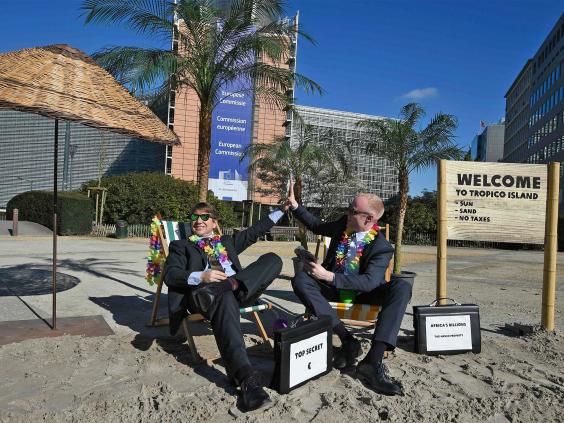
An protest by Oxfam outside the European Commission headquarters in Brussels earlier this week (Getty)
Campaigners have long asked for country-by-country reporting of tax affairs but the latest EC proposals are only a limited version of the rule. A previous tax haven blacklist put together by the European Commission in 2015 was withdrawn after it failed to include key countries like Luxembourg.
The latest European Commission proposals come in the wake of a huge data leak from a law firm in Panama that provided evidence of the true scale of offshore banking by the world’s super rich, including many current and former world leaders. Oxfam described the exploitation of tax loopholes as an “integral component” of the profit-making strategies of many multinational corporations.
Tax avoidance comes in many forms. Companies have reported up to $2 trillion of profits as “permanently reinvested” abroad, meaning it is not accountable for tax in the US. Some of the companies The Independent spoke to said that they still pay high taxes in the countries where the subsidiaries are registered. This practice can help them reduce their US tax bill because companies receive a dollar-for-dollar credit for any amount of tax they pay to other countries.
Oxfam, Christian Aid and Action Aid have said that in order to create a fairer tax system, companies must publically report revenues and taxes, publically declare any subsidiaries in tax havens and publically reveal how much money they spend on lobbying politicians.
The idea of a universal basic income is about to leap from the margins to the mainstream, bringing promises of a happier and healthier population

With a basic income, the harsh, punitive model of ‘welfare’ is a distant memory – passing in and out of the gig economy is something everyone can afford. Photograph: David Pearson/Alamy
John Harris in The Guardian
Imagine a Britain where the government pays every adult the basic cost of living. Whether rich or poor – or, crucially, whether you’re in paid employment or not – everyone gets the same weekly amount, with no strings attached. The harsh, punitive model of modern “welfare” is a distant memory; passing in and out of employment in the so-called gig economy is now something everyone can afford. The positive consequences extend into the distance: women are newly financially independent and able to exit abusive relationships, public health is noticeably improved, and people are able to devote the time to caring that an ever-ageing society increasingly demands. All the political parties are signed up: just as the welfare state underpinned the 20th century, so this new idea defines the 21st.
Welcome to the world of a unconditional basic income, or UBI, otherwise known as citizens’ income or social wage. It might look like the stuff of insane utopianism, but the idea is now spreading at speed, from the fringes of the left into mainstream politics – and being tried out around the world. The UK Green party has supported the notion for decades: staunch backing for a version of UBI was one of its key themes at the last election. At its spring conference last month, the Scottish National party passed a motion supporting the idea that “a basic or universal income can potentially provide a foundation to eradicate poverty, make work pay and ensure all our citizens can live in dignity”. A handful of Labour MPs have started to come round to the idea – and serious work is being done among thinktanks and pressure groups, looking at how it might work in the here and now.
Meanwhile, there have been UBI-type policies and experiments in India and Brazil. These have suggested that, contrary to modern stereotypes about “welfare” sapping people’s initiative, a basic income might actually increase people’s appetite for work, by adding to their sense of stability, and making things such as childcare and transport more accessible. A pilot of a UBI-ish policy whereby people on benefits are paid unconditionally is happening in Utrecht, in the Netherlands; other Dutch towns and cities look set to follow its example, and there are plans to pilot a more ambitious kind of basic income in Finland. On 5 June, the Swiss will vote in a referendum on a plan that would see all adults receive about £1,700 a month, with an extra £400 for each child.
And then there is the rising noise from Silicon Valley. The California-based startup incubator Y Combinator has announced that it wants to fund research into UBI’s viability. Its president, Sam Altman, says: “It is impossible to truly have equality of opportunity without some version of guaranteed income.” In New York, the influential venture capitalist Albert Wenger has been sounding off about a basic income for at least three years, claiming it offers an answer to a very modern question. If, as he says, “we are at the beginning of the time where machines will do a lot of the things humans have traditionally done”, how do you avoid “a massive bifurcation of society into those who have wealth and those who don’t”?
This Saturday, thousands of people are expected in central London for the latest demonstration organised by the anti-austerity alliance the People’s Assembly. The top-line is pretty much as you would expect. “End austerity now” is the big slogan, accompanied by four key words: “health, “homes”, “education” and, of course, “jobs”. But there too will be noise about UBI. A group called Radical Assembly, founded last May, is organising what it terms the No Jobs bloc: a subsection of the march for people sick of the daily grind, looking ahead to a world without it and convinced that technology is the answer. As they see it, the point shouldn’t be to argue for more, or better work, but to demand a world with very little paid work at all – and the key way to make that vision work is a basic income.
The idea cuts straight to the heart of the crisis being experienced by mainstream leftwing parties across Europe and beyond. For the UK Labour party, the concept of a basic income raises a painful question: how can you carry on styling yourself as the party of workers when traditional work is disappearing fast?

If the machines take all the jobs, we’ll need to disentangle the link between work and wages. Photograph: Bloomberg/Getty Images
As well as books such as Guy Standing’s The Precariat: The New Dangerous Class(2011) and Paul Mason’s Postcapitalism (2015), one recent text is talked about more than most among people interested in UBI. Inventing the Future was published last year and has already created significant buzz in leftwing circles; its two authors, Alex Williams and Nick Srnicek, will be appearing at this year’s Glastonbury, and their work is the key inspiration behind what Radical Assembly have planned for this Saturday. The No Jobs bloc, in fact, echoes the slogans printed in bold type on the book’s cover: “Demand full automation, demand universal basic income, demand the future.”
Srnicek, 33, is from Canada: he came to the UK in 2009, and works as a freelance academic in London. He says he’s both thrilled and surprised by the idea of people marching in favour of what he and Williams advocate. “I’ve heard about the No Jobs bloc, and it sounds great,” he says.
As he explains, the concept of a basic income has been doing the rounds for centuries, and has been voiced by such people as the 18th-century radical Thomas Paine, Martin Luther King, and the free-market guru Milton Friedman. In the US, the Nixon administration of the 1970s had plans for a rightwing version that nearly made it into law. Meanwhile, between 1968 and 1978, the US government did a series of experiments with a basic income in such places as New Jersey, Seattle and Denver, Colorado. It was also tried in the small Canadian town of Dauphin, Manitoba. Although it took years for the research findings to be published, they suggested that among the results had been a drop in hospital admissions, and a rise in the number of teenagers staying on in school.
This tangled history contains a few warnings about different political conceptions of the UBI idea. “The right tends to see it as a replacement for the welfare state,” says Snircek. “Basically, in their conception, UBI is a way to do away with benefits and marketise everything. And, obviously, that has to be warded off completely.”
He says he also has concerns about interpretations of the idea from some parts of the political left. “UBI has to be universal: it has to apply to everybody,” he says. “It’s problematic for some people that it includes the rich as well, but universal benefits have a political power that means-tested benefits don’t. It has to be unconditional. It can’t be means-tested. Everybody gets it, no matter what.
“The other aspect is, it should be as a high as possible. It can’t just be some middling level, like the Green party was proposing at the last election.” Their idea, he explains, was to pay everyone around £72 a week, roughly the same level as Jobseekers’ Allowance. “That would help people, but they would still have to go out and find a 40-hour job to survive, so it doesn’t do any of the political things that are so important.”
As Inventing the Future explains, these include boosting people’s bargaining power with employers, and UBI’s distinct feminist aspect: “One of my favourite stories from the experiments with UBI in Canada and the US is that they found that divorces went up. Women had suddenly got financial independence to leave bad and abusive relationships.”
The big theme that sits under Srnicek and Williams’s ideas is that of automation, and its effects on the place of work in our lives. A third of jobs in UK retail are forecast to go by 2025. The Financial Times recently reported on research predicting that 114,000 jobs in British legal sector would be automated over the next 20 years. As and when automation reaches transport, all this could turn nuclear. Recent estimates have put the number of jobs in the US related to traditional trucking at 8.7m – which, when people are talking about automated haulage (in last month’s budget, for example, George Osborne promised trials for driverless lorries), gives a sobering sense of how huge the future changes to paid work could be.
“The technology we’re talking about today is really touching on areas that we thought were always going to be the preserve of humans: non-routine tasks, things like driving a car – but then also the automation of basic social interaction, like call-centre work, customer service work and all that kind of stuff,” says Srnicek. “A lot of jobs are going to be taken, possibly at a very rapid pace. That means that, even if it doesn’t lead to mass unemployment, automation leads to a massive shift in the labour market, and people having to find new jobs and new skills.”
How long does he think it will be before UBI becomes a credible part of mainstream politics?
“Well, I do think this is a longterm project; it’s not going to happen overnight,” he says. “You need to build it up over time. And you also need to find new revenues for it. So you need to be talking about the Panama Papers and tax havens, and how you’re going to claw back tax revenues to pay for it.” The basic point is that something as ambitious as a basic income that allows people meaningful choices is going to cost, and the only way of bringing in the funds chimes with our rising concerns about tax avoidance and evasion – and, for that matter, global inequality and the fragile job markets that increasingly sit under it.
The key point, he says, is context: putting UBI alongside other plans and proposals, so as to flesh out the idea of a world beyond work, and what it would mean. “One big thing would be reducing the working week,” he says. “My preference is to implement a three-day weekend. We already have that in certain cases, because of bank holidays. We’re already used to it. And everybody always really enjoys it. That could plausibly be done in the next five years.”
Friday or Monday?
“I think we’ve got such a hate for Monday, that might be something we need to hold on to. So, maybe Friday.”

Caroline Lucas: UBI is ‘a deeply radical idea in terms of its feminist potential, and what we do in a world in which more and more work is going to be automated.’ Photograph: Action Press/Rex/Shutterstock
The Greens’ sole MP, Caroline Lucas, is a fan of Inventing the Future: “I love the way they talk about a basic income as something really transformative,” she says. She recently tabled an early-day motion in the House of Commons about UBI. Thirty-two MPs signed up to it: 23 from the SNP, with six from Labour, and two from Northern Ireland’s SDLP. The Tories and Lib Dems were conspicuous by their absence.
“This idea works on so many levels,” she says. “It’s a very practical policy, in terms of ensuring that people don’t fall between the cracks of the welfare system. But it’s also a deeply radical idea in terms of its feminist potential, and what we do in a world in which more and more work is going to be automated. It also gets you into a sense of contributing to your community, cleaning up the beach, visiting an elderly friend who might be lonely. There’s a whole freedom and liberation that it gives you, and I think it takes you into really deep questions about whether we really exist simply to spend a third of our lives working for someone else.”
If all that sounds rather high-flown, she also emphasises the hard work that is being done on UBI’s basic economics. In this context, she mentions Compass (the pressure group that includes Greens, Labour members, and many people with no party attachment) and the RSA, formally the Royal Society for the Encouragement of Arts, Manufactures and Commerce, whose basic-income proposal was published in December 2015.
Its author was Anthony Painter, the RSA’s director of policy and strategy. He says a lot of his initial interest in UBI came from his work on the board of an FE college in Hackney, east London, and the way that the local job centre took money from people who were going on its courses, so as to kick them into jobs instead. “This seemed to be the tip of an iceberg of a system that had gone haywire,” he says. So it was that in the spring of 2014, he began looking in depth at the various experiments with a basic income down the years, and how the idea might work in the 21st century. “Our starting point was, how do people get economic security, and why’s the current system going wrong?”
His favourite example of a basic income is the model tried in Manitoba, and what happened as a result. “What was really interesting about it was the wider benefits of a basic income, in terms of health, education, kids staying in education for longer, better mental health and fewer hospital visits,” he says. “Whereas now, our entire conversation about welfare has been narrowed down to a single question: is someone in work, or not in work?”
The RSA proposed an annual UBI of £3,692 for everyone aged between 25 and 65, rising to £7,420 for pensioners. There would also be a temporary basic income for children up to four years old of £4,290 for a family’s first child, falling to £3,387 for other children as they come along, and down to £2,925 for all between the ages of 5 and 25. For people without kids, that would put the weekly UBI at £77 a week. Is that really enough?.
Matthew Taylor is the RSA’s chief executive. Between 2003 and 2006, he headed Tony Blair’s Downing Street policy unit. He’s more sceptical about the looming future of automation than some, but still thinks a basic income is the best route to greater security in an insecure economy. When I mention the argument that less than £80 a week is a rather small amount, he sighs.
“Let’s establish the principle and see that the world doesn’t collapse,” he says. “Then, by all means, if it does work and it does lead to a better society, there’s no reason why it shouldn’t grow. You’ve got to be practical about this. But let’s start the argument in a place where we’re most likely to win.”
Talking to this former Downing Street insider about such a cutting-edge idea feels like proof in itself of how far the idea of a basic income has come. He says the fact that UBI is now discussed all over the left of politics and beyond is proof of how much everything is in flux, from the basics of the economy to the fundamentals of politics. This is an age in which ideas can quickly whizz from the radical fringes to the centre of political debate.
“There was a slightly kind of anally retentive obsession that people like me used to have when I was involved in New Labour – that if you float a dangerous idea, it’s kind of terminal for you,” says Taylor. “But I don’t think people feel like now. I think things can move much faster. And a basic income is one those things where if the argument was made in the right way, all the assumptions we have about how people would react could be blown away pretty quickly.”
Asher Edelman in The Guardian
The potential for a depression looms on the horizon. The Vermont senator is the only candidate who can stop banks from spiraling out of control again

‘Bernie Sanders is the only independent candidate who escapes the malaise of being bought.’ Photograph: Allstar Picture Library
Banking is the least understood, and possibly most lethal, of all the myriad issues at stake in this election. No candidate other than Bernie Sanders is capable of taking the steps necessary to protect the American people from a repeat of the recent debacle that plunged the nation into a recession from which we have not recovered.
The potential for a depression looms heavily on the horizon. As a trained economist who has spent more than 20 years on Wall Street – and one of the models for Gordon Gekko’s character – I know the financial system is in urgent need of regulation and responsibility. Yet Hillary Clinton is beholden to the banks for their largesse in funding her campaign and lining her pockets. The likelihood of any Republican candidate taking on this key issue is not even worthy of discussion.
The recession of 2007-2016, and the persistent transfer of wealth from the 80% to the 1% is, mostly the result of banking irresponsibility precipitated by the repeal of the Glass-Steagall Act in 1999. The law separated commercial banking (responsible for gathering and conservatively lending out funds) from investment banking (more speculative activities).
A new culture emerged that rewarded bankers for return on equity rather than sound lending practices. The wild west of risk-taking, staked on depositors’ money, became the best sport in town. Why not? If management won, they got rich. When they lost, the taxpayer took on the responsibility. If that sounds like a good wager, it was (and is).
The only problem is what happens when the music ends. Debt-to-capital ratios for investment banking functions rose from 12:1 to 30:1. Options on derivatives on other derivatives increased that leverage many fold. Self-regulation became the rule and, lo and behold, in 2008: crash. America and the world were nailed by a fastball from which the bottom 80% of the American population has yet to recover.
Remarkably, today the derivatives positions held by the large banks approach 10 times those of 2007-2008. In four banks alone, they exceed the GDP of the entire world. This is the interesting consequence when unchecked risk management rests in bankers’ hands.
When Clinton repealed Glass-Steagall, it was the culmination of the largest ever lobbying effort by the banking community to that date, $300m spent to convince Congress that Clinton, aided by Robert Rubin (US treasurer, previously with Goldman Sachs) and Alan Greenspan, a Milton Friedman-style supply-side economist, that the restraints on speculation should be removed. The banking community’s gratitude was and is unending. Who can blame them?
Wait, there’s more. After the collapse of 2008, the Federal Reserve invested more than $15tn to save the banks under the guise of monetary stimulation. At the same time, little or no funds were channeled to the needs of the American people. Yet today we face another crisis of liquidity. This time Europe will break first, followed by their highly leveraged US colleagues. Meanwhile, the bottom 80% of Americans remain mired in a recession, having seen no increase in their incomes during the last 20 years.
Poverty is at its highest level since the 1930s (in some areas of the country, higher). More than 30% of all children live with families subsisting below the poverty level. Employment is at a new all-time low (the percentage of employed persons is at about 49%, having been at more than 52% prior to 2008).
The average American is entitled to more. Only Bernie Sanders is committed to honest solutions to these problems. The way to avert the next banking crisis is the most clear. Assuming a Republican Congress, which would prevent the reinstatement of Glass-Steagall, Bernie has only to turn to regulation and responsibility.
Dodd-Frank provides the necessary structure with which to begin. Enforce it. Put teeth into bank regulation. Determine the acceptable level of risk at which banks can operate. Make management, not underlings or stockholders, responsible for violating the law. Encourage the Justice Department to be clear in seeking appropriate penalties for financial crimes in large institutions, not by fines alone but by the prosecution of those executives responsible.
Split up the banks that are speculating with depositor and government funds. Investment banks are supposed to risk investors’ money but commercial banks should return to lending fairly and carefully to help create a foundation for future growth. Bernie Sanders is the only independent candidate who escapes the malaise of being bought. He is paid for by the people and represents their interests. And you can take that to the bank.