Search This Blog

Tuesday, 20 October 2015

The wild animal of batting

Jarrod Kimber in Cricinfo

There are batsmen you can explain, whose magic you can unravel. Virender Sehwag was not one of them
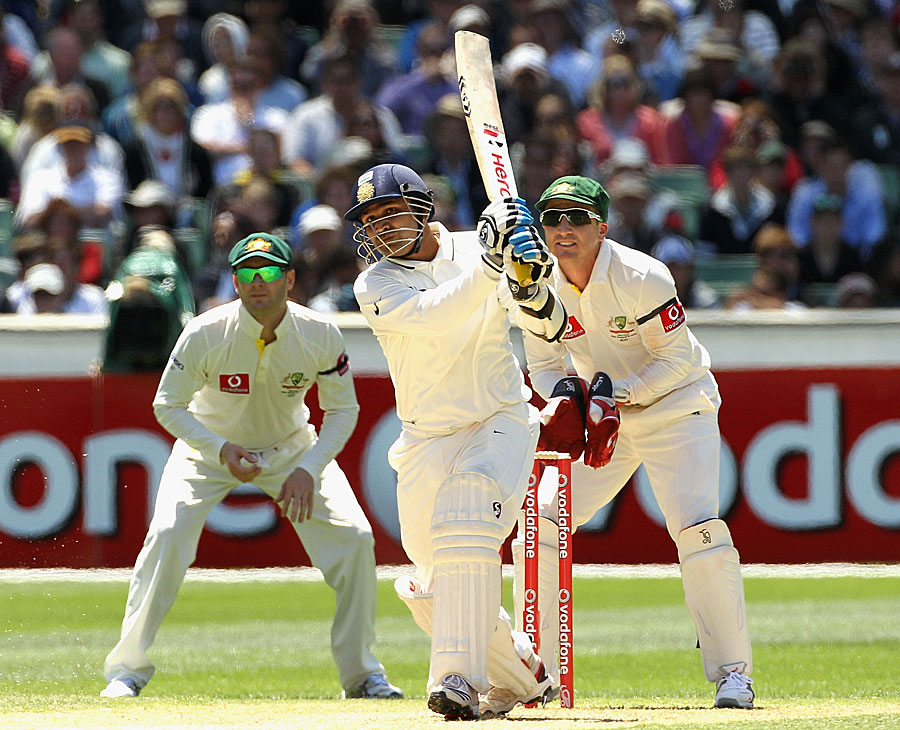

Sehwag: an experience that grabs you © Getty Images


There is a flash. It's up and over a bunch of slips, maybe a gully, and a third man. The ball just disappears up, out of sight, before dropping over the rope. The third man is puffing hard, but this wasn't for him. There is a frustrated, faceless bowler, an unspecified ground and a generic captain rubbing his forehead.

As it happens you can hear whispers of the batsman being compared to Sachin. But that is unfair. This is something different.

There are some things that shouldn't be explained. Maybe that's why we don't get Victor Trumper. We search for answers, facts, numbers and reasons. For some people that doen't work; you have to see them, feel them. They are part of a time and place you don't get. You are not meant to understand what they stood for, just know that it was something special through all the witnesses.

Yet, even when you weren't there, you had no context, no visuals, no memories, no experience; he could still move you. Sometimes it was the actual numbers alone. Just starting at a scorecard, there was an experience of him that just grabs you. The man who wore no number, could with a simple 200 out of 330, give you a sudden rush of blood, that slight, magical dizzy feel of something you can't quite explain.

There are some who say he only makes runs on Asian flat tracks. It feels like abusing a painter for preferring to use canvas instead of wanting to paint a live shark. What he created with the flat tracks was unlike what anyone else would, or could. There were times when he scored that it felt like Asia had been created just so he would have this stage.

There is a flash over the leg side. It's a drop-kick, a pick-up, a smack. The bowler is just an extra, a vessel. The ball goes over a rope, a fence, some spectators, a hill. It hits a scoreboard. Maybe it goes over it. Maybe it disappears into the distance. Maybe it explodes the scoreboard like you see in them Hollywood baseball films. The whole thing happened like it was preordained, like it was supposed to happen that way, and that time, for some secret reason.

He just stands there. Looking generally disinterested. People around the world are yelling, jumping, screaming, laughing. Mouths are wide open, jaws are on the floor. But he doesn't react that way. He almost never does.

There is a flash outside off. The bat has missed the ball. Yet the same general look of disinterest and calmness he has after a boundary follows a play and miss. Other days he uses the same smile after his best shot, or his worst.

Playing and missing is supposed to be a test of who you are as a human being. Do you believe in luck, do you believe in hard work, do you believe in faith? In his case, none of these applied.
As to whether the ball went into a scoreboard, into a crowd, onto a roof, or safely nestled in the keeper's gloves, it was gone. Finished. That moment, that euphoria, that danger, doesn't matter anymore. The greatest legcutter, the sexiest doosra, or a mystery ball fired from a cannon, it doesn't matter. It could be a long hop. A full toss. It just goes past him. When you bowled to him, you weren't bowling to a batsman; you were bowling to a belief system.

There was comfort in his madness. Others have stopped, slowed, changed, restricted, just to survive, to thrive, to score all that they could score. Not him. Maybe he just couldn't slow down, couldn't hold back. He was what he was, a wild animal of batting.

There is a flash through point. It seems to exist on his bat and at the boundary at the same time. It was a cut but could have been a drive. They all went the same way, just as fast. Before the commentator has had time to react, the bowler has placed his hands on his head or the crowd is fully out of their chairs, the ball's journey has been completed.

Maybe it's Chennai. Maybe it's Melbourne. Maybe it's Lahore. Maybe it's Galle. Maybe It's Steyn. Maybe it's Ahktar. Maybe it's McGrath. Maybe it's Murali. It's all too quick. He's already moved on.

There are people who say he is just a slogger. That's a misunderstanding of slogging. Sloggers throw the bat recklessly without a method or a base. They always run out of luck, out of time, are found out. This was Zen slogging. He has a slogger's energy, a batsman's eye, and a tranquil mind. It's an odd combination. It shouldn't work. It didn't always.

But when it did, the innings was something that changed things. He could, when applied correctly, change the future. At other times, it was as if he could predict it. And if he didn't change the future of batting, he, at the very least, foretold it.

There are batsmen you can explain. You can unravel their magic; paint it for others to see. But he was above explanation. You couldn't unravel what he did, you simply had to reclassify it. His batting wasn't from the manual. It wasn't like the others.

If anything, it was a self-help manual, a religious text, wrapped up in cover drives. A road map for better living was right there in the middle of the ground. Play your shots, forget your mistakes, forget your success, keep playing your shots. Believe. Sehwagology.

There is a flash back past the bowler. There is someone, somewhere, stating that it is impossible to play that shot, from that ball. Someone else, somewhere else, is comparing him to another batsman. There is another someone, somewhere online, typing out their theory on his flaws. But at the ground their words get drowned out in applause - not applause, a cacophony of screaming.

There is a flash. A sudden burst of bright light. A brief display of joy. A moment. An instant. Virender Sehwag.

Saturday, 17 October 2015

School leaders quickly forget how tough teaching is

The Secret Teacher in The Guardian

I have recently completed a quest. This quest took several years and led me from the panic-stricken landscape of the newly-qualified teacher (NQT), through the fraught and often terrifying forests of achievement as head of department, to the ivory tower of the senior leadership team (SLT).

Once I stepped inside, the doors closed behind me; I was swept away from the camaraderie of my colleagues and enveloped in a world of administration and posturing. I lived in the darkness there for more than four years, until I had no choice but to escape. Driven mad by bureaucracy, vain nobility and shadowy villains who sought to protect only themselves, I opted to fall upon my sword and return to the chalkface, where I would be reunited with my own morality. And so here I am – older and wiser. 

OK, so that’s a bit of an exaggeration. I actually enjoyed being on the SLT most of the time, but some dramatic life events taught me that data, progression and status are not everything. My mother died within weeks of being diagnosed with a terminal illness and I realised life is for living. So I stepped away from the SLT and return to the classroom, thinking that I would have space to pursue my interests and improve my quality of life in the face of such sadness. I was in for a surprise.

I was certain that my move would buy me more time; no more endless piles of admin, no more mind-numbing meetings until 7pm, no more grim governors’ reports to write, no more dour disciplinary panels to attend. But I had forgotten that the windows in the ivory tower are obscured by pot plants so tall that you can’t see the stressed faces of the teachers as they race past. If you do chance to look up from your paperwork, your rose-tinted glasses made their lives look quite romantic. Oh, how the students adored them! How much fun they had together in their teams! I remembered those days …

I had forgotten that my multitudinous leadership tasks were generously accommodated by my timetable. Yes, I had a lot to do, but I was given a lot of time to do it. How did I forget that it’s impossible to plan adequate lessons in five non-contact periods a week? How did I forget that as I reluctantly sat in meetings, angry that I had failed to see any daylight for the majority of winter, my main-scale colleagues were marking and planning in their classrooms or at their dining tables? How did I think that I had it harder than them?

I had also forgotten how differently you are treated when you are not on the SLT; new staff failed to acknowledge me on the first day in the classroom and even the students seemed to think they could try it on now that my power was diminished. As my fingers hover over reporting Jimmy’s fifth instance of insolence in a week, I wonder if my former SLT colleagues are going to pass the blame on to me, as they so often did to others.

My mistake was not in giving it all up, but in forgetting how hard all teachers work and allowing myself to be sucked in to the dark world of judgment that the SLT inhabits.

Life in the tower is reminiscent of The Emperor’s New Clothes. The headteacher would suggest a crazy idea and every single member of the leadership team would nod in agreement and smile. Meanwhile, the minor failures of main-scale teachers would be aired in evening briefing, upon which each member would shake their heads and tut, obstinately refusing to remember the difficulty of full-time teaching. 

The doors close on accountability, too; as one of the accepted few you become the judge, not the accused. Steely-eyed SLT members brandish clipboards and conduct clinical learning walks and observations for dissection later, but are only observed by each other, allowing weak teaching to be dismissed by close colleagues. In fact, the only time the SLT is truly accountable is when the inspectors call, and that’s when the panic arises. But once they have gone, the “inadequate” teachers only have themselves to blame and the “outstanding” ratings are all thanks to us.

On reflection, I’m not sorry that I left. I never really managed to bridge the gap that so obviously exists between the SLT and other staff. The ridiculous and impossible demands on normal teachers’ time are an enigma to most SLT members. Perhaps an enforced main-scale sabbatical would teach many SLT members an important lesson? My own reminder has certainly made me a better person, even if I am denied the time to be a better teacher.

Thursday, 15 October 2015

We’re not as selfish as we think we are. Here’s the proof

George Monbiot in The Guardian


Do you find yourself thrashing against the tide of human indifference and selfishness? Are you oppressed by the sense that while you care, others don’t? That, because of humankind’s callousness, civilisation and the rest of life on Earth are basically stuffed? If so, you are not alone. But neither are you right.

A study by the Common Cause Foundation, due to be published next month, reveals two transformative findings. The first is that a large majority of the 1,000 people they surveyed – 74% – identifies more strongly with unselfish values than with selfish values. This means that they are more interested in helpfulness, honesty, forgiveness and justice than in money, fame, status and power. The second is that a similar majority – 78% – believes others to be more selfish than they really are. In other words, we have made a terrible mistake about other people’s minds.

The revelation that humanity’s dominant characteristic is, er, humanity will come as no surprise to those who have followed recent developments in behavioural and social sciences. People, these findings suggest, are basically and inherently nice.

A review article in the journal Frontiers in Psychology points out that our behaviour towards unrelated members of our species is “spectacularly unusual when compared to other animals”. While chimpanzees might share food with members of their own group, though usually only after being plagued by aggressive begging, they tend to react violently towards strangers. Chimpanzees, the authors note, behave more like the homo economicus of neoliberal mythology than people do.

Humans, by contrast, are ultrasocial: possessed of an enhanced capacity for empathy, an unparalleled sensitivity to the needs of others, a unique level of concern about their welfare, and an ability to create moral norms that generalise and enforce these tendencies.

Such traits emerge so early in our lives that they appear to be innate. In other words, it seems that we have evolved to be this way. By the age of 14 months,children begin to help each other, for example by handing over objects another child can’t reach. By the time they are two, they start sharing things they value. By the age of three, they start to protest against other people’s violation of moral norms.

A fascinating paper in the journal Infancy reveals that reward has nothing to do with it. Three- to five-year-olds are less likely to help someone a second time if they have been rewarded for doing it the first time. In other words, extrinsic rewards appear to undermine the intrinsic desire to help. (Parents, economists and government ministers, please note.) The study also discovered that children of this age are more inclined to help people if they perceive them to be suffering, and that they want to see someone helped whether or not they do it themselves. This suggests that they are motivated by a genuine concern for other people’s welfare, rather than by a desire to look good.

Why? How would the hard logic of evolution produce such outcomes? This is the subject of heated debate. One school of thought contends that altruism is a logical response to living in small groups of closely related people, and evolution has failed to catch up with the fact that we now live in large groups, mostly composed of strangers.

Another argues that large groups containing high numbers of altruists will outcompete large groups which contain high numbers of selfish people. A third hypothesis insists that a tendency towards collaboration enhances your own survival, regardless of the group in which you might find yourself. Whatever the mechanism might be, the outcome should be a cause of celebration.


‘Philosophers produced persuasive, influential and catastrophically mistaken accounts of the state of nature.’ Photograph: Time Life Pictures/Getty Images

So why do we retain such a dim view of human nature? Partly, perhaps, for historical reasons. Philosophers from Hobbes to Rousseau, Malthus toSchopenhauer, whose understanding of human evolution was limited to the Book of Genesis, produced persuasive, influential and catastrophically mistaken accounts of “the state of nature” (our innate, ancestral characteristics). Their speculations on this subject should long ago have been parked on a high shelf marked “historical curiosities”. But somehow they still seem to exert a grip on our minds.

Another problem is that – almost by definition – many of those who dominate public life have a peculiar fixation on fame, money and power. Their extreme self-centredness places them in a small minority, but, because we see them everywhere, we assume that they are representative of humanity.

The media worships wealth and power, and sometimes launches furious attacks on people who behave altruistically. In the Daily Mail last month, Richard Littlejohn described Yvette Cooper’s decision to open her home to refugees as proof that “noisy emoting has replaced quiet intelligence” (quiet intelligence being one of his defining qualities). “It’s all about political opportunism and humanitarian posturing,” he theorised, before boasting that he doesn’t “give a damn” about the suffering of people fleeing Syria. I note with interest the platform given to people who speak and write as if they are psychopaths.

The effects of an undue pessimism about human nature are momentous. As the foundation’s survey and interviews reveal, those who have the bleakest view of humanity are the least likely to vote. What’s the point, they reason, if everyone else votes only in their own selfish interests? Interestingly, and alarmingly for people of my political persuasion, it also discovered that liberals tend to possess a dimmer view of other people than conservatives do. Do you want to grow the electorate? Do you want progressive politics to flourish? Then spread the word that other people are broadly well-intentioned.

Misanthropy grants a free pass to the grasping, power-mad minority who tend to dominate our political systems. If only we knew how unusual they are, we might be more inclined to shun them and seek better leaders. It contributes to the real danger we confront: not a general selfishness, but a general passivity. Billions of decent people tut and shake their heads as the world burns, immobilised by the conviction that no one else cares.

You are not alone. The world is with you, even if it has not found its voice.

Tuesday, 13 October 2015

‘Living within our means’ makes no economic sense. Labour is right to oppose it

Ha Joon Chang in The Guardian

Some have called it a U-turn; others have described it as a shambles. But John McDonnell’s volte face was the right thing to do, even though it meant losing face, big time.

On the eve of the Labour party conference, McDonnell surprised detractors and supporters alike by saying that Labour should vote for George Osborne’s new fiscal charter, which requires the country to run budget surplus in “normal times”. Now McDonnell says his party should vote against it.

Admittedly, even when proposing to vote in favour of Osborne’s charter, McDonnell advocated a different vision of fiscal responsibility from what the chancellor was proposing. McDonnell pointed out that running a budget surplus means taking demand out of the economy, so there is an economic illiteracy in wanting to run one more or less permanently. He also argued that surplus should be run only on the current (consumption) component of the budget, and that deficit could – and should – be run on the capital (investment) component of it. His view was that if you borrow to invest, the debt will more than pay for itself in the long run as the investment matures and raises the economy’s output, and thus tax revenue.

The shadow chancellor was also insistent that, even while reducing the deficit, he would do it in a more equitable way. Rather than mainly squeezing the most vulnerable groups, as the Conservatives have been doing, the fiscal gap would be closed by raising taxes on the top earners and, especially, being much tougher on tax avoidance and tax evasion.

However, these are all part of the fine print. Once you accept that you have to run a budget surplus in order to be “responsible”, you have, as an anti-austerity politician, already lost the debate. You win a political debate by making people accept your vision, not by pointing out that you offer them better terms in the fine print – which they are unlikely to read anyway.

So if McDonnell is going to win the economic debate, he needs to change its terms. He has to start by doing another U-turn on the statement: “We accept we are going to have to live within our means, and we always will do – full stop.”Because this is simply wrong. This view assumes that our means are given, and we cannot spend beyond them. However, our means in the future are partly determined by what we do today. And if our means are not fixed, then the very idea of living within them loses its meaning.

For example, if you borrow money to do a degree or get a technical qualification, you will be spending beyond your means today. But your new qualification will increase your future earning power. Your future means will be greater than they would have been if you hadn’t taken out the loan. In this case, living beyond your means is the right thing to do.

Now: if you are a government, your means are even more flexible.

Like individuals, of course, a government can increase its means in the long run by borrowing to invest in things that will make the economy more productive, and thus increase the tax revenue. If a government invests in improving the transport system, it will make the country’s logistics industry more efficient. Or if it invests in healthcare and education, that will make the workers more productive.

More importantly, unlike individuals, a government has the ability to spend “money it does not have”, only to find later that it had the money after all. The point is that deficit spending in a stagnant economy will increase demand in the economy, stimulating business and making consumers more optimistic.

If enough businesses and consumers form positive expectations as a result, they will invest and spend more. Increased investment and consumption then generate higher incomes and higher tax revenues. If the tax take increases sufficiently, the government deficit may be eliminated, which means that the government had the money that it spent after all.

If Labour wants to re-establish its credentials for economic management, it needs to start by rejecting the “living within our means” mantra. The idea may have as much obvious appeal as other examples of homespun philosophy, but it is one that is more fitting for 18th-century household management than for the management of a complex 21st-century economy.

Unless the Labour party changes its foundational belief in the virtue of the government living within its means, British voters will never be convinced of the finer points of Keynesian economics, or of the ethics of inequality, that John McDonnell is trying to make.