Search This Blog

Sunday, 28 June 2015

The moral crusade against Greece must be opposed

Zoe Williams in The Guardian


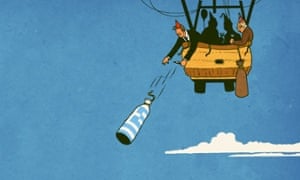
‘Greece is being sacrificed to maintain a set of delusions that enfeebles us all.’ Illustration by Robert G Fresson


‘This is our political alternative to neoliberalism and to the neoliberal process of European integration: democracy, more democracy and even deeper democracy,” said Alexis Tsipras on 18 January 2014 in a debate organised by the Dutch Socialist party in Amersfoort. Now the moment of deepest democracy looms, as the Greek people go to the polls on Sunday to vote for or against the next round of austerity.

Unfortunately, Sunday’s choice will be between endless austerity and immediate chaos. As comfortable as it is to argue from the sidelines that maybe Grexit in the medium term won’t hurt as much as 30 years’ drag on GDP from swingeing repayments, no sane person wants either. The vision that Syriza swept to power on was that if you spoke truth to the troika plainly and in broad daylight, they would have to acknowledge that austerity was suffocating Greece. 

They have acknowledged no such thing. Whatever else one could say about the handling of the crisis, and whatever becomes of the euro, Sunday will be the moment that unstoppable democracy meets immovable supra-democracy. The Eurogroup has already won: the Greek people can vote any way they like – but what they want, they cannot have.

On Saturday the Eurogroup broke with its tradition of unanimity, issuing a petulant statement “supported by all members except the Greek member”. Yanis Varoufakis, the Greek finance minister, sought legal advice on whether the group was allowed to exclude him, and received the extraordinary reply: “The Eurogroup is an informal group. Thus it is not bound by treaties or written regulations. While unanimity is conventionally adhered to, the Eurogroup president is not bound to explicit rules.” Or, to put it another way: “We never had any accountability in the first place, sucker.”

More striking still is this line of the statement: “The Eurogroup has been open until the very last moment to further support the Greek people through a continued growth-oriented programme.” The measures enforced by the troika have created an economic contraction akin to that caused by war. With unemployment at 25% and youth unemployment at nearly half, 40% of children now live below the poverty line. The latest offer to Greece promises more of the same. The idea that any of this is oriented towards growth is demonstrably false. The Eurogroup president, Jeroen Dijsselbloem, has started to assert that black is white.

And that brings us to the crux of the troika’s programme: what is the point of reducing this country to rubble? The stated intention at the start of the austerity package was to restore order: allow Greece to take a short hit to its GDP in the interests of building a stronger, more balanced economy in the long run. As it became clear that growth was not restored and that even on its own terms – the creditor must come first – the plan was failing, the line changed. It became a moral crusade, a collective punishment of the Greeks.

In 2012 the head of the IMF, Christine Lagarde, said in an interview with this newspaper, “Do you know what? As far as Athens is concerned, I also think about all those people who are trying to escape tax all the time. All these people in Greece who are trying to escape tax. And I think they should also help themselves collectively.” How? “By all paying their tax.” At the time, it sounded strange: how, in a country of cripplingly high unemployment, with whole families living off the depleted income of one pensioner, was the answer going to come from tax?

She was offering not a solution but a narrative: the Greeks were in this situation because they were bad people. They wanted a beneficent state, but they didn’t want to pool their resources to create one. The IMF was merely the instrument of a discipline they dearly needed. This line has broadly held – the debtors are presented as morally weaker than the creditors. To give them any concessions would be to reward their laziness and selfishness. The fact that debt is a two-way street – that the returns on debt exist because of the risk that the money might be lost, and creditors have their own moral duty to accept losses when they arise – is erased by this telling of the events.

Also airbrushed out of that story is what the late economist Wynne Godley called (in 1992!) the “lacuna in the Maastricht programme”: that while its single-currency proposal made provision for a central bank, it had nothing to say on the matter of what would replace the democratic institutions – the national governments whose power, once they had no control over their own currency, would be limited. Now we have our answer: the strongest takes control. At the moment, Germany knows best. How do we know they know best? Because they are the richest. The euro was founded on the idea that the control of currency was apolitical. It has destroyed that myth, and taken democracy down with it.

These talks did not fail by accident. The Greeks have to be humiliated, because the alternative – of treating them as equal parties or “adults”, as Lagarde wished them to be – would lead to a debate about the Eurogroup: what its foundations are, what accountability would look like, and what its democratic levers are – if indeed it has any. Solidarity with Greece means everyone, in and outside the single currency, forcing this conversation: the country is being sacrificed to maintain a set of delusions that enfeebles us all.
Greece crisis could be a Sarajevo moment for the eurozone

 
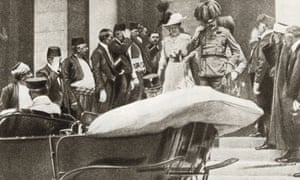
Franz Ferdinand Archduke of Austria and his wife Sophie, Duchess of Hohenberg moments before they were assassinated in Sarajevo on 28 June 1914. Photograph: Design Pics Inc/Rex/Design Pics Inc/Rex


Larry Elliott in The Guardian

Sunday 28 June 2015 19.15 BST

 A hundred and one years ago on Sunday, gun shots rang out in a city in southern Europe. Few at the time paid much heed to the assassination of Archduke Franz Ferdinand and his wife as they drove through the streets of Sarajevo. Within six weeks, however, Europe was at war.

Make no mistake, the decision by Alexis Tsipras to hold a referendum on the bailout terms being demanded of his country has the potential to be a Sarajevo moment. The crisis is not just about whether there is soon to be a bank run in Greece, although there is certainly the threat of one. It is not just about whether the creditors overplayed their hand in the negotiations, although they did. It is about the future of the euro itself.


Greek banks to stay closed on Monday


There will be much talk in the next few days about how Greece can be quarantined. The three people who have been leading the negotiations for the troika - Christine Lagarde of the International Monetary Fund, Jean-Claude Juncker of the European commission and Mario Draghi of the European Central Bank - can still cling to the hope that Tsipras will lose the referendum next Sunday.

In those circumstances, the Syriza-led coalition would have little choice but to hold an election. The return of a government headed by, for example, the centre-right New Democracy, would open up the possibility that Athens would sue for peace on the terms demanded by the troika.

There is, however, no guarantee of this. The troika was certain last week that Tsipras would fold when presented with a final take-it-or-leave-it offer. They were wrong. The Fund, the ECB and the European commission made a fatal misjudgement and have now lost control of events.

The immediate decision for the ECB was whether to cut off emergency funding before the country’s bailout programme formally ends on Tuesday. Wisely, it has chosen not to make matters worse.

In recent weeks, the Greek banks have only been able to stay open because Draghi has provided funds to compensate for capital flight. Sunday night’s announcement of an emergency bank holiday and capital controls demonstrates just how critical the situation has become.

Germany strongly supports the immediate end to emergency liquidity assistance (ELA), arguing that taxpayers in the rest of Europe should not be further exposed to the risk of a Greek exit from the single currency. The ECB, however, has always been reluctant to take what would clearly be a political decision to escalate the pressure on the Greek banks, and has announced that it will continue providing funding at last week’s level.


Greece crisis: a disaster for Athens and a colossal failure for the EU


Even so, Greece now faces a week of turmoil. Tsipras bowed what seemed to be inevitable on Sunday by announcing controls to try to prevent Northern Rock-style queues outside the banks and - just as importantly - money leaving the country.

The Greek government will also be making contingency plans for exit from the single currency. Tsipras and Yannis Varoufakis, his finance minister, say that is not their wish or intention, but if the result of the referendum backs the government’s stance it is hard to see any alternative. Cyprus stayed in the euro after introducing capital controls, but it was done with the approval of other single currency members and involved knuckling down under an austerity programme.

In the meantime, the blame game has begun. The creditors say they offered Greece a deal that would have secured future financing in return for reforms and budget savings which would have hastened the country’s economic recovery. Lagarde has said there is now nothing on the table and that Greece should not expect the same terms to be available after the referendum.

Tsipras said the troika was proposing an “extortionate ultimatum” of “strict and humiliating austerity without end”. A spokesman for Varoufakis said the referendum meant the end to five years of “waterboarding”.

The stance taken by the troika has been wrong-headed but inevitable. Greece has seen its economy shrink by 25% in the past five years. A quarter of its population is unemployed. It has suffered a slump of Great Depression proportions, yet the troika has been demanding fresh tax increases that will suck demand from the economy, stifle growth and add to Greece’s debt burden.

If Greece were outside the euro, IMF advice would be different. The fund would be telling Greece to devalue its currency. It would be telling the country’s creditors that they would have to take a “haircut” in order to make Greece’s debts sustainable. It would then justify domestic austerity on the grounds that the benefits of the devaluation should not be frittered away in higher inflation.


The Greeks for whom all the talk means nothing – because they have nothing


This option, though, has not been made available to Greece. It is unable to devalue and European governments are resistant to the idea of a debt write-down. So the only way Greece can make itself more competitive is to cut costs, by reducing wages and pensions.

A fully fledged monetary union has the means to transfer resources from one region to another. This is what happens in the US or the UK, for example, with higher taxes in areas that are doing well being redistributed to areas with slower growth and higher unemployment.

The euro, however, was constructed along different lines. Countries were allowed to join even though it was clear they would struggle to compete with the better performing nations such as Germany. A stability and growth pact designed to ensure a common set of budget controls was a poor substitute for fiscal union. From the start, it was obvious that the only mechanism for a country that ran into severe difficulties would be harsh austerity. Greece is the result of what happens when politics is allowed to override economics.

If Greece leaves, the idea that the euro is irrevocable is broken. Any government that runs into difficulties in the future will have the Greek option of devaluation as an alternative to endless austerity. Just as importantly, the financial markets will know that, and will pile pressure on countries that look vulnerable. That’s why Greece represents an existential crisis for the eurozone.

It will be said in response that Greece is a small, insignificant country and that the single currency has much better defences than it had at the last moment of acute trouble in the summer of 2012. Diplomats in Europe’s capitals took very much the same view in late June 1914.

My fix for the housing crisis: ban ownership by foreign non-residents

'Politics never looks more pitiful or, frankly, animal crackers than in the housing debate – it’s almost a relief when they don’t discuss it.' Photograph: Helen Yates

 Zoe Williams in The Guardian


It is the one point on which all people and parties agree: Britain’s housing problem is one of supply and demand. The solution is to build more homes. It doesn’t matter who owns them: once we have more supply, the normal market – where perfectly equal individuals reach great deals through mutual self-interest – will resume. This orthodoxy on house-building is so ingrained that if you query it you are regarded as a person who doesn’t understand supply and demand.

Last week the economist John Kay argued that, at the current rate of building – 100,000 homes in 2014 – even to replace existing stock will take 270 years, given that there are 27m dwellings in the country. But this is not accurate – there were actually 141,000 built last year, I guess he was rounding down for ease of arithmetic. It is not enlightening – like a TV chef filling a bus with sugar and yelling “Milwaukee consumes this much sugar every quarter”, the extension is supposed to give a sense of scale, but instead bestows senseless impotence. Ultimately, it is misleading; houses aren’t people, or crops: they don’t have to be replaced every year. Indeed, if you make them really well, you might expect them to last 270 years.

But the supply argument is not a simple mistake; it is deliberated and dearly held. Once you accept it, other things follow: supply is too low because planning is too stringent, because people are selfish and they would prefer to have a large garden than to help their fellow man. It follows also that supply wouldn’t be a problem if demand were lower, so now there are people to blame: immigrants, baby boomers with their great big houses, divorcees who have perverted the supply chain with their toxic personalities, people living alone, whose atomised existences are unsustainable in our tiny jewel of an island.


Home ownership: how the property dream turned into a nightmare


Supply-and-demand turns this into a character weakness. We’re all a little bit too selfish and nimbyish; we’re inconsistent, wanting our house prices to rise but moaning when our kids can’t get on the property ladder; we want cheap labour but don’t want to accommodate the new arrivals who provide it; we’re just bad people who have created the market we deserve; those who’ve had no agency –the under-30s – should direct their ire towards those who have – their own parents and grandparents.

This depressing analysis is, fortunately, quite wrong. The problem of supply, for one thing, is not one of planning but developer incentives. Land value rises faster than the value of housing stock: expecting developers to crack on, to build and sell, is to expect them to get rid of an asset that would otherwise rise in value. This system would work fine if property development were a social enterprise. However, where the aim is maximising shareholder value, these incentives more or less guarantee that they will drag their feet: land with planning permission will remain undeveloped; when it is developed, the housing stock will be thrown up as cheaply as possible.

This is really easily solved, without having to undertake a mass reversal of the modern psyche. We could have a land value tax; the Labour proposal to compulsorily purchase land that was left idle would have worked. The Conservatives branded that “Stalinist”, while including in their own manifesto the proposal to appropriate social housing, then sell it. Politics never looks more pitiful or, frankly, animal crackers than in the housing debate – it’s almost a relief when they don’t discuss it.

But that isn’t the half of it. What we have seen over three decades is a rise in house prices far beyond what people can afford. This is thought of as a London problem, but that can apply only to things that do not infect the rest of the nation. Beards are a London problem – unaffordable housing costs have already spread to Reading, Cambridge, Oxford, Bristol, Brighton and beyond. GDP figures are mainly telling a story of housing costs in the south-east. Cities where housing is less expensive have no part in this economic growth but are expected to rejoice in it anyway. This could never have happened through simple shortage. “The housing market,” wrote Faisal Islam in the Default Line, “is driven principally by the availability of finance, mainly mortgage debt, but sometimes bonuses, inheritances, or hot money from abroad.” He is not, by the way, a Marxist; his career as a broadcaster relies on his impartiality.

To deal with those in reverse order: the money from abroad needn’t even necessarily be hot – 75% of inner London housing is never shown on the UK market, going straight to mainly Asian investors. Last week I shared a panel with a developer, Martyn Evans, and we were looking at a website’s illustration of a block of flats aimed at foreign investors. Apart from Canary Wharf showing up in the background – a scene of geographical impossibility – the funniest bits were the characters: a young man who looked like Prince William, on his phone; a kid with a bunch of balloons, running past in a blur.

This was actually the main point of difference between Evans and me. (It is amazing how many developers also think the system is completely broken.) He said investors look for exactly the same qualities as residents do. No (I insisted): residents want somewhere to live. Investors want somewhere where their investment will be safe. What could possibly be safer than a place where multiple balloons can be carried? Who last saw a child carrying a bunch of balloons?

It has become so normal for housing to be sold abroad that to complain about it sounds old-fashioned, almost racist. However, when anybody from anywhere can buy a flat in your city, sooner or later the people who live and work in it won’t be able to afford to. Rents will become difficult – last week the average monthly rent in London hit £1,500 for the first time. Soon after that, your population is in lifelong servitude to a landlord class, or it moves to Wales. The solution could not be easier: we could ban the ownership of housing by foreign non-residents, as they do in Norway and Australia.

Inequality has also played its part, as salaries in the financial sector have ratcheted up what sounds reasonable. Yet far more important has been the role of banks in extending credit.

This is how money is created – banks lend it to people, and it appears in the economy. Of this lending, 85% is on existing residential housing stock. Essentially, what looks like economic growth is simply the extension of credit to fuel a housing boom. Banks cannot lose: instead of being indebted to them for 20 years, it’s 30; or owing them three times our salary, it’s six; the very luckiest among us have wandered into a state of debt peonage to a high street bank, while the unlucky – who will never get on to the housing ladder – work to service the investments of the lucky. This is a bit more complicated and may involve an overhaul in the way we create money.

But when we look at how badly things are being done – the vanishingly small number of people served by the status quo, the huge numbers, entire generations, who will have to live differently because of what we’ve allowed – this can’t be allowed to stand. So sure, we can talk about supply and demand, and even create the political will to do something about supply. But the exciting bit will start when we allow ourselves to think bigger.

Where Cruelty Is Kindness

Those who promoted laissez-faire economics required an explanation when the magic of the markets failed to deliver their promised utopia. Malthus gave them the answer they needed.

GEORGE MONBIOT in Outlook India

Kindness is cruelty; cruelty is kindness: this is the core belief of compassionate conservatism. If the state makes excessive provision for the poor, it traps them in a culture of dependency, destroying their self-respect, locking them into unemployment. Cuts and coercion are a moral duty, to be pursued with the holy fervour of Inquisitors overseeing an auto da fé.

This belief persists despite reams of countervailing evidence, showing that severity does nothing to cure the structural causes of unemployment. In Britain it is used to justify a £12 billion reduction of a social security system already so harsh that it drives some recipients to suicide. The belief arises from a deep and dearly-held fallacy, that has persisted for over 200 years.

Poverty was once widely understood as a social condition: it described the fate of those who did not possess property. England's Old Poor Law, introduced in 1597 and 1601, had its own cruelties, some of which were extreme. But as the US academics Fred Block and Margaret Somers explain in their fascinating book The Power of Market Fundamentalism, those who implemented it seemed to recognise that occasional unemployment was an intrinsic feature of working life.

But in 1786, as economic crises threw rising numbers onto the mercy of their parishes, the clergyman Joseph Townsend sought to recast poverty as a moral or even biological condition. "The poor know little of the motives which stimulate the higher ranks to action — pride, honour, and ambition", he argued in his Dissertation on the Poor Laws. "In general it is only hunger which can spur and goad them onto labour; yet our laws have said, they shall never hunger."

Thomas Malthus expands on this theme in his Essay on the Principle of Population, published in 1798. Poor relief, he maintained, causes poverty. It destroys the work ethic, reducing productivity. It also creates an incentive to reproduce, as payments rise with every family member. The higher the population, the hungrier the poor became: kindness resulted in cruelty.

Poverty, he argued, should be tackled through shame ("dependent poverty ought to be held disgraceful") and the withdrawal of assistance from all able-bodied workers. Nature should be allowed to take its course: if people were left to starve to death, the balance between population and food supply would be restored. Malthus ignored the means by which people limit their reproduction or increase their food supply, characterising the poor, in effect, as unthinking beasts.

His argument was highly controversial, but support grew rapidly among the propertied classes. In 1832, the franchise was extended to include more property owners: in other words, those who paid the poor rate. The poor, of course, were not entitled to vote. In the same year, the government launched a Royal Commission into the Operation of the Poor Laws.

Like Malthus, the commissioners blamed the problems of the rural poor not on structural factors but on immorality, improvidence and low productivity, all caused by the system of poor relief, which had "educated a new generation in idleness, ignorance and dishonesty". It called for the abolition of "outdoor relief" for able-bodied people. Help should be offered only in circumstances so shameful, degrading and punitive that anyone would seek to avoid them: namely the workhouse. The government responded with the 1834 Poor Law Amendment Act, which instituted, for the sake of the poor, a regime of the utmost cruelty. Destitute families were broken up and, in effect, imprisoned.

The commission was a fraud. It began with fixed conclusions and sought evidence to support them. Its interviews were conducted with like-minded members of the propertied classes, who were helped towards the right replies with leading questions. Anecdote took the place of data.

In reality, poverty in the countryside had risen as a result of structural forces over which the poor had no control. After the Napoleonic wars, the price of wheat slumped, triggering the collapse of rural banks and a severe credit crunch. Swayed by the arguments of David Ricardo, the government re-established the gold standard, that locked in austerity and aggravated hardship, much as George Osborne's legal enforcement of a permanent budget surplus will do. Threshing machines reduced the need for labour in the autumn and winter, when employment was most precarious. Cottage industries were undercut by urban factories, while enclosure prevented the poor from producing their own food.

Far from undermining employment, poor relief sustained rural workers during the winter months, ensuring that they remained available for hire when they were needed by farms in the spring and summer. By contrast to the loss of agricultural productivity that Malthus predicted and the commission reported, between 1790 and 1834 wheat production more than doubled.

As Block and Somers point out, the rise in unemployment and extreme poverty in the 1820s and 1830s represented the first great failure of Ricardian, laissez-faire economics. But Malthus's doctrines allowed this failure to be imputed to something quite different: the turpitude of the poor. Macroeconomic policy mistakes were blamed on the victims. Does that sound familiar?

This helps to explain the persistence of the fallacy. Those who promoted laissez-faire economics required an explanation when the magic of the markets failed to deliver their promised utopia. Malthus gave them the answer they needed.

And still does. People are poor and unemployed, George Osborne and Iain Duncan Smith claimed in this week's Sunday Times, because of "the damaging culture of welfare dependency". Earlier this month, Duncan Smith, in a burst of Malthusiasm, sought to restrict child benefit to two children per family, to discourage the poor from reproducing. A new analysis by the Wellcome Trust suggests that the government, which is about to place 350 psychologists in job centres, now treats unemployment as a mental health disorder.

The media's campaign of vilification associates social security with disgrace, and proposes even more humiliation, exhortation, intrusion, bullying and sanctions. This Thursday, the new household income figures are likely to show a sharp rise in child poverty, after sustained reductions under the Labour government. Doubtless the poor will be blamed for improvidence and feckless procreation, and urged to overcome their moral failings through aspiration.

For 230 years, this convenient myth has resisted all falsification. Expect that to persist.