Search This Blog

Monday, 25 May 2015

The middle-class malaise that dare not speak its name


Zoe Williams in The Guardian


Illustration by Jasper Rietman


What is a “middle-class” expense? According to the Daily Telegraph, after considerable dialogue with its own readers, the key items in the portfolio of the bourgeoisie are as follows: school fees, dental care, health insurance, holidays, wine (fine), new cars, holidays and “cultural activities”. The price rises in all these areas have been astronomical – health insurance has gone up by 51% over the past six years, school fees by 40% – while over the same period earnings in the double-average-wage bracket have gone down by 0.8%.

Private school fees are paid by 7% of the population; private health insurance is taken out by 11%. This isn’t really the middle: the determination to retain the term middle class for those who are actually wealthy is akin to the care with which the right wing never describes its views as rightwing, preferring “commonsense”. It is a constant project to reframe what is normal in the image of what is normal for one person in 10.

But actually, on this matter, the middle classes are pretty normal. Income has stagnated across every section of society apart from the top 1% (whom the Telegraph would probably call upper middle or well-to-do). GDP per capita is lower than it was seven years ago. “That,” said the economist Joseph Stiglitz in an interview on Sunday “is not a success.”

It’s hard for the wealthy to mobilise around their declining living standards. Their options are limited. When so much of your wealth is spent avoiding the social structures on which solidarity is based – education, the health service, our crap dentistry of international renown – who do you complain to? Who are you going to stand shoulder to shoulder with? Your outrage at the world is limited in its expression to your power as a consumer. That’s why the incredibly angry, bright pink man yelling at a BT helpline is such a staple of modern British sitcoms; as a guardian angel against feelings of impotence and injustice, BT can’t really help – even if it does answer the phone.

So there’s the stain of self-interest barring entry to the language and power and solace of unity. There’s also a huge amount of shame involved in being in debt or struggling, especially against the backdrop of assumption that privilege is somehow the result of a lifetime’s sound financial decisions.

There’s a public pressure not to mention declining living standards, because that would be to insult people whose living standards have declined to the point of being unable to eat. There’s also a private pressure, since the status of the affluent is, of course, rooted in the affluence – and if one breaks ranks to say there’s actually quite a lot of anxiety involved, it makes everyone look bad.

Oh, and one other huge impediment: nobody wants you for an ally when your complaint is that health insurance has gone up three times as fast as wages. Had housing been added to the Telegraph’s basket of middle-class goods, they would have seen that, for the older homeowner with a mortgage, the rise in other prices is offset somewhat by the very low interest rates. But they would also have seen that the “middle-class” renter, or even the renter who actually is middle class, is suffering rent rises with no respect to wages, insecurity of tenancy, crummy conditions and life-changingly large proportions of income going on housing costs – very similar conditions, in other words, to everyone else.

The extent to which we are all in this wage-stagnating, price-increasing swamp together is a question of age rather than class. A middle-class person coming out of university is part of the private personal debt boom; a middle-class person under 30 is a victim of the rentier economy. When you strip out the peculiar lottery-win of being over 40 in the housing market, you can see the picture more clearly: everyone who earns, now earns less, while, by incredible coincidence, the ratio between profit and wages has tipped in the shareholders’ favour.

It is deeply ingrained in our political culture that classes must be held in opposition to one another; and a confluence of interests between the middle and the bottom is only possible when the bottom tries to emulate or join the middle (sorry, did I say tries? Of course I meant aspires).

It cuts across the spectrum – on the left, you would never want to preach allegiance between the person hit by the bedroom tax and the person who can’t afford the second holiday. On the right, you would never admit that there was any systemic connection between falling wages for the bottom decile, and falling wages for the eighth.

But considering them together would make it easier to see the patterns: wage depression never conveniently stopped at the bottom 20%, there is little brake on corporate power, and credit is allowing prices in every sphere to peel away from earnings. These trends are obscured by the rather dated political determination that “the needy” must be interested in one kind of politics, and “the aspirational” a completely different kind. Better to acknowledge the similarities in the situations we all face.

Sunday, 24 May 2015

Criminal bankers have brazenly milked the system. Let’s change it


Will Hutton in The Guardian


 Traders colluded in online chatrooms to time the buying and selling of huge amounts of currency. Photograph: Ruben Sprich/REUTERS

The world’s biggest banks had been steeling themselves for months before the US Department of Justice’s rulings on manipulation in the foreign exchange markets. Last week’s announcement was, if anything, less tough than expected; £3.7bn of fines were levied on top of those announced last autumn, to bring the grand total to an astounding £6.3bn. Crucially, the banks also admitted that what they had done was criminal. The US attorney general, Loretta Lynch, declared that foreign exchange traders had exhibited“breathtaking flagrancy” in setting up a group they called “the cartel” to manipulate the market between 2007 and the end of 2013. The fine was “commensurate with the pervasive harm done. And it should deter competitors in the future from chasing profits without regard to fairness, to the law, or to the public welfare”.


Put bluntly, the world’s most prestigious banks had brazenly and systematically ripped off their clients. It was the crime of the decade. Yet the markets had been expecting worse. Only a month ago, Deutsche Bank had paid a record £1.6bn fine for manipulating and rigging prices in the currency and money markets. If this was the benchmark, thought the markets, the fines for other banks would be higher. As it was, £3.7bn seemed almost modest and the share prices of Barclays, RBS, Citigroup and JP Morgan rose sharply in relief.

----Also watch 


Bird and Fortune on Investment Bankers


---------


The hope in the banking world is that the worst may be over. The combination of modestly increased regulation, stronger internal compliance and clawing back pay and bonuses if there has been malpractice – together with genuine determination at board level to root out criminal practice in dealing rooms – should begin to make a difference.


Yet will it be enough? Our grandparents, less in hock to today’s ruling doctrines – that markets can be presumed to be infallible and egoism is always beneficial – were wiser about how to organise markets than today’s economists and regulators. It is striking, despite record fines and the sacking of the Bank of England’s head of foreign exchange operations, who knew about the collusion but never drew it to the authority’s attention (on the grounds that whistleblowing was not part of his duties), that the British approach is still softly, softly.


Minouche Shafik, deputy governor of the Bank of England, expressed her horror at the casual “misconduct” among traders and the language they used to justify what they did in a speech to the London School of Economics last autumn. (Shafik is in charge of the fair and effective market review that will propose changes to the foreign exchange markets.) She conceded that no one can talk any more of a few bad apples – the barrel is rotten. But while recognising that deep change was necessary, her proposed areas for potential remedial action are largely technical. Tonally, her comments reminded me of the infamous Bischoff report into the banking system in 2008/9, which, despite the narrowly averted banking collapse, recommended as little as possible should be done to reform the City.


In fairness, Shafik spoke before last week’s admissions of criminality. The US Justice Department has raised the stakes. What everyone has to confront is that the banks have been party to an organised, global criminal conspiracy to defraud their clients. Traders colluded in secret online chatrooms to time the buying and selling of huge amounts of foreign currency to benefit each other. As one said: “If you ain’t cheating, you ain’t trying.” The entire framework, and the economic philosophy that supported it, has been found wanting.


In terms of structure, the foreign exchange markets are the closest to a Thatcherite nirvana that has ever been devised. Governments do not manage rates to comply with an internationally agreed system, as they did after the war. The price of a pivotal financial asset is determined wholly by private supply and demand. The market makes its rules. There has been close to zero public regulation. Banks buy and sell on their account freely and for their clients. Conflicts of interest abound. The pursuit of profit is the only hallowed value.


The argument in favour of this is that it is vital for the promotion of world trade and prosperity, but daily turnover on the foreign exchange markets dwarfs the volume of world trade. To paraphrase Adair Turner when chair of the now-abolished Financial Services Authority, much of this turnover is plainly neither socially useful nor promotes public welfare. It does, however, enrich those who trade in it and, as we see, criminally.


For 30 years, the doctrine has been that state involvement would be counterproductive. Modern companies, of which banks are a sub-set, have been encouraged to define themselves not as organisations delivering economic and social good, but as profit-making machines for anonymous, tourist shareholders. Managers did not question their trading teams too hard: they knew how important the profit was to their bonuses and to the bank. As for the teams, they were prepared to trade themselves – moving from bank to bank, depending on whoever paid them best. They were not an integral part of great organisation: they were, and are, boys on the make.


In a letter to all the CEOs of Fortune 500 companies, Larry Fink, head of BlackRock Asset Management, the biggest in the world, deplored the short-term financial priorities of modern corporations, which he said had lost their way and urged a refocusing. What has happened in our currency dealing rooms is part of that story. Addressing it requires a new deal between shareholders, companies and their workforces, and between the public and the private. We need a reshaping of company law and the way companies are owned so that managers pursue less fevered, short-term amoral strategies. And we need an acceptance that in market after market there is a co-dependence between state and business.


Rather than imposing swingeing fines after the event, the state has an obligation to create, with the banks, a financial architecture in which such practices cannot happen. Conflicts of interest and opportunities for price rigging should be outlawed. Criminal currency traders should be prosecuted All bonuses should be capable of being clawed back. Currency trading should be licensed on organised, accountable exchanges.


Those rules and systems that the world’s free marketeers considered so antediluvian turn out to be wise and friendly to honest-to-god businesses. Mark Carney’s Bank of England has been quietly re-regulating mortgage finance, abandoning the free-market zealotry of the 1980s and 1990s. It should do the same in the foreign exchange markets. Our grandparents were not so stupid after all.

Arjuna Ranatunga - Large and in charge

Defiant, passionate, cunning - Arjuna Ranatunga was a mighty tough cookie on the field and an unwavering friend off it

MARTIN CROWE in Cricinfo MAY 2015

Truth be known, I love to hate the Australians more than anyone else. And therefore the man who got under their skin the most is my hero. Appearances can be deceiving, and when it comes to Arjuna Ranatunga, the rotund Sri Lankan mastermind, there was nothing soft in his underbelly. He is as tough a cricketer as I have ever come across.

We represented our countries at the same time, both very young, eager allrounders hoping to fit into the cut and thrust of international cricket. Sri Lanka were just beginning their climb, possessing many fine cricketers, if not hardened professionals. New Zealand were a nice mix of amateur and professional, led in example by the pro's pro, Richard Hadlee.

I first spoke to Arjuna while fielding under a helmet at short legin Kandy in 1984. He was defiantly chirpy at the crease, never taking a backward step. His game was a bit limited - the cut and sweep were his release shots. He appeared unfit, yet he never lacked for effort or punch. He quickly became known as "Chef": hungry, dressed in white, and ready to give hell to anyone who didn't conform to the rules of his workspace.

We teased each other a little but deep down we had huge respect for one another, and I loved his smile and zest for life. He had no out-of-control ego, or fear, just a massive heart and a cunning mind. Despite Sri Lanka having no experience as such, Arjuna soaked up all he could. It was as if it was preordained - his apprenticeship was a natural platform for him to learn how to mastermind his team to unprecedented glory.

He quickly became known as "Chef": hungry, dressed in white, and ready to give hell to anyone who didn't conform to the rules of his workspace

I was more comfortable bowling to Arjuna than batting against him. I could swing it away from him, and enjoyed following up my bouncers with a prolonged look to see his response. He was always muttering something and smiling. When he bowled to me, he knew I feared getting out to his miserable deflated wobblies.

Regrettably, he dismissed me too often, notably in Wellington, when I was one short of being the first Kiwi to post a triple-century. I recall the moment when he got to the end of his run-up, beaming ear to ear. He had a gift for me. At that precise moment, up popped the thought that I had already achieved the triple-century. I didn't remove the thought; instead, I hung on to the feeling a bit longer. "Heck, you've done it," I muttered.

Arjuna rolled in and offered up a juicy half-volley wide of off stump. It was a glorious finish to a hard-fought draw, and some history. I never saw the ball leave his hand. My mind was scrambled as I jumped from "Done it", to "Where is it?" Seeing it very late and very wide, I lashed out in desperation, the blade slicing the ball and sending a thick edge into the slip cordon. Hashan Tillakaratne, the wicketkeeper, moved swiftly and calmly to his right and plucked the ball millimetres from the ground.

While Arjuna was upset for me, I was angry and inconsolable. A couple of weeks later, in the Hamilton Test, he dealt it to me again with the same mode of dismissal. Unintentionally, he had got under my skin, in the nicest possible way. I began to hate facing his gentle floating autumn leaves.

By 1996 he was a wise sage. He knew his team and their strengths, and he knew what buttons needed pushing. He saw the Australians as an easy target. He saw how false they could be: loud, lippy banter masking their own fears, often turning into personal abuse when the pressure mounted. He believed the more they resorted to mental disintegration the more they exposed themselves, diverting their attention from their obvious skill and from the job at hand.


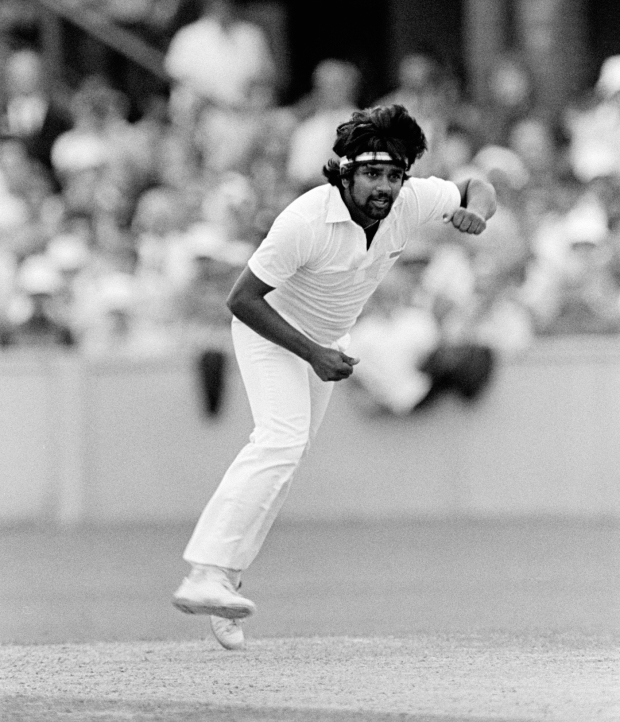
A streamlined Arjuna bowls in the 1983 World Cup © Getty Images

On the eve of the World Cup final he told the many drooling media hounds that Shane Warne was just an average bowler. It caused a violent reaction, more so because "Chef" had been pecking away at the Aussie psyche for a few years and this was the ultimate insult. While Warne tightened with fury, Aravinda de Silva - Arjuna's right-hand man and master batsman - loosened up. Two buttons pressed, both for different purposes, both pushed to achieve one result.

Arjuna dabbed the winning run down to his favourite third-man area. Upon seeing it disappear to the boundary, he reached down and grabbed a stump. It was as if he were picking up the stake he had earlier rammed in the ground upon his arrival. That stake stood for a nation that had cracked the code to win a world title. Ranatunga's name was etched in history forever.

We became close companions off the field. He would take me home to dinner, offering his favourite foods and delights. Not surprisingly, he enjoyed a fine feast, probably more than he did cricket, and I loved hanging out with someone so at ease. He also helped me get expert treatment for my ailing legs, so I could get fit again after developing hamstring problems due to my knee condition. He took me to places I never knew existed, and I felt safer with him in a foreign land than I did in any other.

Arjuna wasn't really an arch-enemy or a player I loved to hate. I loved him, full stop. Mostly I loved the way he stood up to the big boys, the bullies, and bulldozed them back in his unique inspiring way. He represented the underdog.

Arjuna left everything out on the park and, going by his healthy waistline, that was quite a plateful.

Saturday, 23 May 2015

Black academic claims he was denied university job over his plans to 'put white hegemony under the microscope'

Adam Lusher in The Independent


A black academic has claimed he was denied a permanent job at a British university because his plans to “put white hegemony under the microscope” were considered too much of a challenge to white-dominated academia.

Dr Nathaniel Coleman,  who crosses out his surname to “highlight the stigmatising expressive meaning” of the “badge” given to his forebears by slave owners, said his proposals for a new black studies MA were opposed by University College London  colleagues seeking something less critical of the white Establishment. UCL has postponed plans for the new MA and with no course to teach, he will be out of a job when his fixed-term contract at the philosophy department expires in October.

The academic, who has a double first in greats from Oxford University, said that he became just one of five black philosophy academics in UK universities when he joined UCL as Britain’s first research associate in the philosophy of “race” in October 2013.
His new MA, he claimed, would have upset some in white-dominated academia.

“White hegemony was … to be put under the microscope,” he told Times Higher Education. “Turning the spotlight on to the ivory tower, putting the fear of God into many of its scholars – predominantly racialised as white – who had contented themselves hitherto to research and teach in an ‘aracial’ – aka white-dominated – way.”

His claims, which are disputed by UCL, come weeks after the university submitted its application for a Race Equality Charter Mark as part of a pilot scheme running in 30 higher education institutions.

He was initially hired for a year, but had his contract extended for a further 12 months with a view to developing a new MA course.

On the academia.edu website, he called for UCL to face up to “its invention and institutionalisation of national eugenics” under the influence of Sir Francis Galton, the “father” of the discredited pseudoscience of racial purity. In March last year he organised an event at UCL entitled “Why Isn’t My Professor Black?” telling the audience there was a continuing failure to recognise black scholars as philosophers.

The event, which also highlighted the fact that just 85 of the UK’s 18,500 professors were black, was attended by UCL’s provost, Professor Michael Arthur, who wrote: “We cannot suppose unequal treatment stops at our door.”