Search This Blog

Friday, 2 January 2015

Easy to sneer at arts graduates. But we’ll need their skills


Creative types have the confidence to take risks. And they understand that money isn’t everything

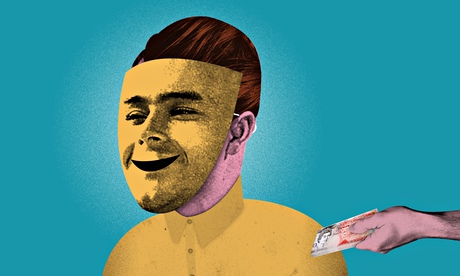
Illustration by Nate Kitch
'Millions indulge their children in careers they know will yield neither financial reward nor national advantage.' Illustration by Nate Kitch

Anthony Ward Thomas, of Ward Thomas Removals, has a problem that he shares with the public. After a life spent turning a man with a van into a multimillion-pound firm, he finds his children are not interested in taking over. “They have different interests,” he says. He is sad, but agrees “there should be no divine right that they get the business”. They should make their own way in the world. This they are doing. His daughters are country and western singers and his son is an actor. I doubt if they are as rich.
When penal supertaxes were ended in the 1980s, the surplus spending power was expected to go on cars, yachts and houses. Much of it did. But a new form of supertax emerged, no less insistent than the last. It was called children. And not just any children, who might look after their parents in old age, but ones seeking a life of fashionable but impecunious “creativity”.
Statistics say the chief cost of child-rearing occurs in the teens. To get an offspring housed, clothed, fed and educated to the age of 21 takes an average of £225,000, or half a million if privately educated. This has more than doubled over the past decade. But ask most parents, and the expense does not stop at 21. It continues through further education, travel, internship, ongoing board and lodging, even early marriage.
Thousands the world over are returning to live at home after university. Australians have “boomerang” children, Italians bamboccioni (big babies), the Japanese parasaito shinguru (parasite singles) and the Germans “hotel mama”. To the youth psychologist Haim Omer, this “entitled dependency” has become “the new hedonism … an ideology at the parents’ expense, nothing less than a pandemic”. Behind this phenomenon stands the famous “bank of mum and dad”, notably in the matter of housing: its motto is “pay up or we stay”. In Britain this bespoke baby bank reportedly hands out a staggering £27bn annually. The loans have nothing to do with investment. The bank would go swiftly bust if they did. Money is spent, above all, on property. A trivial £600m is reckoned to go on business ventures. The bank is too proud to fail. The Ward Thomas branch of this bank is more specific. I am not privy to the family’s circumstances, but if the bank is like many I know, it existed to fund careers in “something creative”, often what the parents once called a hobby but their children consider a talent in need of full occupational rein. This bank of mum and dad becomes a private arts council, far outstripping the resources available to the real one.
A cultural economist might welcome this. It forces down pay and costs in the arts, making it cheaper to run literary festivals, music venues, provincial rep, galleries and publishing. Children are far more expert at extracting “grants” from parents than is the Treasury; HMRC has no clout to compare with “Edinburgh could be our big break, Dad”.
But the phenomenon has consequences. It biases “subsidy”, and the jobs to which they give access, towards the children of the rich. It also seriously distorts higher education, with a booming demand for courses in drama, dance, fine art, music, film, photography, design and creative writing.
Britain now has 160,000 undergraduate and postgraduate students in “creative arts and design”, with more than 20,000 in drama alone. This is more than in the whole of engineering or in maths and computing combined.
This academic bias is far beyond what the market for such skills can sustain. Just 28% of graduates in performing arts find jobs in the arts or media, while almost the same proportion find their way into retail and catering. Britain’s bursting drama schools are training a better class of waiter.
Does this matter? The lethargy afflicting Japan’s once-tiger economy over the past decade is attributed to precisely this career demotivation of the post-salaryman generation. Young Japanese have been able to afford to turn away from their parents’ grinding labour and its karoshi, or death from overwork. A similar collapse may one day afflict Chinese entrepreneurialism. Even the continued vitality of the US and Germany is attributed not to natives but to migrant talent drawn from less favoured countries.
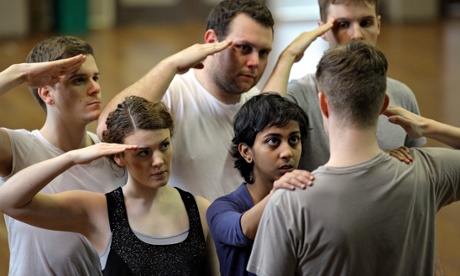
National Theatre Wales students in rehearsal.
‘The bank of mum and dad becomes a private arts council, far outstripping the resources available to the real one.’ National Theatre Wales students. Photograph: D Legakis Photography/Athena
Europe is in the economic doldrums. It may produce the best opera singers and write the best novels, but its cars and computers are rubbish. Its bankers can hedge markets and its tour operators can market hedges, but the funds come from Asian enterprise. Either it will discourage its young from dancing, film-making and creative writing and galvanise it to risk-taking innovation, or it will slither into becoming a gigantic Bournemouth, living off the dwindling fat of its past.
So says the economist. Or should we put more faith in the dynamic of a humanistic education? Graduates in the performing arts are actually high achievers in finding work outside their skill group, probably through enhanced confidence and articulacy. They take chances and do not regard money as everything. They seem better equipped to use their imagination and challenge conventional wisdom.
The pop science bestseller Sapiens, by Yuval Noah Harari, suggests that humans “are now beginning to break the laws of natural selection, replacing them with the laws of intelligent design”. Human advance through natural selection has reached its limit. Strides forward will now be technological rather than biological.
For Harari the question for our species is not “what do we want to become?”, but the far harder question, “what do we want to want?”. Who makes the choices? The answer will not lie in the brave new world of cyborgs and robots. It can only lie in what are rightly called the humanities, the history and imagination of human beings. Alexander Pope was always right: “The proper study of mankind is man.”
Most British adults now believe their offspring will be poorer than themselves. Yet millions indulge their children in careers they know will yield neither financial reward nor national advantage. I am not convinced the world they are creating will really be worse off for that. There is plenty for the robots to do, like running removal firms.

Wednesday, 31 December 2014

Conversion: With targets & incentives, new breed of evangelical groups are like start-ups

T V Mohandas Pai in The Economic Times

The Rajya Sabha has been paralysed by the Opposition on the “Ghar Vapasi” programe of a few organisations from the right. However, if you follow the debate, it is clear that this is a political battle by the left and the left of centre parties to embarrass and discredit the right of centre party in power. Maybe even with the intent to show up the government as incapable of bringing in reforms and development. The so-called conversion debate was an excuse to paralyse the Rajya Sabha, and a great opportunity was missed to debate the issue of large-scale surreptitious conversions across India (which is the real problem).
There is no doubt that large scale conversions have been taking place across India, accelerating over the last 5 years led by evangelical groups from the West. The North East has been converted with Arunachal and Tripura being now targeted. Tribal belts across Odisha, Jharkhand, Gujarat and MP have seen large-scale conversions for several years now.
The new phenomenon over the last 5 years has been the huge increase in evangelical conversions in Chennai and Tamil Nadu, clearly visible via the vehement advertising on particular channels on TV. Andhra Pradesh, particularly the interiors, Hyderabad and the coastal regions, has been specifically targeted due to the red carpet laid by a now deceased Chief Minister whose son-in-law is a Pastor with his own outfit. The visible impact across this region to any observer shows clearly that a huge amount of money has come in and that there is targeted conversion going on. Some evangelical groups have claimed that 9-12% of undivided AP has been converted, and have sought special benefits from the State (which has been reported in the media).
There is a very sophisticated operation in place by the evangelical groups, with a clear target for souls, marketing campaigns, mass prayer and fraudulent healing meetings. Evidence is available in plenty on videos on YouTube, social media, press reports, and on the ground. Pastors have been openly tweeting about souls converted, and saving people from idol worshippers. Some pastors have tweeted with glee about converts reaching 60 million, declaring a target of 100 million, and have also requested for financial support for this openly. Violence in some areas due to this has vitiated the atmosphere. The traditional institutions of both denominations are losing out to the new age evangelicals with their sophisticated marketing, money and legion of supporters from the West. One can almost classify these groups as hyper-growth startups – with a cost per acquisition, a roadmap for acquiring followers, a fund-raising machine, and a gamified approach (with rewards and incentives) to “conquering” new markets.
Our Constitution guarantees the freedom of religion, which includes the right of the individual to choose her religion. This is not in question, and is a very important concept for a nation like ours. But this right is terribly constrained by religions, which severely punish apostasy. Our laws prohibit conversion due to inducement, allurement, undue influence, coercion, or use of supernatural threats. Every debate on TV misses this point -people argue on grounds of constitutional rights and abuse right wings groups who protest such conversion forgetting that these new age evangelicals are clearly breaking the law! They go to the desperate, and prey on their insecurities by offering education for their children, medical services for the sick, and abuse existing religious practices and traditions.
People also point to the approximate 2.3% share of this minority in the last 3 censuses to deny such conversions. Of course, the 2011 census figures on religion has strangely not been released and we need this data. However, the reason why inthe conversion numbers do not show up in the census is that conversions are happening in communities entitled to reservation benefits. It appears that they are clearly told not to reveal their conversion in the census or officially to prevent loss of benefits. Most conversions happen amongst the tribals and rural and urban poor, who are soft targets to inducements.
I have a personal experience of evangelical groups trying to convert members of my family. Two house maids who converted said that the school where their children went raised fees and due to their inability to pay, they were told they would waive it if they converted (which they were forced to do). Of course, the school was rabid in their evangelism with these children. I use a taxi company for travel over the last ten years. I have noticed over 30% of drivers have converted over the last 5 years.
When asked, inevitably they spoke about evangelicals groups that gave them free education for children and paid their medical bills, provided they converted.
It is obvious that large-scale conversion by illegal means is happening in many places and the impact is clearly visible to anybody who would choose to see openly. Some apologists ask – where are the complaints about inducement or coercion? The law needs enforcement by the police independent of complaints, as is happening when rightist groups proudly announce conversions. These rightist groups lack sophistication, but they have squarely focused attention on this large-scale conversion activity. Law enforcers need to act before this becomes a bigger flashpoint.

Reconversion to Hinduism - Challenges of Ghar Wapsi

Jug Suraiya in the Times of India

The ‘ghar wapsi’ campaign needs to rebuild the ‘ghar’ they want people to return to.
The RSS, the Hindu Mahasabha and other elements of the Sangh Parivar who want to turn India into a Hindu rashtra through mass conversions called ‘ghar wapsi’ have their work cut out for them, because they face a couple of serious obstacles in achieving their objective. And these obstacles are not their ideological opponents like Congress and Mulayam Singh Yadav’s Samajwadi Party. Nor is it the trifling matter of the Constitution, which clearly defines India as a secular republic.
No, the real problem with the so-called ‘ghar wapsi’ campaign is that many of those whom the Parivar is urging to come wapsi-ing back to their ghar didn’t belong to the ghar in the first place, which makes it difficult, semantically at least, for them to come back to it. For a lot of people being targeted for ‘reconversion’ by the Parivar belongs to tribal communities, which by and large were animists and did not belong to the Hindu fold. Indeed, as the story of Eklavya in the Mahabharata shows, tribals were given short shrift by mainstream Hinduism with its caste hierarchy: Eklavya, a tribal, is made to cut off his thumb and give it to Dronacharya as guru-dakshina because Dronacharya fears that his ‘low-born’ pupil will outdo the ‘high-born’ Arjuna in archery.
Tribals apart, many of those being ‘reconverted’ are dalits who, if anything, have been even more badly treated than tribals by casteist Hinduism, which looked down on them as being ‘untouchables’, literally and metaphorically. It was this enforced ‘untouchability’ which impelled many dalits to embrace religions like Buddhism. How can those who were considered outcasts – or ‘outcastes’- be brought back to a Hinduism which excluded them to begin with?
But perhaps the biggest problem faced by the ‘reconversionists’ is that, unlike Islam and Christianity, Hinduism has never been a proselytising religion. Before the Arya Samaj leader Swami Shraddhanand launched a programme of mass conversions in the 1920s, Hinduism never had a tradition of conversions, much less ‘reconversions’.
So before the Hindu brotherhood of the Sangh Parivar goes about converting, or ‘reconverting’, people to Hinduism it might have to do a bit of converting of Hinduism itself so as to bring proselytising within its purview. In order to bring in recruits to swell its ranks, Hinduism might have to convert, or reinvent, itself.
But should it do so, it might run a risk. To paraphrase Groucho Marx, recruits to Hinduism could well say that they did not want to join a religion which would have them as converted members.

Batting on bouncy pitches: The secret behind Vijay's success

The Indian opener does not play the horizontal-bat shots, but he has a good record in Australia regardless
Aakash Chopra in Cricinfo
December 31, 2014
 

The best way to play the short ball? Get out of the way © Getty Images

Get lighter bats, bat in the nets against bowling machines or with wet tennis balls on concrete, and practise the horizontal-bat shots. These were a few bits of advice that came my way before I embarked on the tour to Australia in 2003.
We had all heard about how tough it was to bat on the harder, bouncier, faster Australian pitches, and of how important it was to mould one's game for the conditions. Cover drives and flicks off the legs were my lifeblood on Indian pitches, but these shots are useless down under, I was told.
While you cannot undervalue the importance of horizontal-bat shots against Australian fast bowlers in Perth or at the Gabba, it's a fallacy to think that players who don't have an attacking game off the back foot are doomed. M Vijay is a good example of how a solid defensive technique off the back foot, knowledge of where your off stump is, and the ability to transfer weight onto the front foot can do the job just as well, if not better. Vijay has scored over 200 runs against pace in the first two Tests of this series without much square-cutting, hooking or pulling.

Vijay v pace
 RunsBalls% of runs% of ballsWicketsS/R
Front foot24343389.374.8256.12
Back foot2914610.725.2219.86

Vijay's head when the bowler releases the ball is in line with the top of the off stump. That gives him a fair judgement of which balls are to be left alone and which are to be played. He has left alone about 34% (the highest percentage for any active international batsman today) of the balls he has faced in Test cricket since 2011. Most of these are deliveries bowled in the channel outside off. If you regularly allow the ball to go through to the wicketkeeper, bowlers will have to come closer to the stumps in search of the elusive outside edge, which works in your favour. Vijay is old-fashioned in the way he leaves a lot of balls alone and then punishes the full balls that are close to him.
In addition to leaving a lot of balls alone outside off, he leaves alone almost everything directed at his head. In his last three overseas series he has left 96% of all bouncers bowled to him, and hasn't played a single pull, hook or uppercut. It's possible to not attempt attacking shots against bouncers while being comfortable against them. If you find yourself in a tangle while leaving the ball, a lot of bouncers will come your way. Vijay is exceptional in being able to stay out of harm's way by ducking or swaying away. It doesn't come as a surprise that he isn't peppered with short-pitched stuff as much as some other Indian batsmen are.
Since Vijay scores a lot of runs off the front foot, you might be inclined to think that he commits himself on to the front foot and so has a long stride forward. That's not the case, and it is exactly why he is successful, for if you commit yourself on the front foot too early and too much, you can't get back in time, and you become suspect against deliveries that are short of a good length and bounce steeply. Vijay has a short front-foot stride but he has acquired the expertise to wait for the ball to come to him and to then transfer his weight a fraction before the ball arrives. A lot of players with short front-foot strides tend to reach out to the ball with their hands, but Vijay doesn't.
The success of this method also largely depends on the length and line most bowlers bowl in international cricket - full and outside off, for that's what the slip cordon is designed for. Not many batsmen get out nicking to the slip cordon off the back foot, even in places like Australia and South Africa, because it's relatively easier to deal with extra bounce and sideways movement when the ball is short, with the extra time you get at the crease. It's the fuller balls that draw you forward and lure you into playing false shots that end up finding the outside edge to the cordon behind. Don't they say that a half-volley in Feroz Shah Kotla is a half-volley in Perth?
When touring Australia or South Africa it's important to have a solid back-foot game, defensive or offensive. It's equally important to remember that you will be getting out mostly off the front foot, so you shouldn't be abandoning your front-foot skills.
The subtle adjustment that one must make is to stand a little taller and have high hands on the bat, so that the ball isn't hitting higher on the bat than it does elsewhere. A lot of players from the subcontinent have low hands and tend to stay lower to deal with the low bounce back home, and that results in not timing the ball well overseas. Vijay has ticked that box too. He stands tall, plays the ball on the rise, and most importantly, plays it close to his body and under his eyes.