Search This Blog

Monday, 6 April 2020

We're not all in coronavirus together

‘The virus does not discriminate,” suggested Michael Gove after both Boris Johnson and the health secretary, Matt Hancock, were struck down by Covid-19. But societies do. And in so doing, they ensure that the devastation wreaked by the virus is not equally shared writes Kenan Malik in The Guardian


We can see this in the way that the low paid both disproportionately have to continue to work and are more likely to be laid off; in the sacking of an Amazon worker for leading a protest against unsafe conditions; in the rich having access to coronavirus tests denied to even most NHS workers.

But to see most clearly how societies allow the virus to discriminate, look not at London or Rome or New York but at Delhi and Johannesburg and Lagos. Here, “social distancing” means something very different than it does to Europeans or Americans. It is less about the physical space between people than the social space between the rich and poor that means only the privileged can maintain any kind of social isolation.

In the Johannesburg township of Alexandra, somewhere between 180,000 and 750,000 people live in an estimated 20,000 shacks. Through it runs South Africa’s most polluted river, the Jukskei, whose water has tested positive for cholera and has run black from sewage. Makoko is often called Lagos’s “floating slum” because a third of the shacks are built on stilts over a fetid lagoon. No one is sure how many people live there, but it could be up to 300,000. Dharavi, in Mumbai, is the word’s largest slum. Like Makoko and Alexandra, it nestles next to fabulously rich areas, but the million people estimated to live there are squashed into less than a square mile of land that was once a rubbish tip.

In such neighbourhoods, what can social distancing mean? Extended families often live in one- or two-room shacks. The houses may be scrubbed and well kept but many don’t have lavatories, electricity or running water. Communal latrines and water points are often shared by thousands. Diseases from diarrhoea to typhoid stalked such neighbourhoods well before coronavirus.
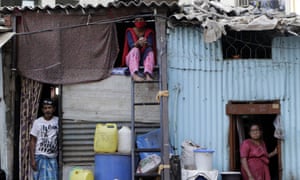


FacebookTwitterPinterest People in their shanties at Dharavi during the coronavirus lockdown in Mumbai. Photograph: Rajanish Kakade/AP

South Africa, Nigeria and India have all imposed lockdowns. Alexandra and Dharavi have both reported their first cases of coronavirus. But in these neighbourhoods, the idea of protecting oneself from coronavirus must seem as miraculous as clean water.

Last week, tens of thousands of Indian workers, suddenly deprived of the possibility of pay, and with most public transport having been shut down, decided to walk back to their home villages, often hundreds of miles away, in the greatest mass exodus since partition. Four out of five Indians work in the informal sector. Almost 140 million, more than a quarter of India’s working population, are migrants from elsewhere in the country. Yet their needs had barely figured in the thinking of policymakers, who seemed shocked by the actions of the workers.

India’s great exodus shows that “migration” is not, as we imagine in the west, merely external migration, but internal migration, too. Internal migrants, whether in India, Nigeria or South Africa, are often treated as poorly as external ones and often for the same reason – they are not seen as “one of us” and so denied basic rights and dignities. In one particularly shocking incident, hundreds of migrants returning to the town of Bareilly, in the northern Indian state of Uttar Pradesh, were sprayed by officials with chemicals usually used to sanitise buses. They might as well have been vermin, not just metaphorically but physically, too.

All this should make us think harder about what we mean by “community”. In Britain, the pandemic has led to a flowering of social-mindedness and community solidarity. Where I live in south London, a mutual aid group has sprung up to help self-isolating older people. The food bank has gained a new throng of volunteers. Such welcome developments have been replicated in hundreds of places around the country.


FacebookTwitterPinterest South African National Defence Force soldiers enforce lockdown in Johannesburg’s Alexandra township on 28 March 2020. Photograph: Luca Sola/AFP via Getty Images
But the idea of a community is neither as straightforward nor as straightforwardly good as we might imagine. When Donald Trump reportedly offers billions of dollars to a German company to create a vaccine to be used exclusively for Americans, when Germany blocks the export of medical equipment to Italy, when Britain, unlike Portugal, refuses to extend to asylum seekers the right to access benefits and healthcare during the coronavirus crisis, each does so in the name of protecting a particular community or nation.
The rhetoric of community and nation can become a means not just to discount those deemed not to belong but also to obscure divisions within. In India, Narendra Modi’s BJP government constantly plays to nationalist themes, eulogising Mother India, or Bhārat Mata. But it’s a nationalism that excludes many groups, from Muslims to the poor. In Dharavi and Alexandra and Makoko, and many similar places, it will not simply be coronavirus but also the willingness of the rich, both in poor countries and in wealthier nations, to ignore gross inequalities that will kill.

In Britain in recent weeks, there has been a welcome, belated recognition of the importance of low-paid workers. Yet in the decade before that, their needs were sacrificed to the demands of austerity, under the mantra of “we’re all in it together”. We need to beware of the same happening after the pandemic, too, of the rhetoric of community and nation being deployed to protect the interests of privileged groups. We need to beware, too, that in a world that many insist will be more nationalist, and less global, we don’t simply ignore what exists in places such as Alexandra and Makoko and Dharavi.

“We’re all at risk from the virus,” observed Gove. That’s true. It is also true that societies, both nationally and globally, are structured in ways that ensure that some face far more risk than others – and not just from coronavirus.

Friday, 3 April 2020

On Tablighi Jamaat, Modi's brilliance. Governance in Pakistan. Shahid Afridi by Arif Ajakia


Tabligi Jamat & Law on the Spread of Coronavirus : Faizan Mustafa

Religion is, indeed the self consciousness and self esteem of man who has either not yet won through to himself or has already lost himself again.

'Religious suffering is, at one and the same time, the expression of real suffering and a protest against real suffering. Religion is the sigh of the oppressed creature, the heart of a heartless world and the soul of soulless conditions. It is the opium of the masses.'     ---Karl Marx


Thursday, 2 April 2020

Tablighi Jamaat India's Love for Extremism during Coronavirus outbreak


Was Greg Chappell really a terrible coach of India?

Chappell and India. You can't ask for a more compelling plot or cast of characters writes Karthik Krishnaswamy in Cricinfo 

The leaked email, the crowd that cheered the opposition, the punch at an airport: Greg Chappell's tumultuous, two-year tenure as India's head coach contains every ingredient you could wish for if you're writing cricket's version of The Damned Utd, the David Peace novel - later adapted into a movie - that tried to get inside Brian Clough's head during his ill-fated, 44-day spell as manager of Leeds United in 1974.

Chappell and India. You can't ask for a more compelling plot or cast of characters. The coach was one of the game's great batsmen and enigmas, upright and elegant but also cold and sneering, a man who once made his brother bowl underarm to kill a one-day game. This man takes over a team of superstars and attempts, perhaps hastily and certainly without a great deal of diplomacy, to remake them in his own image. He precipitates the removal of a long-serving captain who commands a great deal of adoration within the dressing room, and challenges other senior players to break out of their comfort zones without preparing, perhaps, for the inevitable resistance. There are successes, but there's one massive, glaring failure, and with that the entire project comes crashing down. 

If you wrote it well, there wouldn't be heroes or villains, just the universal story of proud and insecure men trying and failing to connect with each other. But it hasn't usually been told that way, certainly not in India, where Chappell remains a hugely polarising figure.

Of those who played under him, most of the prominent voices who have written or spoken about Chappell have had almost nothing good to say of him - Sourav Ganguly, needless to say, but others too. Sachin Tendulkar, VVS Laxman, Zaheer Khan, Harbhajan Singh and Virender Sehwag have all stuck the knife in at various points, and all of them have laid one major charge at Chappell's feet, that he was a poor man-manager.

"Greg," Tendulkar wrote in his book Playing It My Way, "was like a ringmaster who imposed his ideas on the players without showing any signs of being concerned about whether they felt comfortable or not."

Perhaps there's some truth to the idea that Chappell didn't know how to get the best out of a diverse group of players, and that he lacked the instinct to be able to tell whom to cajole and whom to kick up the backside. But while one group of players has been unsparingly critical of Chappell's methods, other prominent voices - Anil Kumble, Yuvraj Singh, MS Dhoni, and above all Rahul Dravid - have largely stayed silent on the matter. Irfan Pathan has rejected, on multiple occasions, the widely held notion that Chappell was responsible for his decline as a swing bowler after a promising start to his career. Pathan was one of a group of younger players heavily backed by Chappell, alongside Yuvraj, Dhoni (whose leadership potential Chappell was one of the first to spot) and Suresh Raina.

Of course, players are the last people you would go to for a dispassionate appraisal of their coach's ideas and methods. If Chappell wanted Zaheer Khan dropped, you wouldn't ask Zaheer Khan if he thought it was a good idea. You wouldn't ask Harbhajan or Sehwag, two players whose early careers Ganguly had a major influence on, whether it was right to strip him of the captaincy.

Let's look, therefore, at some numbers.

The Ganguly question is the easiest to answer. Chappell put forward the idea that he step down from the captaincy during India's tour of Zimbabwe in September 2005. From the start of 2001 to that point, Ganguly had averaged 34.01 in 61 Test innings against all teams other than Bangladesh and Zimbabwe.

Excluding matches against Bangladesh, Zimbabwe and the Associates, his ODI numbers in the same period were just as poor: an average of 30.71, a strike rate of 72.32. Since the start of 2003, he had fared even worse against the top eight ODI teams: 1077 runs in 45 matches at an average of 25.04 and a strike rate of 67.39.

There were performance-related issues behind other players' disagreements with Chappell too. Take Khan, for instance. From the end of the Brisbane Test of December 2003, where he bagged a first-innings five-for, to the Karachi Test of January-February 2006, he took 39 wickets in 15 Tests at 42.41. In that Karachi Test and right through that tour of Pakistan, he was visibly pudgy, bowled off a short run-up, and struggled to move the speedometer needle past the 130kph mark.

Khan's fitness - and Sehwag's - had always been a sticking point with Chappell. Left out of India's next two Test series - against England at home and in the West Indies - Khan signed for Worcestershire and enjoyed a tremendous county season, during which he grew fitter and rediscovered his bowling form. He was a rejuvenated force when he returned to Test cricket on the 2006-07 tour of South Africa, and Chappell, writing in his book Fierce Focus, noted that Khan and Ganguly - who was also making a comeback - were two of India's best players on that tour. "Whether they had improved in order to spite me or prove me right, I didn't care. It cheered me greatly to see them in much better shape than they had been when I started in the job."

In ODIs, India were a poor chasing team when Chappell arrived - their last 20 completed chases before he took over had brought them just five wins, four of those against Zimbabwe or Bangladesh - and they realised the best way to become better at it was to keep doing it. They kept choosing to bowl when they won the toss, and eventually became so good at chasing that they won 17 successive matches batting second.

Before Chappell and Dravid joined forces, India had been hugely reluctant to play five bowlers even when conditions demanded it. Under them, it became a routine occurrence. India were lucky, perhaps, to have an allrounder who made it possible, but it's a telling statistic that the highest Pathan batted in 32 ODIs under Ganguly was No. 7, and that was just once, though he scored two half-centuries from those positions and regularly showed promise with the bat. Dravid regularly used Pathan at No. 3, suggesting either that this was his idea in the first place, or that he was far more willing than Ganguly to take on board one of Chappell's. (Pathan himself has suggested it was Tendulkar's idea.)While one group of players has been critical of Chappell's methods, the likes of Dravid largely stayed silent Getty Images

Under Chappell and Dravid, India often played five bowlers in Test cricket too, showing a willingness to risk losing in order to take 20 wickets and win games. It meant leaving out the sixth batsman, and while Ganguly was the first casualty, the rise of Yuvraj and Mohammad Kaif as ODI regulars knocking hard on the Test door put a bit of pressure on Laxman as well. He was left out of two home Tests against England in 2006, and also had to move up and down the order a fair bit, especially if the batsman left out was one of the regular openers.

This led to the insecurities that Laxman has since expressed in his book, 281 and Beyond, and Chappell, perhaps, didn't do enough to allay them. Chappell admits this failing himself in Fierce Focus, calling his mistakes the "same kinds […] I'd made as captain in my playing days. I didn't communicate my plans well enough to the senior players. I should have let guys like Tendulkar, Laxman and Sehwag know that although I was an agent of change, they were still part of our Test cricket future."

That old man-management thing again. But there was nothing fundamentally wrong with asking a senior player to occasionally sit out games or bat in unfamiliar positions, in order to execute a larger plan for the team's good.

Playing five bowlers, being willing to leave out established players, making fitness a non-negotiable, encouraging players to come out of their comfort zones: if the broad ideas of the Chappell-Dravid era, and the tensions that came out of implementing them, seem eerily familiar, it's because you've seen it all happen - though probably allied with better communication - under Ravi Shastri and Virat Kohli. And that, perhaps, is Chappell's biggest legacy.

Great coaches can get entire teams to buy in to their ideas, and even they - as Clough showed, either side of his Leeds misadventure, at Derby County and Nottingham Forest - need to be at the right place at the right time. Chappell and the India of 2005-07 weren't necessarily made for each other, and the early exit from the 2007 World Cup made that relationship untenable. It may not have lasted too much longer than that in any case, given the breakdown of trust within the dressing room that Chappell contributed to with his tendency to air his criticisms of players to the media.

There isn't a huge deal of evidence from the rest of his coaching career to suggest Chappell had the makings of a great coach anyway. But good ideas are good ideas, no matter how well they're communicated, and Indian cricket continues to benefit from the ones he left behind.