GREENVALE, Melbourne. 1993.
Something hit me in the chest, hard. Knocking me a step back. Why was this guy purposefully bumping into me?
It wasn't a normal under-14 game. This was a special event. The crowd was full of not just parents but senior players from the club. The one umpiring was a thickset middle-order batsman from the 1sts named Darren; most called him Dazza.
Mid-pitch I looked around to see if anyone had seen the bowler charge through, but no one had. So I went on batting until I ended up at Dazza's end. He whispered: "If he does that again, hit him with the bat."
It would never have crossed my mind to do that. I grew up in a tough league where everyone played hard, aggressive cricket. But I was 13 and having fun. Cricket was the thing I loved the most, and as much as I wanted to win, it was still just a game.
The next over I went down to talk to my batting partner and looked up in time to see the same bowler charging. This hit was harder. Straightaway I swung my bat, clipping him on the knee. He went down yelping.
His team-mates came from everywhere. None had seen the original shoulder barge on me; everyone had seen me whack him. Some ran at me, others went to the fallen bowler, and their captain raced over to the umpire. It was Dazza, and he smiled while pretending he hadn't seen it. So they ran to the square-leg umpire, who was their coach, and he said he'd seen it. But he'd also seen the bowler drop his shoulder into me and said he deserved to be hit.
Of the two people over 14 years of age on the field, one encouraged escalating, the other said the extra violence was justified. Welcome to Australian club cricket in 1993.
Dazza and their coach had a quick word with the bowler and me. Their coach was adamant I'd done nothing wrong. I was not as sure, but according to him, I'd been "harsh but fair." What he didn't say was the real truth: it was ugly.
Someone's pinching you at school, not once but over and over, for hours. Some are painful but most are annoying, and the frequency bothers you. You tell your teacher and they give the pincher the odd strong look, but they also make it clear you should handle this. It's just pinching. Move away, ignore it, be the bigger person, and it will stop eventually. But it doesn't, and you let it fester. With each pinch the fury within you builds.
Then there's one - not the hardest, not the most gratuitous, but the one that makes it too many, and you explode and throw a punch.
Who gets in trouble? The pincher will be taken aside and talked to about their behaviour, but any severe detentions or suspensions are for the puncher.
That's what Australia has been doing for generations. They needle until you crack. And when you blow up, they claim persecution. No one plays the moral high ground better than an Australian who seconds earlier was the instigator.
It's something Australians, especially boys, are taught from a young age. When you complain: pfft, it's just a joke. When you retaliate: whoa, you went too far. Until the moment you react, it's all hard but fair, something you can laugh about over a beer, and what happens on the field stays on the field. But when you flare up, they adopt the victim card quicker than an Australian fast bowler spits the dummy.
There have been three textbook occasions of this internationally. When Virat Kohli mentioned Ed Cowan's sick mother. Quinton de Kock talking about David Warner's wife. And Ramnaresh Sarwan bringing up Glenn McGrath's wife, who happened to be ill at the time.
In Australian cricket you are called (insert all the expletives you've ever heard here) quite regularly, where everything about your appearance, alleged sexual preferences, schooling, or the car your dad drives are weaponised. If you're not born into that, it can be hard to know how to react.
It's not like Australian cricket ethics are easy to understand. What we are really talking about here is their infamous line, which no two people ever seem to agree on. Yet it is the moral arbiter all Australian cricketers are judged by. Their line, their mythical line, their ever-changing line, is hard not to cross when you grew up in the game, but harder if you're only exposed to it once you're playing international cricket. It's a miracle the Australian team can headbutt the line, given it moves so frequently.
Australian cricketers are experts in cognitive dissonance - the ability to have two separate beliefs at the same time. In the same breath as letting you know they never walk, they'll sledge you out of the corner of their mouth about how you should have walked.
You can't win this - they were born into it. You can only be soft for failing to stand up to the pressure, or a villain for going too far. There is no right reaction. The line is wherever they want it to be; you are always on the wrong side. That is its sole purpose for existing.
"I know he's your captain, but you can't seriously like him as a bloke. You couldn't possibly like him". That was Tim Paine chatting to M Vijay as they played the second Test on India's last tour to Australia.

"Could you repeat that, please, so I can decide if it crossed the line I just drew here in the sand two seconds ago?" © Cricket Australia
In ten years of writing on Australian cricket, I've never heard a bad word about Paine. When he was brought back from the abyss for Tests, people were desperate to say lovely things about him. Jimmy Anderson recently said, "Tim Paine is a genuinely nice guy", on the BBC.
Australian cricket believes in the good-bloke rule. This is about keeping your head in (ego), being harsh but fair (knowing where the line is on your hilarious banter), and not being a dickhead (not breaking whatever local rules there are that you can't possibly remember). You can be anointed a good bloke - even if you are a woman - by someone who has that authority.
If there are good blokes, there are also bad blokes, and if you're a terrible bloke, you can be called a flog. (Look, mate, I don't have time to explain every bit of Australian culture, but a flog is someone who is really bad, like the sort of bloke who uses your ute to haul shit, fails to wash it, and does doughies on your front lawn when they return it. Or someone who doesn't share your outlook on life.) There's no commission or court you can appeal to to have your lousy reputation fixed.
The whole thing is really about fitting in. You need to pass the test of an ever-changing checklist. Often this involves personality traits that the person who decides who the good bloke is believes in.
Can you take a joke at your expense, and when you give one back, does it upset the person who joked at you? Do you drink, and do you get a round in at the bar? Will you not take offence - basically, can you handle the odd off-colour joke about (insert every part of marginalised society here)? And finally, will you complain? Because complaining, pointing out obvious logical fallacies, double standards, racism, sexism or homophobia, that's often not allowed.
A few weeks after my childhood cricket club appointed their first non-white coach, the singer Mandawuy Yunupingu was not allowed into a bar in Melbourne, since he was an indigenous man. The bar owner was afraid: "If these Aborigines saw one of their own kind in here, they would come in, booze, shoot up heroin and cause all sorts of trouble."
The blokes at my cricket club thought it would be funny to put up a sign in the club bar saying, "No black blokes allowed." When the coach came in, he was refused service, and they pointed to the sign. Almost everyone with white skin laughed, and the coach smiled awkwardly, but one other guy didn't laugh or smile. He was the only other non-white player at the club - his parents were Sri Lankan. And he was furious. He called the stunt racist, and ignored the people who told him, "Calm down, mate, it's just a joke."

It's grim in the grades: those who have played both club cricket and internationals say the sledging in the club game is way worse © Getty Images
I remember the talk around the club after that. The coach who had accepted a joke about him in good spirit was a good bloke. The man who had called out this obviously racist joke was a bad bloke. It seemed to me the guys who made the joke weren't the best arbiters of who a good bloke was.
But they were the best cricketers, or the loudest and most gregarious. Or as we'd call them these days, alphas.
Let's use a concrete example of being the person who gets to decide if someone is a good bloke. Darren Lehmann said when Stuart Broad didn't walk in the 2013 Ashes that it was "blatant cheating" and also said, "And I hope he cries and goes home. I don't advocate walking, but when you hit it to first slip, it's pretty hard." He doesn't advocate walking, so why was he complaining? Because Broad's edge was so blatant, it went to slip. So even non-walkers should walk. Except that the edge wasn't that big - it was a decent nick that hit the keeper's glove and rebounded to slip. But despite the apparent evidence of the keeper's glove and the fact that Lehmann doesn't advocate walking, Broad is a bad enough bloke that you hope he goes home crying.

Miandad v Lillee, 1981 © PA PhotosUgly Australians: a brief history
1981 Greg Chappell, Australia's captain, asked his brother Trevor to roll the last ball of the tri-series final on the ground so that Brian McKechnie couldn't hit it over the fence for the six runs needed for New Zealand to win. Richie Benaud called it "one of the worst things I have ever seen done on a cricket field".
1981 The image of Javed Miandad, bat raised, ready to smash Dennis Lillee over the head, after the two had words in the wake of Lillee obstructing Miandad while he took a run did not, thankfully, translate into actual physical violence.
1995 Curtly Ambrose had to be pulled away from Steve Waugh after the Australian swore at him in the Trinidad Test.
2003 Glenn McGrath v Ramnaresh Sarwan could have turned uglier than it actually was, after McGrath needled Sarwan with homophobic abuse and Sarwan retaliated with a comment about McGrath's wife
2004 and 2009 Two Australian players (Justin Langer and Brad Haddin, now both on the Australian coaching staff) have knocked the bails off "accidentally" and had their teams try to claim wickets.
2013 David Warner got in trouble when he took a swipe at Joe Root in a pub in the UK.
2017 Steve O'Keefe was suspended and fined A$20,000 for a "drunken rant" aimed at fellow New South Wales player Rachel Haynes.
2018 Warner again, this time in an argument that nearly led to a fistfight with Quinton de Kock in a stairwell after de Kock said inappropriate things about Warner's wife.
Lehmann also sent a tweet in June 2018 to cricket reporter Alison Mitchell. On her way into The Oval, Mitchell and fellow commentator Mel Jones had been offered "4" and "6" cards printed on sandpaper. Mitchell noted this on Twitter and Lehmann quote-tweeted Mitchell saying: "Your [sic] better than that @AlisonMitchell?" Better than what? Reporting on something that happened to her on the way into the ground?
Lehmann once called Sri Lankan cricketers "black c***s", and in the book Race, Racism and Sports Journalism, you can find him in a case study entitled "Good Blokes and Black C***s". There they quote Malcom Knox from the Age in 2003:
"Yet for Lehmann, the logic has been reversed. His defenders cannot reconcile his outburst against his Sri Lankan opponents with his reputation as a 'good bloke'. Teammates and associates have described Lehmann's slur as an 'out of character' act, committed 'in the heat of the moment' by someone who is 'universally regarded as a nice guy'. Instead, it is the Sri Lankans who are rendered villains, oversensitive and unmanly to complain".
These days we'd just call it locker-room talk, I suppose.
Yet Lehmann is not only still a good bloke (see this for proof) he's also still allowed to call out the opposition for doing things he does, or reporters for doing what they're paid to do.
When Lehmann stepped down from his coaching position, after the culture he was in charge of tampered with the ball, it was Justin Langer who took over. Langer believed in the good-bloke theory so much he had a book placed prominently in his office, The No Asshole Rule. Which is the American version of the good-bloke rule (also see New Zealand's no-dickhead policy).
At the MCG back in the day, the crowd used to abuse Langer heavily in state games. One day he turned around and threatened to beat up the guy abusing him.

He warms the cockles of Boof's heart, Dave does © Getty Images
In the 2002 Boxing Day Test, the Barmy Army decided to goad Brett Lee, whose bowling action had been subject to an ICC review in 2000, with chants of "no-ball". Langer was quick to judge: "I think they were a disgrace. These people standing behind the fence drinking beer, most of them are about 50 kilos overweight, making ridiculous comments. Gee whiz, as far as I'm concerned, it's easy for someone to say that from behind a fence. While they pay their money and all that sort of stuff, gee whiz, I reckon there's some sort of integrity in life."
On the field Langer once took the bails off as he walked past the stumps and then pretended nothing had happened as Australia appealed for a hit-wicket dismissal. Which was every bit as much cheating as using sandpaper was. He offered this explanation to the Good Weekend magazine: it was a habit. "Actually it was the most innocent thing," he said. "I swear to God, I would have done it 10,000 times. It was like a superstition. I'd just touch the top of the bails and walk off."
When Langer received the coaching job, he said, "It doesn't matter how much money, how many games, how many runs you made. If you are not a good bloke, that is what people remember." A few months ago when Australia were struggling against Pakistan, he good-bloked again, "So there are opportunities for guys in the team, and there are opportunities for guys who are good blokes and make a lot of runs."
Maybe Langer is a good bloke. Perhaps I'm just cherry-picking memories about him that annoy me. Langer and I are very different people. So we have a fundamental clash there, and I possibly hold little things against him that I'd forgive others for.
Of course, if I can do that, then Langer can too. And if it's almost like anyone can decide whether someone is a good bloke, then it's not really a proper system to judge people on.
No one experience can claim to take in all of Australian club cricket. Many will have played in Queensland's coastal Rockhampton but will never play in the mural-infested town of Sheffield, Tasmania. There have been slight generational shifts as well. The Saturday night bar is no longer the centrepiece of clubs.
But most - if not all - who have played club cricket and internationals say the sledging in the club game is way worse. When overseas players talk about their time playing for a club, they do so with wide eyes, even years later, still shocked by the treatment they received.
David Warner, one of the world's biggest sledgers, walked off the field in a grade game in Sydney when Phil Hughes' brother, Jason, went at him very hard and personally.
In my time in Australian club cricket, from '88 to '05, I saw some truly heinous things that don't happen at Test or first-class level. Once, when a legspinner bowled a double bouncer, the batsman somehow missed it, and the bowler, for no real logical reason, sent the batsman off by following him from the ground, screaming. The batsman returned and jumped on him. A brawl ensued. Another game involved a near-certain run-out for our team, but their umpire at square leg disagreed, and our point fielder took a stump and charged at him with it. I played in a game with two brothers, one on each side, where they sledged each other so viciously that they eventually swung punches. At a low-level club cricket grand final, one team decided it would be their last season together and they went nuclear with their sledging. Every over they manhandled the batsmen, threatened the umpires and opposition with violence, told the supporters they would get one if they talked back. They said they'd "f*** up" their cars, which in Australia seemed to be the point many thought was too far. This violent, sociopathic team won, and after that most of them were banned for the following season or more. One for life. But it didn't matter, because they won.

The Good Bloke: coming soon to a superhero movie near you © Getty Images
It may only be club cricket, but that is not how it feels. My father played for his team until he needed two knee replacements because of his frequent 30-over days. My uncle would toss his bat when he was out, and used his knowledge of the laws to push the limits of cricket. Once, when I was 13 and my finger was snapped at slip, I went off the field, someone got some electrical tape and taped my fingers together and sent me back out.
That is what you did. It was your club, your mates, it meant something, so you put in. You risk your body, or sledge until you get a lifetime ban.
It was about winning, at any cost.
Forget academies, development squads, school cricket or underage competitions, Australia believes club cricket makes them great. Throwing boys in among men. Amateur cricket with a professional work ethic. The baggy green is only the final thing to dedicate yourself to.
David Warner was fielding close-in during the Cape Town Test in 2014. You didn't have to see him there; you could hear him. He was on the howl.
In the first innings, when Faf du Plessis had assumed the ball was dead, he'd picked it up, and the Australians abused him for it. They didn't appeal, though du Plessis had grabbed it before it was dead, and without consent from them. At the press conference after play, du Plessis said, "They run like a pack of dogs around you when you get close to that ball."
Hence the howling. It lasted for almost all of du Plessis' second innings. He made 47 off 109 balls in 157 minutes, and the Australians howled through most of it. TV and radio both turned up the sound off the mics, often when Nathan Lyon or Steve Smith were bowling, and there were men (read Warner) around the bat. But you could see it even with the fast men; fielders coming in and acting like cartoon dogs barking at the moon.
There are various styles of Australian nicknames: descriptive, your name but shorter, random, and ironic. Warner became known as the Bull - a comment on his physicality and personality. But his nickname evolved; he became the Reverend. It happened after he got married, became a father, stopped drinking, and took his fitness seriously.
Warner no longer wanted to be the attack dog. He had matured; he wasn't the same guy as when young. The bloke who smashed Dale Steyn back into the Southern Stand and took a swing at Joe Root in a bar was now the best runner between the wickets in the world and a family man.
The Australian team didn't always need him to be that wild dog; it had others. Brad Haddin was around. It was Haddin who mocked New Zealand for being too nice when people suggested that the Australian team could be like them. This was the same Haddin who failed to alert the umpire that it was he who knocked the bails off when Neil Broom was "bowled". Not just failed to report that he'd broken the bails, he celebrated a wicket as bowled when he had to have felt his gloves break the stumps.
Peter Nevill replaced Haddin. Nevill is no one's idea of an angry man, but when the team failed, Steve Smith said he wanted Nevill to be more vocal. While he didn't want Nevill to be an attack dog - he'd be little more than a stern-looking Mexican hairless - it's clear Australia had decided they needed one.

Haddin: not nice, and proud of it © Getty Images
So when Nevill's form with the bat didn't improve, and he made some uncharacteristic mistakes with the gloves, Matthew Wade replaced him. There was little talk of Wade being the superior keeper, and until that point in the season, Nevill had made more Test runs than Wade had in Shield cricket. Their first-class records were also very similar. But Wade could be vocal.
Wade is known as one of the harder guys in Australian cricket, and he's always in the ear of batsmen - whether it's with the catchphrase of "Noice, Garry" or by sledging. Wade is often up at the stumps, arms folded, glove just across his lips, giving the batsman his advice. And Wade will do whatever he needs for a win, including when he did a Baryshnikov twirl on the wicketduring a game for Victoria, which earned him a suspension for pitch-doctoring.
While Wade was loud, in his recall he averaged 20, two fewer than Nevill. So he was dropped, and rather than go back to the quiet Nevill, they went to the equally nice Paine - who can talk, but even his sledges end up as friendly memes. It wasn't the "noise" or aggression they were looking for when they hired Wade again.
So the Bull was reactivated, and the reverend collar returned to the costume-hire shop.
Before the 2017-18 Ashes, Warner said he planned on "being vocal". During the series, England were annoyed twice by him. At first, it was with ball-tampering, which they assumed he was doing using his finger bandages. They even asked journalists to keep an eye out for it. Also, his sledging of Jonny Bairstow, which started being about Bairstow headbutting Cameron Bancroft, then crossed into other abuse. England suggested privately that it was incredibly personal and hurtful.
After the Ashes and before the infamous tour of South Africa, David Warner sat down for an interview with Adam Collins and Geoff Lemon on their Final World podcast. "You are always going to say something in the media," he said. "That's what I love doing... [being] the pantomime villain. If you want to be that person you want to be. And that's me."
Pantomime villain. That's how he referred to the role, because it's not serious to them. It is make-believe, nothing more. And if you are seen as the bad guy by a few other countries, or get the odd angry op-ed about you, then so be it. It's about the team, the cap, your mates. You do what you have to do.
When Warner was seen in his off-field confrontation with de Kock, Adam Gilchrist said on radio, "the Reverend's gone, Bull's back".
When Bancroft gave an interview about his role in the ball-tampering scandal, much of what he said was him trying to play his role as the victim. Aside from that he said one thing that showed the way Australian cricket is. "I've asked myself this question a lot. If I had said 'no', what would that have meant? If I actually said 'no', and I went to bed that night, I had the exact same problem. I had the problem that I had using the sandpaper on the cricket ball. And the problem was that I would have gone to bed and I would have felt like I let everybody down. I would have felt like I would have hurt our chances to win the game of cricket."
An Australian player messaged me when the first Al Jazeera documentary on match-fixing was released last year. "Do you know anything about this Al Jazeera thing? Can't believe any Aussie cricketers would be involved?" A few other Australian players have since shared that sentiment. They seem to think that as if by birthright and a devotion to the baggy green, they won't do anything wrong.

In the '70s, men were men and Australian men doubly so © Getty Images
Australian cricketers have gone to jail, are involved in dodgy housing schemes, and have hit their wives. They do the things that cricketers in every other society do. They're flawed human beings, but they don't seem to see that part.
And when Australians do something terrible, there's always a spin on it.
Like when Shane Warne took a banned substance - a known masking agent - right before a Cricket World Cup. But an Australian cricketer wouldn't take drugs. Except, um, that one guy, sorry, and this guy. But Warne was just vain and naïve, not someone who was potentially hiding another drug. It was like when Warne and Mark Waugh took payments from a bookie for pitch information and the Australian board hid it from the public because the team was on the way to the West Indies for the series that would make them the world's No. 1 Test team. They didn't fix a match, they just received money from a bookmaker. I assume both times the players were on the right side of the line.
People do commit crimes in Australia; not just the immigrants who cop much of the blame but born-and-bred Aussies as well. We've committed serial murder, and the place has a huge problem with domestic violence. The Australian government currently locks up refugees - including children - on the islands of Manus and Nauru, and there has been systemic mistreatment of indigenous people for much of our history.
Australia is subject to the same problems as most modern western countries. It pretends it's not a nation of immigrants, gets involved in wars based on spurious reasons, poisons the earth, and our highest-ranking Catholic, Archbishop George Pell, has been found guilty of child sexual assault.
While we might have an elevated opinion of ourselves, we're subject to the same problems as the rest of humanity.
That self-delusion is what leads to a year-long ban for an offence that others have not even been suspended for. When the ball-tampering happened, Australia clutched at their communal pearls, not so much because of the tampering but because the players were found guilty of bursting the illusion.
Walking was never a word where I played. If there was ever a conversation about it, it was usually about respecting the umpire's decision. "You are there to play cricket, their job is to umpire".
But I also remember the first time it became an issue for me. I was playing senior cricket as a 15-year-old, and I opened the batting and had eight overs to get to stumps. From the moment I took guard, the fielding side took an immediate dislike to me. For eight overs I didn't receive a ball in my half. Off one, I went to hook. There was a huge noise as the ball flew through to the keeper. They appealed, the umpire said not out, they abused him for that. When that did no good, they turned on me for not walking. A few minutes later it was stumps, and they were still abusing me as we left the ground.

If you're Aussie and you know it, shout: Jimmy Barnes and Cold Chisel at a concert ahead of the NRL Grand Final in 2015 © Getty Images
The next day's play took place the following Saturday, and when I took guard again, the sledging recommenced. For the first half hour they were just calling me a cheat. Then they upgraded to threatening violence. The longer I stayed, the worse it got. Then one of them worked out my mother was there and they suggested they were going to have sex with her, with or without her consent.
Even to my 15-year-old brain it was clear that they weren't serious about it. They were just trying to upset me so I'd play a rash shot. But it was so intense being surrounded by grown men screaming and threatening. I kept thinking: these are adults, with proper jobs, who pay taxes, run the BBQ at club events, and have wives and girlfriends who love them. And they are trying to destroy me.
The common wisdom in club cricket is that if you are playing senior level while still young, they should treat you like an adult. It's that intense working over that sorts out the real players, they say. If you survive, you are stronger. But if you survive you are also indoctrinated.
To this day I'm as sure as I can be (which as modern technology has told us, isn't much) that I didn't nick it. But that play and miss changed me. I stayed in as they abused; we won the match, and after that game I never walked. After living through that, I figured I was tough enough to survive club cricket, and I'd play to the umpire's call, and give as good as I got. They didn't get me to walk, but they turned me to their way.
Somewhere along the road, Australian fans changed from cricket fans, well turned out, polite clapping, the odd cheeky word, to more abusive and violent. Sure, there were always types like Yabba, the loudmouth Australian barracker. But you see the old photos of crowds at the MCG or SCG - everyone wearing hats; they could have been on their way to church.
The country itself was a weird mix of England, Ireland and Scotland, with the indigenous rarely mentioned. Publicly we often looked and acted English. Privately we're more Irish and Scottish. Errol Flynn was a born-and-bred Australian with only three years of study in England, yet when he talked, he spoke the Queen's. Compare how he sounded with Mel Gibson, who only moved to Australia when he was 12 and sounded Aussie as.
Somewhere between Flynn's swashbuckling and Gibson's Mad-Maxing, the change was made. Music and cricket showed it best. In the 1970s, Billy Thorpe & the Aztecs, the Angels, AC/DC, and Cold Chisel exploded with their pub rock - sweaty, bare-chested and raw. Lobby Loyde playing guitar, the cigarette hanging from his lips, Jimmy Barnes screaming not singing, and the Young brothers' staccato guitar and piss-taking lyrics. It couldn't have come from anywhere other than Australia, even if not all those musicians were born there.
At the same time in cricket you had Ian Chappell's fierceness, Jeff Thomson's power, Dennis Lillee's presence, and Rod Marsh's anger. These weren't cricketers, they were Australian cricketers. Chappelli wore his shirt unbuttoned because Richie Benaud did. But it wasn't the same. When Benaud did it, he looked like a Gap model; Chappelli made it look like war. Richie was Errol Flynn; Chappelli was Mel Gibson.
They looked angry, played hard, and gave no shits. The slips cordon looked like a bunch of blokes turning up from a pub. The fast bowlers were liked hired goons. There was facial hair, chest hair, and long hair, all of it sweaty. It was a visceral XI - you smelt it.

Why should football fans have a monopoly on in-stadium argy bargy with security staff? A spectator is ejected during the 2012 MCG Test © Getty Images
It's tempting to suggest that they changed the culture, but they were the public face. Lillee's long hair and Loyde's ciggie were just the public manifestations of what was happening in backyards and pubs across the nation. The blokes on the ground looked the same as those in the outer, who'd turn up with a foam esky full of longnecks and drink all day.
The first sign that the crowd had massively turned was probably back when John Snow, the English fast bowler, hit Terry Jenneron the head. Jenner was a tailender, and the umpire had already warned Snow for intimidatory bowling. Snow stormed off to the boundary as the SCG crowd booed him. When he arrived there, some tried to shake his hand, but one fan grabbed at Snow and wouldn't let go, pulling him into the picket fence while other fans threw pies and beer cans at him. That was in 1971.
The MCG was the worst. The vast crowds, hot weather and Christmas holidays seemed to bring out the worst in the fans. My first memory from a Test is of a member of the crowd hitting a Pakistan player as he tried to retrieve a ball. Melbourne fans threw bottles and golf balls at Mark Ealham. A New Zealand player was also almost once hit. You could have as much fun in Bay 13 (the area of the ground made infamous by the Merv Hughes stretching) counting how many spectators got thrown out as watching the game. You also had to beware the story that people would piss in empty beer cups and throw them in the air during the Mexican wave. Maybe that was not true, but on more than one occasion that story passed the smell test.
In 2002, Cricket Australia CEO James Sutherland told the Age, "It's pretty clear from the ICC's point of view that the MCG is in the worst three grounds in the world for crowd behaviour, based on the record in the last few years."
Cricket crowds are not like that in Australia anymore. The MCG and other stadiums have made it virtually impossible to find full-strength beer. But Australian cricket crowds can still be rancid.
In recent years New Zealand bowler Iain O'Brien has been called a faggot by the Gabba crowd. England's Jonathan Trott (who spent time with a psychologist to block out Australian crowds) had to listen to the crowd - including a policeman - chant "Trott, Trott, your mum's got vagina rot." The last Boxing Day Test, Mitchell Marsh was booed by the MCG, and fans were ejected for chanting "Show us your visa" at Indian players and fans.
Crowd behaviour might have changed from the violent and weird '70s, '80s and '90s, but one thing that remains is that Australian crowds are not like cricket watchers in the rest of the world. They are the closest thing cricket has to football fans.
Which arm should we start with - underarm or broken f****n arm? There was the sledging of Glenn Turner. And also Lillee and Javed Miandad fighting. Not to mention the invention of the term "mental disintegration". Do I really have to state all the incidents where Australian cricketers have behaved shockingly? The internet might run out of space if I do.
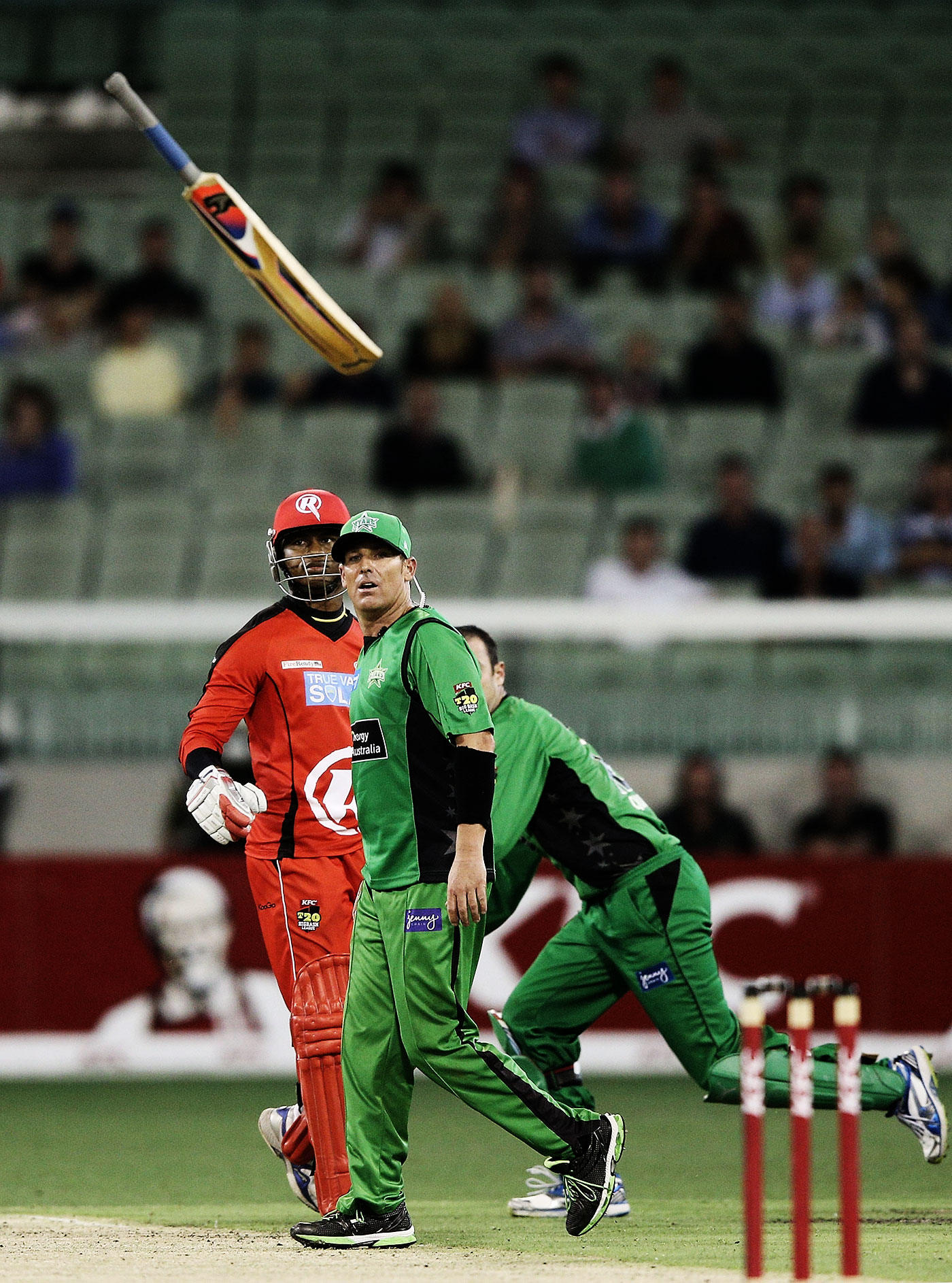
Samuels v Warne: unseemly or a marketing man's dream? © Getty Images
Sharda Ugra listed more than a few here; you can find another few from Osman Samiuddin here. And if you read any piece on Sandpapergate, you'll have found a few more. Australian cricket has always been synonymous with bad behaviour. It's a brand, or even a badge of honour.
A couple of years ago I was in a coffee shop with an Australian coach when one of the women's team players came by to talk about her next match. They were talking about one player who had played for them and had now moved to the opposition. The coach had worked with the cricketer who had moved, so he gave advice about all her weaknesses. Not one of them was technical or about how she played. They were all about her personality and perceived psychological tender spots. It was a perfect illustration of what Ugra described as "premeditated toxic confrontation, a drama scripted between balls".
And it's so deep within cricket's everyday fibre in Australia that it runs from the bottom to the top. When India captain Anil Kumble spoke of how only one team was playing in the spirit of the game in the aftermath of the Sydney Test of 2008, Sutherland responded with: "Test cricket is what is being played here. It's not tiddlywinks."
A few years later came the Big Bash stoush between Marlon Samuels and Shane Warne, where Warne walked down the wicket abusing Samuels and pulled at his shirt, after claiming that Samuels had interfered with a Stars batsman trying to run by pulling his shirt. A few balls later Warne seemed to throw the ball intentionally at Samuels from less than two metres away. Samuels responded by flopping his bat over Warne's head - like he wanted to throw it at him and at the last minute thought better of it.
Samuels was wrong to impede a Stars batsman, Warne was wrong to grab Samuels, Warne was wrong to throw the ball at Samuels, and Samuels was wrong to throw the bat. It was ugly and stupid, and both players should have been looking at long suspensions. Warne was suspended for one game, Samuels none, and Sutherland said, "To be honest I thought it looked like two teams playing in front of a very big crowd in a highly charged environment with a lot at stake. Players are entertainers, they're putting on a show, but first and foremost they're also sportsmen who are competing for big prizes, and I think whilst we can stand here and say we don't condone anything that happened last night, this sort of thing is probably something that only inspires a greater rivalry between the Renegades and the Stars and creates greater interest for the Big Bash League."
You know the problem is deep when the CEO of the board essentially says, "Hey kids, grab a bloke on the field, throw a ball at him, toss your bat dangerously. It just creates more interest. It's not tiddlywinks, you big silly."
And this is the body whose job is to police and organise Australian cricket. Instead, they have often sought to defend silly and offensive behaviour. This is the same organisation that helped cover up Warne and Mark Waugh receiving money from a bookie, who joined the Big Three so willingly, and banned three players for what was a systemic problem in Australian cricket. As Michael Holding once said, "The players are the kids, and the board are the parents." CA might be the adults in the room, but they also grew up in this society.

John Snow being manhandled by fans on the boundary was an early milestone in Australian crowds turning aggressive © Getty Images
They might now want to cleanse Australian cricket culture of the things that make it hard to market to families. And with Sandpapergate, they'll take a moment to try to be good, as they did in the aftermath of Phil Hughes' death. But they still believe in sledging, they still want to play hard, aggressive cricket. They still want to win.
Many Australians think this kind of behaviour helps them win.
''I think there's no doubt the team's performance has been affected. Hard, aggressive cricket is in the Australian team's DNA, and unfortunately the players started second-guessing their natural instincts in the heat of battle for fear of reprisal from Cricket Australia or public backlash from the vocal minority. I know for a fact that many of the opposition teams were seeking to exploit what they now saw as a weakness in the Australian team.''
That was Paul Marsh, son of Rod, and then CEO of the Australian Cricketers' Association, speaking in 2010-11.
"If you keep toning us down, toning us down, you'll make us the same as everybody else."
That was Ricky Ponting, the former captain and commentator, after Australia returned briefly to the top of the ICC rankings in 2014.
Australian cricket has always been this way, hasn't it? I mean, they're the bad guys, the aggressors, the mouthy ones, those who push the laws of the game, because that is what we can remember.
In fact, it was Australia - the first country to unleash a two-man pace attack capable of hurting people - who complained about Bodyline. And they didn't just complain because they were losing - they could have picked a team of quicks themselves. They did it because they thought it was against the spirit of the game.
Part of the early Ashes rivalry was based on Australia feeling aggrieved at things WG Grace did. Like when he "kidnapped" Billy Murdoch from the Australian dressing room before a match. Or perhaps the most famous one where he ran out Sammy Jones while the allrounder was off down the pitch, gardening.
Australians were the nice guys. Victor Trumper was a shining light of all things wonderful, Bill Ponsford was a hugely respected figure in the game, and Benaud would go on to be the game's voice and conscience. And sure, there was also Warwick Armstrong, who is probably ground zero for how Australian cricket came to be known, but it's not true that Australia was always that way.
And here is the thing: Australia were still great in this nice-guy era. Until 1970 they won 46% of their Tests; the next two best were England on 38% and West Indies on 33%. Australia produced the game's greatest player and dominated the Ashes. There was no talk of mental disintegration back then, the word "sledge" barely existed, and no one tried to break anyone's f****n arm. And yet they were still easily the best Test nation.
Since 1970, Australia have won 47% of their Tests; only South Africa are higher, at 49%. Pakistan are way back in third place, on 35%. And while South Africa have won a slightly higher percentage of Tests, they have not had a reign as dominant as Australia's, nor have they won a single ICC event. Australia have five World Cups. They are unquestionably the greatest cricket nation and have been for a very long time.

The way we were: spectators at a Test during the 1954-55 Ashes © Getty Images
They were not always the most hated cricket nation. That has built up over time, perhaps because of all the winning, perhaps because they bought into their own bullshit. The fundamental lie comes in those Paul Marsh and Ricky Ponting statements that have been repeated by so many Australian cricketers and fans over the years. They believe the sledging brought success, when it was the success that brought the sledging. Australian cricketers have never been better because they've sledged; they're just better, and because of that, they sledge.
And that is in part because Australia is a remarkable sporting nation. They have dominated men's and women's tennis, had multiple No. 1s in golf, invented a new stroke just to kill at swimming, and are consistently one of the highest-rated countries in terms of medals per capita at the Olympics. They've won world titles in netball, hockey, both forms of rugby, and despite having virtually no snow, have also won Winter Olympic golds. Melbourne has had two NBA No. 1 draft picks, Albury a WNBA MVP, Queensland has won 26 Olympic gold medals for swimming, and Canberra has provided a Formula One-winning driver. Mount Isa, a place in the middle of Queensland that the overwhelming majority of Australians will never visit, has produced a British Masters winner in golf and a US Open winner in tennis.
Most countries with a population of around 20 million aren't well known, let alone well known for dominating a sport. Australia has been on top of so many.
There's a book called The Lucky Country by Donald Horne, where the author writes: "Australia is a lucky country run mainly by second rate people who share its luck." "The lucky country" is a phrase still used, although not in the original negative sense Horne meant; more that of: aren't we lucky to be from here?
Well, Australia's sports are lucky too. If you planned an ideal nation for sport, Australia would be near perfect. There have been no major wars at home, most of the country is well above the poverty line, there is space for facilities, and the weather is incredible. Then you look at how sport grew. Starting as much to take down the English as for anything else, sport became part of Australia's national identity. At a local level, communities formed around playing and watching sport.
Australia is a tough country; colonising it took hard work. You had to take your chances, back yourself, and help your mates, just to survive. Every team, from the F grade on matting through to the baggy green, still has people who will put in for the side like they are playing for something bigger - the flag, their community, their mates, it doesn't matter. Australian athletes quite often play like they have a significant cause to win for. When you play them, you aren't taking on another team of athletes, you're taking on zealots.
Years ago, during a marathon, an Australian TV commentator pointed out that the top three runners were an Australian and two world-class Kenyans. He mentioned the two Kenyans had far better recent and personal bests. Then added, "But what they don't have is an Australian heart".

Bay 13 at the MCG shows off its wit and wisdom during a 2005 game © Getty Images
They might be more talented, but we'll fight harder and longer. We overlook all the other advantages that Australians have for sport, and just focus on the way we play it, and our giant Australian-made hearts. It doesn't matter if this is nonsense, or that Kenyans also have hearts, and that they would have loved to have grown up in a lucky sports country. It matters that Australian athletes believe in this notion of the cause, and that they try to live up to it.
It is all these reasons that make Australia a remarkable sporting nation that plays sport its own way.
But working out what the Australian way is in cricket is quite tough. A few years ago Russell Jackson took a look at Jack Pollard's book Cricket - The Australian Way. It talks a lot about how Australians play cricket and essentially boils it down to a slogan: play aggressive, positive cricket.
Darren Lehmann had his own lecture series, "The Australian Way", back in 2014. Sam Perry wrote about it:
"A glimpse at a presentation delivered by national coach Darren Lehmann in 2014 to invite-only coaches is instructive […] It outlined how Australia needed to play its cricket. It encouraged attendees to implement Lehmann's philosophy throughout the country. Understandably, it skewed to aggression.
A slide headlined 'Batting - Key Points' saw Lehmann note the importance of being 'aggressive in everything you do!', that '[our] first thought is to score', and that 'team philosophy is going to be aggression and freedom going forward'. The first point of his opening slide simply said 'WTBC' (translation: 'Watch the ball, c***'), going to show that even the most elementary aspect of Australian batting now requires aggression."
So how did Australian cricket get from "aggressive, positive cricket" to "hard, aggressive cricket" and "watch the ball, c***"?
Society changed. And Australia won a lot. They won everything. They beat England into oblivion, finally took down West Indies, collected World Cups, and then fought back against India's obvious challenge to their rightful No. 1 spot.
Did they do this with positive, aggressive cricket? Yes, but they also did it by creating the first truly professional cricket environment. Academies, coaches, sports science, dieticians, psychologists and many other advantages were there for the players. They found some of the most naturally talented players of all time. But it was also about the way their less than all-time great players, from the battlers to the incredibly gifted, were kept in the machine of Australian cricket.
It would seem that in the modern era, for Australia to be great it takes a lot more than positive, hard, aggressive cricket or watching the ball.
In his column for Players Voice after Sandpapergate, former Australia coach Mickey Arthur wrote about the team:
"The behaviour has been boorish and arrogant. The way they've gone about their business hasn't been good, and it hasn't been good for a while. I know what my Pakistani players were confronted with in Australia two summers ago. I heard some things said to the English players during the Ashes. It was scandalous. And I have seen many incidents like Nathan Lyon throwing the ball at AB de Villiers in this series."
[…] "There has been no need for the Australians to play this way. They are wonderful cricketers. They haven't needed to stoop to the depths they have to get results."
That seems like positive, aggressive feedback.
***
CRAIGIEBURN, Melbourne. 1995.
A lot of balls hit me in the chest, hard.
It was a semi-final for our under-16 team. We hadn't played well but had scraped through to the finals. We were playing the best side, Craigieburn. They were a decent team, with one outstanding player. They called him Killer; I think it was something to do with his surname. To anyone who played against him, he seemed a foot taller and thicker than anyone else in our competition. The name was apt.

Australians are past masters at needling you till you blow up, and then playing the victim Quinn Rooney / © Getty Images
We batted first and I opened, because no one else wanted to. Killer bowled downwind on a synthetic turf wicket, where even slow-medium bowlers get some bounce. He was a fair bit quicker than that, and every ball came up at my body. With a bunch of slips, a short leg and a leg gully, I wouldn't last long.
So I let the ball hit me in the chest. I'd never been hit by a quick bowler before, so the first one really stung. I was winded for a moment, as Killer laughed. But from then on in, as long as they didn't hit a vital organ or bone, I could take them. After a few hits, I was turning my back and ducking when he bowled short. The ball kept slamming into my back.
Every time Killer hit me, he got more upset. He started with glares, moved on to general abuse, told me he was going to retire me and made suggestions about my sexuality and gender along the way. His anger took over when he was tired. By the time he was near his tenth over, I could barely feel the ball hitting my back. And he could hardly scream about how shit I was.
After his last ball he stood mid-pitch, winded, clapping at me.
The next over a terrible bowler delivered a half-tracker and I skied it straight up in the air to be caught. Our batsmen fell apart - even without Killer - and we ended up with only 130 to defend.
Killer, like many under-16 superstars, opened the bowling and batting. A few weeks earlier we'd played him, and he'd driven a ball over the fence, past a 30-metre park area, across a road and into a tennis court. I knew that in an hour batting he'd score most of the 130 on his own. So I sledged him.
He was a big bloke who was known for bowling fast and hitting hard. I called him an ox. I just figured - rightly as it turned out - that he'd been named versions of that his whole life. Every time I called him an ox, he swung as hard as he could. He whacked a six and I told him he was too simple to play a real shot. He played and missed and I suggested that his ox brain couldn't handle a complex delivery. He mishit into a gap and I asked him if he wanted us to dumb the bowling down for him. Each ball he tried to hit further. A few disappeared; mostly they were clunked or missed.
I commentated each one, and he swung each time like the ball was my head.
His final delivery, he swung so hard that it was incredible his shoulders didn't dislocate. The ball took the top edge and the keeper completed a steepling catch. When it was caught, Killer dropped his head and trudged off with his quick 30-odd. I followed him off for a few steps before shouting at his back, "Bye-bye, Oxy, baby."
It was graceless and pointless. Also quite unhealthy, as Killer followed me with his bat raised for a few metres until one of our players caught him and suggested he leave the field. At the time I thought it was a masterstroke. But looking back, had we dotted him up, put pressure on him other ways - and we had the bowlers to get him out conventionally, perhaps for less than 30 - the new ball wouldn't have had a chunk of leather taken out from slamming onto a footpath. Either way, we lost the game.
I'd like to tell you that my embarrassment at being this big an idiot - not to mention the potential injury I could have received - meant I never did something that stupid again.
But the next time we needed to win a game, I was that idiotic. Over the next ten years, I did plenty of similarly stupid things to rile the opposition. There were times I claimed a catch I hadn't taken, tried faux mental disintegration, and looked the other way when my team were tampering with the ball. And in that time I went from the kid who learnt it to the adult who taught it.
I thought I was playing hard, aggressive cricket, the Australian way. Now it feels different; I was playing the game the way I had been taught, and because I didn't stand up to that, I was just another ugly Australian.