Search This Blog

Thursday, 23 January 2014

Judge the Royal Mail sale in three months, said Vince Cable. Time's up


Today's share price confirms the company was grossly undervalued, cheating the taxpayer out of billions of pounds

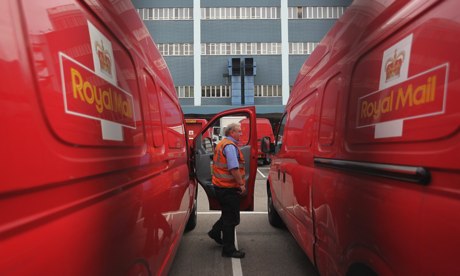
Royal Mail vans
'It turns out that the sale of Royal Mail was, in fact, completely botched.' Photograph: Dan Kitwood/Getty Images
"There's no way we will sell Royal Mail 'on the cheap'," promised the government in its Royal Mail: Myth-Busters factsheet, issued before the sale of most of our stake in the public asset, last October. Many commentators at the time thought the sale was irrational and the company grossly undervalued.
When shares finally opened for conditional trading, their price jumped from the government's valuation of 260p-330p each to more than 450p. The business secretary, Vince Cable, dismissed this as of "absolutely no significance … it is froth and speculation". He asked to be judged on what the price looks like in three months' time.
Well, three months have come and gone and the price of the shares is, at the time of writing, sitting pretty at over 600p each, with a high of 610p a few days ago – an 80% climb on their original price. This suggests that the company was undervalued by a giant £2.8bn: six times the projected saving this year by the imposition of the bedroom tax; six times the amount of money the government hopes to save by the imposition of a levy that is causing misery to thousands of vulnerable people and their carers up and down the country. And Royal Mail could have further to go yet. JP Morgan predicts the price will settle at about 700p a share. Earnings-per-share forecasts bear this out – they estimate a 30% gain this year.
So, now that it turns out that the sale of Royal Mail was, in fact, completely botched and has cheated citizens of billions of pounds' worth of value, where is the apology? Where are the resignations? If something like this had happened at local government level, there may have been questions of criminal prosecution. Why do our representatives in Westminster feel that they don't have to apologise when they get it so disastrously wrong, that they don't even have to give an account of themselves? They can simply ignore criticism; wave it away as if it were an unsavoury smell.
Goldman Sachs and UBS, the companies paid a stonking £16.9m by the government for managing the privatisation, were questioned about the price discrepancy by a parliamentary committee in November. They denied any impropriety, claimed the 330p price was correct according to their research and described the whole fiasco as a "well-executed transaction". Less than a week later, Goldman Sachs issued a note to its investors, advising them that the price of the shares would settle at about 610p.
When it emerged that the very companies advising on the sale were offered millions of shares in Royal Mail, shares which today represent a potential profit of over £35m, the Department for Business, Innovation and Skills said there was no possibility of conflict. This was because shares were offered to the investment arms of the banks and there are"Chinese walls" in place between them and any employees working on the sale. When it transpired that one of the biggest potential private beneficiaries from the flotation was hedge fund management company, Lansdowne Partners, and that George Osborne's best man, Peter Davies, was part of their management team, more denials came: "At no point was George involved in, or even made aware of, the allocations," said a Conservative spokesman. More "Chinese walls". Sir Paul Ruddock, Lansdowne's former chief executive, was awarded a knighthood last year after donating £500,000 to the Conservative party, although he denies the two are linked and stresses that his knighthood was for his services to arts.
Royal Mail has already announced its first post-privatisation price rise on business rates, explicitly to "help secure the sustainability of the Universal Service". Meanwhile, Royal Mail's chief executive, Moya Greene is rumoured to be in line for a £1.5m pay packet. After all, she has magically doubled the company's value in three months, hasn't she? Vince Cable is vowing to do his best to block such a package. Oh, the bitter irony … Vince Cable "playing boss", three months after selling the service, at a bargain basement price. Talking tough on a single payoff, three months after presenting City investors with a bumper £2.8bn bonus. Of our money.

The banking industry's biggest problem isn't bonuses or market share


The only way to make the sector pursue long-term viability instead of short-term greed is to change the rules of the game
Miliband banking speech
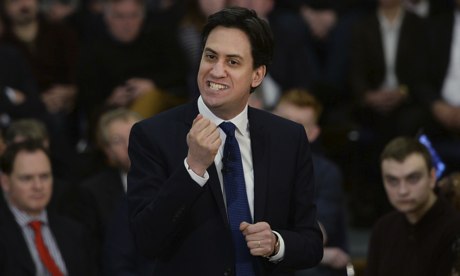
‘The fact that the political class, including Miliband himself, cannot even imagine state-owned banks ditching the business model that caused this crisis is a testimony to the power of the financial industry lobby.’ Photograph: Stefan Rousseau/PA
Last Friday, in another of those agenda-setting speeches for which he has rightly become famous, Ed Miliband took on the biggest of what he describes as "the broken markets" in the UK economy – the financial market.
Taking his "cost of living crisis" theme to another level, the Labour leader emphasised that the issue is not just about oligopolistic firms fleecing their customers; it is also about the lack of jobs with decent wages that can support decent standards of living. The problem with the British banking industry, Miliband pointed out, is not just about the concentration of financial power in the personal account market, but also in the business loan market.
According to Miliband's analysis, the dominant banks are not lending enough to small and medium-sized enterprises because they form a cosy oligopoly (controlling 85% of small business lending) that does not want to take any risk; enterprise loans are inherently riskier than mortgage and personal loans. Given that small businesses create most jobs in the UK (as they do in all countries), lack of finance for them is limiting the creation of decent jobs. The solution, he argued, is to introduce more competition into the small business lending market by capping the share of individual banks.
This proposal has caused much controversy. However, one thing is certain: it is going to be slow-acting. It may be years before proper "challenger" banks emerge, given the time necessary for the review by the Competition and Markets Authority – which takes over the roles of the Competition Commission and Office of Fair Trading from April – and for the process of selling branches.
But there is a quicker and simpler solution to this problem. It is for the government to use its ownership of two of the big four banks, RBS and Lloyds, to direct more lending to small businesses. Thanks to the bailout following the 2008 financial crisis, RBS is 81% owned by the government. This means it can tell RBS what to do. It also owns 33% of Lloyds, and while this does not give it a total control over the bank, it is well above what is normally considered a "controlling stake" in an enterprise.
Now, if you can basically tell two of the four largest banks what to do – say, to increase lending to small businesses – why go through the rigmarole of calculating their market shares and forcing them (and the other two) to sell off some of their branches?
The usual refrain is that Westminster cannot make RBS and Lloyds do things differently because, in order to survive, these banks need to behave like other competitors: generating as much profit and paying their staff as much.
This argument may be right if the existing business model of British banks and other financial companies is fine. But it is not. It is a business model that has caused the biggest financial crisis in 70 years and created imbalances and inequalities that threaten the future viability of the British economy. The fact that the political class, including Miliband himself, cannot even imagine state-owned banks ditching such a model is a testimony to the power of the financial industry lobby.
From the day when RBS and Lloyds were bailed out, the Labour government was at pains to emphasise it would run them along the same lines as before nationalisation. The only thing for which Labour and, subsequently, the coalition government have used the government's dominant shareholding position has been to restrain bonuses. But this is really missing the point.
The problem with bonuses in the financial industry is not about their levels – if someone makes a huge contribution to the economy, he or she should be richly rewarded. The main problem is that these bonuses are given to people for doing the wrong things well – things that harm the economy in order to enrich the shareholders, the top managers of banks and other financial firms.
So the real question is how we make banks and other financial firms pursue the right goals, rather than how much people should be paid, whether in bonuses or salaries. And the only way to make them pursue different goals from those they pursue now is to change the rules of the game.
Unfortunately, few regulations have been introduced since the crisis that have materially changed the goals of financial companies. The result has been "business as usual".
All those complex and risky financial products that were at the centre of the 2008 financial crisis – such as mortgage-backed securities, collateralised debt obligations, credit default swaps and other financial derivatives – are back in vogue again.
The credit rating agencies, whose incompetence and cynicism in rating those financial products has become legendary after the crisis, are still operating in the same way.
Thanks to Help to Buy, the mortgage-lending market is nearly back to its old self. Now you can get loans that are 95% equal to the value of the house – not quite the 125% you could get before the crisis, but nearly there.
In the absence of measures to encourage longer-term shareholding – for instance, by granting more votes or tax advantages – short term-oriented shareholders are still reigning supreme, putting pressures on banks to generate short-term profits, whatever the consequences.
The main problem with the British financial industry is not the level of bonus, or even the concentration in the banking sector; it is that the industry is pursuing goals that are detrimental to the long-term economic viability of the country, in the process enriching only a tiny minority and sapping human and financial resources from the rest of the economy.
Unless those goals are changed through better regulation, the industry will remain harmful to the rest of the economy, whatever we do about bonuses and market concentration.

Wednesday, 22 January 2014

Cost of living? What about the cost of being dead?


The spiralling price of funerals is a symptom of the triumph of the market and the accompanying poverty of civic life
belle funeral
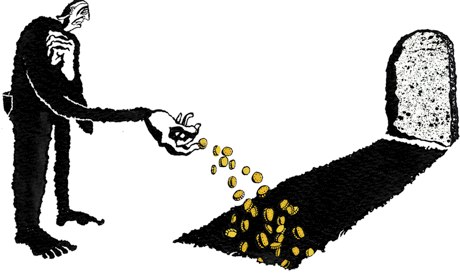
There is 'always the tacit suggestion that if you cared a tiny bit more, you would pay a tiny bit extra. It is, again, the things we don't talk about that cost us the most, the reckoning that happens in the dark.' Illustration by Belle Mellor
"F uneral poverty" – that's the phrase they use at the National Association of Funeral Directors. Like "fuel poverty", "heat poverty" and "child poverty", this is just a long way of saying "poverty": another way to express the situation in which an event or thing that everybody will sometime need is nevertheless hopelessly out of reach of a fair proportion of them. One in five people can't afford funerals – given that the "cost of dying" now averages £7,622, the number of people who are knocked sideways by it financially, for years afterwards, probably considerably exceeds 20%.
That phrase "the cost of dying" has sacrificed accuracy for tact. This is the cost of being dead: the funeral, the cars, probate, the flowers that say "Best Dad Ever", the burial or cremation. If you factor in the costs before death, it's eye-popping. People rarely drop down dead. They have protracted illnesses, they seem like they're going to die and then don't; all emergencies are real, and to count the cost of anything would be sacrilege, and a fast track to bankruptcy.
This inability to tether the process to reality is an offshoot of being unable to talk about death: any discussion of the realities around it is seen to cheapen it. Death, when it eventually arrives, comes at the end of galloping spending, like typhoid at the end of a winter of malnutrition. If they say it costs seven grand, that is a good deal less than it has actually cost.
Why is this news? Because it's not simply expensive, it is "inflation busting", having gone up by 80% since 2004. It sounds like a lot; in fact, energy costs are still worse, having more than doubled over the same period. But that comparison doesn't help, merely ramming home the unaffordability of life in a world where costs soar and wages plateau.
There are a couple of reasons specific to the funeral business for these price rises, however, and both say something about the market generally. First, the cost of a burial plot has increased, as the cost of land has gone up. This makes it a postcode lottery, in which a death in rural Wales will be slightly less crippling than one in Wimbledon; but all postcodes have stayed in the slipstream of inflation, whether their land value has gone up or not. This is at the outermost ripple of the situation we've created for ourselves in which our land is worth much more than anything we earn or do or produce. Can we afford to be buried? Can we afford town halls? Zoos? Can students afford to live near universities?
Basically, no. Those days when a city was built to serve its inhabitants, with the commonly used areas in the middle and the private housing round the edge – those days when the centre of town contained things useful to a population, things like fire stations and schools? Those days are over. Those days have been sold to a Russian oligarch, whose nationality is, of course, not relevant from a racist point of view; it is there to underline how physically distant are the people whose interests are being served by the new equations.
An interesting side point is that councils, ratcheting up burial costs to keep pace with the value of the land, rack up cremation costs at the same time. Well, duh, why wouldn't you? You're in charge; it's not as though anyone can shop around. And here, bad ethics have chased out good ethics, since the latter are the instincts from which the private sector protects itself with competition. Councils shouldn't have to dream up checks and balances to stop themselves ripping off the communities they serve.
But even where competition does thrive, in the funeral industry itself, you see the spectacle of the ceremonial rip-off, wedding economics done sotto voce. Everybody makes poor financial decisions when they're recently bereaved. We put a notice in the Times for my dad, saying, "After a short and ultimately quite half-hearted fight with cancer, Mark Williams has died". Dropped 400 quid making a weak joke at a dead man's expense. And in the Times!
But that doesn't excuse the relentless upselling of the funeral director, the stupid lacquers and extra-price finishes, and always the tacit suggestion that if you cared a tiny bit more, you would pay a tiny bit extra. It is, again, the things we don't talk about that cost us the most, the reckoning that happens in the dark.
"What do people do," John Humphrys asked on BBC radio's Today programme, of Kate Woodthorpe from the University of Bath, "if they just can't afford a funeral?" The council does it, naturally – someone has to. The deceased themselves are too dead to fail. Humphrys and Woodthorpe then reminisced, briefly, about the days when a "pauper's funeral" was a source of shame, when people's own sense of propriety prevailed.
This is a classic manoeuvre – you take financial pressures that are quintessentially modern and then nostalgically lament the fact that people don't deal with them as they would have in the olden days. Expensive heating? In the olden days, they would have worn more jumpers. Unaffordable funerals? They would have saved harder. Food poverty? They would have eaten more potatoes.
All those things may be true, but that era was never characterised by acquiescence. The same people who were too proud for a pauper's funeral would have been too proud to be priced out of their own civic space, out of their own life cycle.

Lottery of NHS drugs punishes the dying


Thousands of patients denied life-extending treatments approved by health watchdog

Thousands of patients denied NHS drugs for major diseases
Despite certain drugs approved by the NHS rationing body, at least 14,000 patients a year are not receiving them Photo: ALAMY
Thousands of patients suffering from cancer and other serious illnesses are being denied the drugs they need from the NHS, according to a report.
Even though the treatments have been approved by the health service rationing body, at least 14,000 patients a year are not receiving them.
As many as one in three of those suffering from some types of cancer are going without medication that could extend their lives, the figures show.
Experts said the report, from the Health and Social Care Information Centre, a government quango that provides NHS statistics and analysis of trends in health and social care, exposed an “endemic and disastrous postcode lottery” of care within the health service.
Charities said the findings were “alarming” and meant patients were being condemned to an early death because local NHS bodies were failing to fund drugs even though they had been proven to work. 
When the National Institute for Health and Care Excellence (Nice) was created by the last Labour government, officials promised to end the variation in medical treatment across the country and ensure that if a drug was found to be effective, patients should not have to fight to get it.
However, the findings show that thousands of patients suffering from cancer, motor neurone disease and an eye condition which is the most common cause of blindness, are not being given the best medication.
The research examined 10 common treatments which have been backed by Nice, meaning they should be given to all patients who require them.
It found that in three of the groups, there was a gulf between the number of patients who should have been given the drugs and the numbers who were actually prescribed them.
The worst findings were for kidney cancer, which affects more than 8,000 patients a year, and for a form of motor neurone disease which affects almost 3,000 people.
One in three patients who could have benefited from sunitinib (which has the brand name Sutent) and pazopanib (brand name Votrient), life-extending drugs for kidney cancer, or from riluzole (brand name Rilutek), the only treatment for motor neurone disease, did not receive them.
More than 12,000 patients were denied injections for wet age-related macular degeneration (AMD), the most common cause of vision loss and blindness.
Nice makes rulings on whether drugs are effective and good value, but has been criticised for refusing to support drugs in the face of evidence that they can extend lives by months or even years, and for delaying decisions.
But the findings suggest that even when Nice says NHS bodies must fund the drugs, thousands of patients are still denied medication.
Charities said too many terminally-ill patients ended up fighting bureaucratic procedures in an attempt to secure NHS funding for treatment.
In other cases, they were never told about drugs such as Sutent, which can double life expectancy with kidney cancer to 28 months, and was approved by Nice more than four years ago.
Andrew Wilson, the chief executive of the Rarer Cancers Foundation, said patients were suffering from “an endemic postcode lottery in access to Nice-approved medicines”.
“It is extremely worrying that the NHS does not seem to be making available cancer treatments to all patients who could benefit, even when the drug is approved by Nice,” he said.
Nick Turkentine, the chief operating officer of the James Whale Fund for Kidney Cancer, said the failure to follow national guidance was “a disaster” for patients with aggressive cancers. He said: “Sutent was one of the first drugs to be approved for kidney cancer — it is really disastrous that patients are still having to battle for a drug which we know can give several extra years of life.”
Duleep Allirajah, the head of policy at Macmillan Cancer Support, said: “Patients do not choose which cancer they get. Every patient deserves equal access to treatment no matter who they are, where they are from, or which cancer they have.”
A spokesman for Nice said the organisation hoped the report would help ensure that guidance was followed more widely, and that local NHS groups needed to be able to justify variations from it.
A spokesman for the Department of Health said: “Patients have a right to drugs and treatments that have been approved by Nice and we expect the NHS to provide them if they are needed.
“That is why the chief executive of the NHS has written to the local NHS requiring them to publish which NHS organisations are funding and using drugs and treatments approved by Nice, and which are not.”
Drugs whose use was lower than expected:
• Riluzole (Rilutek) - the only treatment for motor neurone disease - 35 per cent of patients who would have been expected to receive the drugs did not.
• Sunitnib (Sutent) and pazopanib (Votrient) for kidney cancer - 32 per cent of patients who would have been expected to receive the drugs did not.
• Ranibizumab (Lucentis) - the most effective treatment for wet age-related macular degeneration, which can cause blindness - 5 per cent of patients who would have been expected to receive the drugs did not.

Tuesday, 21 January 2014

The truth is we are all living on Benefits Street


Everyone is on the take, and whole industries are on white-collar subsidies. Some of us are just smarter at concealing it
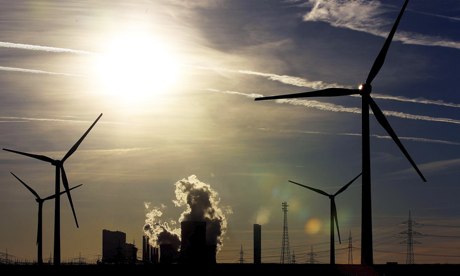
Wind turbines in front of a power plant
‘Child benefits, agriculture subsidies, wind-farm subsidies, house-buying subsidies, arts subsidies and tax avoidance schemes may satisfy the political and electoral goals of passing ministries, but then so do subsidies to the poor.’ Photograph: Alamy/DPA
Let's face it, we all live on Benefits Street. The Channel 4 series may be raising hackles to left and right, but I doubt if there is a person reading this column who is not "on the take" in some sense. We may work a bit, mostly obey the law and not look a total mess, but then we are not really poor. We can still be "on benefit", and some of us are rich because of it.
I was once driving down a country lane with a diplomat friend when we slowed to a crawl behind a tractor. My friend finally lost patience and blurted out that he could count "seven different subsidies" holding us up ahead. He listed them in a rage.
I proceeded to ask after his relocation allowances, subsidised school fees and index-linked pension. He retorted with my heating grants, tax deductions and charity reliefs. I asked which state-funded arts consultancy employed his daughter and which awareness-raising quango kept his son from occupying the family nest. We were about to deflect to the banker in a nearby Cotswold manor, snorting his quantitative easing, when the tractor turned off into a higher-level stewardship meadow to plan a subsidised wind farm. We bowled on down our own benefits lane.
We are all on the game: some of us are just smarter at concealing it. I have a book on my shelf by the Americans Mark Zepezauer and Arthur Naiman called Take the Rich Off Welfare. It glares down at me whenever I think of writing about poverty. It shows how well-heeled Americans, starting in the Reagan years, cornered the lion's share of public spending. They had capital depreciations, fiscal reliefs, muni bonds, fuel subsidies, bailouts, price supports, cultivated waste and tax frauds. It was called "wealthfare".
This was no leftwing tract. It merely pointed out that "wealthfare costs the American taxpayer some three-and-a-half times the cost of welfare for the poor". The relentlessness of the rich lobbying Congress for tax breaks and subsidies meant "the US government today functions mostly as a huge Robin Hood in reverse". If there is money going begging, those who beg loudest get most.
By this book lay other revelations of fiscal outrage. There was The Sacred Cow (agriculture), Putting Patients Last (the NHS), The Terrible Truth about Lawyers (law), A Dinosaur in Whitehall (defence) and Plundering the Public Sector (consultants). The loftier the profession, the wilder the scams. Looming over them was JK Galbraith's pre-crash diatribe, The Economics of Innocent Fraud. After skimming this lot, I thought Benefits Street was like a meeting of the Mothers' Union.
Of course, many of these beneficiaries do serious jobs and rarely break the law. But then, they can get their hands on other people's money without stealing it. One in five British employees now works for the state. In addition to their pay, they have negotiated index-linked pensions that cost the taxpayer £9bn a year, beyond the dreams of those working for themselves.
This is merely the tip of the iceberg. Child benefits, agriculture subsidies, wind-farm subsidies, house-buying subsidies, arts subsidies and tax avoidance schemes may satisfy the political and electoral goals of passing ministries, but then so do subsidies to the poor. Benefits Street's denizens may do drugs, door-to-door selling, odd jobs and pilfering. At least I know them. Running down the Guardian's interactive guide, Visualising Whitehall, I am not sure what is meant by "corporate development, change delivery, compliance strategy". They sound like upmarket benefits scrounging to me. I am sure Benefits Street's White Dee would say she was in human resources strategic delivery if she realised it held the key to George Osborne's wallet.
Whole industries are on white-collar Benefits Street. Higher education, despite fees, is a cross-subsidy from taxpayers (including the poor) to mostly middle-class students and professors, now to the tune of billions of pounds a year. The construction industry is a monument of public plutocracy. Having pocketed £9bn from the Olympics, it is now building Crossrail and hopes to win HS2 and Heathrow Three. Its housebuilders are eating their way through Osborne's soaring subsidies. These projects are essentially tax transfers from poor to relatively (or very) rich.
"Austerity Osborne" claims to be cutting back on public sector jobs to boost private ones. He is shortening Benefits Street to lengthen Enterprise Alley. Public sector employment is falling overall, but the fall is in lower-paid local government jobs outside Osborne's control. His personal Benefits Street, known as Whitehall, actually grew last year by 50,000 jobs. Austerity is always for the other guy.
Eight years ago, David Craig's Plundering the Public Sector calculated that 10 years of New Labour had seen £70bn vanish from taxes into management consultancy, PFI and IT fees, to no noticeable public gain. Most Whitehall IT projects had been fiascos, and there is a new one each week. The beneficiaries have been the rich: firms such as KPMG, Deloitte, PwC, Capita, Serco, McKinsey and others. Today's public accounts committee may howl about waste, but the stable is bare and the horses are over the horizon laden with gold.
None of this approaches the greatest benefits scam of all, the accumulation of public and private debt incurred by today's citizens at the expense of future taxpayers and interest payers. Britain's public and private debt together runs to some 500% of GDP, by far the highest ratio in history. Such benefits to today's citizens – in pensions, housing, travel, lifestyle – are at the expense of tomorrow.
As Niall Ferguson said in The Great Degeneration, his 2012 Reith lectures revised in book form, equitable finances have long relied on trust between one generation and the next. He concludes: "The enormous inter-generational transfers implied by current fiscal policies [are] a shocking and perhaps unparalleled breach" in that trust. The young are entitled to see parents and grandparents as all on benefits at their expense. The pensions time-bomb is real.
Like all journalism, Benefits Street tells a partial truth. Its lesson is banal, that any group of people will live according to their means. At least Iain Duncan Smith is making the first ever serious effort at reform – crippled by computer failure by another sub-contractor beneficiary. But in fairness, Channel 4 should now go for somewhere far harder. It should move from Benefits Street to Subsidy Row and dig out the serious scroungers.

Monday, 20 January 2014

Trickle-down economics is the greatest broken promise of our lifetime


The richest 85 people in the world have as much wealth as the poorest 3.5bn. That should be a wake-up call to the deepest sleepers
Inequality
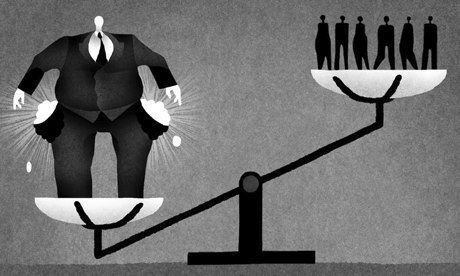
'The realisation must dawn soon – one hopes – that this model is unsustainable because its effects are uncontrollable.' Illustration: Matt Kenyon
The richest 85 people in the world have as much wealth as the poorest 3.5 billion – or half the world's entire population – put together. This is the stark headline of a report from Oxfam ahead of the World Economic Forum at Davos. Is there a reason why the world's powerful, gathering at the exclusive resort to sip cognac and eat blinis, should care? Well, yes.
If one subscribes to the charitable view that neoliberal philosophy was simply naive or misguided in thinking that "trickle down" would work infinitely, then evidence that it doesn't, should be cause for concern. It is a fundamental building block of supply-side economic theory – the tool of choice these past few decades for those in charge to make adjustments. The realisation that governments have been pulling at economic levers which, for some time, have been attached to nothing, should be a wake-up call to the deepest sleepers.
Even if one subscribes to the cynical view that the elite knew what they were doing all along, observing that the "rising tide" is lifting fewer and fewer boats and leaving more and more to rot in the sediment – both at a personal and national level – must make most wonder "am I in the right boat and is it big enough?" Concentration is rampant. Credit Suisse estimates that the world will have 11 trillionaires within two generations.
It is not so much that the supply-side principle "if you build it, they will come" is no longer true. It is more that we appear to have passed a tipping point, where so much wealth has been concentrated at the top, they no longer need bother to "build" anything. In short, it has become more economically efficient to buy countries' economic policy than to create value in order to sell it on. If one can control government to favour the richest, while raising barriers for new entrants, thus increasing their share of the pie exponentially, what is the incentive to grow the pie?
This applies to both companies and individuals. Small business gets clobbered by taxes and business rates, while big business turns around and says to the state: "This is how much tax I fancy paying this year, take it or leave it". The rich no longer create jobs, through a process of consolidation, takeover and merger, they actually destroy them.Zero-hours contracts are the way of the future; in a society that is hungry, desperate and devoid of political engagement or unionism, why would anyone offer terms and conditions that give individual workers any standing?
And yet, the realisation must dawn soon – one hopes – that this model is unsustainable because its effects are uncontrollable. The more unequal we become as a society, the faster the top's earnings diverge from the bottom's. "When so much of the purchasing power, so much of the economic gain, goes to the very top," Bill Clinton's former labour secretary Robert Reich explains in the film Inequality For All. "There's simply not enough purchasing power in the rest of the economy." At the same time, there is far too much loose cash sloshing around at the top, leading to unwise risks and toxic investments. Wealth inequality in the US was at its highest levels, historically, in 1928 and 2007, one year before its two biggest financial crises, notes Reich. The base of the pyramid atrophies and begins to crumble.
Then why are most governments continuing to fiddle with supply-side levers in order to revive the economy, when it is abundantly clear it does not work? The simple answer is in two parts. First part: habit. The second was perfectly expressed by the creator of The Wire, David Simon: "That may be the ultimate tragedy of capitalism in our time, that it has achieved its dominance without regard to a social compact, without being connected to any other metric for human progress."
We have come to measure, to an increasing extent, individuals' success by their wealth, spending power and other assorted trappings. We do the same with the economic success of governments; measure it by an aggregated data set that fails to take into account wealth distribution, educational achievement, innovation, or even the welfare and health of the population they claim to represent. We must shift this perspective. It will be the hardest, simplest thing we have ever had to do as a species.

Sunday, 19 January 2014

The challenge of leaving a faith - From Islam to Atheism

Sarah Morrison in The Independent

Amal Farah, a 32-year-old banking executive, is laughing about a contestant singing off-key in the last series of The X Factor. For a woman who was not allowed to listen to music when she was growing up, this is a delight. After years of turmoil, she is in control of her own life.

On the face of it, she is a product of modern Britain. Born in Somalia to Muslim parents, she grew up in Yemen and came to the UK in her late teens. After questioning her faith, she became an atheist and married a Jewish lawyer. But this has come at a cost. When she turned her back on her religion, she was disowned by her family and received death threats. She has not seen her mother or her siblings for eight years. None of them have met her husband or daughter.

“It was the hardest thing I’ve ever done – telling my observant family that I was having doubts. My mum was shocked; she began to cry. It was very painful for her. When she realised I actually meant it, she cut communication with me,” said Ms Farah. “She was suspicious of me being in contact with my brothers and sisters. She didn’t want me to poison their heads in any way. I felt like a leper and I lived in fear. As long as they knew where I was, I wasn’t safe.”

This is the first time Ms Farah has spoken publicly about her experience of leaving her faith, after realising that she did not want to keep a low profile for ever. She is an extreme case – her mother, now back in Somalia, has become increasingly radical in her religious views. But Ms Farah is not alone in wanting to speak out.

It can be difficult to leave any religion, and those that do can face stigma and even threats of violence. But there is a growing movement, led by former Muslims, to recognise their existence. Last week, an Afghan man is believed to have become the first atheist to have received asylum in Britain on religious grounds. He was brought up as a Muslim but became an atheist, according to his lawyers, who said he would face persecution and possibly death if he returned to Afghanistan.

In more than a dozen countries people who espouse atheism or reject the official state religion of Islam can be executed under the law, according to a recent report by the International Humanist and Ethical Union. But there is an ongoing debate about the “Islamic” way to deal with apostates. Broadcaster Mohammed Ansar says the idea that apostates should be put to death is “not applicable” in Islam today because the act was traditionally conflated with state treason.

Some scholars point out that it is against the teachings of Islam to force anyone to stay within the faith. “The position of many a scholar I have discussed the issue with is if people want to leave, they can leave,” said Shaykh Ibrahim Mogra, the assistant secretary general of the Muslim Council of Britain. “I don’t believe they should be discriminated against or harmed in any way whatsoever. There is no compulsion in religion.”

Baroness Warsi, the Minister of State for Faith and Communities, agreed. “One of the things I’ve done is put freedom of religion and belief as top priority at the Foreign Office,” she said. “I’ve been vocal that it’s about the freedom to manifest your faith, practise your faith and change your faith. We couldn’t be any clearer. Mutual respect and tolerance are what is required for people to live alongside each other.”

Yet, even in Britain, where the freedom to change faiths is recognised, there is a growing number of people who choose to define themselves by the religion they left behind. The Ex-Muslim Forum, a group of former Muslims, was set up seven years ago. Then, about 15 people were involved; now they have more than 3,000 members around the world. Membership has reportedly doubled in the past two years. Another branch, the Ex-Muslims of North America, was launched last year.

Their increasing visibility is controversial. There are those who question why anyone needs to define themselves as an “ex-Muslim”; others accuse the group of having an  anti-Muslim agenda (a claim that the group denies).

Maryam Namazie, a spokeswoman for the forum – which is affiliated with the Council of Ex-Muslims of Britain (CEMB) – said: “The idea behind coming out in public is to show we exist and that we’re not going anywhere. A lot of people feel crazy [when they leave their faith]; they think they’re not normal. The forum is a place to meet like-minded people; to feel safe and secure.”

Sulaiman (who does not want to reveal his surname), a Kenyan-born 32-year-old software engineer living in East Northamptonshire, lost his faith six years ago. His family disowned him. “I knew they would have to shun me,” he said. “They are a religious family from a [close] community in Leicester. If anyone [finds out] their son is not a Muslim, it looks bad for them.” He added that people “find it strange” that he meets up with ex-Muslims, but he said it is important to know “there is a community out there who care about you and understand your issues”.

Another former Muslim in her late twenties, who does not want to be named, said the “ex-Muslim” identity was particularly important to her. “Within Islam, leaving [the religion] is inconceivable. [The term] atheist doesn’t capture my struggle,” she said, adding that her family does not know the truth about how she feels.

Pakistani-born Sayed (not his real name), 51, who lives in Leeds, lost his faith decades ago. He left home at 23 and moved between bedsits to avoid family members who were looking for him. He told his family about his atheism only two years ago. “I was brought up a strict Muslim, but one day, I realised there was no God,” he said. He told his mother and sister by letter that he was an atheist but they found it difficult to comprehend.

“Whenever I tell my sister or my mum that I am depressed, stressed or paranoid, they say it’s because I don’t pray or read the Koran enough,” he said, adding that he will not go to his mother’s funeral when she dies. “I won’t be able to cope with the stress or the religious prayers. There’s quite a lot of stigma around.”

Iranian-born Maryam Namazie, 47, said that it does not have to be this way. Her religious parents supported her decision to leave their faith in her late teens. “After I left, they still used to whisper verses in my ear for safety, but then I asked them not to. There was no pressure involved and they never threatened me,” she said. “If we want to belong to a political party, or religious group, we should be able to make such choices.”

Zaheer Rayasat, 26, from London, has not yet told his parents that he is an atheist. Born into a traditional Pakistani family, he said he knew he didn’t believe in God from the age of 15.

“Most people transition out of faith, but I would say I crashed out. It was sudden and it left a big black hole. I found it hard to reconcile hell with the idea that God was beneficent and merciful.

“I’m sort of worried what will happen when [my parents] find out. For a lot of older Muslims, to be a Muslim is an identity, whereas, for me, it’s a theological, philosophical position. They might feel they have failed as parents; some malicious people might call them up, gloating about it. Some would see it as an act of betrayal. My hope is that they will eventually forgive me for it.”