Search This Blog

Friday, 12 April 2013

Mark Steel: You can't just shut us up now that Margaret Thatcher's dead


Maybe a more modern way of broadcasting the news would have been for Davina McCall to announce it, saying: “She’s gone, but let’s have a look at some of her best bits.” Then we could see her denouncing Nelson Mandela as a terrorist and befriending General Pinochet.

Instead it began as expected, with the Hurds, Howes and Archers phoning in their “remarkables” and “historics”, and we were reminded how she brought down the Berlin Wall and rescued Britain, then an article in The Times claimed she was responsible for ending apartheid, and it seemed by today we’d be hearing she stopped Gibraltar being invaded by Daleks and made  our goldfish feel proud to be British and took  8 for 35 against Australia to win the Ashes.

“Even those who disagreed with her, respected her as a conviction politician”, it was said many times, as if everyone would participate in the mourning. But soon it was impossible to pretend there was a respectful consensus, not because of the odd party in the street, but from a widespread and considered contempt. In many areas it must have been confusing for Jehovah’s Witnesses, as every time they knocked on a door and asked, “Have you heard the good news”, they’d be told “Yes mate, I have, do you want to come in for a beer?”

Before long came the complaints, such as Tony Blair saying: “Even if you disagree with someone very strongly, at the moment of their passing you should show some respect.” Presumably then, when Bin Laden was killed, Blair’s statement was: “Although I didn’t agree with Osama’s policies, he was a conviction terrorist, a colourful character whose short films were not only fun but educational as well. He will be sadly missed.”

The disrespect was inevitable, as millions were opposed to her not because they disagreed with her, but because she’d helped to ruin their lives. If someone robs your house, you don’t say: “I disagreed with the burglar’s policy, of tying me to a chair with gaffer tape and stripping the place bare, even taking the pickled onions, which I consider to be divisive. But I did admire his convictions.”

For example, a Chilean woman living in Britain was quoted in The Nationmagazine, saying: “The Thatcher government directly supported Pinochet’s murderous regime, financially, via military support, even military training. Members of my family were tortured and murdered under Pinochet, who was one of Thatcher’s closest allies and friend. Those of us celebrating are the ones who suffered deeply.” Yes, but she was able to buy shares in British Gas so she was better off in other ways. In so many areas, the party that insists we show compassion for their departed heroine made a virtue of showing none when she was their leader. She didn’t just create unemployment, she gloried in it. Her supporters in the City revelled in their unearned wealth all the more because they could jeer at those with nothing.

But this week Thatcher fans have been unrestrained in their abuse for anyone not displaying “compassion”. Maybe we should give them the benefit of the doubt and accept they’ve just discovered it. They’re all going to the doctors saying: “I’ve been getting this strange sort of caring feeling towards someone who isn’t me. Do I need antibiotics?” If they’re puzzled as to why there isn’t universal sadness this week, maybe they should visit Corby. It’s a town that was built in the 1930s, entirely round a steelworks, and thousands of unemployed Scots moved there for the work. As a result its people still have a strong Scottish accent, even though it’s in Northamptonshire.

But in 1980 Margaret Thatcher’s government shut down most of the steel industry, as part of her plan to break the unions, and the effect on Corby was like someone taking control of the Lake District and concreting in the lakes.

I was there to record a radio show about the town, and met Don and Irene, both in their seventies, at the Grampian Club. Don’s father had walked to Corby from Larkhall, near Glasgow, in 1932. I mentioned the steel strike and plant closure to Don, but he gestured as if it had somehow passed him by. It would have to be mentioned in the show, so I tried to find someone in the town with a story, an anecdote, something. But no one wanted to say a thing about it. During the recording, I asked if anyone had a story to tell from those days, but no one did, until it felt as if the whole audience collectively passed a motion that went: “I think you’d best move on to another subject, Mark.”

Afterwards in the bar, Irene told me: “We weren’t being rude, love, when we didn’t have a lot to say about the closure. But it wasn’t an easy time. Don marched from Corby to London with a banner. It made him angry about everything, we split up for a year because it was too much to live with. But we were lucky, two of our closest friends committed suicide in the months after the closure. So people would rather forget about those times really. But apart from that we really enjoyed the show.”

Still, even those who disagree with her policies, will surely commend her achievements.
Strangely, it’s now her supporters who are insulting her memory, with a funeral paid for by the taxpayer. Surely it would be more fitting to leave her where she is, and say: “If you can’t stand on your own two feet, you can't expect help from the state.”

Wednesday, 10 April 2013

The Herbalife saga is practically a made-for-Hollywood script


Herbalife is a diet company that excels at drama. It has Wall Street titans sparring, KPMG resigning and investors confused
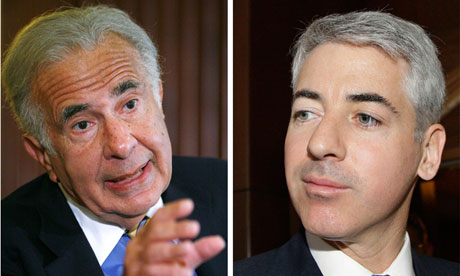
Bill Ackman and Carl Icahn
Bill Ackman (right) traded insults with fellow hedge funder Carl Icahn on television over Herbalife. Photograph: Reuters
There is something about diet company Herbalife that makes very rich men act very strangely. The weight-loss company should be relatively unremarkable. Instead it's been in the center of a dramatic story that should have Hollywood calling.
It has everything – intense, dashing hedge-fund titans embroiled in a public war, allegations of pyramid schemes, billions of dollars riding on on the outcome and now, as of today, a rogue auditor who risked his entire career by allegedly squirreling away inside information to make himself a profit. The Herbalife scandal even features Carl Icahn, one of the 1980s corporate raiders who reportedly inspired the timeless capitalist character of Gordon Gekko. If Wall Street wars got Oscars, Herbalife would be a top contender.
With so much heady money and power surrounding Herbalife, it's no surprise that the wafting scent of greed would envelop one of the people whose virtue should have been above reproach: the company's auditor, the prestigious accounting firm KPMG.
Auditors are not glamorous people. If investment bankers are the popular, fratty jocks of the financial world, and traders are the kids who love to hang out with their Camaros, auditors are more like the bespectacled stars of the math team. They are accountants – precise and cautious by nature – and, as a result, they have all the usual attendant social insecurities that nerds do: they're so happy just to be invited to the party that they may not judge too carefully the underage drinking and drugs that are going on. When auditors get into trouble – as they did with companies like Enron and WorldCom – it's usually because they were too eager to please their clients that they kept quiet when they saw something wrong. They didn't want to lose their place at the party.
So the "rogue auditor" is a rare character to cast. Auditors are often guilty of neglect, or looking the other way; rarely do they do something really bold and reckless like trade on inside information. Yet, apparently prompted by the drama around Herbalife, this is what a partner with the company's auditor, KPMG, did, according to Herbalife.
KPMG fired the rogue auditor on 5 April and told Herbalife about the whole debacle yesterday. This morning, Herbalife's stock was halted for an unusually long time – two hours – as the company tried to decide how to tell investors.
During that time, traders and journalists took to Twitter to speculate on what could possibly be so horrible that it would require the company to completely stop trading its stock for most of the morning.
The answer, it turns out, was pretty bad.
The partner at KPMG was entrusted with combing Herbalife's financial statements for errors. Unfortunately, according to Herbalife's version of the story, he also shared the company's confidential information with someone else, presumably so they could make a profit of their own. That would give him an incentive to mess with the company's results to help his own financial interests. As a result, KPMG's entire opinion on the company is reduced to worthless chaos; the auditor said it had to withdraw its reports on Herbalife for the last three fiscal years.
Herbalife, already embroiled in months of wars between its investors, hastened to assure everyone that the company was still sound. It stressed that KPMG had resigned as its auditor purely because of the possible insider trading and "not for any reason related to Herbalife's financial statements, its accounting practices, the integrity of Herbalife's management or for any other reason".
Herbalife managed to contain the damage: by halting the stock for two hours, it had raised expectations that the news would be far worse. The stock fell only 1% on the news when it finally came out. However, there was still evidence of chaos. In the same statement, Herbalife said that KPMG had said the three years of financial statements could both be "continued to be relied upon" and "should no longer be relied upon".
So that clears things up.
This only adds another twist for the Herbalife saga that's been playing out on the larger Wall Street stage. It was only three months ago that the distinguished Carl Icahn was publicly trading insults on television with Bill Ackman, the silver-haired, baby-faced boy wonder of investing. Ackman has argued that Herbalife is a pyramid scheme and has bet against the company; Icahn took the other side of the bet. Daniel Loeb, who was previously a friend of Ackman's, shocked the investing world by switching allegiances and taking Icahn's side.
There's a lot more information that has yet to come out about the problem with KPMG and Herbalife. That's good if you're in Hollywood. It means there's enough time to run through the casting. What do you think of Alan Alda, Elliott Gould, or Frank Langella to play Carl Icahn? John Slattery to play Bill Ackman? Michael Sheen as Dan Loeb? Philip Seymour Hoffman as the rogue auditor?
Now who's going to call John Grisham and tell him about all this?

Margaret Thatcher and misapplied death etiquette


The dictate that one 'not speak ill of the dead' is (at best) appropriate for private individuals, not influential public figures
Margaret Thatcher
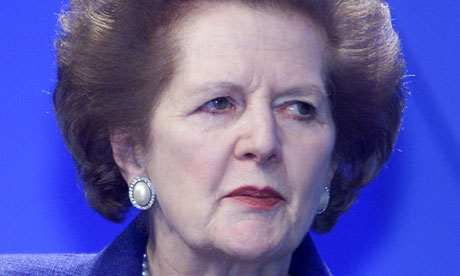
Margaret Thatcher Photograph: Don Mcphee
News of Margaret Thatcher's death this morning instantly and predictably gave rise to righteous sermons on the evils of speaking ill of her. British Labour MP Tom Watsondecreed: "I hope that people on the left of politics respect a family in grief today." Following in the footsteps of Santa Claus, Steve Hynd quickly compiled a list of all the naughty boys and girls "on the left" who dared to express criticisms of the dearly departed Prime Minister, warning that he "will continue to add to this list throughout the day". Former Tory MP Louise Mensch, with no apparent sense of irony, invoked precepts of propriety to announce: "Pygmies of the left so predictably embarrassing yourselves, know this: not a one of your leaders will ever be globally mourned like her."
This demand for respectful silence in the wake of a public figure's death is not just misguided but dangerous. That one should not speak ill of the dead is arguably appropriate when a private person dies, but it is wildly inappropriate for the death of a controversial public figure, particularly one who wielded significant influence and political power. "Respecting the grief" of Thatcher's family members is appropriate if one is friends with them or attends a wake they organize, but the protocols are fundamentally different when it comes to public discourse about the person's life and political acts. I made this argument at length last year when Christopher Hitchens died and a speak-no-ill rule about him was instantly imposed (a rule he, more than anyone, viciously violated), and I won't repeat that argument today; those interested can read my reasoning here.
But the key point is this: those who admire the deceased public figure (and their politics) aren't silent at all. They are aggressively exploiting the emotions generated by the person's death to create hagiography. Typifying these highly dubious claims about Thatcher was this (appropriately diplomatic) statement from President Obama: "The world has lost one of the great champions of freedom and liberty, and America has lost a true friend." Those gushing depictions can be quite consequential, as it was for the week-long tidal wave of unbroken reverence that was heaped on Ronald Reagan upon his death, an episode that to this day shapes how Americans view him and the political ideas he symbolized. Demanding that no criticisms be voiced to counter that hagiography is to enable false history and a propagandistic whitewashing of bad acts, distortions that become quickly ossified and then endure by virtue of no opposition and the powerful emotions created by death. When a political leader dies, it is irresponsible in the extreme to demand that only praise be permitted but not criticisms.
Whatever else may be true of her, Thatcher engaged in incredibly consequential acts that affected millions of people around the world. She played a key role not only in bringing about the first Gulf War but also using her influence to publicly advocate for the 2003 attack on Iraq. She denounced Nelson Mandela and his ANC as "terrorists", something even David Cameron ultimately admitted was wrong. She was a steadfast friend to brutal tyrants such as Augusto Pinochet, Saddam Hussein and Indonesian dictator General Suharto ("One of our very best and most valuable friends"). And as my Guardian colleague Seumas Milne detailed last year, "across Britain Thatcher is still hated for the damage she inflicted – and for her political legacy of rampant inequality and greed, privatisation and social breakdown."
To demand that all of that be ignored in the face of one-sided requiems to her nobility and greatness is a bit bullying and tyrannical, not to mention warped. As David Wearing put it this morning in satirizing these speak-no-ill-of-the-deceased moralists: "People praising Thatcher's legacy should show some respect for her victims. Tasteless." Tellingly, few people have trouble understanding the need for balanced commentary when the political leaders disliked by the west pass away. Here, for instance, was what the Guardian reported upon the death last month of Hugo Chavez:
 " To the millions who detested him as a thug and charlatan, it will be occasion to bid, vocally or discreetly, good riddance."
Nobody, at least that I know of, objected to that observation on the ground that it was disrespectful to the ability of the Chavez family to mourn in peace. Any such objections would have been invalid. It was perfectly justified to note that, particularly as the Guardian also explained that "to the millions who revered him – a third of the country, according to some polls – a messiah has fallen, and their grief will be visceral." Chavez was indeed a divisive and controversial figure, and it would have been reckless to conceal that fact out of some misplaced deference to the grief of his family and supporters. He was a political and historical figure and the need to accurately portray his legacy and prevent misleading hagiography easily outweighed precepts of death etiquette that prevail when a private person dies.
Exactly the same is true of Thatcher. There's something distinctively creepy - in a Roman sort of way - about this mandated ritual that our political leaders must be heralded and consecrated as saints upon death. This is accomplished by this baseless moral precept that it is gauche or worse to balance the gushing praise for them upon death with valid criticisms. There is absolutely nothing wrong with loathing Margaret Thatcher or any other person with political influence and power based upon perceived bad acts, and that doesn't change simply because they die. If anything, it becomes more compelling to commemorate those bad acts upon death as the only antidote against a society erecting a false and jingoistically self-serving history.

In this nuclear standoff, it's the US that's the rogue state


The use of threats and isolation against Iran and North Korea is a bizarre, perilous way to conduct foreign relations
Mellor nuclear
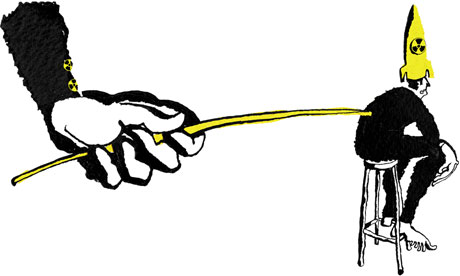
'The alleged crises over North Korea and Iran are just not serious enough to warrant the classroom language of ­shunning and punishment.' Illustration by Belle Mellor
By coincidence two clashes over nuclear issues are hitting the headlines together. North Korea and Iran have both had sanctions imposed by foreign governments, and when they refuse to "behave properly" they are submitted to "isolation" and put in the corner until they are ready to say sorry and change their conduct. If not, corporal punishment will be administered, since they have been given fair warning by the enforcers that "all options are on the table".
It's a bizarre way to run international relations, one we continue to follow at our peril. For one thing, it is riddled with hypocrisy, and not just because states that have hundreds of nuclear weapons are bullying states that have few or none. The hypocrisy is worse than that. If it is offensive for North Korea to talk of launching a nuclear strike at the United States (a threat that is empty because the country has no system to deliver the few nuclear weapons that it has), how is it less offensive for the US to warn Iran that it will be bombed if it fails to stop its nuclear research?
Both states would be resorting to force when dialogue is a long way from being exhausted. They would also be acting against international law. That is patently clear if North Korea ever managed to launch a nuclear strike against South Korea or the US, but the same is true of an altogether more feasible attack on Iran. There is no conceivable scenario under which the United Nations security council would authorise the United States, let alone Israel, to take military action, even if Iran were to tear up its long-standing statement that nuclear bombs are un-Islamic and produce one. So why does Washington go on with its illegal threats?
The underlying cause of most international tension is the unwillingness of powerful states to recognise that we live in a multipolar world. The idea of hegemony, often sanitised as "leadership", is unacceptable. In a post-colonial era there are multiple centres of authority, international influence and soft power, and we should rejoice when new or old states, individually or collectively, have the courage and ability to challenge another state's ambition to be a superpower. States will always make common cause or "coalitions of the willing" on specific issues, but interests fluctuate and priorities change – and we should junk the cold war-style system of military alliances and ideological or sectarian camps.
Let us go further and drop the figment of an "international community", at least in its current western definition as "the United States and its friends". By the same token, let's correct the myopia around isolation. When the leaders of 120 nations travelled to Tehran to ratify Iran's presidency of the Non-Aligned Movement last August, it was risible to hear US officials still talking of Iran being "a rogue state".
In Washington and Whitehall it may seem self-evident that the international community should arm the opposition to Syria's President Assad, but that is not the view of the world's largest democracy, India, or of the most democratic African and Latin American states, South Africa and Brazil. When their leaders convened with Russia and China (in the new Brics coalition) in Durban last month, they "re-affirmed our opposition to any further militarisation of the conflict" and called for a political settlement.
Of course, the non-aligned and Brics summits were barely covered by the US media in its news or comment columns, the normal technique of reality suppression used by American opinion-formers and policy-makers. Rami Khouri, the distinguished US-trained Lebanese writer, calls it "professionally criminal". After a month in the US recently, he found that coverage of Iran was based on "assumptions, fears, concerns, accusations and expectations almost never supported by factual and credible evidence". In as much as these distortions build public support for a military attack on Iran, he finds it as culpable as the media's role in the runup to the attack on Iraq a decade ago.
The alleged crises over North Korea and Iran are just not serious enough to warrant the classroom language of shunning and punishment. Dialogue and respect for other people's positions are the better course. Discuss everything as a package rather than dangle incentives one by one like sweets.
Ironically, it was Iran at the recent talks with security council members that suggested a roadmap with a clear end state: the acceptance of Iran's right to enrich uranium like any other signatory of the non-proliferation treaty. In other words, the issue is primarily a matter of national dignity and sovereignty. Meanwhile, the US declined to promise to lift all sanctions whatever Iran does.
On Korea the best approach is also comprehensive. This would mean trying to reach the full-scale peace treaty that was never concluded when the war ended 60 years ago. North Korea wants a treaty as a sign, like Iran, that the US accepts it as a legitimate state. Steps towards one were agreed in 2007 and a few positive moves followed. But they collapsed when the mentality of suspicion and sanctions revived under the pressure of electoral politics in Seoul and Washington and the arrival of an inexperienced new leader in Pyongyang. It is not too late to drop the self-defeating language of "rogue states" beyond the pale of the "international community" and try again.

Tuesday, 9 April 2013

Margaret Thatcher: pro-European 'wet' transformed by a triumphant war


The hypercautious leader who showered money on the unions was about to get the boot: the Falklands changed all that
Daniel Pudles 09042013
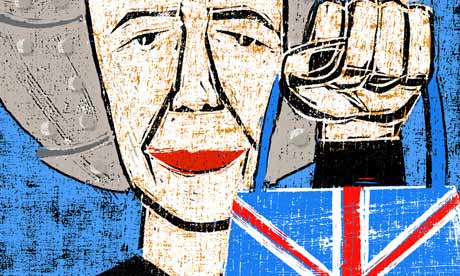
'I think on balance Thatcher did for Britain what was needed at the time.' Illustration by Daniel Pudles
Margaret Thatcher was Britain's most significant leader since Churchill. In 1979 she inherited a nation that was the "sick man of Europe", an object of constant transatlantic ridicule. By 1990 it was transformed. She and her successors John Major and Tony Blair presided over a quarter century of unprecedented prosperity. If it ended in disaster, the seeds were only partly hers.
Almost everything said of Thatcher's early years was untrue, partly through her own invention. She was the daughter of a prosperous civic leader who merely began life as a "grocer". She went to a fee-paying school and to Oxford at her father's expense, gliding easily into the upper echelons of student politics.
A Tory party desperate for women helped Thatcher through the political foothills to early success as an MP. Her gender led her into government and the shadow cabinet, despite Edward Heath's aversion to her. It made her virtually unsackable as education secretary. As she said in her memoirs: "There was no one else." When Heath fell, her promoters ran her as a stalking horse because, as a woman, they thought she could not win. Thatcher became prime minister because she was a woman, not despite it.
As leader she was initially hyper-cautious. An unclubbable outsider, she allied herself to another outsider, Keith Joseph, and his free-market set. But she regarded rightwing causes as an intellectual hobby. She was an ardent pro-European, and her 1979 manifesto made no mention of radical union reform or privatisation. It was thoroughly "wet". On taking office she showered money on public sector unions, and her "cuts" were only to planned increases, mild compared with today's. Yet by the autumn of 1981 they had made her so unpopular that bets were being taken at the October party conference that she would be "gone by Christmas".
What saved Thatcher's bacon, and revolutionised her leadership, was Labour'sunelectable Michael Foot – and the Falklands war. Whatever Tory historians like to claim, this was the critical turning point. By delivering a crisp, emphatic victory Thatcher showed the world, and more important herself, what a talent for solitary command could achieve. From then on she disregarded her critics and became intolerant of any who were "not one of us".
But Thatcher was still cautious. By the 1983 election she had sold off only Britoil and some council houses. The battle with the miners and leftwing councils lay ahead, as did the trauma of an IRA assassination bid. It was only in the mid-80s that she became truly radical and remotely comparable to David Cameron in 2010.
She gave Nigel Lawson at the Treasury his head – and was genuinely alarmed when he cut income tax to 40%. She hurled herself into NHS reform, changes to schools and universities, utilities privatisation and, eventually, local government reform. Each was characterised by her attention to detail. Her political antennae refused to allow her to privatise the coal industry, British Rail or the post office.
Thatcher was never insensitive to the impact of her policies on the poor. As she cut local housing budgets, she sent housing benefit soaring in compensation. She refused to reform social security, or even curb its abuse. Many of today's more controversial benefits, such as disability, date back to the 80s.
After the 1987 election, Thatcher cut an increasingly isolated figure. Rows with Lawson and Geoffrey Howe over a European currency (where she was right) presaged the final shambles of the poll tax. Until then Thatcher had shown the strength of her weakness: a dislike of consensus and aversion to debate, leading to decisive action. A senior civil servant said, "It worked because we all knew exactly what she wanted."
The poll tax showed the opposite, the weakness of Thatcher's strength. The cautious tactician was suppressed. She became deaf to all warning. On the crucial morning in November 1990, her colleagues marched individually into her room and each told her to go. It was a Charles I moment in British history. Everyone knows where they were when they heard.
Thatcher's reputation never recovered from the ruthless budgets of 1980 and 1981, or her insensitivity to colleagues. Many hated her. She was always the Spitting Image bully. Howe's "broken cricket bats" speech in the Commons was the killer blow. It was mostly foreigners who could not understand why she fell.
John Major, the "detoxification" successor, was fated to implement many of her unattempted reforms. But perhaps her greatest legacy was New Labour. The most important thing Tony Blair and Gordon Brown did for British politics was to understand the significance of Thatcherism and to decide not to reverse it, indeed to carry it forward. Their reckless private finance of public investment and services went beyond anything she dared dream of. No one noticed, but she was Blair's first guest at Downing Street in 1997.
Thatcher's most baleful influence on government was not on industries and services she privatised but those she did not. She, and Blair after her, brought an unprecedented dirigisme to the NHS, education, police and local government. She was unashamed about this, loathing localism and rejecting calls to diminish the "strong state". She hated what she called "that French phrase laissez faire". Her centralism, unequalled in Europe, descended under Blair into a morass of targetry, inefficiency and endless reorganisation. Only today are we facing the cost.
I think on balance Thatcher did for Britain what was needed at the time. History will judge her, but not a country in Europe was untouched by Thatcher's example. Under Heath and Jim Callaghan the question was widely asked: had democracies become "ungovernable"? Had pollsters and the 24/7 media forced leaders to follow opinion, not lead it?
Thatcher answered that question, re-energising the concept of democratic leadership. It was sad that she had to learn it in war, a grim example to her British and US successors. She was lucky, in her enemies and friends – notably Reagan in the Falklands conflict. She was lucky in surviving the IRA's bomb.
But she exploited her luck. She showed that modern prime ministers can still mark out room for individual manoeuvre. They do not have to charm, schmooze or play tag with the press. Government will respond to clear leadership if it knows what a leader wants. It knew what Thatcher wanted.

------


Margaret Thatcher: the lady and the land she leaves behind

Her legacy is public division, private selfishness and a cult of greed that together shackle the human spirit
Whether you were for her or against her, Margaret Thatcher set the agenda for the past three and a half decades of British politics. All the debates that matter today in the public arena, whether in economics, social policy, politics, the law, the national culture or this country's relations with the rest of the world, still bear something of the imprint she left on them in her years in office between 1979 and 1990. More than 20 years after her party disposed of her when she had become an electoral liability, British public life is still defined to an extraordinary degree by the argument between those who wish to continue or refine what she started and those who want to mitigate or turn it back. Just as in life she shaped the past 30 years, so in death she may well continue to shape the next 30. These are claims that can be made about no other modern British prime minister. She was in many ways the most formidable peacetime leader this country has had since Gladstone.
The fact that Mrs Thatcher was Britain's first and so far only woman major party leader, chosen entirely on merit, and then Britain's first woman prime minister, were of course huge landmarks. But her gender, though fundamental to her story, was in the end secondary. It was at least as significant, in the evolution of the late 20th-century Tory party, that she came from a petit-bourgeois background, a shopkeeper's daughter, though the man she overthrew in 1975, Ted Heath, had similarly middling origins and John Major an even humbler start. There was something of the rebel and outsider about her, as well as much that was stultifyingly conventional.
Mrs Thatcher's transcendent quality, however, was that she was a political warrior. She had a love of political combat, a zealotry for the causes she believed in, a reluctance to listen to advice, a conviction that she was always right and never wrong, and a scorn for consensus that set her apart from almost all her predecessors and, with the occasional exception of Tony Blair, from those who came after.
Mrs Thatcher was proof positive that personality matters in politics. As a young minister she did not seem destined for greatness. Even her election as Tory leader was something of a surprise, though her audacity in going for the top job while so many more senior figures hesitated was an indication of what was to come. Early on in her leadership, she was much patronised by male colleagues and adversaries. But as the social democratic consensus faltered in the 1970s and then cracked in the 1980s she rode the wind of history with an opportunist's brilliance. A Britain led by Willie Whitelaw or Michael Heseltine would have faced most of the same challenges that the one led by Mrs Thatcher faced. But the response would have been completely different. For good or ill, she made a difference.
The late Guardian columnist and Thatcher biographer Hugo Young, reflecting on her overthrow in 1990, identified five large events that would not have happened the way they did without her.
The first was the Falklands war of 1982, which Young described as "a prime example of ignorance lending pellucid clarity to her judgment". Surrounded by sceptical men who had fought in the second world war and knew what combat involved, she went for it. The result was an astonishing and absurd military triumph followed by an electoral one, which elevated Mrs Thatcher from the ordinary to the extraordinary.
A second, which would not have been possible without the authority conferred by the first, was the dethroning of trade union power. Once again, against the instincts of ministers – and the grandest of grandees, Harold Macmillan – who all preferred compromise to confrontation, she fought the miners' strike to the bitterest of finishes, in a contest that was always about industrial strategy rather than just coal.
Arguably even more important than these headline events was the third example, the conduct of economic policy. There had been a New Right before Mrs Thatcher, but it was the ideas of Friedrich von Hayek, as articulated to her by a series of domestic rightwing ideologues, on which she seized. It was Mrs Thatcher, abetted by her chancellors Sir Geoffrey Howe and Nigel Lawson, who drove the policy that the public sector was an unproductive burden on the wealth-creating sector and on taxpayers, and must therefore be reduced and privatised. It was she who insisted that the chief aim of government economic policy should be price stability, and that it should not give priority to reducing unemployment or to stimulating demand.
And it was she again who seemed to believe, far more than those around her, that the market economy required not a minimal state to protect it but a strong state, marked by everything from the abolition of local government autonomy to the enhancement of police powers, intolerance towards gay rights, the broadcasting ban on Sinn Féin, and increased defence spending. She made enemies without flinching, and they reciprocated. Her rule was marked by the most serious urban riots of the 20th century, one of the most divisive strikes in recent times, and the century's most audacious prime ministerial assassination attempt, which thankfully she survived.
Mrs Thatcher's unique mark was also felt in the two confrontations that ultimately undid her. The first was the poll tax, which was disastrous, unjust and was her policy alone. The poll tax came to embody a prime minister who ruled from conviction not sense, and who did not care about, indeed gloried in, a confrontation that destroyed the Tory party in Scotland and may indirectly come to destroy the union she otherwise championed. Similarly, and less easily disposed of after her fall, was Europe. Mrs Thatcher began her prime ministership as a pragmatic, if often acerbic, European. But as she became a bigger figure on the world stage, feted both by Mr Reagan and by Mikhail Gorbachev, she became increasingly strident and disruptive towards Europe. Her style became the policy, cementing the love affair with an already overmighty press but with disastrous effects for her leadership (which was ended by Sir Geoffrey's resignation over the issue), her party (which became obsessed with the subject) and for Britain. Except for Mr Blair in his early years, every British leader since has felt Mrs Thatcher at his shoulder in dealings with Europe, to the lasting national loss.
When she arrived in Downing Street in 1979 she talked about replacing discord with harmony. She may briefly have meant it, but the harmony she sought in the long term was one whose terms were set overwhelmingly in the interests of the British business class as she perceived them. She disdained the public realm and presided over the growth of the cult of marketplace success as the foundation of a good society – a low-tax, home-owning, privatised, high-carbon, possessive, individualist, winner-takes-all financial model whose failure haunts the choices still facing this country today. Much was wrong with the Britain she inherited in 1979, undemocratic union power among them, and many things, though not wrong in themselves, were unsustainable without radical change, including some nationalised utilities. Britain would have had to alter radically in the 1980s and 90s, and the process would have been hard and controversial. But, as Germany and other northern nations have shown, economic dynamism has been possible without the squandering of social cohesion that Mrs Thatcher promoted.
In the last analysis, though, her stock in trade was division. By instinct, inclination and effect she was a polariser. She glorified both individualism and the nation state, but lacked much feeling for the communities and bonds that knit them together. When she spoke, as she often did, about "our people", she did not mean the people of Britain; she meant people who thought like her and shared her prejudices. She abhorred disorder, decadence and bad behaviour but she was the empress ruler of a process of social and cultural atomism that has fostered all of them, and still does.
The governments that followed have struggled to put a kinder and more cohesive face on the forces she unleashed and to create stability and validity for the public realm that yet remains. New Labour offered a first response. The coalition is attempting a second draft in grimmer circumstances, and there will be others. There can certainly be no going back to the failed postwar past with which Margaret Thatcher had to wrestle. But there should be no going back to her own failed answer either. She was an exceptionally consequential leader, in many ways a very great woman. There should be no dancing on her grave but it is right there is no state funeral either. Her legacy is of public division, private selfishness and a cult of greed, which together shackle far more of the human spirit than they ever set free.

Why India is right on Sri Lanka


HARDEEP S. PURI 


Unless Colombo treats its Tamil citizens with dignity and respect, New Delhi will continue to have limited options


Contemporary developments in India’s foreign policy are often based on perceptions and not facts, views divorced from reality and political advocacy based on make-believe. India’s approach to the Sri Lankan issue and the vote in the Human Rights Council (HRC) is a case in point. Variously described as a “new low” in our foreign policy and a departure from our principled stand of not supporting country-specific resolutions, this line of reasoning suggests that New Delhi should ignore and overrule regional sentiment, and refrain from meddling in the affairs of a small neighbour.
But first the perceptions. One, in 1956, Solomon West Ridgeway Dias (SWRD) Bandaranaike enacted the Sinhala-Only Act. Sections of the political class in New Delhi welcomed it as a consolidation of anti-imperialist sentiment. Years later, Tamils were reduced to second-class citizens and discrimination against them became systemic and entrenched. The anti-Tamil riots in Colombo following the killing of the Mayor of Jaffna, Alfred Duriappa, by a young Prabhakaran led to the rise of Tamil militancy.
Perception two. Most Sinhalese believe, with good reason, that Tamil militancy, rightly viewed by them as terrorism, would not have succeeded in tearing apart Sri Lanka’s social fabric but for support from across the Palk Straits. Prime Minister Rajiv Gandhi sought course correction. He committed India to Sri Lanka’s unity and territorial integrity. This fundamental turnaround meant India would not support the break-up of Sri Lanka and would also cooperate in ending support for terrorism. There was, however, one caveat. The Tamil minority should be treated with dignity and as equal citizens of a multicultural, multiple-ethnic and multilingual Sri Lanka.
Resolution was minimalist
What the international community is questioning is not Colombo’s military operation against the LTTE or human rights violations but specific allegations of war crimes during the last 100 days of military operations. Visual documentation, including by triumphant victors on mobile phones has contributed to Sri Lanka’s discomfort. The U.S. resolution at the 19th session of the HRC in March 2012 was a minimalist attempt. It invited Sri Lanka to act on the recommendations of its own Lessons Learnt and Reconciliation Commission. Even the assistance to be made available to Colombo would have been provided only with its consent. Instead, Colombo chose to prevaricate. With additional visual documentation being made available, the demand for accountability gained momentum. Having voted in favour of the resolution in March 2012, it was next to impossible for India to change its vote in March 2013, especially in the absence of any credible steps by Sri Lanka towards reconciliation and devolution.
It is both in India’s and Sri Lanka’s interest to get a full and final closure on these allegations. Not to do so will allow the wounds to fester.
Sovereignty has never succeeded in providing a cover against genocide, ethnic cleansing, war crimes and crimes against humanity. To suggest that India does not support country-specific resolutions is absurd. Even more, that we have a principled position on this. In any perceived clash between principle and national interest, it is invariably the latter that is invoked and reigns supreme. Following the anti-Tamil riots in Colombo in 1983, New Delhi mustered sufficient courage to spearhead a resolution against Sri Lanka in the Sub-Commission on Prevention of Discrimination and the Protection of Minorities. We vote in favour of similar resolutions against Israel only because they deal with gross and systematic violations of human rights of Palestinian people in the occupied territories. We have never hesitated to take a position on country-specific resolutions whether on DPRK or Iran, whenever our national interest so demanded.
To dismiss popular sentiment in Tamil Nadu as the machinations of politicians is both a misreading of the situation and a recipe for disaster. Why should Sri Lanka not be held to account for not respecting understandings given bilaterally to India, such as those of April-May 2009?
13th Amendment
India can be against the LTTE but cannot afford to be against the Tamils. The problem both amongst the Tamil minority in Sri Lanka and large sections of the Tamil population in India, is that the LTTE successfully manipulated Tamil opinion by projecting itself as the only physical shield against Sinhala repression. We cannot wish away this sentiment. The only safeguard for the Tamils in Sri Lanka is delivery of the promised devolution based on the 13th Amendment.
Both the AIADMK and the DMK, along with the smaller parties in Tamil Nadu are on the same page on the Sri Lanka issue. The problem will continue to fester till Colombo has a genuine change of heart. Recent signals are anything but encouraging. Defence Secretary Gotabaya Rajapaksa said on March 27, 2013: “Could we afford to have a provincial administration here, which pointed a gun at the national leadership at the drop of a hat? We don’t want to be at the mercy of scheming provincial administrations.” Let alone the 13th Amendment, the Defence Secretary seems to be suggesting the winding up of provincial councils altogether!
Notwithstanding assurances to India, the “Brothers” running Sri Lanka appear to have no intention to move on political reconciliation and devolution. This “majoritarianism” in total disregard of respecting and protecting the rights of minorities is a narrow and calibrated political strategy designed to safeguard Sinhalese parliamentary strength. The recent attacks on the Muslim trading community in the heart of Colombo by fanatic Sinhalese, allegedly led by Buddhist monks are manifestations of similar callous and cynical disregard for the rights of linguistic, religious and cultural minorities. India did the right thing by supporting the resolution on war crimes.
Exaggerated projections of Chinese inroads and influence are a bogey which many of our smaller neighbours periodically try on us. Apart from being practical, the Chinese are also hard headed. They will pursue economic and commercial opportunity irrespective of the way India votes. Support for Sri Lanka up to 2012 did not prevent them from looking for commercial projects there. Many Chinese successes have something to do with our own inability to deliver commercial projects on time.
Sri Lanka is not only India’s closest neighbour but in many respects, culturally and emotionally, closest to us as well. We need to reach out to Colombo and drive home the point that it takes two to tango. Relations between countries are assiduously built, step by step. Unless Colombo treats its Tamil citizens with dignity and respect, New Delhi will continue to have limited options. If New Delhi continues to base its choices on misplaced “perceptions” and does not effectively articulate the reasons for the choices so made, only brickbats will be in the offing.
(Hardeep S. Puri is India’s former Permanent Representative to the United Nations in New York.)

Thatcher, Chandraswami and I


K. NATWAR SINGH 


How a future Prime Minister of Britain warmed to the godman with an Indian diplomat playing the reluctant translator

India House is among the better known diplomatic establishments in London. I first set eyes on the imposing building in 1952, when I was a student at Cambridge University. Thirty years later I entered India House as Deputy High Commissioner. One of my less attractive duties was to meet the unreasonable demands of visitors from India. Not all were disagreeable but many were.

Early in the summer of 1975, Mr. Chandraswamy telephones me. He was in London. The late Yashpal Kapoor had asked him to contact me, Chandraswamy invited me to meet me at his place. I said if he wished to see me, he should come to India House. This he did the next day. At the time he was in his late twenties. He was in his “Sadhu” attire. He did not speak a word of English. Now he does.

At this, our first meeting, he dropped names. After a few days he again come to see me. He invited my wife and me to have dinner with him.

The food was delicious. After dinner he said to us, “I will show you something you have never seen”. He then produced a large sheet of white paper and drew lines from top to bottom and left to right. Next he produced three strips of paper asked my wife to write a question on each strip, make a ball and place each one on a square on the chess board. My wife wrote the questions in English. He closed his eyes and went into a trance. I was, by this time getting restless. Suddenly he asked my wife to pick up any of the paper balls. She did so. Opened it. Chandraswamy then told her what the question was. He was spot on. My wife, who is an amateur astrologer, was sceptical at this stage. When Chandraswamy got the next two questions right, she was amazed and interested. I was intrigued. I could not, as a rationalist, accept mumbo-jumbo. Neither could I dismiss Chandraswamy as a complete hoax.

A few days later Y.B. Chavan, the then External Affairs Minister was on his way to the United States. I went to meet him at London’s Heathrow airport. He confirmed he knew Chandraswamy well. I also told Chavan that Chandraswamy had asked me to arrange a meeting with Lord Mountbatten and also with Mrs Thatcher. Should I arrange these meetings? To my discomfiture and surprise, Chavan sahib saw no harm in Chandraswamy meeting Lord Mountbatten or Mrs Thatcher.

I rang up Lord Mountbatten. He said he would have been glad to meet “your friend”, but he was leaving for a holiday in Northern Ireland the next day. I was quite relieved. I informed Chandraswamy. What about Mrs Thatcher?

She had been elected leader of the Conservative Party six months earlier. Doubts still assailed me about Chandraswamy meeting Margaret Thatcher, not yet the iron lady. Suppose Chandraswamy made an ass of himself. I would look a bigger ass. I sought an appointment with the Leader of the Opposition. She promptly obliged. I met her in her tiny office in the House of Commons.

Her response was, “If you think I should meet him, I shall. What does he want to see me for?” “That he will tell you himself,” I said. She agreed to see him in her House of Commons office early the next week. “Only ten minutes, Deputy High Commissioner,” she announced. I thanked her and left.

Chandraswamy was on cloud nine when I gave him the news. I cautioned him not to do or say something silly. I was putting my neck on the line for him. “Chinta mut kareay, (don’t worry”) said the sage. So, to the House of Commons the two of us proceeded. Chandraswamy was dressed in his “sadhu” kit, with a huge tilak on his forehead and a staff in his right hand. Rudraksha malas round his neck. He banged the staff on the road till I told him to stop doing so. I confess, I was feeling self conscious. Not Chandraswamy. He relished the attention he was inviting. Finally we reached Mrs Thatcher’s office. With her was her Parliamentary Private Secretary, Adam Butler, M.P. son of Rab Butler, the Conservative leader.

Introductions over, Mrs Thatcher asked, “What did you want to see me for?” Chandraswamy spoke in Hindi. I translated. “Tell her she will soon find out.” His tone was arrogantly respectful. Mrs Thatcher — “I am waiting.” The clock was ticking away. Chandraswamy was in no hurry. He asked for a large piece of paper. Went through the same routine as with my wife. He gave Mrs. Thatcher five strips of paper and requested her to write a question on each. She obliged, but with scarcely camouflaged irritation. Chandraswamy asked her to open the first paper ball. She did. He gave the text of the question in Hindi. I translated. Correct. I watched Mrs Thatcher. The irritation gave way to curiosity. Next question. Again bull’s eye. Curiosity replaced by interest. By the fourth question the future iron lady’s demeanour changed. She began to look at Chandraswamy not as a fraud, but as a holy man indeed. My body language too altered. Last question. No problem. I heaved a sigh of relief. Mrs Thatcher was now perched on the edge of the sofa. Like Oliver Twist, she asked for more. Chandraswamy was like a triumphant Guru. He took off his chappals and sat on the sofa in the lotus pose. I was appalled. Mrs Thatcher seemed to approve. She asked supplementary questions. In each case Chandraswamy’s response almost overwhelmed the future Prime Minister. She was on the verge of another supplementary, when Chandraswamy regally announced that the sun had set. No more questions. Mrs Thatcher was not put out. She enquired if she could meet him again. I was entirely unprepared for this. Very coolly, almost condescendingly he said, “On Tuesday at 2.30 p.m. at the house of Shri Natwar Singh.” I told him that he was over reaching himself by dictating the day and time without taking into account her convenience. This was not India. He was unmoved “Kunwar sahib, Anuvad kar dijiye aur phir dekhiye.” Please translate and then see. I was astounded when she asked me, “Deputy High Commissioner, where do you live?” This was not all. What followed was something out of a weird novel. Just as we were about to leave, Mr. Holy Man produced a talisman tied to a not so tidy piece of string. He then pronounced that Mrs Thatcher should tie it on her left arm when she came to my house on Tuesday. I was now on the verge of losing my temper. I said I would not translate this dehati rubbish. Mrs Thatcher intervened to know what the holy man was saying. “Mrs Thatcher, please forgive me, but Chandraswamy would like you to wear this talisman on your left arm.” She took the talisman. We were saying our goodbyes, when Chandraswamy produced his sartorial bomb. Turning to me he said “Kunwar Sahib, kindly tell Mrs Thatcher that on Tuesday she should wear a red poshak. I felt like hitting him. He was overdoing this. I firmly told him it was the height of bad manners to tell a lady what she should or should not wear. Mrs Thatcher looked a bit apprehensive at this not so mild altercation between a distraught Deputy High Commissioner and a somewhat ill-mannered holy man. Very reluctantly I said to her that the holy man would be obliged if she wore a red dress on Tuesday. I was looking down at the floor as I said this.

On Tuesday, at 2.30, Mrs Margaret Thatcher, leader of the Conservative Party, arrived at Sun House, Frognal Way, Hampstead. It was a beautiful day. She was wearing a stunning red dress. The talisman too was in its proper place.

She asked many questions but the most important related to the chances of her becoming Prime Minister. My wife was also present. Chandraswamy did not disappoint Mrs Thatcher. He prophesied that she would be Prime Minister for nine, eleven or thirteen years. Mrs Thatcher, no doubt believed that she would be Prime Minister one day. Nine, eleven, thirteen years was a bit much. Mrs Thatcher put one final question. When would she become a Prime Minister? Chandraswamy announced — in three or four years. He was proved right. She was PM for eleven years.

This narrative should have ended here. But there was an aftermath. The Commonwealth Summit was held in Lusaka, Zambia in 1979. Mrs Margaret Thatcher had by then become Prime Minister. I had been posted to Zambia in August 1977. Along with other High Commissioners I went to Lusaka airport to receive Mrs Thatcher. When she greeted me and my wife, I gently whispered “Our man proved right.” For a moment she looked flustered. She took me aside, “High Commissioner, we don’t talk about these matters.” “Of course not, prime minister, of course not,” said I.

(Extracted from K. Natwar Singh’s new book “Walking with Lions — Tales from a Diplomatic Past,”HarperCollins)