Search This Blog

Sunday, 12 February 2017

Instead of draining the swamp, Trump has become Wall Street’s best buddy

Will Hutton in The Guardian


President Trump was an accident waiting to happen. The US had entered a zone of fragility: there were too many inequalities, grievances and accompanying disillusion in a system felt not to work .

A chief reason for that economic and social fragility was the behaviour of the American financial system. It is still astounding how close to disaster high finance brought the US and global economy in 2008. It provoked a vast bailout, and the recovery that followed has been one of the most anaemic sort, during which the wages of average Americans have scarcely grown.

The hangover of debt and legacy of banks trying to rebuild their shattered balance sheets has held the economy back. Meanwhile, some of the weak links in the system, like the sheer scale and opacity of the derivative markets, plus business models riddled with conflicts of interest, have remained unaddressed. Fortunes are still being made and very few have paid the price for cataclysmic mistakes.

On the campaign trail, Trump unfailingly tarred Clinton as compromised by, and enmeshed with, Wall Street and its mega banks. Goldman Sachs had “total control” of her; she was in thrall to a “global power structure that is responsible for the economic decisions that have robbed our working class, stripped our country of its wealth and put that money into the pockets of a handful of large corporations and political entities”.

Trump would drain the swamp, he claimed, and reinstate a “21st-century” version of the law separating main street banking from Wall Street – Roosevelt’s Glass-Steagall Act – which was scrapped by President Bill Clinton, in one of his worst decisions. Trump would throw the money men out of the temple, he said. He would reshape finance for the “little guy”. His audiences roared him on.

But, in office, Trump has proved to be a great deal friendlier to the titans of Wall Street and their interests than he suggested he would be as a candidate, although a close reading of his speeches foretells some of what is now happening. Far from draining the swamp, he is opening the sluicegates; the money men are not so much being hurled out as in full occupation of the economic citadel.

Goldman Sachs’ number two, Gary Cohn, is to be Trump’s chief economic adviser; his Treasury secretary, Steve Mnuchin, was 20 years at Goldman Sachs before running OneWest Bank, which made a fortune by improperly foreclosing on mortgages in ethnic minority communities after the financial crisis. These are not men on the side of the little guy: Cohn has promised to attack “all aspects of Dodd-Frank”, the partially effective regulatory framework that Obama laboriously passed into law in 2010, in the teeth of Republican and Wall Street opposition.

What we know from the financial crisis is that the banking system has become a highly interdependent network in which contagion spreads in hours – it is only as strong as its weakest link. Yet Trump, in thrall to some of the most demonic figures in American finance, last week demanded a 120-day review of all the US’s financial regulations to tame their alleged excesses.

His intent is clear. He has Dodd-Frank in his sights, a “disaster” on which he aims to do “a big number”. There is only one end: to regulate the links in the financial network so they have even less oversight than they do now. And, if things go wrong, Trump will have no hesitation in writing whatever cheques that have to be written to bail out the banks again, just as he backed the bailouts in 2008/9. It is careless, don’t-give-a-damn insouciance on an epic scale.

It seems that a 21st-century version of Glass-Steagall, the core building block in the wholesale reconstruction of the US financial system in the wake of the Depression, was code for doing the exact opposite. Dodd-Frank certainly has weaknesses – in many respects, it does not go far enough and many of its recommendations are yet to be enacted – but it has made US banking immeasurably safer.
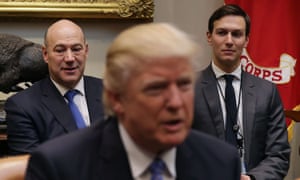

Former Goldman Sachs banker Gary Cohn, left, now Trump’s senior economic adviser, flanks the president during a meeting with business leaders in the White House. Photograph: Chip Somodevilla/Getty Images

The banks now hold a third more capital than they did 10 years ago. They are forbidden from trading in securities on their own account. Thirty-four of them, described as “systemically important financial institutions”, are kept under especially close watch, as key elements in the network. The newly established Consumer Financial Protection Bureau tries to ensure customers are dealt with honestly.

You might think after the extraordinary fraud at Wells Fargo last autumn – bank employees opening millions of phantom accounts and credit cards in customers’ names – that a president on the side of the little guy would at the very least not want to weaken American financial regulation. Rather, Trump is in sympathy with the bankers, horrified at the scale of fines they are now paying – Wells Fargo paid a cool $185m. He is also scandalised that holding so much buffer capital and not being able to trade in securities is damaging the bankers’ personal remuneration.

Dodd-Frank has been under fire since its inception, but then Republicans hated the New Deal too. Roosevelt, like Obama, was a hate figure whose every work had to be undone. Both men represented challenges to an idea of America as offering limitless freedom, not least to billionaires. The accompanying social distress is a price worth paying for such freedom – or so the thinking goes.

Billionaire Trump was right in one respect: Hillary Clinton was profoundly compromised by her relationship with Goldman Sachs, pocketing $675,000 for a mere three private speeches, in which she did voice sympathetic concerns about Dodd-Frank for allegedly making banks more cautious in their lending. She was, and is, indisputably a member of a global elite that cannot escape responsibility for the emergence of so many blighted lives.

But, beyond that, Trump is a phony. His economic programme is no more than Reaganomics on speed run by a group of opportunists and self-interested chancers. In the short run, there will be a Trump upswing triggered by the prospect of careless deregulation, unaffordable cuts in corporate tax and lots of infrastructure spending.

How long it will last, and whether it will be a trade war or a financial crisis that will bring it to an end, is anybody’s guess. But we have now had a glimpse of a darker Trump, the hypocrite for whom the little guy is but a pawn to serve his own delusional ambitions. Pity the US. And pity Brexit Britain, forced to bend the knee to such a man and such a president.
Fatah Ka Fatwa - Episode 6

Women's special

Saturday, 11 February 2017

How Steve Bannon captured America's spirit of revolt

Thomas Frank in The Guardian

 
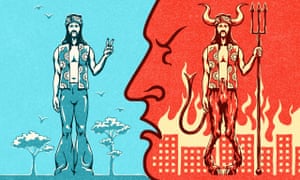
Illustration by Matt Kenyon


So our billionaire president hangs a portrait of Andrew Jackson on his wall, spits on his hands, and takes a sledgehammer to the Dodd–Frank Act. The portrait is of the banks’ all-time arch-enemy; the reality is that the banks are going to be deregulated yet again. And in that insane juxtaposition we can grasp rightwing populism almost in its entirety: fiery verbal hostility to elites, combined with generous government favours for those same elites.

Donald Trump’s adviser Stephen Bannon presents an even more striking combination. A former executive at Goldman Sachs, Bannon is also the product of what the Hollywood Reporter calls a “blue-collar, union and Democratic family” who feels “an unreconstructed sense of class awareness, or bitterness – or betrayal”. Bannon is a founding member of the objectionable far-right website Breitbart and an architect of Trump’s unlikely victory, the man at the right hand of power. And yet almost no one in Washington seems to understand how he pulled this off.

Let me propose a partial explanation: that one of the reasons Bannon succeeded is because he has been able to unite the two unconnected halves of American populist outrage – the cultural and the economic.

Start with the latter. In a 2014 interview on the recent financial crisis, Bannon proclaimed: “The way that the people who ran the banks and ran the hedge funds have never really been held accountable for what they did has fuelled much of the anger in the Tea Party movement in the United States.”

Fair enough. I myself am outraged that financiers were not held responsible for the many obvious mistakes and even acts of fraud they appeared to commit.

But when we turn to the specifics of Bannon’s indictment, accountability gets a little blurry. In 2010 Bannon wrote, directed and produced a documentary film about the 2008 financial crisis called Generation Zero – a documentary that explicitly tries to get laissez-faire capitalism off the hook for this colossal capitalist disaster. Remember the roll-back of banking rules under Bill Clinton and George W Bush, or the hapless regulatory agencies filled with former bank officers and lobbyists? Evidently none of that really mattered. As one of the movie’s many experts intones, “Deregulation is not the problem.” The first sentence in the promotional copy on the back of the DVD case is just as blunt: “The current economic crisis is not a failure of capitalism, but a failure of culture.” 

What culture do you think Bannon means? The buccaneering culture of the Wall Street traders? The corrupt culture of the real estate appraisers or the bond rating agencies? The get-rich-quick culture of the mortgage originators?

No, no and no. He means … the counterculture of the 1960s. Bell bottoms. Drum solos. Dope. That’s the thing to blame for the financial crisis and the bailouts. Not the deregulation of derivatives in 2000. It was those kids having fun at Woodstock in 1969.

I am not joking. This really is Bannon’s argument, illustrated again and again in Generation Zero with 40-year-old footage of hippies dancing and fooling around, which is thrown together with stock footage of dollar bills being counted, or funny old cartoons, or vacant houses, or really mean-looking sharks, and then back to those happy hippies again.

One way of assessing this is that Generation Zero is the transition from the culture wars to Trumpism. What Bannon is doing is bringing the strands of outrage together. He’s saying that the culture wars and the financial crisis both share the same villain: the bad values that supposedly infected our society in the 1960s. The same forces that made the movies and pop music so vulgar also crashed the economy and ruined your livelihood. Here is how Roger Kimball of the New Criterion makes the case in Generation Zero:

“A lot of what we have just seen is a kind of a real-world dramatisation of those ideas that became popular in the 60s and 70s, and that had a dry run then. And that, I think, has been a prescription for disaster in some very concrete ways. Take, for example, the financial crisis. What we have just seen in the irresponsible lending by banks and the irresponsible leveraging by many hedge funds is an abdication of responsibility.”

That gives you a taste of how Bannon’s logic unfolds. The decade of the 60s supposedly introduced Americans to the idea of irresponsibility and self-indulgence, and now that we are suffering from an epidemic of irresponsibility and self-indulgence a mere 50 years later, it’s obviously the fault of people from that decade long ago. Blame is thus offloaded from, say, the captured regulators of the Bush administration to the pot-smoking college students of the Vietnam era. Unfortunately, just because something makes moral sense doesn’t mean it’s true. Take the phenomenon of “stated income” or liar’s loans, the fraud that came to symbolise so much of what went wrong in the last decade. One of the movie’s experts, Peter Schweizer (later the author of Clinton Cash), seems to blame this dirty business on … Saul Alinsky, an author and community organiser who died in 1972. Alinsky, he maintains, “applauded activists who used lying effectively. You end up where applicants lie on their applications, mortgage lenders lie when they pass that to the underwriters, and then these mortgages are sold as mortgage-backed securities on Wall Street ... It’s a chain of lie after lie after lie, which eventually undermines even the most effective system.”

Schweizer is right that loans based on lies undermined the system. By 2005 they had become an enormous part of the mortgage market, and the story of how that happened is a really fascinating one. Many books have been written on the subject. But filmmaker Bannon shows no interest in any of that. He makes little effort to find out who was issuing such loans, what kind of houses they were used to purchase (McMansions?), who packaged them up into securities, or why regulators didn’t do anything to stop it. Instead, the movie just implies that the diabolical Alinsky had some vague something to do with it and then walks away. This is not history, it’s naked blame-shifting.

In fairness, Bannon’s movie also makes plenty of valid points and has some fine moments. The director obviously cares about the working-class people who were ruined by the recession. He correctly portrays the Democratic party’s love affair with Wall Street in the 90s (although he downplays the amorous deeds of Republicans). He understands the cronyism between government and high finance, and one of his sources aptly describes the bailed-out system as “socialism for the wealthy but capitalism for everybody else”. Which kind of sounds like something that old 60s radical Bernie Sanders might say.

The putative moral of Generation Zero is that we all need to grow up and take responsibility for our actions; and yet as I watched it I was bowled over by how profoundly irresponsible this documentary is. Other than a single quote from Time magazine circa 1969 and the old TV footage of hippies doing their dance, Bannon doesn’t really try to nail down what “the 60s” stood for or meant. None of the leading participants in that decade’s bacchanals are interviewed. Skipping ahead to the financial crisis, we never learn whether it’s the dishonest home-buyers who were hippies, or the fly-by-night mortgage lenders or the Wall Street traders who were hippies. Which set of hippies are we supposed to crack down on? We never find out.

All we know, really, is that there was once a dreadful thing called the 60s, and then there was a terrible financial crisis four decades later, and because the one came before the other, it somehow caused it. The effort to bridge that evidence gap is almost nonexistent. In a typical moment, Bannon shows us Republican treasury secretary Hank Paulson desperately trying to stop the money haemorrhage in September 2008, and then cuts immediately to footage of the Black Panthers, holding a rally many decades ago. Why? What is the connection? Does Paulson, the devout Christian Scientist, the teetotalling college football star, have some secret affiliation with 60s radicalism?

Worst of all is the former presidential adviser Dick Morris (Bill Clinton’s Steve Bannon, come to think of it), who appears throughout Generation Zero blowing hard about this outrage and that. Here is what Morris tells the camera about the threat of hyperinflation, which loomed so large in the rightwing mind back in 2010: “The real catastrophe is going to come in about a year, a year and a half, or two years, when all of this money that the Fed has been printing comes out of hiding all at once and causes explosive inflation.”

The movie’s most far-fetched proposition is also its most revealing. Generation Zero asserts that history unfolds in a cyclical pattern, endlessly repeating itself. Historical crises (such as the Depression and second world war) are said to give rise to triumphant and ambitious generations (think Levittown circa 1952), who make the mistake of spoiling their children, who then tear society apart through their decadence and narcissism, triggering the cycle over again. Or as the movie’s trailer puts it: “In history, there are four turnings. The crisis. The high. The awakening. The unravelling. History repeats itself. The untold story about the financial meltdown.”

In a word, the theory is ridiculous. It is so vague and squishy and easily contradicted that the viewer wonders why Bannon included it at all.

And then it hits you. He included it because this rainy-day Marxism is pretty much the only way you can do what Bannon set out to do in this movie: get deregulated capitalism out of the shadow for the financial crisis and blame instead the same forces that the family-values crowd has been complaining about for years. Blame the hippies for what arch-deregulator Phil Gramm did 40 years later and call it a high-flown theory of history: the “fourth turning”, or some such nonsense. Of course Bannon’s fans believe it. It makes perfect sense to them.

A funny thing about Bannon’s stinky pudding of exaggerations and hallucinations: in the broadest terms, it’s also true. The counterculture really did have something to do with both our accelerated modern capitalism and the Democratic party’s shift to the right – it’s a subject I have written about from The Conquest of Cool to Listen, Liberal.

The Clinton administration really did strike up an alliance with Wall Street, and this really did represent a new and catastrophic direction for the Democratic party. Trade deals really did help to deindustrialise the US, and that deindustrialisation really was a terrible thing. The bankers really did get bailed out by their friends the politicians in 2008 and 2009, and it really was the greatest outrage of our stupid century. And there really is a lot of narcissism mixed up in modern capitalism. Just look at the man for whom Bannon presently works.

Generation Zero acknowledges these visible facts but connects the dots by means of a vast looping diagram of confusion and blame evasion. It is a fantasy of accountability that actually serves to get the guilty off the hook.

Then again, another way to judge this alternative theory, with its alternative facts, is to set it off against what the Democratic establishment was saying at the time. Which was pretty much nothing.

Centrist Democrats simply don’t talk about their alliance with Wall Street – it’s like the party’s guilty secret, never to be discussed in a straightforward way. Try asking former President Obama or former treasury secretary Geithner or former attorney general Holder why they were so generous with the bankers and why they never held them responsible, and see what kind of answer you get.

And that, in short, is the story of how the right captured the spirit of revolt in this most flagrantly populist period in modern times. Want to take it away from them, liberal? Start by understanding your history.

The case for sledging

Sam Perry in Cricinfo

Around a decade ago a 20-year-old man walked to a suburban wicket with his team in a precarious position. The previous week they had conceded a glut of runs to a rampaging opposition that included a recently discarded international player. In a message to selectors and anyone else who wanted to listen, the deposed veteran made a score that dropped jaws.

And so the 20-year-old strode to the crease, his team 40 for 4 in reply. Two overs remained before lunch. Slightly shaking but presenting the bravest face possible, he asked for centre. In an attempt at familiarity, he addressed the umpire by name. It was a disastrous overcompensation, seized upon gleefully.

"Do you know him, mate?" offered the point fieldsman. Chuckles ensued from those in earshot. The batsman glanced behind him to see four slips waiting. Each stared, stony-faced, directly back. Two had arms folded, two had hands behind their backs, like policemen strolling their beat. Robocop wraparound sunglasses were the day's fashion, as was the gnashing of chewing gum. The batsman probably shouldn't have addressed the umpire by name. It played on his mind.

"Rod, do you know this bloke?" came the follow-up from first slip. It was the veteran record-breaker, speaking to the umpire, capitalising on the moment. All heads turned to the man in white, now a central character in the contrived pantomime. Rod chuckled. "Nope!" he replied, followed by more laughter. A ball hadn't yet been bowled.

The veteran continued, "Mate, what's going on with your socks?" Now we had a problem. Unbeknown to the batsman, he had tucked his socks into his pants before affixing his pads. "Is this Under-12s? Rod, am I playing Under-12s?" Guffaws followed from all but the already humiliated batsman. He was out for 5, caught at gully off the last ball before lunch.

Sledging has utility and that's primarily why it exists. While few of us ever will, were we to step into the private confines of a professional dressing room, we would likely find believers. You won't hear this publicly, though, as the word itself has become villainous to cricketing morality. Very few are willing to openly defend sledging, though many privately believe in its value. Pragmatism often trumps principle.

So in this Trumpian world, perhaps it's time to air the views of a silent majority. Maybe sledging is effective. Maybe sledging makes a difference. Maybe sledging helps teams win.

We accept that cricket is a mental game, and let's face it, the majority of us cannot control ourselves very well mentally

Contrary to popular conception, sledging is rarely a series of witty one-liners of the sort found in internet listicles. Nor is it often outright verbal abuse. In large part it's merely a stream of hushed expletives, passive-aggressive body language, conversations between team-mates, and assorted noises, the worst of which is laughter.

We accept that cricket is a mental game, and let's face it, the majority of us cannot control ourselves very well mentally. We are not purveyors of unadulterated Zen and focused positivity. We are mostly flawed individuals, who carry our nerves, insecurities and awareness of weakness into most of life's important moments. We all learned at an early age that humiliation, embarrassment, and feelings of not belonging compromise our confidence. Ergo, if you accept that confidence is critical to cricketing success, then isn't it the opposition's imperative to weaken it?

Which brings us to sledging's ethical considerations. Among the many and overlapping guiding principles for a player's behaviour, particularly at the professional level, standing as tall as any is this: "What will help us win?" It's here that we confront sledging's mythical line. For most, the line is simply about what you can get away with. Or as Nathan Lyon described it, "We try to head-butt the line." If there is an upside or edge to be exploited in pursuit of victory, aren't players arguably justified in doing so? When it comes to sledging, for many the question is less "Is this right?", more "Will this work?"

Of course, it doesn't always work. Some personalities thrive under sledging, while others are immune. But these are rare birds. It's more likely than not that sledging hurts us. If we succeed, we do so in spite of it and not because of it. And so in our new, Trump-led world, where the prevailing doctrines seem to be less about honour and more about winning, it is fitting to view sledging as a viable tool in the arsenals of fielding sides. No one will say so, mind.
Beyond its capacity to mentally disrupt the opposition, in some countries sledging seemingly has a cultural allure too. You don't have to travel far on YouTube to witness the bipartisan adoration for former Australian prime minister Paul Keating, whose ability to deliver withering verbal takedowns and comebacks is arguably without peer. He is adored for his capacity to verbally undermine his opposition, and it's understandable that many may seek to emulate that when it comes to facing opponents of their own.

This potent yet fragile tool for psychological disruption remains as alive as ever. Ask any batsman whether they'd prefer to be sledged when they bat or not, and the honest answer will be no. And it is for this reason that they will engage in sledging themselves when fielding. While many might express a glib, deep-voiced indifference to "chat", we would all much prefer friendly, welcoming, encouraging environs when out in the middle. The reality, however sad or unethical, is that sledging usually makes one's innings more difficult. So long as professional pragmatism and the doctrine of winning prevails, so will sledging, whether publicly acknowledged or not.