Sam Perry in Cricinfo
Around a decade ago a 20-year-old man walked to a suburban wicket with his team in a precarious position. The previous week they had conceded a glut of runs to a rampaging opposition that included a recently discarded international player. In a message to selectors and anyone else who wanted to listen, the deposed veteran made a score that dropped jaws.
And so the 20-year-old strode to the crease, his team 40 for 4 in reply. Two overs remained before lunch. Slightly shaking but presenting the bravest face possible, he asked for centre. In an attempt at familiarity, he addressed the umpire by name. It was a disastrous overcompensation, seized upon gleefully.
"Do you know him, mate?" offered the point fieldsman. Chuckles ensued from those in earshot. The batsman glanced behind him to see four slips waiting. Each stared, stony-faced, directly back. Two had arms folded, two had hands behind their backs, like policemen strolling their beat. Robocop wraparound sunglasses were the day's fashion, as was the gnashing of chewing gum. The batsman probably shouldn't have addressed the umpire by name. It played on his mind.
"Rod, do you know this bloke?" came the follow-up from first slip. It was the veteran record-breaker, speaking to the umpire, capitalising on the moment. All heads turned to the man in white, now a central character in the contrived pantomime. Rod chuckled. "Nope!" he replied, followed by more laughter. A ball hadn't yet been bowled.
The veteran continued, "Mate, what's going on with your socks?" Now we had a problem. Unbeknown to the batsman, he had tucked his socks into his pants before affixing his pads. "Is this Under-12s? Rod, am I playing Under-12s?" Guffaws followed from all but the already humiliated batsman. He was out for 5, caught at gully off the last ball before lunch.
Sledging has utility and that's primarily why it exists. While few of us ever will, were we to step into the private confines of a professional dressing room, we would likely find believers. You won't hear this publicly, though, as the word itself has become villainous to cricketing morality. Very few are willing to openly defend sledging, though many privately believe in its value. Pragmatism often trumps principle.
So in this Trumpian world, perhaps it's time to air the views of a silent majority. Maybe sledging is effective. Maybe sledging makes a difference. Maybe sledging helps teams win.
We accept that cricket is a mental game, and let's face it, the majority of us cannot control ourselves very well mentally
Contrary to popular conception, sledging is rarely a series of witty one-liners of the sort found in internet listicles. Nor is it often outright verbal abuse. In large part it's merely a stream of hushed expletives, passive-aggressive body language, conversations between team-mates, and assorted noises, the worst of which is laughter.
We accept that cricket is a mental game, and let's face it, the majority of us cannot control ourselves very well mentally. We are not purveyors of unadulterated Zen and focused positivity. We are mostly flawed individuals, who carry our nerves, insecurities and awareness of weakness into most of life's important moments. We all learned at an early age that humiliation, embarrassment, and feelings of not belonging compromise our confidence. Ergo, if you accept that confidence is critical to cricketing success, then isn't it the opposition's imperative to weaken it?
Which brings us to sledging's ethical considerations. Among the many and overlapping guiding principles for a player's behaviour, particularly at the professional level, standing as tall as any is this: "What will help us win?" It's here that we confront sledging's mythical line. For most, the line is simply about what you can get away with. Or as Nathan Lyon described it, "We try to head-butt the line." If there is an upside or edge to be exploited in pursuit of victory, aren't players arguably justified in doing so? When it comes to sledging, for many the question is less "Is this right?", more "Will this work?"
Of course, it doesn't always work. Some personalities thrive under sledging, while others are immune. But these are rare birds. It's more likely than not that sledging hurts us. If we succeed, we do so in spite of it and not because of it. And so in our new, Trump-led world, where the prevailing doctrines seem to be less about honour and more about winning, it is fitting to view sledging as a viable tool in the arsenals of fielding sides. No one will say so, mind.
Beyond its capacity to mentally disrupt the opposition, in some countries sledging seemingly has a cultural allure too. You don't have to travel far on YouTube to witness the bipartisan adoration for former Australian prime minister Paul Keating, whose ability to deliver withering verbal takedowns and comebacks is arguably without peer. He is adored for his capacity to verbally undermine his opposition, and it's understandable that many may seek to emulate that when it comes to facing opponents of their own.
This potent yet fragile tool for psychological disruption remains as alive as ever. Ask any batsman whether they'd prefer to be sledged when they bat or not, and the honest answer will be no. And it is for this reason that they will engage in sledging themselves when fielding. While many might express a glib, deep-voiced indifference to "chat", we would all much prefer friendly, welcoming, encouraging environs when out in the middle. The reality, however sad or unethical, is that sledging usually makes one's innings more difficult. So long as professional pragmatism and the doctrine of winning prevails, so will sledging, whether publicly acknowledged or not.
Saturday, 11 February 2017
The 100-year-old couple – still married, still going strong
Paul Laity in The Guardian
We don’t know anyone else over 100. We are really oddities: two people married for 78 years, one 103, the other 100. We’ve outlived everybody. And it’s rare, I recognise that. We’re very lucky. The best I can wish you is our luck.”

Morrie Markoff is sitting on the sofa in his downtown Los Angeles apartment next to his wife, Betty. They are delighted that someone from the “Manchester Guardian” has come to talk to them, though these days they are used to a degree of attention. When Morrie was 100, a gallery in the city put on his first art show, exhibiting his scrap-metal sculptures, photographs and paintings. “Ease up on the 100 business,” he remarked at the time. “I’m trying to pass as 90.” Now the Markoffs are to appear in Aging Gracefully, a book of photos of centenarians by Karsten Thormaehlen; they are the only married couple in its pages.
We don’t know anyone else over 100. We are really oddities: two people married for 78 years, one 103, the other 100. We’ve outlived everybody. And it’s rare, I recognise that. We’re very lucky. The best I can wish you is our luck.”
Morrie Markoff is sitting on the sofa in his downtown Los Angeles apartment next to his wife, Betty. They are delighted that someone from the “Manchester Guardian” has come to talk to them, though these days they are used to a degree of attention. When Morrie was 100, a gallery in the city put on his first art show, exhibiting his scrap-metal sculptures, photographs and paintings. “Ease up on the 100 business,” he remarked at the time. “I’m trying to pass as 90.” Now the Markoffs are to appear in Aging Gracefully, a book of photos of centenarians by Karsten Thormaehlen; they are the only married couple in its pages.
“We’ve been together for nearly eight decades, and we still haven’t killed each other!” Morrie says.
“Though we’ve tried a few times,” chimes in Betty. “We’ve had plenty of run-ins, oh my God … but he never hit me, and I never hit him. Though I think I pushed him once.”
In turn, Morrie jokes about trading her in for two 50-year-old women. But whatever arguments they had are a thing of the past. “Now it’s peaceful,” Betty says, her hand touching the back of Morrie’s neck. She dismisses any idea of there being a secret to making a marriage work so long. “Just don’t let every complaint turn to anger. Tolerance and respect. And you’ve got to like them. Morrie would never use the word love; I do, but the actions are the same on either part.”
Why not the word “love”? Morrie replies that “to me, love is possessive; it’s controlling and demanding. The word that I would rather use instead is ‘caring’. You care about people. ‘Care’, to me, has a much deeper meaning. Love is an esoteric word, but one that people also use to mean all sorts of off-hand things. ‘I love playing tennis,’ and such. I hug Betty constantly, I kiss her constantly, I care very much about her.” Morrie assures me that the day they got together was the most fortunate of his life.
They met in New York City in 1938, at the wedding of Betty’s cousin, who happened to be the brother of one of Morrie’s friends. Betty was sitting at the table on Morrie’s left. “On my right,” he picks up the story, “was Rose Lebovsky, a very pretty girl, sophisticated, with wealthy parents. Betty has asked: why did you pick me? And I say: it’s because you ate less.”
Betty’s friends were unsure about the charming machinist, who had grown up in a tenement in East Harlem. But she let him drive her back home to College Point, in Queens.
“He was so handsome, with curly black hair. And on one of our first dates, the car broke down and he fixed it quietly and uncomplainingly, just like that. No fuss, unlike other men. I was impressed. And,” she repeats, “he was so handsome.” What else appealed to you, I ask: his sense of humour? She looks doubtful. “Er, yes, well, I guess so!”
“Though we’ve tried a few times,” chimes in Betty. “We’ve had plenty of run-ins, oh my God … but he never hit me, and I never hit him. Though I think I pushed him once.”
In turn, Morrie jokes about trading her in for two 50-year-old women. But whatever arguments they had are a thing of the past. “Now it’s peaceful,” Betty says, her hand touching the back of Morrie’s neck. She dismisses any idea of there being a secret to making a marriage work so long. “Just don’t let every complaint turn to anger. Tolerance and respect. And you’ve got to like them. Morrie would never use the word love; I do, but the actions are the same on either part.”
Why not the word “love”? Morrie replies that “to me, love is possessive; it’s controlling and demanding. The word that I would rather use instead is ‘caring’. You care about people. ‘Care’, to me, has a much deeper meaning. Love is an esoteric word, but one that people also use to mean all sorts of off-hand things. ‘I love playing tennis,’ and such. I hug Betty constantly, I kiss her constantly, I care very much about her.” Morrie assures me that the day they got together was the most fortunate of his life.
They met in New York City in 1938, at the wedding of Betty’s cousin, who happened to be the brother of one of Morrie’s friends. Betty was sitting at the table on Morrie’s left. “On my right,” he picks up the story, “was Rose Lebovsky, a very pretty girl, sophisticated, with wealthy parents. Betty has asked: why did you pick me? And I say: it’s because you ate less.”
Betty’s friends were unsure about the charming machinist, who had grown up in a tenement in East Harlem. But she let him drive her back home to College Point, in Queens.
“He was so handsome, with curly black hair. And on one of our first dates, the car broke down and he fixed it quietly and uncomplainingly, just like that. No fuss, unlike other men. I was impressed. And,” she repeats, “he was so handsome.” What else appealed to you, I ask: his sense of humour? She looks doubtful. “Er, yes, well, I guess so!”
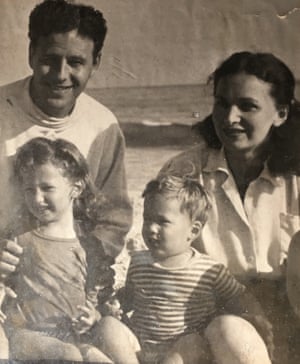
Morrie and Betty with their children, Judith and Steven in the 1940s.
The dating didn’t last long; Morrie left the East Coast and returned to California, where he had lived for some time having taken a road trip there with friends and fallen in love with the sunshine and easy atmosphere. Was it a memorable marriage proposal? “Oh hell no,” Betty replies. “He never proposed. He just asked: would you like to live in California?”
Morrie sent her the fare for the bus, and picked her up in LA after the four-day journey. They “found a rabbi in our price range” and had a simple ceremony, during which the rabbi said: “May the marriage be as pure as the gold in the ring.” Betty and Morrie “looked at each other and almost burst into laughter” – they had a fake gold ring bought at Woolworths.
For Betty, LA is a fabulous city. “You’ve got the beach, the mountains, and the climate is so nice; I think it’s like paradise.” She shows off the one-room condo where they’ve lived for five years, since moving out of their much-loved modernist home a few miles away. The flat is decorated with Morrie’s artwork, most of it from the 1950s and 60s. There’s a view of blue skies and Bunker Hill skyscrapers; Frank Gehry’s Walt Disney Concert Hall, with its luminous swoops and curves, is almost next door.
Betty says that old age for her has meant a great loss of energy: “My walking isn’t good, and I get confused.” These days, Morrie uses a mobility scooter. “He can’t forgive them for taking his car away,” says Betty. But they still go out for breakfast, and declining vigour is in part made up for by a sharpened appreciation of the world around them. Betty enjoys sitting outside a local cafe to see the play of sunlight and shadow, and likes to watch young children splashing in a nearby fountain, wondering which ones will brave the water, and which, too cautious, will turn away.
“I’ve lived a long life and a full one,” Morrie reflects. “I’ve never known a minute of boredom. I’ve always been busy, with work, or making things, or photography or travel, or most recently writing [he’s finished a memoir]. And there’s always another book to read. I sometimes say: I have so much to do, I don’t have time to die.”
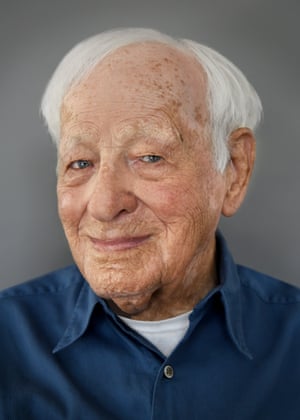
Morrie Markoff. Photograph: Karsten Thormaehlen
The day before his 99th birthday, he did die, at least for a few moments. Having had a heart attack – “Betty acted quickly and dialled 911; she saved my life” – Morrie was undergoing an operation to put in a pacemaker when something went wrong and he flatlined. “The surgeons killed me – not a good idea as I have relations who are attorneys.” Apparently, his mouth fell open, his tongue dropped out and the grieving family retreated to the hospital’s meditation room – only to be called back a little later to find Morrie alive and joking.
“If I were a religious man, I’d put my longevity down to divine intervention,” Morrie says. “As I’m not, I simply say it’s luck.” Though the fact that his father, a very heavy smoker, died aged 94 suggests his genes aren’t bad.
Morrie’s early life was far from pampered. He remembers the tenement he grew up in as rat-ridden, with a kitchen filled with cockroaches and mattresses alive with bedbugs. Six people lived in three rooms; he slept on two chairs his mother put together, piled with cushions, in front of the stove. But he was never hungry, he insists, even in the Depression years, and was given complete freedom.
He remembers swimming naked as a boy in an East River that was full of floating rubbish, condoms, faeces and flotsam; he loved to dive off the flour barges tied to the dock. Perhaps he built up a great immune system, he wonders. And diet? He relishes the memory of hot dogs on Coney Island, with mustard and sauerkraut, washed down with Dr Brown’s celery tonic. Until he got tongue cancer, Morrie also smoked cigarettes, cigars and a pipe. When working as a machinist, he’d leave the cigarettes in his mouth because his hands were so oily; the smoke would fill his eyes, and in the morning he couldn’t open them.
Betty, on the other hand, puts her long life down to her “seventh grade nutrition class”. She was always aware of preparing a meal with protein and vegetables. Plus every morning for decades they’d walk the three miles or so around the local lake, before breakfast.
They always had energy, they insist, and boredom is not in the family. One of their early drives was politics. Morrie was a member of the Communist Party USA and would often go on protests; Betty was once put in prison for an hour for handing out its leaflets. But the aim was never an overthrow of government, just a fairer society. They were devotees of Roosevelt and even more enthusiastic about Barack Obama. As for Trump: “In my lifetime, he’s the oddest person to be elected president … he’s an egomaniac, a wildcard, a casino-owner: how much tax does he pay?”
“He’s so prejudiced,” Betty adds.

Betty Markoff. Photograph: Karsten Thormaehlen
Politics spawned friendships, and they had a close circle when bringing up their two kids, Judith and Steven. (One odd thing about getting to a very advanced age, Betty has said, is seeing your children becoming senior citizens.) The LA house they lived in for decades was part of a progressive housing co-operative; it was designed as a community, and its residents were in and out of each other’s houses all the time. “The friends are not there any more … they are long since gone,” Betty says. I ask her how that feels. She’s quiet but brisk in reply: “Oh, I’m very adaptable.”
After the war, during which he was deferred from the army to make detonators and contour rockets, Morrie ended up owning his own appliance shop. He used the scrap metal from air-conditioner repairs to make the small, dynamic sculptures that were exhibited decades later. But then a passion for travel and photography took over, and Morrie and Betty shine a bit more brightly when remembering their camping trips and tourist escapades. The photos they show me of their trips around the world, from Mexico to Macau, are of an astonishing quality. What camera did you use, I ask? Morrie begins to enthuse about his Rolleiflex and Leica, before Betty groans and changes the subject.
She is clearly proud of him, however. “He’s very talented in lots of directions,” she says in a moment when he’s not around. “If he had grown up differently, who knows what he might have achieved?”
Morrie still feels his days are not long enough, and insists you don’t need much money to live an active and involved life. Their daughter lives in the next building, so even the death of one of the couple won’t spell utter loneliness. Yet again, he mentions their luck.
As I prepare to leave, he chides me mischievously: “You haven’t asked us about our sex life!” Then he laughs: “that’s just a memory”. With his hand on Betty’s knee, Morrie looks at the woman whom he has never told he loves, and says: “After 78 years, I can say I didn’t make a mistake. We’ve had our ups and downs, but we’re still here.”
Thursday, 9 February 2017
Despite his lies, Donald Trump is a potent truth-teller
James S Gordon in The Guardian
Donald Trump evokes a wily and resilient mythic figure: the joker, the trickster, the fool, the one the Lakota people call the Heyoka, the contrary. Had his opponents – like Hillary Clinton – understood this quality in him, the electoral outcome might have been different. The sooner the rest of us understand this side of him, the better.
In the European tradition, the fool holds up the mirror to the monarch and to all of us, mocking our faults and pretensions. He (the fool is almost always a man) is not constrained by deference or allegiance to truth. The Heyoka, one of the purest forms of fool, pretends to shiver when everyone else is sweating and takes off his clothes in winter.
The fool is a potent truth-teller and commands attention. Shakespeare knew this. Lear’s Fool, a gentle version of the species, skewered the arrogance and pride that were his master’s downfall, even as he comforted him. The “scabrous” Thersites in Troilus and Cressida speaks with relentless, scene-stealing venom. He paints Achilles, the Greeks’ greatest hero, as a petulant adolescent; King Agamemnon is a blowhard, Helen of Troy a hooker.
The fool is always addressing us, his audience, as well as his high-ranking targets. He performs a vital social function, forcing us to examine our own preconceptions, especially our inflated ideas about our own virtue. Trump was telling all of us – women and minorities, progressives, pillars of the establishment, as well as his supporters – that we were just like him.
The appropriate, time-honored response to the fool’s sallies is to take instruction from them. Only after we’ve acknowledged and accepted our own shortcomings, do we have the integrity that allows us to keep him in his place. Perhaps if Secretary Clinton had been a more skillful, poised and humble warrior, she could have done this.
Fools serve the collective order by challenging those whose ignorance and blindness threaten it. They are meant to be instruments of awareness, not rulers. Impossible to imagine Lear’s Fool succeeding him or Thersites commanding the Greek army. Trump will not address his own limitations, cannot tolerate criticism, and takes himself dangerously seriously. This makes him is a seriously flawed fool. He believes his own hyperbole and threatens democratic order.
In the weeks since his election, Trump has continued to act the fool. Now, however, the underdog’s challenges have become a bully’s beatdowns. His attack on the steelworkers’ union leader, Chuck Jones, exactly the kind of man whom he claimed to champion, was a vicious and painful lie. Unfunny, purely ugly. His more recent rants, including boasts about the crowds at his inaugural and the millions of imaginary illegal Clinton voters, illuminate his own troubled insecurity: the all-powerful winner acting the petulant, powerless loser.
Many of President Trump’s cabinet choices are like the punchlines of jokes, but punchlines with potentially devastating real-world consequences: an Education Secretary who disparages public education and badly botched her own effort at creating an alternative; men charged with responding to climate change who deny its existence and a National Security Advisor who purveys paranoid fantasies.
There are glimmers of hope that the jester might mature to majesty. General Mattis, the Defense Secretary, inspired a Trumpian epiphany that waterboarding might be counterproductive. Conversations with Al Gore or, more likely, ones with his daughter, Ivanka, could persuade him to open his eyes to the reality of climate change.
Or perhaps President Trump will implode, brought down by the damage done by perverse cabinet choices, or words and actions so intemperate and ill-advised that Congress and the courts call him to a terminal account. His challenged immigration order could be a harbinger.
Meanwhile, what are the rest of us to do? The fact that this question is even being asked is healthy, a residual benefit of his fool’s vocation. Trump’s grand and vulgar self-absorption is inviting all of us to examine our own selfishness. His ignorance calls us to attend to our own blind spots. The fears that he stokes and the isolation he promotes goad us to be braver, more generous.
Already, people all over the United States – Republicans I know as well as Democrats – are beginning to link inner awareness to small and great political action.
The day after Trump’s inauguration, hundreds of thousands of women of all ages, ethnicities, and political affiliations affirmed their rights, celebrated their community and slyly poked at the joker: “if I incorporated my uterus,” read one demonstrator’s sign, “would you stop trying to regulate it.”
The joker who is now our president has served an important function, waking us up to what we’ve not yet admitted in ourselves or accomplished in our country. He is, without realizing it, challenging us to grow in self-awareness, to act in ways that respect and fulfill what is best in ourselves and our democracy.
It’s time for us citizens, who’ve watched the performance, to take the stage.
Donald Trump evokes a wily and resilient mythic figure: the joker, the trickster, the fool, the one the Lakota people call the Heyoka, the contrary. Had his opponents – like Hillary Clinton – understood this quality in him, the electoral outcome might have been different. The sooner the rest of us understand this side of him, the better.
In the European tradition, the fool holds up the mirror to the monarch and to all of us, mocking our faults and pretensions. He (the fool is almost always a man) is not constrained by deference or allegiance to truth. The Heyoka, one of the purest forms of fool, pretends to shiver when everyone else is sweating and takes off his clothes in winter.
The fool is a potent truth-teller and commands attention. Shakespeare knew this. Lear’s Fool, a gentle version of the species, skewered the arrogance and pride that were his master’s downfall, even as he comforted him. The “scabrous” Thersites in Troilus and Cressida speaks with relentless, scene-stealing venom. He paints Achilles, the Greeks’ greatest hero, as a petulant adolescent; King Agamemnon is a blowhard, Helen of Troy a hooker.
The fool is always addressing us, his audience, as well as his high-ranking targets. He performs a vital social function, forcing us to examine our own preconceptions, especially our inflated ideas about our own virtue. Trump was telling all of us – women and minorities, progressives, pillars of the establishment, as well as his supporters – that we were just like him.
The appropriate, time-honored response to the fool’s sallies is to take instruction from them. Only after we’ve acknowledged and accepted our own shortcomings, do we have the integrity that allows us to keep him in his place. Perhaps if Secretary Clinton had been a more skillful, poised and humble warrior, she could have done this.
Fools serve the collective order by challenging those whose ignorance and blindness threaten it. They are meant to be instruments of awareness, not rulers. Impossible to imagine Lear’s Fool succeeding him or Thersites commanding the Greek army. Trump will not address his own limitations, cannot tolerate criticism, and takes himself dangerously seriously. This makes him is a seriously flawed fool. He believes his own hyperbole and threatens democratic order.
In the weeks since his election, Trump has continued to act the fool. Now, however, the underdog’s challenges have become a bully’s beatdowns. His attack on the steelworkers’ union leader, Chuck Jones, exactly the kind of man whom he claimed to champion, was a vicious and painful lie. Unfunny, purely ugly. His more recent rants, including boasts about the crowds at his inaugural and the millions of imaginary illegal Clinton voters, illuminate his own troubled insecurity: the all-powerful winner acting the petulant, powerless loser.
Many of President Trump’s cabinet choices are like the punchlines of jokes, but punchlines with potentially devastating real-world consequences: an Education Secretary who disparages public education and badly botched her own effort at creating an alternative; men charged with responding to climate change who deny its existence and a National Security Advisor who purveys paranoid fantasies.
There are glimmers of hope that the jester might mature to majesty. General Mattis, the Defense Secretary, inspired a Trumpian epiphany that waterboarding might be counterproductive. Conversations with Al Gore or, more likely, ones with his daughter, Ivanka, could persuade him to open his eyes to the reality of climate change.
Or perhaps President Trump will implode, brought down by the damage done by perverse cabinet choices, or words and actions so intemperate and ill-advised that Congress and the courts call him to a terminal account. His challenged immigration order could be a harbinger.
Meanwhile, what are the rest of us to do? The fact that this question is even being asked is healthy, a residual benefit of his fool’s vocation. Trump’s grand and vulgar self-absorption is inviting all of us to examine our own selfishness. His ignorance calls us to attend to our own blind spots. The fears that he stokes and the isolation he promotes goad us to be braver, more generous.
Already, people all over the United States – Republicans I know as well as Democrats – are beginning to link inner awareness to small and great political action.
The day after Trump’s inauguration, hundreds of thousands of women of all ages, ethnicities, and political affiliations affirmed their rights, celebrated their community and slyly poked at the joker: “if I incorporated my uterus,” read one demonstrator’s sign, “would you stop trying to regulate it.”
The joker who is now our president has served an important function, waking us up to what we’ve not yet admitted in ourselves or accomplished in our country. He is, without realizing it, challenging us to grow in self-awareness, to act in ways that respect and fulfill what is best in ourselves and our democracy.
It’s time for us citizens, who’ve watched the performance, to take the stage.
How three students caused a global crisis in economics - A review of The Econocracy
Aditya Chakrabortty in The Guardian
In the autumn of 2011, as the world’s financial system lurched from crash to crisis, the authors of this book began, as undergraduates, to study economics. While their lectures took place at the University of Manchester the eurozone was in flames. The students’ first term would last longer than the Greek government. Banks across the west were still on life support. And David Cameron was imposing on Britons year on year of swingeing spending cuts.
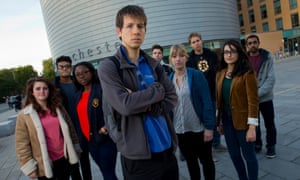
Joe Earle, centre, with the Post-Crash Economics Society at Manchester University. Photograph: Jon Super
The Econocracy makes three big arguments. First, economics has shoved its way into all aspects of our public life. Flick through any newspaper and you’ll find it is not enough for mental illness to cause suffering, or for people to enjoy paintings: both must have a specific cost or benefit to GDP. It is as if Gradgrind had set up a boutique consultancy, offering mandatory but spurious quantification for any passing cause.
Second, the economics being pushed is narrow and of recent invention. It sees the economy “as a distinct system that follows a particular, often mechanical logic” and believes this “can be managed using a scientific criteria”. It would not be recognised by Keynes or Marx or Adam Smith.
In the 1930s, economists began describing the economy as a unitary entity. For decades, Treasury officials produced forecasts in English. That changed only in 1961, when they moved to formal equations and reams of numbers. By the end of the 1970s, 99 organisations were generating projections for the UK economy. Forecasting had become a numerical alchemy: turning base human assumptions and frailty into the marketable gold of rigorous-seeming science.
By making their discipline all-pervasive, and pretending it is the physics of social science, economists have turned much of our democracy into a no-go zone for the public. This is the authors’ ultimate charge: “We live in a nation divided between a minority who feel they own the language of economics and a majority who don’t.”
This status quo works well for the powerful and wealthy and it will be fiercely defended. As Ed Miliband and Jeremy Corbyn have found, suggest policies that challenge the narrow orthodoxy and you will be branded an economic illiterate – even if they add up. Academics who follow different schools of economic thought are often exiled from the big faculties and journals.
The most devastating evidence in this book concerns what goes into making an economist. The authors analysed 174 economics modules for seven Russell Group universities, making this the most comprehensive curriculum review I know of. Focusing on the exams that undergraduates were asked to prepare for, they found a heavy reliance on multiple choice. The vast bulk of the questions asked students either to describe a model or theory, or to show how economic events could be explained by them. Rarely were they asked to assess the models themselves. In essence, they were being tested on whether they had memorised the catechism and could recite it under invigilation.
Critical thinking is not necessary to win a top economics degree. Of the core economics papers, only 8% of marks awarded asked for any critical evaluation or independent judgment. At one university, the authors write, 97% of all compulsory modules “entailed no form of critical or independent thinking whatsoever”.
The high priests of economics still hold power, but they no longer have legitimacy
Remember that these students shell out £9,000 a year for what is an elevated form of rote learning. Remember, too, that some of these graduates will go on to work in the City, handle multimillion pound budgets at FTSE businesses, head Whitehall departments, and set policy for the rest of us. Yet, as the authors write: “The people who are entrusted to run our economy are in almost no way taught to think about it critically.”
They aren’t the only ones worried. Soon after Earle and co started at university, the Bank of England held a day-long conference titled Are Economics Graduates Fit for Purpose?. Interviewing Andy Haldane, chief economist at the Bank of England, in 2014, I asked: what was the answer? There was an audible gulp, and a pause that lasted most of a minute. Finally, an answer limped out: “Not yet.”
The Manchester undergraduates were told by an academic that alternative approaches were as much use as a tobacco-smoke enema. Which is to say, he was as likely to take Friedrich Hayek or Joseph Schumpeter seriously as he was to blow smoke up someone’s arse.
The students’ entrepreneurialism is evident in this book. Packed with original research, it comes with pages of endorsements, evidently harvested by the students themselves, from Vince Cable to Noam Chomsky. Yet the text is rarely angry. Its tone is of a strained politeness, as if the authors were talking politics with a putative father-in-law.
More thoughtful academics have accepted the need for change – but strictly on their own terms, within the limits only they decide. That professional defensiveness has done them no favours. When Michael Gove compared economists to the scientists who worked for Nazi Germany and declared the “people of this country have had enough of experts”, he was shamelessly courting a certain type of Brexiter. But that he felt able to say it at all says a lot about how low the standing of economists has sunk.
The high priests of economics still hold power, but they no longer have legitimacy. In proving so resistant to serious reform, they have sent the message to a sceptical public that they are unreformable. Which makes The Econocracy a case study for the question we should all be asking since the crash: how, after all that, have the elites – in Westminster, in the City, in economics – stayed in charge?
In the autumn of 2011, as the world’s financial system lurched from crash to crisis, the authors of this book began, as undergraduates, to study economics. While their lectures took place at the University of Manchester the eurozone was in flames. The students’ first term would last longer than the Greek government. Banks across the west were still on life support. And David Cameron was imposing on Britons year on year of swingeing spending cuts.
Yet the bushfires those teenagers saw raging each night on the news got barely a mention in the seminars they sat through, they say: the biggest economic catastrophe of our times “wasn’t mentioned in our lectures and what we were learning didn’t seem to have any relevance to understanding it”, they write in The Econocracy. “We were memorising and regurgitating abstract economic models for multiple-choice exams.”
Part of this book describes what happened next: how the economic crisis turned into a crisis of economics. It deserves a good account, since the activities of these Manchester students rank among the most startling protest movements of the decade.
After a year of being force-fed irrelevancies, say the students, they formed the Post-Crash Economics Society, with a sympathetic lecturer giving them evening classes on the events and perspectives they weren’t being taught. They lobbied teachers for new modules, and when that didn’t work, they mobilised hundreds of undergraduates to express their disappointment in the influential National Student Survey. The economics department ended up with the lowest score of any at the university: the professors had been told by their pupils that they could do better.
The protests spread to other economics faculties – in Glasgow, Istanbul, Kolkata. Working at speed, students around the world published a joint letter to their professors calling for nothing less than a reformation of their discipline.
Economics has been challenged by would-be reformers before, but never on this scale. What made the difference was the crash of 2008. Students could now argue that their lecturers hadn’t called the biggest economic event of their lifetimes – so their commandments weren’t worth the stone they were carved on. They could also point to the way in which the economic model in the real world was broken and ask why the models they were using had barely changed.
The protests found an attentive audience among fellow undergraduates – the sort who in previous years would have kept their heads down and waited for the “milk round” to deliver an accountancy traineeship, but were now facing the prospect of hiring freezes, moving back home and paying off their giant student debt with poor wages.
I covered this uprising from the outset, and later served as an unpaid trustee for the network now called Rethinking Economics. To me, it has two key features in common with other social movements that sprang up in the aftermath of the banking crash. Like the Occupy protests, it was ultimately about democracy: who gets to have a say, and who gets silenced. It also shared with the student fees protests of 2010 deep discomfort at the state of modern British universities. What are supposed to be forums for speculative thought more often resemble costly finishing schools for the sons of Chinese communist party cadres and the daughters of wealthy Russians.
Much of the post-crash dissent has disintegrated into trace elements. A line can be drawn from Occupy to Bernie Sanders and Black Lives Matter; some of those undergraduates who were kettled by the police in 2010 are now signed-up Corbynistas. But the economics movement remains remarkably intact. Rethinking Economics has grown to 43 student campaigns across 15 countries, from America to China. Some of its alumni went into the civil service, where they have established an Exploring Economics network to push for alternative approaches to economics in policy making. There are evening classes, and then there is this book, which formalises and expands the case first made five years ago.
Part of this book describes what happened next: how the economic crisis turned into a crisis of economics. It deserves a good account, since the activities of these Manchester students rank among the most startling protest movements of the decade.
After a year of being force-fed irrelevancies, say the students, they formed the Post-Crash Economics Society, with a sympathetic lecturer giving them evening classes on the events and perspectives they weren’t being taught. They lobbied teachers for new modules, and when that didn’t work, they mobilised hundreds of undergraduates to express their disappointment in the influential National Student Survey. The economics department ended up with the lowest score of any at the university: the professors had been told by their pupils that they could do better.
The protests spread to other economics faculties – in Glasgow, Istanbul, Kolkata. Working at speed, students around the world published a joint letter to their professors calling for nothing less than a reformation of their discipline.
Economics has been challenged by would-be reformers before, but never on this scale. What made the difference was the crash of 2008. Students could now argue that their lecturers hadn’t called the biggest economic event of their lifetimes – so their commandments weren’t worth the stone they were carved on. They could also point to the way in which the economic model in the real world was broken and ask why the models they were using had barely changed.
The protests found an attentive audience among fellow undergraduates – the sort who in previous years would have kept their heads down and waited for the “milk round” to deliver an accountancy traineeship, but were now facing the prospect of hiring freezes, moving back home and paying off their giant student debt with poor wages.
I covered this uprising from the outset, and later served as an unpaid trustee for the network now called Rethinking Economics. To me, it has two key features in common with other social movements that sprang up in the aftermath of the banking crash. Like the Occupy protests, it was ultimately about democracy: who gets to have a say, and who gets silenced. It also shared with the student fees protests of 2010 deep discomfort at the state of modern British universities. What are supposed to be forums for speculative thought more often resemble costly finishing schools for the sons of Chinese communist party cadres and the daughters of wealthy Russians.
Much of the post-crash dissent has disintegrated into trace elements. A line can be drawn from Occupy to Bernie Sanders and Black Lives Matter; some of those undergraduates who were kettled by the police in 2010 are now signed-up Corbynistas. But the economics movement remains remarkably intact. Rethinking Economics has grown to 43 student campaigns across 15 countries, from America to China. Some of its alumni went into the civil service, where they have established an Exploring Economics network to push for alternative approaches to economics in policy making. There are evening classes, and then there is this book, which formalises and expands the case first made five years ago.
Joe Earle, centre, with the Post-Crash Economics Society at Manchester University. Photograph: Jon Super
The Econocracy makes three big arguments. First, economics has shoved its way into all aspects of our public life. Flick through any newspaper and you’ll find it is not enough for mental illness to cause suffering, or for people to enjoy paintings: both must have a specific cost or benefit to GDP. It is as if Gradgrind had set up a boutique consultancy, offering mandatory but spurious quantification for any passing cause.
Second, the economics being pushed is narrow and of recent invention. It sees the economy “as a distinct system that follows a particular, often mechanical logic” and believes this “can be managed using a scientific criteria”. It would not be recognised by Keynes or Marx or Adam Smith.
In the 1930s, economists began describing the economy as a unitary entity. For decades, Treasury officials produced forecasts in English. That changed only in 1961, when they moved to formal equations and reams of numbers. By the end of the 1970s, 99 organisations were generating projections for the UK economy. Forecasting had become a numerical alchemy: turning base human assumptions and frailty into the marketable gold of rigorous-seeming science.
By making their discipline all-pervasive, and pretending it is the physics of social science, economists have turned much of our democracy into a no-go zone for the public. This is the authors’ ultimate charge: “We live in a nation divided between a minority who feel they own the language of economics and a majority who don’t.”
This status quo works well for the powerful and wealthy and it will be fiercely defended. As Ed Miliband and Jeremy Corbyn have found, suggest policies that challenge the narrow orthodoxy and you will be branded an economic illiterate – even if they add up. Academics who follow different schools of economic thought are often exiled from the big faculties and journals.
The most devastating evidence in this book concerns what goes into making an economist. The authors analysed 174 economics modules for seven Russell Group universities, making this the most comprehensive curriculum review I know of. Focusing on the exams that undergraduates were asked to prepare for, they found a heavy reliance on multiple choice. The vast bulk of the questions asked students either to describe a model or theory, or to show how economic events could be explained by them. Rarely were they asked to assess the models themselves. In essence, they were being tested on whether they had memorised the catechism and could recite it under invigilation.
Critical thinking is not necessary to win a top economics degree. Of the core economics papers, only 8% of marks awarded asked for any critical evaluation or independent judgment. At one university, the authors write, 97% of all compulsory modules “entailed no form of critical or independent thinking whatsoever”.
The high priests of economics still hold power, but they no longer have legitimacy
Remember that these students shell out £9,000 a year for what is an elevated form of rote learning. Remember, too, that some of these graduates will go on to work in the City, handle multimillion pound budgets at FTSE businesses, head Whitehall departments, and set policy for the rest of us. Yet, as the authors write: “The people who are entrusted to run our economy are in almost no way taught to think about it critically.”
They aren’t the only ones worried. Soon after Earle and co started at university, the Bank of England held a day-long conference titled Are Economics Graduates Fit for Purpose?. Interviewing Andy Haldane, chief economist at the Bank of England, in 2014, I asked: what was the answer? There was an audible gulp, and a pause that lasted most of a minute. Finally, an answer limped out: “Not yet.”
The Manchester undergraduates were told by an academic that alternative approaches were as much use as a tobacco-smoke enema. Which is to say, he was as likely to take Friedrich Hayek or Joseph Schumpeter seriously as he was to blow smoke up someone’s arse.
The students’ entrepreneurialism is evident in this book. Packed with original research, it comes with pages of endorsements, evidently harvested by the students themselves, from Vince Cable to Noam Chomsky. Yet the text is rarely angry. Its tone is of a strained politeness, as if the authors were talking politics with a putative father-in-law.
More thoughtful academics have accepted the need for change – but strictly on their own terms, within the limits only they decide. That professional defensiveness has done them no favours. When Michael Gove compared economists to the scientists who worked for Nazi Germany and declared the “people of this country have had enough of experts”, he was shamelessly courting a certain type of Brexiter. But that he felt able to say it at all says a lot about how low the standing of economists has sunk.
The high priests of economics still hold power, but they no longer have legitimacy. In proving so resistant to serious reform, they have sent the message to a sceptical public that they are unreformable. Which makes The Econocracy a case study for the question we should all be asking since the crash: how, after all that, have the elites – in Westminster, in the City, in economics – stayed in charge?
The Econocracy is published by Manchester University.
Subscribe to:
Comments (Atom)