Search This Blog

Friday, 24 June 2016

Cameron has lost his job – his Teflon cockiness has finally worn off

Aditya Chakrabortty in The Guardian
As the pound plunges and markets slide, remember that this referendum was called by David Cameron to fend off Nigel Farage and his own Tory ultras. He has lost his gamble – and the country will pay the price

Friday 24 June 2016


Financial chaos, economic crisis, the likely breakaway of Scotland and possibly Northern Ireland: quite a morning’s work for the Bullingdon Club.

Remember as the pound plunges and the markets slide that this entire referendum was called by David Cameron to fend off Nigel Farage and his own Tory ultras. There was no public outcry for a ballot – but for the sake of a bit of internal party management, he called one anyway. He gambled Britain and Europe’s future to shore up his own position. With all the confidence of a member of the Etonian officer class, he thought he’d win. Instead he has bungled so badly that the fallout will drag on for years, disrupting tens of millions of lives across Europe.

All this from a man who sauntered into the job of prime minister “because I thought I’d be good at it”. He rarely showed any reason for such self-confidence. His plans to modernise the Conservative party crumbled upon first touch with the banking crisis, which forced him and Osborne to reheat the Thatcherite economics they’d imbibed as students. The “big society” turned almost immediately back into the “small state”. At No 10, he launched an austerity drive that was meant to be over within five years, but is now scheduled to go on for double that. Other prime ministers handed power for a long stretch come up with ideas, policies, a style of governing that defines them: Thatcherism, Blairism. What was Cameronism, apart from a hectoring manner at PMQs and an inability to keep on top of detail?

You’ll be reminded endlessly over the next few days how tight this referendum was – that half the country didn’t vote for this. Quite right – and also serious evidence of the weakness of the prime minister. At the last referendum over Britain’s future in Europe, in 1975, Harold Wilson secured a whopping majority. Never a man to ask a question of whose answer he wasn’t absolutely certain, he got a landslide. But when Cameron was handed the full resources of the British state to run this campaign, he still couldn’t count on anything more than a small lead in the polls. A born member of the governing class, he simply wasn’t able to govern.

Not all of this was his creation; much of it is his political inheritance. For the past 40 years, prime minister after prime minister has embraced a regime that has allowed a massive wealth gap to open up between those at the top and the rest of us, that has fattened up central London even while starving other regions of the country – and that has offered the rest of the country elected police chiefs and city mayors instead of an actual voice.

This morning’s results reflect those decades of calculated callousness and the distrust of the political elites they have produced. Thatcher, Blair, Cameron: all pursued an economic inequality – which in turn bred a political and regional polarisation that marked out this referendum campaign. No wonder inner London voted so strongly for the status quo – it’s one of the few places that is doing well out of it. Likewise, it’s no wonder south Wales mutinied, when all the status quo has offered people there for the past four decades is broken promises and rolling immiseration. The shame of it is that all these justified resentments were mobilised by the racists and the hard-rightists. You know things are upside down when the “big merchant banks” are attacked by a former City trader called Nigel Farage.

As prime minister, Cameron had the chance to tackle this toxic mix of inequality and distrust – instead, he made it worse. Leading the remain campaign, he had the chance to address those who had been cut out of the national settlement – instead, he and George Osborne waved around a threat to house prices, even though housing is now this country’s biggest divide between the haves and the have-nots.

In tacit acceptance of his own lack of popular legitimacy, the prime minister invoked the authority of others: the Bank of England governor, Mark Carney; Christine Lagarde at the IMF; the civil servants at the Treasury. Nothing showed up this politician’s own smallness as the technocrats he sheltered behind.

Now he has lost his big gamble and he has lost his job – but it will be the rest of the country that pays the price. He was never that good, he was just cocky. It was never luck, it was just Teflon. And now it’s worn off.
A basic income could be the best way to tackle inequality

Robert Skidelsky in The Guardian

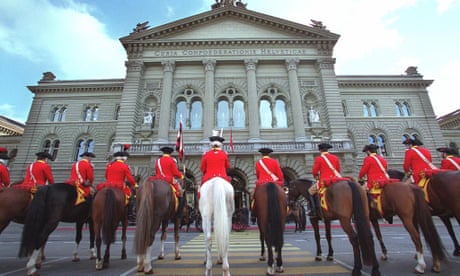
Britain isn’t the only European country to hold a referendum this month. On 5 June, Swiss voters overwhelmingly rejected, by 77% to 23%, the proposition that every citizen should be guaranteed an unconditional basic income (UBI). But that lopsided outcome doesn’t mean the issue is going away anytime soon.

The idea of a UBI has made recurrent appearances in history – starting with Thomas Paine in the 18th century. This time, though, it is likely to have greater staying power, as the prospect of sufficient income from jobs grows bleaker for the poor and less educated. Experiments with unconditional cash transfers have been taking place in poor as well as wealthy countries.


Swiss voters reject proposal to give basic income to every adult and child


UBI is a somewhat uneasy mix of two objectives: poverty relief and the rejection of work as the defining purpose of life. The first is political and practical; the second is philosophical or ethical.


The main argument for UBI as poverty relief is, as it has always been, the inability of available paid work to guarantee a secure and decent existence for all. In the industrial age, factory work became the only source of income for most people – a source that was interrupted by bouts of unemployment as the industrial machine periodically seized up. The labour movement responded by demanding “work or maintenance”. Acceptance of maintenance in lieu of work was reflected in the creation of a system of social security, “welfare capitalism”.

The aim of welfare capitalism was explicitly to provide people an income – typically through pooled compulsory insurance – during enforced interruptions of work. In no sense was income maintenance seen as an alternative to work. As the idea of interruption from work was extended to include the disabled and women bringing up children, so entitlements to income maintenance increased beyond the capacity of social insurance, with benefits paid to eligible individuals from general taxation.

In the 1980s, Ronald Reagan and Margaret Thatcher unwittingly extended the scope of welfare further, as they dismantled institutions and legislation designed to protect wages and jobs in their respective countries. With both left to the market, “in work” benefits, or tax credits, were introduced to enable employed workers to earn a “living wage”. At the same time, conservative governments, alarmed at the growing cost of social security, started to cut back on welfare entitlements.

In this newly precarious environment of work and welfare, UBI is seen as guaranteeing the basic income previously promised by work and welfare, but no longer reliably secured by either. (A leading advocate, Guy Standing at Soas, University of London, has written a book called The Precariat.) An additional argument, always resonant in this tradition, but particularly so today in poorer countries, is UBI’s emancipatory potential for women.

The ethical case for UBI is different. Its source is the idea, found both in the Bible and in classical economics, that work is a curse (or, as economists put it, a “cost”), undertaken only for the sake of making a living. As technological innovation causes per capita income to rise, people will need to work less to satisfy their needs.

Both John Stuart Mill and John Maynard Keynes looked forward to a horizon of growing leisure: the reorientation of life away from the merely useful toward the beautiful and the true. UBI provides a practical path to navigate this transition.

Most of the hostility to UBI has come when it stated in this second form. A poster during the Swiss referendum campaign asked: “What would you do if your income were taken care of?” The objection of most UBI opponents is that a majority of people would respond: “Nothing at all.”

But to argue that an income independent of the job market is bound to be demoralising is as morally obtuse as it is historically inaccurate. If it were true, we would want to abolish all inherited income. The 19th-century European bourgeoisie were largely a rentier class, and few questioned their work effort. Virginia Woolf wrote that a woman who wanted to write fiction “must have money and a room of her own”.

The explosion of robotics has given the demand for UBI renewed currency. Credible estimates suggest that it will be technically possible to automate between a quarter and a third of all current jobs in the western world within 20 years. At the very least, this will accelerate the trend toward the precariousness of jobs and income. At worst, it will make a sizeable share of the population redundant. A standard objection to UBI as a way to replace earnings from vanishing jobs is that it is unaffordable. This partly depends on what parameters are set: the UBI’s level; which benefits (if any) it replaces; whether only citizens or all residents are eligible; and so on.

But this is not the main point. The overwhelming evidence is that the lion’s share of productivity gains in the last 30 years has gone to the very wealthy. And that’s not all: 40% of the gains of quantitative easing in the UK have gone to the wealthiest 5% of households, not because they were more productive, but because the Bank of England directed its cash toward them. Even a partial reversal of this long regressive trend for wealth and income would fund a modest initial basic income.

Beyond this, a UBI scheme can be designed to grow in line with the wealth of the economy. Automation is bound to increase profits, because machines that make human labour redundant require no wages and only minimal investment in maintenance.

Unless we change our system of income generation, there will be no way to check the concentration of wealth in the hands of the rich and exceptionally entrepreneurial. A UBI that grows in line with capital productivity would ensure that the benefits of automation go to the many, not just to the few.

10 Tips on Writing from David Ogilvy

“Good writing is not a natural gift. You have to learn to write well. Here are 10 hints.”

The better you write, the higher you go in Ogilvy & Mather. People who think well, write well.
Woolly minded people write woolly memos, woolly letters and woolly speeches.
Good writing is not a natural gift. You have to learn to write well. Here are 10 hints:
  1. Read the Roman-Raphaelson book on writing. Read it three times.
  2. Write the way you talk. Naturally.
  3. Use short words, short sentences and short paragraphs.
  4. Never use jargon words like reconceptualizedemassification,attitudinallyjudgmentally. They are hallmarks of a pretentious ass.
  5. Never write more than two pages on any subject.
  6. Check your quotations.
  7. Never send a letter or a memo on the day you write it. Read it aloud the next morning — and then edit it.
  8. If it is something important, get a colleague to improve it.
  9. Before you send your letter or your memo, make sure it is crystal clear what you want the recipient to do.
  10. If you want ACTION, don’t write. Go and tell the guy what you want.

David Ogilvy’s 20 unconventional rules for getting clients


  • Regard the hunt for new clients as a sport.Once you land new business, that’s when it’s time to become dead serious — until then — save yourself from dying of ulcers over lost clients. Approach the search for new clients with “light-hearted gusto”. Play to win but enjoy the fun.
  • Never work for a client so big you can’t afford to lose them.
    Why? The fear of losing them, alone, will wreck your life. You will be unable to give candid advice, and “slowly become a lackey”. David Ogilvy once turned down Ford, saying: “Your account would represent one-half of our total billing. This would make it difficult for us to sustain our independence in council.” Landing your ideal client immediately may not be as great for your business as you think.
  • Take immense pain in selecting your clients.On average, Ogilvy and Mather would turn down about 60 clients every year. You too should be choosing clients before they choose you. The truth is first-class agencies aren’t in high supply. You have the power to select who you work with, so do it carefully.
  • Only add 1 new client every 2 years.You want to keep the clients you have. For life. That should be your #1 goal. And if you’re working with great clients and keeping them, then you’ll need only a few clients. David Ogilvy also discovered other reasons adding too many new clients hurt his business. Growing too fast led to hiring too fast. This led to not having well-trained staff. That led to diverting too much of his agencies best brain power away from servicing old clients and failing at keeping clients for life. Plus starting new clients off is often the most difficult work; because you’re building everything from scratch. So screw finding new clients, keep old ones.
  • Only seek clients with a product or service you are proud of. Unlike lawyers and doctors, professionals in the creative field can’t detach themselves from their work. If you privately despise your client’s product or service, you will fail. You need to have a personal fondness for the client you service before you can help them succeed.
  • Only accept a client if you can improve their existing work. Ogilvy was famous for turning down the New York Times because he“didn’t think (he) could produce better advertisements than the brilliant ones they had been running.” Don’t think you can create better work than what’s already there? Don’t take on the client.
  • Don’t take on clients whose business is dying. 
    This can be tough when you need work, but if a client approaches you who you know won’t be able to stay in business, regardless of if they hire you, don’t take them on. It doesn’t matter how great your work is, nothing you do will make up for their deficiencies. You may be hungry for work, but the success of your clients, ultimately defines you. Your profit margin is too slim to survive a prospective client’s bankruptcy.
  • Only work for clients who want you to make a profit. Just because you produce results for a client doesn’t mean you will automatically see those profits come your way. Every client service firm treads a thin line between over-servicing clients and going broke, or under-servicing them and getting fired. Make sure your client’s understand that you too are making money — by helping them make money. Make sure they understand you are planning to take a percentage of their profit (however small). Don’t shy away from it and don’t pretend otherwise.
  • Don’t publicly pursue clients.
    If a client announced they were considering hiring Ogilvy, he would withdraw his company from the race. His reason? “I like to succeed in public, fail in secret.”
  • Avoid contests in which more than four other agencies are involved.It’s way too easy to waste your time in meetings. Especially when you’re on the shopping list of every prospective client. You have other fish to fry — the fish of your current clients. Ideally you wanted to be courted by clients who have no other prospects in mind.
  • Getting new clients is a solo performance. The person who decides to hire you is almost always the top decision maker at the company. David believed, “Chairmen should be harangued by chairmen.” Additionally, he felt having too many people on sales calls caused confusion. That’s why singularity is an important ingredient in winning accounts.
  • Remain flexible when selling clients.It’s OK to rehearse for sales calls but David hated speaking from prepared text. A slide deck or written text locks you into a position which may become irrelevant during the meeting.
  • Tell prospects about your weaknesses.
    David picked this up from antique dealers. He realized that when a dealer drew your attention to a flaw in the furniture, he almost always gained your trust. If you do this too — before the client notices your flaws on their own, you will also gain their trust. It will make you more credible when you boast about your strong points.
  • Don’t get bogged down in case-studies or research numbers.
    These things put prospects to sleep. “No manufacturer ever hired an agency because it increased market-share for somebody else.” Clients care about themselves, talk about them.
  • Explicitly tell clients why they should hire you.The day after a new business a new client meeting, David would send the client a 3-page letter on why they should pick him. Today you can send an equally brief email to help clients make the right decision.
  • Don’t pay an outside source a commission for new business.David Ogilvy believed the type of clients this brought in weren’t worth the trouble. Today commission-based lead finders include recruiters, head-hunters, and even other freelancers.
  • Beware of clients who have no budget but a great idea. Even though they might become huge if everything goes well, it’s more likely that things won’t go well. Servicing these companies will be expensive for you and very few of them will ever make it worth your while.
  • Don’t underestimate personality. The difference between client service firms is not as big as we like to believe. Most can show they produced results that increased sales for some of their clients. Very often the difference in new business depends on the personality of the head of the agency. Know you will win and lose some clients because of your personality.
  • Fire clients at least 5 times more often than you get fired. 
    Always do it for the same reason: if their behavior erodes the morale of the people working on their account. Do not allow this from any client.
  • Use what you specialize in to find new clients. David Ogilvy created ads selling his ad agency. You should dog-food your own service too. So how does your work help clients? Can it help you in the same way? For example, do you help them find customers by creating content? Create content for your agency. Do you do graphic design? Create infographics for potential clients. The trick will be to not just make thing that you like or impress people in your industry, but to make things that impress potential clients.