Search This Blog

Sunday, 19 June 2016

Brussels isn’t the bad guy. Tory cuts cause Britain’s troubles

Phillip Inman in The Guardian


T
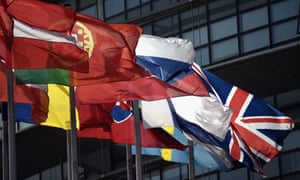
he current and previous governments are to blame for our economic woes, not Brussels. Photograph: Frederick Florin/AFP/Getty Images


Don’t blame the EU for your troubles, blame Tory austerity.
This is the message Labour voters should hear from Jeremy Corbyn. It is a message Ed Miliband could have made more forcefully during his term as Labour leader, when the conversation on the doorstep turned to immigration. Instead, he appeared to choke with embarrassment.

Corbyn has a higher embarrassment threshold. He could look the immigration question in the eye and not blink. Unfortunately, the Islington North MP considers debating immigration off limits.

So, last week, Corbyn tried to persuade voters that the EU is the workers’ friend and a bulwark against a bonfire of employment protections. That’s not an unreasonable position. Yet if immigration is the main source of anger outside the south-east, and if it is driving the Brexit campaign to a possible victory, the subject needs to be tackled head-on. If you think Britain is a great place to live that has been ruined by an alliance with other EU nations, you are mistaken and Labour needs to make that point.

Here are five reasons that the former coalition government and the current Tory administration are to blame, and not Brussels.

Jobs


It is easy to walk around an engineering practice in London, a hospital in Leeds or a leek farm in Lincolnshire and conclude that foreigners are stealing “our” jobs. But, in the main, the roles would be unfilled if they were kept out. The work would probably go abroad.

On one level, the fault lies with consumers and employers, large and small. Consumers would buy a foreign leek before one grown here picked by a Brit who was paid more and treated better. Employers are at fault for not training school leavers, older workers and job switchers because it’s cheaper to hire foreigners. Profits are calculated on this basis. Moreover, without cheaper labour there would, in many cases, be no business.

So foreigners allow employers to expand the number of jobs. That’s what the figures tell us. Compared to this time last year, there are 461,000 more people in work. People from the rest of the EU grabbed a majority of the jobs, but the substitution effect with UK nationals was only at the margins. Overall, the number in work just keeps going up and the UK now has a record employment rate of 74.2%.

Look a little closer and it is clear the government has played a big part by cutting skills and training budgets, laying waste to further education and demanding workers accept precarious employment, whether it be zero-hours contracts or self employment.
Vacancies


Job vacancies are running at a higher level than we have seen at any time this century. A small dip in recent months still leaves the number at 750,000. Most are for services jobs, as one might expect, with the largest number among retailers and wholesalers. Car repair firms reported a 143,000 shortage. The NHS and social work sector accounted for 119,000 of the total.

Finding a mechanic, or hiring a nurse, is as much a problem in Leeds as in London. It’s not just about a lack of skilled jobs being created in the north, but also a mismatch of people to jobs – not a problem invented in Brussels.

Wages

Adjusted for inflation, average wages have collapsed since the 2008 crash. Workers absorbed cuts in overtime and basic hours to keep their jobs.

Since the recovery got into full swing in 2014, wages have nudged ahead of inflation, but not enough to fill the gap. Part of the reason is the lack of investment by employers who rely on cheap workers.

But the UK, like all developed economies, is also suffering from the effects of globalisation, which allows multinationals to invest where subsidies are most generous. Ford has centred much of its European operations in Turkey for that reason. Without investment in skilled jobs there will be no increase in wages, but that is not on the Tory agenda.

Housing

If the worry is that housing is either poor quality or too costly, for yourself and your children, blame successive governments for failing to support good quality state-sponsored housing.

The taxes from migrant workers could be used to fund it, but the current and previous governments have preferred to reduce the top rate of tax and protect pensioners’ benefits.

There is no evidence in the last 100 years that shows private builders can meet the nation’s needs. This means housing associations have to find funds to build – but ministers are denying them access to finance, and councils can’t offer builders land when they are forced to sell to the highest bidder.

Health service


If the queue at the hospital and GP is a problem, this is the result of austerity measures that cut spending growth from 4% a year in real terms to 1% since 2010.
The NHS, coping with an ageing society, was supposed to implement reforms to fill the gap but, to no one’s surprise, this project has so far failed. Worse, in his last budget, George Osborne slashed council spending on health by £800m. That’s cash used for local mental health services and preventative policies, such as tackling obesity. He told local authorities to put up council tax by 2% to fill the gap.

It’s cuts that lead to queues – in a race to the bottom that Osborne, despite his rhetoric, thinks is just fine.

Why failure is the key to flying high


If at first you don’t succeed: Leonardo DiCaprio as Howard Hughes in The Aviator. Photograph: Miramax/Everett/Rex/Shutterstock


Matthew Syed in The Guardian


We want our children to succeed, in school and, perhaps even more importantly, in life. But the paradox is that our children can only truly succeed if they first learn how to fail. Consider the finding that world-class figure skaters fall over more often in practice than low-level figure skaters. At first sight this seems contradictory. Why are the really good skaters falling over the most?

The reason is actually quite simple. Top skaters are constantly challenging themselves in practice, attempting jumps that stretch their limitations. This is why they fall over so often, but it is precisely why they learn so fast. Shizuka Arakawa of Japan estimates that she endured some 20,000 falls as she progressed from a beginner to an Olympic champion.

Lower-level skaters have a quite different approach. They are always attempting jumps they can already do very easily, remaining within their comfort zone. This is why they don’t fall over. In a superficial sense, they look successful, because they are always on their feet. The truth, however, is that by never failing, they never progress.
What is true of skating is also true of life. James Dyson worked through 5,126 failed prototypes for his dual cyclone vacuum before coming up with the design that made his fortune. These failures were essential to the pathway of learning. As Dyson put it: “You can’t develop new technology unless you test new ideas and learn when things go wrong. Failure is essential to invention.”

Even in areas of life where failure is potentially catastrophic, it is still vital to respond positively. In aviation, for example, every aircraft is equipped with two almost-indestructible black boxes: one records the electronic information from the on-board computers and the other records sounds in the cockpit. When there is a crash, these boxes are recovered and analysed so that enlightened changes can be enacted. This means that the same mistake never happens again. It is this constant willingness to learn from failure that means aviation has become one of the world’s safest forms of transportation. Last year the accident rate for major airlines was just one crash for every 8.3 million take-offs.

In healthcare, however, things are very different. Clinicians don’t like to admit to failure, partly because they have healthy egos (particularly the senior doctors) and partly because they fear litigation. The consequence is that instead of learning from failure, healthcare often covers up failure. The direct consequence is that the same mistakes are repeated. According to the Journal of Patient Safety, 400,000 people die every year in American hospitals alone due to preventable error. That is like two jumbo jets crashing every day or 9/11 happening every few days. In the UK, too, the numbers are shocking. Until healthcare learns to respond positively to failure, things will not improve.

But let us return to children. One of the seminal mistakes in education in the 1970s was the attempt to equip children with confidence by giving them lots of successes (setting the bar very low). The consequence was that the self-esteem of kids became bound up with success, and they became unable to take risks and crumpled as soon as they hit a proper challenge.

We need to flip this approach. In a complex world, failure is inevitable. It is those individuals and institutions that have the resilience and flexibility to face up to failure, learn the lessons and adapt which ultimately excel.

Brexit is being driven by English nationalism. And it will end in self-rule

Fintan O'Toole in The Guardian
It is a question the English used to ask about their subject peoples: are they ready for self-government? But it is now one that has to be asked about the English themselves. It’s not facetious: England seems to be stumbling towards a national independence it has scarcely even discussed, let alone prepared for. It is on the brink of one of history’s strangest nationalist revolutions.
When you strip away the rhetoric, Brexit is an English nationalist movement. If the Leave side wins the referendum, it will almost certainly be without a majority in either Scotland or Northern Ireland and perhaps without winning Wales either. The passion that animates it is English self-assertion. And the inexorable logic of Brexit is the logic of English nationalism: the birth of a new nation state bounded by the Channel and the Tweed.
Over time, the main political entity most likely to emerge from Brexit is not a Britain with its greatness restored or a sweetly reunited kingdom. It is a standalone England. Scotland will have a second referendum on independence, this time with the lure of staying in the European Union. Northern Ireland will be in a horrendous bind, cut off from the rest of the island by a European border and with the UK melting around it. Its future as an unwanted appendage of a shrunken Britain is unsustainable. Wales is more uncertain, but a resurgence of Welsh nationalism after Brexit is entirely possible, especially after a Scottish departure from the UK. After Brexit, an independent England will emerge by default.
And this is of course a perfectly legitimate aspiration. Nationalism, whether we like it or not, is almost universal and the English have as much right to it as anyone else. There’s nothing inherently absurd about the notion of England as an independent nation state. It’s just that if you’re going to create a new nation state, you ought to be talking about it, arguing for it, thinking it through. And this isn’t happening. England seems to be muddling its way towards a very peculiar event: accidental independence.
The first thing about the idea of England as a nation state that governs itself and only itself is that it is radically new. The Brexit campaign is fuelled by a mythology of England proudly “standing alone”, as it did against the Spanish armada and Adolf Hitler. But when did England really stand alone? The answer, roughly speaking, is for 300 of the past 1,200 years. England has been a political entity for only two relatively short periods. The first was between the early 10th century, when the first English national kingdom was created by Athelstan, and 1016 when it was conquered by Cnut the Dane. The second was between 1453, when English kings effectively gave up their attempts to rule France, and 1603, when James VI and I united the thrones of England and Scotland.
Otherwise – and this includes all of the past 400 years – England has always been part of at least one larger entity: an Anglo-French kingdom, the United Kingdom in its various forms, a global empire, the European Union. The English are much less used to being left to their own devices than they think they are.
English nationalists can quite reasonably point out that many emerging nation states have even less experience of being a standalone, self-governing entity – my own country, Ireland, being an obvious example. The big difference is that other countries actually go through a process – often very long and difficult – of preparing themselves politically, culturally and emotionally for the scary business of being (to borrow a term from Irish nationalism) “ourselves alone”. In England, there is no process. A decisive step is about to be taken without acknowledging the path ahead.
Hardly anyone is even talking about England – all the Brexit arguments are framed in terms of Britain or the UK, as if these historically constructed and contingent entities will simply carry on regardless in the new dispensation. The Brexiters imagine an earthquake that will, curiously, leave the domestic landscape unaltered. English nationalism is thus a very strange phenomenon – a passion that is driving a nation towards historic change but one that seems unwilling even to speak its own name.
It is hard to think of any parallel for this. Successful national independence movements usually have five things going for them: a deep sense of grievance against the existing order; a reasonably clear (even if invented) idea of a distinctive national identity; a shared (albeit largely imaginary) narrative of the national past; a new elite-in-waiting; and a vision of a future society that will be better because it is self-governing.
The English nationalism that underlies Brexit has, at best, one of these five assets: the sense of grievance is undeniably powerful. It’s also highly ambiguous – it is rooted in the shrinking of British social democracy but the actual outcome of Brexit will be an even closer embrace of unfettered neoliberalism. There is a weird mismatch between the grievance and the solution.
None of the other four factors applies. As a cultural identity, Englishness is wonderfully potent but not distinctive – its very success means that it is global property. From the English language to the Beatles, from Shakespeare to the Premier League, its icons are planetary. The great cultural appeal of nationalism – we need political independence or our unique culture will die – just doesn’t wash. Moreover, this power of English culture derives precisely from its capacity to absorb immigrant energies. From the Smiths to Zadie Smith, from the Brontës to Dizzee Rascal, it is very hard to imagine an “English” culture that is not also Afro-Caribbean, Asian, Irish, Jewish and so on.
Is there a shared narrative of the English past that functions even as a useful collective invention? English nationalism has a hard time integrating the past of John Ball and the Levellers, of Mary Wollstonecraft and Tom Paine with that of monarchs, generals and imperial power.
As for an elite-in-waiting, the English nationalist movement certainly has one. But the handover of elite power that will accompany this particular national revolution will surely be the most underwhelming in history — from one set of public school and Oxbridge Tories to another. And this elite’s vision of a future society seems to come down to the same lump of money – the (dishonestly) alleged £350m a week that will be saved by leaving the EU – being spent over and over on everything from the National Health Service to farm subsidies. Plus, of course, fewer immigrants, thereby creating some kind of imaginary Lebensraum. There is no attempt to articulate any set of social principles by which the new England might govern itself. As Johnny Rotten (a typically English child of immigrants) put it: “There is no future in England’s dreaming.”
When it comes down to it, nationalism is about the line between Them and Us. The Brexiters seem pretty clear about Them – Brussels bureaucrats and immigrants. It’s just the Us bit that they haven’t quite worked out yet. Being ready for self-government demands a much better sense of the self you want to govern.

Saturday, 18 June 2016

So Britain, are you ready to enter the United Kingdom of Ukip?

Marina Hyde in The Guardian


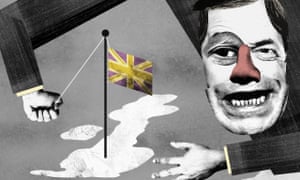
‘Don’t get me wrong on Nigel – he’s fine for a fag, a pint, some jolly japes on the Thames.’ Illustration: Nate Kitch

Right now, in the Ukip bunker, there is a search going on. It is urgent. It is probably desperate. It is the search for a tone. The emotional Rolodex of Nigel Farage is being riffled through in the hope it might throw up something usable. Top presentational aides have been dispatched on a vital quest to find the outer limits of his range. The journey is unlikely to detain them very long. Yet at the most recent reckoning Farage stands a few disputed percentage points away from being acclaimed – like it or not – the most extraordinarily successful British politician of a generation. Globally, he may soon be seen as reflecting us.

A man who yesterday morning was standing in front of a poster eerily similar to genuine Nazi propaganda is today in seclusion, his campaign suspended – like all the official referendum efforts - “out of respect”. And, presumably, out of uncertainty as to what the hell he does next.

Yesterday morning Farage was playing dog-whistle politics. Forgive me: he was playing whistle politics. Understanding the import of the words “BREAKING POINT” across a snaking queue of stricken brown-skinned people does not require ultrasonic capabilities. You can stand down, Lassie. You’re not needed today, girl.

Yesterday afternoon, the MP Jo Cox was killed in the street in her Batley and Spen constituency. That her alleged killer had years of mental health issues seems likely. That he is alleged to have shouted, “Britain first” – perhaps a reference to an organisation with which Ukip were last year forced to deny an electoral pact – is a matter of acute sensitivity. If the party barkers were a hundredth as careful about anything else as they are instructing everyone to be about that alleged “Britain first” cry, then they would have moderated themselves into retirement years ago.

“We are not won by arguments that we can analyse,” the great liberal supreme court justice Louis Brandeis observed, “but by tone and temper; by the manner, which is the man himself.”

Character is not always destiny, but tone matters. As we head towards polling day, all eyes must be on the man himself, Nigel Farage, who did more to bring about this referendum than any other, and whose artless, divisive bait-and-switch has felt like its governing spirit. How bound up Britain’s destiny has seemed with the character of this rather small man. Where does Britain’s-most-successful-politician-in-waiting go from here? Cometh the hour, whence cometh the tone?

Farage will, of course, have to find some words that address the utter loathsomeness of where we find ourselves, and the shame and despair it makes many people feel. Like him or not, David Cameron can do this. Like him or not, Jeremy Corbyn did so on Thursday. Together in Birstall, they found the bearing. And then … Well, it ought to be noted mildly that Thursday’s repulsive poster was merely the first in a planned series. Will we see the rest? At this moment of national and personal destiny, will Farage manage to be the politician of stature he assures us he is?

Hitherto, Farage has had a tried and tested shtick for Serious Moments. I notice it all the time now, but I first saw it when I asked him with sledgehammer flippancywhether Nelson Mandela was one of his political heroes. Immediately, Farage lowered his voice and opened his eyes very wide. “He’s a human hero,” he intoned. “That day he came out of Robben Island” – it wasn’t Robben Island, but anyway – “and stood there and forgave everybody, I just thought: ‘This is Jesus.’” Hugely idiosyncratic for a man on the right of the Tory party at the time, considering most of his political soulmates had only just given up wearing “Hang Mandela” badges, but there you go. “I don’t regard him as a political hero,” Nigel went on very quietly and with his eyes still open very wide. “I think he’s on a rather higher plane than that.”

Drop the voice, widen the eyes. He’ll probably do it this weekend. He certainly does it when anyone accuses him of borderline racism. Down goes the voice, as though he is personally trying to smother their insinuation in the appalled hush it deserves. I have to confess the Farage mind trick doesn’t work on me. Instead, every time Nigel deploys it, it makes me think of a Truman Capote line from In Cold Blood. “The quietness of his tone italicised the malice of his reply.”

That the political atmosphere was febrile and fetid before Jo Cox’s death hardly needs stating. “How foul this referendum is,” wrote the novelist Robert Harris this week. “The most depressing, divisive, duplicitous political event of my lifetime. May there never be another.” Boris Johnson’s sister Rachel has since retweeted the observation.

So many of the things that have felt bizarre or even vaguely comic at one Atlantic Ocean’s remove have suddenly alighted on our shores. Lies are knowingly painted on buses; previously unsayable things have been said on platforms that lend them a hideous legitimacy; the word “expert” has become as dirty as the word “Westminster”; and the shift to post-factual political discourse feels rapidly under way. No one is more post-fact than Farage. Asked why he was back on the cigs again this week, he replied: “I think the doctors have got it wrong on smoking.”

Don’t get me wrong on Nigel – he’s fine for a fag, a pint, some jolly japes on the Thames. The entire campaign’s only moment of levity came on Wednesday, as his flotilla did battle with Bob Geldof’s. In fact, it was while aboard Farage’s boat that I saw two children on one of the small remain dinghies and wondered who they were. They looked the same age as my eldest two – about five and three – and I thought how hilarious and exciting mine would have found the whole spectacle. I smiled and waved at them, because there is obviously a law stating that people in or aboard funny forms of transport should always wave at children. I only found out the next day that those children had been Jo Cox’s. Her husband Brendan had tweeted: “Kids seriously disappointed there isn’t another flotilla today.”

My God, the horror. Lying in wait, the unthinkable horror. Twenty-four hours later, Brendan Cox was issuing a statement on his wife’s murder. That he was able to find the words and tone that I am sure I never could in such unimaginable circumstances has been a thing of marvel to so many. We know the heights of humanity when we see them.

And I’m afraid we know when we don’t. I’m not sure I’ve ever heard humanity emanate from Nigel Farage, certainly not convincingly. On the eve of what he hopes will be his finest hour, he must rise to the challenge now. People expect. Britain expects. If you haven’t the words and the deportment for this sort of horror, and the politics that the timetable dictates will have to be conducted while it is still so fresh, then you are not fit for office or the sniff of it.

There are many people I respect and admire voting leave – there are people in my family voting leave. I understand their reasons. But they must stomach the reality that a vote for leave will be taken by Farage and countless others as a vote for him, a vote for his posters, a vote for his ideas, a vote for his quiet malice, a vote for his smallness in the face of vast horrors. Is it worth it?