Aditya Chakrabortty in The Guardian
IMF economists have published a remarkable paper admitting that the ideology was oversold
‘You hear it when the Bank of England’s Mark Carney sounds the alarm about ‘a low-growth, low-inflation, low-interest-rate equilibrium’. Photograph: Dylan Martinez/AFP/Getty Images
What does it look like when an ideology dies? As with most things, fiction can be the best guide. In Red Plenty, his magnificent novel-cum-history of the Soviet Union, Francis Spufford charts how the communist dream of building a better, fairer society fell apart.
Even while they censored their citizens’ very thoughts, the communists dreamed big. Spufford’s hero is Leonid Kantorovich, the only Soviet ever to win a Nobel prize for economics. Rattling along on the Moscow metro, he fantasises about what plenty will bring to his impoverished fellow commuters: “The women’s clothes all turning to quilted silk, the military uniforms melting into tailored grey and silver: and faces, faces the length of the car, relaxing, losing the worry lines and the hungry looks and all the assorted toothmarks of necessity.”
But reality makes swift work of such sandcastles. The numbers are increasingly disobedient. The beautiful plans can only be realised through cheating, and the draughtsmen know it better than any dissidents. This is one of Spufford’s crucial insights: that long before any public protests, the insiders led the way in murmuring their disquiet. Whisper by whisper, memo by memo, the regime is steadily undermined from within. Its final toppling lies decades beyond the novel’s close, yet can already be spotted.
When Red Plenty was published in 2010, it was clear the ideology underpinning contemporary capitalism was failing, but not that it was dying. Yet a similar process as that described in the novel appears to be happening now, in our crisis-hit capitalism. And it is the very technocrats in charge of the system who are slowly, reluctantly admitting that it is bust.
You hear it when the Bank of England’s Mark Carney sounds the alarm about “a low-growth, low-inflation, low-interest-rate equilibrium”. Or when the Bank of International Settlements, the central bank’s central bank, warns that “the global economy seems unable to return to sustainable and balanced growth”. And you saw it most clearly last Thursday from the IMF.
What makes the fund’s intervention so remarkable is not what is being said – but who is saying it and just how bluntly. In the IMF’s flagship publication, three of its top economists have written an essay titled “Neoliberalism: Oversold?”.
The very headline delivers a jolt. For so long mainstream economists and policymakers have denied the very existence of such a thing as neoliberalism, dismissing it as an insult invented by gap-toothed malcontents who understand neither economics nor capitalism. Now here comes the IMF, describing how a “neoliberal agenda” has spread across the globe in the past 30 years. What they mean is that more and more states have remade their social and political institutions into pale copies of the market. Two British examples, suggests Will Davies – author of the Limits of Neoliberalism – would be the NHS and universities “where classrooms are being transformed into supermarkets”. In this way, the public sector is replaced by private companies, and democracy is supplanted by mere competition.
The results, the IMF researchers concede, have been terrible. Neoliberalism hasn’t delivered economic growth – it has only made a few people a lot better off. It causes epic crashes that leave behind human wreckage and cost billions to clean up, a finding with which most residents of food bank Britain would agree. And while George Osborne might justify austerity as “fixing the roof while the sun is shining”, the fund team defines it as “curbing the size of the state … another aspect of the neoliberal agenda”. And, they say, its costs “could be large – much larger than the benefit”.
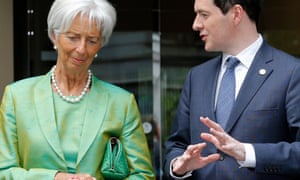
IMF managing director Christine Lagarde with George Osborne. ‘Since 2008, a big gap has opened up between what the IMF thinks and what it does.’ Photograph: Kimimasa Mayama/EPA
Two things need to be borne in mind here. First, this study comes from the IMF’s research division – not from those staffers who fly into bankrupt countries, haggle over loan terms with cash-strapped governments and administer the fiscal waterboarding. Since 2008, a big gap has opened up between what the IMF thinks and what it does. Second, while the researchers go much further than fund watchers might have believed, they leave in some all-important get-out clauses. The authors even defend privatisation as leading to “more efficient provision of services” and less government spending – to which the only response must be to offer them a train ride across to Hinkley Point C.
Even so, this is a remarkable breach of the neoliberal consensus by the IMF. Inequality and the uselessness of much modern finance: such topics have become regular chew toys for economists and politicians, who prefer to treat them as aberrations from the norm. At last a major institution is going after not only the symptoms but the cause – and it is naming that cause as political. No wonder the study’s lead author says that this research wouldn’t even have been published by the fund five years ago.
From the 1980s the policymaking elite has waved away the notion that they were acting ideologically – merely doing “what works”. But you can only get away with that claim if what you’re doing is actually working. Since the crash, central bankers, politicians and TV correspondents have tried to reassure the public that this wheeze or those billions would do the trick and put the economy right again. They have riffled through every page in the textbook and beyond – bank bailouts, spending cuts, wage freezes, pumping billions into financial markets – and still growth remains anaemic.
And the longer the slump goes on, the more the public tumbles to the fact that not only has growth been feebler, but ordinary workers have enjoyed much less of its benefits. Last year the rich countries’ thinktank, the OECD, made a remarkable concession. It acknowledged that the share of UK economic growth enjoyed by workers is now at its lowest since the second world war. Even more remarkably, it said the same or worse applied to workers across the capitalist west.
Red Plenty ends with Nikita Khrushchev pacing outside his dacha, to where he has been forcibly retired. “Paradise,” he exclaims, “is a place where people want to end up, not a place they run from. What kind of socialism is that? What kind of shit is that, when you have to keep people in chains? What kind of social order? What kind of paradise?”
Economists don’t talk like novelists, more’s the pity, but what you’re witnessing amid all the graphs and technical language is the start of the long death of an ideology.
Penny Anderson in The Guardian
Being a landlord is a privilege, and it shouldn’t be available to everybody: with the power they have over their tenants should come a sense of responsibility

‘Owners misunderstand, ignore or forget legal requirement to issue proper notices to quit, or the need for prior warning of inspection visits.’ Photograph: Alamy
There are more private landlords than ever. Many are reasonable. Some are even excellent, but letting property is largely unrestricted.
Sadiq Khan, the mayor of London, has highlighted the failure of his predecessor Boris Johnson to sign up 100,000 landlords to his much vaunted London Rental Standard, which aims to help landlords with things such as having a gas safety check every year, and the laws around deposits and fire safety. After two years in operation, the scheme had attracted fewer than 2,000 landlords in addition to the 13,300 it inherited.
The files reveal that officials warned the mayor at the outset that his target was unattainable and that it would take “more than 50 years to accredit a sufficient number of landlords to meet the target”. Another note read: “We simply don’t have the resources to proactively enforce the London Rental Standard, which leaves us with an unacceptable reputational risk.” Johnson’s betrayal of renters in the capital after all the promises made is embarrassing for him, but a disaster for tenants. There is no doubt that the job needs doing.
Dilettante amateur property investors often know little about basic good practice, the law or simply what’s best for everyone when it comes to running their business in a civilised, humane fashion – and yes, it is a business, with the potential for profit and loss. They might be reluctant or “forced” rentiers (a term I prefer to landlord), with the family home in negative equity, compelled to rent it out if they want to move on. Outside London this is still a reality, and with the predicted house-price crash on Brexit, that practice may become more widespread.
This situation fuels the likelihood that tenants will be turfed out as soon as possible when the building increases in value. Remember that all tenants live under the threat of just two months’ notice when their initial assured shorthold tenancy rolls over. There is no security for renters.
There are recurring issues, such as owners who do not understand the concept of reasonable wear and tear expecting their properties to remain pristine and unmarked, even when the low-quality carpets and sofas they chose were threadbare to begin with. This in turn propagates the now traditional unlawful deposit retention/deduction battle, which can see mundane events – the simple act of using the sofa perhaps – cited as justification for the retention of hundreds of pounds, obliging tenants to fight for, and rarely succeed in getting, the return of hard-earned money paid up-front.

‘There are recurring issues, such as owners not understanding the concept of reasonable wear and tear, even when the low-quality carpets and sofas they chose were threadbare to begin with.’ Photograph: Popperfoto/Getty Images
There are the problems of legal management. Owners misunderstand, ignore or forget the legal requirement to issue proper notices to quit, or the need for prior warning of inspection visits, using the power of thought or suggestion instead. Some owners I have rented from imagine they can let themselves in whenever they see fit.
Let’s be reasonable. We know that property doesn’t manage itself, and can be costly to maintain. The obligation to repair causes tension once owners, even the best-intentioned ones, grow acquainted with the expense of emergency out-of-hours plumbing.
Some owners – through indolence or meanness – would rather let the place rot; a friend’s landlord knowingly allows water from the leaky tiles to be absorbed by cavity wall insulation. Ultimately, his roof will cave in, but he doesn’t seem to care – either about the tenant or the ultimate expense. Other owners issue “revenge” notices – where tenants are forced out for insisting on damage being made good. Tenants who stand up for their rights are frequently viewed as troublemakers.
Tenants are not angelic. Some give as good as they get in the owner-tenant relationship. But the balance of power between the two is clearly in the landlord’s favour. Isn’t it time for power with more responsibility?
A requirement for landlord training would allow neophyte property moguls to escape being bogged down in pointless, petty battles with tenants. They also would learn about both the availability (and wisdom) of landlord insurance and the pros and cons of letting agents, who charge up to 15% of income and often do very little to earn it.
Being a landlord is a profitable privilege, but it isn’t one that should be automatically available to everybody. It should be earned by those who prove themselves knowledgeable and capable, having passed both a “fitting person” test and a criminal records check. Don’t forget: landlords possess keys to their tenants’ homes, and need to understand obligations. Owners would also benefit from better safeguards and more clarity because both would improve their relationships with tenants, and contented tenants stay longer in their properties.
The rentier economy marches on and will continue to do so, because set against the decline in pensions and increasing job insecurity, property is regarded as a solid guarantee against poverty. The fact that people make money from renting isn’t a problem. Nor is the fact that these transactions occur in the private sector. What’s missing and badly needed is the idea of responsibility.
Suzanne Moore in The Guardian
Employers are told to spot ‘potential not polish’, but polish is about the tiny, monstrous ways that class functions – deliberately baffling to outsiders

‘As a mechanism for maintaining privilege, private education, with its gated communities of the elite, simply works.’ Photograph: Peter Titmuss/Alamy
Everyone stop being horrible to posh people! It’s not their fault they have everything. It’s the fault of the schools they went to. I blame the parents. They refuel the class system by sending their offspring to private schools because they are not entirely daft. As a mechanism for maintaining privilege, private education, with its gated communities of the elite, simply works. It has worked through thick and thin. Its pupils may be both.
That 7% figure of people who are privately educated, and who run just about everything, has stalled. Sometimes, people like me squawk about it but, as I have never learned to talk proper, it’s dismissed as “the politics of envy”, an idiotic phrase that reduces justified politics to a personal grudge. Occasionally, though, one of the gilded boys has a go at levelling the playing field. They do love a playing field.
So here we have cabinet minister Matt Hancock (King’s) suggesting that employers check the socio-economic backgrounds of applicants to stop the 93% of us who did not go to private school being discriminated against. Don’t people put their schools down on their CVs anyway? Wouldn’t it be easier to ask applicants if they knew much about skiing and refuse to interview anyone who did?
Still, Hancock’s vapid suggestion was enough to cause Lord Waldegrave, provost of Eton, to have a meltdown and complain that the privately educated could be discriminated against. The poor babies. How they bawl, not when the playing field is level but when anyone ventures near its electric fence.
All this came about as part of Cameron’s “life chances” agenda, some sort of baleful drivel about enhancing social mobility. It is patently obvious that social mobility does not start at a job interview but long before it. When employers are told to spot “potential not polish”, we may ask where on the periodic table this mysterious element “polish” appears.
I have never been able to locate it, that’s for sure. The idea that the existing system can be levelled out by allowing a few escapees from the lower orders into the public school milieu of law, politics, media, academia, judiciary and the City is somewhat cack-handed. For polish is surely about the tiny, monstrous ways that class functions, a series of codes and signals that enable small gangs of people to recognise each other as clubbable, employable, breedable.
It is deliberately baffling to outsiders. When I first started working in the media I was astonished at how everyone seemed to know each other from college. Then I began to realise they had been in schools with “houses”, small class sizes and peculiar sports, and shared the assumption that everything that came out of their mouths was innately fascinating.
On a Radio 4 show, I heard a producer bemoan my “polytechnic accent”. At every meeting I would feel unwashed and somewhat dazed, however long I had spent getting ready. Class manifests as acute discomfort. It’s not about thinking a Findus Crispy Pancake is a nice dinner, it is shared assumptions about what matters.
Lynsey Hanley’s book Respectable charts extremely well her journey into the middle class and all the anxiety it produces. But it bears little relationship to my journey, because there are many different working-class cultures.
What is shared, though, is that to be working class in a middle-class environment requires you to learn certain codes, and once you learn a code you can deconstruct it. The condescending nature of all the guff on private school education is part of this code. This system produces the brightest and the best, if the brightest and the best means booming confidence, inflexible thinking and the regurgitation of specific histories. Thus we have a chancellor who, without studying economics, believes himself an expert on it, whatever the figures say, whatever renowned economists say. Private schools sell self-belief.
In working-class culture, self-belief is played out as bravado and different kinds of knowledge are valued. I don’t romanticise it, as it’s stultifying. Everything is about what can be shown: practical skills, big tellies, getting really dressed up. What can’t be shown, that which is abstract, is not to be dwelt on, so I am forever glad I got away.
Social mobility, though, involves living with restraint. One must bite one’s tongue in order not to bite the hand that feeds you. Do not be prejudiced against your superiors. Just accept they got into Oxbridge by dint of their brainiac qualities. It was simply handy that, while you spent your teenage years sitting on a wall, they were competing in debating societies, editing their own magazine or playing the harp.
Here is the mystical polish. Sadly the self-improving element of the working class beloved by the likes of Raymond Williams, enacted though evening classes and further education, has been killed dead. So, instead we have the engineers of social class suggesting they pull a few of us on to the lifeboats. It is no real answer. What is it about private education that I would want for more children? It is confidence. The confidence to ask whether those in charge are actually so much cleverer than the rest of us, the confidence to insist that employing a normal person is not discrimination, and most of all the confidence to know that “power can be taken, but not given”.
Editorial in The Hindu
Sometimes the reaction is the real joke. The police force in India’s financial capital have sought legal opinion to check if they have grounds to file an FIR against a comedian for a video he recently posted on the messaging application, Snapchat. The Mumbai police were following up on a complaint from the Maharashtra Navnirman Sena, a political party with a remarkably low threshold for taking offence. And the MNS was not the only party outraged by the post by Tanmay Bhat, a comedian fairly well-known for his “roast videos”, or takedowns of celebrities. Sanjay Raut of the Shiv Sena, for instance, decided to make it clear that people like Mr. Bhat “should be whipped in public”. Using the “face swap” feature on Snapchat, Mr. Bhat had spoofed Sachin Tendulkar and Lata Mangeshkar, with jibes about his cricketing ability and her long singing career. It was certainly not polite. It could be argued that locker-room chatter goes with the roast territory, and that it is in the nature of the beast to push the boundary of how much political incorrectness can be deemed passable. The point here is not to applaud his sense of humour — or to condemn it. It is to spotlight the speed with which the system mobilises to shut any expression of mockery targeted at the well-known.
That the effect is to stifle freedom of expression, to force the next person to look over her shoulder before mocking the next public figure, is obvious and intended. To be mocked is the most trying way of being critiqued. One can ignore evenly stated takedowns — not spoofs that make folks laugh. To deal with mockery in a democratic society, one needs to be committed to a public culture of engagement, of openness to questioning. India’s public figures are clearly not. Politicians and celebrities (mainly film and cricket stars) have failed India not just by using the strongest arm of the law to curb expressions of humour aimed at them, thereby forcing self-censorship on what we may laugh about. They have failed it by not enabling sensitisation on what should pass as good humour and what may not. When jokiness is curbed so menacingly — and for all the brave front they may put up, cartoonists and comedians are lonely people against the might of the state — the only response is to rally to defend freedom of expression. In an environment where possibly personal jokes are seen to warrant scrutiny and police action, no space can be available for shared humour, for comedy to evolve sufficiently so that the larger community internalises what is truly, even rockingly, funny and what’s not so progressive.