Monday, 9 May 2016
Tax havens have no economic justification, say some top economists
Thomas Piketty and Jeffrey Sachs among signatories of letter urging world leaders at UK anti-corruption summit to lift secrecy
Oxfam estimates that Africa loses about $14bn (£10bn) in tax revenues annually – enough money to pay for healthcare that could save 4 million children’s lives a year and employ enough teachers to get every African child into school.
Mark Goldring, chief executive of Oxfam GB, said: “It’s not good enough for information about company owners in UK-linked tax havens to be available only to HMRC – it needs to be fully public to ensure that governments and people around the world can claim the money they are owed and hold tax dodgers to account.”
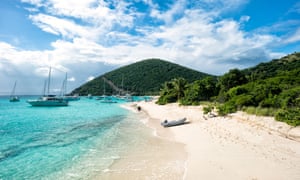
The British Virgin Islands. More than half of the companies set up by Mossack Fonseca, the law firm in the Panama Papers leak, were incorporated in British overseas territories such as BVI. Photograph: Alamy
Patrick Wintour in The Guardian
More than 300 economists, including Thomas Piketty, are urging world leaders at a London summit this week to recognise that there is no economic benefit to tax havens, demanding that the veil of secrecy that surrounds them be lifted.
David Cameron agreed to host the summit nearly a year ago, but the event is in danger of simply turning a spotlight on how the British government has failed to persuade its overseas territories to stop harbouring secretly stored cash.
British officials are locked in negotiations with the crown dependencies and overseas territories, trying to persuade them to agree to a form of automatic exchange of information on beneficial ownership of companies. So far the overseas territories have only agreed to allow UK law enforcement agencies access to a privately held register of beneficial ownership, but the automatic exchange agreement would give a wider range of countries access to information on the ownership of shell companies.
Many overseas territories including the Cayman Islands are resisting the idea, and their attendance at the summit is in doubt.
Apart from Piketty, author of the bestselling Capital in the Twenty-First Century, the impressive roll call of economists includes Angus Deaton, the Edinburgh-born 2015 Nobel prize-winner for economics, and Ha-Joon Chang, the highly regarded development economist at Cambridge University.
Other signatories include Nora Lustig, professor of Latin American economics at Tulane University, as well as influential experts who advise policymakers, such as Jeffrey Sachs, director of Columbia University’s Earth Institute and an adviser to UN secretary general Ban Ki-moon, and Olivier Blanchard, former IMF chief economist.
In total 47 academics from British universities, including Oxford and the London School of Economics, have signed the letter which argues that tax evasion weakens both developed and developing economies, as well as driving inequality.
The signatories state: “Territories allowing assets to be hidden in shell companies or which encourage profits to be booked by companies that do no business there are distorting the working of the global economy.”
To counter this, they are urging governments to agree new global rules requiring companies to publicly report taxable activities in every country in which they operate, and ensure all territories publicly disclose information about the real owners of companies and trusts. A concerted drive by the EU is now under way to require companies to declare where their profits are made, and to ensure tax is paid there rather than in the country in which it is declared.
In a tough broadside against the British prime minister, Jeffrey Sachs said: “Tax havens do not just happen. The British Virgin Islands did not become a tax and secrecy haven through its own efforts. These havens are the deliberate choice of major governments, especially the United Kingdom and the United States, in partnership with major financial, accounting, and legal institutions that move the money.
“The abuses are not only shocking, but staring us directly in the face. We didn’t need the Panama Papers to know that global tax corruption through the havens is rampant, but we can say that this abusive global system needs to be brought to a rapid end. That is what is meant by good governance under the global commitment to sustainable development.”
More than half of the companies set up by Mossack Fonseca, the law firm at the centre of the Panama Papers leak, were incorporated in British overseas territories such as the British Virgin Islands.
The signatories admit: “Taking on the tax havens will not be easy; there are powerful vested interests that benefit from the status quo. But it was Adam Smith who said that the rich ‘should contribute to the public expense, not only in proportion to their revenue, but something more than in that proportion’. There is no economic justification for allowing the continuation of tax havens which turn that statement on its head.”
Oxfam, which coordinated the letter, is urging the UK government to intervene to ensure that Britain’s offshore territories follow its lead by introducing full public registers showing who controls and profits from companies incorporated there.
Patrick Wintour in The Guardian
More than 300 economists, including Thomas Piketty, are urging world leaders at a London summit this week to recognise that there is no economic benefit to tax havens, demanding that the veil of secrecy that surrounds them be lifted.
David Cameron agreed to host the summit nearly a year ago, but the event is in danger of simply turning a spotlight on how the British government has failed to persuade its overseas territories to stop harbouring secretly stored cash.
British officials are locked in negotiations with the crown dependencies and overseas territories, trying to persuade them to agree to a form of automatic exchange of information on beneficial ownership of companies. So far the overseas territories have only agreed to allow UK law enforcement agencies access to a privately held register of beneficial ownership, but the automatic exchange agreement would give a wider range of countries access to information on the ownership of shell companies.
Many overseas territories including the Cayman Islands are resisting the idea, and their attendance at the summit is in doubt.
Apart from Piketty, author of the bestselling Capital in the Twenty-First Century, the impressive roll call of economists includes Angus Deaton, the Edinburgh-born 2015 Nobel prize-winner for economics, and Ha-Joon Chang, the highly regarded development economist at Cambridge University.
Other signatories include Nora Lustig, professor of Latin American economics at Tulane University, as well as influential experts who advise policymakers, such as Jeffrey Sachs, director of Columbia University’s Earth Institute and an adviser to UN secretary general Ban Ki-moon, and Olivier Blanchard, former IMF chief economist.
In total 47 academics from British universities, including Oxford and the London School of Economics, have signed the letter which argues that tax evasion weakens both developed and developing economies, as well as driving inequality.
The signatories state: “Territories allowing assets to be hidden in shell companies or which encourage profits to be booked by companies that do no business there are distorting the working of the global economy.”
To counter this, they are urging governments to agree new global rules requiring companies to publicly report taxable activities in every country in which they operate, and ensure all territories publicly disclose information about the real owners of companies and trusts. A concerted drive by the EU is now under way to require companies to declare where their profits are made, and to ensure tax is paid there rather than in the country in which it is declared.
In a tough broadside against the British prime minister, Jeffrey Sachs said: “Tax havens do not just happen. The British Virgin Islands did not become a tax and secrecy haven through its own efforts. These havens are the deliberate choice of major governments, especially the United Kingdom and the United States, in partnership with major financial, accounting, and legal institutions that move the money.
“The abuses are not only shocking, but staring us directly in the face. We didn’t need the Panama Papers to know that global tax corruption through the havens is rampant, but we can say that this abusive global system needs to be brought to a rapid end. That is what is meant by good governance under the global commitment to sustainable development.”
More than half of the companies set up by Mossack Fonseca, the law firm at the centre of the Panama Papers leak, were incorporated in British overseas territories such as the British Virgin Islands.
The signatories admit: “Taking on the tax havens will not be easy; there are powerful vested interests that benefit from the status quo. But it was Adam Smith who said that the rich ‘should contribute to the public expense, not only in proportion to their revenue, but something more than in that proportion’. There is no economic justification for allowing the continuation of tax havens which turn that statement on its head.”
Oxfam, which coordinated the letter, is urging the UK government to intervene to ensure that Britain’s offshore territories follow its lead by introducing full public registers showing who controls and profits from companies incorporated there.
Oxfam estimates that Africa loses about $14bn (£10bn) in tax revenues annually – enough money to pay for healthcare that could save 4 million children’s lives a year and employ enough teachers to get every African child into school.
Mark Goldring, chief executive of Oxfam GB, said: “It’s not good enough for information about company owners in UK-linked tax havens to be available only to HMRC – it needs to be fully public to ensure that governments and people around the world can claim the money they are owed and hold tax dodgers to account.”
On Dalit-Muslim unity - The Dalits’ dream of Pakistan
Tahir Mehdi in The Dawn
A group of Pakistani Dalits in Mirpurkhas gathered at their town hall recently. They vowed to initiate a movement to assert their distinct political identity, and fight for their communities’ rights.
The word ‘dalit’ literally means ‘oppressed people’; it has been in use since the 19th century to describe communities that fall outside of the four-caste Hindu hierarchy. These ‘outcastes’ or ‘untouchables’ have been subject to horrendous discrimination, in all spheres of life, for at least the past 2,000 years.
As political consciousness in undivided India arose towards the end of the British Raj, a number of Dalit leaders emerged to formulate and push forward their own political demands.
Most prolific among them was Dr B.R. Ambedkar, who did not trust the upper-caste-dominated Congress with the political interests and aspirations of his communities. He made a strong case for a separate electorate for Dalits in the 1930-32 Round Table Conferences. The Muslim League had also made the same demand the centre of their politics.
The Communal Award of 1932 accepted the positions of both, but Gandhi persuaded Ambedkar to agree to reserved seats for Dalits within a joint electorate system, rather than having Dalit voters elect Dalit parliamentarians separately.
The Government of India Act, 1935 included a schedule of castes that were subject of its specific clauses. The term ‘Scheduled Castes’ thus replaced ‘Dalits’ in official parlance. In Pakistan, the government also notified 40 castes as ‘Scheduled’ through an ordinance in 1957, which included Bheel, Kohli and Menghwar.
Dalits did establish a distinct identity — but their mobility within politics continued to remain restricted due to entrenched caste barriers.
Dr Ambedkar made it to the Constituent Assembly of India only with the help of fellow Dalit leader, Jogendra Nath Mandal.
Mandal, from East Bengal, belonged to the Namahsudra (an ‘untouchable’) caste. He was long associated with the Muslim League, and had served as a minister in the Suharwardy-led government of Bengal in 1946. Being a Dalit leader, he had found common cause with poor Bengali Muslims fighting against landlords and moneylenders, the majority of whom were upper-caste Hindus.
He supported the creation of Pakistan, and was made temporary chairman of the first Constituent Assembly. He served as a federal minister in the first cabinet.
Mandal’s elevation was perceived as a gesture towards Dalits, indicating that Muslim Pakistan would treat them better than the caste-plagued Hindu Congress. This gesture proved short-lived — and soon turned into a tale of betrayal.
In March 1949, a Dalit member of the first Constituent Assembly motioned to amend the Objectives Resolution to include ‘Scheduled Castes’ in the language which vowed to safeguard interests of minorities. Sardar Abdur Rab Nishtar defended the original phrasing, arguing that specificity was not required; whether Muslim or Hindu, any marginalised community would be protected.
The amendment was turned down, which was a denial of the everyday realities of our society, where oppression is encoded into the caste system.
It became evident that Pakistan divides its population into two groups only — Muslims and non-Muslims — and that when it comes to sharing state resources and privileges, Muslims would benefit from their preferential status at the expense of non-Muslims.
Mandal resigned in 1950. If one is to trust the veracity of his resignation letter available online, he offered a scathing indictment of Pakistan’s failure to safeguard its minorities. He accused the rulers of extreme forms of discrimination against Dalits — including forced conversions and even mass murder. A dejected Mandal moved back to Kolkata. That is how Dalits’ dream of Pakistan turned into a nightmare. But the worst was yet to come.
Gen Zia introduced the separate electorate system, and allotted seats in elected houses to ‘Hindus and Scheduled Castes’. This collating of Dalits and caste Hindus not only stripped Dalits of the distinct political identity they had struggled for, it also pushed them back into the same Hindu fold, against which Mandal and the Muslim League had sided. Zia’s system was later changed, but the succeeding scheme continued to prefer upper-caste Hindus.
This resulted in rich caste Hindus obtaining ruling positions by using Dalits as their ladder. While there is little doubt that the rich in majority communities also get most party posts and parliamentary seats, in the Dalit context this has additional ramifications.
For example, the well-educated, upper-caste, Sindhi Hindus get admissions in higher education institutions on merit, and happen to occupy more seats than their proportion in the population. It makes sense for them not to demand quotas.
The absence of a quota, however, is against the interests of Dalits, who have a poor educational profile and seldom get good jobs. Their quota demands cannot make headway as long as their representatives belong to the upper-caste.
In matters of personal laws, the positions of Dalits and caste Hindus diverge on issues as important as divorce. Marriage cannot be dissolved according to the upper-caste code, but this is not so with Dalits. Upper-caste insistence that Hindu marriage law should not include a divorce clause has been a major impediment in its enactment.
The upper castes are a minuscule minority within Pakistani Hindus, and the vast Dalit electorate is all that democratically legitimises their politics. Yet, no sincere attempt to reach out to them has been made.
Community organisations formed by the upper castes have primarily charitable goals which, of course, do not include ‘annihilation of caste’. Their membership fees are often more than what most Dalits of Thar could ever pay, even with a loan guarantee taken for a lifetime of bonded labour.
Dalits complain bitterly that when an upper-caste girl is forcibly converted, caste Hindus parade the length of Sindh in protest, making headlines. Dalit women, on the other hand, suffer the same ordeal every day, but all they get from their community ‘leaders’ are empty promises.
The Dalit gathering in Mirpurkhas featured a large poster of Dr Ambedkar. Perhaps Mandal’s decision to call it quits on Pakistan was wrong. Pakistani Dalits will have to pick up the pieces of their broken dream, and start from where Mandal left off.
A group of Pakistani Dalits in Mirpurkhas gathered at their town hall recently. They vowed to initiate a movement to assert their distinct political identity, and fight for their communities’ rights.
The word ‘dalit’ literally means ‘oppressed people’; it has been in use since the 19th century to describe communities that fall outside of the four-caste Hindu hierarchy. These ‘outcastes’ or ‘untouchables’ have been subject to horrendous discrimination, in all spheres of life, for at least the past 2,000 years.
As political consciousness in undivided India arose towards the end of the British Raj, a number of Dalit leaders emerged to formulate and push forward their own political demands.
Most prolific among them was Dr B.R. Ambedkar, who did not trust the upper-caste-dominated Congress with the political interests and aspirations of his communities. He made a strong case for a separate electorate for Dalits in the 1930-32 Round Table Conferences. The Muslim League had also made the same demand the centre of their politics.
The Communal Award of 1932 accepted the positions of both, but Gandhi persuaded Ambedkar to agree to reserved seats for Dalits within a joint electorate system, rather than having Dalit voters elect Dalit parliamentarians separately.
The Government of India Act, 1935 included a schedule of castes that were subject of its specific clauses. The term ‘Scheduled Castes’ thus replaced ‘Dalits’ in official parlance. In Pakistan, the government also notified 40 castes as ‘Scheduled’ through an ordinance in 1957, which included Bheel, Kohli and Menghwar.
Dalits did establish a distinct identity — but their mobility within politics continued to remain restricted due to entrenched caste barriers.
Dr Ambedkar made it to the Constituent Assembly of India only with the help of fellow Dalit leader, Jogendra Nath Mandal.
Mandal, from East Bengal, belonged to the Namahsudra (an ‘untouchable’) caste. He was long associated with the Muslim League, and had served as a minister in the Suharwardy-led government of Bengal in 1946. Being a Dalit leader, he had found common cause with poor Bengali Muslims fighting against landlords and moneylenders, the majority of whom were upper-caste Hindus.
He supported the creation of Pakistan, and was made temporary chairman of the first Constituent Assembly. He served as a federal minister in the first cabinet.
Mandal’s elevation was perceived as a gesture towards Dalits, indicating that Muslim Pakistan would treat them better than the caste-plagued Hindu Congress. This gesture proved short-lived — and soon turned into a tale of betrayal.
In March 1949, a Dalit member of the first Constituent Assembly motioned to amend the Objectives Resolution to include ‘Scheduled Castes’ in the language which vowed to safeguard interests of minorities. Sardar Abdur Rab Nishtar defended the original phrasing, arguing that specificity was not required; whether Muslim or Hindu, any marginalised community would be protected.
The amendment was turned down, which was a denial of the everyday realities of our society, where oppression is encoded into the caste system.
It became evident that Pakistan divides its population into two groups only — Muslims and non-Muslims — and that when it comes to sharing state resources and privileges, Muslims would benefit from their preferential status at the expense of non-Muslims.
Mandal resigned in 1950. If one is to trust the veracity of his resignation letter available online, he offered a scathing indictment of Pakistan’s failure to safeguard its minorities. He accused the rulers of extreme forms of discrimination against Dalits — including forced conversions and even mass murder. A dejected Mandal moved back to Kolkata. That is how Dalits’ dream of Pakistan turned into a nightmare. But the worst was yet to come.
Gen Zia introduced the separate electorate system, and allotted seats in elected houses to ‘Hindus and Scheduled Castes’. This collating of Dalits and caste Hindus not only stripped Dalits of the distinct political identity they had struggled for, it also pushed them back into the same Hindu fold, against which Mandal and the Muslim League had sided. Zia’s system was later changed, but the succeeding scheme continued to prefer upper-caste Hindus.
This resulted in rich caste Hindus obtaining ruling positions by using Dalits as their ladder. While there is little doubt that the rich in majority communities also get most party posts and parliamentary seats, in the Dalit context this has additional ramifications.
For example, the well-educated, upper-caste, Sindhi Hindus get admissions in higher education institutions on merit, and happen to occupy more seats than their proportion in the population. It makes sense for them not to demand quotas.
The absence of a quota, however, is against the interests of Dalits, who have a poor educational profile and seldom get good jobs. Their quota demands cannot make headway as long as their representatives belong to the upper-caste.
In matters of personal laws, the positions of Dalits and caste Hindus diverge on issues as important as divorce. Marriage cannot be dissolved according to the upper-caste code, but this is not so with Dalits. Upper-caste insistence that Hindu marriage law should not include a divorce clause has been a major impediment in its enactment.
The upper castes are a minuscule minority within Pakistani Hindus, and the vast Dalit electorate is all that democratically legitimises their politics. Yet, no sincere attempt to reach out to them has been made.
Community organisations formed by the upper castes have primarily charitable goals which, of course, do not include ‘annihilation of caste’. Their membership fees are often more than what most Dalits of Thar could ever pay, even with a loan guarantee taken for a lifetime of bonded labour.
Dalits complain bitterly that when an upper-caste girl is forcibly converted, caste Hindus parade the length of Sindh in protest, making headlines. Dalit women, on the other hand, suffer the same ordeal every day, but all they get from their community ‘leaders’ are empty promises.
The Dalit gathering in Mirpurkhas featured a large poster of Dr Ambedkar. Perhaps Mandal’s decision to call it quits on Pakistan was wrong. Pakistani Dalits will have to pick up the pieces of their broken dream, and start from where Mandal left off.
Sunday, 8 May 2016
Offshore finance: more than £12tn siphoned out of emerging countries
Analysis shows £1.3tn of assets from Russia sitting offshore, as David Cameron prepares to host anti-corruption summit.
David Cameron under pressure to end tax haven secrecy
The analysis, carried out by Columbia University professor James S Henry for the Tax Justice Network, shows that by the end of 2014, $1.3tn of assets from Russia were sitting offshore. The figures, which came from compiling and cross-checking data from global institutions including the International Monetary Fund and the United Nations, follow the Panama Papers revelations of global, systemic tax avoidance.
Chinese citizens have $1.2tn stashed away in tax havens, once estimates for Hong Kong and Macau are included. Malaysia, Thailand, and Indonesia – all of which have seen high-profile corruption scandals in recent years – also come high on the list of the worst-affected countries.
Henry, a former chief economist at consultancy McKinsey, told the Guardian his research underlines the fact that tax-dodging is not the only motivation for using tax havens – criminals and kleptocrats also make prolific use of their services, to keep their wealth secret, and their money safe. He said the list of users of offshore jurisdictions is like the cantina scene in Star Wars, where a motley group of unsavoury intergalactic characters is assembled. Henry said: “It’s like the Star Wars scene: you have the tax dodgers in one corner, the arms dealers in another, the kleptocrats over here. There’s also those using tax havens for money laundering, or fraud.”
Oil-rich countries including Nigeria and Angola feature as key sources of offshore funds, the research finds, as do Brazil and Argentina. Henry said the owners of this hidden capital are often so keen to secure secrecy and avoid their wealth being appropriated back home, that they are willing to accept paltry financial returns rather than investing it in ways that might promote economic development. Charging just 1% tax on this mountain of offshore wealth would yield more than $120bn a year — almost equivalent to the entire $131bn global aid budget.
The TJN is urging Cameron to push for agreement on a series of issues at this week’s summit, including a tougher crackdown on the banks, lawyers and other professionals who facilitate financial secrecy; and an obligation on all politicians to make their personal financial situation transparent.
The prime minister published a summary of his tax affairs last month, after the Panama Papers leaks revealed that his father had set up an investment fund, Blairmore, based in the offshore jurisdiction of Panama.
Henry argued that when senior figures in authoritarian states such as China use tax havens to guard their money safely, they are effectively free-riding on the legal and financial systems of other countries. “All of these felons and kleptocrats are in a way essentially dependent on the rule of law when it comes to protecting their money,” he said.
He said it was not just exotic locations such as the Cayman Islands where money can effectively be hidden, but also some US states, such as Delaware, where it is possible for foreign investors to start up and run a company without making clear its ultimate ownership – something all UK firms will have to do from later this year.
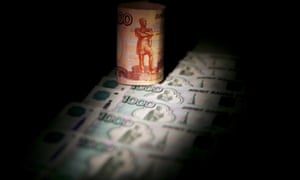
Russian banknotes. A detailed 18-month research project has uncovered a sharp increase in the capital flowing offshore from developing countries, in particular Russia and China. Photograph: Maxim Zmeyev/Reuters
Heather Stewart in The Guardian
More than $12tn (£8tn) has been siphoned out of Russia, China and other emerging economies into the secretive world of offshore finance, new research has revealed, as David Cameron prepares to host world leaders for an anti-corruption summit.
A detailed 18-month research project has uncovered a sharp increase in the capital flowing offshore from developing countries, in particular Russia and China.
Heather Stewart in The Guardian
More than $12tn (£8tn) has been siphoned out of Russia, China and other emerging economies into the secretive world of offshore finance, new research has revealed, as David Cameron prepares to host world leaders for an anti-corruption summit.
A detailed 18-month research project has uncovered a sharp increase in the capital flowing offshore from developing countries, in particular Russia and China.
David Cameron under pressure to end tax haven secrecy
The analysis, carried out by Columbia University professor James S Henry for the Tax Justice Network, shows that by the end of 2014, $1.3tn of assets from Russia were sitting offshore. The figures, which came from compiling and cross-checking data from global institutions including the International Monetary Fund and the United Nations, follow the Panama Papers revelations of global, systemic tax avoidance.
Chinese citizens have $1.2tn stashed away in tax havens, once estimates for Hong Kong and Macau are included. Malaysia, Thailand, and Indonesia – all of which have seen high-profile corruption scandals in recent years – also come high on the list of the worst-affected countries.
Henry, a former chief economist at consultancy McKinsey, told the Guardian his research underlines the fact that tax-dodging is not the only motivation for using tax havens – criminals and kleptocrats also make prolific use of their services, to keep their wealth secret, and their money safe. He said the list of users of offshore jurisdictions is like the cantina scene in Star Wars, where a motley group of unsavoury intergalactic characters is assembled. Henry said: “It’s like the Star Wars scene: you have the tax dodgers in one corner, the arms dealers in another, the kleptocrats over here. There’s also those using tax havens for money laundering, or fraud.”
Oil-rich countries including Nigeria and Angola feature as key sources of offshore funds, the research finds, as do Brazil and Argentina. Henry said the owners of this hidden capital are often so keen to secure secrecy and avoid their wealth being appropriated back home, that they are willing to accept paltry financial returns rather than investing it in ways that might promote economic development. Charging just 1% tax on this mountain of offshore wealth would yield more than $120bn a year — almost equivalent to the entire $131bn global aid budget.
The TJN is urging Cameron to push for agreement on a series of issues at this week’s summit, including a tougher crackdown on the banks, lawyers and other professionals who facilitate financial secrecy; and an obligation on all politicians to make their personal financial situation transparent.
The prime minister published a summary of his tax affairs last month, after the Panama Papers leaks revealed that his father had set up an investment fund, Blairmore, based in the offshore jurisdiction of Panama.
Henry argued that when senior figures in authoritarian states such as China use tax havens to guard their money safely, they are effectively free-riding on the legal and financial systems of other countries. “All of these felons and kleptocrats are in a way essentially dependent on the rule of law when it comes to protecting their money,” he said.
He said it was not just exotic locations such as the Cayman Islands where money can effectively be hidden, but also some US states, such as Delaware, where it is possible for foreign investors to start up and run a company without making clear its ultimate ownership – something all UK firms will have to do from later this year.
Subscribe to:
Posts (Atom)