Sunday, 3 January 2016
What is TTIP? The controversial trade deal proposal explained
Julia Kollewe in The Guardian
The EU claims it will create millions of jobs and bring down the cost of living – but others say it is a threat to public services such as the NHS

As highlighted in this Guardian video, another major concern is whether standards will drop. For example, the EU bans cosmetics tested on animals but the US does not. Another question is what happens if EU countries want some protection, for instance Italy for its Parma ham, and the UK for its pork pies.
One of the most controversial elements of the trade proposal is the Investor State Dispute Settlement (ISDS) provision. ISDS provisions have been included in many trade deals since the 1980s, to encourage overseas investment in poorer countries. It means private investors can ask a tribunal of international arbitratorsto judge if a government has treated them unfairly – and can get compensation.
Over the past decade some big, mainly American companies, such as tobacco conglomerate Philip Morris, have used ISDS to claim rights. The provision would in theory allow private investors to sue governments for the loss of future profits due to decisions made by national parliaments. Critics say it could be used to attack the UK’s NHS by making privatisations of specific services harder to reverse.
-----
Some say the US/EU trade deal that could be agreed this year will open up markets and promote UK growth. Others fear it will drive down wages and promote privatisation
Philip Inman in The Guardian
Cheap American olive oil could, in a few years’ time, be sitting on supermarket shelves next to the Tuscan single estate varieties loved by British foodies. At present a prohibitive tariff on US imports effectively prices them out of contention.
But a groundbreaking trade deal could lower the $1,680-a-tonne tariff on US olive oil to match the $34 a tonne the US charges on imports from the EU. Or the tariffs could disappear altogether. Either way, Greek, Spanish and Italian olive farmers must fear the Transatlantic Trade and Investment Partnership (TTIP), a deal that aims to create a level playing field between them and massive US agri-businesses.
Trade deals were once seen as a panacea for global poverty. In the 1990s, the World Trade Organisation was formed to harmonise cross-border regulations on everything from cars to pharmaceuticals and cut tariffs in order to promote the free flow of goods and services around the world.
There was always a fear that, far from being a winning formula for all, lower tariffs would favour the rich and powerful and crucify small producers, who would struggle to compete in an unprotected environment.
The effects of the North American Free Trade Agreement (Nafta), signed by the US, Mexico and Canada in 1993, appeared to justify that fear: it became in later years a cause celebre for anti-poverty campaigners, angered by the plight of Mexican workers. Not only were they subjected to low wages and poor working conditions by newly relocated US corporations – and, as consumers, to the relentless marketing power of Walmart, Coca Cola and the rest – but the major fringe benefit of cutting corruption remained illusory.
This year the US hopes to sign what many believe will be Nafta’s direct successor – TTIP. Should it get the green light from Congress and the EU commission, the agreement will be a bilateral treaty between Europe and the US, and, just like Nafta before it, outside the ambit of a gridlocked WTO.
Supporters say it will be an improvement on its predecessor because the main proponents are a liberal US president and a European commission that considers itself concerned with workers and consumers. Why, the commission asks, would 28 relatively affluent member states with concerns about high unemployment, stagnant wages, welfare provision and climate change agree to a charter that undermines workers’ rights, attacks public services or reduces environmental regulations?
TTIP is also billed as an agreement between equals that allows both sides to promote trade: it is claimed that the UK’s national income could be raised by £4bn-£10bn annually, or up to £100bn over 10 years. That amounts to a 0.3 percentage point boost to GDP, which would have pushed this year’s expected 2.4% growth to 2.7%.
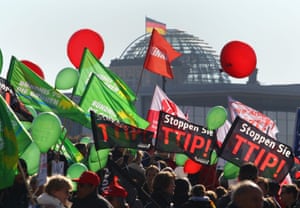
An anti-TTIP demonstration in Berlin this year. Photograph: Wolfram Steinberg/EPA
But it strikes fear into the hearts of many, who believe it to be a Trojan horse for rapacious corporations. These corporations, hellbent on driving down costs to enhance shareholder value, spell the end for Europe’s cosy welfare states and their ability to shield fledgling or, in the case of steel and coal, declining industries from the harsh realities of open competition.
TTIP has been compared to the 1846 Corn Law abolition, which either swept away protectionist tariffs that impoverished millions of workers, or protected a vital source of food and led Karl Marx to ask: “What is free trade under the present condition of society?” His answer was: “It is the freedom which capital has to crush the worker.” Is that the case with TTIP? Here are five key factors to consider.
Health and public services
From the moment TTIP became part of President Barack Obama’s growth strategy, critics have feared that he little realised the expansionary intentions of US healthcare companies or was too distracted to care. The concern relates to the prospect of EU countries, under pressure from rising healthcare costs, handing over major parts of healthcare provision to the private sector. Once services are in private hands, say critics, TTIP rules will prevent them being taken back into state control.
Since these fears were voiced, trade negotiators have excluded provisions that would have allowed firms to sue governments for the loss of health and public services contracts once they expired. This allows the UK’s rail franchise system and the contracting-out of health services to continue under time-limited contracts.
But the US private health industry, which is the largest in the world, views a Europe struggling with the needs of an ageing baby-boomer generation as ripe for the picking. For this reason alone, contracting out the distribution of drugs, the supply of medical devices and the provision of vital services could prove irresistible.
Dispute resolution
A little known facet of every trade deal is a separate form of arbitration for the businesses covered by the agreement, allowing them to avoid the civil courts. As such, the investor-state dispute resolution (ISDS) gives foreign investors the power to sue a government for introducing legislation that harms their investment.
Famously, it was used by big tobacco to sue the Australian government when it introduced plain cigarette packaging. Before and after the scandal, other governments have come under legal challenge from corporations concerned that public policymaking is denying them revenues.
In spring 2014, UN official and human rights lawyer Alfred de Zayas called for a moratorium on TTIP negotiations until ISDS was excluded. He warned that the secret court tribunals held to settle trade disputes were undemocratic. Their reliance on a small group of specialist lawyers also meant that arbitrators sitting in judgment were the ones who at other times represented corporate clients.
De Zayas feared that smaller states would find themselves in the same position as many governments in trade disputes, suffering huge legal bills and long delays to public policy reforms. He was joined in his mission by NGOs and, most importantly, by MEPs in Strasbourg.
As a first concession, the US side agreed to prohibit “brass-plate” firms – those that exist only by name in a county, without any employees or activity – from suing a government. This aimed to prevent a repeat of the Australia incident when the Ukrainian arm of tobacco firm Philip Morris, effectively a brass-plate entity, spearheaded the attack on plain packaging.
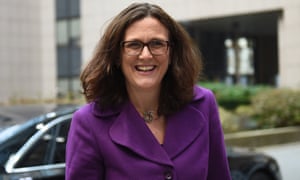
European commissioner Cecilia Malmström has proposed an international court of arbitration to settle investor disputes. Photograph: Emmanuel Dunand/Getty
Many EU politicians said this concession was too easy to circumvent, leaving corporations in a powerful position. So Europe’s chief negotiator, Swedish commissioner Cecilia Malmström, hatched a scheme for an international court of arbitration – an open public forum instead of the private court system. Even her critics said it was a bold move, and unlikely to be accepted by the Americans.
Washington has countered with proposals for a more transparent ISDS court, with live-streamed meetings and the publication of all documents. Not enough, says de Zayas, who wrote recently: “Alas, countless ISDS awards have shown a business bias that shocks the conscience. To the extent that the procedures are not transparent, the arbitrators are not always independent and the annulment procedure is nearly useless, ISDS should be abolished as incompatible with article 14(1) of the ICCPR [International Covenant on Civil and Political Rights] which requires that all suits at law be decided by independent and competent tribunals under the rule of law.”
The two sides have yet to formally discuss either proposal: under deals between the US and Japan and the EU and Canada the issue was barely mentioned, but it is now expected to be among the most contentious.
Regulations
Michael Froman, the US chief negotiator, described the task of harmonising regulations as follows: “For years the US and EU have accepted each other’s inspection of aeroplanes because it was obvious they would not be able to check all the planes landing in their jurisdiction. We seek to expand this practice to other areas.”
So how would Froman apply this to the fact that American cars will still be left-hand drive, restricting their use on British roads? He argues that the cost of imported cars, research and development and testing can still benefit from the harmonisation of regulations on either side of the Atlantic.
Yet there is nothing US food regulators would like less than to accept processed foods tested by EU officials who failed to spot the horsemeat scandal.
And EU regulators are duty bound to reject GM foods, after sustained protests by Europe’s consumers in direct conflict with US farmers. Washington claims it will accept the science when it applies to regulations, which supports GM foods being accepted by the EU as part of TTIP, just as it is part of the WTO agreement.
Labour standards and workers’ rights
Japanese trade unions supported the TPP deal, and unions in Europe are expected to follow suit with TTIP. They accept that labour protection rules lie outside the scope of a deal, and that their governments can therefore continue to implement minimum wage legislation and other supportive measures without being sanctioned.
But unions, where they exist, tend to represent workers in successful industries, which naturally welcome access to wider markets. Workers in weaker areas of the economy could find their jobs coming under pressure from harmonised regulations, lower tariffs, or even just exposure to a US rival with a work ethic that denies most employees more than two weeks’ holiday a year.
TTIP is important to the UK government because the US is our biggest market for goods and services outside the EU. It’s seen as especially important for small and medium-sized businesses, which appreciate the lack of language barrier. Britain also has a trade surplus with the US: we export more than we import, which helps counterbalance the country’s huge trade deficit.
Such is the momentum behind the talks that a deal could be agreed by the end of the year, and go before Congress and EU parliaments in 2017. Both sides claim to be making good progress. But the dispute over ISDS and protests from farmers could yet quash Obama’s hopes for US olive oil sales.
The EU claims it will create millions of jobs and bring down the cost of living – but others say it is a threat to public services such as the NHS
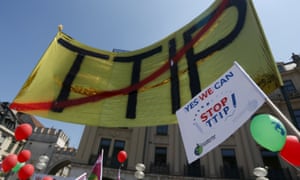
An anti-TTIP banner is held aloft at a rally before the G7 summit in Munich in June. Photograph: Wolfgang Rattay/Reuters
If you are not yet familiar with the acronym TTIP it is likely you soon will be. TheTransatlantic Trade and Investment Partnership is a proposed trade agreement and the subject of an ongoing series of negotiations between the EU and US aimed at creating the world’s biggest free trade zone spanning the north Atlantic.
It would dwarf all past free trade deals: the European commission reckons it could boost the size of the EU economy by €120bn (£85bn) – equal to 0.5% of GDP – and the US economy by €95bn – 0.4% of GDP.
It would create several million jobs dependent on exports, Brussels says, while consumers would enjoy cheaper products and services. The average European household of four would be around €500 a year better off as a result of wage increases and price reductions, according to the study commissioned from the Centre for Economic Policy Research in 2013.
The plan is to cut tariff barriers – levies imposed to control cross-border trade – to zero and other non-tariff barriers by 25-50%. The study insists this is a realistic prospect. The business sectors that would benefit most include industries based around metal products, processed food and chemicals, and especially the motor industry.
In the UK (and elsewhere), the main beneficiaries would be big businesses, as smaller firms are less likely to trade outside Britain. The UK could benefit to the tune of £10bn, which means the average household would be £400 a year better off.
The main aim of TTIP is to reduce regulatory barriers to trade, in areas ranging from food safety law to environmental rules and banking regulations. Opponents argue it will water down important EU regulations.
Food safety has become a major stumbling block in the negotiations as both sides prepare for the latest round – the 10th – which takes place from 13 to 17 July in Brussels.
The talks have been conducted largely in secret, but opposition to TTIP is growing on the ground. More than 2 million people in Europe have signed an online petition against the proposed deal. Campaigners have been outspoken about TTIP’s potential dangers and have painted it as a threat to European democracy.
In Britain, MPs on the all-party business, innovations and skills committee havedenounced the government’s firm support for TTIP amid fears for the NHS and other public services.
Concerns are mounting that TTIP could lead to more privatisation, with the prospect of US corporations providing vital UK public services such as transport, education, water and health.
If you are not yet familiar with the acronym TTIP it is likely you soon will be. TheTransatlantic Trade and Investment Partnership is a proposed trade agreement and the subject of an ongoing series of negotiations between the EU and US aimed at creating the world’s biggest free trade zone spanning the north Atlantic.
It would dwarf all past free trade deals: the European commission reckons it could boost the size of the EU economy by €120bn (£85bn) – equal to 0.5% of GDP – and the US economy by €95bn – 0.4% of GDP.
It would create several million jobs dependent on exports, Brussels says, while consumers would enjoy cheaper products and services. The average European household of four would be around €500 a year better off as a result of wage increases and price reductions, according to the study commissioned from the Centre for Economic Policy Research in 2013.
The plan is to cut tariff barriers – levies imposed to control cross-border trade – to zero and other non-tariff barriers by 25-50%. The study insists this is a realistic prospect. The business sectors that would benefit most include industries based around metal products, processed food and chemicals, and especially the motor industry.
In the UK (and elsewhere), the main beneficiaries would be big businesses, as smaller firms are less likely to trade outside Britain. The UK could benefit to the tune of £10bn, which means the average household would be £400 a year better off.
The main aim of TTIP is to reduce regulatory barriers to trade, in areas ranging from food safety law to environmental rules and banking regulations. Opponents argue it will water down important EU regulations.
Food safety has become a major stumbling block in the negotiations as both sides prepare for the latest round – the 10th – which takes place from 13 to 17 July in Brussels.
The talks have been conducted largely in secret, but opposition to TTIP is growing on the ground. More than 2 million people in Europe have signed an online petition against the proposed deal. Campaigners have been outspoken about TTIP’s potential dangers and have painted it as a threat to European democracy.
In Britain, MPs on the all-party business, innovations and skills committee havedenounced the government’s firm support for TTIP amid fears for the NHS and other public services.
Concerns are mounting that TTIP could lead to more privatisation, with the prospect of US corporations providing vital UK public services such as transport, education, water and health.
As highlighted in this Guardian video, another major concern is whether standards will drop. For example, the EU bans cosmetics tested on animals but the US does not. Another question is what happens if EU countries want some protection, for instance Italy for its Parma ham, and the UK for its pork pies.
One of the most controversial elements of the trade proposal is the Investor State Dispute Settlement (ISDS) provision. ISDS provisions have been included in many trade deals since the 1980s, to encourage overseas investment in poorer countries. It means private investors can ask a tribunal of international arbitratorsto judge if a government has treated them unfairly – and can get compensation.
Over the past decade some big, mainly American companies, such as tobacco conglomerate Philip Morris, have used ISDS to claim rights. The provision would in theory allow private investors to sue governments for the loss of future profits due to decisions made by national parliaments. Critics say it could be used to attack the UK’s NHS by making privatisations of specific services harder to reverse.
-----
TTIP: the key to freer trade, or corporate greed?
Some say the US/EU trade deal that could be agreed this year will open up markets and promote UK growth. Others fear it will drive down wages and promote privatisation
Philip Inman in The Guardian
Cheap American olive oil could, in a few years’ time, be sitting on supermarket shelves next to the Tuscan single estate varieties loved by British foodies. At present a prohibitive tariff on US imports effectively prices them out of contention.
But a groundbreaking trade deal could lower the $1,680-a-tonne tariff on US olive oil to match the $34 a tonne the US charges on imports from the EU. Or the tariffs could disappear altogether. Either way, Greek, Spanish and Italian olive farmers must fear the Transatlantic Trade and Investment Partnership (TTIP), a deal that aims to create a level playing field between them and massive US agri-businesses.
Trade deals were once seen as a panacea for global poverty. In the 1990s, the World Trade Organisation was formed to harmonise cross-border regulations on everything from cars to pharmaceuticals and cut tariffs in order to promote the free flow of goods and services around the world.
There was always a fear that, far from being a winning formula for all, lower tariffs would favour the rich and powerful and crucify small producers, who would struggle to compete in an unprotected environment.
The effects of the North American Free Trade Agreement (Nafta), signed by the US, Mexico and Canada in 1993, appeared to justify that fear: it became in later years a cause celebre for anti-poverty campaigners, angered by the plight of Mexican workers. Not only were they subjected to low wages and poor working conditions by newly relocated US corporations – and, as consumers, to the relentless marketing power of Walmart, Coca Cola and the rest – but the major fringe benefit of cutting corruption remained illusory.
This year the US hopes to sign what many believe will be Nafta’s direct successor – TTIP. Should it get the green light from Congress and the EU commission, the agreement will be a bilateral treaty between Europe and the US, and, just like Nafta before it, outside the ambit of a gridlocked WTO.
Supporters say it will be an improvement on its predecessor because the main proponents are a liberal US president and a European commission that considers itself concerned with workers and consumers. Why, the commission asks, would 28 relatively affluent member states with concerns about high unemployment, stagnant wages, welfare provision and climate change agree to a charter that undermines workers’ rights, attacks public services or reduces environmental regulations?
TTIP is also billed as an agreement between equals that allows both sides to promote trade: it is claimed that the UK’s national income could be raised by £4bn-£10bn annually, or up to £100bn over 10 years. That amounts to a 0.3 percentage point boost to GDP, which would have pushed this year’s expected 2.4% growth to 2.7%.
An anti-TTIP demonstration in Berlin this year. Photograph: Wolfram Steinberg/EPA
But it strikes fear into the hearts of many, who believe it to be a Trojan horse for rapacious corporations. These corporations, hellbent on driving down costs to enhance shareholder value, spell the end for Europe’s cosy welfare states and their ability to shield fledgling or, in the case of steel and coal, declining industries from the harsh realities of open competition.
TTIP has been compared to the 1846 Corn Law abolition, which either swept away protectionist tariffs that impoverished millions of workers, or protected a vital source of food and led Karl Marx to ask: “What is free trade under the present condition of society?” His answer was: “It is the freedom which capital has to crush the worker.” Is that the case with TTIP? Here are five key factors to consider.
Health and public services
From the moment TTIP became part of President Barack Obama’s growth strategy, critics have feared that he little realised the expansionary intentions of US healthcare companies or was too distracted to care. The concern relates to the prospect of EU countries, under pressure from rising healthcare costs, handing over major parts of healthcare provision to the private sector. Once services are in private hands, say critics, TTIP rules will prevent them being taken back into state control.
Since these fears were voiced, trade negotiators have excluded provisions that would have allowed firms to sue governments for the loss of health and public services contracts once they expired. This allows the UK’s rail franchise system and the contracting-out of health services to continue under time-limited contracts.
But the US private health industry, which is the largest in the world, views a Europe struggling with the needs of an ageing baby-boomer generation as ripe for the picking. For this reason alone, contracting out the distribution of drugs, the supply of medical devices and the provision of vital services could prove irresistible.
Dispute resolution
A little known facet of every trade deal is a separate form of arbitration for the businesses covered by the agreement, allowing them to avoid the civil courts. As such, the investor-state dispute resolution (ISDS) gives foreign investors the power to sue a government for introducing legislation that harms their investment.
Famously, it was used by big tobacco to sue the Australian government when it introduced plain cigarette packaging. Before and after the scandal, other governments have come under legal challenge from corporations concerned that public policymaking is denying them revenues.
In spring 2014, UN official and human rights lawyer Alfred de Zayas called for a moratorium on TTIP negotiations until ISDS was excluded. He warned that the secret court tribunals held to settle trade disputes were undemocratic. Their reliance on a small group of specialist lawyers also meant that arbitrators sitting in judgment were the ones who at other times represented corporate clients.
De Zayas feared that smaller states would find themselves in the same position as many governments in trade disputes, suffering huge legal bills and long delays to public policy reforms. He was joined in his mission by NGOs and, most importantly, by MEPs in Strasbourg.
As a first concession, the US side agreed to prohibit “brass-plate” firms – those that exist only by name in a county, without any employees or activity – from suing a government. This aimed to prevent a repeat of the Australia incident when the Ukrainian arm of tobacco firm Philip Morris, effectively a brass-plate entity, spearheaded the attack on plain packaging.
European commissioner Cecilia Malmström has proposed an international court of arbitration to settle investor disputes. Photograph: Emmanuel Dunand/Getty
Many EU politicians said this concession was too easy to circumvent, leaving corporations in a powerful position. So Europe’s chief negotiator, Swedish commissioner Cecilia Malmström, hatched a scheme for an international court of arbitration – an open public forum instead of the private court system. Even her critics said it was a bold move, and unlikely to be accepted by the Americans.
Washington has countered with proposals for a more transparent ISDS court, with live-streamed meetings and the publication of all documents. Not enough, says de Zayas, who wrote recently: “Alas, countless ISDS awards have shown a business bias that shocks the conscience. To the extent that the procedures are not transparent, the arbitrators are not always independent and the annulment procedure is nearly useless, ISDS should be abolished as incompatible with article 14(1) of the ICCPR [International Covenant on Civil and Political Rights] which requires that all suits at law be decided by independent and competent tribunals under the rule of law.”
The two sides have yet to formally discuss either proposal: under deals between the US and Japan and the EU and Canada the issue was barely mentioned, but it is now expected to be among the most contentious.
Regulations
Michael Froman, the US chief negotiator, described the task of harmonising regulations as follows: “For years the US and EU have accepted each other’s inspection of aeroplanes because it was obvious they would not be able to check all the planes landing in their jurisdiction. We seek to expand this practice to other areas.”
So how would Froman apply this to the fact that American cars will still be left-hand drive, restricting their use on British roads? He argues that the cost of imported cars, research and development and testing can still benefit from the harmonisation of regulations on either side of the Atlantic.
Yet there is nothing US food regulators would like less than to accept processed foods tested by EU officials who failed to spot the horsemeat scandal.
And EU regulators are duty bound to reject GM foods, after sustained protests by Europe’s consumers in direct conflict with US farmers. Washington claims it will accept the science when it applies to regulations, which supports GM foods being accepted by the EU as part of TTIP, just as it is part of the WTO agreement.
Tariffs
Dispensing with tariffs seems like a straightforward process compared with tackling complex regulations. Under TTIP, tariffs on goods and services should disappear, though it is expected that some will only be reduced, and others may take years to go the way of history.
Under the Trans Pacific Partnership (TPP) recently agreed, but not yet implemented, between the US, Japan, Australia, Vietnam and other East Asian countries, all goods, from pork to cars, are covered.
A good example of how long it can take for tariffs to come down is found in the case of the 2.5% rate slapped on Japanese car imports to the US: this will start to be incrementally lowered 15 years after the agreement takes effect, halved in 20 years and eliminated in 25 years. In return, Japan will, among other things, lower its tariff on imported beef from 38.5% to 9% over 16 years. A similar programme could be possible under TTIP, with olive oil tariffs lowered over 25 years.
Dispensing with tariffs seems like a straightforward process compared with tackling complex regulations. Under TTIP, tariffs on goods and services should disappear, though it is expected that some will only be reduced, and others may take years to go the way of history.
Under the Trans Pacific Partnership (TPP) recently agreed, but not yet implemented, between the US, Japan, Australia, Vietnam and other East Asian countries, all goods, from pork to cars, are covered.
A good example of how long it can take for tariffs to come down is found in the case of the 2.5% rate slapped on Japanese car imports to the US: this will start to be incrementally lowered 15 years after the agreement takes effect, halved in 20 years and eliminated in 25 years. In return, Japan will, among other things, lower its tariff on imported beef from 38.5% to 9% over 16 years. A similar programme could be possible under TTIP, with olive oil tariffs lowered over 25 years.
Labour standards and workers’ rights
Japanese trade unions supported the TPP deal, and unions in Europe are expected to follow suit with TTIP. They accept that labour protection rules lie outside the scope of a deal, and that their governments can therefore continue to implement minimum wage legislation and other supportive measures without being sanctioned.
But unions, where they exist, tend to represent workers in successful industries, which naturally welcome access to wider markets. Workers in weaker areas of the economy could find their jobs coming under pressure from harmonised regulations, lower tariffs, or even just exposure to a US rival with a work ethic that denies most employees more than two weeks’ holiday a year.
TTIP is important to the UK government because the US is our biggest market for goods and services outside the EU. It’s seen as especially important for small and medium-sized businesses, which appreciate the lack of language barrier. Britain also has a trade surplus with the US: we export more than we import, which helps counterbalance the country’s huge trade deficit.
Such is the momentum behind the talks that a deal could be agreed by the end of the year, and go before Congress and EU parliaments in 2017. Both sides claim to be making good progress. But the dispute over ISDS and protests from farmers could yet quash Obama’s hopes for US olive oil sales.
On Maududi - A founder of political Islam
Nadeem F Paracha in The Dawn
Abul Ala Maududi (d.1979), is considered to be one of the most influential Islamic scholars of the 20th century. He is praised for being a highly prolific and insightful intellectual and author who creatively contextualised the political role of Islam in the last century, and consequently gave birth to what became known as ‘Political Islam.’
Simultaneously, his large body of work was also severely critiqued as being contradictory and for being an inspiration to those bent on committing violence in the name of faith.
Interestingly, Maududi’s theories and commentaries received negative criticism not only from those on the left and liberal sides of the divide, but from some of his immediate religious contemporaries as well.
Nevertheless, his thesis on the state, politics and Islam, managed to influence a number of movements within and outside of Pakistan.
For example, the original ideologues of the Egyptian Muslim Brotherhood organisation (that eventually spread across the Arab world), were directly influenced by Maududi’s writings.
Maududi’s writings also influenced the rise of ‘Islamic’ regimes in Sudan in the 1980s, and more importantly, the same writings were recycled by the Ziaul Haq dictatorship (1977-88), to indoctrinate the initial batches of Afghan insurgents (the ‘mujahideen’), fighting against Soviet troops stationed in Afghanistan.
In the last century, the modern Islamic Utopia that Maududi was conceptualising had become the main motivation behind several political and ideological experiments in various Muslim countries.
However, 21st century politics (in the Muslim world) is not according to the kind enthusiastic reception that Maududi’s ideas received in the second half of the 20th century.
By the early 2000s, almost all experiments based on Maududi’s ideas seemed to have collapsed under their own weight. The imagined Utopia turned into a living dystopia, torn apart by mass level violence (perpetrated in the name of faith) and the gradual retardation of social and economic evolution in a number of Muslim countries, including Pakistan.
This is ironic. Because when compared to the ultimate mindset that his ideas seemed to have ended up planting within various mainstream regimes and clandestine groups, Maududi himself sounds rather broad-minded.
Born in 1903 in Aurangabad, India, Maududi’s intellectual evolution is a fascinating story of a man who, after facing bouts of existential crises, chose to interpret Islam as a political theory to address his own spiritual and ideological impasses.
He did not come raging out of a madressah, swinging a fist at the vulgarities of the modern world. On the contrary, he was born into a family that had relations with the enlightened 19th century Muslim reformist and scholar, Sir Syed Ahmed Khan.
Maududi received his early education at home through private tutors who taught him the Quran, Hadith, Arabic and Persian. At age 12, Maududi was sent to the Oriental High School whose curriculum had been arranged by famous Islamic scholar, Shibli Nomani.
Maududi was studying at a college-level Islamic institution, the Darul Aloom, when he had to rush to Bhopal to look after his ailing father. In Bhopal, he befriended the rebellious Urdu poet and writer, Niaz Fatehpuri.
Fatehpuri’s writings and poetry were highly critical of the orthodox Muslim clergy. This had left him fighting polemical battles with the ulema.
Inspired by Fatehpuri, Maududi too decided to become a writer. In 1919, the then 17-year-old Maududi moved to Delhi, where for the first time he began to study the works of Sir Syed Ahmed Khan in full. This, in turn, led Maududi to study the major works of philosophy, sociology, history and politics authored by leading European thinkers and writers.
In 1929, after resurfacing from his vigorous study of Western philosophical and political thought, Maududi published his first major book, Al-Jihad Fil-Islam. The book is largely a lament on the state of Muslim society in India and in it he attacked the British, modernist Muslims and the orthodox clergy for combining to keep Indian Muslims subdued and weak.
Writing in flowing, rhetorical Urdu, Maududi criticised the Muslim clergy for keeping Muslims away from the study of Western philosophy and science. Maududi suggested that it were these that were at the heart of Western political and economic supremacy and needed to be studied so they could then be effectively dismantled and replaced by an ‘Islamic society’.
In 1941 Maududi formed the Jamaat-i-Islami (JI). The outfit was shaped on the Leninist model of forming a ‘party of a select group of committed and knowledgeable vanguards’ who would attempt to grab state power through revolution.
In an essay that was later republished (in 1980) in a compilation of his writings, Come let us Change This World, Maududi castigated the ulema for ‘being stuck in the past’ and thus halting the emergence of new research and thinking in the field of Islamic scholarship.
He was equally critical of modernist Muslims (including Mohammad Ali Jinnah). In the same essay he lambasted them for understanding Islam through concepts constructed by the West and for believing that religion was a private matter.
Though an opponent of Jinnah and the creation of Pakistan (because he theorised that an ‘Islamic State’ could not be enacted by ‘Westernised Muslims’), Maududi did migrate to the new Muslim-majority country once it came into being in 1947.
In a string of books, mainly Khilafat-o-Malukiyat, Deen-i-Haq, Islamic Law and Constitution and Economic System of Islam, Maududi laid out his precepts of the modern-day ‘Islamic State’.
He was adamant about the need to gain state power to impose his principles of an Islamic State, but cautioned that the society first needed to be Islamised from below (through evangelical action), for such a state to begin imposing Islamic Laws.
In these books he was the first Islamic scholar to use the term ‘Islamic ideology’ (in a political context). The term was later rephrased as ‘Political Islam’ by the western scholarship on the subject.
In 1977 when Maududi agreed to support the Ziaul Haq dictatorship, he was criticised for attempting to grab state power through a Machiavellian military dictator.
Maududi’s decision sparked an intense critique of his ideas by the modernist Islamic scholar, Dr Fazal Rehman Malik. In his book, Islam and Modernity, Dr Malik described Maududi as a populist journalist, rather than a scholar. Malik suggested that Maududi’s writings were ‘shallow’ and crafted only to bag the attention of muddled young men craving for an imagined faith-driven Utopia.
Maududi’s body of work is remarkable in its proficiency and creativity. And indeed, it is also contradictory. He used Western political concepts of the state to explain the modern idea of the Islamic State; and yet he accused modernist Muslims of understanding Islam through Western constructs. He saw no space for monarchies in Islam, yet was entirely uncritical of conservative Arab monarchies. He would often prefix the word Islam in front of various Western economic and political ideas — (Islamic-Economics, Islamic-Banking and Islamic-Constitution) — and yet he reacted aggressively towards the idea of ‘Islamic-Socialism’ that came from his leftist opponents in the 1960s.
Writing in the Princeton Encyclopedia of Islamic Political Thought, Political Anthropologist, Professor Irfan Ahmed, suggested that there was not one Maududi, but many.
He wrote that elements of Leninism, Hegel’s dualism, Jalaluddin Afghani’s Pan-Islamism and various other modern political theories can be found in Maududi’s thesis.
Perhaps this is why Maududi’s ideas managed to appeal to various sections of the urban Muslim middle-classes; modern conservative Muslim movements; and all the way to the more anarchic and reactionary forces.
But the question is, had Maududi been alive today, which one of the many Maududis would he have been most comfortable with in a Muslim world now crammed with raging dystopias?
Abul Ala Maududi (d.1979), is considered to be one of the most influential Islamic scholars of the 20th century. He is praised for being a highly prolific and insightful intellectual and author who creatively contextualised the political role of Islam in the last century, and consequently gave birth to what became known as ‘Political Islam.’
Simultaneously, his large body of work was also severely critiqued as being contradictory and for being an inspiration to those bent on committing violence in the name of faith.
Interestingly, Maududi’s theories and commentaries received negative criticism not only from those on the left and liberal sides of the divide, but from some of his immediate religious contemporaries as well.
Nevertheless, his thesis on the state, politics and Islam, managed to influence a number of movements within and outside of Pakistan.
For example, the original ideologues of the Egyptian Muslim Brotherhood organisation (that eventually spread across the Arab world), were directly influenced by Maududi’s writings.
Maududi’s writings also influenced the rise of ‘Islamic’ regimes in Sudan in the 1980s, and more importantly, the same writings were recycled by the Ziaul Haq dictatorship (1977-88), to indoctrinate the initial batches of Afghan insurgents (the ‘mujahideen’), fighting against Soviet troops stationed in Afghanistan.
In the last century, the modern Islamic Utopia that Maududi was conceptualising had become the main motivation behind several political and ideological experiments in various Muslim countries.
However, 21st century politics (in the Muslim world) is not according to the kind enthusiastic reception that Maududi’s ideas received in the second half of the 20th century.
By the early 2000s, almost all experiments based on Maududi’s ideas seemed to have collapsed under their own weight. The imagined Utopia turned into a living dystopia, torn apart by mass level violence (perpetrated in the name of faith) and the gradual retardation of social and economic evolution in a number of Muslim countries, including Pakistan.
This is ironic. Because when compared to the ultimate mindset that his ideas seemed to have ended up planting within various mainstream regimes and clandestine groups, Maududi himself sounds rather broad-minded.
Born in 1903 in Aurangabad, India, Maududi’s intellectual evolution is a fascinating story of a man who, after facing bouts of existential crises, chose to interpret Islam as a political theory to address his own spiritual and ideological impasses.
He did not come raging out of a madressah, swinging a fist at the vulgarities of the modern world. On the contrary, he was born into a family that had relations with the enlightened 19th century Muslim reformist and scholar, Sir Syed Ahmed Khan.
Maududi received his early education at home through private tutors who taught him the Quran, Hadith, Arabic and Persian. At age 12, Maududi was sent to the Oriental High School whose curriculum had been arranged by famous Islamic scholar, Shibli Nomani.
Maududi was studying at a college-level Islamic institution, the Darul Aloom, when he had to rush to Bhopal to look after his ailing father. In Bhopal, he befriended the rebellious Urdu poet and writer, Niaz Fatehpuri.
Fatehpuri’s writings and poetry were highly critical of the orthodox Muslim clergy. This had left him fighting polemical battles with the ulema.
Inspired by Fatehpuri, Maududi too decided to become a writer. In 1919, the then 17-year-old Maududi moved to Delhi, where for the first time he began to study the works of Sir Syed Ahmed Khan in full. This, in turn, led Maududi to study the major works of philosophy, sociology, history and politics authored by leading European thinkers and writers.
In 1929, after resurfacing from his vigorous study of Western philosophical and political thought, Maududi published his first major book, Al-Jihad Fil-Islam. The book is largely a lament on the state of Muslim society in India and in it he attacked the British, modernist Muslims and the orthodox clergy for combining to keep Indian Muslims subdued and weak.
Writing in flowing, rhetorical Urdu, Maududi criticised the Muslim clergy for keeping Muslims away from the study of Western philosophy and science. Maududi suggested that it were these that were at the heart of Western political and economic supremacy and needed to be studied so they could then be effectively dismantled and replaced by an ‘Islamic society’.
In 1941 Maududi formed the Jamaat-i-Islami (JI). The outfit was shaped on the Leninist model of forming a ‘party of a select group of committed and knowledgeable vanguards’ who would attempt to grab state power through revolution.
In an essay that was later republished (in 1980) in a compilation of his writings, Come let us Change This World, Maududi castigated the ulema for ‘being stuck in the past’ and thus halting the emergence of new research and thinking in the field of Islamic scholarship.
He was equally critical of modernist Muslims (including Mohammad Ali Jinnah). In the same essay he lambasted them for understanding Islam through concepts constructed by the West and for believing that religion was a private matter.
Though an opponent of Jinnah and the creation of Pakistan (because he theorised that an ‘Islamic State’ could not be enacted by ‘Westernised Muslims’), Maududi did migrate to the new Muslim-majority country once it came into being in 1947.
In a string of books, mainly Khilafat-o-Malukiyat, Deen-i-Haq, Islamic Law and Constitution and Economic System of Islam, Maududi laid out his precepts of the modern-day ‘Islamic State’.
He was adamant about the need to gain state power to impose his principles of an Islamic State, but cautioned that the society first needed to be Islamised from below (through evangelical action), for such a state to begin imposing Islamic Laws.
In these books he was the first Islamic scholar to use the term ‘Islamic ideology’ (in a political context). The term was later rephrased as ‘Political Islam’ by the western scholarship on the subject.
In 1977 when Maududi agreed to support the Ziaul Haq dictatorship, he was criticised for attempting to grab state power through a Machiavellian military dictator.
Maududi’s decision sparked an intense critique of his ideas by the modernist Islamic scholar, Dr Fazal Rehman Malik. In his book, Islam and Modernity, Dr Malik described Maududi as a populist journalist, rather than a scholar. Malik suggested that Maududi’s writings were ‘shallow’ and crafted only to bag the attention of muddled young men craving for an imagined faith-driven Utopia.
Maududi’s body of work is remarkable in its proficiency and creativity. And indeed, it is also contradictory. He used Western political concepts of the state to explain the modern idea of the Islamic State; and yet he accused modernist Muslims of understanding Islam through Western constructs. He saw no space for monarchies in Islam, yet was entirely uncritical of conservative Arab monarchies. He would often prefix the word Islam in front of various Western economic and political ideas — (Islamic-Economics, Islamic-Banking and Islamic-Constitution) — and yet he reacted aggressively towards the idea of ‘Islamic-Socialism’ that came from his leftist opponents in the 1960s.
Writing in the Princeton Encyclopedia of Islamic Political Thought, Political Anthropologist, Professor Irfan Ahmed, suggested that there was not one Maududi, but many.
He wrote that elements of Leninism, Hegel’s dualism, Jalaluddin Afghani’s Pan-Islamism and various other modern political theories can be found in Maududi’s thesis.
Perhaps this is why Maududi’s ideas managed to appeal to various sections of the urban Muslim middle-classes; modern conservative Muslim movements; and all the way to the more anarchic and reactionary forces.
But the question is, had Maududi been alive today, which one of the many Maududis would he have been most comfortable with in a Muslim world now crammed with raging dystopias?
Thursday, 31 December 2015
UK Floods: What have we done to make the flooding worse?
By Camila Ruz and Jon Kelly in BBC News Magazine
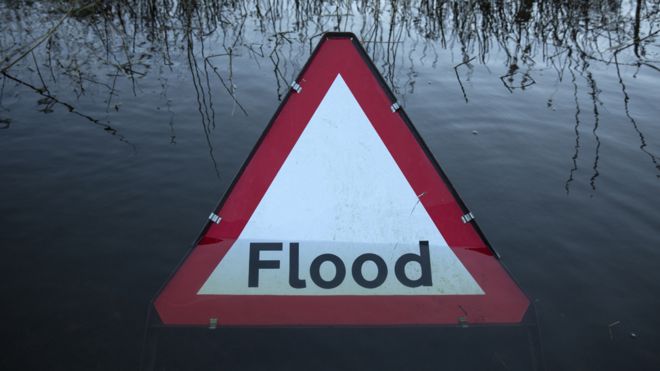 Image copyrightGetty Images
Floods have caused havoc across much of the UK. Have decisions made by the public and politicians alike made things worse?
Thousands of homes are without power after Storm Frank as people brace themselves for more flooding.
Dozens of flood warnings remain in place with north-east Scotland at risk of heavy rainfall on Sunday and Monday.
Here are some of the things that it has been suggested have contributed to the problem.
Building on flood plains
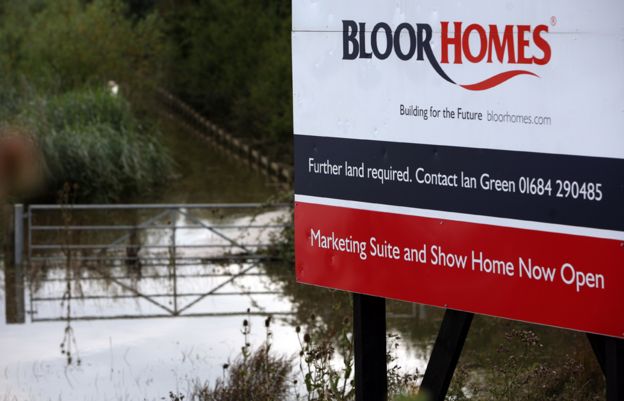 Image copyrightGetty Images
Some four million residential properties in England currently sit on places with a one in 1,000 risk of flooding each year.
After floods in 2007 that affected 55,000 homes, the government commissioned a review chaired by Sir Michael Pitt to ensure it didn't happen again. The review said it wasn't possible to prevent all building on floodplains but recommended that there should be a strong presumption against it. It also said buildings should avoid creating flood problems for themselves or their neighbours.
But large-scale building on floodplains has continued. In fact, according to the Committee on Climate Change (CCC), housing in areas where flooding is likely has grown at a rate of 1.2% per year since 2011, while the building of residential properties in areas of low risk has risen by just 0.7% over the same period.
Policy-makers are often keen to see brownfield land used for residential development, but these areas are often most vulnerable to flooding. Demand from buyers has fuelled this growth, too.
You might assume that there would be huge drops in property prices after highly publicised floods. But in places like Tewkesbury, Gloucestershire, and Cockermouth, Cumbria, which experienced heavy flooding in 2007 and 2009 respectively, prices have remained largely unaffected in the long run.
Dredging
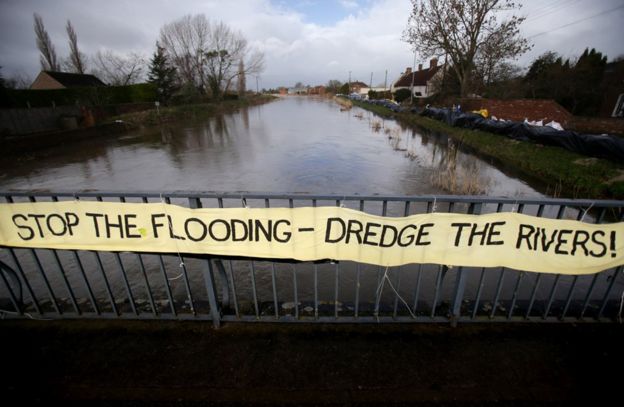 Image copyrightGetty Images
The argument over dredging has been going strong since floods in Somerset in 2013-14. At the time, farmers claimed that lack of river dredging had been making the problem worse. "Somerset is suffering from the impacts of two decades of underinvestment with the cessation of dredging along the lowland rivers Parrett and Tone," said the National Farmers Union in their Flooding Manifesto.
Dredging removes the silt that builds up at the bottom of rivers and deepens the channel. Some people say that it helps prevent flooding by making the water flow faster and more efficiently. Supporters of dredging have complained that the European Water Framework Directive prevents it being carried out.
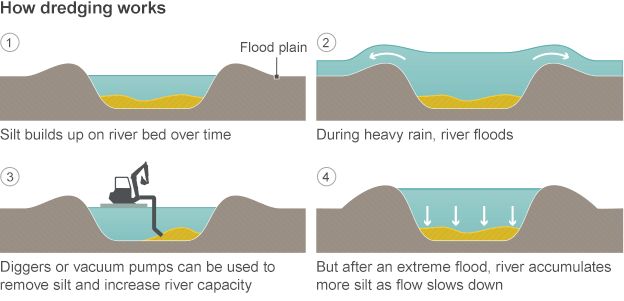
But others have argued that it's not a good idea because the river can still be overwhelmed. When this happens it can cause faster and more dangerous floods downstream. "We've tended to straighten rivers, to canalise them, to embank them and all that rushes the water down to the nearby urban pinch point," explains environmentalist and writer George Monbiot, adding that the flow of water should be slowed down and the rivers lengthened instead.
River straightening
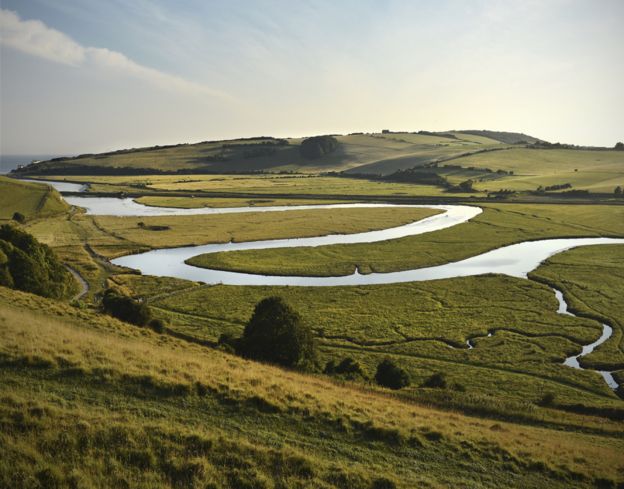 Image copyrightiStock
One way of encouraging a river to take its time in getting to its destination - and therefore reduce the risk of flooding - is to allow it to make large bends called meanders or to braid itself into a network of smaller channels. These twists and turns can help prevent flash floods from racing their way down at full force.
"There still has to be somewhere for that rain to go, you are not going to be able to hold it all back in the hills," explains Monbiot.
Reconnecting a river with its flood plain can also help prevent extreme events downstream. This allows the river to flood in certain areas, storing water in fields until it can be released slowly once the danger has passed. But this has to be controlled.
"If it's not managed carefully, obviously that flooding can have a serious impact on the farming business," says Rob Howells, the NFU's Water Quality Adviser. "The protection of the urban area has to be planned in conjunction with the protection of rural areas to make sure that everything is joined up and to make sure that you are not having unintended consequences elsewhere," he adds.
Destruction of upland habitats
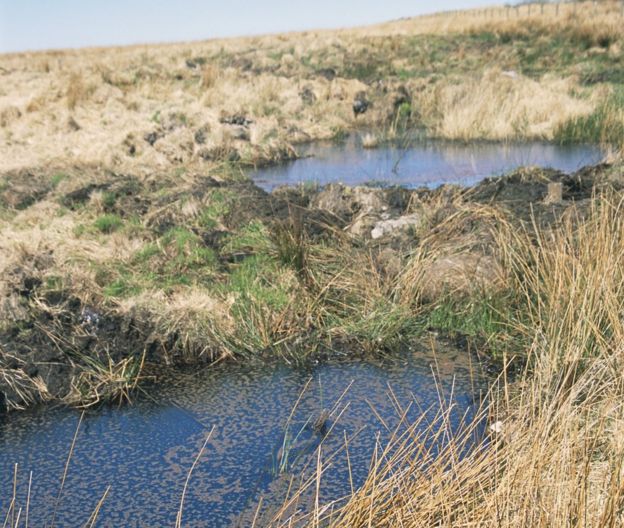 Image copyrightScience Photo Library
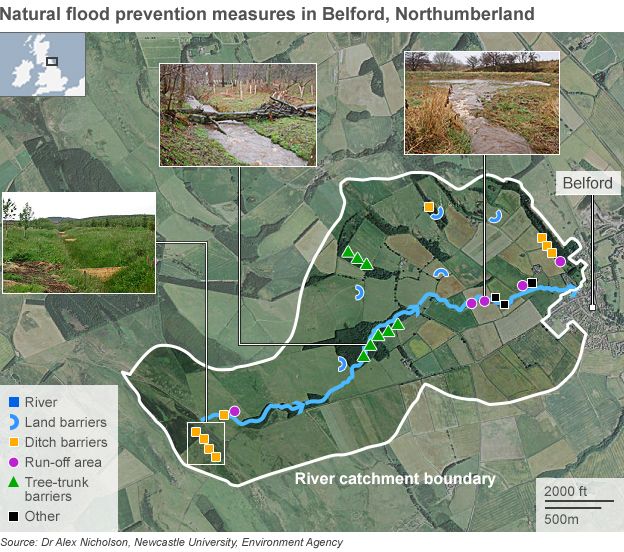
Trees can act as a natural flood defence. They have roots that reach deep into the soil, loosening it and allowing water to drain down more easily. A hillside covered in thick vegetation tends to release water more slowly than a bare hill. The compacted soil of farmland can also make the problem worse by reducing the ground's ability to hold water.
This is especially important upstream. Planting woodlands at a stream's upper reaches could help delay the water from reaching the main river. Trees can also end up providing small dams, although this needs to be managed with care.
Beavers would do this work for free, adds Monbiot. "They could be a very useful tool in preventing floods."
The Environment Agency has said that large areas of trees would need to be replanted for them to really make a difference. Flood defences on farmlands upstream might also not have had much effect in preventing the current flooding. "The levels of rainfall in the North West on already saturated ground were unprecedented," says a spokesman from the Department for the Environment, Food and Rural Affairs (Defra). "It is unlikely flood protection on farmland would have made a material difference in such an exceptional flood."
Blanket bogs also play a key role in soaking up rainfall upstream. The peaty soil of a bog can be up to 90% water. Sphagnum mosses growing there can also hold water like a sponge. But many blanket bogs have been drained and their peat cut out which can increase the risk of flooding downstream.
Some people argue that there is not much incentive for farmers to keep land covered in thick vegetation because of EU rules. Land covered with "permanent ineligible features" such as ponds, dense scrub and some woodland can be disqualified from farm subsidies.
Woodland cover has increased in the UK since its lowest point during World War One but the UK is still one of the least wooded countries in Europe. "Planting trees can help to slow the flow of rivers and has an important role to play in reducing flood risk but they need to be located carefully to make sure that they are actually being beneficial," adds Howells.
Flood defences
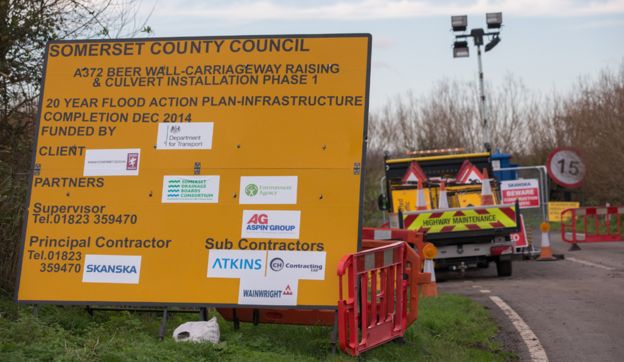 Image copyrightGetty Images
Critics have focused on the effectiveness of existing barriers. Carlisle's £38m flood-defence scheme was breached despite having been constructed only five years before, with an additional half-metre (1ft 8in) added on top to allow for the effects of climate change. There was anger at the decision to lift York's Foss Barrier, a key part of the city's flood defence system, because its pumps were at risk of electrical failure.
During its first year in office, the Conservative-Liberal Democrat coalition announced it was cutting spending on flood defences by 8% compared with previous yearly spend - though the Environment Agency said at the time that the budget had actually been reduced by 27% in cash terms.
Critics have said reductions in maintenance budgets have worsened the problem. Judith Blake, the leader of Leeds City Council said there was a "north-south divide" in efforts to prevent flooding. She said the north of England had not seen "anywhere near the support that we saw going into Somerset", which flooded in 2014, and pointed out that the government had cut funding for a flood defence project in Leeds in 2011. She said there was now a "real anger growing across the North".
However, the prime minister said the government had spent more per head of the population on flood defences in the north than in the south and that £2.3bn would be spent on flood defences by 2020. The government has ordered a major review of flood prevention strategy.
A Defra spokeswoman said £1.7bn of investment into new or expanded flood defences in the previous parliament was an increase on spending from the previous administration. The spokeswoman added that a new six-year spending programme - replacing an annual bidding process for flood defence schemes - has allowed the government to make a long term commitment to protect the £171m spent each year on maintaining defences in real terms.
The concentration of Britons in urban areas - 82% live in towns and cities - has made them especially vulnerable to flooding because concrete surfaces, unlike soil, are almost completely impenetrable to water.
And even when new flood defences are built to protect homes in one area, there are complaints that they often simply cause flooding elsewhere. When the Berkshire town of Wraysbury flooded in 2014, residents said they were being used as "sacrificial lambs" to prevent Maidenhead from being flooded.
Climate change
Cameron has made a link between the floods and climate change. The government anticipates trends which have seen drier summers and wetter winters in the UK to continue. The UK Climate Projections of 2009 estimated a sea-level rise of between 13cm and 76cm for the UK by 2095.
The prime minister has said climate change is one of the biggest challenges the country faces and the government has announced plans for the UK's coal plants to be phased out within 10 years. The Environment Secretary recently announced a National Flood Resilience Review that would look again at flood risk, including the future impact of climate change.
Labour have said climate change should be treated as a national security issue and urged the government to do more. Environmental campaigners have criticisedministers for cutting support for green energy sources.
The climate change summit in Paris agreed a deal to attempt to limit the rise in global temperatures to less than 2C. However, Monbiot says "we have to take urgent action on climate change and go a lot further than the Paris agreement proposed".
Subscribe to:
Posts (Atom)