
Thursday, 3 December 2015
Tuesday, 1 December 2015
Why blame culture is toxic for sport
Ed Smith in Cricinfo
Is ranting at players during team talks like bloodletting in the age of quack doctors?
 Shouting at players: Satisfying? Yes. Effective? No © AFP
The subversive in me would love to whitewash over the usual clichés and catchphrases that are splashed on dressing-room walls and replace them with a more cynical message:
The six phases of a project:
1. Enthusiasm
2. Disillusionment
3. Panic
4. Search for the guilty
5. Punishment of the innocent
6. Rewards for the uninvolved
Not very cheering, I admit, but a salutary warning about our obsession with blame - a preoccupation sustained by dodgy narratives about "causes" that leads not to institutional improvement but to self-serving politics. Having pinned the blame on someone - rightly or, more likely, wrongly - the next task is "moving on". Sound familiar?
The "six phases" were attached to an office wall by an employee at the Republic Bank of New York. The story appears in Black Box Thinking, Matthew Syed's new book. Syed (a leading sports columnist and double Olympian) argues that our preoccupation with convenient blame - rather than openness to learning from failure - is a central factor holding teams and individuals back from improving. I think he is right.
Syed expresses admiration for the airline industry and its commitment to learning from failure - especially from "black boxes", the explosion-proof devices that record the conversations of pilots and other data. If the plane's wreckage is found, lessons - no matter how painful - must be learned. In the jargon, learning inside the aviation industry is an "open loop". (An "open loop" leads to progress because the feedback is rationally acted on; a "closed loop" is where failure doesn't lead to progress because weaknesses are ignored or errors are misinterpreted.) Syed presents harrowing examples from hospital operating theatres, of "closed loops" costing lives. Indeed, with its recurrent plane crashes and botched operations, the book takes the search for transferrable lessons to harrowing extremes.
One question prompted by Black Box Thinking is why is sport is not instinctively enthusiastic about evidence-based discussion. You might think that sports teams would be so keen to improve that they would rush to expose their ideas to rational and reflective scrutiny. But that's not always the case. As a player I often felt that insecure teams shrank from critical thinking, where more confident teams encouraged it.
The first problem sport has with critical thinking is the "narrative fallacy" (a concept popularised by Nassim Taleb). Consider this statement, thrown at me by a coach as I left the dressing room and walked onto the field after winning the toss and deciding to bowl first: "We need to have them five wickets down at lunch to justify the decision."
Hmm. First, even thinking about "justifying" a decision is an unnecessary distraction. Secondly, it's also irrational to think that the fact of taking five wickets, even if it happens, proves the decision was right. I might have misread the wicket, which actually suited batting first, but the opposition might have suffered a bad morning - five wickets could fall and yet the decision could still easily be wrong.
Alternatively, the wicket might suit bowling - and hence "justify" my decision - but we might bowl improbably badly and drop our catches. In other words, it could be the right decision even if they are no wickets down at lunch. What happened after the decision (especially when the sample of evidence is small or, as in this instance, solitary) does not automatically prove the rightness or wrongness of the decision.
Fancy theorising? Prefer practical realities? This kind of theorising, in fact, is bound up with very practical realities. Consider this example.
For much of medical history, bloodletting was a common and highly respected procedure. When a patient was suffering from a serious ailment and went to a leading doctor, the medical guru promptly drained significant amounts of blood from an already weak body. Madness? It happened for centuries.
And sometimes, if we don't think critically, it "works". As Syed points out, in a group of ten patients treated with bloodletting, five might die and five get better. So it worked for the five who survived, right?
Only, it didn't, of course. The five who were healed would have got better anyway (the body has great powers of self-recuperation). And some among the five who died were pushed from survival into death. Proving this fact, however, was more difficult - especially in a medical culture dominated by doctors who advocated and profited materially from bloodletting.
The challenge of demonstrating the real usefulness (or otherwise) of a procedure led to the concept of the "control group". Now imagine a group of 20 patients with serious illnesses - and split them into two groups, ten in each group. One group of ten patients gets a course of bloodletting, the other group of ten (the control group) does not. If we discover that five out of ten died in the bloodletting group and only three out of ten among the non-bloodletting group, then, at last, we have the beginnings of a proper evidence-based approach. The intervention (bloodletting) did more harm than simply doing nothing. It was iatrogenic.
Iatrogenic interventions are common in sport, too - such as when the coach tells a batsman to change his lifelong grip before making his Test debut. (Impossible? Exactly that happened to a friend of mine.) The angry team meeting is a classic iatrogenic intervention. Shouting at the team and vindictively blaming individual players, like bloodletting, provides the coach with the satisfying illusion that it works well sometimes. By "it works", we imply that the team in question played better after half-time or the following morning. Even having suffered an iatrogenic intervention, however, some teams - like some patients enduring bloodletting - inevitably play better afterwards. But on average, all taken together, teams would have playedbetter still without the distraction of a raging coach. (This insight helped win Daniel Kahneman a Nobel Prize, as I learned when I interviewed him.)
The great difficulty of sport, of course, is the challenge of conducting a proper control group experiment - because the game situation, pressures and circumstances are seldom exactly the same twice over. However, merely being open to the logic of these ideas, constantly exposing judgements and intuitions to critical thinking, takes decision-makers a good step in the direction of avoiding huge errors of conventional thinking.
That is why much of what Syed calls "black box thinking" could, I think, be filed under "critical thinking" - the desire to refine and improve one's system of thought as you are exposed to new experiences and ideas. Here is a personal rule of thumb: critical thinkers are also the best company over the long term. Critical thinkers are not only better bets professionally, they are also more interesting friends. Who wants to listen to the same set of unexamined views and sacrosanct opinions for decades? If you believe that your ideas don't ever need to evolve and adapt, can we at least skip dinner?
It is hard to imagine how anyone who is interested in leadership, innovation or self-improvement could fail to find something new and challenging in this book. Rather than presenting a simplistic catch-all solution, Syed takes us on a modern and personal walk through the scientific method. The book makes an interesting contrast with Syed's first book,Bounce, which proposed that talent is a myth - an argument that can be summed up in a single, seductive phrase: genius is a question of practice.
Rather than presenting a single idea, Black Box Thinking circles around a main theme - illustrating and illuminating it by drawing on a dizzyingly wide and eclectic series of ideas, case studies and lines of philosophical enquiry. The reader finishes the book with a deeper understanding of how he might improve and grow over the long term, rather than the transient feeling of having all his problems solved. The author, we sense, has experienced a similar journey while writing the book. Syed doesn't just preach black-box thinking, he practises it.
Is ranting at players during team talks like bloodletting in the age of quack doctors?
Shouting at players: Satisfying? Yes. Effective? No © AFPThe subversive in me would love to whitewash over the usual clichés and catchphrases that are splashed on dressing-room walls and replace them with a more cynical message:
The six phases of a project:
1. Enthusiasm
2. Disillusionment
3. Panic
4. Search for the guilty
5. Punishment of the innocent
6. Rewards for the uninvolved
Not very cheering, I admit, but a salutary warning about our obsession with blame - a preoccupation sustained by dodgy narratives about "causes" that leads not to institutional improvement but to self-serving politics. Having pinned the blame on someone - rightly or, more likely, wrongly - the next task is "moving on". Sound familiar?
The "six phases" were attached to an office wall by an employee at the Republic Bank of New York. The story appears in Black Box Thinking, Matthew Syed's new book. Syed (a leading sports columnist and double Olympian) argues that our preoccupation with convenient blame - rather than openness to learning from failure - is a central factor holding teams and individuals back from improving. I think he is right.
Syed expresses admiration for the airline industry and its commitment to learning from failure - especially from "black boxes", the explosion-proof devices that record the conversations of pilots and other data. If the plane's wreckage is found, lessons - no matter how painful - must be learned. In the jargon, learning inside the aviation industry is an "open loop". (An "open loop" leads to progress because the feedback is rationally acted on; a "closed loop" is where failure doesn't lead to progress because weaknesses are ignored or errors are misinterpreted.) Syed presents harrowing examples from hospital operating theatres, of "closed loops" costing lives. Indeed, with its recurrent plane crashes and botched operations, the book takes the search for transferrable lessons to harrowing extremes.
One question prompted by Black Box Thinking is why is sport is not instinctively enthusiastic about evidence-based discussion. You might think that sports teams would be so keen to improve that they would rush to expose their ideas to rational and reflective scrutiny. But that's not always the case. As a player I often felt that insecure teams shrank from critical thinking, where more confident teams encouraged it.
The first problem sport has with critical thinking is the "narrative fallacy" (a concept popularised by Nassim Taleb). Consider this statement, thrown at me by a coach as I left the dressing room and walked onto the field after winning the toss and deciding to bowl first: "We need to have them five wickets down at lunch to justify the decision."
Hmm. First, even thinking about "justifying" a decision is an unnecessary distraction. Secondly, it's also irrational to think that the fact of taking five wickets, even if it happens, proves the decision was right. I might have misread the wicket, which actually suited batting first, but the opposition might have suffered a bad morning - five wickets could fall and yet the decision could still easily be wrong.
Alternatively, the wicket might suit bowling - and hence "justify" my decision - but we might bowl improbably badly and drop our catches. In other words, it could be the right decision even if they are no wickets down at lunch. What happened after the decision (especially when the sample of evidence is small or, as in this instance, solitary) does not automatically prove the rightness or wrongness of the decision.
Fancy theorising? Prefer practical realities? This kind of theorising, in fact, is bound up with very practical realities. Consider this example.
For much of medical history, bloodletting was a common and highly respected procedure. When a patient was suffering from a serious ailment and went to a leading doctor, the medical guru promptly drained significant amounts of blood from an already weak body. Madness? It happened for centuries.
And sometimes, if we don't think critically, it "works". As Syed points out, in a group of ten patients treated with bloodletting, five might die and five get better. So it worked for the five who survived, right?
Only, it didn't, of course. The five who were healed would have got better anyway (the body has great powers of self-recuperation). And some among the five who died were pushed from survival into death. Proving this fact, however, was more difficult - especially in a medical culture dominated by doctors who advocated and profited materially from bloodletting.
The challenge of demonstrating the real usefulness (or otherwise) of a procedure led to the concept of the "control group". Now imagine a group of 20 patients with serious illnesses - and split them into two groups, ten in each group. One group of ten patients gets a course of bloodletting, the other group of ten (the control group) does not. If we discover that five out of ten died in the bloodletting group and only three out of ten among the non-bloodletting group, then, at last, we have the beginnings of a proper evidence-based approach. The intervention (bloodletting) did more harm than simply doing nothing. It was iatrogenic.
Iatrogenic interventions are common in sport, too - such as when the coach tells a batsman to change his lifelong grip before making his Test debut. (Impossible? Exactly that happened to a friend of mine.) The angry team meeting is a classic iatrogenic intervention. Shouting at the team and vindictively blaming individual players, like bloodletting, provides the coach with the satisfying illusion that it works well sometimes. By "it works", we imply that the team in question played better after half-time or the following morning. Even having suffered an iatrogenic intervention, however, some teams - like some patients enduring bloodletting - inevitably play better afterwards. But on average, all taken together, teams would have playedbetter still without the distraction of a raging coach. (This insight helped win Daniel Kahneman a Nobel Prize, as I learned when I interviewed him.)
The great difficulty of sport, of course, is the challenge of conducting a proper control group experiment - because the game situation, pressures and circumstances are seldom exactly the same twice over. However, merely being open to the logic of these ideas, constantly exposing judgements and intuitions to critical thinking, takes decision-makers a good step in the direction of avoiding huge errors of conventional thinking.
That is why much of what Syed calls "black box thinking" could, I think, be filed under "critical thinking" - the desire to refine and improve one's system of thought as you are exposed to new experiences and ideas. Here is a personal rule of thumb: critical thinkers are also the best company over the long term. Critical thinkers are not only better bets professionally, they are also more interesting friends. Who wants to listen to the same set of unexamined views and sacrosanct opinions for decades? If you believe that your ideas don't ever need to evolve and adapt, can we at least skip dinner?
It is hard to imagine how anyone who is interested in leadership, innovation or self-improvement could fail to find something new and challenging in this book. Rather than presenting a simplistic catch-all solution, Syed takes us on a modern and personal walk through the scientific method. The book makes an interesting contrast with Syed's first book,Bounce, which proposed that talent is a myth - an argument that can be summed up in a single, seductive phrase: genius is a question of practice.
Rather than presenting a single idea, Black Box Thinking circles around a main theme - illustrating and illuminating it by drawing on a dizzyingly wide and eclectic series of ideas, case studies and lines of philosophical enquiry. The reader finishes the book with a deeper understanding of how he might improve and grow over the long term, rather than the transient feeling of having all his problems solved. The author, we sense, has experienced a similar journey while writing the book. Syed doesn't just preach black-box thinking, he practises it.
Wednesday, 25 November 2015
Consume more, conserve more: sorry, but we just can’t do both
Economic growth is tearing the planet apart, and new research suggests that it can’t be reconciled with sustainability
George Monbiot in The Guardian
We can have it all: that is the promise of our age. We can own every gadget we are capable of imagining – and quite a few that we are not. We can live like monarchs without compromising the Earth’s capacity to sustain us. The promise that makes all this possible is that as economies develop, they become more efficient in their use of resources. In other words, they decouple.
There are two kinds of decoupling: relative and absolute. Relative decoupling means using less stuff with every unit of economic growth; absolute decoupling means a total reduction in the use of resources, even though the economy continues to grow. Almost all economists believe that decoupling – relative or absolute – is an inexorable feature of economic growth.
On this notion rests the concept of sustainable development. It sits at the heart of the climate talks in Paris next month and of every other summit on environmental issues. But it appears to be unfounded.
A paper published earlier this year in Proceedings of the National Academy of Sciences proposes that even the relative decoupling we claim to have achieved is an artefact of false accounting. It points out that governments and economists have measured our impacts in a way that seems irrational.
Here’s how the false accounting works. It takes the raw materials we extract in our own countries, adds them to our imports of stuff from other countries, then subtracts our exports, to end up with something called “domestic material consumption”. But by measuring only the products shifted from one nation to another, rather than the raw materials needed to create those products, it greatly underestimates the total use of resources by the rich nations.
For instance, if ores are mined and processed at home, these raw materials, as well as the machinery and infrastructure used to make finished metal, are included in the domestic material consumption accounts. But if we buy a metal product from abroad, only the weight of the metal is counted. So as mining and manufacturing shift from countries such as the UK and the US to countries like China and India, the rich nations appear to be using fewer resources. A more rational measure, called the material footprint, includes all the raw materials an economy uses, wherever they happen to be extracted. When these are taken into account, the apparent improvements in efficiency disappear.
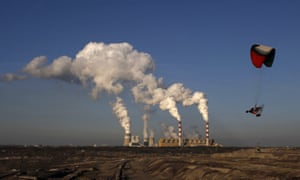
Europe’s largest coal-fired power plant, in Belchatow, Poland. ‘New analysis suggests that in the EU, the US, Japan and the other rich nations, there have been ‘no improvements in resource productivity at all’.’ Photograph: Kacper Pempel/Reuters
In the UK, for instance, the absolute decoupling that the domestic material consumption accounts appear to show is replaced with an entirely different chart. Not only is there no absolute decoupling; there is no relative decoupling either. In fact, until the financial crisis in 2007, the graph was heading in the opposite direction: even relative to the rise in our gross domestic product, our economy was becoming less efficient in its use of materials. Against all predictions, a recoupling was taking place.
While the OECD has claimed that the richest countries have halved the intensity with which they use resources, the new analysis suggests that in the EU, the US, Japan and the other rich nations, there have been “no improvements in resource productivity at all”. This is astonishing news. It appears to makes a nonsense of everything we have been told about the trajectory of our environmental impacts.
I sent the paper to one of Britain’s leading thinkers on this issue, Chris Goodall, who has argued that the UK appears to have reached “peak stuff”: in other words, there has been a total reduction in our use of resources, otherwise known as absolute decoupling. What did he think?
To his great credit, he responded that “broadly, of course, they are right”, even though the new analysis appears to undermine the case he has made. He did have some reservations, however, particularly about the way in which the impacts of construction are calculated. I also consulted the country’s leading academic expert on the subject, Professor John Barrett. He told me that he and his colleagues had conducted a similar analysis, in this case of the UK’s energy use and greenhouse gas emissions, “and we find a similar pattern”. One of his papers reveals that while the UK’s carbon dioxide emissions officially fell by 194m tonnes between 1990 and 2012, this apparent reduction is more than cancelled out by the CO2 we commission through buying stuff from abroad. This rose by 280m tonnes in the same period.
Dozens of other papers come to similar conclusions. For instance, a report published in the journal Global Environmental Change found that with every doubling of income, a country needs a third more land and ocean to support its economy because of the rise in its consumption of animal products. A recent paper in the journal Resources found that the global consumption of materials has risen by 94% over 30 years, and has accelerated since 2000. “For the past 10 years, not even a relative decoupling was achieved on the global level.”
We can persuade ourselves that we are living on thin air, floating through a weightless economy, as gullible futurologists predicted in the 1990s. But it’s an illusion, created by the irrational accounting of our environmental impacts. This illusion permits an apparent reconciliation of incompatible policies.
Governments urge us both to consume more and to conserve more. We mustextract more fossil fuel from the ground, but burn less of it. We should reduce, reuse and recycle the stuff that enters our homes, and at the same time increase, discard and replace it. How else can the consumer economy grow? We should eat less meat to protect the living planet, and eat more meat to boost the farming industry. These policies are irreconcilable. The new analyses suggest that economic growth is the problem, regardless of whether the word sustainable is bolted to the front of it.
It’s not just that we don’t address this contradiction; scarcely anyone dares even name it. It’s as if the issue is too big, too frightening to contemplate. We seem unable to face the fact that our utopia is also our dystopia; that production appears to be indistinguishable from destruction.
George Monbiot in The Guardian
We can have it all: that is the promise of our age. We can own every gadget we are capable of imagining – and quite a few that we are not. We can live like monarchs without compromising the Earth’s capacity to sustain us. The promise that makes all this possible is that as economies develop, they become more efficient in their use of resources. In other words, they decouple.
There are two kinds of decoupling: relative and absolute. Relative decoupling means using less stuff with every unit of economic growth; absolute decoupling means a total reduction in the use of resources, even though the economy continues to grow. Almost all economists believe that decoupling – relative or absolute – is an inexorable feature of economic growth.
On this notion rests the concept of sustainable development. It sits at the heart of the climate talks in Paris next month and of every other summit on environmental issues. But it appears to be unfounded.
A paper published earlier this year in Proceedings of the National Academy of Sciences proposes that even the relative decoupling we claim to have achieved is an artefact of false accounting. It points out that governments and economists have measured our impacts in a way that seems irrational.
Here’s how the false accounting works. It takes the raw materials we extract in our own countries, adds them to our imports of stuff from other countries, then subtracts our exports, to end up with something called “domestic material consumption”. But by measuring only the products shifted from one nation to another, rather than the raw materials needed to create those products, it greatly underestimates the total use of resources by the rich nations.
For instance, if ores are mined and processed at home, these raw materials, as well as the machinery and infrastructure used to make finished metal, are included in the domestic material consumption accounts. But if we buy a metal product from abroad, only the weight of the metal is counted. So as mining and manufacturing shift from countries such as the UK and the US to countries like China and India, the rich nations appear to be using fewer resources. A more rational measure, called the material footprint, includes all the raw materials an economy uses, wherever they happen to be extracted. When these are taken into account, the apparent improvements in efficiency disappear.
Europe’s largest coal-fired power plant, in Belchatow, Poland. ‘New analysis suggests that in the EU, the US, Japan and the other rich nations, there have been ‘no improvements in resource productivity at all’.’ Photograph: Kacper Pempel/Reuters
In the UK, for instance, the absolute decoupling that the domestic material consumption accounts appear to show is replaced with an entirely different chart. Not only is there no absolute decoupling; there is no relative decoupling either. In fact, until the financial crisis in 2007, the graph was heading in the opposite direction: even relative to the rise in our gross domestic product, our economy was becoming less efficient in its use of materials. Against all predictions, a recoupling was taking place.
While the OECD has claimed that the richest countries have halved the intensity with which they use resources, the new analysis suggests that in the EU, the US, Japan and the other rich nations, there have been “no improvements in resource productivity at all”. This is astonishing news. It appears to makes a nonsense of everything we have been told about the trajectory of our environmental impacts.
I sent the paper to one of Britain’s leading thinkers on this issue, Chris Goodall, who has argued that the UK appears to have reached “peak stuff”: in other words, there has been a total reduction in our use of resources, otherwise known as absolute decoupling. What did he think?
To his great credit, he responded that “broadly, of course, they are right”, even though the new analysis appears to undermine the case he has made. He did have some reservations, however, particularly about the way in which the impacts of construction are calculated. I also consulted the country’s leading academic expert on the subject, Professor John Barrett. He told me that he and his colleagues had conducted a similar analysis, in this case of the UK’s energy use and greenhouse gas emissions, “and we find a similar pattern”. One of his papers reveals that while the UK’s carbon dioxide emissions officially fell by 194m tonnes between 1990 and 2012, this apparent reduction is more than cancelled out by the CO2 we commission through buying stuff from abroad. This rose by 280m tonnes in the same period.
Dozens of other papers come to similar conclusions. For instance, a report published in the journal Global Environmental Change found that with every doubling of income, a country needs a third more land and ocean to support its economy because of the rise in its consumption of animal products. A recent paper in the journal Resources found that the global consumption of materials has risen by 94% over 30 years, and has accelerated since 2000. “For the past 10 years, not even a relative decoupling was achieved on the global level.”
We can persuade ourselves that we are living on thin air, floating through a weightless economy, as gullible futurologists predicted in the 1990s. But it’s an illusion, created by the irrational accounting of our environmental impacts. This illusion permits an apparent reconciliation of incompatible policies.
Governments urge us both to consume more and to conserve more. We mustextract more fossil fuel from the ground, but burn less of it. We should reduce, reuse and recycle the stuff that enters our homes, and at the same time increase, discard and replace it. How else can the consumer economy grow? We should eat less meat to protect the living planet, and eat more meat to boost the farming industry. These policies are irreconcilable. The new analyses suggest that economic growth is the problem, regardless of whether the word sustainable is bolted to the front of it.
It’s not just that we don’t address this contradiction; scarcely anyone dares even name it. It’s as if the issue is too big, too frightening to contemplate. We seem unable to face the fact that our utopia is also our dystopia; that production appears to be indistinguishable from destruction.
Tuesday, 24 November 2015
There’s a population crisis all right. But probably not the one you think
While all eyes are on human numbers, it’s the rise in farm animals that is laying the planet waste
A recent paper in the journal Science of the Total Environment suggests that our consumption of meat is likely to be “the leading cause of modern species extinctions”. Not only is livestock farming the major reason for habitat destruction and the killing of predators, but its waste products are overwhelming the world’s capacity to absorb them. Factory farms in the US generate 13 times as much sewage as the human population does. The dairy farms in Tulare County, California, produce five times as much as New York City.
Freshwater life is being wiped out across the world by farm manure. In England the system designed to protect us from the tide of slurry has comprehensively broken down. Dead zones now extend from many coasts, as farm sewage erases ocean life across thousands of square kilometres.
Livestock farming creates around 14% of the world’s greenhouse gas emissions: slightly more than the output of the world’s cars, lorries, buses, trains, ships and planes. If you eat soya, your emissions per unit of protein are 20 times lower than eating pork or chicken, and 150 times lower than eating beef.
So why is hardly anyone talking about the cow, pig, sheep and chicken in the room? Why are there no government campaigns to reduce the consumption of animal products, just as they sometimes discourage our excessive use of electricity?
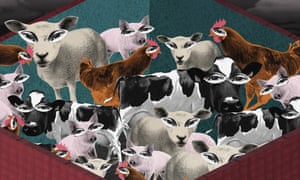
‘By 2050 the world’s living systems will have to support about 120m tonnes of extra humans, and 400m tonnes of extra farm animals.’ Illustration by Nate Kitch
GeorgeMonbiot in The Guardian
This column is about the population crisis. About the breeding that’s laying waste the world’s living systems. But it’s probably not the population crisis you’re thinking of. This is about another one, that we seem to find almost impossible to discuss.
You’ll hear a lot about population in the next three weeks, as the Paris climate summit approaches. Across the airwaves and on the comment threads it will invariably be described as “the elephant in the room”. When people are not using their own words, it means that they are not thinking their own thoughts. Ten thousand voices each ask why no one is talking about it. The growth in human numbers, they say, is our foremost environmental threat.
At their best, population campaigners seek to extend women’s reproductive choices. Some 225 million women have an unmet need for contraception. If this need were answered, the impact on population growth would be significant, though not decisive: the annual growth rate of 83 million would be reduced to 62 million. But contraception is rarely limited only by the physical availability of contraceptives. In most cases it’s about power: women are denied control of their wombs. The social transformations that they need are wider and deeper than donations from the other side of the world are likely to achieve.
At their worst, population campaigners seek to shift the blame from their own environmental impacts. Perhaps it’s no coincidence that so many post-reproductive white men are obsessed with human population growth, as it’s about the only environmental problem of which they can wash their hands. Nor, I believe, is it a coincidence that of all such topics this is the least tractable. When there is almost nothing to be done, there is no requirement to act.
Such is the momentum behind population growth, an analysis in the Proceedings of the National Academy of Sciences discovered, that were every government to adopt the one-child policy China has just abandoned, there would still be as many people on Earth at the end of this century as there are today. If 2 billion people were wiped out by a catastrophe mid-century, the planet would still hold a billion more by 2100 than it does now.
If we want to reduce our impacts this century, the paper concludes, it is consumption we must address. Population growth is outpaced by the growth in our consumption of almost all resources. There is enough to meet everyone’s need, even in a world of 10 billion people. There is not enough to meet everyone’s greed, even in a world of 2 billion people.
So let’s turn to a population crisis over which we do have some influence. I’m talking about the growth in livestock numbers. Human numbers are rising at roughly 1.2% a year, while livestock numbers are rising at around 2.4% a year. By 2050 the world’s living systems will have to support about 120m tonnes of extra humans, and 400m tonnes of extra farm animals.
Raising these animals already uses three-quarters of the world’s agricultural land.A third of our cereal crops are used to feed livestock: this may rise to roughly half by 2050. More people will starve as a result, because the poor rely mainly on grain for their subsistence, and diverting it to livestock raises the price. And now the grain that farm animals consume is being supplemented by oil crops, particularly soya, for which the forests and savannahs of South America are being cleared at shocking rates.
This might seem counter-intuitive, but were we to eat soya rather than meat, the clearance of natural vegetation required to supply us with the same amount of protein would decline by 94%. Producing protein from chickens requires three times as much land as protein from soybeans. Pork needs nine times, beef 32 times.
GeorgeMonbiot in The Guardian
This column is about the population crisis. About the breeding that’s laying waste the world’s living systems. But it’s probably not the population crisis you’re thinking of. This is about another one, that we seem to find almost impossible to discuss.
You’ll hear a lot about population in the next three weeks, as the Paris climate summit approaches. Across the airwaves and on the comment threads it will invariably be described as “the elephant in the room”. When people are not using their own words, it means that they are not thinking their own thoughts. Ten thousand voices each ask why no one is talking about it. The growth in human numbers, they say, is our foremost environmental threat.
At their best, population campaigners seek to extend women’s reproductive choices. Some 225 million women have an unmet need for contraception. If this need were answered, the impact on population growth would be significant, though not decisive: the annual growth rate of 83 million would be reduced to 62 million. But contraception is rarely limited only by the physical availability of contraceptives. In most cases it’s about power: women are denied control of their wombs. The social transformations that they need are wider and deeper than donations from the other side of the world are likely to achieve.
At their worst, population campaigners seek to shift the blame from their own environmental impacts. Perhaps it’s no coincidence that so many post-reproductive white men are obsessed with human population growth, as it’s about the only environmental problem of which they can wash their hands. Nor, I believe, is it a coincidence that of all such topics this is the least tractable. When there is almost nothing to be done, there is no requirement to act.
Such is the momentum behind population growth, an analysis in the Proceedings of the National Academy of Sciences discovered, that were every government to adopt the one-child policy China has just abandoned, there would still be as many people on Earth at the end of this century as there are today. If 2 billion people were wiped out by a catastrophe mid-century, the planet would still hold a billion more by 2100 than it does now.
If we want to reduce our impacts this century, the paper concludes, it is consumption we must address. Population growth is outpaced by the growth in our consumption of almost all resources. There is enough to meet everyone’s need, even in a world of 10 billion people. There is not enough to meet everyone’s greed, even in a world of 2 billion people.
So let’s turn to a population crisis over which we do have some influence. I’m talking about the growth in livestock numbers. Human numbers are rising at roughly 1.2% a year, while livestock numbers are rising at around 2.4% a year. By 2050 the world’s living systems will have to support about 120m tonnes of extra humans, and 400m tonnes of extra farm animals.
Raising these animals already uses three-quarters of the world’s agricultural land.A third of our cereal crops are used to feed livestock: this may rise to roughly half by 2050. More people will starve as a result, because the poor rely mainly on grain for their subsistence, and diverting it to livestock raises the price. And now the grain that farm animals consume is being supplemented by oil crops, particularly soya, for which the forests and savannahs of South America are being cleared at shocking rates.
This might seem counter-intuitive, but were we to eat soya rather than meat, the clearance of natural vegetation required to supply us with the same amount of protein would decline by 94%. Producing protein from chickens requires three times as much land as protein from soybeans. Pork needs nine times, beef 32 times.
A recent paper in the journal Science of the Total Environment suggests that our consumption of meat is likely to be “the leading cause of modern species extinctions”. Not only is livestock farming the major reason for habitat destruction and the killing of predators, but its waste products are overwhelming the world’s capacity to absorb them. Factory farms in the US generate 13 times as much sewage as the human population does. The dairy farms in Tulare County, California, produce five times as much as New York City.
Freshwater life is being wiped out across the world by farm manure. In England the system designed to protect us from the tide of slurry has comprehensively broken down. Dead zones now extend from many coasts, as farm sewage erases ocean life across thousands of square kilometres.
Livestock farming creates around 14% of the world’s greenhouse gas emissions: slightly more than the output of the world’s cars, lorries, buses, trains, ships and planes. If you eat soya, your emissions per unit of protein are 20 times lower than eating pork or chicken, and 150 times lower than eating beef.
So why is hardly anyone talking about the cow, pig, sheep and chicken in the room? Why are there no government campaigns to reduce the consumption of animal products, just as they sometimes discourage our excessive use of electricity?
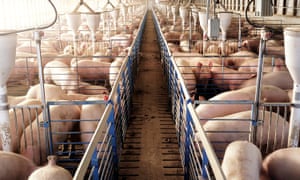
A factory farm in Missouri, USA. ‘Why is hardly anyone talking about the cow, pig, sheep and chicken in the room?’ Photograph: Daniel Pepper/Getty Images
A survey by the Royal Institute of International Affairs found that people are not unwilling to change diets once they become aware of the problem, but that many have no idea that livestock farming damages the living world.
It’s not as if eating less meat and dairy will harm us. If we did as our doctors advise, our environmental impacts would decline in step with heart disease, strokes, diabetes and cancer. British people eat, on average, slightly more than their bodyweight in meat every year, while Americans consume another 50%: wildly more, in both cases, than is good for us or the rest of life on Earth.
But while plenty in the rich world are happy to discuss the dangers of brown people reproducing, the other population crisis scarcely crosses the threshold of perception. Livestock numbers present a direct moral challenge, as in this case we have agency. Hence the pregnant silence.
A survey by the Royal Institute of International Affairs found that people are not unwilling to change diets once they become aware of the problem, but that many have no idea that livestock farming damages the living world.
It’s not as if eating less meat and dairy will harm us. If we did as our doctors advise, our environmental impacts would decline in step with heart disease, strokes, diabetes and cancer. British people eat, on average, slightly more than their bodyweight in meat every year, while Americans consume another 50%: wildly more, in both cases, than is good for us or the rest of life on Earth.
But while plenty in the rich world are happy to discuss the dangers of brown people reproducing, the other population crisis scarcely crosses the threshold of perception. Livestock numbers present a direct moral challenge, as in this case we have agency. Hence the pregnant silence.
Subscribe to:
Posts (Atom)