Search This Blog

Tuesday, 24 November 2015

Road to Islamic State was paved by America’s Faustian bargain with Saudi Wahhabism

Sameer Arshad in Times of India

In the aftermath of the Paris carnage, US president Barack Obama led the usual counterproductive finger-pointing telling Muslims to ask themselves how extremist ideologies took root. Obama’s point is perhaps valid, but that is only a part of the problem. The West needs to answer far more serious questions. Besides waging destabilising, unjust wars and propping up despotic regimes in the Muslim world, it bears responsibility for planting cancer, which Daesh or the so-called Islamic State (IS) is a symptom of, in the process.
It is unfair to collectively blame Muslims for IS since they are and have been the worst victims of the mindless violence of the creed it represents for three centuries. Daesh has its roots in 18th century preacher Abd-al-Wahhab’s doctrine, which rejected Islamic pluralism enshrined in the Quran and declared war on Muslims other than Salafis.
The Ottoman Empire, which represented contemporary mainstream Muslims, resisted this challenge tooth and nail. It in fact coined the term Wahhabism to describe Wahhab’s creed and to underline it fell outside Islam’s pale. Thanks to the West’s myopic foreign policy goals and lust for oil, the creed has come a long way since the 18th century when even Wahhab’s brother and father rejected his doctrine. The creed has been defined mainly by hostility towards Islamic mysticism and seeking death for ‘deviant’ Muslims.
Beyond his family, Wahhab’s teaching found few takers. The vandalism inspired by him infuriated neighbouring tribes, who forced Wahhab to take refuge in Dariyya after threatening to kill him. Wahhab’s flight proved the turning point in his career as Dariyya chieftain Muhammad ibn Saud got into an irrevocable alliance with the preacher in 1747, under which he pledged his family would promote Wahhabism. It laid the foundation for Saudi Arabia on the ruins of the Ottoman Empire in 1932.
By the time Wahhab died in 1792 his followers had become lethal. They declared a war on mainstream Islamic sects by branding them polytheists. Taking ‘deviant’ Muslim lives was justified along with seizure of their properties and enslaving their women and children. This prompted the Mecca qadi to denounce Wahhabis as non-Muslims and bar them from entering Islam’s holiest city. The Ottomans condemned Wahhabis as Kharjites (defectors) and banned them from performing Hajj.
But the Saudis have honoured their pact with Wahhab by using petrodollars to export his creed through a cultural offensive which has undermined Islamic pluralism, triggered fratricidal sectarian conflict and birthed terrorist groups like al-Qaida and IS. The US has been complicit as the principal backer of Saudi Arabia.
This has helped America satiate its thirst for oil and use Wahhabi doctrine for short term goals like defeating USSR in Afghanistan. In the 1970s, the US used the Saudi alliance to counter Egyptian pan-Arab socialist Gamal Abdel Nasser and post-revolution Iran. In the process it often patronised the nihilistic forces that have now turned their guns on the West.

Eating less meat key to curbing climate change


People are more likely to back policies to curb meat eating for health and climate reasons, Chatham House survey suggests


Meat production produces 15% of all greenhouse gases. Photograph: Alamy


Damian Carrington in The Guardian


Taxing meat to simultaneously tackle climate change and improve global health would be far less unpalatable than governments think, according to new research.

Meat production produces 15% of all greenhouse gases – more than all cars, trains, planes and ships combined – and halting global warming appears near impossible unless the world’s fast growing appetite for meat is addressed.

The new analysis says this could be done through taxes, increasing vegetarian food in schools, hospitals and the armed forces and cutting subsidies to livestock farmers, all supported by public information campaigns.

The research, from the international affairs thinktank Chatham House and Glasgow University, involved surveys and focus groups in 12 countries and found that even measures restricting peoples’ behaviour could be accepted if seen as in the public interest, as was seen with smoking bans.

“Governments are ignoring what should be a hugely appealing, win-win policy,” said lead author Laura Wellesley, at Chatham House.

“The idea that interventions like this are too politically sensitive and too difficult to implement is unjustified. Our focus groups show people expect governments to lead action on issues that are for the global good. Our research indicates any backlash to unpopular policies would likely be short-lived as long as the rationale for action was strong.”

Increasing appetite for meat and population growth in developing countries mean global meat consumption is on track to increase 75% by 2050, which would make it virtually impossible to keep global warming below the internationally-agreed limit of 2C.

Meat consumption is already well above healthy levels in developed nations and growing fast in other countries, and is linked to rising rates of heart disease and cancer. To get to healthy levels, US citizens would need to cut the meat they eat by two-thirds, those in the UK by a half and those in China by a third.

If the world’s population cuts to healthy levels of meat consumption – about 70g per day – it would reduce carbon emissions by an amount equivalent to annual output of the US, the world’s second biggest polluter.

The UN climate change summit begins in Paris on 30 November, where the world’s nations aim to seal a deal to tackle climate change.

Most countries have already submitted pledges to cut their emissions, but they are not enough to keep warming below dangerous levels. Cutting meat eating to healthy levels would make up a quarter of that shortfall and is very low cost way of curbing emissions, according to the report, but action to achieve this is non-existent.

Previous calls to cut meat consumption, from the chief of the UN’s climate science panel and the economist Lord Stern, or to tax it, have been both rare and controversial.

“We are not in any way advocating for global vegetarianism,” said Wellesley. “We can see massive changes [to emissions] from just converging around healthy levels of meat eating.” She said raising awareness of the impact on the climate from meat production was the first step, but was unlikely to shift diets by itself.

“The level of awareness is very low, indeed in China it is almost non-existent,” said Catherine Happer, at Glasgow University. She said people in the 36 focus groups viewed meat taxes as the most effective, if unpopular, but that cutting subsidies for meat production was seen as both effective and popular.

“An awful lot of people were surprised that there were subsidies at all,” she said. “They felt, particularly in the US, that governments had propped up a very unhealthy food market.” Livestock subsidies in the 34 OECD nations alone were $53bn in 2013, including an average of $190 per cow. People also said any government action must avoid disadvantaging poorer citizens.

Prof Greg Philo, also at Glasgow University, said the key was “creating a new public understanding that industrial production of meat is not only dangerous to your own health but to human ecology as a whole.”


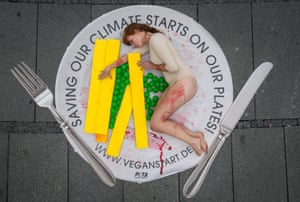
Animal rights organisation Peta’s climate message in Munich, Germany, aims to raise awareness of the link between climate change and the consumption of meat. Photograph: Mathias Balk/Alamy Stock Photo


Clare Oxborrow, a campaigner at Friends of the Earth, said: “Meat consumption can no longer be ignored in the climate debate – shifting diets to less meat and more plant proteins will be crucial. The government must stop using consumer backlash as an excuse for inaction”.

The reductions mapped out by the report would not reduce the size of the global meat industry, the researchers said, because rising population is pushing up demand, but it would significantly slow its growth.

They also said efforts to make meat production greener could cut emissions by up to a third, but that this would be swamped by growing demand if action was not taken. Meat eating has plateaued in recent years in richer nations, but is growing fast in developing countries.

Previous studies have calculated that, on current trends, agricultural emissions will take up the entire world’s carbon budget by 2050, meaning every other sector, including energy, industry and transport, would have to be zero carbon, a scenario described as “impossible”.

Meat production produces greenhouse gases via the methane emitted by livestock, the cutting down of forests for pasture, the production of fertiliser for feed crops and the energy and transport used by farmers. Beef is responsible for far higher emissions than chicken or pork.

None of the report’s authors are vegetarians, but Rob Bailey, from Chatham House, said: “Having worked on this project, I have drastically reduced my meat consumption – I now eat it once a month.”

Monday, 23 November 2015

Freemasons from throughout history to be revealed

The list is being published online by the genealogy company, Ancestry

Ian Johnston in The Independent


A once highly secret list containing the identities of two million Freemasons throughout history is to be published online, revealing the extent of the organisation’s influence in the upper echelons of society.

Everyone from Oscar Wilde and Rudyard Kipling to the Duke of Wellington and Lord Kitchener were members, The Daily Telegraph reported.

There are even claims that a singer suspected of being Jack the Ripper was protected from prosecution because he was a mason.

Other members include Sir Winston Churchill, Edward VII, George VI, Edward VIII, explorers Ernest Shackleton and Captain Robert Falcon Scott, scientists Edward Jenner and Sir Alexander Fleming, engineer Thomas Telford, businessman Harry Selfridge and social reformer Thomas Barnardo, as well as both Gilbert and Sullivan.

The list is being published online by the genealogy company, Ancestry.

Miriam Silverman, senior UK content manager at Ancestry, told the Telegraph: “We’re delighted to be able to offer people an online window into a relatively unknown organisation.”

Meanwhile a new book by the director and screenwriter of the film Withnail and I, Bruce Robinson, claims that Jack the Ripper was a singer called Michael Maybrick.

The book, The All Love Jack: Busting the Ripper, claims that all the murders had elements of masonic ritual. The symbol of a pair of compasses, for example, was carved into the face of one victim.

Maybrick and his brother James, also a suspect, were both masons, as were two senior police officers, three police doctors and two coroners involved in the case. Maybrick was a member of the “Supreme Grand Council of Freemasons”.

Robinson told the Telegraph: “It was endemic in the way England ran itself. At the time of Jack the Ripper, there were something like 360 Tory MPs, 330 of which I can identify as Masons.

“The whole of the ruling class was Masonic, from the heir to the throne down. It was part of being in the club.

Part of the whole ethic of Freemasonry is whatever it is, however it’s done, you protect the brotherhood – and that’s what happened.

“They weren’t protecting Jack the Ripper, they were protecting the system that Jack the Ripper was threatening. And to protect the system, they had to protect him. And the Ripper knew it.”


Sunday, 22 November 2015

Why job interviews are pointless


Richard Nisbett in The Guardian


Hard taskmaster: Ricky Gervais as David Brent in The Office. Photograph: Adrian Rogers/BBC


Statistics often sounds like a dry subject, but many judgments and decisions in everyday life would be improved by an application of statistical principles. Take the following scenario: a football scout hears of a player who has powered his team to a good win-loss record. His coaches think he’s one of the most talented players they’ve seen. But the scout is unimpressed by the one practice game he sees him in; he tells his manager it’s not worth trying to recruit the player. 

Most sports fans would think that was a pretty foolish call, right? Athletic performance is much too variable to base an important judgment on such a small sample. It’s not necessary to take a statistics course to get the correct answer to this problem.

But consider this problem: an employer gets an application from a junior executive with an excellent college record and strong references from his current employer. The employer interviews the applicant and is unimpressed. The employer tells his colleagues that it’s not worthwhile recruiting him.

Most people regard this as a reasonable sort of decision. But it isn’t. Countless studies show that the unstructured 30-minute interview is virtually worthless as a predictor of long-term performance by any criteria that have been examined. You have only slightly more chance of choosing the better of two employees after a half-hour interview as you would by flipping a coin.

In both of these cases, predictions based on references – school reports, prior performance, letters of recommendation – give a 65-75% chance of choosing the better of the two.

Why do we get the athletic problem right and the employment problem wrong? Because in the case of the job, unlike for athletic performance, we haven’t seen hundreds of candidates in interviews of a particular type and seen how well performance in the interview corresponds to ultimate performance in the setting we’re concerned about. We haven’t seen that the guy who looks like a dunce in the interview turns out to be a whiz on the job and the guy who aced the interview turns out to be a dud. The only way to see that the interview isn’t going to be worth much is to be able to apply the “law of large numbers”, which prompts the recognition that an interview represents a very small sample of behaviour, whereas the references summarise a lot of behaviour.

The bottom line: there’s safety in numbers. The more recommendations a person has, the more positive the outcome is likely to be for the employer. Consider the job interview: it’s not only a tiny sample, it’s not even a sample of job behaviour but of something else entirely. Extroverts in general do better in interviews than introverts, but for many if not most jobs, extroversion is not what we’re looking for. Psychological theory and data show that we are incapable of treating the interview data as little more than unreliable gossip. It’s just too compelling that we’ve learned a lot from those 30 minutes.

My recommendation is not to interview at all unless you’re going to develop an interview protocol, with the help of a professional, which is based on careful analysis of what you are looking for in a job candidate. And then ask exactly the same questions of every candidate. It’s harder to develop such a protocol than you might guess. But it can really pay off.