Search This Blog

Friday, 30 October 2015

Why cricket is the greatest of all games

Ian McDonald in Cricinfo 

No other sport compares in terms of the number of skills displayed, and the blend of subtlety, entertainment, sudden thrill and sustained intellectual interest on offer


Twenty-two yard theatre: a good Test match is the equal of a five-act masterpiece of the stage © Getty Images

I have been looking at a great deal of cricket lately from across the world: Test cricket - the Ashes, India versus Sri Lanka - and ODIs and T20 cricket from all over. I am more than ever convinced that cricket is the greatest game that exists for the delight and fascination of mankind. I am also confirmed in my settled view that of all forms of this great game, Test cricket is by far the most interesting, satisfying and lastingly memorable.

When I was young I played a little cricket. Indeed, one of my most precious memories, a memory now nearly 70 years old, is of playing for my school 3rd XI on a rough pitch up near Mount St Benedict in Trinidad and taking five wickets in one eight-ball over with some slow, cunning legbreaks that did not turn - they were an early incarnation of the doosra. However, much to my regret, I never became a serious cricketer. I played tennis hard and grew to love the game. And tennis was certainly good to me, filling my life with much pleasure, excitement, challenge and reasonable achievement. It was a game that introduced me to many lifelong friends and taught me, I think, a few of life's important lessons.

And yet always, in my heart of hearts, I have thought that cricket is the greatest, the most splendid, game of all. If I had been given the choice by some benevolent God between winning Wimbledon and hitting a match-winning century at Lord's for West Indies I always knew which I would have chosen.

I have no doubt that cricket is in fact the greatest game yet invented. No other sport compares with it in the number of skills displayed: batting skill; bowling skill; throwing skill; catching skill; running skill. It requires fitness, strength, delicacy of touch, superb reflexes, footwork like a cat, the eye of a hawk, the precision and accuracy of a master jeweller. It involves individual skill and nerve and also unselfish team play. It calls for short-term tactics and long-term strategy. In the course of a good cricket match there is a mixture of courage, daring, patience, aggression, flair, imagination, expertise and dour defiance that is certainly unequalled in all other, more superficial, games. It is not at all surprising that cricket has inspired by far the best and most varied literature of any sport.

If I had been given the choice by some benevolent God between winning Wimbledon and hitting a match-winning century at Lord's for West Indies, I always knew which I would have chosen

There are games that take more strength, more speed, ones that require a higher level of fitness, and ones that require deeper resources of endurance. But no game equals cricket in its all-round development of all the aptitudes. There are games that contain a greater concentration of excitement per playing hour. But no game approaches cricket in its blend of subtlety, entertainment, sudden thrill and sustained intellectual interest. Cricket, like no other game, takes the whole of a man - his body, soul, heart, will and wits.

Cricket - real cricket; that is, Test cricket - has been stigmatised as being too slow, too leisurely, lacking in colour and excitement. I believe this is simply one more aspect of the malignant modern appetite for instant stimulation and quick-fire titillation. The slash-bang games may satisfy the craving for a quick thrill, but they bear about the same relationship to a good game of cricket as instant food does to a superbly cooked gourmet dinner.

It is like the difference between lust and love. There is, it is true, the temporary excitement of a passionate one-night stand. But who can doubt that the more mature, the more beguiling, the longer-lasting love affair provides the more challenging and the deeper experience?

So it is with Test cricket. Like any lasting love affair a good Test match has its moments when the play is ordinary, slow-moving, and even boring. But the complex interplay of emotion, psychology, collective bonding and individual character, allied with the sudden bursts of excitement and the unexpected twists of fortune, add up to an experience that far outweighs the temporary and quick-fading lust for instant gratification that so many other sports supply.

One of the glories of cricket is the way the drama of a match develops, how the pace varies from the leisurely to the suddenly lethal, how the plot thickens, and the subplots are interlinked as the play goes on, how the heroes and the villains take the stage with time enough to act out their roles. A good Test match is the equal of a five-act masterpiece of the stage. Even the best of the other games can really only compare with one-act spectacles that attract those whose attention span is brief and whose imaginations are lacking. It may be that the latest pop star with his highly charged and hectic act can attract much larger crowds than Shakespeare's King Lear or Brecht's The Caucasian Chalk Circle, but we all know that the one will fade into oblivion long, long before the others' glory ends. For me, T20 cricket is a very popular, quickly-fading-in-the-memory game whose main purpose is to generate the money that will keep Test cricket active.

T20 money may keep Test cricket alive in other countries, but in the West Indies the dissolution of its Test team is a threat to be feared © Caribbean Premier League


Sadly, it will not keep Test activity alive and well in the West Indies. It is becoming clear the we will never again compete at the highest level of Test cricket. Increasingly our players are opting out of Test cricket for the sake of T20 gold. More and more our administrators will concentrate on the shorter, easy-to-make-money game. And more and more of our fans will only be interested in T20. And as these tendencies grow, the forces leading to a break-up of the West Indies team into its constituent parts will gain strength and eventually the countries will find their way in the shorter cricket world as Jamaica, Trinidad, Guyana, Barbados etc. It is sad but there seems no stopping this. The current sorry lot in charge of West Indies cricket are presiding over the death not only of West Indies Test cricket but also over the dissolution of the West Indies cricket team.

I think there is a large measure of truth in what the old men say - that in cricket today there is too much playing for self, playing for averages, playing for money, and that therefore a lot of the variety, spice, spontaneity and sportsmanship has gone out of the game. Lord Harris, a former England captain, wrote some famous words about cricket:

"You do well to love this cricket, for it is more free from anything sordid, anything dishonourable, anything savouring of servitude, than any game in the world. To play it keenly, honourably, generously, self-sacrificingly is a moral lesson in itself, and the classroom is God's air and sunshine. Foster it, my brothers, so that it may attract all who can find the time to play it, protect it from anything that would sully it, so that it may grow in favour with all men."

These words summon up a view of cricket that, sadly, seems now much too idealistic and almost completely outdated.

And yet, and yet, I wonder. Cricket is a game great enough to rise above the limitations of this overly commercial age. In cricket we will always have dramas and performances to match any in the past. You can be sure there will be games of cricket that generations to come will wish they had seen.

Cricket contains the pure stuff of human nature. As Neville Cardus and CLR James advised long ago, you must go to this best of all games with your imagination's eye, as well as your physical eye, open. To the dull of spirit who merely looks at the scoreboard when, say, a Sobers is batting:

"A Sobers at the crease's rim
A simple Sobers is to him
And he is nothing more."
But to the cricket lover of sensibility this Sobers, and his fellows, are artists all and the game they play is the wonderful game of life itself.

Wednesday, 28 October 2015

Why don’t we save our steelworkers, when we’ve spent billions on bankers?


Aditya Chakrabortty in The Guardian


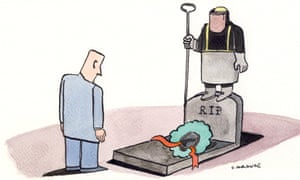
‘Britain is entering the early stages of yet another industrial catastrophe.’ Illustration by Andrzej Krauze


Every so often a society decides which of its citizens really matter. Which ones get the star treatment and the big cash handouts – and which get shoved to the bottom of the pile and penalised. These are the big, rough choices post-crash Britain is making right now.

A new hierarchy is being set in place by David Cameron in budget after austerity budget. Wealthy pensioners: winners. Young would-be homeowners: losers. Millionaires see their taxes cut to 45%, while the working poor pay a marginal tax rate of 80%. Big business gets to write its own tax code; benefit claimants face harsh sanctions.

When the contours of this new social order are easy to spot, they can cause public uproar – as with the cuts to tax credits. Elsewhere, they’re harder to pick out, though still central. It is into this category that the crisis in the British steel industry falls.


Tata Steel confirms 1,200 job losses as industry crisis deepens


It would be easy to tune out the past few weeks’ headlines about plant closures and job losses as just another story of business disaster. But what’s happening to our steelworkers, and what we do to protect them, goes to the heart of the debate about which people – and which places – count in Britain’s political economy.

If Westminster lets the UK’s steel industry die, it’s in effect declaring that certain regions and the people who live and work in them are surplus to requirements. That it really doesn’t matter if Britain makes things. That the phrase “skilled working-class jobs” is now little more than an oxymoron. That’s the criteria against which to judge MPs, as they continue to take evidence today on the crisis and then debate options.

What does this crisis look like? Imagine coming to work on a September morning – only to find that you and one in six other employees in your entire industry face redundancy before Christmas. That’s the prospect facing British steelworkers. Motherwell, Middlesbrough, Scunthorpe: some of the most kicked-about places in de-industrialised Britain now face more punishment.

Mothball the SSI plant in Redcar and it’s not just 2,200 workers that you send to the dole office and whose families you shove on the breadline. An entire local economy goes on life support: the suppliers of parts, the outside engineers who used to do the servicing, the port workers and hauliers, the cafes and shops. Within days of SSI’s closure, one of Teesside’s biggest employment agencies went into liquidation.


‘If Westminster lets the UK’s steel industry die, it’s effectively declaring that certain regions and the people who live and work in them are surplus to requirements.’ Photograph: Nigel Roddis/Reuters

Steel is a fundamental part of manufacturing, so that the closure of a handful of steelworks in Scotland and the north endangers businesses in Derby and Walsall. At the West Midlands Economic Forum, the chief economist Paul Forrest calculates that about 260,000 jobs in the Midlands rely on steel for everything from basic metals to car assembly and aerospace engineering. He believes that the closures at Tata, SSI and Caparo leave 52,000 local manufacturing workers at direct risk of losing their jobs within the next five years. That’s just after the past few weeks – the UK Steel director Gareth Stace thinks that more plants face closure “within months”.

Join up these predictions, and Britain is entering the early stages of yet another industrial catastrophe. It could finally sink a sector, steel, that actually helps reduce the country’s gaping trade deficit. With that will go another pocket of well-paid blue-collar jobs. Chuck in employer contributions to pensions and national insurance, and the total remuneration per SSI staffer is £40,000 a year. Just try getting such pay in a call centre or distribution warehouse, even as a manager.

Imagine what would happen if manufacturing were centred around the capital, and its executives had Downing Street on speed dial. Actually, you needn’t imagine – merely remember the meltdown of 2008. Then Gordon Brown was so desperate to save the City that the IMF estimates he propped it up with £1.2 trillion of public money. That’s the equivalent of nearly £20,000 from every man, woman and child in the country doled out to bankers in direct cash, loans and taxpayer guarantees.

That’s what the state can do when it decides a sector matters. In 2011 David Cameron stormed out of a Brussels summit rather than agree to more regulation on the City. When it comes to steel, his ministers shrug at the difficulties posed by the EU’s state-aid rules. Michael Heseltine even declares this a “good time” for Teesside’s workers to lose their jobs in Britain’s “exciting” labour market. Let them eat benefits!

True, the problems in the steel industry aren’t confined to these shores. They’re driven by a world economy coming off the boil and China dumping its excess steel output on the global market. Yet other European governments are being far more aggressive in confronting them. Italy’s prime minister, Matteo Renzi, bailed out a huge steelworks last December. Germany’s Angela Merkel ensures that steel producers are cushioned from higher energy prices.

Just how lame, by comparison, is Cameron? Here’s an example: the European commission runs a publicly funded globalisation adjustment fund that can grant over £100m a year for precisely the sort of situation British steelworkers now face. The Germans, the French, the Dutch: they’ve all drawn down many millions apiece. The British? European commission officials told me this week that they had never so much as seen an application from the UK. Here’s a giant pot of money – into which Whitehall can’t even be bothered to dip its fingers.

Once our steel capacity is gone, it’s gone – and with it goes a big chunk of what’s left of our manufacturing base. Whole swaths of the country that have only just got off their backs after Thatcher’s de-industrial revolution will be knocked to the floor all over again.

The choice is stark. Westminster can sit on its hands, pretend it can’t do anything about the supposedly free market in steel (in which the single biggest player is the Chinese Communist party), and let tens of thousands of families go to the wall. Or our political class acts as if its job is actually to protect people from market fluctuations – and keep the steel industry afloat by extended bridging loans and capital investment in return for public stakes.

A return to British Leyland? No: a far cheaper and smaller rescue than RBS and HBOS. Free-market fundamentalists will decry this as a wage subsidy to steelworkers. But the alternative is to wind up paying far more in benefits to thousands of unemployed workers and their families. Besides, the state already shells out billions in hidden wage subsidies, through the tax credits and housing benefit that taxpayers give to employees of poverty-pay firms such as Sports Direct and Amazon.

What’s being proposed here is open, transparent support to employees in normally high-paying and high-skilled jobs. To keep a vital industry from disappearing for good. And to show that it’s not just the City that matters.

Why are drugs illegal?


‘To enable Harry Anslinger to keep his army of drug enforcers [the Untouchables], he created a new drug threat, cannabis, which he called marijuana to make it sound more Mexican.’ Photograph: Tomas Rodriguez/Corbis

 David Nutt in The Guardian


This is, of course, a flawed question but one that illustrates a major paradox in the UK and international laws on drugs. Some drugs – such as alcohol, caffeine and nicotine – are legal, whereas others – such as cannabis, cocaine and opium – are not. This has not always been the case.

In the 19th century extracts of these three now-illegal drugs were legal in the UK, and were sold in pharmacies and even corner shops. Queen Victoria’s physician was a great proponent of the value of tincture of cannabis and the monarch is reputed to have used it to counteract the pain of menstrual periods and childbirth. Now it is denied to people with severe enduring spasticity and pain from neurological disorders and cancer. Why?


Activists to get high together in protest against psychoactive substances ban


The truth is unpalatable and goes back to the period of alcohol prohibition in the US in the 1920s. This was introduced as a harm-reduction measure because alcohol was seen (correctly) as a drug that seriously damaged families and children. But public demand for alcohol in the US did not abate and this fuelled a massive rise in bootleg alcohol and underground bars (known as speakeasys) that encouraged the rise of the mafia and other crime syndicates.

To combat this, the US government set up a special army of enforcers, under the command of Harry Anslinger, which became known as “the untouchables”. This army of enforcers was widely celebrated by the newspapers and the acclaim propelled Anslinger to national prominence. However, when public disquiet at the crime and social damage caused by alcohol prohibition led to its repeal, Anslinger saw his position as being in danger.

To enable him to keep his army of drug enforcers, he created a new drug threat: cannabis, which he called marijuana to make it sound more Mexican. Working with a newspaper magnate, William Randolph Hearst, he created hysteria around the impact of cannabis on American youth and proclaimed an invasion of marijuana-smoking Mexican men assaulting white women. The ensuing public anxiety led to the drug being banned. The US then imposed its anti-cannabis stance on other western countries and this was finally imposed on the rest of the world through the first UN convention on narcotic drugs in 1961.


Mexican soldiers burning marijuana, cocaine, heroin and other drugs in Ciudad Juarez, Chihuahua. Photograph: AFP/Getty

This process of vilifying drugs by engendering a fear of the “other people” who use them became a recurring theme in drug policy. Black Americans were stigmatised on account of heroin use in the 1950s. In the 1960s hippies and psychedelics were targeted because they opposed the Vietnam war. In the 1970s it was again inner-city black Americans who used crack cocaine who received the brunt of opprobrium, so much so that the penalties for crack possession were 100 times higher than those for powder cocaine, despite almost equivalent pharmacology. Then came “crystal” (methamphetamine) and the targeting of “poor whites”.

The UK has followed US trends over cannabis, heroin and psychedelics, and led the world in the vilification of MDMA (ecstasy). In the UK a hate campaign against young people behaving differently was instigated by the rightwing press. As with past campaigns, they hid their prejudice under the smokescreen of false health concerns. It was very effective and resulted in both MDMA and raves being banned. This occurred despite the police being largely comfortable with MDMA users since they were friendly – a stark contrast to those at alcohol-fuelled events.


Since the demise of ecstasy we have seen the rise and fall of several alternative legal highs, most notably mephedrone. This was banned following a relentless media campaign, despite no evidence of deaths and with little attempt to properly estimate its harm. Subsequently we have discovered that it saved more lives than it took because so many people switched from cocaine and amphetamine to mephedrone that deaths from these more toxic stimulants decreased by up to 40%. Since mephedrone was banned in 2010, cocaine deaths have risen again and are now above their pre-mephedrone levels.

As young people seek to find legal ways to enjoy altered consciousness without exposing themselves to the addictiveness and toxicity of alcohol or the danger of getting a criminal record, so the newspapers seek to get these ways banned too. Politicians collude as they are subservient to those newspapers that hate youth and they know that the drug-using population is much less likely to vote than the drug-fearing elderly. We have moved to a surreal new world in which the government, through the new psychoactive substances bill, has decided to put an end to the sale of any drug with psychoactive properties, known or yet to be discovered.

This ban is predicated on more media hysteria about legal highs such as nitrous oxide and the “head shops” that sell them. Lies about the number of legal high deaths abound, with Mike Penning, minister for policing and justice, quoting 129 last year in the bill’s second reading. The true figure is about five, as the “head shops” generally now sell safe mild stimulants because they don’t want their regular customers to die.

‘Queen Victoria’s physician was a great proponent of the value of tincture of cannabis, and she is reputed to have used it to counteract the pain of menstrual periods and childbirth.’ Photograph: Alamy


The attack on nitrous oxide is even more peculiar as this gas has been used for pain control for women in childbirth and surgical pain treatments for more than 100 years with minimal evidence of harm. But when a couple of premiership footballers are filmed inhaling a nitrous oxide balloon, then it becomes a public health hazard. In typical fashion the press renamed it “hippy crack” to scare people – what could me more frightening to elderly readers than an invasion of hippies on crack? In truth, the effect of nitrous oxide is nothing like crack and no self-respecting hippy would ever use it. Still, it seems likely it will be banned along with every other mind-altering substance that is not exempted.

The psychoactive substances bill is the most oppressive law in terms of controlling moral behaviour since the Act of Supremacy in 1558 that banned the practice of the Catholic faith. Both are based on a moral superiority that specifies the state will decide on acceptable actions and beliefs even if they don’t affect other people. Worse, it won’t work – evidence from other countries such as Poland and Ireland that have tried such blanket bans shows an increase in deaths as people go back to older illegal drugs such as cocaine and heroin.

Moreover, it may seriously impede research in brain disorders, one of the few scientific areas in which the UK is still world-leading. But hey, who cares about the consequences of laws, so long as the police and the press are appeased?

So the short answer to the question “why are (some) drugs illegal?” is simple. It’s because the editors of powerful newspapers want it that way. They see getting drugs banned as a tangible measure of success, a badge of honour. And behind them the alcohol industry continues secretly to express its opposition to anything that might challenge its monopoly of recreational drug sales. But that’s another story.

To Beef or not to Beef - A Personal View on the Beef Crisis in India

 By Girish Menon


Photo courtesy: Berkeley Graduate School of Journalism


I come from a Hindu family from Kerala. Our diet used to be pre-dominantly vegetarian by tradition and choice, though some men folk indulged in the pleasures of animal flesh whenever they wished to give themselves 'a treat' (usually accompanied by alcohol). I studied in a Catholic school in Mumbai with UP Brahmins as my teachers of Sanskritised Hindi. My first conflict with beef arose when Mr. Tiwari mentioned in class that Hindus do not eat beef while only a few days earlier my father had cooked some beef at home for the two of us to eat.

Historically, beef eating has been used as a primary ritual in the conversion of a Hindu to Islam. I'm not sure if the early Christian missionaries indulged in similar Hindu iconoclasm? Hence, I can understand why banning beef has become a major issue in the first predominantly upper class Hindu Indian government.

In Britain where animal meat is the staple food of most residents there was recently a great display of revulsion when horse meat was found to enter the food supply. Britons have also been critical of the Koreans who love to eat dog meat. And human meat is still frowned upon. Using the market mantra isn't this totalitarian view depriving lovers of unusual meats a chance to improve their own welfare?

In my view, beef will become the next Babri Masjid of modern India. Its ban will be essential for Hindus to prove that they have exorcised yet another ghost from the past (how many more ghosts do they wish to exorcise?). 

So, what will happen to the Taslima's orphaned cows and to beef lovers like me? The orphaned cows will meet the same fate as the Indian poor - who cares!. As for beef loving Hindus like me, I could get a permit to eat beef for health reasons (the Dubai model). For those who cannot afford the high price of a permit, the Gujarat model on alcohol could be also be successfully replicated. Go to the police station for a portion of beef!