Search This Blog

Sunday, 7 June 2015

Please, FBI, investigate the 1966 World Cup – if only to shut up Greg Dyke

Marina Hyde in The Guardian


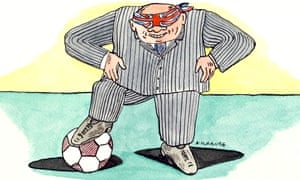
‘There is a huge section of fans – and, clearly, administrators – with absolutely no idea how much England is detested within world football, nor any idea as to why.’ Illustration: Andrzej Krauze

You know when World Cups started being corrupt? 1970. And anything up to and including 1962. Between those dates, there was a brief and ineffably beautiful interregnum in the chicanery, which thereafter was never allowed to happen again. Why? Well, there was a global sense, really, that the sainted custodians of both tournament and trophy during that time were simply too exquisitely mannered, too morally faultless, too humble, too generous-spirited, too brilliant at football ever to be permitted to shame the rest of the world in this manner again.

Did you enjoy that story? If so, you may be Greg Dyke, or have suffered a recent head trauma. Either way, please seek help immediately.

The Fifa scandal erupted a mere 10 days ago, and it took barely two of those for England to make it all about itself. Ooh, you’ve no idea how they treated us during the bid process. Ooh, the main thing about this is that we should be given one of the disputed World Cups. The scale of the FBI takedown of Fifa is vast. England is like a diner in one of the ground-floor restaurants of the Towering Inferno building, wondering how what’s going on upstairs is going to affect its drinks order. Odd how they underplay the fact that England’s bid team gave the wives of the executive committee – their wives! – Mulberry handbags. This isn’t being “above” bribery. It’s being unable to get out of the group stages of bribery.

Already, culture secretary John Whittingdale has announced that England is ready to host the 2022 World Cup, should Qatar be stripped of it. Newsflash, buddy: at their current rate of acquisition of English landmarks, Qatar will already own all our major stadiums and half our infrastructure by 2022, so that’ll be just the sort of pyrrhic two-fingers in which we specialise. Yes, Qatar, you’ll know we’ve really beaten you when England lose to Paraguay in the opening match of the tournament at Liverpool’s Qatar Airways stadium (when you go down the tunnel on to the pitch there’s a spine-tingling sign that reads “THIS IS DOHA”.)

I say “we”, but there is no longer a “we” as far as the Fifa exposé goes. We had a good innings, being all in it together. People who don’t even care for football were remarking how watchable footballing arrests were. The utter insufferability of Sepp Blatter was something we could all get behind, while his victory last Friday was an election result on which we could all agree, so soon after our own one, on which we couldn’t.

But the point-missing parochialism was always in the post, and its arrival marks the end of the cross-party, cross-club, cross-everything love-in that has characterised the Fifa story.

From phone-ins to frontbenches, you now cannot move for Little Englanders telescoping world football down to their concerns. At their notional helm is FA chairman Greg Dyke, who did such a bang-up job dealing with the Hutton inquiry that he’s decided to come and bring that same grasp of nuance to what he presumably imagines to be his moment on the global stage. I suppose the best you can say is that there’s less left to damage with English football than there was with the BBC. But really, there hasn’t been a managerial double whammy like it since André Villas-Boas swept from Chelsea to Tottenham.

Historically, there have been few statements less guaranteed to fill you with confidence than “this is a matter for the FA”. Unless you count something like “this is a matter for the Jockey Club”, whose two-legged overlords were traditionally intellectually outclassed by their four-legged underlings. The competition to be the worst-run British sporting body is always hard fought, but the FA has won the title more than any of the others.

And they look to have another in the bag with their reflexive prejudging of corruption allegations, ill-advised speculation about the FBI investigation, and jingoistic bleats about how unfair it all is. It’s just a marginally more self-regarding version of throwing cafeteria furniture across a city square in a Sun-issue Tommy hat. They are naturally supported by said newspaper, whose Pooterish idea that Sepp Blatter was paying attention to what was in their leader column saw it declare in 2010: “Today the Sun makes this plea to Mr Blatter and Fifa. Don’t be put off by the BBC rehashing ancient history. Despite BBC muck-raking, the Sun trusts Fifa to put football first.”

Even our football-loving prime minister is just another Englishman whose criticism of Fifa is based solely on self-interest, as opposed to principle, and whose pettiness only serves to underscore the global perception that our position on everything is based on sour grapes. Back in 2010, he too criticised the British media for daring to investigate Fifa, while the bid team called it “unpatriotic”. Cameron has spent the past week falsifying his anti-Blatter history while failing to disguise his belief that nicking the 2018 World Cup hosting rights would be the perfect money-shot to his prime ministership.
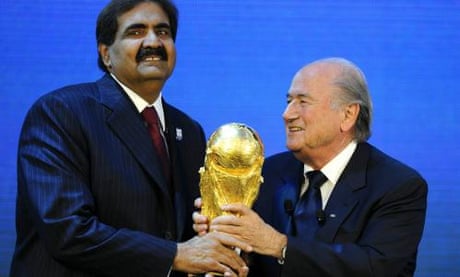


England ready to host 2022 World Cup in place of Qatar, culture secretary says


Consider these powers the perfect spiritual leaders for a tribe whose analogue is probably those Americans who genuinely hadn’t a clue they were even disliked before 9/11. There is a huge section of fans – and, clearly, administrators – with absolutely no idea how much England is detested within world football, nor any idea as to why. And no interest in getting one.

Ideally, each and every one of them would be forced to attend a six-week residential course in which a series of instructors prepared detailed presentations on the matter, which concluded with the rhetorical inquiry: “Do you now understand why everyone thinks we’re just absolutely massive arses?”

Unfortunately, I am told that given the numbers involved this is not a scaleable solution. In which case, just for the merriment, please, please let the FBI open an investigation into how hosting rights for the 1966 World Cup were won. I don’t even care about international law any more, or the increasingly bonkers mission creep which has seen the US announce additional probes into the 2010 and 2014 World Cups, as well the 2018 and 2022 vote, and which will now clearly end in this being the US’s legal equivalent of Nam. I just want someone – anyone – to bring home the realisation that we really are the Ukip of international football. And, increasingly, of international life.


Friday, 5 June 2015

Imran Khan and his defamatory 35 Punctures (Penti Penture) story

Najam Sethi in The Friday Times

Theory of “35 Punctures” Punctured


The Theory of “Penti Pentures” (35 punctures) was supposed to explode with a bang. Instead it has evaporated into thin air without a whimper.
There was no secret tape recording of mine informing Nawaz Sharif that I, as caretaker CM Punjab, had applied “Penti Pentures” (ie rigged 35 seats) to the elections in 2013. Indeed, not one word of “Penti Pentures” was even whispered by the great Hafeez Pirzada (with Imran Khan breathing down his neck) when I was cross-examined before the Judicial Commission last week. What was produced was a clip from my TV show of 7th July 2013 in which I had said that about fifteen days before the end of my tenure as caretaker chief minister Punjab on June 6th 2013, (ie, ten days after the election results were announced on May 11) I had become powerless and the Punjab bureaucracy was already looking to the designated new chief minister. So what was so strange about that, the CJP seemed to imply, when he asked Mr Pirzada to move on.

----Also watch

------
Imran Khan’s unending harangue about Nawaz Sharif “rewarding” me for applying “penti pentures” by appointing me chairman of the Pakistan Cricket Board also fell flat. Indeed, it never went to the point of explicating the substance of the so-called “reward”. How could it? I have not drawn a penny in salary for two years. I have not even taken a luxury vehicle for my personal use. In fact, I have abolished all undue “perks and privileges” that previous chairmen enjoyed, like free First Class International Travel with spouse, a posse of hangers-on, a fleet of expensive rented cars, millions of rupees of free tickets for family, friends and cronies during international cricket events abroad, unlimited entertainment allowances, BoG meetings in holiday resorts, and a score-full of jobs in PCB for sifarishis and family.
The “Penti Penture Theory” was based on idle talk cunningly fabricated by a maverick named Ejaz Hussain who was desperate to worm his way into the top echelons of Khan’s party. A gullible Imran bought into it readily because it suited his political ploy. How could he manufacture a conspiracy theory of Nawaz Sharif stealing the election without challenging the results of the elections in the Punjab that contributed to Mr Sharif”s thumping victory? Hence it was critical to damn my administration. Fourteen months ago, I sued him in court to prove his allegations or pay damages for defaming me. He hasn’t appeared in court once, nor filed a word in response to my complaint. Much the same may be said of his lackeys like Naeem ul Haque and Shirin Mazari who have parroted the same lie ad nauseum, and “journalists” like Dr Shahid Masood who are constantly creeping out of the woodwork. The amusing fact is that only days after the fiasco in the Supreme Court, Naeem blatantly named the source of the “penti penture” story as Agha Murtaza Poya, the veteran politician and ex-owner of The Muslim newspaper, only to be rebuffed by a stout public denial by Mr Poya hours later.
The fact is that I was the caretaker CM nominee of the PPP and its allies. The fact is that the PMLN had fielded two candidates of its own but only acceded in my favour half an hour before the three-day deadline because it realized its nominees would most certainly be adjudged unsuitable by the ECP. The fact is that Imran Khan publicly welcomed my nomination as a consensus caretaker CM in March. The fact is that I refused to accept the nominee of the ECP, Qamaruzaman Chaudhry, as my Chief Secretary because Imran Khan publicly asked me not to appoint him. The fact is that I shunted 15 senior bureaucrats from the Punjab to Islamabad because they were allegedly close to the Sharifs. The fact is that I shuffled the bureaucracy from Patwari to Chief Secretary and SHO to IGP so that none could complain I was biased. The fact is that I retained two senior secretaries whose close relatives were contesting on PTI tickets. The fact is that my Home Minister was on the PTI’s Task Force on Terrorism. The fact is that I even leaned on the Advocate General appointed by Shahbaz Sharif to resign his constitutional position in order to be neutral. The fact is that the only favour I ever did anyone was to Imran Khan when I allowed him to hold rallies in the centre of the small towns on his campaign trail in Southern Punjab, which was contrary to the SOPs of the elections. The PTI accepted the results as free and fair, a fact corroborated by FAFEN and over 100 international observers.
Imran Khan didn’t have the courage to accuse ex-CJP Iftikhar Chaudhy, ex-Justice Khalil Ramday, and GEO/Jang Group in the JC, all co-accused with me in public. Now that his short-cut-to-power bid has failed and been exposed, he should have the courage to apologise to me and stop tarnishing my reputation.

Thursday, 4 June 2015

Now the truth emerges: how the US fuelled the rise of Isis in Syria and Iraq

Seumas Milne in The Guardian

The war on terror, that campaign without end launched 14 years ago by George Bush, is tying itself up in ever more grotesque contortions. On Monday the trial in London of a Swedish man, Bherlin Gildo, accused of terrorism in Syria, collapsed after it became clear British intelligence had been arming the same rebel groups the defendant was charged with supporting.

The prosecution abandoned the case, apparently to avoid embarrassing the intelligence services. The defence argued that going ahead with the trial would have been an “affront to justice” when there was plenty of evidence the British state was itself providing “extensive support” to the armed Syrian opposition.

That didn’t only include the “non-lethal assistance” boasted of by the government (including body armour and military vehicles), but training, logistical support and the secret supply of “arms on a massive scale”. Reports were cited that MI6 had cooperated with the CIA on a “rat line” of arms transfers from Libyan stockpiles to the Syrian rebels in 2012 after the fall of the Gaddafi regime.

Clearly, the absurdity of sending someone to prison for doing what ministers and their security officials were up to themselves became too much. But it’s only the latest of a string of such cases. Less fortunate was a London cab driver Anis Sardar, who was given a life sentence a fortnight earlier for taking part in 2007 in resistance to the occupation of Iraq by US and British forces. Armed opposition to illegal invasion and occupation clearly doesn’t constitute terrorism or murder on most definitions, including the Geneva convention.

But terrorism is now squarely in the eye of the beholder. And nowhere is that more so than in the Middle East, where today’s terrorists are tomorrow’s fighters against tyranny – and allies are enemies – often at the bewildering whim of a western policymaker’s conference call.

For the past year, US, British and other western forces have been back in Iraq, supposedly in the cause of destroying the hyper-sectarian terror group Islamic State (formerly known as al-Qaida in Iraq). This was after Isis overran huge chunks of Iraqi and Syrian territory and proclaimed a self-styled Islamic caliphate.

The campaign isn’t going well. Last month, Isis rolled into the Iraqi city of Ramadi, while on the other side of the now nonexistent border its forces conquered the Syrian town of Palmyra. Al-Qaida’s official franchise, the Nusra Front, has also been making gains in Syria.

Some Iraqis complain that the US sat on its hands while all this was going on. The Americans insist they are trying to avoid civilian casualties, and claim significant successes. Privately, officials say they don’t want to be seen hammering Sunni strongholds in a sectarian war and risk upsetting their Sunni allies in the Gulf.

A revealing light on how we got here has now been shone by a recently declassified secret US intelligence report, written in August 2012, which uncannily predicts – and effectively welcomes – the prospect of a “Salafist principality” in eastern Syria and an al-Qaida-controlled Islamic state in Syria and Iraq. In stark contrast to western claims at the time, the Defense Intelligence Agency document identifies al-Qaida in Iraq (which became Isis) and fellow Salafists as the “major forces driving the insurgency in Syria” – and states that “western countries, the Gulf states and Turkey” were supporting the opposition’s efforts to take control of eastern Syria.

Raising the “possibility of establishing a declared or undeclared Salafist principality”, the Pentagon report goes on, “this is exactly what the supporting powers to the opposition want, in order to isolate the Syrian regime, which is considered the strategic depth of the Shia expansion (Iraq and Iran)”.

Which is pretty well exactly what happened two years later. The report isn’t a policy document. It’s heavily redacted and there are ambiguities in the language. But the implications are clear enough. A year into the Syrian rebellion, the US and its allies weren’t only supporting and arming an opposition they knew to be dominated by extreme sectarian groups; they were prepared to countenance the creation of some sort of “Islamic state” – despite the “grave danger” to Iraq’s unity – as a Sunni buffer to weaken Syria.

That doesn’t mean the US created Isis, of course, though some of its Gulf allies certainly played a role in it – as the US vice-president, Joe Biden, acknowledged last year. But there was no al-Qaida in Iraq until the US and Britain invaded. And the US has certainly exploited the existence of Isis against other forces in the region as part of a wider drive to maintain western control.

The calculus changed when Isis started beheading westerners and posting atrocities online, and the Gulf states are now backing other groups in the Syrian war, such as the Nusra Front. But this US and western habit of playing with jihadi groups, which then come back to bite them, goes back at least to the 1980s war against the Soviet Union in Afghanistan, which fostered the original al-Qaida under CIA tutelage.

It was recalibrated during the occupation of Iraq, when US forces led by General Petraeus sponsored an El Salvador-style dirty war of sectarian death squads to weaken the Iraqi resistance. And it was reprised in 2011 in the Nato-orchestrated war in Libya, where Isis last week took control of Gaddafi’s home town of Sirte.

In reality, US and western policy in the conflagration that is now the Middle East is in the classic mould of imperial divide-and-rule. American forces bomb one set of rebels while backing another in Syria, and mount what are effectively joint military operations with Iran against Isis in Iraq while supporting Saudi Arabia’s military campaign against Iranian-backed Houthi forces in Yemen. However confused US policy may often be, a weak, partitioned Iraq and Syria fit such an approach perfectly.

What’s clear is that Isis and its monstrosities won’t be defeated by the same powers that brought it to Iraq and Syria in the first place, or whose open and covert war-making has fostered it in the years since. Endless western military interventions in the Middle East have brought only destruction and division. It’s the people of the region who can cure this disease – not those who incubated the virus.

Wednesday, 3 June 2015

How a corporate cult captures and destroys our best graduates

George Monbiot in The Guardian

People who had spent the preceding years laying out exultant visions of a better world were suddenly sucked into the mouths of corporations dangling money like angler fish.’ Photograph: Daniel Pudles

To seek enlightenment, intellectual or spiritual; to do good; to love and be loved; to create and to teach: these are the highest purposes of humankind. If there is meaning in life, it lies here.

Those who graduate from the leading universities have more opportunity than most to find such purpose. So why do so many end up in pointless and destructive jobs? Finance, management consultancy, advertising, public relations, lobbying: these and other useless occupations consume thousands of the brightest students. To take such jobs at graduation, as many will in the next few weeks, is to amputate life close to its base.

I watched it happen to my peers. People who had spent the preceding years laying out exultant visions of a better world, of the grand creative projects they planned, of adventure and discovery, were suddenly sucked into the mouths of corporations dangling money like angler fish.

At first they said they would do it for a year or two, “until I pay off my debts”. Soon afterwards they added: “and my mortgage”. Then it became, “I just want to make enough not to worry any more”. A few years later, “I’m doing it for my family”. Now, in middle age, they reply, “What, that? That was just a student fantasy.”

Why did they not escape, when they perceived that they were being dragged away from their dreams? I have come to see the obscene hours some new recruits must work – sometimes 15 or 16 a day – as a form of reorientation, of brainwashing. You are deprived of the time, sleep and energy you need to see past the place into which you have been plunged. You lose your bearings, your attachments to the world you inhabited before, and become immersed in the culture that surrounds you. Two years of this and many are lost for life.

Employment by the City has declined since the financial crash. Among the universities I surveyed with the excellent researcher John Sheil, the proportion of graduates taking jobs in finance and management consultancy ranges from 5% at Edinburgh to 13% at Oxford, 16% at Cambridge, 28% at the London School of Economics and 60% at the London Business School. But to judge by the number of applications and the rigour of the selection process, these businesses still harvest many of the smartest graduates.

Recruitment begins with lovebombing of the kind that cults use. They sponsor sports teams and debating societies, throw parties, offer meals and drinks, send handwritten letters, use student ambassadors to offer friendship and support. They persuade undergraduates that even if they don’t see themselves as consultants or bankers (few do), these jobs are stepping stones to the careers they really want. They make the initial application easy, and respond immediately and enthusiastically to signs of interest. They offer security and recognition when people are most uncertain and fearful about their future. And there’s the flash of the king’s shilling: the paid internships, the golden hellos, the promise of stupendous salaries within a couple of years. Entrapment is a refined science.

We have but one life. However much money we make, we cannot buy it back. As far as self-direction, autonomy and social utility are concerned, many of those who enter these industries and never re-emerge might as well have locked themselves in a cell at graduation. They lost it all with one false step, taken at a unique moment of freedom

.
We have but one life. However much money we make, we cannot buy it back.

John Sheil and I sent questions to eight of the universities with the highest average graduate salaries: Oxford, Cambridge, Imperial, the LSE, the London Business School, Warwick, Sheffield and Edinburgh. We asked whether they seek to counter these lavish recruitment drives and defend students from the love blitz. With one remarkable exception, their responses ranged from feeble to dismal. Most offered no evidence of any prior interest in these questions. Where we expected deep deliberation to have taken place, we found instead an intellectual vacuum.

They cited their duty of impartiality, which, they believe, prevents them from seeking to influence students’ choices, and explained that there were plenty of other careers on offer. But they appear to have confused impartiality with passivity. Passivity in the face of unequal forces is anything but impartial. Impartiality demands an active attempt to create balance, to resist power, to tell the dark side of the celestial tale being pummelled into the minds of undergraduates by the richest City cults.

Oxford University asked us, “isn’t it preferable that [the City] recruits bright, critical thinkers and socially engaged graduates who are smart enough to hold their employers to account when possible?”. Oh blimey. This is a version ofthe most desperate excuse my college friends attempted: “I’ll reform them from within.” This magical thinking betrays a profound misconception about the nature and purpose of such employers.

They respond to profit, the regulatory environment, the demands of shareholders, not to the consciences of their staff. We all know how they treat whistleblowers. Why should “bright, critical thinkers and socially engaged graduates” be dispatched on this kamikaze mission? I believe these universities are failing in their duty of care.
 
The hero of this story is Gordon Chesterman, head of the careers service at Cambridge, and the only person we spoke to who appears to have given some thought to these questions. He told me his service tries to counter the influence of the richest employers.

It sends out regular emails telling students “if you don’t want to become a banker, you’re not a failure”, and runs an event called “But I don’t want to work in the City”. It imposes a fee on rich recruiters and uses the money to pay the train fares of nonprofits. He expressed anger about being forced by the government to provide data on graduate starting salaries.

“I think it’s a very blunt and inappropriate means [of comparison], that rings alarm bells in my mind.”

Elsewhere, at this vulnerable, mutable, pivotal moment, undergraduates must rely on their own wavering resolve to resist peer pressure, the herd instinct, the allure of money, flattery, prestige and security.

Students, rebel against these soul-suckers! Follow your dreams, however hard it may be, however uncertain success might seem.