Search This Blog

Friday, 7 November 2014

The British government is leading a gunpowder plot against democracy


This bill of corporate rights threatens to blow the sovereignty of parliament unless it can be stopped

Illustration by Sébastien Thibault
On this day a year ago, I was in despair. A dark cloud was rising over the Atlantic, threatening to blot out some of the freedoms our ancestors lost their lives to secure. The ability of parliaments on both sides of the ocean to legislate on behalf of their people was at risk from an astonishing treaty that would grant corporations special powers to sue governments. I could not see a way of stopping it.
Almost no one had heard of the Transatlantic Trade and Investment Partnership (TTIP) between the EU and the US, except those who were quietly negotiating it. And I suspected that almost no one ever would. Even the name seemed perfectly designed to repel public interest. I wrote about it for one reason: to be able to tell my children that I had not done nothing.
To my amazement, the article went viral. As a result of the public reaction and the involvement of remarkable campaigners, the European commission and the British government responded. The Stop TTIP petition now carries more than 750,000 signatures; the 38 Degrees petition has 910,000. Last month there were 450 protest actions across 24 member states. The commission was forced to hold a public consultation about the most controversial aspect, and 150,000 people responded. Never let it be said that people cannot engage with complex issues.
Nothing has yet been won. Corporations and governments – led by the UK – are mobilising to thwart this uprising. But their position slips a little every month. When the British minister responsible at the time, Ken Clarke, responded to my first articles, he insisted that “nothing could be more foolish” than making the European negotiating position public, as I’d proposed. But last month the commission was obliged to do just this. It’s beginning to look as if the fight against TTIP could become a historic victory for people against corporate power.
The central problem is what the negotiators call investor-state dispute settlement (ISDS). The treaty would allow corporations to sue governments before an arbitration panel composed of corporate lawyers, at which other people have no representation, and which is not subject to judicial review.
Already, thanks to the insertion of ISDS into much smaller trade treaties, big business is engaged in an orgy of litigation, whose purpose is to strike down any law that might impinge on its anticipated future profits. The tobacco firm Philip Morris is suing governments in Uruguay and Australia for trying to discourage people from smoking. The oil firm Occidental was awarded $2.3bn in compensation from Ecuador, which terminated the company’s drilling concession in the Amazon after finding that Occidental had broken Ecuadorean law. The Swedish company Vattenfall is suing the German government for shutting down nuclear power. An Australian firm is suing El Salvador’s government for $300m for refusing permission for a goldmine over concerns it would poison the drinking water.
The same mechanism, under TTIP, could be used to prevent UK governments from reversing the privatisation of the railways and the NHS, or from defending public health and the natural world against corporate greed. The corporate lawyers who sit on these panels are beholden only to the companies whose cases they adjudicate, who at other times are their employers.
As one of these people commented: “When I wake up at night and think about arbitration, it never ceases to amaze me that sovereign states have agreed to investment arbitration at all … Three private individuals are entrusted with the power to review, without any restriction or appeal procedure, all actions of the government, all decisions of the courts, and all laws and regulations emanating from parliament.”
So outrageous is this arrangement that even the Economist, usually the champion of corporate power and trade treaties, has now come out against it. It calls investor-state dispute settlement “a way to let multinational companies get rich at the expense of ordinary people”.
When David Cameron and the corporate press launched their campaign against the candidacy of Jean-Claude Juncker for president of the European commission, they claimed that he threatened British sovereignty. It was a perfect inversion of reality. Juncker, seeing the way the public debate was going, promised in his manifesto that “I will not sacrifice Europe’s safety, health, social and data protection standards … on the altar of free trade … Nor will I accept that the jurisdiction of courts in the EU member states is limited by special regimes for investor disputes.” Juncker’s crime was that he had pledged not to give away as much of our sovereignty to corporate lawyers as Cameron and the media barons demanded.
Juncker is now coming under extreme pressure. Last month 14 states wrote to him, privately and without consulting their parliaments, demanding the inclusion of ISDS (the letter was leaked a few days ago). And who is leading this campaign? The British government. It’s hard to get your head around the duplicity involved. While claiming to be so exercised about our sovereignty that it is prepared to leave the EU, our government is secretly insisting that the European commission slaughter our sovereignty on behalf of corporate profits. Cameron is leading a gunpowder plot against democracy.
He and his ministers have failed to answer the howlingly obvious question: what’s wrong with the courts? If corporations want to sue governments, they already have a right to do so, through the courts, like anyone else. It’s not as if, with their vast budgets, they are disadvantaged in this arena. Why should they be allowed to use a separate legal system, to which the rest of us have no access? What happened to the principle of equality before the law?
If our courts are fit to deprive citizens of their liberty, why are they unfit to deprive corporations of anticipated future profits? Let’s not hear another word from the defenders of TTIP until they have answered this question.
It cannot be ducked for much longer. Unlike previous treaties, this one is being dragged by campaigners into the open, where its justifications shrivel on exposure to the light. There’s a tough struggle to come, and the outcome is by no means certain, but my sense is that we will win.
Thursday, 6 November 2014

Nehru and Indira laid down principles of secularism and nationalism that today’s politicians can’t ignore

Vinod Mehta in The Times of India
It is open season on Jawaharlal Nehru and Indira Gandhi. No opportunity is lost to demonise and denigrate father and daughter. Even October 31, the day the lady was assassinated, became a day-long festival for celebrating her wickedness, besides proclaiming she was no martyr but a case of self-destruction. Fortunately, we are told, a set of rulers, or shall i say ruler, is at hand, with the wisdom and vision to repair the damage.
We need to talk about Jawaharlal and Indira. That’s for sure. But we also need to keep some touch with historical veracity. For their lifelong opponents truth lies in the eye of the beholder. Consequently, 2014 onwards provides an excellent window to demolish once and for all the myth about their contribution to nation-building. What they built, so the argument goes, is their family dynasty.
Party politics can and is used to float falsehoods with the help of state power. Witness how the fable concerning our glorious Vedic past is being represented triumphantly (in which allegedly plastic surgery and stem cell research flourished) without a murmur of incredulity, or a titter of mirth. If truth is the first casualty in war, it is the second casualty in times when, as Lawrence Durrell puts it, “truth is what contradicts itself”.
The systematic and organised campaign to vilify the Nehru legacy and replace it with the more ‘muscular and patriotic’ legacy of Sardar Patel is top of the agenda. The exercise is ludicrous and an insult to the great Sardar. But let us leave that falsehood alone for the moment.
At the heart of the demolition project is the announcement that a new Idea of India, contrary to the one proposed by Nehru, is available, and in need of urgent execution. It is an abiding irony that the sole politician in the current pantheon of saffron leaders the present prime minister pays obeisance to is Atal Bihari Vajpayee, who ruled the country with Nehru as his lodestar.
What is this new Idea of India? I think we should be told. Alas, its architects have provided no blueprint except to declare it exists. If i were say Mani Shankar Aiyar, i would argue it consists of one part jingoism and one part xenophobia. Perhaps that is a slight exaggeration. More accurately, it rejects the legendary poet Raghupati Sahay aka Firaq Gorakhpuri’s thesis, “Sar zamiin-e hind par aqwaam-e alam ke Firaq/ Kaafile baste gae, Hindustan bantaa gayaa”. (In the sacred land of Hind, caravans of the world Firaq went on settling, and Hindustan kept on being formed.)
If one takes the short view of history, Nehru is an easy target, and Indira even easier. To compile a list of ‘sins’ the duo committed would be superfluous since the compilation has already been lovingly done by the Sangh Parivar. Many of the sins are not without basis but they are not black and white either, except the Emergency. They were committed at a specific moment in history. Happily, we have access to material which provides us with full, balanced assessments – warts and all. We are therefore neither astonished nor shocked when these transgressions are presented. No verdict on Nehru or Indira is possible without its share of criticism.
Perhaps this is the right time to ask the hunters looking for two prized scalps some questions. Where did Narayana Murthy and the entire information technology industry come from? Where did Indra Nooyi come from? Where did Warren Buffett’s financial wizard, Ajit Jain, come from? They all came from the IITs, IIMs and other world-class education centres Nehru had the foresight to set up.
If India has the ‘bomb’ and internationally renowned research labs, the credit must go to the same man. At a time when the republic struggled, he insisted a newly independent, backward nation be fully engaged with the contemporary first world through advanced learning and progressive thinking. Nehru ensured a society steeped in superstition, ritual, religious dogma and belief in kismet embraced a scientific temper so that the temptation to wallow in a mythical ‘glorious’ past could be resisted. The modern nation state – outward-looking, open, rational, argumentative, sceptical – armed with universal adult franchise, is the creation of Jawaharlal Nehru. Rubbish that if you like.
I yield to no one in my abhorrence for aspects of Indira Gandhi’s prime ministership. Because i entered journalism in 1974, i experienced the full horrors of civilian dictatorship. That she wrecked critical democratic institutions is undeniable. But we must also remember she dismembered Pakistan and made sure it could never pose a threat. There is a good Indira and a bad Indira.
Incidentally, when i read opinion polls reveal she is easily the most popular prime minister the country has produced, when i see long queues outside her Safdarjung Memorial, I wonder if our Iron Lady needs more than one yardstick (Emergency) to assess her term in office.
If Nehru’s legacy is the real obstacle holding India back, why don’t its adversaries throw it into the wastepaper basket? And govern on the majoritarian doctrine? Not a chance. When it comes to self-preservation, the new rulers are wise. They know they would soon be out of a job, if they abandoned the idea (secularism) which has held the country together.

Tuesday, 4 November 2014

DWP orders man to work without pay for company that made him redundant


John McArthur is sanctioned by jobcentre after refusing ‘forced labour’ at firm where he was previously paid minimum wage
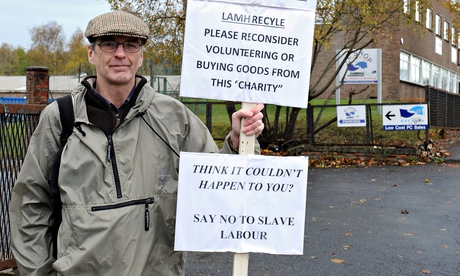
John McArthur makes his one-man protest outside LAMH in Motherwell
John McArthur makes his one-man protest outside LAMH in Motherwell after having his jobseeker’s allowance cut. Photograph: Alan Watson/HE Media/South West News

 man who was let go at the end of a temporary job has been ordered by the Department for Work and Pensions (DWP) to work for the same firm for six months without pay.
Electronics specialist John McArthur, now unemployed, says he is living off 16p tins of spaghetti and without heating after being sanctioned by a jobcentre for refusing to work unpaid for LAMH Recycle in Motherwell, a Scottish social enterprise.
He says he was happy to work for LAMH under the now-defunct future jobs fund for the minimum wage in 2010-2011, but refuses on principle to do the same job unpaid.
McArthur, 59, says he is surviving on a monthly pension of £149 after the DWP stopped his unemployment benefit until January as punishment for his refusal to go on the 26-week community work placement (CWP).
For almost three months, McArthur has spent two hours each weekday morning parading outside the plant wearing a placard reading: “Say no to slave labour”.
“It was simply a case of: ‘Go here, work for nothing and if you don’t we’ll stop your subsistence level benefit,’” he said.
McArthur, who says he has been applying for 50 jobs a week without joy, said the CWP programme was “entirely exploitative” and came at the “expense of poor people who’ve got absolutely no choice”. He added: “They [the government] deny it’s forced labour, that you can say no, but forced doesn’t always mean physical, it can be psychological or economic.
“The person who is trying to survive already on subsistence level welfare has absolutely no choice in the matter … especially if they’ve got young children to look after.”
LAMH confirmed it has 16 people working for six months without pay under CWP but added that since the end of June, six had progressed into paid employment.
The social enterprise, which repairs computers and recycles tin and cardboard, says it helps dozens of people each year who are long-term unemployed, many of whom have health issues.
Joe Fulton, the operations and development manager, said he believed the scheme “worked for people who want to make it work for them”. He added that out of the organisation’s paid workforce of 39, 25 had previously been unemployed.
McArthur said there were no jobs for someone his age in the Lanarkshire area. He said support for his placard demonstration had been overwhelming and just one person had objected.
Following conversations with local councillors, North Lanarkshire council passed a motion in October strongly objecting to forced employment schemes saying it would not get involved itself. “This council will not provide jobs or placements without pay as a condition of receiving benefits unless it is truly voluntary,” the motion read.
“We do not support any mandation of unemployed people to work without pay that puts their benefits at risk.”
The motion added such measures were ineffective and could “further stigmatise and demotivate” the unemployed in their search for work.
Last Wednesday, the DWP continued to battle the information commissioner and hostile court judgments ordering it to reveal where possibly hundreds of thousands of people are being sent to work without pay, sometimes for months at a time.
At the tribunal, the DWP argued that if the public knew exactly where people were being sent on placements political protests would increase, which was likely to lead to the collapse of several employment schemes and undermine the government’s economic interests.
The DWP confirmed some of the UK’s biggest charities, including the British Heart Foundation, Scope, Banardo’s, Sue Ryder, and Marie Curie had withdrawn from the CWP scheme, causing a significant loss of placements.
Giving evidence, senior civil servant Jennifer Bradley confirmed that numerous charities and businesses were receiving cash payments as an incentive to take on the unemployed.
She said several DWP schemes used mandatory unpaid work as a tool to help people but stressed that it was written into the terms that charities and businesses could not use people out of work to replace their paid workforce.
The DWP said it could not comment on individual cases but added that community work placements “help long-term unemployed people to gain work experience which increases their confidence, helps them to gain vital skills and crucially, improves their chances of getting a job.
“We are not naming the charities and community groups involved in the scheme in order to protect them from those who seem intent on stopping us helping people into work.”

Monday, 3 November 2014

Keith Miller lived his life and played his cricket king-size


Ashley Mallett
November 3, 2014
 

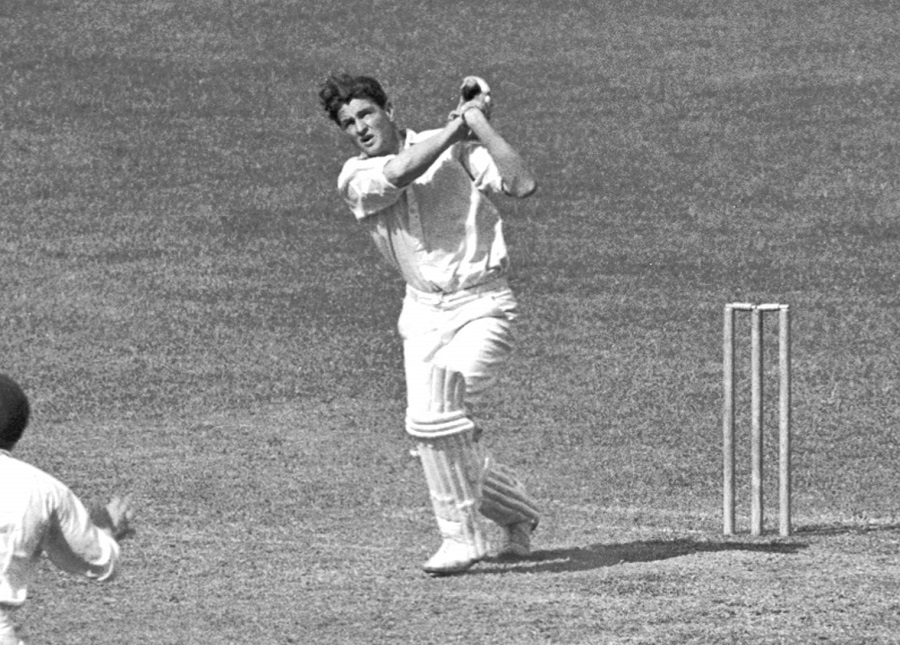
Keith Miller on his way to a hundred in one of the Victory Tests at Lord's © PA Photos

Arguably Keith Miller was cricket's greatest swashbuckler. Larger than life, he leapt straight at you from the pages of Boy's Own Paper.
He was born in November 1919, named after airmen brothers Keith and Ross Smith, who were creating world aviation history with their first epic flight from England to Australia. He never lost his stamina or zest for life. Miller whacked sixes, backed horses, had film-star looks, bowled bouncers, caught blinders and attracted beauties.
He flew night missions over Germany and Occupied France in his Mosquito, bombing and strafing Nazi rocket bases. The stories from his war days are legion.
Michael Parkinson quizzed him about the pressure in the Test arena once. "Pressure?" Miller asked, "There's no pressure in Test cricket. Real pressure is when you are flying a Mosquito with a Messerschmitt up your arse!"
Flight Lieutenant Miller's love of classical music compelled him on one mission to turn his Mosquito back to the war zone. Taking a slight detour, he flew over Bonn, Beethoven's birthplace.
One day at Great Massingham, Norfolk, Miller fought to control his plane as he came in to land. The starboard engine was spurting flame and Miller crash-landed the ailing aircraft, which lost its tail on impact with the ground.
Miller once flew up the straight at Royal Ascot one clear Saturday afternoon and another day he buzzed the Goodwood track. His commanding officer gave Miller a dressing down, calling him an "utter disgrace to the air force".
How the worm turned.
During the Australian team's tour of England in 1953, Miller, resplendent in top hat and tails, drove to Royal Ascot in a gleaming Rolls Royce. As he drove into the car park he noticed that the attendant was none other than his old RAF Commanding Officer. Miller stepped from his vehicle and, pretending not to have recognised his ex-CO, said in his best official voice, "Ah, my good fellow. Park my Rolls in the shade, will you? That's a good chap."
A week or two earlier Lindsay Hassett's Australians had visited Buckingham Palace. Miller was rumoured to have been friendly with Princess Margaret, and when he emerged from the bus he began to wander from the vehicle and headed towards a distant building.
"Nugget, where are you going?" Hassett asked.
"Oh, it's okay, skipper. I know of another entrance here," came the reply.
For much of the war, Miller was based near Bournemouth. Every Friday night it became tradition for Miller and his mates from the RAF base to meet at the Carlton Hotel in Bournemouth. One fateful Friday night, Miller couldn't make the regular appointment and when he returned he found the town barricaded after a German raid. A Focke-Wulf fighter bomber had strafed the church next to the hotel, causing the church spire to collapse directly on to the front bar, instantly killing his eight mates. Each year for more than 50 years Miller returned to England and spent time with a relative of each of his mates killed that tragic night in 1943.
Miller's attacking batting and brilliant fast bowling made an instant impact in world cricket when he impressed as an allrounder in the Victory Tests in 1945. He scored 514 runs in the series, including a brilliant 185 at Lord's, where he hit Eric Hollies for seven sixes, one of the hits crashing into the top of the Lord's pavilion.

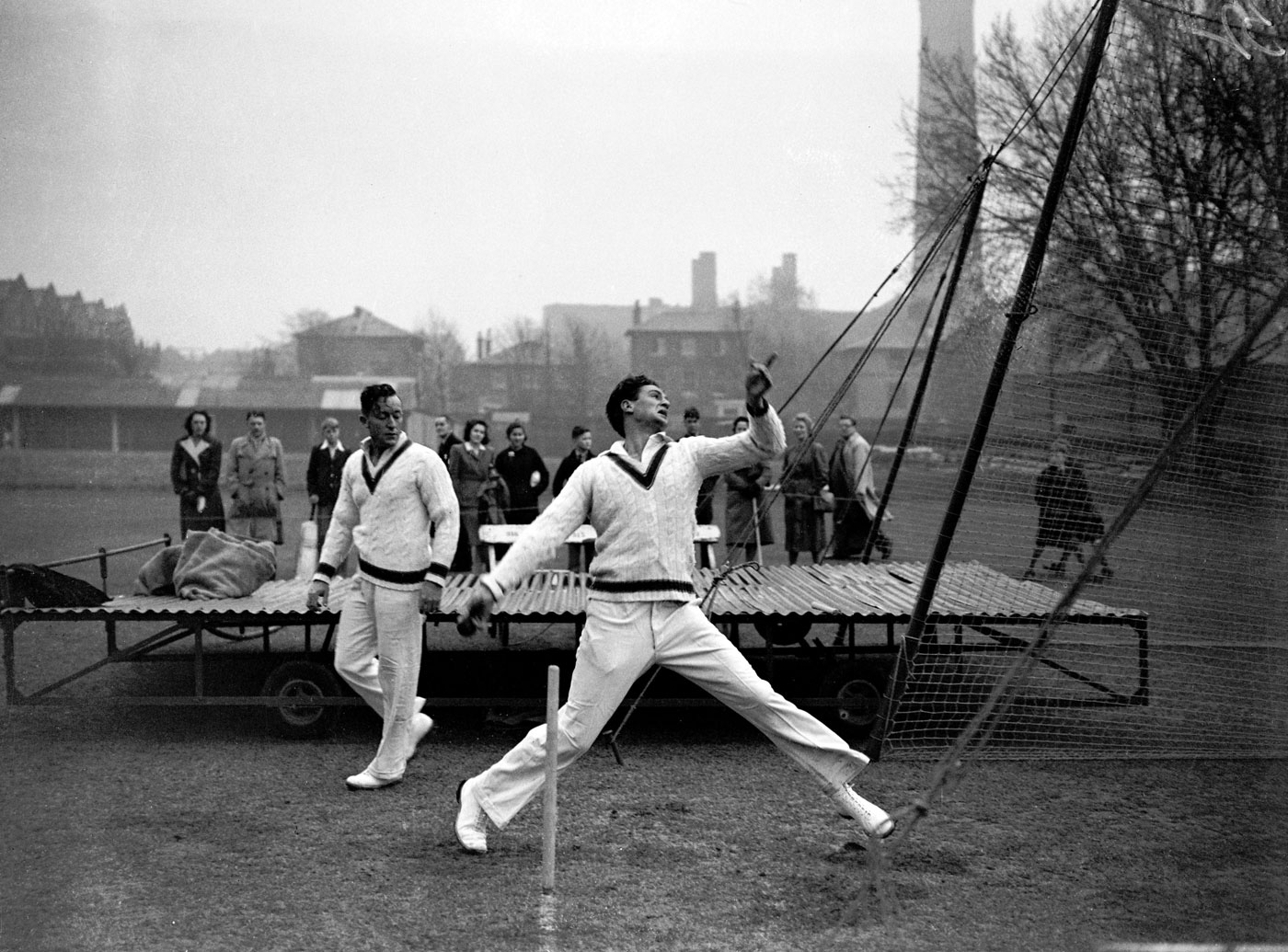
Miller bowls in the nets at Lord's in 1948 © PA Photos
John Arlott once wrote that Miller seemed to be "busy living life in case he ran out of it". Miller found a classical-music soulmate in Neville Cardus and had an equally good rapport with the great conductor Sir John Barbirolli.
Miller never captained Australia but he did lead New South Wales with distinction in the 1950s. Richie Benaud regards Miller as the best captain "never to have captained his country", for the way he led by instinct and by example.
In November 1955, Miller's New South Wales struggled to 215 for 8 on the first day of a Sheffield Shield match against South Australia. At stumps Miller declared the innings closed and then partied long and hard to celebrate the birth of his first child. His NSW team-mates were already on the ground when Miller arrived the next morning, so he hurriedly tossed on his cricket gear, his bootlaces trailing as he wandered onto the ground. When he focused his bleary eyes on the wicket, they opened wide, for the wicket was green as a tree frog.
Left-arm paceman Alan Davidson had already measured out his 15-paced approach and was eager to bowl the first ball. He was standing at the top of his mark when Miller approached.
"Ahem, now Davo, I think you can do a job for us today," Miller said before turning his back and walking down towards the stumps and the beginning of the green pitch. He stopped, turned around and waved to Davidson. "Ah Davo, try the other end, I'll have a go here."
Within a few overs South Australia were dismissed for 27. Miller took a career-best 7 for 12. Davidson didn't get a bowl.
As NSW captain, Miller's legend grew. Once, someone alerted him to the fact that there were 12 men on the field. "It seems we have too many men out here," Miller said. "Will one of you blokes piss off?"
In 55 Tests between 1946 and 1956, he took 170 wickets at 22.97 and scored 2958 runs at 36.97. He also pulled off some wonderful catches in the slips. He was agile, some said he possessed lightning reflexes and moved swiftly and gracefully, like a panther.

In 1969 I was invited by the NSW Cricket Association to take part in making a coaching film. The event was sponsored by the Rothmans Sports Foundation. I was rapt at getting the chance to spend time in the company of Alan Davidson and Keith Miller. Each of us was required to bowl a couple of balls at a set of stumps on the SCG No. 2 Ground.
Miller borrowed some gear and as he walked past me, he said, "Ahem, I'll pitch leg and hit off." He did not measure out his run. He simply wandered back a few paces, turned and began his approach. Despite being 50, not having bowled a ball in a decade, he moved in with the grace and power of a finely tuned racehorse. The ball left his hand seam up. It came from a fair height, for Miller stayed "tall" throughout and the ball pitched on the line of leg stump and hit the top of off. He bowled three balls and two of his deliveries pitched leg and hit off. Then he walked away. It was the most amazing thing I've seen in cricket.
Benaud once confessed to Miller: "You know, Keith, I wish I had been given the chance to bowl to Don Bradman. I came into the side just too late." Miller coughed and replied, "Ahem, Richie, my boy, your not having to bowl to Bradman was your one lucky break in cricket."

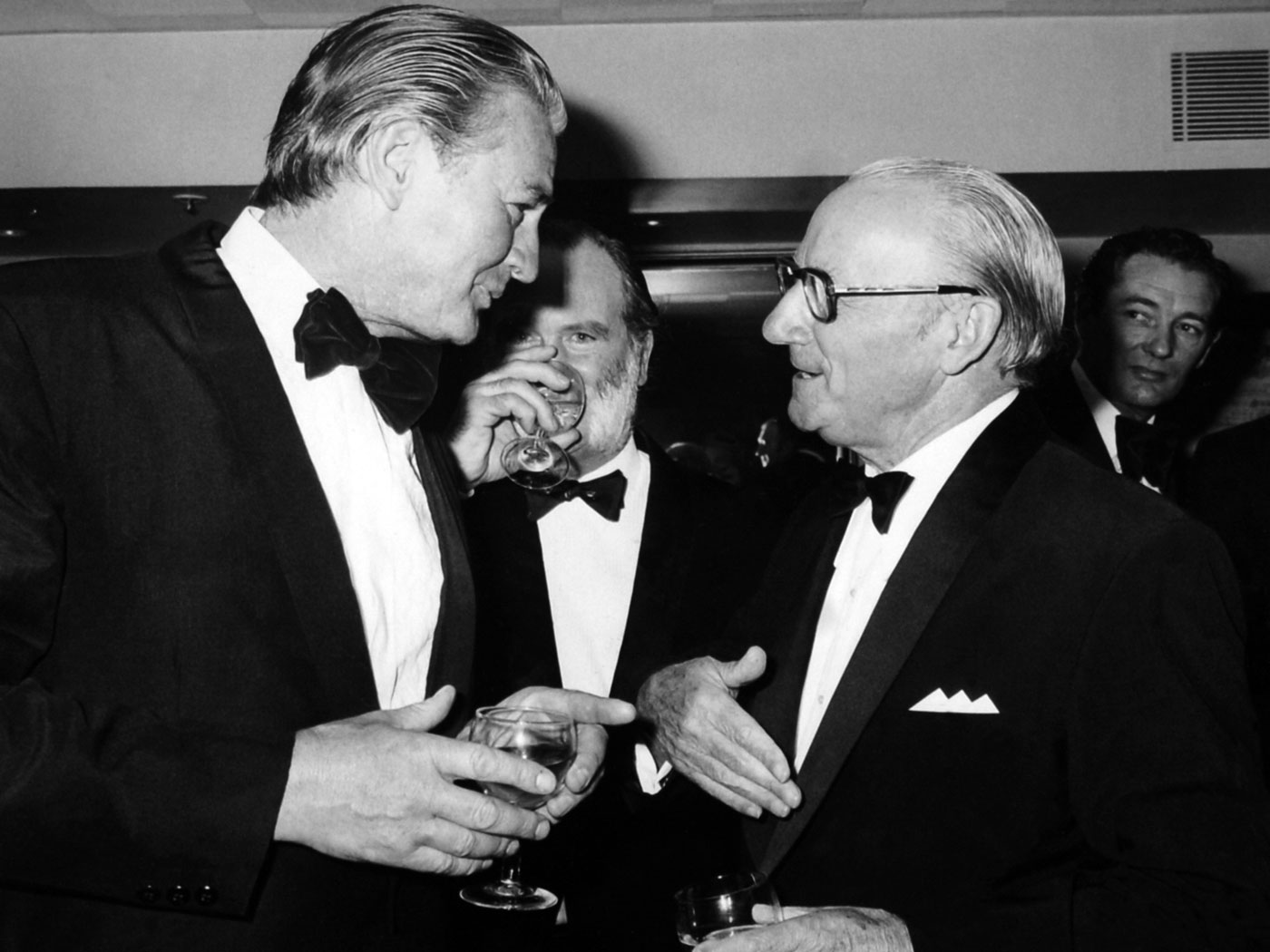
Miller and Bradman chat during a charity event in London in 1974 © PA Photos
Len Hutton, one of the greatest England batsmen of all time, always found Miller a handful. "He'd just as likely bowl me a slow wrong'un first ball of a Test match as he would an outswinger or a searing bouncer," Sir Len told me in Adelaide in 1984. "Keith was the greatest bowler I ever faced in Test cricket."
Miller admired Hutton's cricket too, and when I once pressed him about the relative merits of Hutton and Geoff Boycott's batting, Miller said: "Both were fine players. Hutton had a far greater range of attacking strokes, but defensively I reckon they were pretty much on a par." He then looked at me and smiled, "But for heaven's sake, don't tell Boycott!"
Miller greatly admired the skill of Bradman, but he didn't quite know how great the Don was until he bowled to him in a match after his retirement. "I decided to bowl a few short ones, "just to test his reflexes," Miller said. "First one was a medium-fast bouncer. It didn't get up too far, but Don was swiftly into position and he smashed it like a rocket past mid-on.
"Fast bowlers don't like that treatment, so I charged in for the next ball and gave it my all. It was a tremendous bumper, straight at his head, but he simply swung into position and cracked it forward of square, almost decapitating Sam Loxton on its way to the fence. If Bradman was 'better' in the 1930s he must have been some player."
So too Keith Ross Miller, Australia's greatest allrounder.