Search This Blog

Sunday, 10 January 2016

How much inequality is too much?

BBC Business

Sacks of money on scalesImage copyrightiStock
The richest 10% of Americans earn half of all of income. In Britain, the top 10% hold 40% of all the income.
Inequality isn't just an issue for rich countries: a billion people have been lifted out of poverty since 1990, but inequality has also been rising in many countries too.
Four experts talk to the BBC World Service Inquiry programme about the effect inequality has on growth and prosperity.

Deirdre McCloskey: Capitalism is not the enemy

Deirdre McCloskey is Distinguished Professor of Economics, History, English, and Communication at the University of Illinois at Chicago. The daughter of a Harvard Professor, her brother became a university cleaner.
"You can't force people to take advantages that are placed in front of their nose, and that's my brother's case. No amount of income redistribution or socialist schemes to give my brother more opportunities would have made any difference at all to his life.
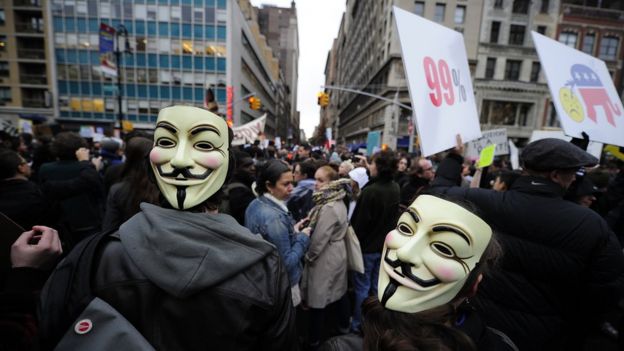
Occupy Wall Street protestors in New YorkImage copyrightGetty Images
Image captionOccupy protesters have highlighted the gap between the wealthiest 1% and the other 99%
"If people strive, some of them succeed and get rich, at least momentarily until other people strive and compete with them. This striving turns out to be good for all of us.
"The percentage of people in the world living on $2 (£1.30) a day - an appalling level of income - has halved in the last 30 years. That's not by foreign aid or redistribution. It's by letting the economy function in a more innovative way.
"The wrong way to cure inequality is to attack the people who are taller, or have better parents, or live in richer countries. The way to do it is to uplift the poor. I approve of being taxed to help the very poor. But I don't want to kill the goose that laid the golden eggs. Capitalism is not the problem, it's the solution.
"The growth in the last couple of centuries has been astounding. It's a factor of 30 - about 3,000% per head for the average English or American person. Explosive, unprecedented growth. Meanwhile, inequality has gone up and down a little bit.
"If you were to make a rule that the chief executive could only earn 50 times the shop floor employee, that would not reduce inequality substantially.
"I'm very relaxed about [inequality] as long as it's not force or fraud that caused it."

Jared Bernstein: Inequality impedes growth

Jared Bernstein is a senior fellow at the Center on Budget and Policy Priorities in Washington DC, and a former economic advisor to President Obama.
"I was a member of the President's economics team during the worst recession we've had since the Great Depression. The responsibility to try to turn that around was huge.
"This wedge of inequality between growth and the income of working families undermines the basic incentive that hard work will be rewarded.

A repossessed house in Stockton, CaliforniaImage copyrightGetty Images
"I call it the shampoo cycle - bubble, bust, repeat. And because middle and low income families lack the income growth they used to see, they borrow to make the difference. That creates large leverage bubbles which explode and hurt growth.
"Once wage inequality gets too high, and you have lots of low income people stuck in tough neighbourhoods that are segregated by income and race, and they have fewer libraries and a more difficult learning environment, you begin to see this connection between high levels of inequality and barriers to opportunity.
"You don't necessarily see that in today's economy because that's a cumulative process, but it's very possible that we'll see that in economies 20 years from now when these children come into the job market.
"If you go back to the period where productivity and incomes for middle class families were growing together - in the US that would be back to the mid 1970s - you'll see that the top 1% held about 10% of all income.
"Now it's 20 times that. That's too much. I'm not saying we necessarily have to get back to the late 1970s level, but I do think that a good metric here would be that the income of middle income families would grow closer to the rate of productivity growth, and that's something that we haven't seen for a while."

Jonathan Ostry: Opportunity more important than inequality

Jonathan Ostry is deputy director of the Research Department of the International Monetary Fund.
"We don't have a threshold level for how much inequality is too much. We don't have a magic number. Sometimes a rise in inequality is perfectly compatible with healthy growth and prosperity, and in other cases the rise has gone way too far.
"When China opened up, it not only took off in terms of economic growth, but there was a marked and quite significant increase in income inequality. I'd be prepared to venture that was a good increase in inequality. Sometimes you need to have a little bit more inequality in order to get growth going as part of deregulating of your economy.
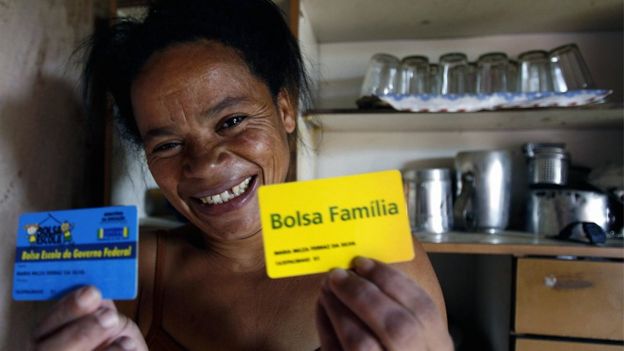
A woman holds her Bolsa Familia cardImage copyrightGetty Images
Image captionThe Bolsa Familia programme to tackle poverty was a centrepiece of former Brazilian President Lula's social policy
"Think of the very high levels of inequality that prevailed in Brazil when President Lula came to office, and the steps he took with the Bolsa Familia conditional cash transfer programmes. His policies were successful without jeopardising economic growth.
"I would want to be sure that in a country with a lot of inequality those at the bottom still had opportunities to be well-educated, to have adequate nutrition, and were not shut out from credit and banks. Likewise if there was a fair degree of equality, but nevertheless those at the bottom didn't have adequate opportunities, I'd be concerned.
"So for me it would be more a question of whether there were adequate opportunities for the less well-off in society. Provided that was the case I wouldn't be overly concerned that a given level of inequality was causing great harm.
"[However] it turns out that income equality is an important factor in separating countries that have been successful at sustaining growth for long periods, versus those that have enjoyed spurts of growth which have fizzled out rather quickly. Too much inequality can undercut the ability to sustain growth.
"In more equal societies, those that are more socially cohesive, governments are able to take measures that have buy-in from the population at large. Therefore they can right their economies more quickly.
"In more unequal, less socially cohesive societies, people don't buy the notion that if the economic ship is righted, everyone will benefit. They're more likely to oppose the painful short-term measures that governments need to take to right the economic ship. And so righting that ship becomes much more difficult in less equal societies."

Branko Milanovic: Beware rising inequality within countries

Professor Branko Milanovic has spent his career studying inequality, and is now a visiting professor at the City University of New York.
"We need inequality. Perfect equality, everybody having the same income, doesn't exist anywhere, nor has it. Obviously some countries - maybe China during the cultural revolution - came relatively close, but some inequality has always existed.
"Without inequality you lack incentives to do practically anything - to work, to invent new things or to invest. Nobody is going to do things for nothing and we know that monetary rewards are really crucial, so this is the good part of inequality. We should not forget that inequality is indispensible for the development of a society.
"Globalisation has been very good for the middle classes in the emerging markets - China in particular, parts of India, Thailand, Indonesia. They are still not level in terms of income with the middle class in the rich world, but it's improving, On the other hand, we have essentially a stagnation of middle class incomes in rich countries, a very interesting and a potentially politically destabilising development.
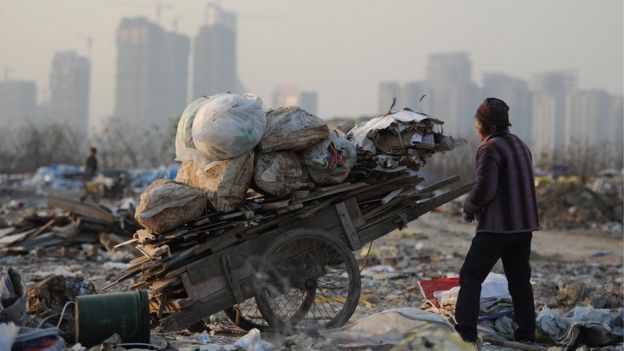
A man collects rubbish from a construction site in Hefei, central China's Anhui provinceImage copyrightGetty Images
Image captionThe economic disparity between the wealthiest and poorest in China is stark
"If the gaps keep on increasing as they've increased in the last 20 years, you would end up with two types of societies within a single country. If there is no sufficient middle class and if the poor really are very far from the rich, then you really cannot speak of a single society.
"We could end up with a kind of a global plutocracy, this global one per cent or even half a per cent that are very similar among themselves, but really belong to different nations.
"We might have a situation that most of global inequality is due to inequalities within nations which was more or less the situation 200 years ago. So we may be really going back to the situation that existed before the industrial revolution."
Two-thirds of Tory MPs want Britain to quit European Union

Toby Helm and Henry McDonald in The Guardian


Party sources say Brexit support is rising – despite David Cameron’s preference for staying in EU – but U-turns are possible

 
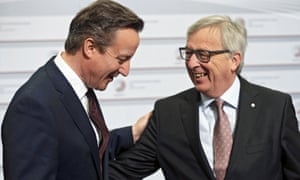
David Cameron with the European commission president Jean-Claude Juncker. Photograph: Ints Kalnins/Reuters

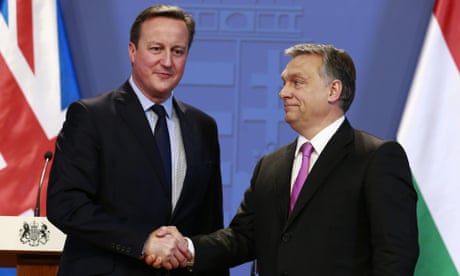
Two-thirds of Conservative MPs now support Britain’s exit from the European Union, despite David Cameron’s clear preference for staying in, according to senior sources within the party.

Key figures in Tory high command say analysis of public statements and private views expressed by their 330 MPs shows that at least 210 now believe that the UK would be better off “out”.

The surge in support within the parliamentary party for leaving will greatly encourage “out” campaigners, who believe many people will take their lead from local MPs when they decide which way to vote. However, party managers say the total number of Tory MPs who will join the campaign to leave could turn out to be significantly fewer – around 110 – if in the next few months opinion polls begin to point towards a close result or a win for the pro-EU side.

“Certainly at least two-thirds want to leave as it stands,” said a senior party figure. “But if things are very tight some will be bought off by offers of patronage and will be reluctant to take a different line to the prime minister. Plenty will not want their careers blighted by being on the wrong side of such an important debate.” The Observer has also been told that soundings taken by MPs show the “vast majority” of grassroots activists now want to quit the EU – and that most will not be swayed by whatever deal Cameron achieves in his attempt to renegotiate UK membership.


EU referendum expected in September as hopes fade of deal next month


Last week Cameron, in effect, conceded that his party was split from top to bottom over Europe when he agreed that members of his government, including cabinet ministers, would be allowed to speak out against the official line during the campaign, which is expected to be later this year.

While the holders of the top offices of state – including the chancellor, George Osborne, the foreign secretary, Philip Hammond and the home secretary, Theresa May – are likely to back staying in, other senior ministers, including the work and pensions secretary, Iain Duncan Smith, the leader of the House of Commons, Chris Grayling, and the Northern Ireland secretary, Theresa Villiers, want to campaign to leave.

The spotlight will inevitably now turn to Boris Johnson, who attends cabinet in his role as mayor of London and sees himself as a future leader of the party. A longstanding critic of the EU, Johnson has yet to indicate whether he will campaign to stay in or leave.

The ability of Villiers to remain as Northern Ireland secretary if she sides with the “out” campaign was being called into question on Saturday night as opposition MPs said leaving the EU would not be in Northern Ireland’s interests, could harm the peace process and damage Northern Ireland’s economy. The Liberal Democrat MEP Catherine Bearder, who speaks for her party on the referendum campaign, said Villiers should stand down, saying a Brexit would not be compatible with her role. “It would be highly inappropriate for Theresa Villiers to remain in her post while campaigning to leave the EU,” Bearder said. “Leaving Europe would risk stoking sectarian tensions and undoing years of peace-building, much of it funded through EU peace programmes.

“It would also fundamentally transform the UK’s relationship with the Republic of Ireland and put at risk the open land border we currently share.
Government ministers should not be able to campaign for an EU exit if this completely goes against their role and responsibilities.”


Osborne: PM giving ministers free rein on EU referendum is not a U-turn


The only Irish nationalist party represented in the House of Commons also questioned whether Villiers could remain in her post. Colum Eastwood, new leader of the Social Democratic and Labour party, said Britain’s departure from the EU could put at risk Northern Ireland’s £1.6bn of trade with the Irish Republic. “While Theresa Villiers is obviously entitled to engage in the internal and long-running Tory battles over Europe, her role as secretary of state for Northern Ireland places upon her a separate responsibility. That role should require her to represent the best interests of people in the north. A Brexit is not in our interest. It is not in the interest of our economy or in the interest of our society,” he said.

“All the evidence, all the major voices in our agricultural and business communities, have warned that a Brexit would devastate the fundamentals of our economy.”

Meanwhile, the EU spokesman of the strongly Eurosceptic Danish People’s party, Kenneth Kristensen Berth, said he did not believe the UK should leave. “I fully understand the British people’s scepticism, but the answer is not to leave now. The answer is to work within the EU framework to slim down the EU cooperation, and that’s a job that will be significantly harder without the British.”

James McGrory, chief campaign spokesman for Britain Stronger In Europe, said: “It shows how isolated Ukip and the Leave campaigns are when even rightwing Eurosceptics in other countries are arguing that Britain should remain in Europe.

“Europe needs reform, but leaving altogether would take us to very extreme fringes of the international community, where even far-right outfits like the Danish People’s party don’t want to be.”

Friday, 8 January 2016

Is China really devaluing its currency?

An advertisement poster promoting China's renminbi (RMB) or yuan , U.S. dollar and Euro exchange services is seen outside at foreign exchange store in Hong Kong, China
China's foreign exchange reserves have fallen from a gigantic $4 trillion in the first half of 2014 to around $3.2 trillion today Photo: Reuters

What's happened to the renminbi?

Since the summer, investors have been keeping an uneasy eye on the value of the Chinese currency.
In August, Beijing decided to tweak its exchange rate peg with the dollar, making the renminbi float in a wider band against the greenback.

This sparked immediate market panic that China was entering into the world's currency wars.
But the devaluation in itself was small. Allaying fears further, the Chinese began to immediately intervene to prop up the RMB to stop it falling too fast by drawing down their reserves.
But devaluation fears are returning. The country's export performance has stuttered, while the dollar has rocketed on the back of a stronger US economy.
In response, on January 7, authorities set their "daily fix" against the dollar 0.51pc lower. This was the single biggest move since August and set off a new bout of mass stock market hysteria.
Overall, the RMB has weakened by around 10pc against the dollar over the last two years.
"Over half of the weakness has come in the last four months," says Sean Yokota at SEB.
"We are heading to 6.83; the level China pegged to the dollar post the global financial crisis of 2008."
Kevin Lai at Daiwa Capital expects the RMB to fall even further. He forecasts it will hit 7.50 by the end of the year.
"There is likely still to be plenty of depreciation to come," he said.

Does it really matter?

China has said it is not in the business of competitive currency devaluation.
The central bank, The People's Bank of China (PBOC), has said its main exchange rate target is against a broader basket of currencies and it's not fixated on the greenback.
The PBOC has repeated this claim again, saying that it is happy to let the yuan-to-dollar rate have a more "market determined value".
It wants to ensure that when measured against a wider basket of currencies - which includes sterling and the yen - the RMB remains "stable."

What's happened to the trade weighted value?

In worrying signs for the Politburo, the RMB's weakness is being reflected across the board - and not just against the dollar.
The chart below shows how the exchange rate against a basket of currencies has broadly tracked the dollar rate since the start of last summer.

Are the Chinese losing control?

Beijing has been intervening heavily to support its currency and latest evidence suggests it has been drawing down on its reserves on a massive scale.
The latest December figures show reserves fell by a record $108bn. Such steep falls are also evidence of worsening capital flight in the country.
Net outflows reached $140bn last month, surpassing the previous peak seen in August, says Mark Williams, at Capital Economics.
The Communist party has responded to mass capital outflows by using the full force of the state to punish those it accuses of "illegal cash transfers" out of the country.
Some claim that the Chinese are beginning to lose control over their exchange rate and their economic policy.
Burning through reserves exerts a tightening effect on the economy. This has been offset in the past by cutting interest rates. However, rate cuts only hasten capital outflows and so the vicious cycle continues.
China's exchange rate policy, it could be said, has put the country in a bind.

Thursday, 7 January 2016

Hashim Amla did the honourable thing by jettisoning his burden

Mike Selvey in The Guardian

It may be unusual to change captains at the midpoint of a series but Hashim Amla has chosen a good moment to concede his position and drop back into the ranks. A resignation after the massive defeat in Durban would have represented capitulation even if he had been contemplating it for a while.
Now though he has done so on the back of a stirring fightback from the side he led, and an emphatic return not so much to form (he had not looked out of touch in the second innings in Durban) as to relentless run-gathering. It is a little too strong to describe the outcome of a Test that had yet to complete its third innings as a “winning draw” for South Africa. With the conditions finally giving the bowlers some lateral movement on the final day, we can only surmise what the England bowlers might have managed had they been defending, say, 200 and their colleagues rediscovered the art of catching but at least we know there will be an almighty scrap now up on the highveld.
Sometimes it is only in the aftermath of such a decision that the extent of the burden is revealed. Those who were there in the dining room at Edgbaston remember the red eyes of Nasser Hussain, that most passionate of England captains. There were Michael Vaughan’s tears at the ECB centre of excellence at Loughborough. Such is the responsibility, beyond simply a job, that comes with captaining one’s country or even just playing. It is only around nine months since Jonathan Trott, a man whose implacable demeanour hid inner turmoil, was lbw in what was to prove his final innings for England. He positively skipped from the field and sprinted up the pavilion steps, a man clearly content it was finally over. So there should be no surprise that in Amla’s case, he conducted a press conference that was a long way from the soul-searching of others and simply that of a man happy in the decision at which he had arrived and itching to get on with the job at which he truly excels.
There is absolutely no question of Amla being coerced into applying for the job in the first place on account of his ethnicity. With Graeme Smith’s retirement, he, as a senior player, put his name forward with others, including AB de Villiers. He did so because he believed he could make a difference, and after due process, was installed. It would also be wrong though to assume that, all things being equal, this was not the choice that would be made, convenient for South African cricket that he had applied.
It would also be erroneous to deduce that after the strong rumours in Durban that things were in some disarray on and off the field that he had been pushed out of the job. There was some fierce external criticism, most prominently from Smith in his role as media pundit, to which the response of Cricket South Africa was to invite him into the camp. But Smith’s remarks, while trenchant, would surely have been taken on board by Amla, a trusted colleague in Smith’s teams: there is a difference between being pushed and being encouraged.
A decade ago, when England were in India, I went to stay with their then coachGreg Chappell, and conducted an interview with him, which in part resonates now with the situation in which Amla found himself. At the time, Chappell had been dividing opinion in the country because of his fractious relationship with the former captain Sourav Ganguly, who had been struggling desperately for batting form with one Test hundred, in Bulawayo, in two-and-a-half years. He had been replaced as the captain by Rahul Dravid and the coach was portrayed as the man who sacked him, which was far from the truth.
“We clashed,” Chappell told me, “because his needs as a struggling player and captain and those of the team were different. I’m not the hard-nosed control freak that I have been portrayed. I’m thorough, a realist, a pragmatist and I’m honest. Much has been written and said, a lot of it misleading, but in essence I told Sourav that if he wanted to save his career he should consider giving up the captaincy. He was just hanging in there. Modest innings were draining him. He had no energy to give to the team, which was helping neither him nor us. It was in his own interest to give himself mind space to work on his batting so that it could be resurrected.”
Here we have in Ganguly and Amla two captains at opposite ends of the spectrum: the one desperate to hang on to his position at all costs; the other understanding his leadership may not be in the best interests either of the side or himself. Serene and understated, Amla had taken over a side who were in inevitable transition after the loss of some of the greatest players the game has seen. So a downturn in performance was not entirely unexpected. But he has nonetheless presided over the longest winless streak, eight matches, in South Africa’s Test history, mitigation coming only in the state of the Bangladesh weather and the pitches in India. Certainly in this, Amla has seen the broader picture.
Where they share a common theme is the impact, as Chappell said of Ganguly, that it was having on his batting and the team. Until his redemptive double hundred in Cape Town, Amla’s previous 13 matches as captain had brought him an average of 40.76 against a career average 10 points or so higher. Since the start of the tour of India that preceded the current series, nine innings had brought him five single figure scores and a top score of 43.
Whether, like Ganguly, his tribulations with the bat were impacting on the team in a manner other than simply the lack of runs is doubtful. If the captaincy itself, and all that it entailed, was affecting the capacity to do the job at which he truly excelled, then Amla is understanding enough to be able to arrive at the conclusion he has. It is an honourable thing to have done, which may well be to the detriment of England. That he has been able to do so on the back of a momentous innings, played perhaps with the release that comes with already having made a decision, merely serves to highlight it.

Tuesday, 5 January 2016

By the end of my first year as a doctor, I was ready to kill myself

An Anonymous junior doctor in The Guardian


On my morning drives to the hospital, the tears fell like rain. The prospect of the next 14 hours – 8am to 10pm with not a second’s respite from the nurses’ bleeps, or the overwhelming needs of too many sick patients – was almost too much to bear. But on the late-night trips back home, I’d feel nothing at all. Deadbeat, punch-drunk, it was utter indifference that nearly killed me. Every night, on an empty dual carriageway, I had to fight with myself to keep my hands on the steering wheel. The temptation to let go – of the wheel, the patients, my miserable life – was almost irresistible. Then I’d never have to haul myself through another unfeasible day at the hospital.


By the time I neared the end of my first year as a doctor, I’d chosen the spot where I intended to kill myself. I’d bought everything I needed to do it. All my youthful enthusiasm for healing, big dreams of saving lives and of making a difference, had soured and I felt an astronomic emptiness. Made monumentally selfish by depression, I’d ceased even to care what my husband would think of me, or that my little boy would grow up without his mother.


Doctor suicide is the medical profession’s grubby little secret. Female doctors aretwice as likely as the general population to take our own lives. A US study shows our suicide rate appears higher than that of other professional groups, with young doctors at the beginning of their training being particularly vulnerable. As I wrestled silently with the urge to kill myself, another house officer in my trust went right on and did it. To me, that monstrous waste of young life seemed entirely logical. The constant, haunting fear of hurting my patients, coupled with relentless rotas at work, had rendered me incapable of reason.


Though we know large numbers of doctors kill themselves, what is less clear are the reasons why, when dedicated to preserving human life, some doctors silently plot their own deaths. A 2006 study at the University of Pennsylvania identified that during their first year as doctors, young physicians experienced skyrocketing rates of burnout, with symptoms of emotional exhaustion, depersonalisation, and reduced sense of personal accomplishment soaring from 4% to 55%.


For me, the explanation ran deeper. I was entrenched in a hospital system that brutalised young doctors. Working on my hospital’s surgical emergency unit, there were simply too few of us to cope with the daily onslaught of patients. Officially eight or 10-hour days ran routinely into 13, 14 or 15 hours as we house officers worked at fever pitch to provide what was, at best, a mediocre service for our patients. Run ragged, we fought to keep our patients safe, but their numbers outstripped ours 20 or 30 to one, and the efforts this took were superhuman. The nurses knew, the consultants knew, even the hospital management knew, yet no one seemed to give a damn.

It wasn’t just exhaustion that drove me into depression. Plenty of jobs are busy. But there is something uniquely traumatic about being responsible for patients’ lives, while being crushed under a workload so punitive it gives neither the time nor space for safe assessment of those patients. Days were bad enough, but nights on call were terrifying. I remember running from the bed of one patient, still haemorrhaging blood from her surgical wound, to another whose heart rate had plummeted to 20, perilously close to a cardiac arrest. Two stricken patients, but only one doctor, wracked with the knowledge that if something went wrong, the guilt would be hers alone.


I was lucky. I was pushed by the colleague in whom I finally confided into seeking professional help. It took anti-depressants, therapy and a narrowly-avoided psychiatric inpatient admission to bring me back to the land of the living.


 Now, on the cusp of junior doctors’ first national strike in 40 years, I’m astounded the health secretary persists in ignoring unanimous condemnation of his new contract from juniors and medical leaders alike. If he gets his way, Jeremy Hunt will make it easier for hospitals to abuse their juniors, by stripping away the safeguards that stop hospitals overworking us, fining those that do. Under his new contract, our hours will become even longer, even more antisocial – at a time when we simply have nothing more to give. And as we are pushed to treat more and more patients, faster and faster, fatigue and psychological distress will dull our competence: your lives will be less safe in our hands. And our own? Take it from someone who’s been there. Watch the suicide rate climb.

Monday, 4 January 2016

Prohibition, Discrimination in Kerala's alcohol policy

Suhrith Parthasarathy in The Hindu

Regardless of what our respective moral positions on policies of prohibition might be, and regardless of the potential efficacy of such programmes, the judgment on the validity of Kerala’s liquor policy militates against the fundamental promise of equal concern and treatment under the Constitution.


As virtually its last significant act of 2015, on December 29, the Supreme Court of India delivered its judgment on the validity of Kerala’s newest liquor policy, which seeks to prohibit the sale and service of alcohol in all public places, save bars and restaurants in five-star hotels. Regardless of what our respective moral positions on policies of prohibition might be, and regardless of the potential efficacy of such programmes, the new law, as is only plainly evident, militates against the fundamental promise of equal concern and treatment under the Constitution. In placing five-star hotels on a pedestal, the law takes a classist position, and commits a patent discrimination that is really an affront to the underlying principles of our democracy. Regrettably, though, the Supreme Court’s judgment, in The Kerala Bar Hotels Association v. State of Kerala, eschews even the most basic doctrines of constitutionalism, and, in so doing, allows the state to perpetrate a politics of hypocrisy.
Kicking off the excise policy

Since 2007, the Kerala government has sought to tighten its Abkari (excise) policy with a view to making liquor less freely available in the State, ostensibly in the interest of public health. At first, the State sought to amend the policy by permitting new bar licences to be granted only to those hotels that were accorded a rating of three stars or more by the Central government’s Ministry of Tourism. In 2011, these rules were further changed. This time, all hotels that had a rating of anything below four stars were disentitled from having a licence issued to serve alcoholic beverages on their premises. However, those hotels with existing licences were accorded an amnesty, which permitted them to have their licences renewed even if they did not possess a four-star mark.
The Supreme Court held, in a convoluted judgment, in March 2014, that the deletion of three-star hotels from the category of hotels eligible for a liquor licence was, in fact, constitutionally valid. The court provided a rather bizarre rationale for what appeared to be a palpable act of favouritism. Even hotels without a bar licence, it said, were entitled to three-star statuses under the Ministry of Tourism’s rules and regulations.
In August 2014, the Kerala government sought to further intensify its Abkari policy, by making its most drastic change yet, in purportedly trying to enforce complete prohibition. Only hotels classed as five star and above, by the Union government’s Ministry of Tourism, the new policy commanded, would be entitled to maintain a bar licence. To give effect to this rule, the Abkari Act, a pre-constitutional enactment that was extended in 1967 to Kerala, was duly amended, and the State’s excise commissioners issued notices to all hotels of four stars and below, which served liquor, intimating them of the annulment of their respective bar licences.
The new policy was immediately challenged in a series of petitions filed in the Kerala High Court by hotels of various different denominations. In May last year, after a division bench of the High Court had ruled in favour of the State, the hotels filed appeals before the Supreme Court. They raised two primary grounds of challenge, both predicated on fundamental rights guaranteed under Part III of India’s Constitution.
Fundamental rights

First, the hotels submitted that in cancelling their bar licences, and in prohibiting them from serving and selling liquor on their premises, the State had infracted their right, under Article 19(1)(g), to practise any profession, or to carry on any occupation, trade or business. Second, they pleaded, in separately categorising hotels of five stars or more, and in permitting those hotels alone to serve liquor in public, the new Abkari policy had made an unreasonable classification, by treating persons on an equal standing unequally, and therefore violated Article 14 of the Constitution.
The first argument was admittedly going to be a difficult one to maintain. The liberty to freely carry on any trade or business is subject to reasonable restrictions that may be imposed by the state in the interest of the general public. The Constitution itself, in Article 47, requires States to make an endeavour towards improving public health, including by bringing about prohibition of the consumption of liquor. Therefore, quite naturally, any policy in purported furtherance of such goals would almost always be viewed as a legitimate limitation on any freedom to do business. In fact, in 1994, a constitution bench of the Supreme Court, in Khoday Distilleries Ltd. v. State of Karnataka, explicitly questioned whether any right to trade in alcoholic beverages even flowed from our Constitution.
“The State can prohibit completely the trade or business in potable liquor since liquor as beverage is res extra commercium,” wrote Justice P.B. Sawant. “The State may also create a monopoly in itself for trade or business in such liquor. The State can further place restrictions and limitations on such trade or business which may be in nature different from those on trade or business in articles res commercium.” Therefore, the court, in The Kerala Bar Hotels Association case, perhaps, had little choice but to hold the Abkari policy as being in conformity with the right under Article 19(1)(g).
Such a holding, though, ought not to have precluded the court from scrutinising the liquor policy with further rigour. The mere fact that a commodity is res extra commercium — a thing outside commerce — does not give the state absolute power to make laws on the subject in violation of the guarantee of equal treatment. While a law might represent a valid constraint on the freedom to trade, it nonetheless must confirm to other constitutional commands, including Article 14, which assures us that the state shall not deny to any person equality before the law or the equal protection of the laws within the territory of India.
The point of classification

Equality, as the legal philosopher Ronald Dworkin once wrote, is a contested concept. But it is however, in its abstract form, a solemn constitutional pledge that underpins our democracy. The Supreme Court, in some of its earliest decisions, interpreted Article 14 as forbidding altogether any law that seeks to make distinctions based on class, except where reasonable classifications are made in a manner that does no violence to the provision’s core promise. The court also crystallised a basic two-prong test to determine what constitutes such a classification: there must be, it held, an intelligible differentia, which distinguishes persons or things that are grouped together from others left out of the group, and this differentia must have a rational relation to the object sought to be achieved by the law in question.
Hence, in determining whether Kerala’s Abkari policy violated the right to equality, the question was rather simple: has the State made a reasonable classification in consonance with Article 14 by permitting only five-star hotels and above to serve liquor? When we apply the test previously laid down by the Supreme Court, there is little doubt that the distinction that the policy makes between hotels on the basis of their relative offering of luxuries constitutes a discernible intelligible differentia between two classes of things. But a proper defence of the law also requires the government to additionally show us how this classification of five-star hotels as a separate category bears a sensible nexus with the object of the law at hand. The changes in the liquor policy were ostensibly brought through with the view of promoting prohibition, and thereby improving the standard of public health in the State. Now, ask yourself this: how can this special treatment of five-star hotels possibly help the Kerala government in achieving these objectives?
The Supreme Court, as it happened, made no concerted effort to answer this question. This could be because, however hard we might want to try, it’s difficult to find any cogent connection between classifying five-star hotels separately and the aim of achieving prohibition. The court, therefore simply said, “There can be no gainsaying that the prices/tariff of alcohol in Five Star hotels is usually prohibitively high, which acts as a deterrent to individuals going in for binge or even casual drinking. There is also little scope for cavil that the guests in Five Star hotels are of a mature age; they do not visit these hotels with the sole purpose of consuming alcohol.” Given the palpable inadequacies of such a justification — and also given its validation of a manifestly classist position — the court also used the State government’s excuse of tourism as a further ruse to defend the law. But when a policy exists to promote the prohibition of the consumption of liquor, it’s specious to use an extraneous consideration, in this case, tourism, to defend a classification made in the law, regardless of how intelligible such a classification might be.
Prohibition often has a polarising effect on the polity. But the criticisms of the ineffectuality of such policies apart, Kerala’s new law ought to have been seen for what it is: paternalism, at its best, and, at its worst, an extension of an ingrained form of classism that is demonstrably opposed to the guarantee of equality under our Constitution. The judgment in The Kerala Bar Hotels Association case is therefore deeply unsatisfactory, and requires reconsideration.