Search This Blog

Sunday, 16 February 2014

Why we argue – and how to do it properly


The internet provides ample space for stating opinions. But true persuasion is an art – one this week-long series aims to teach
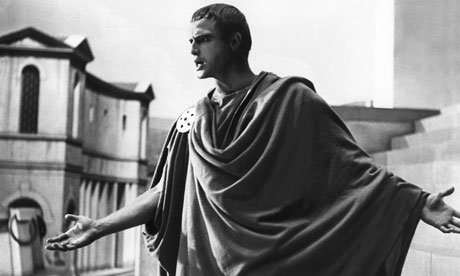
Marlon Brando as Mark Anthony in the 1953 film Julius Caesar
Marlon Brando as Mark Anthony in the 1953 film Julius Caesar. 'True persuasion is democratic.' Photograph: Cine Text/Allstar
It's the weekend and you are heading out to meet friends at the cinema. You are looking forward to seeing the new thriller by a favourite director. But then you discover that some of your friends would rather see the latest superhero movie, or some a new romantic comedy. Everybody pauses, uncertain how to proceed. You decide to get everyone to see the thriller. You won't force them – after all, they are your friends and unlikely to remain so if you threaten them. You could bribe them by offering to buy the tickets – but movie-going is expensive enough as it is, and you don't want to set a precedent. So you decide to try and persuade them – to get them to really want to go. But how?
You could begin by telling your friends about reviews you have read recommending your chosen film and trashing the others – or by pointing out the relative box office success of the movies on offer. But what reviewers do your friends trust? Do they want to see a hit movie or are they the sort of people who like to "discover" hidden gems?
Perhaps you should remind them that on previous visits to the cinema your choices have been good ones. And all you want is for everybody to have a good time. Alternatively you might explain just how much you have been looking forward to the movie after a really bad week. Are your friends likely to be moved by pity or should you appeal to other feelings?
Perhaps these appeals – to the authority of reviewers, your own character, and to your friends' emotions – seem too manipulative. You could try logic. Movie-going may not be an exact science but there are degrees of reasonableness. If a director's movies have been dire since that first breakout hit then it's a good bet that the new one will be weak. You might argue that the superhero blockbuster is good but the genre can never be truly great; that one of the movies has a lead actor with a bad track record; that the comedy is so long the bar will shut before it ends.
However strong your convictions about quality cinema may be, these alone will not win the day. You need to make an argument. And a successful argument must appeal not to just anyone in general but to your friends in particular. It must be adapted to their estimations of movie reviewers, feelings and beliefs about you and your character, and rely on rational claims of a kind they will recognise.
What is true of the cinema is – in this case – also true in public and political life. In a democracy, rather than force or bribe people to assent to our ideology, we try to win them over through persuasion. That can be a challenge. It requires us to understand where other people are coming from and to develop arguments that are outward-facing.
Not everyone thinks as we do. People have different experiences and possess different information; they have different values and do not always share our criteria of judgment. To persuade them we have to make connections with our audience – with what they might think, feel and be familiar with. This is not about tricking people or fooling them. It is about truly persuading them to share our views on a particular issue – and that means developing a relationship.
A glance at the newspapers and much of the internet demonstrates, however, that many people think the purpose of public communication is to reflect well on themselves – to announce their own importance, specialness or cleverness. An infamous academic chooses not to be convincing but to increase his brand value by performing provocatively; a troll communicates publicly but seeks only private "lulz"; shouting things your audience already believes, yet pretending that you're not allowed to say them, seems to be an easy route to success on talk radio or the op-ed pages. But the only thing such people are saying with their arguments is "look at me!"
Online communication makes easy the simple affirmation of our beliefs, the monetisation of strident "opinion" and the anonymous onanistic expression of inchoate hostility. And that means more arguments – but less persuasion.
True persuasion is democratic. In giving people reasons to act with us we recognise that they aren't inferiors who can be compelled but thinking, feeling and speaking beings. And true persuasion is an art. Contrary to the books on the self-help and business psychology shelves there are no magic "words that work". You have to cultivate an "eye", developing a feel for situations and empathy for those you want to persuade. The name of that art is "rhetoric".
Of course, you don't need to bother with any of this if you and your friends just go and see your favoured films separately. But that is to give up on society, politics and progress. If people cannot persuade or be persuaded then there can be no shared beliefs, co-ordinated collective action or intellectual evolution. The only change will come from force, bribery or manipulation.
In defiance of such a bleak outcome, Comment is free will over the coming week run a series on how to argue in the spirit of Isocrates, the ancient Greek philosopher and rhetorician: "the kind of art which can implant honesty and justice in depraved natures has never existed and does not exist … But I do hold that people can become better and worthier if they conceive an ambition to speak well, if they become possessed of the desire to be able to persuade their hearers."

-----

How to judge your audience and remain true to your arguments

Being two-faced has had a bad rap recently. But to convince people of your argument you have to adapt it to your audience
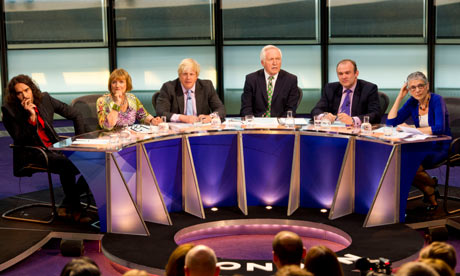
Question Time
'On BBC Question Time Russell Brand is never going to persuade Melanie Phillips, and she will never sway him. They'd be foolish to try.' Photograph: Matt Crossick/PA
One of the greatest achievements of reality television gameshows has been the promotion of a distinctive ethical principle: that almost the worst thing you can do is be "two-faced". To say one thing to one group of people and something else to another is widely regarded as the epitome of dishonesty. And the very worst thing? The failure to be "true" to yourself – to moderate or modify your public appearance in response to the expectations of others.

Adapt to circumstances

But if you want to persuade people, or simply communicate clearly, the last thing you should do is say the same thing to everyone and refuse to adapt to circumstances. On the contrary, the first step in developing a good argument is to think about how to fit it to the situation in which you find yourself. It used to be that skill in this was considered a virtue. Rhetoricians called it "decorum".
Today we think of being "decorous" as conforming. But all it means is being "fitting" – using words and arguments that are "apt" given the situation. It is generally a bad idea to give an expletive-packed wedding speech that endlessly insults the bride, not because expletives and insults are always bad but because they are at odds with the mood of collective celebration characteristic of weddings.
Similarly, an economist explaining the Phillips curve ought to do so differently if talking to a niece taking business studies GCSE, the retired sales executive next door or a room full of trade unionists.

Know your audience

In making an argument you are trying to bring three things into alignment: yourself, your words and your audience. You are trying to move your audience so that it is in agreement with you – but to do that you need to move too. And between you – what moves you both – is a form of words and a set of arguments. If you are inflexible, using words and making references that are completely at odds with your audience you won't persuade anybody of anything (except of the view that you are unconvincing and unintelligible).
In practical terms this simply means that you need to know your audience. Cicero, the Roman philosopher, rhetorician and politician, believed that the perfect orator would have to master everything to do with the life of other citizens: laws and customs, traditions and general outlooks, "the way people usually think". In becoming familiar with the general outlooks of other people, as well as the particular outlook of specific groups, you are better placed to adapt your argument as needed.
A problem in the present day is that contemporary communications media make decorum extremely difficult, if not completely impossible. Politicians have long been aware that words said in one context may be rebroadcast in quite another. They have tended to deal with this by being bland and non-commital or by supplementing what they say with briefing and spin. In adopting such positions on the basis of opinion polls and focus groups politicians make the opposite mistake to the foul-mouthed best man. They forget their argument and give themselves over entirely to the audience (who, in turn, succumb to boredom).
It's not only politicians who can find their words taken and used in a quite unexpected context. These days any of us might be live-tweeted or filmed and put online. The examples are piling up of those who forgot that what they said on social media was not private but being said to everybody. On below-the-line comments boards – where most are anonymous or pseudonymous – it is difficult to be sure who one is talking to. This is one reason why people on Guardian comment threads often try to appeal to the (possibly imaginary) audience they know that exists: the moderators, subeditors, or "Guardian readers".

Pitching to the third party

But if you want to persuade you need to have a better idea of the audience you mean to reach. And it isn't the person whose comments you are attacking. On BBC Question Time Russell Brand is never going to persuade Melanie Phillips, and she will never sway him. They'd be foolish to try. They are trying to persuade the people watching them. It is the same online. Persuasive arguments will be pitched to a "third party" – the audience of readers.
Of course you don't know who that audience is. Are they old or young, male or female, new to the topic or experienced? Yet all of us, when we start to compose some kind of general argument, has in mind an "ideal" or "typical" audience. It is worth being clear to yourself who you think this is. It shouldn't be people who think exactly as you do – since those aren't people you need to persuade. Nor should it be a bunch of idiosyncratic types who think like nobody else.

Let's be reasonable

It needs to be something like generally "reasonable" people, neither fanatical nor obstinate, informed but not specialist. What views or outlooks can you assume they share? What are they likely to think decent, kind and reasonable and what might they think is unacceptable, unkind and daft? Be clear on this and you can start to think about how to argue your case. That means paying attention to, and thinking about, other people, their feelings and experiences. If you want to have a chance of persuading people then you need to have a lot more than two faces. Don't be true to yourself. Be true to your arguments.
----

How to use your anecdotes well – and sparingly

There's an art to telling stories to complement an argument without overdoing it – or making yourself the centre of attention
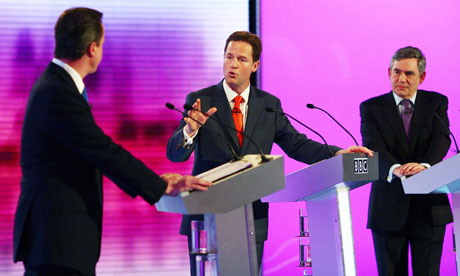
David Cameron, Nick Clegg and Gordon Brown
David Cameron, left, Nick Clegg and Gordon Brown all used anecdotes about people they had met during the 2010 leaders' debate. Photograph: Gareth Fuller/PA
The most memorable moment of the 2010 general election leaders' debate was when David Cameron tried to justify a point about immigration by citing the agreement of "a 40-year-old black man" he had met in Plymouth who had served in the Royal Navy for 30 years (thus enlisting at the age of 10).
This impossibly young seaman was not the only person called as a witness in that debate: Nick Clegg had been talking to a ward nurse in a short-staffed hospital and a burglary victim from London; Gordon Brown had met a trainee chef and received a letter from a recovered cancer patient; Cameron had also recently met a crime victim from Crosby, a drug addict from Witney and a man suffering from cancer of the kidney. The latter reappeared in Cameron's 2012 speech to his party conference, and in a recent speech on social security Ed Miliband told stories of meeting a young unemployed man in Long Eaton and "somebody who had worked all his life, for 40 years" in the scaffolding business.
Are such stories a good form of argument? They seem to be popular with political speech writers and advertising copywriters who often use them to lend colour and "human interest" to a speech. But as the leaders' debate demonstrated, they can also sound such a false note that they distract from the claims you want to advance. To work well, stories must be in harmony with, and contributing to, your overall argument.
One way they can do this is by bringing to your argument "witnesses" who provide evidence that supports a particular claim. In school we learn to quote supposed "authorities" – writers who lend support to our case not simply because of the veracity of their findings or the eloquence they lend to our words but also because they have some kind of recognised standing which we hope to add to our own.

Know your witnesses

Outside school such citations are useful, but the range of potential sources is greater and the usefulness of any single one cannot be taken for granted. Different audiences value different sorts of "authorities" and a fundamental mistake is to refer to something your audience cannot evaluate or will not evaluate positively. Far from strengthen your case this will weaken it.

Use your anecdotes sparingly

Even good witnesses should be used sparingly and carefully. Excessive and obvious reliance on them will make it seem as if you can't think for yourself. And it can easily seem pretentious. Someone trying to persuade you simply by dropping names of powerful people they have met or of authors they have read is, to put it mildly, annoying.

Make anecdotes tell stories

Stories can also serve as examples – instances of reality which are presented as proofs of some kind of norm. They invite people to make an induction – to conclude that there is some kind of general underlying rule at work and of which we must take heed. When a child points out that their friend doesn't have to go to bed so early, or a teenager insists to a parent that "nobody else has to visit Grandma every weekend", they are trying to illustrate the presence of a rule or a norm from which their parents are unreasonably or bizarrely departing. In a similar way Cameron wants us to conclude from a single dramatic example that the NHS is bad for patients and Miliband that apprenticeships are working out well.
Anecdotal examples of this sort are a necessary and valuable part of everyday, public and political argument. That is because (climate change partially excepted) such arguments are rarely about the nature of physical reality but often about social reality. They concern partial and practical judgments about some aspect of our varied and complex cultures: whether or not people are on the whole trustworthy; the likelihood that people receiving social security are "striving" or "skiving"; whether exams are getting easier or harder.
To make strong claims about the social reality of these things you will need to present examples and these can be made vivid if expressed in the form of stories. The most effective – combined with other evidence and information – help bring clearly to mind something you want the audience to think about more, to sympathise with or to see in a new way. They help to establish a picture of a situation and a definition of reality on the basis of which conclusions may be drawn.
Stories come in many genres. They may be little comedies or tragedies, homely confirmations of what "everybody knows" or unexpected revelations. It is important to be sure that your story is emotionally in tune with the rest of your argument (rather than a substitute for it). And it certainly must not dominate.

Don't make yourself the story

One of the more annoying techniques of politicians is to use purely personal experience as an anecdotal exemplar – as if, just because the politician "got on their bike", we must accept that everyone could or should do likewise. Stories about the speaker may be fine for entertaining dinner speeches (on the way to which a really funny thing happened), but they have a limited place in argumentative speeches where the good character of a speaker should be evident and not need explicit mention.
The problem with Cameron, Clegg, Brown and Miliband's stories is that often they aren't a contribution to the main argument but an attempt to convince the audience that these are great guys, men of the people, on our level. They have forgotten that a good argument is always about the audience to whom it is addressed and not the person making it. If you make yourself the story your argument will fail.
------

Ask yourself: what are you arguing about?

Life is not a well-set exam – the questions we ask may be ambiguous. Defining the dispute is itself part of the argument

Toasted Cheddar Cheese sandwich with the liquified cheese oozing out from between the bread
'When your flatmate accuses you of eating the last of the cheese your first reaction might be to refute the conjecture.' Photograph: CS-Stock / Alamy
The New Statesman columnist Mehdi Hasan recently addressed his online interlocutors thus: "Dear thickos on Twitter, for the 100th time: opposing arming the rebels does not make one 'pro-Assad'."
Now, there's a lot happening in this short rhetorical moment – including invective and hyperbole aimed at the refutation of a false syllogism. But overall it is an argument about arguments. Hasan wants to argue over the question "Should the UK arm the rebels in Syria?"; others would prefer the question: "Should the UK support Assad?" Although connected, these are two distinct questions. Which one is asked makes quite a difference to how a discussion about policy towards Syria will unfold. In any argument what we are arguing about may be the most important thing to dispute.

What are you arguing about?

Life is not a well-set examination. Our problems are not clearly specified and the questions we have to answer to ourselves are rarely unambiguous. Even something seemingly simple such as an argument about what music to play at a family party might also, possibly, be an argument about what kind of party it is to be, who the party should be for, or which members of the family deserve most respect. If you think the debate is about the relative merits of Britpop over glam rock, you might be in trouble if your partner thinks it is about your inability to respect your in-laws. In short, the point of a dispute isn't clear or fixed before an argument begins. It is one of the things established in and through the argument.
Understanding this can be emotionally important when organising the family get-together. It is of immense political importance when there is going to be a vote. Voters think lots of different things and they think them in all sorts of different ways.
Consequently, a vote will work out differently depending on how voters perceive an issue. For example, the renewal of Trident might be presented as purely a defence issue. People's views will then depend on how they think about threats to security and how they assess the usefulness of Trident in warding them off. But the issue can plausibly be construed as one of cost. In deciding on that question, the same people might take a different position. "Should we seek to deter nuclear attacks on the UK?" and "Are nuclear weapons your No 1 priority for government spending?" will lead to very different outcomes.

Four kinds of argument

In arguing, then, we need to think carefully about the explicit and implicit questions we are addressing and about the kind of argument that we want to have about them. Roman rhetoricians had a useful way of thinking about this. They used the term "stasis" for the "point" around which a dispute could or should turn, and identified four general kinds.

1. Fact

The first kind is "conjecture". This is the argument about fact – whether something is or is not the case. When your flatmate accuses you of eating the last of the cheese your first reaction might be to refute the conjecture – you were at work, you are allergic to dairy, your flatmate ate them last night when he had the munchies.

2. Definition

But suppose you did take the cheese and there is no denying it? The argument might then shift to "definition" – the name that should be given to your action. You might have taken the cheese thinking it was yours – in which case it wasn't "theft" but a "mistake".

3. Quality

Your third option is to make the argument one of "quality"; you admit the crime but argue that your action was a good one. You were aiding your flatmate in a diet, the cheese was almost out of date and you were avoiding waste, you gave it to someone who was really hungry.
These are all ways of shifting the terrain of a dispute. How you use them depends in part on whether or not you are in the position of prosecution or defence. A prosecutor wants to keep things narrow, presenting an audience with a simple choice of yes or no, guilty or not guilty. A defendant will want to open up a variety of arguments so as to sow reasonable doubt. The political conservative might want to keep things at conjecture so as to avoid challenges to "traditional values" while the political radical may want an argument about "quality" so as to show how an unconventional action expresses a higher moral code.
You can see how different stases work in many contemporary political arguments. Debate about the EU is an obvious example. "Sceptics" have successfully made the argument about a conjecture. They ask, implicitly, "who has given away British sovereignty?". They then resist any sort of nuance seeking only to bring forward as many examples as they can to prove the fact that sovereignty has been lost. "Europhiles" try to move on to a debate about definition (talking about "partnership" and so on) or over "quality", where they like to argue that since sovereignty is weakened by globalisation, joining a larger bloc is to enhance rather than give away power.

4. Place

There is a fourth "stasis" that the Romans referred to as "place". Here, the dispute is over jurisdiction – whether or not the issue is one that can legitimately be addressed. In Rome that meant disputing that it was something the court could hear. In politics this is usually a "reactionary" argument since it is intended to ward off disputes.
Thus, we hear often that government has no right to decide on same-sex marriage or tell people who they can and can't employ, and that courts cannot judge the content of newspapers. But in our crowded and cacophonous virtual public spheres we (like Mehdi Hasan) might all make good use of the stasis of place. The art of arguing involves knowing which questions to ask and how to ask them, learning how to answer the questions put and deciding which questions to ignore. Sometimes, just before the guests arrive is neither the time nor the place to start an argument.

Don’t throw the book at the publisher

Shobha De in The Times of India

Am I offended by Wendy Doniger’s book? Hell, no! Am I surprised by what happened this week? Naaaah! Is it the end of the world? You must be joking. Do I think Hinduism is under threat or that Wendy set out to insult a great religion? Frankly, the answer is ‘no’ to both. Wendy Doniger is a professional scholar. This is her interpretation. She is entitled to it. Those who find the book objectionable need not read it. If you choose to read the material — and react — do it. Go ahead and write your own book. Or write to the scholar/author and refute the thesis. Hold a peaceful meeting and state your perspective. There are ways and ways to respond — passionately and spiritedly — without converting your views into an ugly, self-defeating pitched battle. Which is precisely what has happened with Doniger’s The Hindus: An Alternative History. 

-----

-----

Now, let’s see it from the publisher’s point of view (I have to state here that I am a Penguin author). But this battle does not begin or end with Penguin Books and Wendy Doniger. Nor with those who asked for the book to be withdrawn and pulped — the Shiksha Bachao Andolan Samiti. The SBAS has been at it for years (remember how 75 paragraphs were removed from several NCERT textbooks?). They will be at it for several more. The thing is, this time their victory appeared easy. Was it really a ‘victory’? And how easy was it? What about the publisher? The rather facile argument is that Penguin should not have buckled under pressure. That in ‘the old days’ publishers were bold enough to stand by authors and books. Well, it’s time to state the bald truth and say it like it is (sorry, intellectuals!). Those old days are over. The world of publishing has changed. Knock off all the romantic notions surrounding the book business and what do you get? A business under financial threat across the world. A business trying to stay afloat in the face of competition from unexpected directions and in entirely unknown forms (come on, who could have anticipated ebooks and free downloads?). Survival itself is at stake given these daunting developments. 

Besides, let’s be candid, at the end of the day, publishing IS a business. And every publisher in the universe is a ‘baniya publisher’ (a term that has been thrown around a lot these days). And hello! Which publisher would actively back a book that has zero sales potential? Which publisher is willing to lose money on a book? Which publisher wants a book/author to get into trouble? Not one. Every book is a gamble. It is published in good faith. Publishers don’t consciously court controversy. They don’t enjoy facing criminal charges (as in this case). And they certainly don’t like losing money! If that makes them ‘baniya publishers’, that’s okay. And yes, in today’s aggressive environment in which everything is potentially a ‘product’ that has to be flogged in the marketplace, there really isn’t that much of a difference left between selling a book and selling a bar of soap. If that sounds awful, it is a reality one has to accept. Authors and public intellectuals taking a lofty view of the publishing industry should smell the coffee. It is likely to get still worse by the ‘old’ standards, as decisions whether or not to publish a book are taken by marketing mavens crunching numbers and not visionary publishers willing to back a tome they believe in. Yes, it’s that grim. Publishers with a book like Wendy’s on their list are particularly vulnerable. It is not about having financial resources to fight it out in court. It is about asking a basic practical question: is it worth it? 

Wendy’s controversial book will do just fine. More people will read it now that it has become a hot potato. The SBAS will no doubt, look for other soft targets, and gloat over this particular win. The ‘scholar dollars’ won’t dry up. So, relax. Hinduism has survived worse. And will continue to thrive — book or no book. Our various freedoms are definitely under threat. Make no mistake about that. It’s just a question of figuring out whose freedom scores in such wars. And whether there is something called absolute freedom in the first place. A difficult decision needed to be taken. And it was taken. It was not ‘fear’ alone (despite the rumoured death threats) that dictated Penguin’s decision, I imagine. It was a question of not hurting public sentiment. There really are no winners here. Least of all the much-loathed SBAS.

Saturday, 15 February 2014

The ‘Pulping’ Of Thought


That Penguin has decided to pulp Wendy Doniger's The Hindus should come as no surprise...

This article is not about the content of Wendy Doniger’s book, The HindusAn Alternative History. That debate, I am sure, will happen. This article is about the larger context within which, Penguin, the publisher of the book, decided to call it a day and reach an agreement with the little known Siksha Bachao Samiti which had found the book offensive to Hindu religious sensibilities. That Penguin has decided to pulp The Hindus should come as no surprise. Rather one must praise Penguin for fighting it out for four long years when many others surrendered meekly or were more than happy to oblige the government of the day.

This was waiting to happen. The signs were ominously clear. Remember James Laine’s book on Shivaji and its aftermath when the Sambhaji Brigade hoodlums decided that it reflected badly on their Maratha icon. Or consider the cowardly capitulation of the Symbiosis institute in cancelling the screening of Jashn- e-Azadi, again due to pressures from right wing Hindu groups. Consider again, the VC of Madras University succumbing to threats from a lunatic Muslim fringe and not letting Amina Wadud speak on the campus. In each of these cases, the method has been similar: religious or nationalist groups have approached the state that their ‘feelings’ are hurt, the state through the police or the courts has tried to convince institutions and individuals not to create a ‘law and order’ problem and the institutions have more than obliged. More than being a ‘republic of hurt’, we are in this present mess because the state has abdicated its responsibility to protect freedom and dissent.

------
Also read The Silencing of Liberal India
------ 

In the neo-liberal dispensation, the state has taken a managerial turn. It is no longer interested in ideological positioning towards the creation and inculcation of a modern citizenry. Rather, it has become post ideological in the sense that it is only interested in the management of a problem. In this kind of a resolution, ' community sentiments', no matter how dumb they may be, become the defining resolution. There is no creative engagement with the problem, but only postponing of the problem through an appeasement of the worst possible kind. The state has not withered away, but consciously abdicated itself, leaving matters of democracy and dissent to de dealt and debated by communities. In our case, religious communities are hardly amenable to a rational debate. 

Spokespersons of gods, they appropriate for themselves what is good or bad for their respective communities; they define the boundaries of free speech and limits of tolerance. If critique is central to modernity, then our principal critique should be directed towards religion. But the more important question to ask is whether one can do it in a context where the state is arraigned against the critic. We are perhaps looking into a bleak future: a future without criticality, engaged writing, meaningful publishing, ability to talk and think. Some have called this state of affairs as fascism.

What is equally problematic is the academic credibility that this managerial turn of the state gets through fashionable terms like multiculturalism. Acceptance of different faith communities must be promoted, but it should not preclude the right to criticise what one finds retrograde or purely abhorrent in a particular religious or cultural tradition. In the name of promoting and practising multiculturalism, there has emerged a culture of silence around issues which need to be critiqued and roundly condemned. Tolerance (which is itself a problematic word) of different cultural traditions should not mean tolerance of anti- women, anti- gay attitudes present within different cultures. Added to this is also the managerial turn of some activists who claim to have created alternative spaces for articulating dissent, freedom and resistance. Before we knew that Tarun Tejpal was more interested in profits (of different kinds) rather than in making us think through his ‘thinkfest’, there was the Jaipur literary festival. The meek abject surrender by the organisers which we witnessed when Salman Rushdie was not allowed to speak at the festival speaks volumes about their politics and conviction. One is tempted to ask the need for this alternative space when it cannot speak out against religious bigotry.

Freedoms of thought, freedom to hear and be heard are values which must be defended if India is to become a better democracy. And where religious communities are concerned, freedom to critique, provoke and even offend should be understood as an inalienable part of freedom of expression.

Wednesday, 12 February 2014

The silencing of liberal India

Liberal India is being silenced because its joy at exposing hypocrisy is far greater than its commitment to defending freedom.

Pratap Bhanu Mehta in The Indian Express
Yet another book withdrawn and pulped by the publisher under pressure. The “pulping” of Wendy Doniger’s book, The Hindus: An Alternative History, is the pulping of liberal India. The agreement by the publisher to withdraw it is like putting a contract out on free expression. In India you publish at your peril. It is in a shockingly long line of books and art withdrawn from free circulation one way or the other, sometimes against the law, sometimes in the garb of law.
India is a democracy, but its reputation as a bastion of liberal values is dimming by the day. The argumentative Indian is being replaced by the offended Indian, the tolerant Indian by the intolerant mob, the reflective citizen by the hurt communal mobiliser, the courageous Indian by the cowardly thug who needs the state to protect it against every argument, the pious Indian by the ultimate blasphemer who thinks he needs to protect the gods rather than the gods being there to protect him. Whether this is a tiny minority or represents the majority is beside the point. The point is that the assault on free expression is winning. How is liberal India being silenced?
Liberal India is being silenced because its joy at exposing hypocrisy is far greater than its commitment to defending freedom. Every time a book is under assault, the same tiresome argument breaks out. “Oh, you did not speak when so and so was banned. You did not speak when Taslima Nasreen was the target, or when Jitender Bhargava was ordered to withdraw his book on Air India.” Or there is the partisan division: you did not object to what the Congress did to Salman Rushdie, or the CPM in West Bengal.
The point is that we spend all our psychic energies in exposing each other, not in defending values. If freedom is to survive, we have to set aside this debate on hypocrisy. It devours all energy. But it also legitimises the disposition that is at the heart of banning books: a fragile ego that takes joy in revenge, rather than taking pride in freedom. Let us get on with the task of defending the core values.
Liberal India has been silenced because it never understood that toleration does not, to use Govind Ranade’s phrase, come in halves. You cannot pick and choose when to be tolerant. You cannot choose to be tolerant along partisan lines. Neither can you choose to be tolerant based on what you think are distinctions between good and bad scholarship, serious and scurrilous books. These distinctions are a good basis for criticism; they are not the best basis for deciding whom the law will protect. And R.V. Bhasin, author of a banned book on Islam, will be protected as much as Wendy Doniger. And so it should be. If you want a hundred flowers to bloom, a few weeds will grow as well.
Liberal India has been silenced because the one institution that needs to protect it constantly fails: the courts. Civil society and politics have a lot to answer for. But the incentives to mobilise around the banning of books have largely been created by the laws and by the convoluted jurisprudence of the courts. A law that signals that it is open to banning books will incite mobilisations to ban books. If the state gives the category of taking easy “offence” such aid and succour, offence will be easily taken.
In the case of Doniger’s book, there seems to have been no threat of the book provoking large-scale violence. Despite protest and criticism, the book has been in circulation. But more importantly, the courts have sown the seeds of further confusion. For example, the Bombay High Court judgment on the Bhasin case upheld the idea that it is “no defence that the writing contains a truthful account of past events or is supported by good authority.” Courts uphold the idea that the criticism of religion must only be “academic”, whatever that means. Lampooing is part of legitimate criticism.
While banning the novel, Dharamkaarana, they showed no regard for the artistic integrity of the work. Courts should be the bully pulpit of constitutional values. They should draw strong lines protecting freedom. No wonder liberals worry that the court will not rescue them. No wonder the mere threat of litigation is a dampener on free expression.
Liberal India has been silenced by professional offence-mongers. Those who now claim to speak on behalf of communities use every trick they can to silence. There is often the threat of violence. The use of law is not, in this instance, an exercise of citizens’ rights. It is the use of law as a tactic of intimidation. Often, these groups have the implicit backing of political parties. No political party in Maharashtra stood up for the rights of scholars. As a result of the James Laine episode, most publishers do not want to even touch books on Shivaji.
The BJP’s relationship with groups that initiate these mobilisations has often been one of plausible deniability. It gives aid and succour to vicious offence mongering, it legitimises this contrived narrative of Hindu hurt. All it needs to do to overcome these suspicions is come clean and emphatically state that it does not support the “withdrawal” of books. We do not need political parties that take on the garb of liberalism by avoiding issues; we need political parties that actually defend liberal values.
Liberal India has been let down by its publishers. If major presses like Oxford University Press (OUP) and Penguin cave in to the threat of litigation so easily and fail to take matters up to the Supreme Court, it will become easier for people to intimidate. Recall OUP’s conduct in the case of the Calcutta High Court banning a scholarly monograph by Hans Dembowski on the judiciary. Indian business is supine because it feels politically vulnerable at so many different levels.
Liberal India has been silenced by its educators. The extraordinary failure of the project of liberal education is manifesting itself in the pathology of liberal institutions. If so many of India’s educated middle classes, which inhabit key institutions like the judiciary, bureaucracy, media, are so confused about basic constitutional values, if they are so content at liberty being abridged, one by one, you have to wonder about liberal education.
The fact that universities themselves did not remain exemplars of criticism, that they banished a healthy engagement with tradition has meant that the most ignorant and violent have now become the custodians of tradition. Wendy Doniger could not have damaged Hindus. But if Liberal India dies, Hinduism will die as well.

Pakistan - The pipe dream of peace


Khaled Ahmed | February 12, 2014 


In Pakistan, the Taliban is negotiating in bad faith. Its choice of interlocutors for talks and list of demands confirm this.
The peace pipe Pakistan wished to smoke with the Taliban was turned into  a pipe dream after the banned organisation issued, on February 9, the following “to do” list for Islamabad before it could think of a ceasefire: one, stop drone attacks; two, introduce sharia law in courts; three, introduce Islamic system of education in public and private institutions; four, release Pakistani and foreign Taliban prisoners; five, restore property damaged by drone attacks and pay compensation; six, hand over control of tribal areas to local forces; seven, withdraw the army from tribal areas and close down checkposts; eight, drop all criminal charges against the Taliban; nine, release prisoners from both sides; ten, grant equal rights for all, poor and rich; eleven, offer jobs to the families of drone-attack victims; twelve, end interest-based system; thirteen, end support for the US’s “war on terror”; fourteen, replace democratic system of governance with Islamic system; and fifteen, end all relations with the US.
After deciding to talk peace with the Taliban, Pakistan had nominated a four-member “pro-Taliban” negotiating team. The Taliban responded by naming a five-member, equally “pro-Taliban” team, without consultation with them: Maulana Samiul Haq of the Jamiat Ulema-i-Islam-Samiul Haq (JUI-S), Imran Khan of the Pakistan Tehreek-e-Insaf (PTI), Kifaetullah of the Jamiat Ulema-e-Islam-Fazl (JUI-F), Maulana Abdul Aziz of the Red Mosque of Islamabad and Mohammad Ibrahim of the Jamaat-e-Islami (JI). None of them is a member of the Tehreek-e-Taliban Pakistan (TTP), which is a banned organisation. The new Taliban leader, a wanted criminal named Mullah Fazlullah, seemed to thumb his nose at the state of Pakistan by choosing his team from the politico-religious mainstream.
The five members represent a Talibanised section of the country, boasting old connections with the Afghan Taliban and the TTP. The irony was crushing — Prime Minister Nawaz Sharif’s own team contained people with pro-Taliban and anti-American leanings. The idea was to win the confidence of the Taliban, but Mullah Fazlullah didn’t bite. The talks wouldn’t commit the TTP to anything.
Another irony was that Fazlullah named Imran Khan on his panel, thus creating a situation where the PTI would be talking to itself while pretending to talk to the TTP. Mercifully, Khan begged off from this absurd scenario. After that, Kifaetullah of the JUI-F too bowed out. The JUI-F is more vulnerable to the Taliban because of its location close to North Waziristan than Samiul Haq, whose seminary is close to Peshawar. Fazlur Rehman has escaped attacks from the terrorists, which means North Waziristan thinks him soft on the state of Pakistan.
Maulana Abdul Aziz, frontman of al-Qaeda’s policy of Islamic vigilantism in Islamabad, whom the judiciary is perhaps too scared to convict in scores of cases of terrorism, held a separate press conference in the capital with scary-looking armed guards to say that “nothing short of [the] removal of democracy and [the] constitution itself would be acceptable as a condition for peace.”
His Red Mosque was attacked by commando troops in 2007, after he staged a number of vigilante incidents to force Islamabad to become an Islamic city the way the TTP thinks it should be. He symbolises Pakistan’s trajectory of Islamisation since 1947 and causes the Pakistani mind to split over what should be the next phase of state identity. By voting rightwing in 2013 against the ever-dwindling liberal elements, the people of Pakistan have joined the issue on the side of the Taliban. Intimidation plays the part of a persuader more than is often realised.
After Imran Khan and the JUI-F opted out, Fazlullah reiterated his disdain towards Islamabad by proposing two replacements: the chief reporter of a leading English-language newspaper, Ansar Abbasi, whose reports read like sermonising opinion pieces; and a serving senior bureaucrat, Oria Maqbul Jan, whose crazy advocacy of the Taliban has upset all kinds of Pakistanis. Both begged off, although their worldview on TV talk shows has presaged the next mutation of the Islamic state.
A debate is raging on TV about sharia. Almost all religious organisations — most of them with street muscle and some clearly aligned with the TTP — are convinced that sharia is not in force, and therefore the Taliban demand for dismantling the modern state is justified. An important presence on the negotiating panel appointed by the Taliban, the Jamaat-e-Islami, has however decided not to support the Taliban’s rejection of the current constitution.
The Jamaat clerics, however, insist that Pakistan’s Islamic constitution is not acted upon. They have in the past rejected the modern state’s punishment of “bad” conduct (munkirat) under a penal code and neglect of “good” conduct (marufat) as pieties enforceable through punitive legislation. Starting in the post-medieval period in Europe, the modern state stopped punishing the lack of piety and concentrated only on punishing crime. The Muslims of the world, free to choose as in Egypt, want it back. Already, Pakistan is fast losing the distinction between sin and crime.
The drive to get the arrested Taliban out of state custody remains on top of the Taliban agenda. So far, they have broken two big jails under the administered jurisdiction of the state and got their killers out — most of them returning piously to their job of killing innocent people. The Shia remain in their crosshairs and don’t mind lying when it suits them to keep the common Pakistani deluded into thinking that the Shia are, in fact, being killed by America and India. They have denied the killing of Shias in a Peshawar restaurant earlier in February.
One reason the TTP has more credibility than the state is the former’s intimidatory hold over the media. Most opinion-makers in Urdu are already on their side because of Urdu’s more unbuttoned ideological message against the modern state. But the English-language newspapers are actually threatened into censoring themselves by removing the more convincing liberal-secular voices from their opinion pages.
The “popular consensus” is thus against the state and in favour of the terrorists. Of course, peace has to prevail, but will the state accept its death that easily? Sharif will have to intervene and say enough is enough at some stage of this unfolding farce.
In the first week of February, Finance Minister Ishaq Dar had to go to Dubai to meet the IMF team because the multilateral financial institution is unwilling to come to Islamabad after being painted by the media as an enemy of Islam and as an instrument of America’s diabolical plots against Pakistan. Dar was asking the IMF for another loan of a half a billion dollars while the Taliban had made a billion dollars in 2013 from Karachi alone .
One reason the Taliban can’t think of peace is the money it is making in Pakistan with almost zero loss of manpower, setting itself apart from the terror franchises in Yemen, Somalia and Mali — dying states that don’t have the financial lucre to attract terrorists. Pakistanis wonder who is financing the Taliban, often blaming Saudi Arabia, America and India.
The fact is that the Taliban is in the process of emptying Karachi of its cash after leaching the city of Peshawar dry. Out of the four billion dollars the Afghan Taliban makes from heroin, at least one billion falls to the TTP’s share as the “southern funnel”. Moreover, news of shakedowns from Islamabad and Lahore is being suppressed because the well-heeled victims want to keep it hush-hush.

Why is it always about the team?


Insiders consider Kevin Pietersen's lack of "teamliness" his biggest flaw but spectators love to watch him play. So who matters more?
Christian Ryan in Cricinfo
February 12, 2014
 

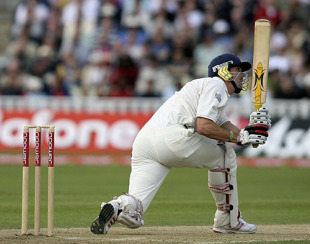
Kevin Pietersen plays an extraordinary reverse-sweep off Muttiah Muralitharan for six, 2nd Test, Edgbaston, May 26, 2006
KP: often turned spectators into pogo sticks © Getty Images 
Enlarge
 
Cricket is not maths. Also, no wooden ruler exists that can be lined upright beside cricketers and the adjudication handed down to chop this brat, but this other brat's a brat who can bat, so he stays. And the far-sighted correspondents of several nations' newspapers have had their says while trying to convey the gist of the wishes of the England XI, of whom Kevin Pietersen is no longer one. That makes ten. And I get that Pietersen was ego-burdened, money-fixated, ungrateful, unruly, unEnglish and that reflecting ponds were for him a serious life hazard. But they're still only ten. People like me, who like cricket, we number billions.
Not all the billion-odd liked Pietersen. Of those that didn't, many gutturally and vehemently didn't. Few were indifferent to him. The usual blindfolded detective work has since gone into guessing the where, how, why and who of his sacking. Particularly foggy is the "who". Of the "who", we know only this: the billion-odd were not among them. The feelings of the billion-odd went unmentioned in the backroom manoeuvrings and were put on no table for consideration. The ten mattered totally, and none thought to think of the billion. If we twist "who" round to mean who of the ten wished Pietersen out, we are not actually sure it was ten. It could have been seven, and three abstainers; it may, for all that the detective work has so far taught us, have been one. And in a soundproof room, there rails a billion.
To propose that the cricket-watching public's interests should have been taken into account in all of this would be reckoned the zenith of stupidity, were anyone stupid enough to utter such a thing. Call me stupid but is it not striking how neatly this Pietersen business folds into the current governing crisis - the tripartite Indo-Anglo-Bozo hijacking of the International Cricket Council? At the root of that is a scrambling for TV money. And is it not the cricket-watching public's eyeballs that watch the cricket that spurs the ratings that attract the TV dollars that put the fuel inside the cricket administrators' flash cars?
 
 
Pietersen was something stranger and rarer, too, than a player of great innings - a player of great shots. He'd dream up a shot, think wouldn't that be cool?, then try to get away with it
 
From there it may follow that if this billion-strong public, which brings in the bacon, likes to see a particular batsman bat - perhaps because he is entertaining and takes risks and bats with a certain free spirit - then the matter of them liking him should be a factor in any conversations held before that batsman is gotten rid of. But there are insiders. There are outsiders. The gap is wide. The insiders say the team's interests and team ethic is everything, always has been, which they are wrong about. Cricket for a lot of its existence was chiefly an entertainment. Were a player entertaining to watch, that could help get him a game. Not until much later did the winning and the losing take precedence over the entertaining. And only very recently did the making of money shout down all else, relegating entertainment to a distant third priority, with the entertainees voiceless.
The insiders believe a lack of teamliness in an individual's make-up to be the biggest and least overlookable flaw. I am not sure that's right either. Nor do the fixations alluded to earlier - with money, with self, with tasty biltong - seem so grave, on paper. Being a bully: that has to be worse. And I've read some history books and skimmed some player memoirs, and now my eyes are running down the all-time runs and wickets tables and although the bullies don't quite outnumber the goodies, the bullies are certainly not short of company. Of course, there is only so far one can go in separating these broader principles from the specific individual at hand: Pietersen.
"International cricket is where legacies are made," writes the Telegraph's Derek Pringle, "and Pietersen leaves with his only half realised as a player of great innings but not a great batsman."
Well, I know which kind of great I'd usually rather watch. And I worry that the maths is getting in theTelegraph correspondent's eyes. I don't watch batting averages ticking. I don't even watch cricket hoping a particular team will win. I watch to be moved and entertained. I can think of many a "great batsman" of my home country who moved me not nearly as much as a handful of "players of great innings" did.
Pietersen was something stranger and rarer, too, than a player of great innings - a player of great shots. He'd dream up a shot, think wouldn't that be cool?, then try to get away with it. Such a batsman's a high-value spectator attraction. A by-product is that his value to spectators can run in inverse proportion to the team. But why is it always about the team, never the spectator?

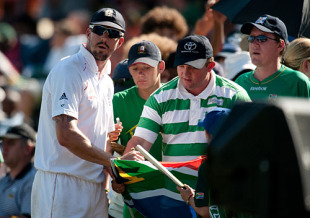
Kevin Pietersen shows the South African crowd some love, South Africa v England, 1st Test, Centurion, December 16, 2009
Pietersen's relationship with South Africa was often a prickly one © PA Photos 
Enlarge
Not only that. Pietersen, having hatched this shot out of the blue sky once and escaped, would reattempt it. At Edgbaston in 2006 medium-pacer Farveez Maharoof was bowling to a loaded off-side field. Before the next ball left Maharoof's hand, Pietersen was leaning across, softly wandering, culminating in a giant step forward, and though the ball landed a foot and a half outside off stump, angling further away, Pietersen's hands followed it, his wrists uncoiling, and he dispatched the ball miraculously cross-careening past mid-on to where no fielders were stationed. By then Pietersen was perching lopsided and one-legged, his back foot curled in the air. The shot acquired a name - "the flamingo" - and when he tried something similar off Dwayne Bravo at Headingley a year later he made Mike Atherton splutter into his microphone. "Unbelievable shot. It's the length that enables him to play the stroke. Anything a bit short and it's a more difficult shot to play… " - which rang true of the Bravo ball. But the Maharoof ball pitched barely halfway up. The wrist strength required of Pietersen was verging on uncomputable. He was 70 not out. On 79 he did it again: same bowler and field setting, near-replica delivery, four runs. And this - the reattempting of it - was what tipped the crowd over the edge, turned individual spectators into pogo sticks. That Pietersen passage burns in the memory alongside a 51 he made in Melbourne when I counted how many times he let the ball go, 14, each leave so tumultuous that the bat's stickers were pointing sky-side up.
He had another quality - what Sir Viv Richards was sort of referring to last year when he claimed "the comparison I'm drawing is with Muhammad Ali… you want to see KP get knocked over, but he goes out there and bang, bang, bang!", except an online commentator underneath a Guardian post put it better last week:
Since I started watching cricket as a 10 year old in 1991, I have seen no England batsman so talented and so exciting to watch … You don't really need more than that, but here's why I loved him more: his attitude, his demeanour, his style of play thoroughly pissed off the English cricketing establishment and I bloody loved it. These are the people who dropped Gower … who ruined Hick and Ramprakash.
I make no apology for quoting a member of the public, one of the billion-odd.
I do not want a reality TV-type scenario where people can text-vote "KP In/Out". I'd prefer to trust wise men to make the call and for one of their criteria to be the good that a player gives to cricket - and I'm not confident that happened here or ever does anymore.
And I accept what the journalist Peter Oborne writes of Don Bradman, Frank Worrell, Abdul Hafeez Kardar and a cricket world where "it was axiomatic that the individual should subordinate himself and his talents to the team". I see the nobleness in this, and it was an ingredient always missing in Pietersen, and had it been there he'd have been even better to watch, pure pleasure.
Oborne continues: "In so far as Pietersen has any nationality, he seems to be South African… He emerged as a cricketer in the most wonderful moment in South African history, when apartheid had gone and the country was building a multi-racial national team. Pietersen wanted no part in this new world. He got out as soon as he could, claiming that the positive discrimination necessary to help black cricketers stood in his way."
They are words that damn, as were Rachel Cooke's in an Observer profile of Pietersen years ago - "When he smiles it's only his mouth that softens, not his eyes." I know without meeting him that's right. I've seen the cold-eyes smile. It was even there at Edgbaston, in Melbourne. And when I reread something Pietersen said to Cooke - "I've never once criticised South Africa. I love the country. The people are fantastic. The exchange rate is magnificent" - what I think is: tosshead.
But there are high-stakes questions here, e.g. why does cricket exist? And for who? All I'm sure of is that two plus two is seven, and Pietersen equals the cricketer who cricket could least afford to lose.