As even its harshest critics concede, neoliberalism is hard to pin down. In broad terms, it denotes a preference for markets over government, economic incentives over cultural norms, and private entrepreneurship over collective action. It has been used to describe a wide range of phenomena – from Augusto Pinochet to Margaret Thatcher and Ronald Reagan, from the Clinton Democrats and the UK’s New Labour to the economic opening in China and the reform of the welfare state in Sweden.
The term is used as a catchall for anything that smacks of deregulation, liberalisation, privatisation or fiscal austerity. Today it is routinely reviled as a shorthand for the ideas and practices that have produced growing economic insecurity and inequality, led to the loss of our political values and ideals, and even precipitated our current populist backlash.
We live in the age of neoliberalism, apparently. But who are neoliberalism’s adherents and disseminators – the neoliberals themselves? Oddly, you have to go back a long time to find anyone explicitly embracing neoliberalism. In 1982, Charles Peters, the longtime editor of the political magazine Washington Monthly, published an essay titled A Neo-Liberal’s Manifesto. It makes for interesting reading 35 years later, since the neoliberalism it describes bears little resemblance to today’s target of derision. The politicians Peters names as exemplifying the movement are not the likes of Thatcher and Reagan, but rather liberals – in the US sense of the word – who have become disillusioned with unions and big government and dropped their prejudices against markets and the military.
The use of the term “neoliberal” exploded in the 1990s, when it became closely associated with two developments, neither of which Peters’s article had mentioned. One of these was financial deregulation, which would culminate in the 2008 financial crash and in the still-lingering euro debacle. The second was economic globalisation, which accelerated thanks to free flows of finance and to a new, more ambitious type of trade agreement. Financialisation and globalisation have become the most overt manifestations of neoliberalism in today’s world.
That neoliberalism is a slippery, shifting concept, with no explicit lobby of defenders, does not mean that it is irrelevant or unreal. Who can deny that the world has experienced a decisive shift toward markets from the 1980s on? Or that centre-left politicians – Democrats in the US, socialists and social democrats in Europe – enthusiastically adopted some of the central creeds of Thatcherism and Reaganism, such as deregulation, privatisation, financial liberalisation and individual enterprise? Much of our contemporary policy discussion remains infused with principles supposedly grounded in the concept of homo economicus, the perfectly rational human being, found in many economic theories, who always pursues his own self-interest.
But the looseness of the term neoliberalism also means that criticism of it often misses the mark. There is nothing wrong with markets, private entrepreneurship or incentives – when deployed appropriately. Their creative use lies behind the most significant economic achievements of our time. As we heap scorn on neoliberalism, we risk throwing out some of neoliberalism’s useful ideas.
The real trouble is that mainstream economics shades too easily into ideology, constraining the choices that we appear to have and providing cookie-cutter solutions. A proper understanding of the economics that lie behind neoliberalism would allow us to identify – and to reject – ideology when it masquerades as economic science. Most importantly, it would help us to develop the institutional imagination we badly need to redesign capitalism for the 21st century.
Neoliberalism is typically understood as being based on key tenets of mainstream economic science. To see those tenets without the ideology, consider this thought experiment. A well-known and highly regarded economist lands in a country he has never visited and knows nothing about. He is brought to a meeting with the country’s leading policymakers. “Our country is in trouble,” they tell him. “The economy is stagnant, investment is low, and there is no growth in sight.” They turn to him expectantly: “Please tell us what we should do to make our economy grow.”
The economist pleads ignorance and explains that he knows too little about the country to make any recommendations. He would need to study the history of the economy, to analyse the statistics, and to travel around the country before he could say anything.
 Tony Blair and Bill Clinton: centre-left politicians who enthusiastically adopted some of the central creeds of Thatcherism and Reaganism. Photograph: Reuters
But his hosts are insistent. “We understand your reticence, and we wish you had the time for all that,” they tell him. “But isn’t economics a science, and aren’t you one of its most distinguished practitioners? Even though you do not know much about our economy, surely there are some general theories and prescriptions you can share with us to guide our economic policies and reforms.”
The economist is now in a bind. He does not want to emulate those economic gurus he has long criticised for peddling their favourite policy advice. But he feels challenged by the question. Are there universal truths in economics? Can he say anything valid or useful?
So he begins. The efficiency with which an economy’s resources are allocated is a critical determinant of the economy’s performance, he says. Efficiency, in turn, requires aligning the incentives of households and businesses with social costs and benefits. The incentives faced by entrepreneurs, investors and producers are particularly important when it comes to economic growth. Growth needs a system of property rights and contract enforcement that will ensure those who invest can retain the returns on their investments. And the economy must be open to ideas and innovations from the rest of the world.
But economies can be derailed by macroeconomic instability, he goes on. Governments must therefore pursue a sound monetary policy, which means restricting the growth of liquidity to the increase in nominal money demand at reasonable inflation. They must ensure fiscal sustainability, so that the increase in public debt does not outpace national income. And they must carry out prudential regulation of banks and other financial institutions to prevent the financial system from taking excessive risk.
Now he is warming to his task. Economics is not just about efficiency and growth, he adds. Economic principles also carry over to equity and social policy. Economics has little to say about how much redistribution a society should seek. But it does tell us that the tax base should be as broad as possible, and that social programmes should be designed in a way that does not encourage workers to drop out of the labour market.
By the time the economist stops, it appears as if he has laid out a fully fledged neoliberal agenda. A critic in the audience will have heard all the code words: efficiency, incentives, property rights, sound money, fiscal prudence. And yet the universal principles that the economist describes are in fact quite open-ended. They presume a capitalist economy – one in which investment decisions are made by private individuals and firms – but not much beyond that. They allow for – indeed, they require – a surprising variety of institutional arrangements.
So has the economist just delivered a neoliberal screed? We would be mistaken to think so, and our mistake would consist of associating each abstract term – incentives, property rights, sound money – with a particular institutional counterpart. And therein lies the central conceit, and the fatal flaw, of neoliberalism: the belief that first-order economic principles map on to a unique set of policies, approximated by a Thatcher/Reagan-style agenda.
Consider property rights. They matter insofar as they allocate returns on investments. An optimal system would distribute property rights to those who would make the best use of an asset, and afford protection against those most likely to expropriate the returns. Property rights are good when they protect innovators from free riders, but they are bad when they protect them from competition. Depending on the context, a legal regime that provides the appropriate incentives can look quite different from the standard US-style regime of private property rights.
This may seem like a semantic point with little practical import; but China’s phenomenal economic success is largely due to its orthodoxy-defying institutional tinkering. China turned to markets, but did not copy western practices in property rights. Its reforms produced market-based incentives through a series of unusual institutional arrangements that were better adapted to the local context. Rather than move directly from state to private ownership, for example, which would have been stymied by the weakness of the prevailing legal structures, the country relied on mixed forms of ownership that provided more effective property rights for entrepreneurs in practice. Township and Village Enterprises (TVEs), which spearheaded Chinese economic growth during the 1980s, were collectives owned and controlled by local governments. Even though TVEs were publicly owned, entrepreneurs received the protection they needed against expropriation. Local governments had a direct stake in the profits of the firms, and hence did not want to kill the goose that lays the golden eggs.
China relied on a range of such innovations, each delivering the economist’s higher-order economic principles in unfamiliar institutional arrangements. For instance, it shielded its large state sector from global competition, establishing special economic zones where foreign firms could operate with different rules than in the rest of the economy. In view of such departures from orthodox blueprints, describing China’s economic reforms as neoliberal – as critics are inclined to do – distorts more than it reveals. If we are to call this neoliberalism, we must surely look more kindly on the ideas behind the most dramatic poverty reduction in history.
One might protest that China’s institutional innovations were purely transitional. Perhaps it will have to converge on western-style institutions to sustain its economic progress. But this common line of thinking overlooks the diversity of capitalist arrangements that still prevails among advanced economies, despite the considerable homogenisation of our policy discourse.
What, after all, are western institutions? The size of the public sector in OECD countries varies, from a third of the economy in Korea to nearly 60% in Finland. In Iceland, 86% of workers are members of a trade union; the comparable number in Switzerland is just 16%. In the US, firms can fire workers almost at will; French labour laws have historically required employers to jump through many hoops first. Stock markets have grown to a total value of nearly one-and-a-half times GDP in the US; in Germany, they are only a third as large, equivalent to just 50% of GDP.
 ‘China turned to markets, but did not copy western practices ... ’ Photograph: AFP/Getty
The idea that any one of these models of taxation, labour relations or financial organisation is inherently superior to the others is belied by the varying economic fortunes that each of these economies have experienced over recent decades. The US has gone through successive periods of angst in which its economic institutions were judged inferior to those in Germany, Japan, China, and now possibly Germany again. Certainly, comparable levels of wealth and productivity can be produced under very different models of capitalism. We might even go a step further: today’s prevailing models probably come nowhere near exhausting the range of what might be possible, and desirable, in the future.
The visiting economist in our thought experiment knows all this, and recognises that the principles he has enunciated need to be filled in with institutional detail before they become operational. Property rights? Yes, but how? Sound money? Of course, but how? It would perhaps be easier to criticise his list of principles for being vacuous than to denounce it as a neoliberal screed.
Still, these principles are not entirely content-free. China, and indeed all countries that managed to develop rapidly, demonstrate the utility of those principles once they are properly adapted to local context. Conversely, too many economies have been driven to ruin courtesy of political leaders who chose to violate them. We need look no further than Latin American populists or eastern European communist regimes to appreciate the practical significance of sound money, fiscal sustainability and private incentives.
Of course, economics goes beyond a list of abstract, largely common-sense principles. Much of the work of economists consists of developing stylised models of how economies work and then confronting those models with evidence. Economists tend to think of what they do as progressively refining their understanding of the world: their models are supposed to get better and better as they are tested and revised over time. But progress in economics happens differently.
Economists study a social reality that is unlike the physical universe. It is completely manmade, highly malleable and operates according to different rules across time and space. Economics advances not by settling on the right model or theory to answer such questions, but by improving our understanding of the diversity of causal relationships. Neoliberalism and its customary remedies – always more markets, always less government – are in fact a perversion of mainstream economics. Good economists know that the correct answer to any question in economics is: it depends.
Does an increase in the minimum wage depress employment? Yes, if the labour market is really competitive and employers have no control over the wage they must pay to attract workers; but not necessarily otherwise. Does trade liberalisation increase economic growth? Yes, if it increases the profitability of industries where the bulk of investment and innovation takes place; but not otherwise. Does more government spending increase employment? Yes, if there is slack in the economy and wages do not rise; but not otherwise. Does monopoly harm innovation? Yes and no, depending on a whole host of market circumstances.
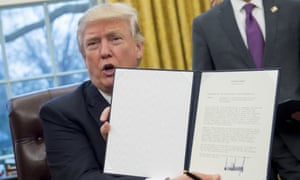 ‘Today [neoliberalism] is routinely reviled as a shorthand for the ideas that have produced growing economic inequality and precipitated our current populist backlash’ … Trump signing an order to take the US out of the TPP trade pact. Photograph: AFP/Getty
In economics, new models rarely supplant older models. The basic competitive-markets model dating back to Adam Smith has been modified over time by the inclusion, in rough historical order, of monopoly, externalities, scale economies, incomplete and asymmetric information, irrational behaviour and many other real-world features. But the older models remain as useful as ever. Understanding how real markets operate necessitates using different lenses at different times.
Perhaps maps offer the best analogy. Just like economic models, maps are highly stylised representations of reality. They are useful precisely because they abstract from many real-world details that would get in the way. But abstraction also implies that we need a different map depending on the nature of our journey. If we are travelling by bike, we need a map of bike trails. If we are to go on foot, we need a map of footpaths. If a new subway is constructed, we will need a subway map – but we wouldn’t throw out the older maps.
Economists tend to be very good at making maps, but not good enough at choosing the one most suited to the task at hand. When confronted with policy questions of the type our visiting economist faces, too many of them resort to “benchmark” models that favour the laissez-faire approach. Kneejerk solutions and hubris replace the richness and humility of the discussion in the seminar room. John Maynard Keynes once defined economics as the “science of thinking in terms of models, joined to the art of choosing models which are relevant”. Economists typically have trouble with the “art” part.
This, too, can be illustrated with a parable. A journalist calls an economics professor for his view on whether free trade is a good idea. The professor responds enthusiastically in the affirmative. The journalist then goes undercover as a student in the professor’s advanced graduate seminar on international trade. He poses the same question: is free trade good? This time the professor is stymied. “What do you mean by ‘good’?” he responds. “And good for whom?” The professor then launches into an extensive exegesis that will ultimately culminate in a heavily hedged statement: “So if the long list of conditions I have just described are satisfied, and assuming we can tax the beneficiaries to compensate the losers, freer trade has the potential to increase everyone’s wellbeing.” If he is in an expansive mood, the professor might add that the effect of free trade on an economy’s longterm growth rate is not clear either, and would depend on an altogether different set of requirements.
This professor is rather different from the one the journalist encountered previously. On the record, he exudes self-confidence, not reticence, about the appropriate policy. There is one and only one model, at least as far as the public conversation is concerned, and there is a single correct answer, regardless of context. Strangely, the professor deems the knowledge that he imparts to his advanced students to be inappropriate (or dangerous) for the general public. Why?
The roots of such behaviour lie deep in the culture of the economics profession. But one important motive is the zeal to display the profession’s crown jewels – market efficiency, the invisible hand, comparative advantage – in untarnished form, and to shield them from attack by self-interested barbarians, namely the protectionists. Unfortunately, these economists typically ignore the barbarians on the other side of the issue – financiers and multinational corporations whose motives are no purer and who are all too ready to hijack these ideas for their own benefit.
As a result, economists’ contributions to public debate are often biased in one direction, in favour of more trade, more finance and less government. That is why economists have developed a reputation as cheerleaders for neoliberalism, even if mainstream economics is very far from a paean to laissez-faire. The economists who let their enthusiasm for free markets run wild are in fact not being true to their own discipline.
How then should we think about globalisation in order to liberate it from the grip of neoliberal practices? We must begin by understanding the positive potential of global markets. Access to world markets in goods, technologies and capital has played an important role in virtually all of the economic miracles of our time. China is the most recent and powerful reminder of this historical truth, but it is not the only case. Before China, similar miracles were performed by South Korea, Taiwan, Japan and a few non-Asian countries such as Mauritius. All of these countries embraced globalisation rather than turn their backs on it, and they benefited handsomely.
Defenders of the existing economic order will quickly point to these examples when globalisation comes into question. What they will fail to say is that almost all of these countries joined the world economy by violating neoliberal strictures. South Korea and Taiwan, for instance, heavily subsidised their exporters, the former through the financial system and the latter through tax incentives. All of them eventually removed most of their import restrictions, long after economic growth had taken off.
But none, with the sole exception of Chile in the 1980s under Pinochet, followed the neoliberal recommendation of a rapid opening-up to imports. Chile’s neoliberal experiment eventually produced the worst economic crisis in all of Latin America. While the details differ across countries, in all cases governments played an active role in restructuring the economy and buffering it against a volatile external environment. Industrial policies, restrictions on capital flows and currency controls – all prohibited in the neoliberal playbook – were rampant.
 Protest against Nafta in Mexico City in 2008: since the reforms of the mid-90s, the country’s economy has underperformed. Photograph: EPA
By contrast, countries that stuck closest to the neoliberal model of globalisation were sorely disappointed. Mexico provides a particularly sad example. Following a series of macroeconomic crises in the mid-1990s, Mexico embraced macroeconomic orthodoxy, extensively liberalised its economy, freed up the financial system, sharply reduced import restrictions and signed the North American Free Trade Agreement (Nafta). These policies did produce macroeconomic stability and a significant rise in foreign trade and internal investment. But where it counts – in overall productivity and economic growth – the experiment failed. Since undertaking the reforms, overall productivity in Mexico has stagnated, and the economy has underperformed even by the undemanding standards of Latin America.
These outcomes are not a surprise from the perspective of sound economics. They are yet another manifestation of the need for economic policies to be attuned to the failures to which markets are prone, and to be tailored to the specific circumstances of each country. No single blueprint fits all.
As Peters’s 1982 manifesto attests, the meaning of neoliberalism has changed considerably over time as the label has acquired harder-line connotations with respect to deregulation, financialisation and globalisation. But there is one thread that connects all versions of neoliberalism, and that is the emphasis on economic growth. Peters wrote in 1982 that the emphasis was warranted because growth is essential to all our social and political ends – community, democracy, prosperity. Entrepreneurship, private investment and removing obstacles that stand in the way (such as excessive regulation) were all instruments for achieving economic growth. If a similar neoliberal manifesto were penned today, it would no doubt make the same point.
Critics often point out that this emphasis on economics debases and sacrifices other important values such as equality, social inclusion, democratic deliberation and justice. Those political and social objectives obviously matter enormously, and in some contexts they matter the most. They cannot always, or even often, be achieved by means of technocratic economic policies; politics must play a central role.
Still, neoliberals are not wrong when they argue that our most cherished ideals are more likely to be attained when our economy is vibrant, strong and growing. Where they are wrong is in believing that there is a unique and universal recipe for improving economic performance, to which they have access. The fatal flaw of neoliberalism is that it does not even get the economics right. It must be rejected on its own terms for the simple reason that it is bad economics.