Pervez Hoodbhoy in The Dawn
PAKISTAN’S military and government have proscribed the militant Islamic State (IS, aka Daesh aka ISIS) group and declared it an enemy organisation. They have never explained why. Of course, IS’s atrocities — which include beheadings, crucifixions, suicide bombings, and intimidation of civilians in captured territories — have been condemned by many. It is also a fact that IS has killed many more Muslims than non-Muslims. But is IS to be faulted for bad tactics or is its goal to create an Islamic state in Pakistan itself wrong? Should attempts to make a global caliphate be condemned or, instead, assisted?
Our generals and politicians would rather bomb IS than argue logically against it because they know IS’s stated goal resonates with millions of ordinary Pakistanis. Through its internet machinery, IS declares it will establish God’s principality (mumlikat-i-khudadad) headed by a righteous caliph who would govern by God’s law. For this to happen territory must be seized and secured, idolatry and heresy eliminated, and the immoral mixing of men and women stopped. This is sweet music to many Pakistani ears.
IS literature claims that Muslims can properly practise their faith only in an Islamic state. This also resonates perfectly. The leader of Kashmiri separatists and a member of the Jamaat-i-Islami, Syed Ali Shah Geelani, put it succinctly: “It’s as difficult for a Muslim to live in a non-Muslim society as it is for a fish to live out of the water.”
More support comes from Allama Iqbal, Pakistan’s celebrated poet-philosopher who declared that the ultimate goal of Muslims is to create a caliphate. In his influential 1934 lectures The Reconstruction of Religious Thought in Islam, Iqbal said: “In order to create a really effective political unity of Islam, all Muslim countries must first become independent: and then in their totality they should range themselves under one caliph. Is such a thing possible at the present moment? If not today, one must wait.”
Pakistan’s generals and politicians would rather bomb IS than argue logically against it.
With such a powerful voice advocating the caliphate as an eventual goal, should one then accept IS’s vision as authentically Islamic? Does IS genuinely represent Muslim thought and Muslim aspirations today? For two strong reasons — the ones that generals and politicians fail to articulate — I think not.
First, IS claims its legitimacy through Islam. But this is futile. IS’s takfiri Islam is definitely not mainstream Islam. This one particular strain must be contrasted against countless gentler, differently reasoned, more humane forms that reject IS’s harsh interpretations. To say which one of these is the truer Islam is irresolvable since Islam does not have a central authority like the pope.
But IS wants ‘purification’ and so those Shia Muslims and Sunni Muslims who disagree with its version have been declared apostates, stoned, killed, and had their hands and feet cut off. Like the Afghan Taliban, IS delights in destroying humanity’s common heritage. It despises archaeology, women and non-Muslims. Even if some Muslims agree with IS’s deeds, most reject them.
Second, IS’s claim that Islam insists upon a caliphate is not supported by the Holy Quran. Every Islamic scholar has to agree that the Quran does not mention a territorial Islamic state. In fact, there is no word for a territorial state in classical Arabic. That which comes closest today is dawlah but this word acquired its current meaning well after the 1648 Treaty of Westphalia, when the European concept of a geographically defined nation-state was born.
Islam’s greatest sociologist and political scientist, Ibn-i-Khaldun (1332-1406), had emphatically rejected the concept of an Islamic state and opposed using religion in politics. Others such as al-Mawardi (earlier) and Syed Abul Ala Maudoodi (later) thought otherwise, but all agree that the holy texts are not governance manuals.
Quarrels among scholars would have been stilled if the Quran or hadith had defined even the broad outlines of statehood. However these texts provide no hint of an executive or of government ministries. How should administrative units be determined, and the police or army organised. Would there be jails?
Most tellingly, the holy texts leave us guessing on how an Islamic state’s ruler is to be chosen and what might be legitimate cause for his removal. To this day there are furious disagreements as to whether Prophet Muhammad (PBUH) did or did not specify his successor — or even a procedure for determining one. This created an enduring schism on how to select the next leaders of the faithful. So, for example, is Abu Bakr al-Baghdadi acceptable as the present caliph or should it be someone else?
There can surely be hugely different opinions on religious and political matters, including whether a caliphate is desirable or possible in a globalised world. These are tolerable, arguable differences. But what Pakistan absolutely must not tolerate is messianic radicalism that encourages the killing of innocents after labelling them kafirs. Whether a group is anti-Pakistan (IS, Tehreek-i-Taliban Pakistan), or pro-Pakistan (Afghan Taliban, Lashkar-e-Taiba, Jaish-e-Mohammad) is irrelevant. Every group that calls for violence against civilians inside or outside national borders should be banned. A victory of religious fanatics would ensure limitless suffering and the destruction of every Muslim society on this planet.
So far ideologically unchallenged, IS is now fast increasing its presence across Pakistan and particularly in Balochistan. Even as it loses territory in Iraq and Syria, its propaganda units are trying to create new generations of religious extremists, much as they have done in Europe. Decrying IS as a rogue movement is insufficient to reverse this trend. It is also futile to claim that IS has nothing to do with Islam because its leadership carefully quotes supportive holy doctrines to justify every major atrocity. Therefore IS must first be defeated on ideological grounds — military action can come later if necessary.
Counter narratives to radicalisation do exist within the Islamic paradigm. A meeting of ulema called by the National Counter Terrorism Authority that I attended earlier this year cogently argued that radical takfiri groups depart from Islamic tradition and that their interpretation of Islamic sources is incorrect. But these wise recommendations, like many before them, have met obscurity. No Pakistani civil or military leader of significance has had the courage to endorse or own them. Extremism can breed rapidly in this climate.
Saturday, 14 October 2017
When it comes to meat, the kitchen is a battlefield – and conscience is a casualty

When he was a schoolboy, the great polymath Jonathan Miller won a reputation as the finest chicken impersonator in north London.
The pleasure his friends and family took in his performance had encouraged him to get the linguistics absolutely right. Rival impersonators at his school were happy to make do with “buk, buk, buk, buk … bacagh” but the future satirist, actor, opera director and neuropsychologist noticed that the noise chickens made wasn’t so regular, that “chickens liked to lead you up the garden path”, as he wrote in Granta magazine in 1988.
“They would lead you to expect that for every four or five ‘buks’ there would be a ‘bacagh’ … What I noticed, after prolonged examination, was an entirely different pattern of chicken speech behaviour. Thus: Buk, buk, buk, buk, buk, buk, bacagh, buk, buk, bacagh, buk, buk, buk, buk, buk, buk, buk, buk, buk … BACAGH, buk, buk …”
There was a war on – rationing, a shortage of eggs. Miller knew chickens intimately because his father, a military psychiatrist, kept them, and towed them in a trailer behind the car as the family moved from one hospital posting to the next.
My own family’s chickens, perhaps kept a little later than Miller’s but for similar reasons, weren’t so well travelled. They merely moved out of their shed in the daytime and back again at night, through a little door that could be lowered and raised like a shutter in an old-fashioned railway booking office.
The industrialisation of the meat supply, which began in the 19th century, worked both for and against compassion
When we got rid of the chickens this sliding door was nailed shut, to survive until the shed’s demolition 50 years later as a mysterious architectural feature that made sense only to those of us who’d seen the creatures stalking cautiously through it – “buk, buk, buk” – in those faraway days of cod liver oil and powdered egg.
What happened to the inmates? My memory is inexact, but I remember a scene in the kitchen: a hen fluttering and squawking (“BACAGH”), my father laughing and half-crying at the same time. “I cannie do it, I just cannie do it.” The hen was a favourite of his called Betty, and what he couldn’t bring himself to do was wring her neck. I don’t know what happened next, or what became of Betty’s four or five companions – perhaps they were sold or given away, or had their necks successfully wrung.
I also don’t recall eating any chicken, and chicken on the menu would have been rare enough to be memorable then, and in our house and many other houses would remain so into the 1960s. All that remains is an image: a frightened hen and its frustrated would-be killer.
Two weeks ago, when the Guardian and ITV published their undercover investigation into dubious work practices at a West Midlands chicken factory, that memory prompted a fantastical calculation. The plant’s owner, the 2 Sisters Food Group, kills and processes 6 million chickens every week. Other firms in the UK kill another 11 million chickens, which means the country contributes about 875 million chickens every year to the global total of more than 50 billion that are reared and killed annually for food.
If only a tiny proportion of these birds were looked on affectionately by the people who killed them, the distress added to humankind would still be considerable: my fantastical calculation imagined that kitchen scene of 60-odd years ago multiplied many million times, like frames in a very long film, each flickering with remorse.
Of course, the ever-moving production lines of the industrial food system spare workers no time to reflect. And they’ve come after all – from 36 different countries, in the case of 2 Sisters – to make money rather than campaign for animal rights.
And of course, the point of the Guardian-ITV story was to raise concerns on the consumer’s behalf rather than the animals’, with footage showing chicken pieces being retrieved from the factory floor and thrown straight back on to the production line, and evidence that packets contained chicken older than the sellby dates suggested.
But while these malpractices may threaten human health, they carry much less emotional weight than the sight of the slaughtering and cutting process itself, no matter how hygienic or well run. They seem like small breaches of discipline in the corner of a gory battlefield that we usually take care to avoid any sight of.
The industrialisation of the meat supply, which began in the 19th century, worked both for and against compassion. On the one hand, it broke the relationship between the animal and his human keeper by taking slaughter out of the farm and the butcher’s shop and confining it to the municipal abattoir, where beasts were literally poleaxed by slaughtermen whose only business was killing. On the other hand, it made a later generation uneasy about the invisible cruelty in their midst. In an increasingly urban and technological society, where animals were sentimentally attractive, the notion of “preventable suffering” grew.
Under the banner of its irreconcilable title, the Humane Slaughter Association campaigned for the humane mechanical killer – the stun gun – that was already used in parts of continental Europe when the association was founded in London in 1911.
By 1913 a Birmingham company, Accles & Shelvoke, had come up with something rather better – the captive-bolt Cash pistol, named after the animal welfarist Christopher Cash, who first had the idea. Since the Slaughter of Animals Act in 1933, Cash pistols have stunned most of Britain’s cattle, calves and sheep and made the fortune of Accles & Shelvoke, which surprisingly still exists to make them.
Poultry are not prepared for death that way. The big processing plants have two methods. In the older, the birds are hung by their legs from a moving line that swings them head-first into a bath of electrified water, which according to the strength and frequency of the current can either just stun the birds (if religious tradition insists they be kept alive for bleeding), or kill as well as stun them. In the newer method, using gas, the birds pass through a machine with a controlled atmosphere that makes them first unconscious and then dead.
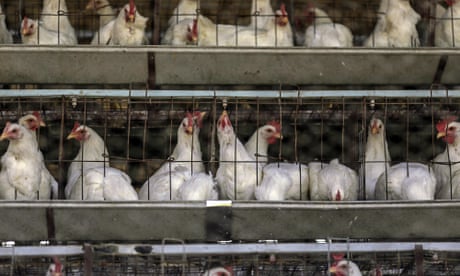
If consumers knew how farmed chickens were raised, they might never eat their meat again
These aren’t pleasant facts, and yet in most cases they represent a kindness – a quick and sure death – that has been absent in a typical chicken’s life until that point.
Felicity Lawrence, the Guardian’s writer on the food industry, has vividly described the effects of the genetic research that has gone into finding the most economically efficient bird. Fleshy breasts are particularly important in the broiler chicken. “By day nine, the broiler’s legs can barely keep its oversized breast off the ground. By day 11, it is puffed up to double the size of its [egg-laying] cousin … By day 35, it looks more like a weightlifter on steroids … bones, hearts and lungs cannot keep up. A large proportion of broilers suffer from leg problems … Birds that sit in foul litter suffer more skin disease. Deaths from heart attacks or swollen hearts that cannot supply enough oxygen to their oversized breast muscles are also common.”
Poultry now accounts for about a half of all meat eaten in Britain. It’s cheap. The cruelty that goes into the making of it is unconscionable.
Friday, 13 October 2017
Will India get over its obsession with godmen?
K N Pannikar in The Hindu
The recent revelations about the ‘divine preoccupations’ of godmen in the sacred precincts of their ashrams have been appalling, not because they were bereft of such qualities in the past. From the time of the Maharaj libel case (1862) through the intrigues of Chandraswami and Dhirendra Brahmachari, to the contemporary saga of Dera Sacha Sauda and Asaram Bapu, the list is unending. But this time the incidents of sex, murder and mayhem, which were reportedly enacted in their ashrams, are lurid and startling. That the godmen were able to pursue their interests for years without attracting the attention of the state is perhaps not surprising, given the nexus between political power and religious establishments, but it is reprehensible.
The unflinching faith of the followers in the divinity of godmen is the latter’s main capital, which is assiduously constructed over time. Under coercion or consent, the devotees appear to submit to the extortion or exploitation of godmen. Contemporary India looks like a modern country with scientific establishments, and high-speed trains and expansive highways, but set in a social situation reeking of medievalism, caste discrimination, religious obscurantism, gender inequality and superstitions.
Modernity and irrationality
The coexistence of modernity with irrationality and obscurantism, which has often been dismissed as a passing phase of a society in transition, has been a (the?) hallmark of independent India. The ruling elite pinned their hopes on economic development to overcome this impediment, but economic development has not been all-embracing. Facing the crisis thus generated by the apparently elite character of development, it was not surprising that a large segment of the population succumbed to the temptations of an unreal world which godmen proffered.
Yet another constituency of the godmen were the members of the burgeoning middle class of the post-Independence era. The hallmark of this class was the intense cultural and social crisis for which they sought a solution in other-worldliness advocated by the godmen. They were led to an island of liberation where all social inhibitions could be shed, and peace and salvation promised, through the medium of the godmen. The mindless support godmen thus elicit from their unsuspecting followers is used to garner social, political and economic power.
In recent times, the increasing number of godmen (and women) are spotted in State governments and corporate board meetings, educational institutions, and all other important places. They are not spiritual men but ambitious con artists who purvey deception, falsehood and religiosity in the name of god.
Education not enough
Rationalists and liberals looked upon education which promoted scientific temper and rational thinking as the antidote to what they conceived as a result of cultural and social backwardness. But education has not adequately fulfilled this role. After all, the substantial following that godmen command is not from the illiterate masses, but from the well-educated middle class that tends to celebrate the irrational in the name of culture.
Popular media, either consciously or unconsciously, promotes and reinforces irrationality and superstition. The reading material available in almost all Indian languages is replete with accounts of the charismatic personae and spiritual qualities of godmen. Not only religious channels, but some secular channels too telecast programmes eulogising their qualities and achievements. From these popular representations, and patronage they seem to enjoy from the state, they derive considerable legitimacy.
The godmen are here to stay, until social consciousness undergoes a qualitative change.
Thursday, 12 October 2017
IMF: higher taxes for rich will cut inequality without hitting growth
Analysis supports tax strategy of Jeremy Corbyn’s Labour in UK – and undermines that of Donald Trump in US
Larry Elliott in The Guardian
 The IMF said tax theory suggested there should be ‘significantly higher’ tax rates for high earners. Photograph: Oli Scarff/Getty Images
Higher income tax rates for the rich would help reduce inequality without having an adverse impact on growth, the International Monetary Fund has said.
The Washington-based IMF used its influential half-yearly fiscal monitor to demolish the argument that economic growth would suffer if governments in advanced Western countries forced the top 1% of earners to pay more tax.
The IMF said tax theory suggested there should be “significantly higher” tax rates for those on higher incomes but the argument against doing so was that hitting the rich would be bad for growth.
But the influential global institution said: “Empirical results do not support this argument, at least for levels of progressivity that are not excessive.” The IMF added that different types of wealth taxes might also be considered.
Labour seized on the report, calling for higher taxes on the rich, citing the IMF’s intervention as evidence of the need for a fairer tax system.
In its election manifesto, Labour proposed a new 45% tax band on those earning more than £80,000 and a 50% rate for those on more than £123,000.
John McDonnell, the shadow chancellor, said: “The IMF support the argument we made in the General Election for a fairer tax system. There is no evidence to support those who scaremonger about the effects of making the rich pay fairer tax.”
He added: “ Not only have the Tories slashed the top rate of tax, they still plan billions in tax giveaways to the super rich and big corporations over this parliament.”
Despite claims from ministers that Labour’s tax plans would be both politically and economically damaging, McDonnell believes higher taxes for the rich would be both workable and popular.
“With every day that passes the case for a change of direction at the Treasury grows. Instead of engaging in infighting in his own party the chancellor should listen to Labour’s calls for fairer taxes and increased investment, so we will build an economy for the many not the few.”
Theresa May has repeatedly attacked Labour’s approach as extreme, claiming in prime minister’s questions on Wednesday that Corbyn and McDonnell are on “planet Venezuela”.
But the prime minister conceded at a fringe meeting at her party’s conference in Manchester that public opinion appears to be more favourable to some of Labour’s economic ideas than Conservative strategists had assumed in the run-up to June’s general election.
“We thought there was a political consensus,” she said. “Jeremy Corbyn changed that”.
With Philip Hammond due to deliver his budget next month, it is unclear whether the government will press ahead with promised tax cuts for higher earners, including plans to increase the higher rate threshold for income tax to £50,000.
The fiscal monitor does not mention any country by name and does not specify at what level governments should set the new higher rate for top earners. But the report stressed that cutting tax for the top 1% had gone too far - a strong hint that the IMF has doubts about the pro-rich tax plan proposed by Donald Trump for the US.
Instead, the IMF said higher tax for the rich was necessary to arrest rising income inequality – the argument used by McDonnell and the Labour leader Jeremy Corbyn.
The fiscal monitor said most advanced economies in the West had experienced a sizeable increase in income inequality in the past three decades, driven primarily by the growing income of the top 1%.
Traditionally, governments have sought to make their societies less unequal by levying higher income tax rates on the rich and using the proceeds to help those less well off either directly or through public services.
But it found that income tax systems had become markedly less progressive in the 1980s and 1990s and had remained stable since then, even though growing inequality raised the need for a more progressive approach.
In an IMF blog, the head of the IMF’s fiscal affairs unit, Vitor Gaspar, said the average top income tax rate for the rich country members of the Organisation for Economic Cooperation and Development had fallen from 62% in 1981 to 35% in 2015.
“In addition, tax systems are less progressive than indicated by the statutory rates, because wealthy individuals have more access to tax relief,” Gaspar said in the blog co-written with Mercedes Garcia-Escribano. “Importantly, we find that some advanced economies can increase progressivity without hampering growth, as long as progressivity is not excessive.”
IMF research found that between 1985 and 1995, redistribution through the tax system had offset 60% of the increase in inequality caused by market forces. But between 1995 and 2010, income tax systems failed to respond to the continuing increase in inequality.
It also said inequality should be tackled by giving a more pro-poor slant to public spending.
“Despite progress, gaps in access to quality education and healthcare services between different income groups in the population remain in many countries,” Gaspar and Garcia-Escribano said, adding that in rich countries men with university education lived up to 14 years longer than those with secondary education or less.
“Better public spending can help, for instance, by reallocating education or health spending from the rich to the poor while keeping total public education or health spending unchanged,” they added.
In its separate global financial stability review, the IMF said it would take several years for central banks to return interest rates to more normal levels due to the risk of aborting recovery.
But the report also highlighted the risk that prolonged monetary support could lead to the buildup of further financial excesses. Too much money was chasing too few assets offering a yield, the IMF said.
A Treasury spokesperson said: “A fair tax system is a critical part of our plan to build a fairer society. Today, the richest 1% pay over a quarter of all income tax while 4 million of the lower earners have been taken out of income tax altogether.”
Larry Elliott in The Guardian
The IMF said tax theory suggested there should be ‘significantly higher’ tax rates for high earners. Photograph: Oli Scarff/Getty ImagesHigher income tax rates for the rich would help reduce inequality without having an adverse impact on growth, the International Monetary Fund has said.
The Washington-based IMF used its influential half-yearly fiscal monitor to demolish the argument that economic growth would suffer if governments in advanced Western countries forced the top 1% of earners to pay more tax.
The IMF said tax theory suggested there should be “significantly higher” tax rates for those on higher incomes but the argument against doing so was that hitting the rich would be bad for growth.
But the influential global institution said: “Empirical results do not support this argument, at least for levels of progressivity that are not excessive.” The IMF added that different types of wealth taxes might also be considered.
Labour seized on the report, calling for higher taxes on the rich, citing the IMF’s intervention as evidence of the need for a fairer tax system.
In its election manifesto, Labour proposed a new 45% tax band on those earning more than £80,000 and a 50% rate for those on more than £123,000.
John McDonnell, the shadow chancellor, said: “The IMF support the argument we made in the General Election for a fairer tax system. There is no evidence to support those who scaremonger about the effects of making the rich pay fairer tax.”
He added: “ Not only have the Tories slashed the top rate of tax, they still plan billions in tax giveaways to the super rich and big corporations over this parliament.”
Despite claims from ministers that Labour’s tax plans would be both politically and economically damaging, McDonnell believes higher taxes for the rich would be both workable and popular.
“With every day that passes the case for a change of direction at the Treasury grows. Instead of engaging in infighting in his own party the chancellor should listen to Labour’s calls for fairer taxes and increased investment, so we will build an economy for the many not the few.”
Theresa May has repeatedly attacked Labour’s approach as extreme, claiming in prime minister’s questions on Wednesday that Corbyn and McDonnell are on “planet Venezuela”.
But the prime minister conceded at a fringe meeting at her party’s conference in Manchester that public opinion appears to be more favourable to some of Labour’s economic ideas than Conservative strategists had assumed in the run-up to June’s general election.
“We thought there was a political consensus,” she said. “Jeremy Corbyn changed that”.
With Philip Hammond due to deliver his budget next month, it is unclear whether the government will press ahead with promised tax cuts for higher earners, including plans to increase the higher rate threshold for income tax to £50,000.
The fiscal monitor does not mention any country by name and does not specify at what level governments should set the new higher rate for top earners. But the report stressed that cutting tax for the top 1% had gone too far - a strong hint that the IMF has doubts about the pro-rich tax plan proposed by Donald Trump for the US.
Instead, the IMF said higher tax for the rich was necessary to arrest rising income inequality – the argument used by McDonnell and the Labour leader Jeremy Corbyn.
The fiscal monitor said most advanced economies in the West had experienced a sizeable increase in income inequality in the past three decades, driven primarily by the growing income of the top 1%.
Traditionally, governments have sought to make their societies less unequal by levying higher income tax rates on the rich and using the proceeds to help those less well off either directly or through public services.
But it found that income tax systems had become markedly less progressive in the 1980s and 1990s and had remained stable since then, even though growing inequality raised the need for a more progressive approach.
In an IMF blog, the head of the IMF’s fiscal affairs unit, Vitor Gaspar, said the average top income tax rate for the rich country members of the Organisation for Economic Cooperation and Development had fallen from 62% in 1981 to 35% in 2015.
“In addition, tax systems are less progressive than indicated by the statutory rates, because wealthy individuals have more access to tax relief,” Gaspar said in the blog co-written with Mercedes Garcia-Escribano. “Importantly, we find that some advanced economies can increase progressivity without hampering growth, as long as progressivity is not excessive.”
IMF research found that between 1985 and 1995, redistribution through the tax system had offset 60% of the increase in inequality caused by market forces. But between 1995 and 2010, income tax systems failed to respond to the continuing increase in inequality.
It also said inequality should be tackled by giving a more pro-poor slant to public spending.
“Despite progress, gaps in access to quality education and healthcare services between different income groups in the population remain in many countries,” Gaspar and Garcia-Escribano said, adding that in rich countries men with university education lived up to 14 years longer than those with secondary education or less.
“Better public spending can help, for instance, by reallocating education or health spending from the rich to the poor while keeping total public education or health spending unchanged,” they added.
In its separate global financial stability review, the IMF said it would take several years for central banks to return interest rates to more normal levels due to the risk of aborting recovery.
But the report also highlighted the risk that prolonged monetary support could lead to the buildup of further financial excesses. Too much money was chasing too few assets offering a yield, the IMF said.
A Treasury spokesperson said: “A fair tax system is a critical part of our plan to build a fairer society. Today, the richest 1% pay over a quarter of all income tax while 4 million of the lower earners have been taken out of income tax altogether.”
Subscribe to:
Comments (Atom)