My colleagues should have been holding the Tories to account for the Brexit vote. Instead they’ve unleashed self-serving havoc on their own party
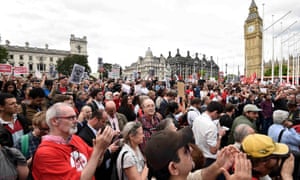
Labour supporters show their support for Jeremy Corbyn in Parliament Square earlier this week. Photograph: Toby Melville/Reuters
A swirling red mist has descended over the eyes of many Labour MPs. It is a mist that makes them blind to how their activities look to the world outside the Westminster village. If they don’t like Jeremy Corbyn (and despite their protestations to the contrary they give every appearance of not doing so) then they always had the option of a leadership challenge under the rule book. It could have been conducted in an orderly, perhaps low-key fashion, at least until parliament went into recess in just three weeks’ time. The aim would have been to try to concentrate on bringing the country together in a time of great peril after the Brexit vote. And it would have been important in these early days for the entire parliamentary party to focus on holding the Tories to account.
Instead Labour MPs chose to stage a blood-stained three-ring circus. Instead of putting their energies into fighting the Tories, colleagues have been concentrating on orchestrating waves of MPs – whom no one has ever heard of – into resigning from jobs that nobody knew they had. Colleagues could have been providing leadership against the resurgent racism that so many of their constituents are terrified by.
Instead Labour MPs have spent time in huddles with their fellow inhabitants of the Westminster bubble, lobby correspondents. These journalists, supposed political experts, did not see the Jeremy Corbyn phenomenon coming last summer and have never supported him. Accordingly they are now using their columns to tell him to walk away. Colleagues have contrived a “vote of no confidence” that has absolutely no basis in the rule book. There was no notice. It was tabled on Monday and the vote held the following day. No institution would run an important ballot in this way. And it was a secret ballot.
All this was necessary because some Labour MPs expressly did not want any time to consult with ordinary party members. On the contrary they were terrified that their members might actually find out how they voted. Hence the haste and the secrecy. But the climax of all this was Monday’s parliamentary Labour party (PLP) meeting. MP after MP got up to attack Jeremy Corbyn in the most contemptuous terms possible, pausing only to text their abuse to journalists waiting outside. A non-Corbynista MP told me afterwards that he had never seen anything so horrible and he had felt himself reduced to tears. Nobody talked about Jeremy Corbyn’s politics. There was only one intention: to break him as a man.
This attempt to hound Jeremy Corbyn out of the leadership has been planned for months and was entirely outside the rules. Blaming him for the Brexit vote was just a pretext. The truth is that Jeremy travelled thousands of miles mobilising Labour voters. Nearly two-thirds of Labour voted to remain.
If David Cameron had been able to persuade a similar proportion of his Tories to vote for remain, we would still be in the EU. But colleagues went for lynch mob tactics because they didn’t actually want a leadership election with Jeremy on the ballot. Their fear is that he will win. Which brings us to the heart of the matter.
This is not the PLP versus Jeremy Corbyn; this is the PLP versus the membership. It is the inhabitants of the Westminster bubble versus the ordinary men and women who make up the party in the country.
Now, finally, after a hugely destructive attempt to drive Jeremy out of office, his enemies are poised to do what they have struggled to avoid. A formal leadership challenge is imminent. Hopefully the wider Labour party will now begin to leave behind the hysteria that has engulfed the PLP these past few days. Once again party members will be asked what sort of party they want to be and what sort of leadership they want. It can be imagined that they will not look kindly on those who have unleashed the utterly self-serving havoc of the past few days.
A swirling red mist has descended over the eyes of many Labour MPs. It is a mist that makes them blind to how their activities look to the world outside the Westminster village. If they don’t like Jeremy Corbyn (and despite their protestations to the contrary they give every appearance of not doing so) then they always had the option of a leadership challenge under the rule book. It could have been conducted in an orderly, perhaps low-key fashion, at least until parliament went into recess in just three weeks’ time. The aim would have been to try to concentrate on bringing the country together in a time of great peril after the Brexit vote. And it would have been important in these early days for the entire parliamentary party to focus on holding the Tories to account.
Instead Labour MPs chose to stage a blood-stained three-ring circus. Instead of putting their energies into fighting the Tories, colleagues have been concentrating on orchestrating waves of MPs – whom no one has ever heard of – into resigning from jobs that nobody knew they had. Colleagues could have been providing leadership against the resurgent racism that so many of their constituents are terrified by.
Instead Labour MPs have spent time in huddles with their fellow inhabitants of the Westminster bubble, lobby correspondents. These journalists, supposed political experts, did not see the Jeremy Corbyn phenomenon coming last summer and have never supported him. Accordingly they are now using their columns to tell him to walk away. Colleagues have contrived a “vote of no confidence” that has absolutely no basis in the rule book. There was no notice. It was tabled on Monday and the vote held the following day. No institution would run an important ballot in this way. And it was a secret ballot.
All this was necessary because some Labour MPs expressly did not want any time to consult with ordinary party members. On the contrary they were terrified that their members might actually find out how they voted. Hence the haste and the secrecy. But the climax of all this was Monday’s parliamentary Labour party (PLP) meeting. MP after MP got up to attack Jeremy Corbyn in the most contemptuous terms possible, pausing only to text their abuse to journalists waiting outside. A non-Corbynista MP told me afterwards that he had never seen anything so horrible and he had felt himself reduced to tears. Nobody talked about Jeremy Corbyn’s politics. There was only one intention: to break him as a man.
This attempt to hound Jeremy Corbyn out of the leadership has been planned for months and was entirely outside the rules. Blaming him for the Brexit vote was just a pretext. The truth is that Jeremy travelled thousands of miles mobilising Labour voters. Nearly two-thirds of Labour voted to remain.
If David Cameron had been able to persuade a similar proportion of his Tories to vote for remain, we would still be in the EU. But colleagues went for lynch mob tactics because they didn’t actually want a leadership election with Jeremy on the ballot. Their fear is that he will win. Which brings us to the heart of the matter.
This is not the PLP versus Jeremy Corbyn; this is the PLP versus the membership. It is the inhabitants of the Westminster bubble versus the ordinary men and women who make up the party in the country.
Now, finally, after a hugely destructive attempt to drive Jeremy out of office, his enemies are poised to do what they have struggled to avoid. A formal leadership challenge is imminent. Hopefully the wider Labour party will now begin to leave behind the hysteria that has engulfed the PLP these past few days. Once again party members will be asked what sort of party they want to be and what sort of leadership they want. It can be imagined that they will not look kindly on those who have unleashed the utterly self-serving havoc of the past few days.