The Tragedy of 1971 - explained in Urdu by Hamid Bhashani
The story behind the Kargil war - explained in Urdu by Hamid Bhashani
The 1965 War - explained in Urdu by Hamid Bhashani
The 1948 War - explained in Urdu by Hamid Bhashani
Sunday, 15 May 2016
Saturday, 14 May 2016
Corrupt elites will fight hard to stop the dismantling of the looting machines from which they draw their vast wealth
States that get all their revenues from selling their oil, gas and minerals could easily turn into kleptocracies where the majority stay poor
Patrick Cockburn in The Independent
READ MORE
This is the essay on corruption that Cameron didn't want you to read
Burgis explains the devastating outcome of a government acquiring such great wealth without doing more than license foreign companies to pump oil or excavate minerals. This “creates a pot of money at the disposal of those who control the state. At extreme levels the contract between rulers and the ruled breaks down because the ruling class does not need to tax the people – so it has no need for their consent.”
He writes primarily about Africa south of the Sahara, but his remarks apply equally to the oil states of the Middle East. He rightly concludes that “the resource industry is hardwired for corruption. Kleptocracy, or government by theft, thrives. Once in power, there is little incentive to depart.” Autocracy flourishes, often same ruler staying for decades.
Most, but not all, of this is true of the Middle East oil producers. A difference is that most of these have patronage and client systems through which oil wealth funds millions of jobs. This goes a certain way in distributing oil revenues among the general population, though the benefits are unfairly skewed towards political parties or dominant sectarian and ethnic groups.
In Iraq there are seven million state employees and pensioners out of a population of 33 million who are paid $4bn a month or a big chunk of total oil income. Often these employees don’t do much or, on occasion, anything at all, but it is an exaggeration to imagine that Iraq’s oil money is all syphoned off by the ruling elite.
I remember in one poor Shia province in south Iraq talking to local officials who said that they had just persuaded the central government to pay for another 50,000 jobs, though they admitted that they had no idea what these new employees would be doing.
Reformers frequently demand that patronage be cut back in the interests of efficiency, but a more likely outcome of such a change is that a smaller proportion of the population would benefit from the state income.
READ MORE
Saudi is about to attempt its own version of Mao's Great Leap Forward
This could be the result of Deputy Crown Prince Mohammed bin Salman’s radical plans to transform the way Saudi Arabia is run and end its reliance on oil by 2030. He may well find that the way Saudi society works has long gelled and face strong resistance to changing a system in which ordinary Saudis feel entitled to some sort of job and salary.
The “resource curse” is not readily reversible, because it eliminates other forms of economic activity. The price of everything produced in an oil state is too expensive to compete with the same goods made elsewhere so oil becomes the only export. Migrants pour in as local citizens avoid manual labour or employment with poor pay and conditions.
A further consequence of the curse is that the rulers of resource rich states – like many an individual living on an unearned income – get an excessive and unrealistic idea of their own abilities. Saddam Hussein was the worst example of such megalomania, starting two disastrous wars against Iran and Kuwait. But the Shah of Iran was not far behind the Iraqi leader in grandiose ideas, blithely ordering nuclear power stations and Concorde supersonic passenger aircraft.
Muammur Gaddafi insisted that Libyans study the puerile nostrums of the Green Book, and those failing that part of the public examinations about the book, were failed generally and had to re-take all their exams again.
Can “the looting machine” in the Middle East, Africa and beyond be dismantled or made less predatory?

READ MORE
Catholic leaders are undoing the good work of Pope Francis on migrants
Its gargantuan size and centrality to the interest of ruling classes probably makes its elimination impossible, though competition, transparency and more effective bureaucratic procedures in the award of contracts might have some effect. The biggest impulse to resistance locally to official corruption has come because the fall in the price of oil and other commodities since 2014 means that the revenue cake has become too small to satisfy all the previous beneficiaries.
The mechanics and dire consequences of this system are easily explained though often masked by neo-liberal rhetoric about free competition.
In authoritarian states without accountability or a fair legal system, this approach becomes a license to loot. Corruption cannot be tamed because it is at the very heart of the system.
Patrick Cockburn in The Independent
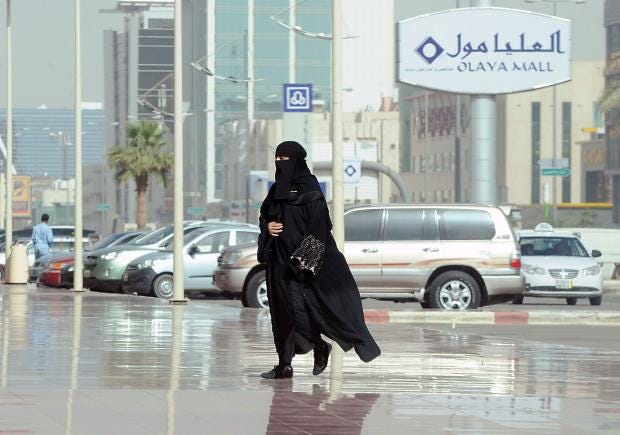
A shooper at the Olaya mall in the Saudi capital of Riyadh. Ordinary citizens may be hit by efforts to tackle global corruption and patronageGetty
Can corruption be controlled by reform or is it so much the essential fuel sustaining political elites that it will only be ended – if it ends at all – by revolutionary change?
The answer varies according to which countries one is talking about, but in many - particularly those relying on the sale of natural resources like oil or minerals - it is surely too late to expect any incremental change for the better. Anti-corruption drives are a show to impress the outside world or to target political rivals.
The anti-corruption summit in London this week may improve transparency and disclosure, but it can scarcely be very effective against politically well-connected racketeers, busily transmuting political power into great personal wealth.
This is peculiarly easy to do in those countries in the Middle East and Africa which suffer from what economists call “the resource curse”, where states draw their revenues directly from foreign buyers of their natural resources. The process is described in compelling detail by Tom Burgis in his book, The Looting Machine: Warlords, Tycoons, Smugglers and the Systematic Theft of Africa’s Wealth. He quotes the World Bank as saying that 68 per cent of people in Nigeria and 43 per cent in Angola, respectively the first and second largest oil and gas producers in Africa, live in extreme poverty, or on less than $1.25 a day. The politically powerful live parasitically off the state’s revenues and are not accountable to anybody.
Can corruption be controlled by reform or is it so much the essential fuel sustaining political elites that it will only be ended – if it ends at all – by revolutionary change?
The answer varies according to which countries one is talking about, but in many - particularly those relying on the sale of natural resources like oil or minerals - it is surely too late to expect any incremental change for the better. Anti-corruption drives are a show to impress the outside world or to target political rivals.
The anti-corruption summit in London this week may improve transparency and disclosure, but it can scarcely be very effective against politically well-connected racketeers, busily transmuting political power into great personal wealth.
This is peculiarly easy to do in those countries in the Middle East and Africa which suffer from what economists call “the resource curse”, where states draw their revenues directly from foreign buyers of their natural resources. The process is described in compelling detail by Tom Burgis in his book, The Looting Machine: Warlords, Tycoons, Smugglers and the Systematic Theft of Africa’s Wealth. He quotes the World Bank as saying that 68 per cent of people in Nigeria and 43 per cent in Angola, respectively the first and second largest oil and gas producers in Africa, live in extreme poverty, or on less than $1.25 a day. The politically powerful live parasitically off the state’s revenues and are not accountable to anybody.
READ MORE
This is the essay on corruption that Cameron didn't want you to read
Burgis explains the devastating outcome of a government acquiring such great wealth without doing more than license foreign companies to pump oil or excavate minerals. This “creates a pot of money at the disposal of those who control the state. At extreme levels the contract between rulers and the ruled breaks down because the ruling class does not need to tax the people – so it has no need for their consent.”
He writes primarily about Africa south of the Sahara, but his remarks apply equally to the oil states of the Middle East. He rightly concludes that “the resource industry is hardwired for corruption. Kleptocracy, or government by theft, thrives. Once in power, there is little incentive to depart.” Autocracy flourishes, often same ruler staying for decades.
Most, but not all, of this is true of the Middle East oil producers. A difference is that most of these have patronage and client systems through which oil wealth funds millions of jobs. This goes a certain way in distributing oil revenues among the general population, though the benefits are unfairly skewed towards political parties or dominant sectarian and ethnic groups.
In Iraq there are seven million state employees and pensioners out of a population of 33 million who are paid $4bn a month or a big chunk of total oil income. Often these employees don’t do much or, on occasion, anything at all, but it is an exaggeration to imagine that Iraq’s oil money is all syphoned off by the ruling elite.
I remember in one poor Shia province in south Iraq talking to local officials who said that they had just persuaded the central government to pay for another 50,000 jobs, though they admitted that they had no idea what these new employees would be doing.
Reformers frequently demand that patronage be cut back in the interests of efficiency, but a more likely outcome of such a change is that a smaller proportion of the population would benefit from the state income.
READ MORE
Saudi is about to attempt its own version of Mao's Great Leap Forward
This could be the result of Deputy Crown Prince Mohammed bin Salman’s radical plans to transform the way Saudi Arabia is run and end its reliance on oil by 2030. He may well find that the way Saudi society works has long gelled and face strong resistance to changing a system in which ordinary Saudis feel entitled to some sort of job and salary.
The “resource curse” is not readily reversible, because it eliminates other forms of economic activity. The price of everything produced in an oil state is too expensive to compete with the same goods made elsewhere so oil becomes the only export. Migrants pour in as local citizens avoid manual labour or employment with poor pay and conditions.
A further consequence of the curse is that the rulers of resource rich states – like many an individual living on an unearned income – get an excessive and unrealistic idea of their own abilities. Saddam Hussein was the worst example of such megalomania, starting two disastrous wars against Iran and Kuwait. But the Shah of Iran was not far behind the Iraqi leader in grandiose ideas, blithely ordering nuclear power stations and Concorde supersonic passenger aircraft.
Muammur Gaddafi insisted that Libyans study the puerile nostrums of the Green Book, and those failing that part of the public examinations about the book, were failed generally and had to re-take all their exams again.
Can “the looting machine” in the Middle East, Africa and beyond be dismantled or made less predatory?
READ MORE
Catholic leaders are undoing the good work of Pope Francis on migrants
Its gargantuan size and centrality to the interest of ruling classes probably makes its elimination impossible, though competition, transparency and more effective bureaucratic procedures in the award of contracts might have some effect. The biggest impulse to resistance locally to official corruption has come because the fall in the price of oil and other commodities since 2014 means that the revenue cake has become too small to satisfy all the previous beneficiaries.
The mechanics and dire consequences of this system are easily explained though often masked by neo-liberal rhetoric about free competition.
In authoritarian states without accountability or a fair legal system, this approach becomes a license to loot. Corruption cannot be tamed because it is at the very heart of the system.
Friday, 13 May 2016
Donald Trump supporters are not the bigots the left likes to demonise
John Harris in The Guardian
Last Tuesday, at about 3pm, I parked my rental car outside a polling station in the suburbs of Indianapolis, and began to talk to the droves of people going in and out. There was only one subject I really wanted to hear about:Donald Trump, and his jaw-dropping progress to being the presumptive Republican nominee.
As he said himself, a win in the state of Indiana would seal the deal, and so it proved: he got 53% of the vote, which triggered the exit of his two supposed rivals. Meanwhile, the global liberal left seemed to be once again working itself into a lather, which was easily translatable: how awful that a man routinely described using all the boo-words progressives can muster – misogynist, racist, fascist, xenophobe, or “xenophobic fascist”, as George Clooney understatedly put it – could now be a resident of the political mainstream, and a serious contender for president.
Though calling him a fascist surely demeans the victims of the real thing, Trump has some extremely grim views, and the idea of him in the White House has an obviously terrifying quality. But for those who loathe him, a problem comes when the nastier elements of his rhetoric are conflated with the supposed instincts of millions of his supporters, and familiar stereotypes come into play. “Not all Donald Trump supporters are racists, but most racists are Donald Trump supporters,” says the liberal online outlet Salon. “The unusual geographic pattern of Trumpism … corresponds to the geography of white racial resentment in the United States,” offers a contributor to the political website Vox. “They vote for him because he is a racist bigot,” reckoned one eloquent tweeter I briefly corresponded with.

George Clooney: 'There’s not going to be a President Donald Trump'
Caricatures of rednecks and white trash are obviously in the foreground here. Worse still, such judgments are often arrived at through polling data, guesswork, and a large measure of metropolitan prejudice: in keeping with one of the most baffling failings of political journalism across the globe, too few people think of speaking to the voters themselves.
So to Indiana, where, with my Guardian colleague John Domokos, I spent the best part of five days following the Trump campaign. No one mentioned his assuredly unpleasant ideas about excluding Muslims from the US, nor his absurd proposal to build a wall between America and Mexico, at the latter country’s expense. Indeed, when I saw Trump speak at a rally in the Indiana town of Evansville, he made no reference to what he has said about Muslims, and dealt with the fabled wall in a matter of seconds.
Instead, he talked at length about two of his pet themes. First, he banged on about the free trade deals that he says have blitzed US industry as companies have moved abroad, luxuriated in newly low labour costs, and imported their wares back into the country. Second, he fed that specific story into a general sense of national decline.

‘Clinton’s enemies malign her as someone who enthusiastically supported the trade deal to end all trade deals: Nafta, in 1994, which the Carrier workers put at the centre of their predicament.’ Photograph: Mark Wilson/Getty
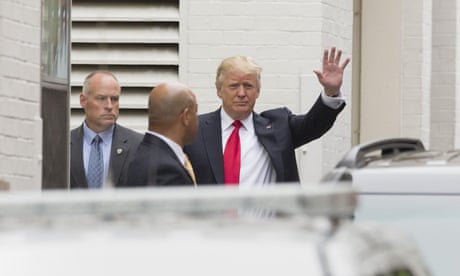
Trump calls DC Republicans to heel
But in the case of Trump, his positioning fuses with his hyperactive, barnstorming TV persona, and creates something with particularly populist appeal. The presentation is pure political vaudeville, used in the service of anti-politics: rambling (and often very funny) oratory, cartoon political incorrectness, self-obsession so extreme that it comes out looking endearingly self-parodic. But at the core are oomphy words about something built into his audiences’ daily reality: stores full of goods made overseas, and jobs that feel increasingly under threat.
His proposed solution, his detractors say, is probably beyond the reach of a president, and in the short term would presumably hit his supporters’ wallets like a hammer, but it’s simple enough: if any company dares move overseas, he’ll whack their goods with such high tariffs that they’ll soon come running back.
At the polling station, all of the above was reflected in the reasons people gave for supporting him. Just to make this clear: obviously, there are voters with bigoted opinions who think he’s their man. But equally, almost none of the Trumpites I met seemed to be the gun-toting zealots of liberal demonology: they explained voting for him in very matter-of-fact terms, usually with explicit criticism of the current political class. “Jobs, outsourcing, bringing jobs back to our country,” offered one of his supporters. “We’re getting aluminium from China – we don’t need aluminium from China. Hell, we make it right here,” said another. There was also much more nuance than you might expect. “I hate the way he talks about women, but I love the way he handles things,” one woman told me.
Indiana has one particular case study Trump talks about. In Indianapolis, a company called Carrier recently announced the imminent closure of an air-conditioning factory, with the loss of 1,400 jobs. Its operations will be shifted to Mexico. In Indianapolis, average wages are over $20 an hour, but once the move over the border is complete, pay will be more like $3. Talking to workers, it seemed that they were split down the middle, with some – like the local branch of their union, the United Steelworkers – supporting Sanders, while others favoured Trump.
Again, the latter option was often framed in terms of difficult choices, and some degree of hesitancy. A Carrier employee called Brad Stepp described his fear of the future, and why Trump represents “the lesser of three evils”. He was well aware of the absurdities of a high-living billionaire claiming to have the back of American workers, not least in the context of Trump’s recent(ish) claim that people in the US are paid too much. But he had made his choice. “We need somebody that’s tough,” he said. “If he can’t stop Carrier going, maybe he can stop other companies doing the same thing.” In the midst of all this, one character sits in a very uneasy position. Unsettled by their popularity, Hillary Clinton has been trying to echo some of Trump’s and Sanders’ pronouncements on trade and jobs. “I won’t support any agreement unless it helps create good jobs and higher wages for American workers,” she says, offering to be the president for “the struggling, the striving and the successful”. Her enemies, by contrast, malign her as someone who enthusiastically supported the trade deal to end all trade deals: the North American Free Trade Agreement of 1994, which the Carrier workers put at the centre of their predicament. In fact, politics being politics, the details of her record matter less than broad-brush appearances. And here, the story for her adversaries is a cinch. The establishment has failed; she is a card-carrying member of that establishment; ergo, she has failed too.
Herein lies a vulnerability that should chill the liberal left to the bone. Five days after I got back from Indiana, polls suggested that the presumed contest between Clinton and Trump will be much closer than some people imagine. For those who yell at him and his supporters from the sidelines, that news ought to give pause for thought: before it’s too late, maybe it’s time to stop hysterically moralising and instead try to understand not just how mainstream US politics has so awfully failed, but how it might somehow be rescued.
Last Tuesday, at about 3pm, I parked my rental car outside a polling station in the suburbs of Indianapolis, and began to talk to the droves of people going in and out. There was only one subject I really wanted to hear about:Donald Trump, and his jaw-dropping progress to being the presumptive Republican nominee.
As he said himself, a win in the state of Indiana would seal the deal, and so it proved: he got 53% of the vote, which triggered the exit of his two supposed rivals. Meanwhile, the global liberal left seemed to be once again working itself into a lather, which was easily translatable: how awful that a man routinely described using all the boo-words progressives can muster – misogynist, racist, fascist, xenophobe, or “xenophobic fascist”, as George Clooney understatedly put it – could now be a resident of the political mainstream, and a serious contender for president.
Though calling him a fascist surely demeans the victims of the real thing, Trump has some extremely grim views, and the idea of him in the White House has an obviously terrifying quality. But for those who loathe him, a problem comes when the nastier elements of his rhetoric are conflated with the supposed instincts of millions of his supporters, and familiar stereotypes come into play. “Not all Donald Trump supporters are racists, but most racists are Donald Trump supporters,” says the liberal online outlet Salon. “The unusual geographic pattern of Trumpism … corresponds to the geography of white racial resentment in the United States,” offers a contributor to the political website Vox. “They vote for him because he is a racist bigot,” reckoned one eloquent tweeter I briefly corresponded with.
George Clooney: 'There’s not going to be a President Donald Trump'
Caricatures of rednecks and white trash are obviously in the foreground here. Worse still, such judgments are often arrived at through polling data, guesswork, and a large measure of metropolitan prejudice: in keeping with one of the most baffling failings of political journalism across the globe, too few people think of speaking to the voters themselves.
So to Indiana, where, with my Guardian colleague John Domokos, I spent the best part of five days following the Trump campaign. No one mentioned his assuredly unpleasant ideas about excluding Muslims from the US, nor his absurd proposal to build a wall between America and Mexico, at the latter country’s expense. Indeed, when I saw Trump speak at a rally in the Indiana town of Evansville, he made no reference to what he has said about Muslims, and dealt with the fabled wall in a matter of seconds.
Instead, he talked at length about two of his pet themes. First, he banged on about the free trade deals that he says have blitzed US industry as companies have moved abroad, luxuriated in newly low labour costs, and imported their wares back into the country. Second, he fed that specific story into a general sense of national decline.
‘Clinton’s enemies malign her as someone who enthusiastically supported the trade deal to end all trade deals: Nafta, in 1994, which the Carrier workers put at the centre of their predicament.’ Photograph: Mark Wilson/Getty
All of this is very real. From the dreadful state of the roads to the palpable sense of communities reeling from the military adventures that began in 2001, time spent in the US quickly reveals a country that collectively feels it has taken no end of wrong turns, and must somehow sort itself out. It is one of the more overlooked stories of the 2016 election that Trump’s views about this malaise intersect with the insurgent campaign still being waged by that great left hope, Bernie Sanders. There are, in other words, two anti-establishment figures doing their thing on either side of the political divide, with great success.
Trump calls DC Republicans to heel
But in the case of Trump, his positioning fuses with his hyperactive, barnstorming TV persona, and creates something with particularly populist appeal. The presentation is pure political vaudeville, used in the service of anti-politics: rambling (and often very funny) oratory, cartoon political incorrectness, self-obsession so extreme that it comes out looking endearingly self-parodic. But at the core are oomphy words about something built into his audiences’ daily reality: stores full of goods made overseas, and jobs that feel increasingly under threat.
His proposed solution, his detractors say, is probably beyond the reach of a president, and in the short term would presumably hit his supporters’ wallets like a hammer, but it’s simple enough: if any company dares move overseas, he’ll whack their goods with such high tariffs that they’ll soon come running back.
At the polling station, all of the above was reflected in the reasons people gave for supporting him. Just to make this clear: obviously, there are voters with bigoted opinions who think he’s their man. But equally, almost none of the Trumpites I met seemed to be the gun-toting zealots of liberal demonology: they explained voting for him in very matter-of-fact terms, usually with explicit criticism of the current political class. “Jobs, outsourcing, bringing jobs back to our country,” offered one of his supporters. “We’re getting aluminium from China – we don’t need aluminium from China. Hell, we make it right here,” said another. There was also much more nuance than you might expect. “I hate the way he talks about women, but I love the way he handles things,” one woman told me.
Indiana has one particular case study Trump talks about. In Indianapolis, a company called Carrier recently announced the imminent closure of an air-conditioning factory, with the loss of 1,400 jobs. Its operations will be shifted to Mexico. In Indianapolis, average wages are over $20 an hour, but once the move over the border is complete, pay will be more like $3. Talking to workers, it seemed that they were split down the middle, with some – like the local branch of their union, the United Steelworkers – supporting Sanders, while others favoured Trump.
Again, the latter option was often framed in terms of difficult choices, and some degree of hesitancy. A Carrier employee called Brad Stepp described his fear of the future, and why Trump represents “the lesser of three evils”. He was well aware of the absurdities of a high-living billionaire claiming to have the back of American workers, not least in the context of Trump’s recent(ish) claim that people in the US are paid too much. But he had made his choice. “We need somebody that’s tough,” he said. “If he can’t stop Carrier going, maybe he can stop other companies doing the same thing.” In the midst of all this, one character sits in a very uneasy position. Unsettled by their popularity, Hillary Clinton has been trying to echo some of Trump’s and Sanders’ pronouncements on trade and jobs. “I won’t support any agreement unless it helps create good jobs and higher wages for American workers,” she says, offering to be the president for “the struggling, the striving and the successful”. Her enemies, by contrast, malign her as someone who enthusiastically supported the trade deal to end all trade deals: the North American Free Trade Agreement of 1994, which the Carrier workers put at the centre of their predicament. In fact, politics being politics, the details of her record matter less than broad-brush appearances. And here, the story for her adversaries is a cinch. The establishment has failed; she is a card-carrying member of that establishment; ergo, she has failed too.
Herein lies a vulnerability that should chill the liberal left to the bone. Five days after I got back from Indiana, polls suggested that the presumed contest between Clinton and Trump will be much closer than some people imagine. For those who yell at him and his supporters from the sidelines, that news ought to give pause for thought: before it’s too late, maybe it’s time to stop hysterically moralising and instead try to understand not just how mainstream US politics has so awfully failed, but how it might somehow be rescued.
Thursday, 12 May 2016
Receptionist 'sent home from work without pay for refusing to wear high heels'
Siobhan Fenton in The Independent
A woman has been sent home from work for refusing to wear high heels, it has been reported.
Temp worker Nicola Thorp says she arrived for her first day in a new role at the London offices of accountancy firm PwC wearing flat shoes. She says she was told to change into high heels with a height of 2 to 4 inches.
Ms Thorp claims she was laughed at when she challenged the policy and sent home without pay when she refused to wear heels.
Ms Thorp told The BBC that she was shocked when she arrived at work for her first day and was told about the policy: “I said ‘If you can give me a reason as to why wearing flats would impair me to do my job today, then fair enough’, but they couldn’t. I was expected to do a nine-hour shift on my feet escorting clients to meeting rooms. I said ‘I just won’t be able to do that in heels’.”
She says she asked whether men were also expected to wear high heels and was laughed at for raising the objection. She said: “I was a bit scared about speaking up about it in case there was backlash. But I realised I needed to put a voice to this as it is a much bigger issue. Aside from the debilitating factor, it’s a sexism issue. I think companies shouldn’t be forcing that on their female employees.”
Ms Thorp has launched a petition calling for the law to be changed to stop employers from being able to insist that a woman wear high heels as part of their work. It has amassed more than 20,000 signatures of support.
PwC have stated that the dress code is not their policy but that of a third party recruitment firm Portico which they use to employ staff. A spokesperson told The BBC: “PwC outsources its front of house and reception services to a third party supplier. We first became aware of this matter on 10 May, some five months after the issue arose. The dress code is not a PwC policy.”
A Portico spokesperson said: “In line with industry standard practice, we have personal appearance guidelines across many of our corporate locations. These policies ensure staff are dressed consistently and include recommendations for appropriate style of footwear for the role. We have taken on board the comments regarding footwear and will be reviewing our guidelines in consultation with our clients and team members.”
A woman has been sent home from work for refusing to wear high heels, it has been reported.
Temp worker Nicola Thorp says she arrived for her first day in a new role at the London offices of accountancy firm PwC wearing flat shoes. She says she was told to change into high heels with a height of 2 to 4 inches.
Ms Thorp claims she was laughed at when she challenged the policy and sent home without pay when she refused to wear heels.
Ms Thorp told The BBC that she was shocked when she arrived at work for her first day and was told about the policy: “I said ‘If you can give me a reason as to why wearing flats would impair me to do my job today, then fair enough’, but they couldn’t. I was expected to do a nine-hour shift on my feet escorting clients to meeting rooms. I said ‘I just won’t be able to do that in heels’.”
She says she asked whether men were also expected to wear high heels and was laughed at for raising the objection. She said: “I was a bit scared about speaking up about it in case there was backlash. But I realised I needed to put a voice to this as it is a much bigger issue. Aside from the debilitating factor, it’s a sexism issue. I think companies shouldn’t be forcing that on their female employees.”
Ms Thorp has launched a petition calling for the law to be changed to stop employers from being able to insist that a woman wear high heels as part of their work. It has amassed more than 20,000 signatures of support.
PwC have stated that the dress code is not their policy but that of a third party recruitment firm Portico which they use to employ staff. A spokesperson told The BBC: “PwC outsources its front of house and reception services to a third party supplier. We first became aware of this matter on 10 May, some five months after the issue arose. The dress code is not a PwC policy.”
A Portico spokesperson said: “In line with industry standard practice, we have personal appearance guidelines across many of our corporate locations. These policies ensure staff are dressed consistently and include recommendations for appropriate style of footwear for the role. We have taken on board the comments regarding footwear and will be reviewing our guidelines in consultation with our clients and team members.”
Subscribe to:
Comments (Atom)