Search This Blog

Tuesday, 26 April 2016

Jeremy Hunt is a hero for standing up to the BMA bullies

Leo McKinstry in The Telegraph

Today, junior doctors are staging the first ever all-out strike in the history of the NHS. Never can a stoppage have been less justified than this one. In their irresponsible greed and puerile militancy, the strikers are making a complete mockery of the Hippocratic Oath to do no harm

------

--------

With spectacular double standards, they claim that they oppose the new contract because it is “unsafe for patients”, yet their own selfish industrial action is putting the lives of vulnerable people at risk. They profess their devotion to the publicly funded NHS, then threaten to work in the private sector overseas if the Government refuses their pay demands.
Their sense of entitlement is repugnant. They enjoy salaries, pensions and job security far beyond the dreams of most professionals, while they have been offered an excellent new deal in return for the removal of outdated weekend practices.
Yet, suffused with victimhood, they act like oppressed members of the proletariat.

They are only able to get away with this hypocrisy because of their exploitation of public sentimentality towards the NHS. The former Chancellor Nigel Lawson once famously said that the health service is “the nearest thing the English have to a religion.” By cynically posing as the keepers of the holy faith and presenting every attempt at reform as wicked heresy, they have been able to protect their privileges and ruthlessly advance their own interests.

But now they have met a stumbling block in the form of Health Secretary Jeremy Hunt. With his air of reasonableness and quiet, almost deferential manner, Hunt may seem an unlikely figure to challenge union blackmail. But his willingness to take on the reactionary bullies of the BMA shows that he has an inner steel similar to that displayed by Margaret Thatcher when she took on the unions in the 1980s.

In the process, Hunt has taken a tremendous amount of increasingly hysterical abuse. He has been vilified as the enemy of the NHS, a Right-wing extremist, a Nazi and a potential killer. But alongside these savage personal insults, there has also been the persistent complaint that he has somehow “mishandled” the dispute. It is a refrain that is heard not just from Labour politicians and Left-wing commentators, but even, privately, from some of his own MPs and fellow Ministers.

Yet the charge is absurd, for Hunt has shown remarkable patience in his negotiations with the unions. The term “mishandled” is really code for his refusal to surrender to the unions. Effectively, his critics are arguing that he should have caved in at the first sign of trouble from the BMA. That is how most of his predecessors have acted, always desperate to avoid confrontation. So the NHS remains hopelessly unreformed, a gigantic bureaucratic monolith operating more for the convenience of its staff than the real needs of its patients.

No one elected the BMA to decide how the NHS should be run. That should be the job of our democratic politicians. Hunt has a clear mandate from the Conservative victory in 2015 to introduce a proper 7-day-a-week health service, which can only be done through a new contract. If the NHS is to improve, the privileged, picket-line poseurs have to be defeated. Hunt should be praised, not demonised, for taking his heroic stand in this battle. Even if they dislike him now, the British public will ultimately benefit from his courage.
Monday, 25 April 2016

Pakistan Army Accounts - No Audit permitted


Accountability without exception Friday Night with Hamid Bashani Ep48 (in Urdu)


History of Pakistan's Foreign Policy - AApas ki Baat with Najam Sethi and Muneeb Farooq


Politician & Military in Pakistan Part II


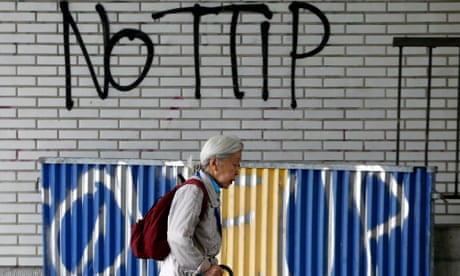
TTIP is a very bad excuse to vote for Brexit

Nick Dearden in The Guardian

Barack Obama gave TTIP the hard sell, but leaving the EU would only make the controversial trade deal more likely – and possibly worse
 

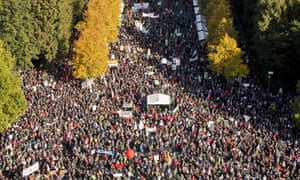
‘In Berlin, 250,000 people took to the streets last October to protest about TTIP.’ Photograph: Axel Schmidt/Getty Images


Barack Obama’s key message to Europe’s leaders last week was “let’s speed up TTIP”. The US-EU trade deal, formally called the Transatlantic Trade and Investment Partnership, has been mired in controversy on both sides of the Atlantic. The “free trade” agenda has become poison in the US primaries, forcing even pro-trade Hillary Clinton to re-examine TTIP.

The next round of talks begin on Monday in New York and Obama is worried – unless serious progress is made in coming months, his trade legacy may be doomed. The problem for the US president is selling TTIP at the same time as trying to warn against the dangers of Brexit. This is a tough ask because TTIP has been a godsend for Brexit campaigners, who argue that the deal is a major reason to cut loose from Brussels.

It’s true that TTIP is a symbol of all that’s wrong with Europe: dreamed up by corporate lobbyists, TTIP is less about trade and more about giving big business sweeping new powers over our society. It is a blueprint for deregulation and privatisation. As such it makes a good case for Brexit.

Until you remember that the British government has done everything possible to push the most extreme version of TTIP, just as they’ve fought against pretty much every financial regulation, from bankers bonuses to a financial transaction tax. While Germany and France were concerned about TTIP’s corporate court system – which allows foreign business to sue governments for “unfair” laws like putting cigarettes in plain packets – the UK secretly wrote to the European commission president demanding he retain it.

At the heart of TTIP is a radical agenda of deregulation. The ambition is that everything from food standards to financial policies are “standardised” in the US and EU, with big business gaining new powers over the process. This could have been inspired by David Cameron’s own programme of stripping away laws that annoy big business, no matter how important they are for people and the environment.

Cameron’s policy means scrapping two laws for every one brought in and giving every regulatory body the duty to have regard to the desirability of “promoting economic growth”. That could include the equality and human rights commission and the health and safety executive. The TUC described Britain as “exporting their anti-worker position into Europe and it is spreading like a bad outbreak of gastric flu”.

Brexit wouldn’t necessarily stop TTIP anyway – that’s all down to the transition process. At the very least, Britain would need to adopt many of TTIP’s provisions in order to remain in the single market.

But it gets worse: every scenario for Brexit is premised on extreme free trade agreements coupled with looser regulation to make us more competitive. “Outcompeting” the EU through lower standards is the strategy. High-profile supporters of the Brexit campaign have repeatedly said that they believe the UK would be able to realise a more “ambitious” and faster free trade deal if we stood alone. There’s every reason to think that Brexit will turn the UK into a paradise for free market capitalism: a TTIP on steroids.

-----


What is TTIP and why should we be angry about it?
--------


Is there any hope? Yes – the movement to defeat TTIP received the support of well over 3 million Europeans in a little over a year. In Berlin, 250,000 people took to the streets last October. The deal was meant to be signed by now – but together, Europe’s people have seriously stalled things. Would it really be possible to stop such a move if we couldn’t link up with campaigners across Europe? If being in the EU has brought us TTIP, it has also brought us the means to stop it.

Europe also allows the potential to take on the corporate power which TTIP symbolises: the biggest threat to our sovereignty. Even in the best of circumstances, there is only so much a small nation state can do against the size and power of global big business. But through being in Europe we could stop tax avoidance, introduce a financial transactions tax, hold corporations legally responsible for their human rights abuses, enforce world-leading climate targets, develop new forms of public ownership of key resources. At least, we could if Britain stopped standing in the way.

Obama’s rationale for avoiding Brexit is quite different. The US establishment has always been interested in Britain’s role as a fifth column in Europe, undermining a social Europe on behalf of global (read US) corporations. Reclaiming our sovereignty means not playing this role, and instead working with those in Europe who want to build a different world. Another Europe is possible.

The things economists know. . . and don’t know about Brexit

Roger Bootle in The Telegraph

Last week we were treated to a fine exhibition of the economist’s art. I refer to the Treasury study of the economic impact of Brexit, which told us that in 15 years’ time, on a central view, the average British household would be worse off by £4,300 a year. This episode has prompted me to think about what it is that economists know – and what they don’t.

It is clear that economists’ prognostications have, at best, a mixed record. Not only can economists not reliably tell you what GDP is going to be in two or three years’ time but, as a group, they seem pretty bad at anticipating major developments.

Although some economists did foresee the financial crisis, as a whole they did not. Nor did most foresee the emergence of a zero inflation/deflation world.

Let me say, though, that of its type, last week’s Treasury document was a fine specimen. A large team of economists has been working on it for the best part of a year, and these are good, professional people who have not simply been doing what they were told by their political bosses. Nevertheless, that doesn’t mean that what they have produced is of serious value. 


The problem with much of economics is that what we can readily measure, even when it is tendentious, is often the minor part of the question. Yet there is a natural tendency to measure what is measurable and to leave to one side, or to downplay, the things that are not.
The Treasury study concentrated on the effects of a Brexit on UK trade and the consequences for GDP and investment on a static “other things equal” basis. It assumed that we would be unable to secure any more favourable trade agreements with non-EU countries.

Interestingly, it did not begin to quantify the possible economic gains from a policy of radical deregulation. The reason is apparently that it is not clear that we would repeal and rescind EU legislation and directives and, in any case, the UK is a relatively lightly-regulated economy. The implication is that there is next to nothing to be gained from deregulation.

This is, to put it mildly, a rather odd stance to take – certainly if you were trying to be fair across all sides of the debate. After all, those economists who think that there is much to be gained economically from leaving the EU tend to rest their case mainly on large potential gains from EU deregulation.

Moreover, umpteen businesses across the country bemoan the costs of regulation on their operations. It is not that their case has been disproved by last week’s study; it has simply been ignored. 


The study, in accordance with convention, took a static approach to how the EU might evolve. True, this excluded some of the potential benefits of remaining in the EU from the extension of the single market. But it also excluded some of the most important negative possibilities.

Once the UK referendum is out of the way, if we vote to stay in, it is likely that the EU will turn quite nasty towards us. This will not only be because the EU’s leaders will be cheesed off with us, although they most certainly will be.

More importantly, they will think that we have shot our bolt. In particular, we would probably find that, far from rejoicing in the City’s role as Europe’s financial centre, the EU would renew its attempts to undermine it.

Meanwhile, the EU would have to embark on truly momentous changes in order to make the eurozone work. Banking union, fiscal union and political union must be put in place for the euro to survive.

We don’t know what effects this cocktail of changes will have upon European politics and economic performance – and hence on us.

The overwhelming majority of the EU will be inside the euro, and what needs to be done to make the euro work would be the EU’s leading concern.

We do not know what things will be forced upon us by qualified majority voting. Moreover, with the referendum behind us, there is a good chance of a renewed push to get the UK into the euro. What have the calculations that produce the figure £4,300 a year got to say about this? The answer, of course, is precisely nothing.

And all this is before we take account of the dynamic effects and their political consequences. Perhaps after a Brexit our leaders would become enmeshed in rivalrous infighting and it would be impossible to put together an economic programme for national renewal.

But there is surely a good chance, as Michael Gove suggested last week, that by contrast EU departure would be the equivalent of a shot in the arm.

Nor did the study have anything to say about the congestion and social costs implied by uncontrolled immigration, which are at the heart of so many people’s concerns about the EU.

Although the future is beset with uncertainty, about this issue we do know some things. We know that over recent decades the EU has been a comparative economic failure.

We know that unless something really radical happens, it is set to fall sharply in relative economic performance over the decades to come. We know that the EU is set to embark on a course of integration from which we aim to stand aside. We know that inside the EU we do not have full control of our destiny.

We know that inside the EU but outside the eurozone we will be marginalised.

I cannot say what all this means in terms of pounds per annum for the UK average household in 15 years’ time. But I can recognise the difference between a situation of opportunity and a pig in a poke.