Louis Dore in The Independent
The Dutch city of Utrecht will start an experiment which hopes to determine whether society works effectively with universal, unconditional income introduced.
The city has paired up with the local university to establish whether the concept of 'basic income' can work in real life, and plans to begin the experiment at the end of the summer holidays.
Basic income is a universal, unconditional form of payment to individuals, which covers their living costs. The concept is to allow people to choose to work more flexible hours in a less regimented society, allowing more time for care, volunteering and study.
The Netherlands as a country is no stranger to less traditional work environments - it has the highest proportion of part time workers in the EU, 46.1 per cent. However, Utrecht's experiment with welfare is expected to be the first of its kind in the country.
Alderman for Work and Income Victor Everhardt told DeStad Utrecht: "One group will have compensation and consideration for an allowance, another group with a basic income without rules and of course a control group which adhere to the current rules."
"Our data shows that less than 1.5 percent abuse the welfare, but, before we get into all kinds of principled debate about whether we should or should not enter, we need to first examine if basic income even really works.
"What happens if someone gets a monthly amount without rules and controls? Will someone sitting passively at home or do people develop themselves and provide a meaningful contribution to our society?"
The city is also planning to talk to other municipalities about setting up similar experiments, including Nijmegen, Wageningen, Tilburg and Groningen, awaiting permission from The Hague in order to do so.
Friday, 26 June 2015
Tuesday, 23 June 2015
Peter Moores: 'The portrayal of me as a coach is wrong'
George Dobell - Cricinfo
"Frustration" is a word that crops up often in Peter Moores' sentences at present.
He is "frustrated" that he cannot finish the job he started in rebuilding the England team. He is frustrated that he will never lead England through an Ashes series. He is "frustrated" that history appears to have repeated itself. And he is, in his words, "doubly frustrated" that his portrayal in the media differs so markedly from reality.
That portrayal stems, in part, from a radio interview conducted by the BBC moments after England's World Cup exit. In it, Moores was alleged to have said that England would need to check the "data" before coming to any conclusions about the reasons for their failure.
It came to be a defining moment in his downfall. It has been used to illustrate his perceived faults: an obsession with stats and a propensity to overanalyse. England's talented young players, it was said, were stifled by such a policy.
But it never happened. As was reported by ESPNcricinfo, Moores actually said "later" in that BBC interview. But his words were misheard - an honest and understandable mistake as there was a minor microphone malfunction during the interview - and while the BBC subsequently apologised to him (at first verbally and then in writing), the error was public and the apology was private. The damage, in terms of public perception, was done.
The image of Moores as stats-driven has little basis in reality. So frustrated was Nathan Leamon, England's analyst at the World Cup, by the lack of use of his statistics that it was briefly feared he may go home. Meanwhile Paul Farbrace, Moores' faithful deputy and the man who has recently been portrayed as a liberator of the England team, has said repeatedly that the Sri Lanka team he coached to success in the 2014 World T20 used such data far more.
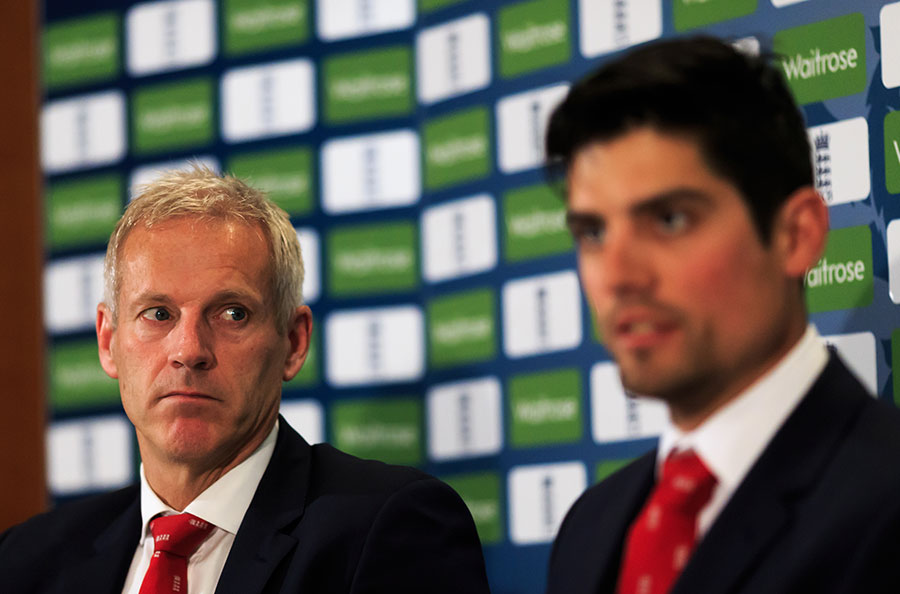 "I don't have regrets. I look back with quite a lot of pride" © Getty Images
While it is true Moores used the word "data" during an excellent eight-minute interview on Sky (he said "we'll have to analyse the data") it was in response to several detailed questions and after an initial answer that started: "Now is not the time to be analysing."
It is Moores' frustration - that word again - at such a characterisation that has prompted him to talk now. While he remained silent the first time he was sacked as England coach, declining lucrative invitations to give his side of the story, this time he has decided to speak in an attempt to correct at least a few of the misconceptions about his period as coach. He was not paid and the only item he would not discuss is how he was sacked.
While Moores will not be drawn on it - he is simply not the sort to be dragged into mudslinging - ESPNcricinfo understands that he learned of his fate after his wife read about it on Twitter and phoned him. Whatever you think of him or Paul Downton (who learned of his fate a similar way), they deserved better than that. The ECB, to its credit, apologised in private and public.
He does not comment, though. He hardly ever does. When he was sacked as England coach at the start of 2009, he said nothing. When England went to No. 1 in the Test rankings in 2011, largely with players he had selected, he said nothing. When Kevin Pietersen's book came out, he said nothing. And each day he woke up and read another column from an ex-player - usually an ex-player he had dropped during his first spell as England coach - rubbishing his methods and caricaturing his personality, he said nothing.
"I have to accept my time as England coach has gone," Moores says. "It's pretty hard to accept. But it's done. The umpire's finger is up. I have to look at where I go next.
"But I am frustrated. The portrayal of me as a coach in the media is just wrong. If people said 'I don't rate you as a coach' then fine. But when it's not what you are, it's really frustrating.
"I don't know how to change that. I've not spent my life trying to be really good with the media; I've spent it trying to make players better. I still passionately want to do that.
"I have an official letter from the BBC. It's a tough one, I didn't say it. I know what I am as a coach. I've done it for a long time. I've been in the game for 33 years and I've coached for 17. I know the game. And what I've learned is, my job is to simplify the game for players and free them up to go and play.
"We moved away from stats and data. Coaching doesn't work like that at all. You watch a lot to say a little. It's not a numbers game. We kept it simple. We tried to give the players responsibility to lead themselves.
"There is a big support staff with England. And they're all valuable. You need the security staff, the physio and the doctor. But there are times when you just want the 11 players and two coaches to watch the game and talk about it together. We were creating that environment. We were getting there."
The "we were getting there" phrase is another recurring theme. Moores felt his England side were on the right track. While he accepts the World Cup was wretched, there was evidence in Test cricket, that they were making progress. At the time he was sacked, England - a side containing half-a-dozen young or inexperienced players - had won four and lost one of their last six Tests.
Against relatively modest opposition that is perhaps decent rather than exceptional. But Moores did inherit an England side that had just been beaten 5-0 in the Ashes and was clearly in a transitional phase. It was always going to take time.
"In Test terms, we felt we had turned a corner," Moores says. "We were getting there. Would I have been sacked had we won in Barbados? You'll have to ask the people who made the decision. I was aware that things were building but I wasn't expecting it.
"The frustration is not being able to carry something through. When I took the job, I knew we would go through this period of trial. And transition is difficult. You will lose sometimes.
"The evolution, of a team, of a player, is that you're going to be inconsistent. You're going to lose. But in Tests we were moving and moving quite fast. You could see it happening. Young players were developing fast. And you know there is a timeframe for that.
"I'm also confident in my ability to evolve teams to become very good teams. And, given time, I've always gone on to be successful. And you're not trying to be successful for a short time, but for a long time.
"So to not have time to finish the job with England... I thought we were getting there. I was genuinely excited when we got back from the Caribbean."
Moores denies any mixed emotions at watching England's improved showing against New Zealand. But it has not gone unnoticed that, just as he built the side that Andy Flower went on to lead to such success (Flower, it should be noted, was always the first to praise Moores' contribution), he will spend the next few years seeing some of those he selected this time flourish in international cricket.
It was, after all, Moores that replaced the new-ball pair of Steve Harmison and Matthew Hoggard with James Anderson and Stuart Broad. He installed Graeme Swann as first-choice spinner and Matt Prior as wicketkeeper. He laid many of the foundations on which Flower built.
This time, his commitment to Jos Buttler, Moeen Ali, Gary Ballance (originally selected by Flower), Joe Root (who had been dropped by the time Moores took over) and others could have similar long-term benefits.
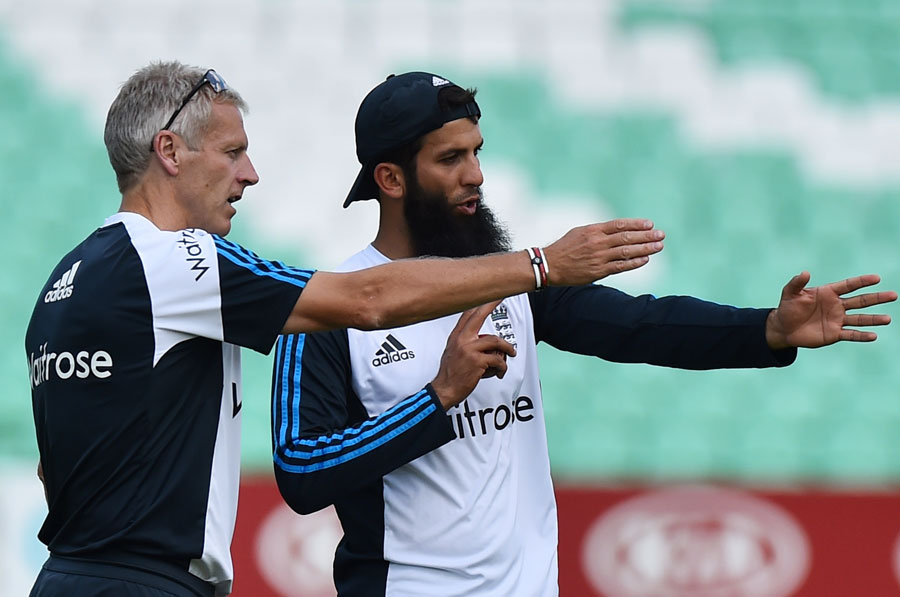 Moores brought new faces into the England side during both spells in charge © AFP
"I didn't go into the job to get the credit," he says. "But yes, history probably has repeated itself a bit. I'd love it if England won the Ashes. I'm an England fan.
"I've probably debuted more players than most England coaches. You hope when you introduce players that they'll carry on in the long term. I think we picked some good players who will become good England players over time. They'll go through ups and down.
"I know I left a united group of people - players and coaches - with a clear vision of where we were going and working towards it. I don't have regrets. I look back with quite a lot of pride."
It seems he was rated in his second spell as England coach, in part, by the mistakes he made in his first. Famously described as "the woodpecker" by Kevin Pietersen - an image that suggests a man forever tapping away at players and, as a result, preventing them from relaxing - Moores admits he made some mistakes the first time around.
"I don't think there was any truth in the woodpecker thing, no," he says now. "But I do think the version of me as a coach now to the version that first coached England is a better version.
"I evolved quite a lot as a coach, as a player would. It's no different. This time I knew what I was going into. You understand the real challenges for players, as you've been there before.
"I've reflected on that first time. We needed to change. And I look back and think, yes, in my enthusiasm, I pushed too hard. You should allow that to happen. I wanted them to be fitter and, yes, you can push too hard.
"So I knew when I came in this time, there had been mistakes made. I wanted to allow captains to evolve themselves and create a place where the players felt supported.
"Part of the skill of a coach is to disappear. You're in the room but it's as if you aren't. You're not making anyone nervous. Because if you need 40 to win in four overs, nobody wants a coach who is twitchy.
"Look, I've made loads of mistakes as a coach. But you make fewer as you learn. That side of my coaching, I know, I've got better."
England's performance - or lack of it - at the World Cup does not reflect well on anyone, though. While they went into the event talking an aggressive game, they played pretty timid cricket, with Moores' selections - Ian Bell as opener and Gary Ballance at No. 3 - contrasting starkly with the approach in the recent ODI series against New Zealand.
So does he accept that either the selections were flawed or he was unable to coax the best out of the players?
"In terms of selection, we got to the final of the tri-series with Ian Bell playing very well. I think he made two centuries and we made 300 against Australia. And Moeen was playing with freedom.
"We moved James Taylor down the order as we felt he was a good finisher and brought Gary in as he has a very good record in limited-overs cricket. He's a very good player. Ravi Bopara was struggling a bit and not really getting a bowl. It all felt natural at the time and we tried to stay consistent in selection.
"As to getting it out of them... great players don't always play great cricket. It didn't happen for them. Senior players didn't grab the game by the scruff of neck. But you learn from failure and the reaction of those players who went through it is encouraging.
"But yes, I felt hollow at the end of the tournament."
The one thing Moores will not ever do is blame the players. Never, in public or private, does he seek to do so. In fact, it is notable that, on or off the record, he does not criticise anyone. Not Andrew Strauss, not Kevin Pietersen (about whom he says, "he's a funny mix. There are things I admire") and not Colin Graves, who was in Barbados at the time of Moores' last Test but didn't find the time to tell his coach he was about to be sacked. His only gripe, really, is with his public image as a stats-driven, robotic coach and the interview that may have cemented that reputation.
It is notable, too, that several of the players have made their support of Moores public. Joe Root, who called him "brilliant" and praised him as knowing "how to get the best out of me", crediting Moores for his "drastic improvement", was the most vocal but also far from atypical. Whoever Strauss consulted before making his decision, it certainly was not the England Test squad. Many of them remain in touch with him. "Once your coach, always your coach," Moores says with a smile. "They know they can call me.
"Joe's words were appreciated. It was brave of him to say that at that time."
And yet, after two sackings and some treatment that can only be described as shoddy, Moores says he would still work for the ECB again. While he has not yet been approached for a role at Loughborough - an organisation that is about to have a radical overhaul - it remains highly probable that he will be. His eye for young talent, his record as a developer of that talent, and his ability to impart knowledge to other coaches, remain assets.
"Yes, I'd work for the ECB again," he says. "A role at Loughborough would be exciting. I love coaching and that would be working with the best players and coaches. Yes, it appeals.
"Professional sport can be cruel. Or maybe ruthless is a better word. You know that when you go into it. You are immersed in it."
His fault, as much as it is one, was his inability to play the media or political game. His failure to understand that style is as important as substance when it comes to selling yourself to the public. His failure to understand the dark side of the organisation that had employed him.
While a perception that he was closely aligned to an unattractive ECB regime - the regime of Downton and Giles Clarke that talked of people being "outside cricket" - no doubt hurt him, his main fault may well have been simply being a decent man in an increasingly indecent world. A man who thought that, if he worked hard, planned for the future and forged a strong relationship, it would be enough.
And that's the lasting impression of Moores. For whatever you think of his coaching - his international record is modest; his county and development record excellent - as a man, he has a dignity that is rare in professional sport.
A sense of perspective, too. After England lost to India at Lord's last summer, Moores was asked if he was at "rock bottom". His reply - "who knows what rock bottom is, but it isn't losing a cricket match" - sums him up better than anything else he said in his period at the helm. Even after his second sacking, he found a positive. "If feels as if I've got my wife and kids back," he said.
Following this interview, he went to see his son, Tom, a hard-hitting wicketkeeper-batsman, play for Nottinghamshire seconds against Warwickshire. The sacking has hurt, but he will cope. "A glass of wine helps," he says.
"I don't put this on," he says as the interview draws to a close. "I don't know if it's from my mum or what. But I am a calm person who can see the value of looking at people in their best light. It was such a slanging match last time. There were so many opinions. And so much of it was wrong. I didn't want to get involved. It's all so easy to do that. I'm not going down that route.
"I've been offered book deals, but it's not who I am. And if I did one, I would want it to be things I've learned and stories to help people get the best out of themselves and others. I have to be true to what I am. There's not a lot of mileage in negativity, you know.
"Of course it's been tough. This is the first summer for 33 years I've not been involved in the game in a professional way. But I'm a coach. It's what I do. I love England and I love cricket. The game doesn't owe me anything. It's been great fun working in it. And the hunger... it's just starting to come back."
"Frustration" is a word that crops up often in Peter Moores' sentences at present.
He is "frustrated" that he cannot finish the job he started in rebuilding the England team. He is frustrated that he will never lead England through an Ashes series. He is "frustrated" that history appears to have repeated itself. And he is, in his words, "doubly frustrated" that his portrayal in the media differs so markedly from reality.
That portrayal stems, in part, from a radio interview conducted by the BBC moments after England's World Cup exit. In it, Moores was alleged to have said that England would need to check the "data" before coming to any conclusions about the reasons for their failure.
It came to be a defining moment in his downfall. It has been used to illustrate his perceived faults: an obsession with stats and a propensity to overanalyse. England's talented young players, it was said, were stifled by such a policy.
But it never happened. As was reported by ESPNcricinfo, Moores actually said "later" in that BBC interview. But his words were misheard - an honest and understandable mistake as there was a minor microphone malfunction during the interview - and while the BBC subsequently apologised to him (at first verbally and then in writing), the error was public and the apology was private. The damage, in terms of public perception, was done.
The image of Moores as stats-driven has little basis in reality. So frustrated was Nathan Leamon, England's analyst at the World Cup, by the lack of use of his statistics that it was briefly feared he may go home. Meanwhile Paul Farbrace, Moores' faithful deputy and the man who has recently been portrayed as a liberator of the England team, has said repeatedly that the Sri Lanka team he coached to success in the 2014 World T20 used such data far more.
"I don't have regrets. I look back with quite a lot of pride" © Getty ImagesWhile it is true Moores used the word "data" during an excellent eight-minute interview on Sky (he said "we'll have to analyse the data") it was in response to several detailed questions and after an initial answer that started: "Now is not the time to be analysing."
It is Moores' frustration - that word again - at such a characterisation that has prompted him to talk now. While he remained silent the first time he was sacked as England coach, declining lucrative invitations to give his side of the story, this time he has decided to speak in an attempt to correct at least a few of the misconceptions about his period as coach. He was not paid and the only item he would not discuss is how he was sacked.
While Moores will not be drawn on it - he is simply not the sort to be dragged into mudslinging - ESPNcricinfo understands that he learned of his fate after his wife read about it on Twitter and phoned him. Whatever you think of him or Paul Downton (who learned of his fate a similar way), they deserved better than that. The ECB, to its credit, apologised in private and public.
He does not comment, though. He hardly ever does. When he was sacked as England coach at the start of 2009, he said nothing. When England went to No. 1 in the Test rankings in 2011, largely with players he had selected, he said nothing. When Kevin Pietersen's book came out, he said nothing. And each day he woke up and read another column from an ex-player - usually an ex-player he had dropped during his first spell as England coach - rubbishing his methods and caricaturing his personality, he said nothing.
"I have to accept my time as England coach has gone," Moores says. "It's pretty hard to accept. But it's done. The umpire's finger is up. I have to look at where I go next.
"But I am frustrated. The portrayal of me as a coach in the media is just wrong. If people said 'I don't rate you as a coach' then fine. But when it's not what you are, it's really frustrating.
"I don't know how to change that. I've not spent my life trying to be really good with the media; I've spent it trying to make players better. I still passionately want to do that.
"I have an official letter from the BBC. It's a tough one, I didn't say it. I know what I am as a coach. I've done it for a long time. I've been in the game for 33 years and I've coached for 17. I know the game. And what I've learned is, my job is to simplify the game for players and free them up to go and play.
"We moved away from stats and data. Coaching doesn't work like that at all. You watch a lot to say a little. It's not a numbers game. We kept it simple. We tried to give the players responsibility to lead themselves.
"There is a big support staff with England. And they're all valuable. You need the security staff, the physio and the doctor. But there are times when you just want the 11 players and two coaches to watch the game and talk about it together. We were creating that environment. We were getting there."
The "we were getting there" phrase is another recurring theme. Moores felt his England side were on the right track. While he accepts the World Cup was wretched, there was evidence in Test cricket, that they were making progress. At the time he was sacked, England - a side containing half-a-dozen young or inexperienced players - had won four and lost one of their last six Tests.
Against relatively modest opposition that is perhaps decent rather than exceptional. But Moores did inherit an England side that had just been beaten 5-0 in the Ashes and was clearly in a transitional phase. It was always going to take time.
"In Test terms, we felt we had turned a corner," Moores says. "We were getting there. Would I have been sacked had we won in Barbados? You'll have to ask the people who made the decision. I was aware that things were building but I wasn't expecting it.
"The frustration is not being able to carry something through. When I took the job, I knew we would go through this period of trial. And transition is difficult. You will lose sometimes.
"The evolution, of a team, of a player, is that you're going to be inconsistent. You're going to lose. But in Tests we were moving and moving quite fast. You could see it happening. Young players were developing fast. And you know there is a timeframe for that.
"I'm also confident in my ability to evolve teams to become very good teams. And, given time, I've always gone on to be successful. And you're not trying to be successful for a short time, but for a long time.
"So to not have time to finish the job with England... I thought we were getting there. I was genuinely excited when we got back from the Caribbean."
Moores denies any mixed emotions at watching England's improved showing against New Zealand. But it has not gone unnoticed that, just as he built the side that Andy Flower went on to lead to such success (Flower, it should be noted, was always the first to praise Moores' contribution), he will spend the next few years seeing some of those he selected this time flourish in international cricket.
It was, after all, Moores that replaced the new-ball pair of Steve Harmison and Matthew Hoggard with James Anderson and Stuart Broad. He installed Graeme Swann as first-choice spinner and Matt Prior as wicketkeeper. He laid many of the foundations on which Flower built.
This time, his commitment to Jos Buttler, Moeen Ali, Gary Ballance (originally selected by Flower), Joe Root (who had been dropped by the time Moores took over) and others could have similar long-term benefits.
Moores brought new faces into the England side during both spells in charge © AFP"I didn't go into the job to get the credit," he says. "But yes, history probably has repeated itself a bit. I'd love it if England won the Ashes. I'm an England fan.
"I've probably debuted more players than most England coaches. You hope when you introduce players that they'll carry on in the long term. I think we picked some good players who will become good England players over time. They'll go through ups and down.
"I know I left a united group of people - players and coaches - with a clear vision of where we were going and working towards it. I don't have regrets. I look back with quite a lot of pride."
It seems he was rated in his second spell as England coach, in part, by the mistakes he made in his first. Famously described as "the woodpecker" by Kevin Pietersen - an image that suggests a man forever tapping away at players and, as a result, preventing them from relaxing - Moores admits he made some mistakes the first time around.
"I don't think there was any truth in the woodpecker thing, no," he says now. "But I do think the version of me as a coach now to the version that first coached England is a better version.
"I evolved quite a lot as a coach, as a player would. It's no different. This time I knew what I was going into. You understand the real challenges for players, as you've been there before.
"I've reflected on that first time. We needed to change. And I look back and think, yes, in my enthusiasm, I pushed too hard. You should allow that to happen. I wanted them to be fitter and, yes, you can push too hard.
"So I knew when I came in this time, there had been mistakes made. I wanted to allow captains to evolve themselves and create a place where the players felt supported.
"Part of the skill of a coach is to disappear. You're in the room but it's as if you aren't. You're not making anyone nervous. Because if you need 40 to win in four overs, nobody wants a coach who is twitchy.
"Look, I've made loads of mistakes as a coach. But you make fewer as you learn. That side of my coaching, I know, I've got better."
England's performance - or lack of it - at the World Cup does not reflect well on anyone, though. While they went into the event talking an aggressive game, they played pretty timid cricket, with Moores' selections - Ian Bell as opener and Gary Ballance at No. 3 - contrasting starkly with the approach in the recent ODI series against New Zealand.
So does he accept that either the selections were flawed or he was unable to coax the best out of the players?
"In terms of selection, we got to the final of the tri-series with Ian Bell playing very well. I think he made two centuries and we made 300 against Australia. And Moeen was playing with freedom.
"We moved James Taylor down the order as we felt he was a good finisher and brought Gary in as he has a very good record in limited-overs cricket. He's a very good player. Ravi Bopara was struggling a bit and not really getting a bowl. It all felt natural at the time and we tried to stay consistent in selection.
"As to getting it out of them... great players don't always play great cricket. It didn't happen for them. Senior players didn't grab the game by the scruff of neck. But you learn from failure and the reaction of those players who went through it is encouraging.
"But yes, I felt hollow at the end of the tournament."
The one thing Moores will not ever do is blame the players. Never, in public or private, does he seek to do so. In fact, it is notable that, on or off the record, he does not criticise anyone. Not Andrew Strauss, not Kevin Pietersen (about whom he says, "he's a funny mix. There are things I admire") and not Colin Graves, who was in Barbados at the time of Moores' last Test but didn't find the time to tell his coach he was about to be sacked. His only gripe, really, is with his public image as a stats-driven, robotic coach and the interview that may have cemented that reputation.
It is notable, too, that several of the players have made their support of Moores public. Joe Root, who called him "brilliant" and praised him as knowing "how to get the best out of me", crediting Moores for his "drastic improvement", was the most vocal but also far from atypical. Whoever Strauss consulted before making his decision, it certainly was not the England Test squad. Many of them remain in touch with him. "Once your coach, always your coach," Moores says with a smile. "They know they can call me.
"Joe's words were appreciated. It was brave of him to say that at that time."
And yet, after two sackings and some treatment that can only be described as shoddy, Moores says he would still work for the ECB again. While he has not yet been approached for a role at Loughborough - an organisation that is about to have a radical overhaul - it remains highly probable that he will be. His eye for young talent, his record as a developer of that talent, and his ability to impart knowledge to other coaches, remain assets.
"Yes, I'd work for the ECB again," he says. "A role at Loughborough would be exciting. I love coaching and that would be working with the best players and coaches. Yes, it appeals.
"Professional sport can be cruel. Or maybe ruthless is a better word. You know that when you go into it. You are immersed in it."
His fault, as much as it is one, was his inability to play the media or political game. His failure to understand that style is as important as substance when it comes to selling yourself to the public. His failure to understand the dark side of the organisation that had employed him.
While a perception that he was closely aligned to an unattractive ECB regime - the regime of Downton and Giles Clarke that talked of people being "outside cricket" - no doubt hurt him, his main fault may well have been simply being a decent man in an increasingly indecent world. A man who thought that, if he worked hard, planned for the future and forged a strong relationship, it would be enough.
And that's the lasting impression of Moores. For whatever you think of his coaching - his international record is modest; his county and development record excellent - as a man, he has a dignity that is rare in professional sport.
A sense of perspective, too. After England lost to India at Lord's last summer, Moores was asked if he was at "rock bottom". His reply - "who knows what rock bottom is, but it isn't losing a cricket match" - sums him up better than anything else he said in his period at the helm. Even after his second sacking, he found a positive. "If feels as if I've got my wife and kids back," he said.
Following this interview, he went to see his son, Tom, a hard-hitting wicketkeeper-batsman, play for Nottinghamshire seconds against Warwickshire. The sacking has hurt, but he will cope. "A glass of wine helps," he says.
"I don't put this on," he says as the interview draws to a close. "I don't know if it's from my mum or what. But I am a calm person who can see the value of looking at people in their best light. It was such a slanging match last time. There were so many opinions. And so much of it was wrong. I didn't want to get involved. It's all so easy to do that. I'm not going down that route.
"I've been offered book deals, but it's not who I am. And if I did one, I would want it to be things I've learned and stories to help people get the best out of themselves and others. I have to be true to what I am. There's not a lot of mileage in negativity, you know.
"Of course it's been tough. This is the first summer for 33 years I've not been involved in the game in a professional way. But I'm a coach. It's what I do. I love England and I love cricket. The game doesn't owe me anything. It's been great fun working in it. And the hunger... it's just starting to come back."
Greece is a sideshow. The eurozone has failed, and Germans are its victims too

'This is what the noble European project is turning into: a grim march to the bottom. This isn’t about creating a deeper democracy, but deeper markets.' Photograph: Matt Kenyon
Aditya Chakrabortty in The Guardian
Aditya Chakrabortty in The Guardian
Nearly every discussion of the Greek fiasco is based on a morality play. Call it Naughty Greece versus Noble Europe. Those troublesome Greeks never belonged in the euro, runs this story. Once inside, they got themselves into a big fat mess – and now it’s up to Europe to sort it all out.
Eurozone creditors raise hopes of Greek bailout deal
Read more
Those are the basics all Wise Folk agree on. Then those on the right go on to say feckless Greece must either accept Europe’s deal or get out of the single currency. Or if more liberal, they hem and haw, cough and splutter, before calling for Europe to show a little more charity to its southern basketcase. Whatever their solution, the Wise Folk agree on the problem: it’s not Brussels that’s at fault, it’s Athens. Oh, those turbulent Greeks! That’s the attitude you smell when the IMF’s Christine Lagarde decries the Syriza government for not being “adult” enough. That’s what licenses the German press to portray Greece’s finance minister, Yanis Varoufakis, as needing “psychiatric help”.
There’s just one problem with this story: like most morality tales, it shatters upon contact with hard reality. Athens is merely the worst outbreak of a much bigger disease within the euro project. Because the single currency isn’t working for ordinary Europeans, from the Ruhr valley to Rome.
On saying this, I don’t close my eyes to the endemic corruption and tax-dodging in Greece (nor indeed, does the outsiders’ movement Syriza, which came to power campaigning against just these vices). Nor am I about to don Farage-ist chalkstripes. My charge is much simpler: the euro project is not only failing to deliver on the promises of its originators, it’s doing the exact opposite – by eroding the living standards of ordinary Europeans. And as we’ll see, that’s true even for those living in the continent’s number one economy, Germany.
First, let’s remind ourselves of the noble pledges made for the euro project. Let’s play the grainy footage of Germany’s Helmut Schmidt and France’s Giscard d’Estaing, as they lay the foundations for Europe’s grand unifier. Most of all, let’s remind ourselves of what the true believers felt. Take this from Oskar Lafontaine, Germany’s minister of finance, on the very eve of the launch of the euro. He talked of “the vision of a united Europe, to be reached through the gradual convergence of living standards, the deepening of democracy, and the flowering of a truly European culture”.
We could quote a thousand other such stanzas of euro-poetry, but that single line from Lafontaine shows how far the single-currency project has fallen. Instead of raising living standards across Europe, monetary union is pushing them downwards. Rather than deepening democracy, it is undermining it. As for “a truly European culture”, when German journalists accuse Greek ministers of “psychosis”, that mythic agora of nations is a long way off.
Of all these three charges, the first is most important – because it explains how the entire union is being undermined. To see what’s happened to the living standards of ordinary Europeans, turn to some extraordinary research published this year by Heiner Flassbeck, former chief economist at the United Nations Conference on Trade and Development, and Costas Lapavitsas, an economics professor at Soas University of London turned Syriza MP.
In Against the Troika, the German and the Greek publish one chart that explodes the idea that the euro has raised living standards. What they look at is unit labour costs – how much you need to pay staff to make one unit of output: a widget, say, or a bit of software. And they map labour costs across the eurozone from 1999 to 2013. What they find is that German workers have barely seen wages rise for the 14-year stretch. In the short life of the euro, working Germans have fared worse than the French, Austrians, Italians and many across southern Europe.
Yes, we’re talking about the same Germany: the mightiest economy on the continent, the one even David Cameron regards with envy. Yet the people working there and making the country more prosperous have seen barely any reward for their efforts. And this is the model for a continent.
Perhaps you have an image of Deutschland as being a nation of highly skilled, highly rewarded workers in gleaming factories. That workforce and its unions still exist – but it’s shrinking fast. What’s replacing it, according to Germany’s leading expert on inequality, Gerhard Bosch, are crap jobs. The low-wage workforce has shot up and is now almost at US levels, he reckons.
Don’t blame this on the euro, but on the slow decline of German unions, and the trend of business towards outsourcing to cheaper eastern Europe. What the single currency has done is make Germany’s low-wage problems the ruin of an entire continent.
Workers in France, Italy, Spain and the rest of the eurozone are now being undercut by the epic wage freeze going on in the giant country in the middle. Flassbeck and Lapavitsas describe this as Germany’s “beggar thy neighbour” policy – “but only after beggaring its own people”.
In the last century, the other countries in the eurozone could have become more competitive by devaluing their national currencies – just as the UK has done since the banking meltdown. But now they’re all part of the same club, the only post-crash solution has been to pay workers less.
That is expressly what the European commission, the European Central Bank and the IMF are telling Greece: make workers redundant, pay those still in a job much less, and slash pensions for the elderly. But it’s not just in Greece. Nearly every meeting of the Wise Folk in Brussels and Strasbourg comes up with the same communique for “reform” of the labour market and social-security entitlements across the continent: a not-so-coded call for attacking ordinary people’s living standards.
This is what the noble European project is turning into: a grim march to the bottom. This isn’t about creating a deeper democracy, but deeper markets – and the two are increasingly incompatible. Germany’s Angela Merkel has shown no compunction about meddling in the democratic affairs of other European countries – tacitly warning Greeks against voting for Syriza for instance, or forcing the Spanish socialist prime minister, José Luis Rodríguez Zapatero, to rip up the spending commitments that had won him an election.
The diplomatic beatings administered to Syriza since it came to power this year can only be seen as Europe trying to set an example to any Spanish voters who might be tempted to support its sister movement Podemos. Go too far left, runs the message, and you’ll get the same treatment.
Whatever the founding ideals of the eurozone, they don’t match up to the grim reality in 2015. This is Thatcher’s revolution, or Reagan’s – but now on a continental scale. And as then, it is accompanied by the idea that There Is No Alternative either to running an economy, or even to which kind of government voters get to choose.
The fact that this entire show is being brought in by agreeable-looking Wise Folk often claiming to be social democratic doesn’t render the project any nicer or gentler. It just lends the entire thing a nasty tang of hypocrisy.
Don’t blame this on the euro, but on the slow decline of German unions, and the trend of business towards outsourcing to cheaper eastern Europe. What the single currency has done is make Germany’s low-wage problems the ruin of an entire continent.
Workers in France, Italy, Spain and the rest of the eurozone are now being undercut by the epic wage freeze going on in the giant country in the middle. Flassbeck and Lapavitsas describe this as Germany’s “beggar thy neighbour” policy – “but only after beggaring its own people”.
In the last century, the other countries in the eurozone could have become more competitive by devaluing their national currencies – just as the UK has done since the banking meltdown. But now they’re all part of the same club, the only post-crash solution has been to pay workers less.
That is expressly what the European commission, the European Central Bank and the IMF are telling Greece: make workers redundant, pay those still in a job much less, and slash pensions for the elderly. But it’s not just in Greece. Nearly every meeting of the Wise Folk in Brussels and Strasbourg comes up with the same communique for “reform” of the labour market and social-security entitlements across the continent: a not-so-coded call for attacking ordinary people’s living standards.
This is what the noble European project is turning into: a grim march to the bottom. This isn’t about creating a deeper democracy, but deeper markets – and the two are increasingly incompatible. Germany’s Angela Merkel has shown no compunction about meddling in the democratic affairs of other European countries – tacitly warning Greeks against voting for Syriza for instance, or forcing the Spanish socialist prime minister, José Luis Rodríguez Zapatero, to rip up the spending commitments that had won him an election.
The diplomatic beatings administered to Syriza since it came to power this year can only be seen as Europe trying to set an example to any Spanish voters who might be tempted to support its sister movement Podemos. Go too far left, runs the message, and you’ll get the same treatment.
Whatever the founding ideals of the eurozone, they don’t match up to the grim reality in 2015. This is Thatcher’s revolution, or Reagan’s – but now on a continental scale. And as then, it is accompanied by the idea that There Is No Alternative either to running an economy, or even to which kind of government voters get to choose.
The fact that this entire show is being brought in by agreeable-looking Wise Folk often claiming to be social democratic doesn’t render the project any nicer or gentler. It just lends the entire thing a nasty tang of hypocrisy.
Saturday, 20 June 2015
On the English Cricket Board and insider journalists
What the papers say
by Maxie Allen in The Full Toss •

Subscribe to:
Comments (Atom)