Search This Blog

Monday, 1 December 2014

Cricket: Helmets alone offer no guarantees

Michael Jeh in Cricinfo
At times like this, words too can hurt, however unintentionally. Phillip Hughes' accident is not a topic to be tackled lightly. The sensitivities of many need to be considered.
At junior cricket on the weekend, much of the talk among parents was to do with the topic of safety, head injuries, helmets and short-pitched bowling. Many of these parents have never played cricket to a high standard and fall prey to some of the careless and uninformed media hype surrounding this issue. A few of them even took me to task (with good intentions) for not forcing my sons to wear a helmet.
 A year ago, I wrote a mildly provocative piece, questioning the whole helmet-wearing mantra of junior cricket. In light of what has just happened in Sydney, it's topical to revisit that piece, but I trust it can be done respectfully and with due deference to the seriousness of the injury to Hughes. I would hope that respondents to this piece, regardless of which view they subscribe to, will respect the gravity of the situation and respond accordingly. This is a time to unite, to debate, to question but not to vilify.
At the time I wrote my piece, it never occurred to me that an accident of this nature would happen, despite the ever-present possibility, I suppose. That it has happened so rarely is itself a surprise. Given the number of close shaves and actual hits, it was almost inevitable that a projectile thudding into the head at 130kph-plus would eventually result in a catastrophic outcome. Despite recent events, I still stand by my opinion that helmets alone do not negate the threat of serious injury, as has now tragically been proven.
In the case of Hughes, it's not like it was a particularly vicious delivery anyway. If anything, he was beaten for lack of pace. He was through the shot a tad early, hence it clocked him just above the left ear. The helmet proved less than invincible, sadly. So the mere wearing of a helmet is no immunity.
Similarly a knee-jerk reaction against short-pitched bowling would be wrong too. The delivery was neither vicious nor intimidatory - Hughes was a good player of the pull shot, and was just unlucky that he was early on the shot. Accidents happen.
I wrote that piece last year with a focus on why I thought helmets for the very young might affect their balance and footwork, which was more about improving batsmanship than worrying about injury. Nevertheless, I broached the topic of young kids sometimes forgetting the art of ducking, weaving and avoiding the short ball because they have grown up learning to bat fearlessly, taking on the short ball with a bulletproof attitude. My sons (eight and 11) still don't wear helmets, but we spend a lot of time in the nets (and hallway) learning to keep their eyes on the ball and getting out of the way. They don't pull and hook instinctively, which may be a disadvantage in terms of run-scoring, but I can see the benefits in terms of the lightness of their footwork and a head that is not unbalanced by a helmet. At that age, no one is quick enough to bowl short stuff anyway. Full tosses and top edges represent the biggest threat. More wicketkeepers get hit in the mouth than batsmen.
My sons (eight and 11) still don't wear helmets but we spend a lot of time in the nets (and hallway) learning to keep their eyes on the ball and getting out of the way
Throughout my modest career, I rarely wore a helmet, including the time Shoaib Akhtar hurled thunderbolts at me, intent on knocking my block off. My reasoning was that I was uncomfortable wearing a helmet, it restricted my vision, and I was happy to back my instincts to keep swaying out of the way. He peppered me with bouncers, as he was entitled to, I kept ducking, and it didn't end in tears.
My theory was that I didn't take on the horizontal-bat shots against the short ball until I was well set, but even that theory is flawed. Hughes was 63 not out, going well, in good form, played the short ball well, wearing a helmet. So where are the guarantees? There are none!
My sons have chosen to follow in my footsteps (in junior ranks anyway) and we concentrate on footwork and keeping your eye on the ball. History may well judge me foolish but I still maintain that helmets alone are not enough protection for a batsman who is determined to camp on the front foot and take on anything short. It might work for geniuses like Sir Viv Richards but for the rest of us mere mortals, it is poor advice to tell young cricketers to don a helmet and then hook and pull indiscriminately. At a young age, I prefer to teach my sons to have balanced heads and good footwork. But it needs to be acknowledged again that I have yet to see anyone bowl a genuine bumper at that level. For now, it's just Dad pinging tennis balls at their head from short range.
This excellent piece, published on ABC Online explores this argument more eloquently. It speaks to the generation of modern batsman who hook and pull instinctively, sometimes off the front foot, only ducking as a last resort. So many good reasons for that. Faster scoring rates, more aggressive intent, heavier bats, T20 thinking (even in the longer formats), and a marked reluctance to keep allowing dot balls to sail through at head height to the keeper.
I only have my gut feeling to back me up on this but it seems to me that there a lot more instances of batsmen being sconed these days. Yes, there is more cricket played (and televised) but even allowing for that, I think more batsmen are being hit because they simply haven't learned the art of playing short-pitched bowling correctly. They have been taught to hook and pull, which is reflected in increased run-scoring opportunities, but that alone doesn't make it "correct".
No theories or statistics can comfort the Hughes family at a time like this. No fault should be laid at the feet of the batsman or bowler or curator. Take away the short ball (as some alarmists are advocating; do they really "get" cricket?) and you might as well play French cricket. The wearing of helmets is an individual choice and it is rare to see anyone eschewing that protection these days. I coach young lads who have been so conditioned to fear the ball that they wear helmets even when standing back to a fast bowler while keeping. Their techniques are shot to pieces, they are scared of the ball, they don't catch it under their eyes, but they feel safe. My fear is that so many of these kids will leave the game at around the age of 14, when these faulty techniques result in poor performances and a corresponding lack of love for the game.
The Phillip Hughes accident will inevitably trigger a wave of caution that will only exacerbate this tendency, I fear. Yet, the nature of sport, especially a sport like cricket, can never truly eliminate risk. As for my sons - and this is a personal choice, I stress, until they are old enough to face genuine short-pitched bowling - I will continue to teach them to duck and weave and watch the ball. Helmets alone offer no guarantees - even the very best players in the world cannot legislate against freak accidents. They don't come much better than Hughes, as a cricketer and a bloke.
Reasons why the Green Party should not be allowed on TV debates

Mark Steel in The Independent

If the Green Party isn’t allowed into the TV election debates, there should be a compromise, such as its MP, Caroline Lucas, being allowed to present an episode of Top Gear.
She could zip through the Lake District, saying: “But while it HANDLES like a DREAM, the new Alfa Romeo 2.3 litre XL Deluxe has just one problem. It’s an UNBELIEVABLY inefficient way to use energy compared to a reasonably priced re-nationalised rail network.”
Or the leader of the Green Party, Natalie Bennett, could be offered a different slot, such as commentating on an international rugby match. “The New Zealand pack is absolutely immense,” she could say, adding: “But even if it rucked across Sussex for two months it wouldn’t endanger natural resources as much as fracking.”
The party might have to try this, because the debates proposed don’t include the Greens at all, despite some polls showing it ahead of the Liberal Democrats. The BBC explained this was because, “We take into account electoral results from past elections”, in which case there must be an argument for including the Whigs, which remained high in the polls up to 1850.
Its leader could promise to reduce the deficit by colonising Africa, before becoming involved in a heated discussion about immigration with a Saxon warlord, who had been invited as he was part of a coalition government throughout much of the 10th century.
The Liberal Democrats have agreed the Green Party shouldn’t be allowed to take part, although it came ahead of the Lib Dems in the European elections and many recent polls. Maybe party members feel there should be a different set of rules for who’s invited, depending on the number of letters in a party’s name. So the debate on Channel 4 should only include the Liberal Democrats and the Reclassify the Brontosaurus as a Type of Diplodocus Party.

You can understand the Liberal Democrats feeling jittery about the TV election debates. Because in the last ones the party leader persuaded many people to vote for him, by confirming his pledge to abolish tuition fees. But in all the stress of a live debate, he got the words abolish and treble mixed up.
And he harangued the Conservatives for planning to put up VAT to 20 per cent, which the party angrily denied. But happily a few weeks later they’d sorted out this disagreement, by both putting it up to 20 per cent together. It’s a heart-warming tale of friendship overcoming silly squabbles that should be made into a romcom with Clegg played by Jennifer Aniston.
The problem now is no sane person can believe anything Nick Clegg promises, pledges or vows again. So there’s no point in him being there at all, as he’s like the bloke in the pub who tells ridiculous stories no one listens to. Dimbleby can ask whether he’d renew Trident, and he could reply: “I know Ronnie O’Sullivan. I always beat him at snooker, only the Government doesn’t let me in the tournaments ‘cos I’ve been shagging Michele Obama.”
Despite this, no one would suggest Nick Clegg shouldn’t be allowed in the TV debates. But it might be best if he was given a separate slot, like the act that comes on half way through the Super Bowl. He can dance to his latest apology, maybe in a provocative dress, and that way he doesn’t make such a fool of himself but the honour of the democratic process is preserved.  
Another reason given for excluding the Greens is that once you have five people in a debate, it becomes too unmanageable. And you can see how it might become difficult for the viewer to even remember who was who. When there are just four white men between 40 and 50 in suits and ties, it’s easy to tell everyone apart. But the Green Party leader is an Australian woman, and if you add her in, people watching at home would get her mixed up with Nigel Farage, or become confused and think they were watching an old episode of Neighbours.
There’s another reason why the Greens could spoil the evening. If the debates are just between the four leaders, there will be a soothing pattern to the discussion. For example, on immigration each leader in turn will say: “I deny we’ll let in more immigrants and that swe like immigrants and accuse all of you of liking immigrants, and you say you hate immigrants but we really hate immigrants and we’ll ban immigrants from eating biscuits until they’ve been here three years, and won’t let them into doctors’ surgeries unless they drink a tin of paint for the amusement of other patients.”
So if someone answers by suggesting immigration isn’t the main problem, it will ruin the whole event, like if someone turned up for a game of cards and insisted on playing tag-team wrestling instead.
You can understand why the three old parties are worried about letting in anyone from outside, as they seem honestly to believe they’re the main, proper, real parties and everyone else is still “others”. Their most persuasive argument against voting for anyone else is “they can’t win”, or “don’t all vote for them, they’re unelectable”.
The answer could be to allow the five leaders to take part in the debates, but allow each one to nominate a programme the others have to appear in, starting with David Cameron on Made in Chelsea, spending the whole show saying “Sorry, do I know you?” as he pretended not to know all his old mates

The Art of Stillness


The art of stillness: Pico Iyer in TED

Private schools know how to game elite universities – state-educated kids don’t have this privilege


The system fails bright pupils from ordinary backgrounds. And here’s how we all lose ...
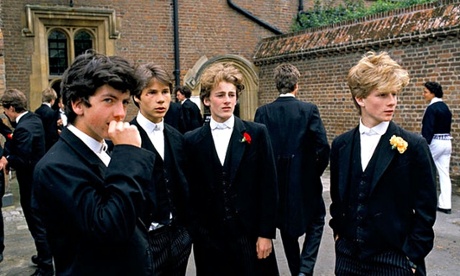
Eton schoolboys
'There is, in short, massive asymmetry of information in the post-16 education system and the critical determinant is class.' Photograph: Alamy

Let’s call him Matt. Aged 16, he is tall, taciturn and highly talented. He goes to a state school and is about to choose his A-levels. For all kinds of reasons, he believes he should progress, via Oxbridge or the Ivy League, to become an aerospace engineer.
So should he do further maths? If maths is the new rock’n’roll in education, then further maths is a VIP enclosure that fewer than 15,000 young people a year get into.
Last week, I had the chance to put this question to the deputy head of a top private school. “By all means do further maths, but only if you are guaranteed to get an A,” came the answer, as if it were a no-brainer. It was advice born out of years of practical knowledge.
Other opinions are available of course – and that’s the problem. This year, a quarter of a million 16-year-olds will make their A-level choices relying on hearsay, myth and information that is outdated or uncheckable. Those choices will shape their options when it comes to university – and the courses they apply for will then shape their chances of getting in.
There is, in short, massive asymmetry of information in the post-16 education system and the critical determinant is class. Kids at private school can rely on schools that have continual informal contact with elite universities. The result is that – for all the hard work being done by outreach teams in Russell Group universities, and by access teams in state schools – there’s an inbuilt advantage among those going to private schools based on informal knowledge.
Last year’s results for further maths demonstrate the problem. In English state schools, further education and sixth-form colleges, about 11,100 young people sat the exam; in the private sector, which accounts for just 7% of the school population, 3,600 sat it. And private school results were better, with 69% getting A or A* versus 54% in state schools.
Government tables show that this achievement gap is even more pronounced for ordinary maths and the three main science subjects. There are numerous private websites that offer A-level advice, and anecdotally social media are abuzz with the wisdom of teenage crowds over course and subject choices.
But why isn’t there a central repository of information that would turn all this folkore into a level playing field of checkable knowledge? Why isn’t there a single, open-source database that models all specific pathways into higher education? Without it, state school students will always find it hard to win the inside-knowledge game.
At my old university, Sheffield, they told me that you need maths and physics as part of three A grades to study aerospace engineering. That’s in line with the Russell Group’s guide, which also tells you to add design/technology, computer science or further maths.
The admissions tutor of an Oxbridge college, however, tells me: “I think here they’d be worried about no further maths, especially if it was offered at school but they didn’t take it, though I do worry that we send out mixed messages about this.”
The knowledge asymmetries deepen once you realise that elite universities require additional, bespoke tests. Cambridge University’s website reveals that if you want to do engineering at Christ’s, Peterhouse or St John’s you might need to take an extra exam called Step.
In a cantankerous, unsigned diatribe, the Step chief examiner for 2014 complains that only 3.8% of applicants scored top marks. The majority were not prepared for the kind of thinking they had to do. “Curve-sketching skills were weak,” the examiner noted, together with “an unwillingness to be imaginative and creative, allied with a lack of thoroughness and attention to detail”.
I will wager that the people who scored top marks knew that their curves had to look like Leonardo da Vinci’s and that they had to demonstrate imagination and creativity – because their teachers had long experience of this exam, and the others had not. One Oxbridge admissions tutor admitted to me that such testing may add a further barrier to people from state schools.
Suppose Matt wants to go to Oxbridge more than he wants to be an aerospace engineer? Here the advice is – for those in the know – really clear. Don’t apply for the most popular courses, where there can be 12 people for every place. Work out the college and subject combinations that reduce the odds to just three or four to one.
Oxford’s website shows the success ratio for getting on to its popular engineering and economic management course is just 10%, while the success rate of applications for materials science is 42%. A senior administrator at Oxford told me that they suspected few state school teachers really understand this game of playing the ratios. State-school students and people from ethnic minorities crowd each other out by going for the same, obvious, high-ratio and vocational courses.
Why should this matter to the majority of young people, who do not aspire to go to an elite university? And to the rest of society? First, because it is creating needless inequality of opportunity and is just the most obvious example of how poor access to informal knowledge penalises state school kids. Second, because in an economy set to be dominated by information and technology, those 15,000 people who can attempt further maths each year are the equivalent of Aztec gold for the conquistadores. Their intelligence will be the raw material of the third industrial revolution.
There is no reason – other than maintaining privilege – to avoid presenting subject and course choices clearly, logically and transparently. When the system fails bright kids from non-privileged backgrounds, we all lose.