'People will forgive you for being wrong, but they will never forgive you for being right - especially if events prove you right while proving them wrong.' Thomas Sowell
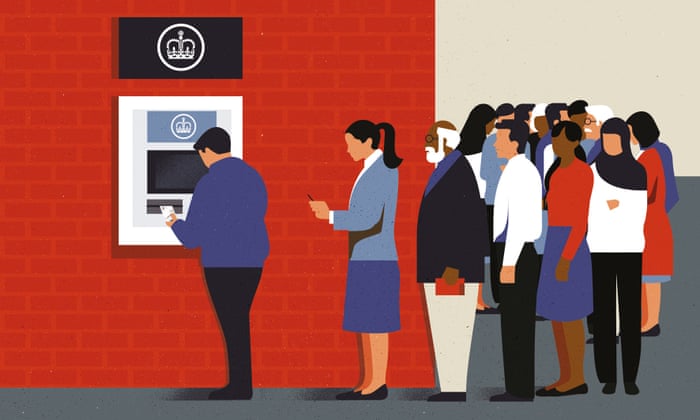
There aren’t many ideas that unite trade unionists, the libertarian right, the green movement, and the Silicon Valley tech scene . But that’s the rainbow alliance backing a universal basic income, a centuries-old idea posited as the solution to a range of 21st-century problems. Is its surprising coalition of bedfellows a sign of an idea whose time has at last resoundingly come – or a symptom of a catch-all, superficial fix in search of a problem?
Universal basic income, sometimes called a citizens’ income, is the idea that the state should pay every adult citizen a regular, modest income. It is a no-strings payment, so unlike benefits currently available to people of working age, it is not means tested. You get it regardless of whether you have a job, are looking for work, or whether you are even willing to work.
A basic income has long counted on support from the political fringes. It has appealed to radical feminists and greens frustrated by capitalist failure to properly value non-monetary work, such as care. The libertarian right embraces it as an opportunity to roll back the bureaucracy of the state, replacing public services with a simple, regular cash payment, to be spent as people wish.
But the real reason for basic income’s unlikely elevation to idea of the moment is the growing chorus of thinkers who seem to believe the modern economy can’t function without it. Tech utopians talk up the rise of robots and the development of artificial intelligence, which they say will leave less work to go round. They argue that this is the perfect opportunity to embrace a four-day working week and top everyone up with a basic income payment.
Labour market dystopians, on the other hand, rightly point to growing insecurity in the low-paid labour market and the millennials bouncing from gig to gig, never quite pinning down the security of a permanent contract. For them, a basic income is the poverty backstop that could help people cope with this brave new world.
Ken Loachian welfare critics, meanwhile, denounce today’s convoluted benefits system, worlds away from the contributory, insurance-based system of the past. It has become overloaded with sanctions as politicians compete to become ever more punitive to demonstrate there’s no such thing as something for nothing. So people who have been laid off find themselves pushed further into hardship after having their benefits docked for reasons outside their control. Wouldn’t it be easier to eradicate that inhumane, overbearing complexity, and replace it with something that gives people more breathing room to find the right job?
But, like so many ideas overstretched to become the answer to all problems, a basic income falls short on all of the above. If we could be bothered, we could fix the caring issue simply by increasing the generosity of the stingy state benefits paid to those who care full-time for older people or adults with disabilities. If we were so inclined, we could get rid of punitive benefit sanctions and replace them with a welfare-to-work system that puts much more emphasis on training and support for people to find the job that is right for them, not the first that comes along.
But it is in its most ambitious and radical incarnations that basic income runs aground. People have been predicting the end of work for a long time. Guess what: whether they count themselves utopian or dystopian, they have always been proved wrong. The wheel, the loom, the washing machine, the PC: as innovation after innovation has replaced some forms of human labour, the steady march of progress has replaced that labour with something else.
It’s tempting to think our inventions are more transformative than those of our ancestors. But it’s much more likely that, as in the past, technology will radically reshape the world of work without reducing its sum total. That’s partly because the idea that there is a set amount of paid work to be done is an error, which economists call the “lump of labour fallacy”. In fact, the richer we get, the more cash we have to spend – creating more demand and more jobs.
None of this should take away from the fact that we have some serious challenges ahead. The idea that the labour market is being reshaped rather than shrunk won’t be very comforting to taxi drivers losing their jobs to self-driving cars and finding they lack the skills for the new ones being created. But paying people a meagre basic income won’t help: we know from deindustrialisation in the past that leaving people who get laid off languishing on long-term benefits wreaks untold damage on working lives curtailed decades too early.
Britain has also always had too many low-skill, low-paid jobs offering poor prospects of progression. That should seriously worry us, particularly in the light of new research that suggests having a low-paid, stressful job is even worse for your mental health than unemployment.
Far from robots stealing jobs, the reality of today’s economy is that many companies are underinvesting in technology, suppressing productivity growth. In some sectors, labour is so cheap and easily exploitable it doesn’t make sense to modernise – for instance, Leicester’s garment industry is still heavily reliant on old-fashioned sweatshop models. In sectors such as parcel delivery and logistics, technology itself is being used to turn workers into quasi-robots. Wrist-based devices measure routes workers take round the warehouse or delivery rounds to check them for speed and efficiency, and track them right down to how long they take for toilet breaks.
The answer cannot be to accept this sorry state of affairs and try to patch things up with a basic income. It must be to address the fundamental power imbalances that allow employers to shift risk on to their employees by forcing them to become self-employed contractors, or refusing to pay them for breaks. And to develop long-term solutions for improving the quality of work.
You can see the attractions of a basic income for Silicon Valley. Firms such as Uber, whose drivers are classified as self-employed “partners” rely on this risk-shift model. Even as Facebook’s founder, Mark Zuckerberg, heaps praise on a basic income, the tech giant does all in its legal power to avoid tax and dodge paying its fair share towards the social infrastructure it relies on. The left must not allow itself to be seduced. A basic income is a distraction from these core issues of economic power; a radical-sounding excuse to look the other way from the less glamorous, more complex question of how to ensure labour market rights are properly enforced. Accepting a deterioration in employment rights and working conditions in exchange for a basic income could be dangerously counterproductive.
The tax credits that function as income top-ups for people in low-paid work have steadily been eroded by Conservative chancellors over eight years. Labour rights are more future proof: it’s impossible to imagine the government being able to cut statutory maternity leave, the minimum wage or limits on the working week without a much tougher fight – although if they are not properly enforced these rights can end up meaning little in practice for workers with unscrupulous employers.
The left will have to pick its battles. It must focus on winning the right to a decently paid job for all, not sell out by extolling a basic income as a panacea for the ills of the modern labour market. It must choose the fight for power, not the fight for a dribble of cash.
The most surprising thing about these Gujarat elections is that people are so surprised at the Prime Minister’s rhetoric. Narendra Modi has eschewed all talk of development, and has played to the worst impulses of the Gujarati people. His main tool is Hindu-Muslim polarisation, which is reflected in the language he uses for his opponents. The Congress has a “Mughlai” mentality, they are ushering in an “Aurangzeb Raj”, and their top leaders are conspiring with Pakistan to make sure Mr. Modi loses. A Bharatiya Janata Party (BJP) spokesperson has also launched a scathing attack on Congress president-elect Rahul Gandhi. None of this is new.
Mr. Modi’s rhetoric in the heat of campaigning has always come from below. From his references to “Mian Musharraf” over a decade ago to the “kabristan-shamshaan” comments of the recent elections in Uttar Pradesh, it has been clear that the otherness of Muslims is central to the BJP playbook. Hate drives more people to the polling booth than warm, fuzzy feelings of pluralism. But, the question is, are the Congress leaders really conspiring with Pakistan to make sure the BJP lose?
Answer: It doesn’t matter.
No care for truth
In 1986, the philosopher Harry G. Frankfurt wrote an essay named “On Bullshit”, which was published as a book in 2005 and became a surprise bestseller. The book attempts to arrive at “a theoretical understanding of bullshit”. The key difference between a liar and a , ‘bullshitter’, Frankfurt tells us, is that the liar knows the truth and aims to deceive. The ‘bullshitter’, on the other hand, doesn’t care about the truth. He is “neither on the side of the true nor on the side of the false,” in Frankfurt’s words. “His eye is not on the facts at all, as the eyes of the honest man and of the liar are, except insofar as they may be pertinent to his interest in getting away with what he says.”
The ‘bullshitter’ is wise, for he has cottoned on to an important truth that has become more and more glaring in these modern times: that facts don’t matter. And to understand why, I ask you to go back with me in time to another seminal book, this one published in 1922.
The first chapter of “Public Opinion”, by the American journalist, Walter Lippmann, is titled “The World Outside and the Pictures in Our Heads”. In it, Lippmann makes the point that all of us have a version of the world inside our heads that resembles, but is not identical to, the world as it is. “The real environment,” he writes, “is altogether too big, too complex, and too fleeting for direct acquaintance.”
We construct a version of the world in our heads, and feed that version, for modifying it too much will require too much effort. If facts conflict with it, we ignore those facts, and accept only those that conform to our worldview. (Cognitive psychologists call this the “Confirmation Bias”.)
Lippmann sees this as a challenge for democracy, for how are we to elect our leaders if we cannot comprehend the impact they will have on the world?
Fragmented media
I would argue that this is a far greater problem today than it was in Lippmann’s time. Back then, and until a couple of decades ago, there was a broad consensus on the truth. There were gatekeepers to information and knowledge. Even accounting for biases, the mainstream media agreed on some basic facts. That has changed. The media is fragmented, there are no barriers to entry, and the mainstream media no longer has a monopoly of the dissemination of information. This is a good thing, with one worrying side effect: whatever beliefs or impulses we might have — the earth is flat, the Jews carried out 9/11, India is a Hindu nation — we can find plenty of “evidence” for it online, and connect with like-minded people. Finding others who share our beliefs makes us more strident, and soon we form multiple echo chambers that become more and more extreme. Polarisation increases. The space in the middle disappears. And the world inside our heads, shared by so many other, becomes impervious to facts.
This also means that impulses we would otherwise not express in polite society find validation, and a voice. Here’s another book you should read: in 1997, the sociologist, Timur Kuran, wrote “Private Truths, Public Lies” in which he coined the term “Preference Falsification”. There are many things we feel or believe but do not express because we fear social approbation. But as soon as we realise that others share our views, we are emboldened to express ourselves. This leads to a “Preference Cascade”: Kuran gives the example of the collapse of the Soviet Union, but an equally apt modern illustration is the rise of right-wing populists everywhere. I believe — and I apologise if this is too depressing to contemplate — that the majority of us are bigots, misogynists, racists, and tribal in our thinking. We have always been this way, but because liberal elites ran the media, and a liberal consensus seemed to prevail, we did not express these feelings. Social media showed us that we were not alone, and gave us the courage to express ourselves.
That’s where Donald Trump comes from. That’s where Mr. Modi comes from. Our masses vote for these fine gentlemen not in spite of their bigotry and misogyny, but because of it. Mr. Trump and Mr. Modi provide them a narrative that feeds the world inside their heads. Mexicans are rapists, foreigners are bad, Muslims are stealing our girls, gaumutra cures cancer — and so on. The truth is irrelevant. Facts. Don’t. Matter.
Think about the implication of this. This means that the men and women who wrote the Constitution were an out-of-touch elite, and the values they embedded in it were not shared by most of the nation. (As a libertarian, I think the Constitution was deeply flawed because it did not do enough to protect individual rights, but our society’s consensus would probably be that it did too much.) The “Idea of India” that these elites spoke of was never India’s Idea of India. These “liberal” values were imposed on an unwilling nation — and is such imposition, ironically, not deeply illiberal itself? This is what I call The Liberal Paradox.
All the ugliness in our politics today is the ugliness of the human condition. This is how we are. This is not a perversion of democracy but an expression of it. Those of us who are saddened by it — the liberal elites, libertarians like me — have to stop feeling entitled, and get down to work. The alt-right guru Andrew Breitbart once said something I never get tired of quoting: “Politics is downstream from Culture.” A political victory will now not come until there is a social revolution. Where will it begin?
“Suit the action to the word, the word to the action,” says Hamlet in William Shakespeare’s play. Hamlet’s advice is given to actors rehearsing a play within the play, but it is advice all of us can take. Words not suited to action are considered empty or hollow. We do not trust people whose words have little or nothing to do with their actions.
And yet, as communities, we tend to fall into this trap. We repeat some words, almost as if they were mantras, blithely ignoring the fact that our actions often do not vindicate such words.
The two most common sets of words that I hear these days come from Hindus and Muslims, all of them well meaning. Hindus in India keep telling me that “Hinduism is an inclusive, tolerant religion” and Muslims all over the world keep telling me that “Islam is a religion of peace.” Now, no doubt, they are largely right. There is much in history to suggest that Hinduism is an inclusive and tolerant religion, and that Islam puts a lot of stress on peace: the basic greeting of Islam, salaam-alai-kum, means ‘peace be on you.’
And yet, if we stop with these words, we are either being wilfully blind or displaying a remarkable lack of awareness and self-criticism. Because, very often, these words are not redeemed by action. Anyone who reads the newspapers today can see that not all Hindus are inclusive and not all Muslims are peace-loving.
The religion of Rahul Gandhi
One cannot help noticing that if Hinduism was always inclusive and tolerant, then the recent controversy over Rahul Gandhi’s religious beliefs would not have occurred. One also cannot help noticing that if Islam was equated solely with peace, groups of Muslims would not be shooting at each other in almost every third Muslim country in the world.
Let’s face it: why should the fact of Rahul Gandhi’s religious beliefs — or, for that matter, Jawaharlal Nehru’s agnosticism — become a matter of discussion in an India full of inclusive and tolerant Hindus? Let alone the fact that the oldest community of Christians in India can be dated back to 2,000 years, a truly inclusive and tolerant Hindu would not expect other Indians to obtain a ‘Hindu’ religious certificate in order to run for office. Similarly, surely, such a Hindu would be able to accept not just Indian Muslims, who have contributed to India for about 1,500 years, but also monuments, such as the Taj Mahal, associated with the so-called Muslim period of India. I must say that I was surrounded by really tolerant and inclusive Hindus in the India in which I grew up, and I must add that their numbers seem to be greatly reduced today.
Violence instead of protest
Similarly, the Muslim claim that Islam is a religion of peace seems hollow not just when one looks at what some Muslims are doing to other Muslims, but also when one hears religious discourses about the supposed ‘moral victory’ of Islam over other faiths. I will not even talk of Islamist terrorism, mostly because it is often discussed in excess to its reality, but surely some other people would bring it up, and who can say that their fears are totally unjustified? Islam might be a religion of peace, but too many Muslims seem to take recourse to violence instead of peaceful and democratic modes of protest and action.
Once again, this is a tendency that has increased in Muslim communities — where there is increasing impatience with those Muslims who do not kowtow to fundamentalist prescriptions.
In such a context, when Hindus say that Hinduism is an inclusive and tolerant religion, and Muslims say that Islam is a religion of peace, there can be only two explanations. First, and positively, what they mean is that the essence of Hinduism is inclusive and the essence of Islam is peaceful, and hence intolerant Hindus or violent Muslims are going against the essence of their own religions. If this is the intention, the statements are at least partly justified.
But, often, this is not the intention. The intention is not to critique wrong tendencies within Hinduism or Islam but to dismiss criticisms — from within or outside. Often, Hindus who beat the drum of the inclusiveness of Hinduism do so in order to dismiss contrary evidence, and so do Muslims who beat the drum of the peacefulness of Islam. In such cases, what they utter are empty words. Or worse: inclusiveness becomes a weapon to exclude, peace becomes a justification of violence.
The statements “Hinduism is an inclusive, tolerant religion” and “Islam is a religion of peace” contain much truth — but this truth has to be regularly vindicated by action. There seems to be an increasing failure to do so on the part of many Hindus and Muslims. Each one of us has to face up to this failure. Every time we use such words, we need to ask ourselves: do we really mean it, and does the evidence around us sustain such claims? We have to ask ourselves: are we using these words as ideals or as excuses?
Because, finally, words only mean what we put into them — by our daily acts. And when we use words that are being emptied of meaning, we simultaneously hollow out the rich and wonderful realities of our world.
She is 27 and lives in Bengaluru. Let’s call her Radhika. Radhika says she was 18 when she became “conscious” that she wanted to be intimate with multiple partners. In other words, that she was polyamorous. She has come out to a few friends and reactions have been mixed.
“Some are accepting, but some are sceptical, and tell me that I am being foolish and polyamory will never work.” She hasn’t told her parents yet simply because they will not understand. Even more difficult has been to find partners willing to accept polyamory. Radhika says she has been practising polyamory for only two years now, when she finally began to find the first few partners open to the idea.
The dictionary defines polyamory as ‘the practice of engaging in multiple sexual relationships with the consent of all the people involved.’ Its definition is often expanded as ‘consensual, ethical, and responsible non-monogamy’ to differentiate it from what it is often misunderstood for — a committed couple in an open relationship where each is allowed to experiment outside the relationship every now and then. In polyamory, however, there is no single committed couple — the polyamorous group is committed to every one of its members, mentally and physically.
In hushed tones
As definitions of relationships and sexualities morph dramatically across the world, India is no exception. Polyamory India is a Facebook group formed about eight years ago by the San Diego-based Rohit Juneja and has as its background image the words, ‘The capacity for human love is unlimited.’ And about a year ago, Bangalore Polycules was formed, a ‘hush-hush’ community of people who are polyamorous and meet occasionally in private spaces.
Members have come together through an underground network. In a departure from their fool-proof privacy, the group organised a public event, a screening of a French film Lutine on polyamory, in order to educate more people about it. And when earlier this year, they announced the event at the city’s famous art space, 1 Shanthiroad Studio, it led also to their name cropping up on search engines.
That is how I found them. And perhaps that’s how Basit Manham found them. At 24, Manham says he is dealing with depression. Outwardly, his lean frame exudes confidence, showing no signs of the inner turmoil. Manham, a college dropout, moved to Bengaluru from Pune about a year ago as the senior community manager of Stay Abode. He comes from an orthodox Muslim family and in 2014, when he declared himself as ‘agnostic’ on social media, he was immediately disowned by his family and has had to support himself since. A few months later, he used social media again to declare that he was polyamorous.
Two major public declarations in quick succession, and their fallout, have clearly affected him deeply. “Probably,” he says. Alone in a new place, all Manham wanted was to be with people who would not question him or judge his choices. And then he stumbled upon Bangalore Polycules.
Not polygamy
The film screening of Lutine was open to all, polyamorous or otherwise, and it was followed by a Skype Q&A with the film’s director Isabelle Broué. When asked who had organised the screening and Q&A session, the gallery representatives would only say that they got a request for the event via email and that there was a good turnout of people. A city-based filmmaker who attended it says he could not figure out who the founders of the group were.
I spoke to Broué in an email interview, and she recollected her experience of talking to audience members. One of the questions asked of her was a common one that vexes most Polycules members. Is polyamory the same as polygamy? “I gave the usual answer: that polygamy is about being ‘officially’ in an union (from the Greek word gamos) with someone, whereas in polyamory, we’re talking about intimate relationships without social recognition,” says Broué, who is polyamorous herself.
Polyamory is about equity and egality: any person in a relationship has the same rights, no matter her or his gender, sexual orientation or age. But what Broué remembers most is seeing so many women in the audience, mostly “young women”. It reaffirmed her belief that polyamory is a way to assert yourself as a free person. “It is both personal and political,” she says, “a feminist way of living your relationships.”
On the evening of the event, one of the audience members, who had attended out of curiosity, got the feeling that the “whole thing was about kids wanting to have a good time”. Otherwise why wouldn’t they be in a monogamous relationship? Radhika doesn’t agree. “I am polyamorous,” she says. “I don’t think I have a choice in the matter. Whenever I’ve been in monogamous relationships, I have resented the fact that wanting a relationship with someone else is considered taboo (unless it’s within the framework of friendship). And that has been very stifling.”
Coming out as polyamorous in today’s society is obviously still difficult, despite the growing openness. What makes it easier are groups like the Polycules. As one of its members says in an email interview, the “primary purpose of this group is to be a place where people can share and support each other.”
For Manham, it was pure serendipity that he found a local community. He has been to a few of their meet-ups and finds the members are on his wavelength. He cannot give more details — the group has requested him not to volunteer more information about it. He says, “Idea-wise, we are connected and that’s enough for me.”
A polyamorous person can choose to be in a hierarchal or non-hierarchal relationship, which, simply put, means they could have a primary partner or all partners can be of equal relevance. In Manham’s case, his first relationship broke up because his girlfriend was not okay with him seeing others. “Each of my relationships satisfies a different emotional need. I can’t satisfy someone in all ways and vice versa,” he explains.
In a monogamous relationship, one either makes do with the partner, warts and all, or tries to change the partner. “Most poly people do not change anything about a partner,” Manham says. “It is cruel to try and change someone.”
Polyamorous people are also quick to point out that their proclivity for more than one partner does not make them simply promiscuous or disloyal.
A survey conducted of the Bangalore Polycules members found that 72% inform their partners of other relationships. About 85% said they would continue with a satisfying relationship even when sex dwindles or isn’t in the equation. They cite this to indicate that their ethics overrule the assumptions of promiscuity labelled on them. The Polyamory India group says on its Facebook page: ‘It is not about free sex, casual sex, extramarital affairs and nor is it a way to make friends or pick up sex partners. If you are looking for any of these please go elsewhere.’
The Bangalore Polycules community has people of diverse gender identity: male, female and other genders. Their sexual orientations range from heterosexuals at 35%, bisexual 35% and 30% homosexuals and others. But no matter what, all of them listed understanding and communication as the most important aspects in each of their relationships. “Communication is important because there is no standard protocol as there is in monogamy,” says Radhika. “Being receptive to each other’s needs, desires and preferences is crucial.” One of the Polycules members, who identified as demi-sexual, stressed on “honest communication” as being the key to satisfying polyamorous relationships.
Still, jealousy rears its ugly head. Sitting in a crowded restaurant and eating a piping hot vada and sambar, Manham is dealing with a few issues himself. “I still feel uncomfortable when my primary partner tells me about her other relationships,” he confesses. Only uncomfortable? “No, make that jealous,” he says, after a moment of silence. “So, I tell her it is okay if she doesn’t tell me about her relationships.” But omission is not honest communication. And that is a troubling issue.
It is not that polyamorous people do not feel jealousy. “We try to handle it differently,” as Radhika says. Some of it, according to her, is about thinking from a different perspective; people conventionally are not jealous if one friend seeks other friendships. “Often, jealousy stems from unmet needs in a current relationship, so figuring out what those are could be helpful,” she says. For Manham, acknowledging the emotion and reasoning it out is a step forward. As he says, “No matter what, I will support my primary partner, even when she has any issues with her other relationships.”
Questions of fidelity
Most members of Bangalore Polycules said that sex is not the key factor driving them to polyamory. In fact, for Manham, he broke off two relationships when he realised the partners were in it for sex only. “I thought we were in a relationship,” he says. One respondent said that even though he was not in a relationship at the moment, for him, platonic love transcends sex. He calls himself ‘asexual’, and he thinks it is possible to be connected only emotionally.
When questioned about what happens at the meet-ups, Manham retorts, “Just because we resonated idea-wise, doesn’t mean that I was sexually attracted to them.” Orgies are not the point of the meet-ups, a myth most non-poly people conjure. And in sexual relations, it is unwritten convention that the onus of safe sex is on all the partners. As Manham tells me, he and his partners (there are currently three), inform each other if they have had unprotected sex.
The expectations of emotional fidelity, on the other hand, are divided among members. Exactly half the respondents said they expected it, while the other half said they did not.
One issue that has yet to come up for most of them — given that the majority are in the 26-40 years age bracket — is the question of children. Will anything change then? Manham isn’t sure. And neither were some of the others. One of them, a young computer engineer in his early 30s, who guards his privacy ferociously as he is unsure of his workplace’s reactions, says he is now under pressure from his family to get married, settle down, have children.
“They look at my polyamory relationships as a ‘macho’ thing and want me to commit to one girl and have children,” he says. “But none of my partners are ready to be married and, frankly, neither am I. And having children out of wedlock will bring in other issues.”
For now, the issues facing the group are privacy related. As they grow older, there will no doubt be new issues. But the challenge at any age will be getting the right to live their lives the way they want, without society telling them how to live.
Dekh lee teree khudayee
bas meraa dil bhar gayaa
dekh lee teree khudayee
teree rahemat chup rahee
teree rahemat chup rahee
mai rote rote mar gayaa
dekh lee teree khudayee
Mere maalik kyaa kahu
teree duwaaon kaa fareb
mere maalik kyaa kahu
teree duwaaon kaa fareb
mujhpe yun chhaayaa ke mujhko
mujhpe yun chhaayaa ke mujhko
ghar se beghar kar gayaa
dekh lee teree khudayee
Woh bahaare naachatee thee
jhumatee thee badaliya
woh bahaare naachatee thee
jhumatee thee badaliya
apanee kismat yaad aate
apanee kismat yaad aate hee
meraa jee dar gayaa
dekh lee teree khudayee
bas meraa dil bhar gayaa
dekh lee teree khudayee
teree rahemat chup rahee
teree rahemat chup rahee
mai rote rote mar gayaa
dekh lee teree khudayee
देख ली तेरी खुदाई
बस मेरा दिल भर गया
देख ली तेरी खुदाई
तेरी रहेमत चुप रही
तेरी रहेमत चुप रही
मैं रोते-रोते मर गया
देख ली तेरी खुदाई
मेरे मालिक क्या कहूँ
तेरी दुआओं का फ़रेब
मेरे मालिक क्या कहूँ
तेरी दुआओं का फ़रेब
मुझ पे यूँ छा कि मुझको
मुझ पे यूँ छा कि मुझको
घर से बेघर कर गया
देख ली तेरी खुदाई
वो बहारें नाच उठी थी
झूम उठी थीं बदलियाँ
वो बहारें नाच उठी थी
झूम उठी थीं बदलियाँ
अपनी क़िस्मत याद आते
अपनी क़िस्मत याद आते ही
मेरा दिल डर गया
देख ली तेरी खुदाई
बस मेरा दिल भर गया
देख ली तेरी खुदाई
तेरी रहेमत चुप रही
तेरी रहेमत चुप रही
मैं रोते-रोते मर गया
देख ली तेरी खुदाई