James Moore in The Independent
Those Brexiteers who fondly believe that Britain will be able to have its cake and eat it too as regards trade with the EU often used to like to point to Canada as a potential model for our future relationship with our former partners.
Canada, you see, was in the process of negotiating a trade deal that would have eliminated nearly all the tariffs between the two sides.
It would have thus facilitated access to the European single market for the country without it being a member and having to accept lots of Europeans turning up and looking for work in Toronto.
Everything was going swimmingly until, that is, the Walloons of Belgium kicked up a fuss and threatened to derail the deal, the future of which is now hanging on a knife edge.
To get agreements like the Comprehensive Economic and Trade Agreement (Ceta) up and running requires the assent of all of the EU’s 28 member states. Unfortunately, before Belgium can add its name to the list it first has to secure the assent of six regional assemblies. The Wallonian one is worried about the impact of the deal on its farmers.
Cue a blizzard of statements, and counter statements, and threats and counter threats, as both sides face up to the fact that they may have wasted seven years of complex and painstaking work.
Critics of the EU in Britain have used the debacle to bolster the case for leaving.
But critics within the EU have tabled a rather different argument. They suggest that the problem lies with Brussels having ceded too much control over trade to national Parliaments. There is a rich irony in the fact that Britain and its Eurosceptics are part of the reason for that.
For years they preached the virtue of national vetoes and subsidiarity. No handing power to Brussels Bureaucrats!
That may now come back to bite them because it might just scupper hopes of securing a favourable trade deal with Europe.
But, but, but we buy lots from the Wallonian farmers so they won’t have a problem with us!
That was the knuckle-headed response of Brexit supporting minister Chris Grayling. We’ve heard many variants on that sort of theme in recent months.
It’s true that Grayling’s flimsy argument was given something of a boost when the entirely more substantial figure of Germany’s Angela Merkel said she didn’t necessarily see parallels between this debacle and the upcoming talks between the UK and the EU.
But what if someone does kick up a fuss when the outcome of those talks becomes known? Germany might not, despite the childish insults lobbed its way by some right wing politicians and some right wing newspapers. Germany, however, doesn’t speak for the entire EU.
Perhaps the Spanish will decide to throw a spanner into the works unless there’s some movement on the question of Gibraltar. You could hardly blame the Poles for digging their heels in given the way Britain has treated the citizens of that country who live here. Maybe the French will decide it’s time for some payback for past British obstructionism.
Hang on, I hear you say, they’re grown ups. They surely wouldn’t stoop to such tactics. They’ll want a deal that works for both sides too.
Perhaps that’s so. But would you really be confident in ruling out the risk of a repeat performance when it’s Britain’s turn?
The Canadians will manage without this deal. They’re already part of the North American Free Trade Agreement, and they have trade deals in place with other countries besides.
Britain shorn of the EU has nothing of the sort. And it has a very different international image to the one that Canada has.
You couldn’t imagine its Prime Minister Justin Trudeau not guaranteeing the rights of Europeans living in his country if the issue cropped up, or of tolerating calls for child refugees to submit to dental testing.
Goodwill and good PR are powerful currencies, and Trudeau has lots of both, in stark contrast to Theresa May’s nasty and inward looking Tory administration.
An administration that doesn’t appear to have anything resembling a strategy beyond waving its fists, stomping its feet and threatening to go home and sulk if its former European friends won’t play the game by its rules.
Soon the reality of that will start to bite. The sort of problems Canada is having with Europe may ultimately pale by comparison to the ones faced by Britain.
We’ll know who to blame when they emerge. Clue: it won’t be the Wallonian farmers or their surrogates.
Thursday, 27 October 2016
Wednesday, 26 October 2016
Donald Trump is no outsider: he mirrors our political culture
George Monbiot in The Guardian
What is the worst thing about Donald Trump? The lies? The racist stereotypes? The misogyny? The alleged gropings? The apparent refusal to accept democratic outcomes? All these are bad enough. But they’re not the worst. The worst thing about Donald Trump is that he’s the man in the mirror.
We love to horrify ourselves with his excesses, and to see him as a monstrous outlier, the polar opposite of everything a modern, civilised society represents. But he is nothing of the kind. He is the distillation of all that we have been induced to desire and admire. Trump is so repulsive not because he offends our civilisation’s most basic values, but because he embodies them.
Trump personifies the traits promoted by the media and corporate worlds he affects to revile; the worlds that created him. He is the fetishisation of wealth, power and image in a nation where extrinsic values are championed throughout public discourse. His conspicuous consumption, self-amplification and towering (if fragile) ego are in tune with the dominant narratives of our age.
The entire electoral process is stolen from the American people before they even cast their vote
As the recipient of vast inherited wealth who markets himself as solely responsible for his good fortune, he is the man of our times. The US Apprentice TV show which he hosted tells the story of everything he is not: the little guy dragging himself up from the bottom through enterprise and skill. None of this distinguishes him from the majority of the very rich, whose entrepreneurial image, loyally projected by the media, clashes with their histories of huge bequests, government assistance, monopolies and rent-seeking.
If his politics differ from those of the rest of the modern Republican party, it is because he is, in some respects, more liberal. Every vice, for the Republican trailblazers such as Ted Cruz and Scott Walker, is now a virtue; every virtue a vice. Encouraged by the corporate media, the Republicans have been waging a full-spectrum assault on empathy, altruism and the decencies we owe to other people. Their gleeful stoving in of faces, their cackling destruction of political safeguards and democratic norms, their stomping on all that is generous and caring and cooperative in human nature, have turned the party into a game of Mortal Kombat scripted by Breitbart News.
Did Trump invent the xenophobia and racism that infuse his campaign? Did he invent his conspiracy theories about stolen elections and the criminality of his opponents? No. They were there all along. What is new and different about him is that he has streamlined these narratives into a virulent demagoguery. But the opportunity has been building for years; all that was required was someone blunt and unscrupulous enough to take it.
What is the worst thing about Donald Trump? The lies? The racist stereotypes? The misogyny? The alleged gropings? The apparent refusal to accept democratic outcomes? All these are bad enough. But they’re not the worst. The worst thing about Donald Trump is that he’s the man in the mirror.
We love to horrify ourselves with his excesses, and to see him as a monstrous outlier, the polar opposite of everything a modern, civilised society represents. But he is nothing of the kind. He is the distillation of all that we have been induced to desire and admire. Trump is so repulsive not because he offends our civilisation’s most basic values, but because he embodies them.
Trump personifies the traits promoted by the media and corporate worlds he affects to revile; the worlds that created him. He is the fetishisation of wealth, power and image in a nation where extrinsic values are championed throughout public discourse. His conspicuous consumption, self-amplification and towering (if fragile) ego are in tune with the dominant narratives of our age.
The entire electoral process is stolen from the American people before they even cast their vote
As the recipient of vast inherited wealth who markets himself as solely responsible for his good fortune, he is the man of our times. The US Apprentice TV show which he hosted tells the story of everything he is not: the little guy dragging himself up from the bottom through enterprise and skill. None of this distinguishes him from the majority of the very rich, whose entrepreneurial image, loyally projected by the media, clashes with their histories of huge bequests, government assistance, monopolies and rent-seeking.
If his politics differ from those of the rest of the modern Republican party, it is because he is, in some respects, more liberal. Every vice, for the Republican trailblazers such as Ted Cruz and Scott Walker, is now a virtue; every virtue a vice. Encouraged by the corporate media, the Republicans have been waging a full-spectrum assault on empathy, altruism and the decencies we owe to other people. Their gleeful stoving in of faces, their cackling destruction of political safeguards and democratic norms, their stomping on all that is generous and caring and cooperative in human nature, have turned the party into a game of Mortal Kombat scripted by Breitbart News.
Did Trump invent the xenophobia and racism that infuse his campaign? Did he invent his conspiracy theories about stolen elections and the criminality of his opponents? No. They were there all along. What is new and different about him is that he has streamlined these narratives into a virulent demagoguery. But the opportunity has been building for years; all that was required was someone blunt and unscrupulous enough to take it.
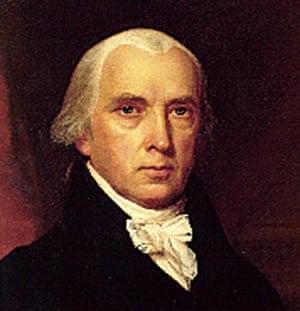
The fourth US president, James Madison. Photograph: White House/Reuters
Nor can you single out Trump for ignoring, denying and deriding the key issues of our time, such as climate change. Almost all prominent Republicans have been at it. In fact, across the four presidential debates, not one question about climate change was asked. Even when politicians and journalists accept the science, it makes little difference if they avoid the subject like the plague.
America’s fourth president, James Madison, envisaged the United States constitution as representation tempered by competition between factions. In the 10th federalist paper, written in 1787, he argued that large republics were better insulated from corruption than small, or “pure” democracies, as the greater number of citizens would make it “more difficult for unworthy candidates to practise with success the vicious arts by which elections are too often carried”. A large electorate would protect the system against oppressive interest groups. Politics practised on a grand scale would be more likely to select people of “enlightened views and virtuous sentiments”.
Instead, the US – in common with many other nations – now suffers the worst of both worlds: a large electorate dominated by a tiny faction. Instead of republics being governed, as Madison feared, by “the secret wishes of an unjust and interested majority”, they are beholden to the not-so-secret wishes of an unjust and interested minority. What Madison could not have foreseen was the extent to which unconstrained campaign finance and a sophisticated lobbying industry would come to dominate an entire nation, regardless of its size.
For every representative, Republican or Democrat, who retains a trace element of independence, there are three sitting in the breast pocket of corporate capital. Since the supreme court decided that there should be no effective limits on campaign finance, and, to a lesser extent, long before, candidates have been reduced to tongue-tied automata, incapable of responding to those in need of help, incapable of regulating those in need of restraint, for fear of upsetting their funders.
Democracy in the US is so corrupted by money that it is no longer recognisable as democracy. You can kick individual politicians out of office, but what do you do when the entire structure of politics is corrupt? Turn to the demagogue who rages into this political vacuum, denouncing the forces he exemplifies. The problem is not, as Trump claims, that the election will be stolen by ballot rigging. It is that the entire electoral process is stolen from the American people before they get anywhere near casting their votes. When Trump claims that the little guy is being screwed by the system, he’s right. The only problem is that he is the system.
The political constitution of the United States is not, as Madison envisaged, representation tempered by competition between factions. The true constitution is plutocracy tempered by scandal. In other words, all that impedes the absolute power of money is the occasional exposure of the excesses of the wealthy. What distinguishes Trump’s political career is that, until recently, his scandals have done him no harm.
Trump disgusts us because, where others use a dog whistle, he uses a klaxon. We hate to hear his themes so clearly articulated. But we know in our hearts that they suffuse the way the world is run.
Because this story did not begin with Trump, it will not end with Trump, however badly he may lose the election. Yes, he is a shallow, mendacious, boorish and extremely dangerous man. But those traits ensure that he is not an outsider but the perfect representation of his caste, the caste that runs the global economy and governs our politics. He is our system, stripped of its pretences.
Nor can you single out Trump for ignoring, denying and deriding the key issues of our time, such as climate change. Almost all prominent Republicans have been at it. In fact, across the four presidential debates, not one question about climate change was asked. Even when politicians and journalists accept the science, it makes little difference if they avoid the subject like the plague.
America’s fourth president, James Madison, envisaged the United States constitution as representation tempered by competition between factions. In the 10th federalist paper, written in 1787, he argued that large republics were better insulated from corruption than small, or “pure” democracies, as the greater number of citizens would make it “more difficult for unworthy candidates to practise with success the vicious arts by which elections are too often carried”. A large electorate would protect the system against oppressive interest groups. Politics practised on a grand scale would be more likely to select people of “enlightened views and virtuous sentiments”.
Instead, the US – in common with many other nations – now suffers the worst of both worlds: a large electorate dominated by a tiny faction. Instead of republics being governed, as Madison feared, by “the secret wishes of an unjust and interested majority”, they are beholden to the not-so-secret wishes of an unjust and interested minority. What Madison could not have foreseen was the extent to which unconstrained campaign finance and a sophisticated lobbying industry would come to dominate an entire nation, regardless of its size.
For every representative, Republican or Democrat, who retains a trace element of independence, there are three sitting in the breast pocket of corporate capital. Since the supreme court decided that there should be no effective limits on campaign finance, and, to a lesser extent, long before, candidates have been reduced to tongue-tied automata, incapable of responding to those in need of help, incapable of regulating those in need of restraint, for fear of upsetting their funders.
Democracy in the US is so corrupted by money that it is no longer recognisable as democracy. You can kick individual politicians out of office, but what do you do when the entire structure of politics is corrupt? Turn to the demagogue who rages into this political vacuum, denouncing the forces he exemplifies. The problem is not, as Trump claims, that the election will be stolen by ballot rigging. It is that the entire electoral process is stolen from the American people before they get anywhere near casting their votes. When Trump claims that the little guy is being screwed by the system, he’s right. The only problem is that he is the system.
The political constitution of the United States is not, as Madison envisaged, representation tempered by competition between factions. The true constitution is plutocracy tempered by scandal. In other words, all that impedes the absolute power of money is the occasional exposure of the excesses of the wealthy. What distinguishes Trump’s political career is that, until recently, his scandals have done him no harm.
Trump disgusts us because, where others use a dog whistle, he uses a klaxon. We hate to hear his themes so clearly articulated. But we know in our hearts that they suffuse the way the world is run.
Because this story did not begin with Trump, it will not end with Trump, however badly he may lose the election. Yes, he is a shallow, mendacious, boorish and extremely dangerous man. But those traits ensure that he is not an outsider but the perfect representation of his caste, the caste that runs the global economy and governs our politics. He is our system, stripped of its pretences.
How do batsmen cope with the intensity of their lonely skill?
Digging the pitch, repetitive body movements, talking to themselves, superstitious behaviour, visualisation - different ways that batsmen deal with the pressure of their profession
Michael Bond in Cricinfo
All sportspeople like to imagine that their discipline is the most mentally challenging, that winning or losing comes from within. But batsmen have a stronger claim than most. What other sport demands such intense concentration, affords participants so little control over their situation and penalises mistakes so cruelly and with such dramatic ritual?
Batting is a game of life and death like no other. Success - a century, a match-saving last stand - can live with you forever. But getting out feels like the end of everything: you are dismissed not just from the field of play, but from your own dreams of hopefulness and redemption.
---Also read
THE MASKS WE WEAR
----
Dismissed batsmen are like mourners at their own funerals. The dressing room falls silent as they return, "in respect for the dead", as Mike Brearley puts it in The Art of Captaincy (1985).
"There aren't many situations in sport where you have this challenge of one tiny mistake and that's it, finished, the rest of the day you're watching from the sidelines," says sports psychologist Steve Bull, who worked with the England cricket team for 17 years. "It creates a particular type of pressure which I don't think other athletes experience."
Given the intensity of the mental drama, it is little wonder that a batsman's struggles are with himself as much as with the bowler he faces, and that a lack of confidence can invite negative thinking and a fear of failure. For top-level batsmen with near-perfect technical skills, protecting themselves from such tendencies is critical. The methods they use to reduce anxiety, stay positive and maintain focus are idiosyncratic, often eccentric and tell us as much about the quirks of the human mind as the nuances of cricket.
If you watched England's three-match Test series against Sri Lanka this summer, you will have spotted a graphic example of one of these methods. Before each ball, the Sri Lankan opener Kaushal Silva performs what psychologists call a "pre-performance routine". He adjusts the velcro on his gloves, moves his bat from his left to his right hand and holds it up in front of him, moves his left elbow back and forth eight times (fewer if he's facing a spinner) as if pulling on an imaginary rope, then, gripping his bat with both hands, arches his back before settling into his crease.
The repetition looks neurotic, but Silva has developed it to help him feel settled. "I don't really count the exact number of times I do it, it just comes from my body," he says. "I do it until I have calmed my nerves and I feel OK and I'm really focused. These small things help me to be myself and to just concentrate on the next ball."
It seems to be working. Sri Lanka lost 0-2, but Silva won his team's Player-of-the-Series award for his 193 runs.
Most batsmen have pre-performance routines, though few as elaborate as Silva's. They might wander a few steps towards square leg, tap the bat on the ground a particular way or pull at their shirt. What psychological purpose does this serve? Brearley thinks it's "a way of clearing the mind of the last ball, getting on with the next one, making clear to oneself that a line needs to be drawn under the last one".
In Jonathan Trott's case this is literally true. He marks his guard with a shallow trench, which he reinforces before each delivery, as if to bury everything that's gone before, a habit he repeats whether he's batting in the nets or in a county or international game.
Such repetition is critical to why routines work, says Bull. "It has to be 100% consistent, every ball always the same. You need to get your routines habitualised to the point where you don't think about them, to practise them so that when you're in the middle you go into automatic pilot."
In other words, batsmen should tune their mental routines alongside their physical ones so that the two coalesce. Consider Kevin Pietersen's advice to a 12-year-old budding cricketer who asked him on Twitter how to stop "second-guessing" himself when playing a shot, a common mental error among cricketers still developing their technique. "Practise, practise, practise, and trust your practise," Pietersen replied. "Hardest thing to do but when you do it changes your game."
Perhaps the most tangible function of routines is that they give the batsman a sense of control over a situation which, for the most part, is out of their hands. The state of the wicket, the weather, the path of the ball through the air and off the pitch are beyond his reckoning; his pre-ball ritual is all his own. This need for control amid so much uncertainty may explain why batsmen are particularly prone to superstitions. Unlike a pre-performance routine, a superstition - essentially an irrational belief in implausible causality - is unlikely to improve performance. Yet cricket is full of them.
The Glamorgan opener Steve James avoided eating duck meat until he retired, and he wouldn't allow his daughter to have plastic ducks in her bath. Mike Atherton had to be first on to the field at the start of an innings, even if it meant barging past his opening partner on the way down the pavilion steps. The South African batsman Neil McKenzie used to tape his bat to the dressing-room ceiling because his team-mates had once done this as a practical joke prior to him scoring a century. Steve Waugh batted with a red rag in his pocket for similar reasons.
Derek Randall, like many batsmen, hated being on 13. "I couldn't wait to get off it," he says. "Sometimes I'd get out because I was trying too hard to get off the blooming thing."
Ed Smith, one of the most notoriously superstitious cricketers, had a habit of asking the umpire, mid-over, how many balls were left. For the first part of his career he did this always after the fourth ball, then switched to asking after the third ball. Since he batted for around 15,000 overs in his career, he must have asked this question of the umpire around 15,000 times.
"It was silly and I knew it," he writes in Luck: A Fresh Look at Fortune (2012). "It was unintelligent and I knew it. It was a source of mirth and I knew it. But I did it anyway. Superstition was a dependency I found hard to give up."
Many batsmens' superstitions revolve around an obsession with their kit. Trott is scrupulous about how he arranges his bats. Atherton always followed the same padding-up routine: box, chest guard, inside thigh-pad, outside thigh-pad, left pad, right pad, arm guard, gloves, helmet. This kind of fastidiousness is not too surprising since batting is much about organisation, repetition and structure.
Yet rigorously adhering to a ritual is unlikely to put you in the runs and could make things worse. "If the superstition is something you might not have control over, like wearing your lucky socks, what happens when you lose your lucky socks or they fall apart," says sports psychologist Stewart Cotterill. "It will have the opposite effect: you'll feel you're not ready."
Once all the fussing and the rituals and the routines are done and the batsman is settled at the crease, he can then focus on the bowling. This is where the real test begins. Unless you are an expert meditator, paying close sustained attention to something for long periods can be mentally draining. To deal with this, coaches encourage batsmen to "dial up" their focus when the bowler is running in and "dial down" between balls.
Atherton says switching on and off like this is "absolutely vital" and came easily to him, a naturally relaxed character. "All studies show you can't concentrate for lengthy periods without a break. The ball is 'live' for maybe six to ten seconds, so that is all you have to concentrate for."
Silva pares down the window of concentration even further, to three or four seconds, switching on only when the bowler is halfway through his run-up. He calculates that this way, if he sets out to score a century in, say, 180 to 200 balls, he will have to concentrate deeply for just ten to 15 minutes. "So it's 15 minutes to get 100 runs. If you cut it down like this then it will be easier. You don't worry about the long term, you just focus on the particular ball."
"Mental skills are like physical skills. You have to work at them relentlessly. You have to challenge your brain to get better at blocking out the negatives and replacing them with positives"
STEVE BULL, SPORTS PSYCHOLOGIST
The thought of surviving hours at the crease can seem overwhelming if you don't break it down.
Tammy Beaumont, who this summer became the first woman to hit back-to-back ODI centuriesfor England, during the series against Pakistan, worries only about the next five runs. "I'll tell myself: get to five, once I get to five get to ten, keep it like that, keep it all about the next ball."
Another approach is to segment time. Brearley and Randall did this during the Centenary Testbetween England and Australia in Melbourne in 1977. Needing 463 to win with a wicket down, they decided to take it in 15-minute sections. "Stick at it, Skip. In ten minutes there'll only be 15 minutes to tea," Brearley recalls Randall saying, in The Art of Captaincy. They lost by 45 runs; Randall scored 174.
You don't have to be an international or even a professional cricketer to benefit from these mental heuristics. Bull says the key difference between elite and "Sunday afternoon batsmen" is that "Sunday afternoon batsmen tend to overcomplicate things. They're standing there tapping the ground as the bowler runs in, thinking about where the fields are, thinking about their left-hand grip, where their shoulders are. The best players in the world are just standing there saying: watch the ball."
Mental routines are a way to simplify things, to shut out technical thoughts, memories of mistimed shots and other internal distractions, and to help the batsman settle into a state of readiness that Bull calls "relaxed alertness". But routines alone may not be enough, especially in international games where the pressures can be immense. To settle nerves and maintain confidence through an innings, many batsmen engage in what used to be considered a symptom of mental illness but is now recognised as fully functional: talking to yourself.
In a 2013 study at an English first-class cricket club, psychologists at Cardiff Metropolitan University found that batsmen used self-talk regularly, either to motivate themselves in challenging situations - when walking out to bat, for example, or after a poor shot - or to deliver instructional cues that focus attention, such as "Watch the ball!"
In fact, "Watch the ball" seems to be the default cue for most batsmen. Ricky Ponting used it. You can sometimes see Eoin Morgan mouthing it before a ball. Beaumont, after watching one of Ponting's masterclasses, adopted it then adapted it - her current cue is "Time the ball, play straight". Easy if you know how.
One of the most notorious self-talkers in cricket history is Randall. He did it constantly and out loud. "It was spontaneous, it was a natural thing to do. When I'm nervous I start talking. It would help me concentrate. It annoyed everybody, including the people who played with me."
During the fourth Test of the 1978-79 Ashes, when Randall scored 150 during the second innings and turned the series in England's favour, his monologue continued throughout the nine hours and 42 minutes he spent at the crease. Here's a snatch of it, as related to Sunday Times journalist Dudley Doust by his opponents and team-mates: "Come on, Rags," he says. "Get stuck in. Don't take any chances. Get forward, get forward. Get behind the ball. Take your time, slow and easy. You idiot, Rags. Come on, come. Come on, England."
Younis Khan, who averages 53.72 in Test cricket and is Pakistan's highest-ever run scorer, also talks to himself all the time when he's at the wicket. But he has a slightly different approach to most, conducting his conversations with an alter ego that he conjures up as he goes out to bat.
"I imagine there is a guy standing in front of me and he is Younis Khan, and just talk with him. It's like there are two Younis Khans standing face to face like a boxer, and they are talking and looking each other in the eyes. Come on, Younis Khan, you can do this, you can do that."
Self-talk can keep you focused, and it can also help maintain confidence, without which batting can feel like Russian roulette. Mark Ramprakash, the England men's batting coach, says confidence and self-belief are "absolutely paramount. They can work wonders: they can make up for a less-than-perfect technique. The thing with cricket is that you have a lot of bad days. You make one wrong decision, or someone takes a great catch. The best players, like Alastair Cook, are incredibly resilient to those bad days. They maintain a belief in their own ability."
Ramprakash himself suffered a crisis of belief early on in his England career when he failed to make a big score and began to question whether he belonged at Test level. Then in 1998 he started working with Bull, brought in by England as team psychologist.
"He gave me a very simple framework of coping with all the scrambled thoughts that were going on in my head," says Ramprakash.
Silva pares down the window of concentration to three or four seconds, switching on only when the bowler is halfway through his run-up. "So it's 15 minutes to get 100 runs. If you cut it down like this then it will be easier"
It proved pivotal. Soon after meeting Bull he scored 154 against West Indies in Barbados - his first Test century - and then topped the averages the following winter in Australia. His team-mate Atherton, writing in his autobiography, said he sensed at the time that Ramprakash was "a totally different person, and consequently, player".
Today the mental side of batting and the pressures that come with playing at international level are taken very seriously by England's management, due in no small part to Ramprakash's influence. Yet confidence is a fickle trait. Sometimes it's necessary to fake it to make it, so to speak. Psychologists have known for decades that feelings and emotions stem from changes in the body, rather than the other way round - a phenomenon known as embodied cognition - which means it's possible to generate confidence simply by acting it out.
"Shadow batting" - practising sublime strokes between balls - or walking out to bat with head held high, can have a positive effect on the way you play. The sports psychologist Jamie Barker, who works with Nottinghamshire Cricket Club and the ECB's performance programme, makes a point of getting players to focus on their body language as they leave the pavilion, to appear confident even if they don't feel it: "If you're assertive, your brain will pick up on that."
Another way of "faking" confidence is to visualise the way you want to play in your mind's eye before the game begins. In 1974, early in his career, Randall suffered four first-class innings in a row without scoring a run. "It was a nightmare," he says. "The pressure just builds on you." So on the morning of his fifth innings he got up early and arrived at the ground while it was still deserted, strapped on his pads, walked out to the middle, played a cover drive and took a run, "just to remember what it was like". He scored 93 that day.
Ramprakash encourages England's batsmen to use this kind of visualisation, which serves as a cognitive rehearsal for the main event. There is much evidence that it works. One problem with all these approaches is that worrying too much about your own performance can easily make things worse. Steven Sylvester, Middlesex's psychologist and author of the recent book Detox Your Ego(2016), thinks that for players at the top of their game what really matters is "where your heart is, why am I here?"
The important thing, he says, is to believe at an emotional level that you are playing not for yourself but for your team or your country, or some other ideal that transcends you. "When players start to think about their performance as serving the group it increases their self-esteem, their belief goes up and they become a bit freer in their skills. It gives them a little bit extra."
In 2013, Sylvester helped Australia and Middlesex batsman Chris Rogers after he was called up to the Ashes squad more than five years after his previous Test. "It became blindingly obvious that his fear of representing his country in the Ashes as an opening batsman was stopping him from moving forward," he says. "Through a deep discussion of how to serve his country he came up with a more compelling reason to doing well than if it was just about him."
Sylvester coached Moeen Ali through a similar process, helping him put his cricket in the context of his faith and his desire to be a role model. The Pakistan batsman Asad Shafiq, who has scored eight Test centuries at No. 6 - a world record - gives an equally compelling reason for his own success: "To bat at No. 6 you have to be patient, as most of the time the tailenders are with you. You have to give them confidence and support."
Shafiq is batting not just for himself, but for Nos. 7, 8, 9, 10 and 11 as well. He epitomises CLR James' portrait in his classic Beyond a Boundary (1963) of the batsman as the ultimate team player. When facing the ball, writes James, he "does not merely represent his side. For that moment, to all intents and purposes, he is his side."
Without doubt, all batsmen can improve their confidence, resilience and other mental attributes if they're willing to practise. "Mental skills are like physical skills," says Bull. "You have to work at them relentlessly. You have to challenge your brain to get better at blocking out the negatives and replacing them with positives."
Yet it also seems clear that some people are inherently better at this than others. In 2005, Bull carried out a psychological analysis of 12 English cricketers from the previous two decades whom county coaches had identified as the toughest mentally in the country. Among them were Atherton, Graham Gooch and Alec Stewart. Bull found them all to be highly competitive and motivated, full of self-confidence and with a never-say-die attitude, some of which derived from their upbringing, some from the teams they had played with and some from their personality.
For the rest of us, it is comforting to know that we can learn such skills - and that even the greats can struggle at times. Even Don Bradman called batting "a nerve-racking business". In The Art of Cricket (1958), he implores us to give a thought to the batsman's travails as he wends his way to the wicket: "He is human like you, and desperately anxious to do well."
Michael Bond in Cricinfo
All sportspeople like to imagine that their discipline is the most mentally challenging, that winning or losing comes from within. But batsmen have a stronger claim than most. What other sport demands such intense concentration, affords participants so little control over their situation and penalises mistakes so cruelly and with such dramatic ritual?
Batting is a game of life and death like no other. Success - a century, a match-saving last stand - can live with you forever. But getting out feels like the end of everything: you are dismissed not just from the field of play, but from your own dreams of hopefulness and redemption.
---Also read
THE MASKS WE WEAR
----
Dismissed batsmen are like mourners at their own funerals. The dressing room falls silent as they return, "in respect for the dead", as Mike Brearley puts it in The Art of Captaincy (1985).
"There aren't many situations in sport where you have this challenge of one tiny mistake and that's it, finished, the rest of the day you're watching from the sidelines," says sports psychologist Steve Bull, who worked with the England cricket team for 17 years. "It creates a particular type of pressure which I don't think other athletes experience."
Given the intensity of the mental drama, it is little wonder that a batsman's struggles are with himself as much as with the bowler he faces, and that a lack of confidence can invite negative thinking and a fear of failure. For top-level batsmen with near-perfect technical skills, protecting themselves from such tendencies is critical. The methods they use to reduce anxiety, stay positive and maintain focus are idiosyncratic, often eccentric and tell us as much about the quirks of the human mind as the nuances of cricket.
If you watched England's three-match Test series against Sri Lanka this summer, you will have spotted a graphic example of one of these methods. Before each ball, the Sri Lankan opener Kaushal Silva performs what psychologists call a "pre-performance routine". He adjusts the velcro on his gloves, moves his bat from his left to his right hand and holds it up in front of him, moves his left elbow back and forth eight times (fewer if he's facing a spinner) as if pulling on an imaginary rope, then, gripping his bat with both hands, arches his back before settling into his crease.
The repetition looks neurotic, but Silva has developed it to help him feel settled. "I don't really count the exact number of times I do it, it just comes from my body," he says. "I do it until I have calmed my nerves and I feel OK and I'm really focused. These small things help me to be myself and to just concentrate on the next ball."
It seems to be working. Sri Lanka lost 0-2, but Silva won his team's Player-of-the-Series award for his 193 runs.
Most batsmen have pre-performance routines, though few as elaborate as Silva's. They might wander a few steps towards square leg, tap the bat on the ground a particular way or pull at their shirt. What psychological purpose does this serve? Brearley thinks it's "a way of clearing the mind of the last ball, getting on with the next one, making clear to oneself that a line needs to be drawn under the last one".
In Jonathan Trott's case this is literally true. He marks his guard with a shallow trench, which he reinforces before each delivery, as if to bury everything that's gone before, a habit he repeats whether he's batting in the nets or in a county or international game.
Such repetition is critical to why routines work, says Bull. "It has to be 100% consistent, every ball always the same. You need to get your routines habitualised to the point where you don't think about them, to practise them so that when you're in the middle you go into automatic pilot."
In other words, batsmen should tune their mental routines alongside their physical ones so that the two coalesce. Consider Kevin Pietersen's advice to a 12-year-old budding cricketer who asked him on Twitter how to stop "second-guessing" himself when playing a shot, a common mental error among cricketers still developing their technique. "Practise, practise, practise, and trust your practise," Pietersen replied. "Hardest thing to do but when you do it changes your game."
Perhaps the most tangible function of routines is that they give the batsman a sense of control over a situation which, for the most part, is out of their hands. The state of the wicket, the weather, the path of the ball through the air and off the pitch are beyond his reckoning; his pre-ball ritual is all his own. This need for control amid so much uncertainty may explain why batsmen are particularly prone to superstitions. Unlike a pre-performance routine, a superstition - essentially an irrational belief in implausible causality - is unlikely to improve performance. Yet cricket is full of them.
The Glamorgan opener Steve James avoided eating duck meat until he retired, and he wouldn't allow his daughter to have plastic ducks in her bath. Mike Atherton had to be first on to the field at the start of an innings, even if it meant barging past his opening partner on the way down the pavilion steps. The South African batsman Neil McKenzie used to tape his bat to the dressing-room ceiling because his team-mates had once done this as a practical joke prior to him scoring a century. Steve Waugh batted with a red rag in his pocket for similar reasons.
Derek Randall, like many batsmen, hated being on 13. "I couldn't wait to get off it," he says. "Sometimes I'd get out because I was trying too hard to get off the blooming thing."
Ed Smith, one of the most notoriously superstitious cricketers, had a habit of asking the umpire, mid-over, how many balls were left. For the first part of his career he did this always after the fourth ball, then switched to asking after the third ball. Since he batted for around 15,000 overs in his career, he must have asked this question of the umpire around 15,000 times.
"It was silly and I knew it," he writes in Luck: A Fresh Look at Fortune (2012). "It was unintelligent and I knew it. It was a source of mirth and I knew it. But I did it anyway. Superstition was a dependency I found hard to give up."
Many batsmens' superstitions revolve around an obsession with their kit. Trott is scrupulous about how he arranges his bats. Atherton always followed the same padding-up routine: box, chest guard, inside thigh-pad, outside thigh-pad, left pad, right pad, arm guard, gloves, helmet. This kind of fastidiousness is not too surprising since batting is much about organisation, repetition and structure.
Yet rigorously adhering to a ritual is unlikely to put you in the runs and could make things worse. "If the superstition is something you might not have control over, like wearing your lucky socks, what happens when you lose your lucky socks or they fall apart," says sports psychologist Stewart Cotterill. "It will have the opposite effect: you'll feel you're not ready."
Once all the fussing and the rituals and the routines are done and the batsman is settled at the crease, he can then focus on the bowling. This is where the real test begins. Unless you are an expert meditator, paying close sustained attention to something for long periods can be mentally draining. To deal with this, coaches encourage batsmen to "dial up" their focus when the bowler is running in and "dial down" between balls.
Atherton says switching on and off like this is "absolutely vital" and came easily to him, a naturally relaxed character. "All studies show you can't concentrate for lengthy periods without a break. The ball is 'live' for maybe six to ten seconds, so that is all you have to concentrate for."
Silva pares down the window of concentration even further, to three or four seconds, switching on only when the bowler is halfway through his run-up. He calculates that this way, if he sets out to score a century in, say, 180 to 200 balls, he will have to concentrate deeply for just ten to 15 minutes. "So it's 15 minutes to get 100 runs. If you cut it down like this then it will be easier. You don't worry about the long term, you just focus on the particular ball."
"Mental skills are like physical skills. You have to work at them relentlessly. You have to challenge your brain to get better at blocking out the negatives and replacing them with positives"
STEVE BULL, SPORTS PSYCHOLOGIST
The thought of surviving hours at the crease can seem overwhelming if you don't break it down.
Tammy Beaumont, who this summer became the first woman to hit back-to-back ODI centuriesfor England, during the series against Pakistan, worries only about the next five runs. "I'll tell myself: get to five, once I get to five get to ten, keep it like that, keep it all about the next ball."
Another approach is to segment time. Brearley and Randall did this during the Centenary Testbetween England and Australia in Melbourne in 1977. Needing 463 to win with a wicket down, they decided to take it in 15-minute sections. "Stick at it, Skip. In ten minutes there'll only be 15 minutes to tea," Brearley recalls Randall saying, in The Art of Captaincy. They lost by 45 runs; Randall scored 174.
You don't have to be an international or even a professional cricketer to benefit from these mental heuristics. Bull says the key difference between elite and "Sunday afternoon batsmen" is that "Sunday afternoon batsmen tend to overcomplicate things. They're standing there tapping the ground as the bowler runs in, thinking about where the fields are, thinking about their left-hand grip, where their shoulders are. The best players in the world are just standing there saying: watch the ball."
Mental routines are a way to simplify things, to shut out technical thoughts, memories of mistimed shots and other internal distractions, and to help the batsman settle into a state of readiness that Bull calls "relaxed alertness". But routines alone may not be enough, especially in international games where the pressures can be immense. To settle nerves and maintain confidence through an innings, many batsmen engage in what used to be considered a symptom of mental illness but is now recognised as fully functional: talking to yourself.
In a 2013 study at an English first-class cricket club, psychologists at Cardiff Metropolitan University found that batsmen used self-talk regularly, either to motivate themselves in challenging situations - when walking out to bat, for example, or after a poor shot - or to deliver instructional cues that focus attention, such as "Watch the ball!"
In fact, "Watch the ball" seems to be the default cue for most batsmen. Ricky Ponting used it. You can sometimes see Eoin Morgan mouthing it before a ball. Beaumont, after watching one of Ponting's masterclasses, adopted it then adapted it - her current cue is "Time the ball, play straight". Easy if you know how.
One of the most notorious self-talkers in cricket history is Randall. He did it constantly and out loud. "It was spontaneous, it was a natural thing to do. When I'm nervous I start talking. It would help me concentrate. It annoyed everybody, including the people who played with me."
During the fourth Test of the 1978-79 Ashes, when Randall scored 150 during the second innings and turned the series in England's favour, his monologue continued throughout the nine hours and 42 minutes he spent at the crease. Here's a snatch of it, as related to Sunday Times journalist Dudley Doust by his opponents and team-mates: "Come on, Rags," he says. "Get stuck in. Don't take any chances. Get forward, get forward. Get behind the ball. Take your time, slow and easy. You idiot, Rags. Come on, come. Come on, England."
Younis Khan, who averages 53.72 in Test cricket and is Pakistan's highest-ever run scorer, also talks to himself all the time when he's at the wicket. But he has a slightly different approach to most, conducting his conversations with an alter ego that he conjures up as he goes out to bat.
"I imagine there is a guy standing in front of me and he is Younis Khan, and just talk with him. It's like there are two Younis Khans standing face to face like a boxer, and they are talking and looking each other in the eyes. Come on, Younis Khan, you can do this, you can do that."
Self-talk can keep you focused, and it can also help maintain confidence, without which batting can feel like Russian roulette. Mark Ramprakash, the England men's batting coach, says confidence and self-belief are "absolutely paramount. They can work wonders: they can make up for a less-than-perfect technique. The thing with cricket is that you have a lot of bad days. You make one wrong decision, or someone takes a great catch. The best players, like Alastair Cook, are incredibly resilient to those bad days. They maintain a belief in their own ability."
Ramprakash himself suffered a crisis of belief early on in his England career when he failed to make a big score and began to question whether he belonged at Test level. Then in 1998 he started working with Bull, brought in by England as team psychologist.
"He gave me a very simple framework of coping with all the scrambled thoughts that were going on in my head," says Ramprakash.
Silva pares down the window of concentration to three or four seconds, switching on only when the bowler is halfway through his run-up. "So it's 15 minutes to get 100 runs. If you cut it down like this then it will be easier"
It proved pivotal. Soon after meeting Bull he scored 154 against West Indies in Barbados - his first Test century - and then topped the averages the following winter in Australia. His team-mate Atherton, writing in his autobiography, said he sensed at the time that Ramprakash was "a totally different person, and consequently, player".
Today the mental side of batting and the pressures that come with playing at international level are taken very seriously by England's management, due in no small part to Ramprakash's influence. Yet confidence is a fickle trait. Sometimes it's necessary to fake it to make it, so to speak. Psychologists have known for decades that feelings and emotions stem from changes in the body, rather than the other way round - a phenomenon known as embodied cognition - which means it's possible to generate confidence simply by acting it out.
"Shadow batting" - practising sublime strokes between balls - or walking out to bat with head held high, can have a positive effect on the way you play. The sports psychologist Jamie Barker, who works with Nottinghamshire Cricket Club and the ECB's performance programme, makes a point of getting players to focus on their body language as they leave the pavilion, to appear confident even if they don't feel it: "If you're assertive, your brain will pick up on that."
Another way of "faking" confidence is to visualise the way you want to play in your mind's eye before the game begins. In 1974, early in his career, Randall suffered four first-class innings in a row without scoring a run. "It was a nightmare," he says. "The pressure just builds on you." So on the morning of his fifth innings he got up early and arrived at the ground while it was still deserted, strapped on his pads, walked out to the middle, played a cover drive and took a run, "just to remember what it was like". He scored 93 that day.
Ramprakash encourages England's batsmen to use this kind of visualisation, which serves as a cognitive rehearsal for the main event. There is much evidence that it works. One problem with all these approaches is that worrying too much about your own performance can easily make things worse. Steven Sylvester, Middlesex's psychologist and author of the recent book Detox Your Ego(2016), thinks that for players at the top of their game what really matters is "where your heart is, why am I here?"
The important thing, he says, is to believe at an emotional level that you are playing not for yourself but for your team or your country, or some other ideal that transcends you. "When players start to think about their performance as serving the group it increases their self-esteem, their belief goes up and they become a bit freer in their skills. It gives them a little bit extra."
In 2013, Sylvester helped Australia and Middlesex batsman Chris Rogers after he was called up to the Ashes squad more than five years after his previous Test. "It became blindingly obvious that his fear of representing his country in the Ashes as an opening batsman was stopping him from moving forward," he says. "Through a deep discussion of how to serve his country he came up with a more compelling reason to doing well than if it was just about him."
Sylvester coached Moeen Ali through a similar process, helping him put his cricket in the context of his faith and his desire to be a role model. The Pakistan batsman Asad Shafiq, who has scored eight Test centuries at No. 6 - a world record - gives an equally compelling reason for his own success: "To bat at No. 6 you have to be patient, as most of the time the tailenders are with you. You have to give them confidence and support."
Shafiq is batting not just for himself, but for Nos. 7, 8, 9, 10 and 11 as well. He epitomises CLR James' portrait in his classic Beyond a Boundary (1963) of the batsman as the ultimate team player. When facing the ball, writes James, he "does not merely represent his side. For that moment, to all intents and purposes, he is his side."
Without doubt, all batsmen can improve their confidence, resilience and other mental attributes if they're willing to practise. "Mental skills are like physical skills," says Bull. "You have to work at them relentlessly. You have to challenge your brain to get better at blocking out the negatives and replacing them with positives."
Yet it also seems clear that some people are inherently better at this than others. In 2005, Bull carried out a psychological analysis of 12 English cricketers from the previous two decades whom county coaches had identified as the toughest mentally in the country. Among them were Atherton, Graham Gooch and Alec Stewart. Bull found them all to be highly competitive and motivated, full of self-confidence and with a never-say-die attitude, some of which derived from their upbringing, some from the teams they had played with and some from their personality.
For the rest of us, it is comforting to know that we can learn such skills - and that even the greats can struggle at times. Even Don Bradman called batting "a nerve-racking business". In The Art of Cricket (1958), he implores us to give a thought to the batsman's travails as he wends his way to the wicket: "He is human like you, and desperately anxious to do well."
Subscribe to:
Comments (Atom)