Richard Murphy in The Guardian
If there is a name that is synonymous with tax avoidance in the UK, it is that of the Duke of Westminster. The duke in question was, admittedly, the second duke, who in 1936 won an infamous tax case that permitted him to pay his gardeners in a way that avoided a tax liability. He achieved abiding fame as a consequence of the opinion of Lord Tomlin, who in his judgment on that case said: “Every man is entitled if he can to order his affairs so that the tax attracted under the appropriate act is less than it otherwise would be. If he succeeds in ordering them so as to secure this result, then, however unappreciative the commissioners of Inland Revenue or his fellow taxpayers may be of his ingenuity, he cannot be compelled to pay an increased tax.”
That statement has, to a large degree, been both the foundation of and justification for all tax avoidance activity in the UK since. That this activity continues is evidenced by the fact that the sixth duke is said to have left an estate worth £9.9bn upon his death this week to his son and yet, despite the fact that inheritance tax is supposedly payable on all estates on death worth more than £325,000, it has been widely reported that very little tax will be due in this case. It seems that the sixth duke has put the second to shame: his forebear saved a few pounds on his wages bill while the sixth has avoided something approaching £4bn. He may in the process have even outdone the fifth duke, who argued the fourth duke died of a war wound 232 years after he suffered it to escape all charges on the estate in the 1960s.
His likely motives for doing so can be easily summarised: there may be greed involved; a belief that the duke’s heirs are better entitled to this property than anyone else; and a hostility to any claim that the state might make on property that has been apparent in the UK aristocracy since the time of the Crusades.
The English legal concept of a trust is believed to have been developed during that era, when knights departing the country with no certainty of returning wanted to ensure that their land passed to those who they thought to be their rightful heirs without interference from the Crown. Trusts achieved that goal and the concept has remained in existence ever since, representing the continual struggle of those with wealth to subvert the rule of law that may apply to others but that they believe should not apply to them.
Recent political challenges have not ended the resulting abuse. Labour tried to introduce effective tax charges on inheritance in the 1970s, the Conservatives undermined them a decade later, and every subsequent attempt to tackle tax abuse using trusts (and Gordon Brown made many), has by and large left existing arrangements intact, only seeking to prevent abuse in new arrangements. As if to add insult to injury, the 2013 general anti-abuse rule, which was introduced by the coalition government and supposedly negated the decision by Lord Tomlin noted above, cannot be applied retrospectively: anything done by a duke before that date is outside of its scope.
So why has this tax avoidance been allowed to continue? First, it’s because no one in the UK has, since 1980, had the political will to tackle the use and abuse of trusts – even though continental Europe has shown it is perfectly possible to run an economy without them. Second, it’s down to the continuing power of the aristocracy and their chosen professional agents (lawyers, accountants, bankers and wealth managers) who have been willing to compromise themselves in exchange for fees to perpetuate the situation. And third, it’s because the Conservatives, in particular, have been keen to let the situation continue unchanged as they support the largely unfettered inheritance of substantial wealth.
Another issue is that we know so little about trusts even when they are at least as powerful as companies and are even more commonly used for tax abuse. This is because of a mistaken perception of privacy, which should only be due to individuals and not artificial arrangements created by law, which trusts are. This can be corrected: we need transparency and that means a full register of trusts and their accounts on public record above modest financial limited, as for companies.
What can be done about this? In addition to the points already noted, the obvious solution is to abolish the inheritance tax reliefs that permit this tax avoidance, whether that be for trusts themselves or for those who own private companies and agricultural land. Inheritance tax assumes that the children of the wealthy are the rightful best next generation of managers of these assets and so lets them be passed on to them tax free, perpetuating wealth concentration in the process.
To put it another way, 800 years of claims by an elite to be above the law applicable to everyone else so that wealth can remain in the hands of the few has to be brought to an end. And if now is not the time to do it, I am really not sure when it will be.
Friday, 12 August 2016
Think loneliness is about single people looking for love? Think again
Gaby Hinsliff in The Guardian
It’s hard to feel alone inside a long and happy marriage. But it’s easier than it looks, perhaps, to feel lonely. Last week, Italian police officers responding to reports of screaming and crying inside an apartment in Rome found something unexpected behind the door. Jole and Michele were a devoted elderly couple who had ostensibly got themselves worked up over a sad story on the TV news, but some gentle questioning elicited the fact that both were struggling with terrible loneliness. After 70 years of apparently loving marriage they still had each other, and yet that clearly was not enough.
This being Italy, the officers rather charmingly cooked them a meal of spaghetti with butter and parmesan and stayed to chat, before doing the washing up and posting a flowery account on Facebook of how loneliness can suddenly sweep over you “like a summer storm”. The story went viral because it’s so heartwarming, and yet on second reading it’s also rather unsettling. The lonely are not quite the people we think they are.
It will be 20 years ago this summer that the first Bridget Jones novel was published, a timely reminder to ignore the spectacularly awful sequels and remember just how neatly the original skewered some of the myths about lonely singleton life.
Bridget was famously terrified of dying alone and forgotten, but ironically the one thing she wasn’t was lonely: she was riotously surrounded by friends and family, even if they did all keep harping on about her getting a proper boyfriend. It’s smug marrieds who can all too easily collapse in on themselves, severing old friendships they will come to regret in the process. (Anyone who thinks that having a baby means you’ll never feel alone again, meanwhile, has yet to find out how it feels to be home with a howling infant, desperately trying to engage the postman in conversation because he’s the only sentient adult you’ll see for hours.)
It’s all too easy to become consumed by family life and then wake up in middle age, ostensibly at the centre of a rich and busy life, struggling to remember your last meaningful conversation. That feeling may not be loneliness yet, but it’s a first step on the road.
For while the cavernously empty feeling endured by the bereaved or unwillingly single can indeed be a terrible thing, and life-shortening to boot, it’s not the only kind of loneliness. A recent University of California study found that while almost half of its elderly subjects confessed to feeling lonely at times, only 18% of them actually lived alone.
Unhappy marriages, atrophying into long silences and separate lives, might have something to do with that, but the story of Jole and Michele suggests something else: a distinct kind of loneliness stemming not from the absence of significant others but from a feeling of disconnection with the wider world, a sense that you’re no longer part of something shared and human. Is it just a coincidence that the Italian couple’s crisis seems to have been provoked by a run of news stories – violent attacks, abuse at a kindergarten – revealing human nature at its coldest?
Fleeting loneliness comes to all of us occasionally, but it solidifies into something deeper and darker for those who start to perceive the world as a harsh and hostile place, one that wouldn’t welcome efforts to connect even if you try. It’s that nagging feeling of rejection, of not belonging or standing somehow apart from others, that is the true hallmark of feeling lonely in a crowd, and it’s by no means the preserve of the old.
Interestingly, a recent Brunel University study of over-50s found more than half of those identifying themselves as lonely had been that way for over 10 years, suggesting the feeling had become part of the fabric of their lives. (The same study, by the way, found levels of loneliness had barely changed since the second world war; so much for the idea of a modern epidemic, caused by fragmenting and hectic modern family lives.)

The future of loneliness
So perhaps it’s not so surprising that this week’s obituaries of the fabulously wealthy Duke of Westminster, a father of four, should describe him as “lonely”. Immense wealth can of course be isolating – although the money clearly didn’t make the duke unhappy enough to get rid of it, or indeed to eschew the family tradition of minimising inheritance tax liabilities – but in Gerald Grosvenor’s case something else seems to be going on. What emerges is a picture of a man struggling all his life with feelings of inadequacy and anxiety, worried that he had done nothing to live up to the reputation of those ancestors who built his unearned fortune. Bullied at school, he reportedly left Harrow without one proper friend.
And if you can’t bring yourself to feel sorry for a billionaire, the blunt truth is that not all lonely people are lovable old grannies who tug at your heartstrings. An unhappy few have pushed others away with their self-destructive behaviour and are now paying a high price for it; some have struggled bitterly all their lives with the art of making friends, never quite mastering social norms. How much of the late-night bile spewed on social media simply reflects the envy and frustration of those who see other people happily connecting all around them and just don’t quite know how to join in? Loneliness has its dark side, one not so easily solved by more visits from the grandchildren or well-meaning volunteer “befrienders” popping in for chats over coffee.
For Jole and Michele, at least, perhaps there will be a happy ending. Now their story has been made public, perhaps surviving relatives or old friends will rally round, and if nothing else the knowledge that strangers worldwide are now asking how they can send letters or visit must do something to restore their faith in human nature.
Yet while a little kindness goes a very long way, it’s too easy to pretend loneliness can all be solved by a few more companionable plates of spaghetti. It makes for a less heartwarming story but the truth is that, like the poor, the lonely may to some degree always be with us – even, perhaps, when they’re ostensibly with someone else.
It’s hard to feel alone inside a long and happy marriage. But it’s easier than it looks, perhaps, to feel lonely. Last week, Italian police officers responding to reports of screaming and crying inside an apartment in Rome found something unexpected behind the door. Jole and Michele were a devoted elderly couple who had ostensibly got themselves worked up over a sad story on the TV news, but some gentle questioning elicited the fact that both were struggling with terrible loneliness. After 70 years of apparently loving marriage they still had each other, and yet that clearly was not enough.
This being Italy, the officers rather charmingly cooked them a meal of spaghetti with butter and parmesan and stayed to chat, before doing the washing up and posting a flowery account on Facebook of how loneliness can suddenly sweep over you “like a summer storm”. The story went viral because it’s so heartwarming, and yet on second reading it’s also rather unsettling. The lonely are not quite the people we think they are.
It will be 20 years ago this summer that the first Bridget Jones novel was published, a timely reminder to ignore the spectacularly awful sequels and remember just how neatly the original skewered some of the myths about lonely singleton life.
Bridget was famously terrified of dying alone and forgotten, but ironically the one thing she wasn’t was lonely: she was riotously surrounded by friends and family, even if they did all keep harping on about her getting a proper boyfriend. It’s smug marrieds who can all too easily collapse in on themselves, severing old friendships they will come to regret in the process. (Anyone who thinks that having a baby means you’ll never feel alone again, meanwhile, has yet to find out how it feels to be home with a howling infant, desperately trying to engage the postman in conversation because he’s the only sentient adult you’ll see for hours.)
It’s all too easy to become consumed by family life and then wake up in middle age, ostensibly at the centre of a rich and busy life, struggling to remember your last meaningful conversation. That feeling may not be loneliness yet, but it’s a first step on the road.
For while the cavernously empty feeling endured by the bereaved or unwillingly single can indeed be a terrible thing, and life-shortening to boot, it’s not the only kind of loneliness. A recent University of California study found that while almost half of its elderly subjects confessed to feeling lonely at times, only 18% of them actually lived alone.
Unhappy marriages, atrophying into long silences and separate lives, might have something to do with that, but the story of Jole and Michele suggests something else: a distinct kind of loneliness stemming not from the absence of significant others but from a feeling of disconnection with the wider world, a sense that you’re no longer part of something shared and human. Is it just a coincidence that the Italian couple’s crisis seems to have been provoked by a run of news stories – violent attacks, abuse at a kindergarten – revealing human nature at its coldest?
Fleeting loneliness comes to all of us occasionally, but it solidifies into something deeper and darker for those who start to perceive the world as a harsh and hostile place, one that wouldn’t welcome efforts to connect even if you try. It’s that nagging feeling of rejection, of not belonging or standing somehow apart from others, that is the true hallmark of feeling lonely in a crowd, and it’s by no means the preserve of the old.
Interestingly, a recent Brunel University study of over-50s found more than half of those identifying themselves as lonely had been that way for over 10 years, suggesting the feeling had become part of the fabric of their lives. (The same study, by the way, found levels of loneliness had barely changed since the second world war; so much for the idea of a modern epidemic, caused by fragmenting and hectic modern family lives.)
The future of loneliness
So perhaps it’s not so surprising that this week’s obituaries of the fabulously wealthy Duke of Westminster, a father of four, should describe him as “lonely”. Immense wealth can of course be isolating – although the money clearly didn’t make the duke unhappy enough to get rid of it, or indeed to eschew the family tradition of minimising inheritance tax liabilities – but in Gerald Grosvenor’s case something else seems to be going on. What emerges is a picture of a man struggling all his life with feelings of inadequacy and anxiety, worried that he had done nothing to live up to the reputation of those ancestors who built his unearned fortune. Bullied at school, he reportedly left Harrow without one proper friend.
And if you can’t bring yourself to feel sorry for a billionaire, the blunt truth is that not all lonely people are lovable old grannies who tug at your heartstrings. An unhappy few have pushed others away with their self-destructive behaviour and are now paying a high price for it; some have struggled bitterly all their lives with the art of making friends, never quite mastering social norms. How much of the late-night bile spewed on social media simply reflects the envy and frustration of those who see other people happily connecting all around them and just don’t quite know how to join in? Loneliness has its dark side, one not so easily solved by more visits from the grandchildren or well-meaning volunteer “befrienders” popping in for chats over coffee.
For Jole and Michele, at least, perhaps there will be a happy ending. Now their story has been made public, perhaps surviving relatives or old friends will rally round, and if nothing else the knowledge that strangers worldwide are now asking how they can send letters or visit must do something to restore their faith in human nature.
Yet while a little kindness goes a very long way, it’s too easy to pretend loneliness can all be solved by a few more companionable plates of spaghetti. It makes for a less heartwarming story but the truth is that, like the poor, the lonely may to some degree always be with us – even, perhaps, when they’re ostensibly with someone else.
Satire - Labour is using members’ money to ban them from voting
Mark Steel in The Independent
It’s marvellous how they manage it, but every week the people running the Labour Party election perform a stunt even more spectacular than the last.
Next week Margaret Hodge will kidnap John McDonnell, which she will claim is in accordance with the Labour Party Constitution, Rule 457. (Shadow Chancellor Chained to a Radiator in the Basement Clause (14 B iii).) Peter Mandelson will reveal he has met Vladimir Putin to request he cuts off the oil supply to Jeremy Corbyn’s office, and Hilary Benn will announce he has hired a fleet of Tornados to bomb a Momentum branch meeting in Exeter.
Labour must be bold and ambitious, and never before can an organisation have illegally banned its own members from voting in an election it promised them a vote in, then spent the money it took from those members on appealing to the High Court to try and keep the ban.
The argument of those who brought in the ban was that, although the new members were promised a vote in Labour elections, they didn’t mean the next election, but at some unspecified one in the future.
What a boost this method would be if it was adopted by British business. Comet would never have gone bankrupt if anyone buying a washing machine handed over their money and was then told they wouldn’t actually be given a washing machine, but the money they had paid would be used on appealing to the High Court for the company’s right to not hand over a washing machine.
And this is from the wing of the Labour Party that insists it can be trusted on the economy.
It would be entertaining if it ran the country like this: Angela Eagle would announce: “We’ve spent the education budget wisely, on an appeal to the High Court that no one in Wales should be allowed to eat bananas.”
Because Labour must be modern, and to prove how modern it is, the plotters are furious at how democratic they are ordered to be by High Court judges. Maybe this is how it plans to win a General Election – by appealing to the High Court to only allow someone to vote if they’re called Kinnock or Eagle.
But these extreme measures are essential because, as Tom Watson explained, the Labour election has been undermined by “Trotsky entryists twisting arms of young members”. This explains why Corbyn is expected to win again, because the 300,000 new members of Labour are powerless before the arm-twisting might of Britain’s 50 Trotsky entryists.
Some people may wonder why these arm-twisters never overturned Tony Blair during the 15 years he was leader. That is because the Trotsky entryists were living in a city under the ground guarded by men in yellow boiler suits, perfecting their evil arm-twisting machine, cackling “soon we will unleash our power on Ipswich Constituency Labour Party then nothing can stop us… mwahaha”.
Now the worry is what other votes they are influencing by arm-twisting. We should watch out for this year’s Strictly Come Dancing, when Will Young comes second to Alf Barnshaw, the central committee member of the Trotsky Entryist group the Revolutionary Movement for Extremely Violent Workers’ Anger.
The whole strategy of the anti-Corbyn plotters appears to be random fury. Every vote that goes against them is a result of “bullying”, and one MP, Conor McGinn, told the press that Corbyn “threatened to call my Dad”. This suggests their aim to win a general election is to go after the toddler vote. They are going to campaign for the voting age to be reduced to three, then issue a manifesto that goes: “It’s not faIr becoos I wozent doing anyfink and Treeza MAy kAlld my daD just like jErmY and thats wie I want to b pie minister.”
But they don’t appear to have any desire to work out what might be taking place. Because, like a married couple who scream at each other for hours about who left the ironing board in the wrong place, clearly there is something more to this disagreement than the rows they have about who sent a nasty message on Twitter.
The anti-Corbyn plotters complain Corbyn’s policies make him unelectable, so their strategy appears to be to have no policies at all. They make no effort to explain why the support for Corbyn is an English version of what has happened across Europe and America. Presumably they think Bernie Sanders won millions of supporters because he borrowed Corbyn’s arm-twisting machine, and the SNP won in Scotland because Nicola Sturgeon threatened to call Ed Miliband’s dad.
And none of them attempt to assess why thousands turn out to hear Corbyn in town centres. They must be the only people in political history to see huge crowds coming into the streets to support their party and think “We’ll ban that lot for a start”.
So Owen Smith’s campaign insists he will continue with many of Corbyn’s radical ideas but do it more competently. If you were cynical you might wonder how strongly he backs Corbyn’s ideas, when the people backing Smith most fervently are Peter Mandelson and Alastair Campbell, and everyone else who hates everything Corbyn stands for. It is like standing for the General Synod of the Anglican Church when your campaign manager is Richard Dawkins.
The result is their campaign amounts to a series of unconnected exasperated attempts to force him to stand down, by all resigning or appealing to a High Court for the right to rig the vote, making them look like Wile E Coyote chasing the Road Runner.
Next week, at a Corbyn rally, Stephen Kinnock will hide above him waiting to drop an ACME piano, but the balcony he is on will collapse and he will land on Laura Kuenssberg.
Then Tom Watson will try to shoot him through a hole in a tree, but the gun will bend back through another hole and he will shoot himself in the face, so he will issue a statement that this proves Corbyn must stand down – he simply isn’t competent.
It’s marvellous how they manage it, but every week the people running the Labour Party election perform a stunt even more spectacular than the last.
Next week Margaret Hodge will kidnap John McDonnell, which she will claim is in accordance with the Labour Party Constitution, Rule 457. (Shadow Chancellor Chained to a Radiator in the Basement Clause (14 B iii).) Peter Mandelson will reveal he has met Vladimir Putin to request he cuts off the oil supply to Jeremy Corbyn’s office, and Hilary Benn will announce he has hired a fleet of Tornados to bomb a Momentum branch meeting in Exeter.
Labour must be bold and ambitious, and never before can an organisation have illegally banned its own members from voting in an election it promised them a vote in, then spent the money it took from those members on appealing to the High Court to try and keep the ban.
The argument of those who brought in the ban was that, although the new members were promised a vote in Labour elections, they didn’t mean the next election, but at some unspecified one in the future.
What a boost this method would be if it was adopted by British business. Comet would never have gone bankrupt if anyone buying a washing machine handed over their money and was then told they wouldn’t actually be given a washing machine, but the money they had paid would be used on appealing to the High Court for the company’s right to not hand over a washing machine.
And this is from the wing of the Labour Party that insists it can be trusted on the economy.
It would be entertaining if it ran the country like this: Angela Eagle would announce: “We’ve spent the education budget wisely, on an appeal to the High Court that no one in Wales should be allowed to eat bananas.”
Because Labour must be modern, and to prove how modern it is, the plotters are furious at how democratic they are ordered to be by High Court judges. Maybe this is how it plans to win a General Election – by appealing to the High Court to only allow someone to vote if they’re called Kinnock or Eagle.
But these extreme measures are essential because, as Tom Watson explained, the Labour election has been undermined by “Trotsky entryists twisting arms of young members”. This explains why Corbyn is expected to win again, because the 300,000 new members of Labour are powerless before the arm-twisting might of Britain’s 50 Trotsky entryists.
Some people may wonder why these arm-twisters never overturned Tony Blair during the 15 years he was leader. That is because the Trotsky entryists were living in a city under the ground guarded by men in yellow boiler suits, perfecting their evil arm-twisting machine, cackling “soon we will unleash our power on Ipswich Constituency Labour Party then nothing can stop us… mwahaha”.
Now the worry is what other votes they are influencing by arm-twisting. We should watch out for this year’s Strictly Come Dancing, when Will Young comes second to Alf Barnshaw, the central committee member of the Trotsky Entryist group the Revolutionary Movement for Extremely Violent Workers’ Anger.
The whole strategy of the anti-Corbyn plotters appears to be random fury. Every vote that goes against them is a result of “bullying”, and one MP, Conor McGinn, told the press that Corbyn “threatened to call my Dad”. This suggests their aim to win a general election is to go after the toddler vote. They are going to campaign for the voting age to be reduced to three, then issue a manifesto that goes: “It’s not faIr becoos I wozent doing anyfink and Treeza MAy kAlld my daD just like jErmY and thats wie I want to b pie minister.”
But they don’t appear to have any desire to work out what might be taking place. Because, like a married couple who scream at each other for hours about who left the ironing board in the wrong place, clearly there is something more to this disagreement than the rows they have about who sent a nasty message on Twitter.
The anti-Corbyn plotters complain Corbyn’s policies make him unelectable, so their strategy appears to be to have no policies at all. They make no effort to explain why the support for Corbyn is an English version of what has happened across Europe and America. Presumably they think Bernie Sanders won millions of supporters because he borrowed Corbyn’s arm-twisting machine, and the SNP won in Scotland because Nicola Sturgeon threatened to call Ed Miliband’s dad.
And none of them attempt to assess why thousands turn out to hear Corbyn in town centres. They must be the only people in political history to see huge crowds coming into the streets to support their party and think “We’ll ban that lot for a start”.
So Owen Smith’s campaign insists he will continue with many of Corbyn’s radical ideas but do it more competently. If you were cynical you might wonder how strongly he backs Corbyn’s ideas, when the people backing Smith most fervently are Peter Mandelson and Alastair Campbell, and everyone else who hates everything Corbyn stands for. It is like standing for the General Synod of the Anglican Church when your campaign manager is Richard Dawkins.
The result is their campaign amounts to a series of unconnected exasperated attempts to force him to stand down, by all resigning or appealing to a High Court for the right to rig the vote, making them look like Wile E Coyote chasing the Road Runner.
Next week, at a Corbyn rally, Stephen Kinnock will hide above him waiting to drop an ACME piano, but the balcony he is on will collapse and he will land on Laura Kuenssberg.
Then Tom Watson will try to shoot him through a hole in a tree, but the gun will bend back through another hole and he will shoot himself in the face, so he will issue a statement that this proves Corbyn must stand down – he simply isn’t competent.
Nigel Farage or National Front or NF
A former friend of Nigel Farage in The Independent
Dear Nigel,
I won’t give my name – my family isn’t even aware I’m writing this and I wish to protect them. But I have a funny feeling you’ll know who I am.
At school, at Dulwich College in the late Seventies, we were close friends in our teenage years. I stayed at your house once – your mother did do a fantastic great British breakfast for us.
I remember the way you enchanted people at school, senior teachers and fellow pupils alike. Your English project on fishing enthralled everyone. I remember mine being particularly boring. You were and are a great speaker, for sure.
But I also remember other, darker things about you. There was a time when I used to look back and dismiss much of them as the amusing naughtiness of teenagers as we were, much like our old headmaster David Emms did.
I haven’t chosen to write before, but I simply have to now. I now wonder if there is a connection between you at 16 and you at 52. I don’t believe you have fascist sympathies now, but there are things that tell me your views might not have changed that much despite the many years.
I think there comes a time – however difficult it may be – when enough is enough. I remember those school days in the UK. As you know, teachers were concerned. You’ll remember being confronted three years ago by journalists who had a letter from the school teacher Chloe Deakin to Mr Emms. You’ll remember she was concerned about “fascist views”. Other teachers also had concerns, but none of them would have known you like your own peers, the friends you used to spend time with.
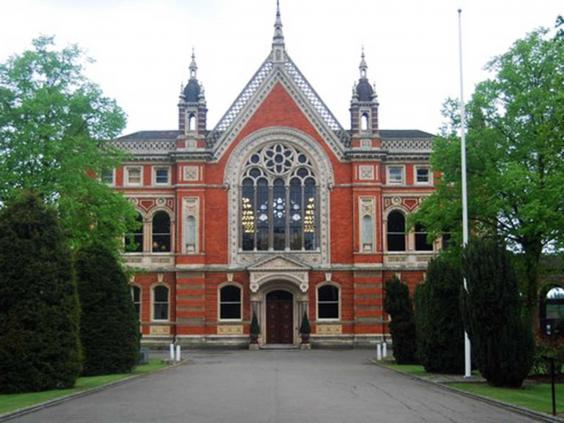
Nigel Farage attended Dulwich College in the late Seventies (Creative Commons)
We hear much of “due diligence” in today's financial world, but had the teachers and headmaster of Dulwich investigated the concerns around your appointment as a prefect with your peers - as they would hopefully today in similar circumstances - they might have made a very different decision. They might not have brushed them under the carpet; they might have made you think a little more about your rhetoric; history might be a little different today.
For I vividly recall the keen interest you had in two initials of your name written together as a signature and the bigoted symbol that represents from the many doodles over your school books. Nigel Farage, NF, National Front. I remember watching you draw it. Just a laugh, eh, Nigel?
As the son of an immigrant family, your frequent cry of “Send em home” and mention of the name Oswald Mosley didn’t mean much to me either until much later when I learnt of the British Fascists.

The former friend says he saw Nigel Farage draw a version of the National Front logo on his college books
I remember you spending hours with spit and polish producing what were unquestionably the brightest pair of CCF (Combined Cadet Force) army boots in school. I also remember your snuff tobacco that you kept hidden from unwitting teachers.
But I also remember something altogether more alarming: the songs you chanted at school. In her letter Chloe Deakin mentioned reports of you singing Hitler Youth songs, and when you were confronted by that, you denied it.
But I do remember you singing the song starting with the words “gas them all, gas ‘em all, gas them all”. I can’t forget the words. I can’t bring myself to write the rest of it for it is more vile that anything the teachers at Dulwich would ever have been aware of.
I too think that things can be in the past and that people grow up from being naughty schoolchildren. Heaven help us if they didn’t, let's face it, but heaven help us if we believe all children do.
As someone wanting the EU to be challenged more robustly, I found myself thinking “Good on Nigel” for the amusement your speeches in the European Parliament gave us. Let's face it, mass migration and its management by the EU has been a consistent mess of mixed messages. You’re absolutely right to challenge the EU – it’s just people need to see the full picture — before aligning themselves to strangers, however charming their messages are.
From being a real fan, I found myself thinking more and more with every appearance of yours on television that we must be aware of false prophets. Notably, the image of a desperate line of refugees, photographed not even in England, showed me that Nigel Farage has perhaps not changed that much.
These people were used as live currency to further your cause to represent Britain being at breaking point from European immigrants – although those people were from outside of Europe. The imagery of a loss of control, hopelessness, of our own politicians not caring for us is the stuff of two world wars. I can hear you say “useless” in the way you used to.
As I have said, the immigration issue surely needs fixing, but you have shamefully used this picture.
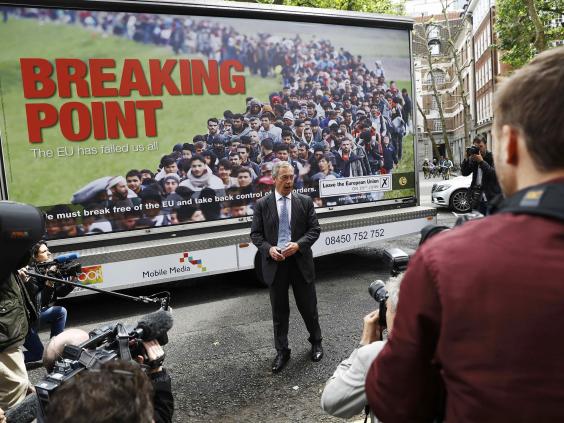
Ex-Ukip leader Nigel Farage's use of refugees in the Breaking Point poster appalled his former friend (Reuters)
Seeing your gloating display post-referendum at the European Parliament just rammed home the point: it seemed here we had a bit of the Nigel I knew at school. Yes, you’ve fought 20 years and no one took you seriously – but let us have some humility. We now learn you will start touring other EU countries, beginning in Athens in September, to encourage them to follow your lead. I’m sure the neo-Nazis in Golden Dawn in Greece will cheer you loudly. The people of Greece, beware.
Oh, for the record, I’m not a blind Remainer. I’m more a 51 per cent reluctant Remainer. Yes, I see the many 21st century challenges with which the EU has failed to deal – immigration and “over-involvement” being the most obvious.
Who cannot see that having no common policy to deal with hundreds of thousands of immigrants is going to strain the most robust of institutions to its limits? Who cannot see that criminal elements within those hundreds of thousands are not going to use the cover of desperate people for their own personal gain or distorted beliefs?
But then again, don’t some politicians use the cover of people’s strife for their own gain or beliefs? Would we as a nation not be alarmed if we were to find out that a Muslim politician or teacher for example had made reference to forced repatriation or joked about beheading all non-Muslims as a teenager at school? Let’s hope schools are now taking action on the kind of comments you made at school.
But let me indulge you in a story. On a recent trip to Berlin, I found myself in a wonderful park in Spandau on the banks of the Havel. It was a windy day and a chap next to me was meticulously laying out some papers on a bench. But then a gust of wind sent them a few metres, happily straight into my hands.
He was incredibly grateful and strangely offered me some orange juice and a banana. I felt a little embarrassed.
And then I realised the papers on the bench were in fact asylum papers and the orange juice and banana in a park in Berlin meant more to him than I could ever imagine. He was a teacher of physics or something similar; it was the only thing I could deduce from his broken English.
I tried a little German but to this he just shrugged his shoulders and gave a hopelessly lost smile. He was a Syrian filling out papers for his family and, had my appointment contact not have arrived a few minutes later, I could have spent all day right there.
Perhaps he was in that infamous Leave poster you exploited to such effect? It’s easy to tar everyone with the same brush just because of a few criminals.
But neither am I someone with rose-tinted spectacles. Although this meeting in Berlin was a wake-up moment for me, I also know there are serious issues for Europe to solve. We really have been let down by our European leaders.
Perhaps people found no other way to represent their dissatisfaction with Europe and the very many things that need fixing other than embracing you? Is it our fault? No, sorry, there’s never an excuse for whipping up some racial animosity as a means to an end.
I think you’re a troublemaker. You were at school, you are now. But we need to beware of what’s whipped up.
In April 1981, we had the Brixton riots. They happened just up the road from our school. The images of rioting people, many of them from the racial minorities, made it easy to discriminate; many people did back then. The National Front was hugely popular by comparison to today. So, turbulent times back then… but have you not moved on?
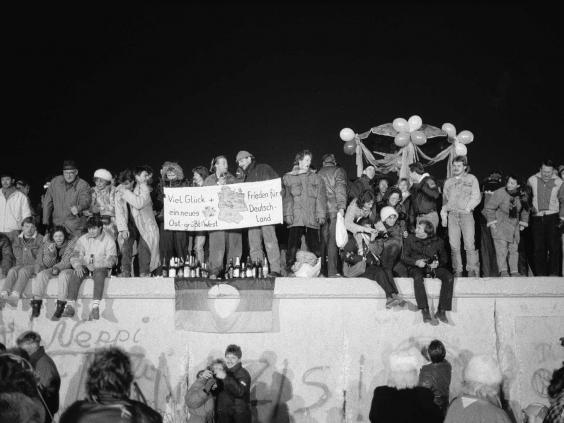
Nigel Farage's schoolfriend believes East Germans celebrating the fall of the Berlin Wall in 1989 was true 'independence' (Getty Images)
I agree with you there are historic dates that change lives. I stood on the Berlin Wall on that wonderful day in 1989 and have 8mm ciné film I took that never fails to choke me: the images of euphoria, loud noise and waving flags of all colours. Those are real celebrations – and for good reason. I congratulate the German people on their achievement in integrating two by then divergent cultures. It has taken decades rather than the few years Helmut Kohl predicted, but from mutual animosity and envy on both sides, today the country bears little evidence of physical or societal difference.
After the referendum vote, you called for an “independence day” to mark the result. It’s an insult those good people in the real world who have died fighting real struggles for independence. I hope the nation sees just as I do that we have allowed ourselves to be enchanted by the charismatic and populist against plainly obvious EU failings without any real thought as to the background and objectives of the people delivering the messages.
Déjà vu, I'm afraid.
Dear Nigel,
I won’t give my name – my family isn’t even aware I’m writing this and I wish to protect them. But I have a funny feeling you’ll know who I am.
At school, at Dulwich College in the late Seventies, we were close friends in our teenage years. I stayed at your house once – your mother did do a fantastic great British breakfast for us.
I remember the way you enchanted people at school, senior teachers and fellow pupils alike. Your English project on fishing enthralled everyone. I remember mine being particularly boring. You were and are a great speaker, for sure.
But I also remember other, darker things about you. There was a time when I used to look back and dismiss much of them as the amusing naughtiness of teenagers as we were, much like our old headmaster David Emms did.
I haven’t chosen to write before, but I simply have to now. I now wonder if there is a connection between you at 16 and you at 52. I don’t believe you have fascist sympathies now, but there are things that tell me your views might not have changed that much despite the many years.
I think there comes a time – however difficult it may be – when enough is enough. I remember those school days in the UK. As you know, teachers were concerned. You’ll remember being confronted three years ago by journalists who had a letter from the school teacher Chloe Deakin to Mr Emms. You’ll remember she was concerned about “fascist views”. Other teachers also had concerns, but none of them would have known you like your own peers, the friends you used to spend time with.
Nigel Farage attended Dulwich College in the late Seventies (Creative Commons)
We hear much of “due diligence” in today's financial world, but had the teachers and headmaster of Dulwich investigated the concerns around your appointment as a prefect with your peers - as they would hopefully today in similar circumstances - they might have made a very different decision. They might not have brushed them under the carpet; they might have made you think a little more about your rhetoric; history might be a little different today.
For I vividly recall the keen interest you had in two initials of your name written together as a signature and the bigoted symbol that represents from the many doodles over your school books. Nigel Farage, NF, National Front. I remember watching you draw it. Just a laugh, eh, Nigel?
As the son of an immigrant family, your frequent cry of “Send em home” and mention of the name Oswald Mosley didn’t mean much to me either until much later when I learnt of the British Fascists.
The former friend says he saw Nigel Farage draw a version of the National Front logo on his college books
I remember you spending hours with spit and polish producing what were unquestionably the brightest pair of CCF (Combined Cadet Force) army boots in school. I also remember your snuff tobacco that you kept hidden from unwitting teachers.
But I also remember something altogether more alarming: the songs you chanted at school. In her letter Chloe Deakin mentioned reports of you singing Hitler Youth songs, and when you were confronted by that, you denied it.
But I do remember you singing the song starting with the words “gas them all, gas ‘em all, gas them all”. I can’t forget the words. I can’t bring myself to write the rest of it for it is more vile that anything the teachers at Dulwich would ever have been aware of.
I too think that things can be in the past and that people grow up from being naughty schoolchildren. Heaven help us if they didn’t, let's face it, but heaven help us if we believe all children do.
As someone wanting the EU to be challenged more robustly, I found myself thinking “Good on Nigel” for the amusement your speeches in the European Parliament gave us. Let's face it, mass migration and its management by the EU has been a consistent mess of mixed messages. You’re absolutely right to challenge the EU – it’s just people need to see the full picture — before aligning themselves to strangers, however charming their messages are.
From being a real fan, I found myself thinking more and more with every appearance of yours on television that we must be aware of false prophets. Notably, the image of a desperate line of refugees, photographed not even in England, showed me that Nigel Farage has perhaps not changed that much.
These people were used as live currency to further your cause to represent Britain being at breaking point from European immigrants – although those people were from outside of Europe. The imagery of a loss of control, hopelessness, of our own politicians not caring for us is the stuff of two world wars. I can hear you say “useless” in the way you used to.
As I have said, the immigration issue surely needs fixing, but you have shamefully used this picture.
Ex-Ukip leader Nigel Farage's use of refugees in the Breaking Point poster appalled his former friend (Reuters)
Seeing your gloating display post-referendum at the European Parliament just rammed home the point: it seemed here we had a bit of the Nigel I knew at school. Yes, you’ve fought 20 years and no one took you seriously – but let us have some humility. We now learn you will start touring other EU countries, beginning in Athens in September, to encourage them to follow your lead. I’m sure the neo-Nazis in Golden Dawn in Greece will cheer you loudly. The people of Greece, beware.
Oh, for the record, I’m not a blind Remainer. I’m more a 51 per cent reluctant Remainer. Yes, I see the many 21st century challenges with which the EU has failed to deal – immigration and “over-involvement” being the most obvious.
Who cannot see that having no common policy to deal with hundreds of thousands of immigrants is going to strain the most robust of institutions to its limits? Who cannot see that criminal elements within those hundreds of thousands are not going to use the cover of desperate people for their own personal gain or distorted beliefs?
But then again, don’t some politicians use the cover of people’s strife for their own gain or beliefs? Would we as a nation not be alarmed if we were to find out that a Muslim politician or teacher for example had made reference to forced repatriation or joked about beheading all non-Muslims as a teenager at school? Let’s hope schools are now taking action on the kind of comments you made at school.
But let me indulge you in a story. On a recent trip to Berlin, I found myself in a wonderful park in Spandau on the banks of the Havel. It was a windy day and a chap next to me was meticulously laying out some papers on a bench. But then a gust of wind sent them a few metres, happily straight into my hands.
He was incredibly grateful and strangely offered me some orange juice and a banana. I felt a little embarrassed.
And then I realised the papers on the bench were in fact asylum papers and the orange juice and banana in a park in Berlin meant more to him than I could ever imagine. He was a teacher of physics or something similar; it was the only thing I could deduce from his broken English.
I tried a little German but to this he just shrugged his shoulders and gave a hopelessly lost smile. He was a Syrian filling out papers for his family and, had my appointment contact not have arrived a few minutes later, I could have spent all day right there.
Perhaps he was in that infamous Leave poster you exploited to such effect? It’s easy to tar everyone with the same brush just because of a few criminals.
But neither am I someone with rose-tinted spectacles. Although this meeting in Berlin was a wake-up moment for me, I also know there are serious issues for Europe to solve. We really have been let down by our European leaders.
Perhaps people found no other way to represent their dissatisfaction with Europe and the very many things that need fixing other than embracing you? Is it our fault? No, sorry, there’s never an excuse for whipping up some racial animosity as a means to an end.
I think you’re a troublemaker. You were at school, you are now. But we need to beware of what’s whipped up.
In April 1981, we had the Brixton riots. They happened just up the road from our school. The images of rioting people, many of them from the racial minorities, made it easy to discriminate; many people did back then. The National Front was hugely popular by comparison to today. So, turbulent times back then… but have you not moved on?
Nigel Farage's schoolfriend believes East Germans celebrating the fall of the Berlin Wall in 1989 was true 'independence' (Getty Images)
I agree with you there are historic dates that change lives. I stood on the Berlin Wall on that wonderful day in 1989 and have 8mm ciné film I took that never fails to choke me: the images of euphoria, loud noise and waving flags of all colours. Those are real celebrations – and for good reason. I congratulate the German people on their achievement in integrating two by then divergent cultures. It has taken decades rather than the few years Helmut Kohl predicted, but from mutual animosity and envy on both sides, today the country bears little evidence of physical or societal difference.
After the referendum vote, you called for an “independence day” to mark the result. It’s an insult those good people in the real world who have died fighting real struggles for independence. I hope the nation sees just as I do that we have allowed ourselves to be enchanted by the charismatic and populist against plainly obvious EU failings without any real thought as to the background and objectives of the people delivering the messages.
Déjà vu, I'm afraid.
Subscribe to:
Comments (Atom)