Aditya Chakrabortty
By March 2015, George Osborne was pulling together his final budget before the general election. The austerity chancellor had already hacked billions from health, education and social security; now he planned to slash billions more. But he had prepared one massive give-away: the complete abolition of taxes on savings, worth well over £1bn in lost revenue.
It was costly, at a time when the government was cutting to the bone. It was unjust, throwing millions at the richest, who needed it least. And it was a kick in the teeth to all those whose lives had been turned upside down in the past five years. The idea was blocked by Nick Clegg and his Liberal Democrat coalition partners.
Osborne’s response is recorded by David Laws, Clegg’s ally in government negotiations. It ranks as among the most revealing things ever said about the Conservatives’ austerity strategy.
The multi-million-pound spending spree wasn’t justifiable, admitted Osborne, according to Laws’ recent memoir, Coalition. “It will only really be of help to stupid, affluent and lazy people, who can’t be bothered to put their savings away into tax-efficient vehicles!” said Osborne. “But it will still be very popular – we have polled it.”
Disabled people could kill themselves to put an end to the government’s reign of terror, and the chancellor would shrug. Working-class kids could live on foodbank lunches and ministers would claim they had no alternative. But shovelling cash at the people seen as undeserving by their very own benefactor? That, Mr Austerity would happily do. Anything to buy votes.
Remember that exchange as the moist-eyed tributes to Osborne come in over the next few days from his friends in the Conservative party and press. “A great chancellor,” says his former aide. The man himself has kept it uncharacteristically modest: “I hope I’ve left the economy in a better state than I found it.”
If only, George. While at Oxford, Osborne was a member of the Bullingdon Club and during his six years at Number 11, he trashed the economy as thoroughly as the Bullingdon boys trashed their restaurants.
Under him, Britain has endured its weakest recovery in well over 100 years. The average worker is still worse off than they were before the banks collapsed in 2008. The chancellor, who promised a march of the makers, has presided over the collapse of our steel industry. The enemy of government borrowing has bequeathed to the nation a public debt burden almost three times what it was when Margaret Thatcher was ejected from office.
The arch defender of our credit rating has seen Britain lose its AAA status. And now he leaves the country staring into what David Blanchflower – the former Bank of England rate-setter who predicted the last crash – now warns could be “a crisis bigger than Lehman Brothers: a political and economic disaster”.
Osborne’s fiscal rules have been either broken or discarded, and where their replacement should be is instead a complete vacuum. The man praised for his “strategic grip” by his former permanent secretary admitted last month that he hadn’t bothered coming up with a post-Brexit strategy. Britain is adrift in what could be the choppiest waters in decades without a fiscal policy, a paddle – or even a map.
None of this is accidental. All of it could have been foreseen – indeed, was foreseen by some of us. But it is the direct result of a sniggering callousness that punished the poor while rewarding the rich, that promised greater power for the provinces while shunting ever more money to central London, that bilked the young of their futures while bribing their grandparents all the way to the ballot box.
Perhaps the biggest charge historians will make against the chancellor is that his unfair, unreasonable economics helped produce the vote to leave Europe.
At the heart of Osbornomics were two contradictory impulses. First, and most important, was his belief that the state was “crowding out private endeavour”. His remedy was simple: slash the public sector and cut taxes and – hey presto! – you have a flourishing economy. This is what produced the wild optimism of those early forecasts of a historic boom in business investment (which never came) and the deficit paid off within five years (a deadline that was soon extended to 10 years).
To bolster his case, Osborne used evidence the way a drunk uses lampposts – not for illumination, merely to support him in his excesses. He often quoted a paper by Carmen Rheinhart and Ken Rogoff predicting disaster if public debt got too high. The finding was utterly debunked by a 20-something student, but Osborne kept quoting it anyway. The result was that the UK took longer to come out of its slump and was robbed of income – until panicky backbenchers forced Downing Street to park the strategy and chase growth from any source, especially the housing market.
The other part of Osbornomics stemmed from a justified desire to “rebalance” the economy, away from the City and London towards other industries and parts of the country. That would have required serious analysis and investment. What it got was glibness and austerity economics.
The “march of the makers” ended with the collapse of the Redcar and Port Talbot steelworks. As for the much-vaunted “northern powerhouse”, it was always a branding exercise rather than anything serious. After Clegg lobbied him to include Sheffield, he came out of the meeting chuckling to Laws: “George is hilarious. He immediately suggested including Sheffield and just dropping Leeds.” Sheffield, Leeds: to a Notting Hill boy they’re all oop north, aren’t they?
It was all just a hi-vis gag: according to the government’s own figures from last July, of all the spending on infrastructure on which work is actually under way, almost 50p of every pound is going to London. The north-east is getting less than a penny. Alongside this are the findings of Steve Fothergill and Christina Beatty, showing how the Tories’ welfare cuts left the prosperous south-east and booming inner London almost untouched. According to the authors, the areas hit hardest were “older industrial areas, less prosperous seaside towns, some London boroughs”. In other words, Brexit-land.
Thatcher and Blair might have left parts of the country battered and feeble, but it was Osborne who cut off their life support, by taking away the public sector jobs and benefits. It was Osborne who created the post-crash economy of low pay and zero-hours contracts, at the apex of which stand the likes of Mike Ashley and Philip Green. It was Osborne who took the tax revenue from eastern European workers but refused to reinvest it in schools and local government, thus stoking community tensions. It was Osborne who indulged in the divide-and-rule rhetoric of skivers v strivers. He has to take part of the blame for Brexit, even while he no longer has to shoulder the responsibility for it.
It’s his successor, Philip Hammond, who will face the news of big businesses pulling investment, workers getting less work and shops receiving less money. Of Mark Carney admitting the Bank of England has precious little room for manoeuvre – as a direct consequence of Osborne’s failure. To save the economy, Hammond will have to repudiate Osbornomics. I fear that that remains unthinkable for a Tory.
Still, George, what larks, eh? Now on to the non-executive directorships and six-figure speeches.
Friday, 15 July 2016
A Uniform Civil Code: It isn’t about women
Nivedita Menon in The Hindu
The talk of a Uniform Civil Code has nothing to do with gender justice. It has entirely to do with a Hindu nationalist agenda to ‘discipline’ Muslims
For nearly eight decades, the women’s movement has discussed and debated the desirability and feasibility of a Uniform Civil Code, and has ended up posing a simple question — what is the value of uniformity? Is it for the “integrity of the nation” that uniformity in laws is required, as some judicial pronouncements have suggested? If so, who exactly is the beneficiary? Which sections of people benefit from “integrity of the nation”, that abstract entity which is not exactly at the top of your mind as your husband throws you out on the street?
Or are uniform laws meant to ensure justice for women in marriage and inheritance? In that case, a Uniform Civil Code would simply put together the best gender-just practices from all Personal Laws. So yes, polygamy and arbitrary divorce would be outlawed (a feature derived from Hindu Personal Law). But conversely, as feminist legal activist Flavia Agnes has often pointed out, a Uniform Civil Code would require the abolition of the Hindu Undivided Family, a legal institution that gives tax benefits only to Hindus, and all citizens of India would have to be governed by the largely gender-just Indian Succession Act, 1925, currently applicable only to Christians and Parsis.
A stick to beat Muslims with
Muslim Personal Law is already modern in this sense, since it has since the 1930s enshrined individual rights to property, unlike Hindu law, in which the family’s natural condition is assumed to be “joint”. In the decades of the 1930s and 1940s, contrary to later discourses about Muslim law being backward, it was Hindu laws that were considered “backward” and needing to be brought into the modern world of individual property rights.
Muslim Personal Law is already modern in this sense, since it has since the 1930s enshrined individual rights to property, unlike Hindu law, in which the family’s natural condition is assumed to be “joint”. In the decades of the 1930s and 1940s, contrary to later discourses about Muslim law being backward, it was Hindu laws that were considered “backward” and needing to be brought into the modern world of individual property rights.
Again, since the Muslim marriage as contract protects women better in case of divorce than the Hindu marriage as sacrament, all marriages would have to be civil contracts. Mehr, in Muslim Personal Law, paid by the husband’s family to the wife upon marriage, is the exclusive property of the wife and it is hers upon divorce, offering her a protection Hindu women do not have. So, the Uniform Civil Code would make the practice of mehr compulsory for all while abolishing dowry.
The patent absurdity of these suggestions arises not from the ideas themselves, but from the fact, recognised by everybody, that the talk of a “Uniform Civil Code” has nothing to do at all with gender justice. It has entirely to do with a Hindu nationalist agenda, and is right up there with the beef ban and the temple in Ayodhya. A Uniform Civil Code is meant to discipline Muslims, teach them (if they didn’t know it already) that they are second-class citizens, and that they live at the mercy of “the national race” (the Hindus), as M.S. Golwalkar decreed.
The real issue of gender justice
Moreover, polygamy is not exclusive to Muslims. Hindu men are polygamous too, except that because polygamy is legally banned in Hindu law, subsequent wives have no legal standing and no protection under the law. Under Sharia law, on the contrary, subsequent wives have rights and husbands have obligations towards them. If gender justice is the value we espouse, rather than monogamy per se, we would be thinking about how to protect “wives” in the patriarchal institution of marriage. “Wives” are produced through the institution of compulsory heterosexual marriage, the basis of which is the sexual division of labour. This institution is sustained by the productive and reproductive labour of women, and almost all women are exclusively trained to be wives alone.
Thus, when a marriage fails to fulfil its patriarchal promise of security in return for that labour, all that most women are left with is the capacity for unskilled labour. Or they remain trapped in marriage with children to provide for, while men marry again, legally or otherwise, producing still more dependent, exploited wives and children for whom they take no responsibility. If gender justice is the point of legal reforms, the centrality and power of the compulsory heterosexual, patriarchal marriage, and the damage it can do to women, is what must be mitigated. This would mean recognising the reality of multiple “wives” as a common practice across communities, and the protection of the rights of all women in such relationships.
In this sense, recent Supreme Court rulings that have granted rights to second wives in Hindu marriages dilute the legal standing of monogamy for Hindus but empower women.
A survey conducted by the Bharatiya Muslim Mahila Andolan, a significant voice in the debate, found that more than 90 per cent of Muslim women in India want a ban on “triple talaq” and polygamy in Muslim Personal Law. That is, the demand is made within the framework of codifying Muslim Personal Law, not in favour of a Uniform Civil Code, partly because there is no clarity on what a uniform code would look like, but also because the demand comes from clearly Hindutvavadi quarters which have shown that both women and minorities are expendable for them.
Lessons from the Goa experience
The only example of a uniform code in India is the Portuguese Civil Procedure Code (1939) of Goa, which is neither ‘uniform’ nor gender-just. Marriage laws differ for Catholics and people of other faiths, and if a marriage is solemnised in church, then Church law applies, permitting, for example, arbitrary annulment at the behest of one of the parties. The “customs and usages” of the Hindus of Goa are recognised, including “limited” polygamy for Hindus.
The only example of a uniform code in India is the Portuguese Civil Procedure Code (1939) of Goa, which is neither ‘uniform’ nor gender-just. Marriage laws differ for Catholics and people of other faiths, and if a marriage is solemnised in church, then Church law applies, permitting, for example, arbitrary annulment at the behest of one of the parties. The “customs and usages” of the Hindus of Goa are recognised, including “limited” polygamy for Hindus.
The positive aspect of Goa’s Civil Code is the Community Property Law, which guarantees each spouse 50 per cent of all assets owned and due to be inherited at the time of marriage. However, this provision can be sidestepped in practice, given the power relations in a marriage, and studies show that it has not made any impact on the incidence of domestic violence.
Clearly, if gender justice is not prioritised, both uniformity as well as its dilution can reinforce patriarchy and majoritarianism.
The woman at the centre of this recent round of debate on the Uniform Civil Code is Shayara Bano, who received talaq by post. Her lawyer, instead of using any of the three recourses available discussed above — the Protection of Women from Domestic Violence Act, 2005, the Muslim Women (Protection of Rights on Divorce) Act, 1986, or the citation of the Shamim Ara v. State of U.P. (2002) judgment — decided to file a Public Interest Litigation in the Supreme Court challenging triple talaq on the grounds of violation of Fundamental Rights. Ms. Bano is now in the media spotlight, spiritedly criticising patriarchy in the Muslim community.
Revealingly, a recent interview with her in a national newspaper concluded with a startling question — “What about the ‘Bharat Mata ki Jai’ slogan controversy?” Ms. Bano replies, “I feel all Muslims should say Bharat Maa ki Jai.”
Does the question seem irrelevant in the context of Ms. Bano’s fight for personal justice? What does compulsory chanting of “Bharat Mata ki Jai” have to do with a woman fighting patriarchy?
But the question does not seem irrelevant at all; it seems to be at the heart of the interview. This alone should alert us to what the demand for a Uniform Civil Code is actually about.
Nivedita Menon, a feminist scholar, is a professor at Jawaharlal Nehru University
Thursday, 14 July 2016
A vote for the Labour leader? That'll cost you £25 - even if you're a member. So much for anti-austerity politics
'The ridiculous charge is an attempt to keep the most working class, marginalised people from voting for Corbyn. It's an insult to anyone in a difficult financial situation and an attempt to stifle their political voice.'
Kirsty Major in The Independent
According to the Labour Party website: “As a democratic, socialist party we welcome people to join… from all walks of life, to have their say and influence policy. We welcome membership applications from individuals, families, young people, students, workers, unemployed, older people – anyone with an interest in building a better Britain.”
It also states: “To newcomers, working out how everything fits together can seem a bit of a maze” - and they’re not wrong there. New members, including those young and unemployed supporters, have been left wondering why some members of the National Executive Committee (NEC) have voted to retrospectively disenfranchise them. Following a decision taken last night, the 130,000 members who joined in the last six months are no longer able to vote and will have to re-register and pay a whopping £25 registration fee if they wish to vote in the upcoming Labour leadership election.
£25 is an outstanding amount of money for the young, the unemployed, workers on low wages, and older people – the very groups the party purports to represent. A person looking for work, unable to work because of illness, or a person who is pregnant, a carer, or a single parent on low income and working less than 16 hours per week is given between £57.90 and £73.10 per week to live on. So if you are on benefits, becoming a supporter of the Labour Party will cost you between 34 per cent and 45 per cent of your weekly income. Being a member of the Labour Party then starts to look like an opportunity for the privileged few, rather than one available to all.
The move was supposedly an attempt to prevent a split in the party, but by bringing these measures in, members of the NEC who voted in favour of the motion have already ripped up their supporters’ trust. Many new members joined following Brexit, feeling motivated to engage with politics after seeing figures like Boris Johnson, Michael Gove and Nigel Farage exploit the concerns of working class communities worn down by years of Tory-led austerity. They joined Labour in the hope of becoming involved in their local branch and voting for a leader - be it Angela Eagle or Jeremy Corbyn - who would create a credible alternative to the Conservative Party.
Instead, the NEC have decided to financially and democratically exclude members, who they suspect are largely Corbyn supporters, to further their own party goals of winning at any cost. Furthermore, some in the NEC have been accused of gerrymandering after the vote was taken on the motion which was not included on the agenda, and after Corbyn and other pro-Corbyn members had left the room. So much for restoring trust in the Labour Party.
This move only serves to exacerbate the social exclusion of those who need more than ever to be given a voice within mainstream parties. If you needed proof of their anger, the damning protest vote against parliamentary politics during the EU referendum was pretty hard evidence. Amina Gichinga, 26, a recent Labour Party member and community organiser in Newham, told me recently, “The ridiculous £25 charge is an attempt to keep out the most working class marginalised people from voting because they know it'll amount to a landslide vote for Corbyn. £25 is some family's weekly shopping money - it is an insult to anyone in a difficult financial situation and an attempt to stifle their political voice.”
Wednesday, 13 July 2016
Billionaires bought Brexit – they are controlling our venal political system
We may be told donors do not influence policy, but anywhere else our setup would be seen as corruption
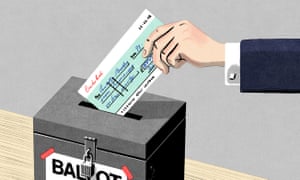
Is this a democracy or is it a plutocracy? Between people and power is a filter through which decisions are made, a filter made of money. In the European referendum, remain won 46% of the money given and lent to the two sides(£20.4m) and 48% of the vote; leave won 54% of the money and 52% of the vote. This fearful symmetry should worry anyone who values democracy. Did the vote follow the money? Had the spending been the other way round, would the result have reflected that? These should not be questions you need to ask in a democracy.
If spending has no impact, no one told the people running the campaigns: both sides worked furiously at raising funds, sometimes from gruesome people. The top donor was the stockbroker Peter Hargreaves, who gave £3.2m to Leave.eu. Heexplained his enthusiasm for leaving the EU thus: “It would be the biggest stimulus to get our butts in gear that we have ever had … We will get out there and we will be become incredibly successful because we will be insecure again. And insecurity is fantastic.”
No one voted for such people, yet they are granted power over our lives. It is partly because the political system is widely perceived to be on sale that people have become so alienated. Paradoxically, political alienation appears to have boosted the leave vote. The leave campaign thrived on the public disgust generated by the system that helped it to win.
If politics in Britain no longer serves the people, our funding system has a lot to do with it. While in most other European nations, political parties and campaigns are largely financed by the state, in Britain they are largely funded by millionaires, corporations and trade unions. Most people are not fools, and they rightly perceive that meaningful choices are being made in private, without democratic consent. Where there is meaning, there is no choice; where there is choice, there is no meaning.
Politicians insist that donors have no influence on policy, but you would have to be daft to believe it. The fear of losing money is a constant anxiety, and consciously or subconsciously people with an instinct for self-preservation will adapt their policies to suit those most likely to fund them. Nor does it matter whether policies follow the money or money follows the policies: those whose proposals appeal to the purse-holders will find it easier to raise funds.

David Cameron with Ruby Wax at the Conservatives’ Black and White Ball, 2006. ‘You get the access you pay for: £5,000 buys you the company of a junior minister; £15,000, a cabinet minister.’ Photograph: Richard Young / Rex Features
Sometimes the relationship appears to be immediate. Before the last general election, 27 of the 59 richest hedge fund managers in Britain sponsored the Conservatives. Perhaps these donations had nothing to do with the special exemption from stamp duty on stock market transactions the chancellor granted to hedge funds, depriving the public sector of about £145m a year. But that doesn’t seem likely.
At the Conservatives’ annual Black and White Ball, you get the access you pay for: £5,000 buys you the company of a junior minister; £15,000, a cabinet minister. Politicians insist that there’s no relationship between donations and appointments to the House of Lords, but a study at Oxford University found that the probability of this being true is “approximately equivalent to entering the national lottery and winning the jackpot five times in a row”.
We might not have had a say in the choice of the new prime minister, but I bet there was a lively conversation between Conservative MPs and their major funders.
Among the many reasons for the crisis in the Labour party is the desertion of its large private donors. One of them, the corporate lawyer Ian Rosenblatt,complains: “I don’t think Jeremy Corbyn or anyone around him is remotely interested in whether people like me support the party or not.” Why should the leader of the Labour party have to worry about the support of one person ahead of the votes of millions?
The former Labour adviser Ayesha Hazarika urged Corbyn to overcome his scruples: “Meeting rich people and asking for money is not exactly part of the brand that has been so successful among his party faithful. But … sometimes you just have to suck it up and do things you don’t like.”
Under our current system she might be right, not least because the Conservatives have cut Labour’s other sources of funding: trade union fees and public money. But what an indictment of the system that is. During the five years before the last election, 41% of the private donations made to political parties came from just 76 people. This is what plutocracy looks like.
Stand back from this system and marvel at what we have come to accept. If we saw it anywhere else, we would immediately recognise it as corruption. Why should parties have to grovel to oligarchs to win elections? Or, for that matter, trade unions?
The political system should be owned by everyone, not by a subset. But the corruption at its heart has become so normalised that we can scarcely see it.

Two-fifths of British political donations made by just 76 people
Read more
Here is one way in which we could reform our politics. Each party would be allowed to charge the same fee for membership – a modest amount, perhaps £20. The state would then match this money, at a fixed ratio. And that would be it. There would be no other funding for political parties. The system would be simple, transparent and entirely dependent on the enthusiasm politicians could generate. They would have a powerful incentive to burst their bubbles and promote people’s re-engagement with politics. The funding of referendums would be even simpler: the state would provide an equal amount for each side.
The commonest argument against such arrangements is that we can’t afford them. Really? We can’t afford, say, £50m for a general election, but we can afford the crises caused by the corruption of politics? We could afford the financial crisis, which arose from politicians’ unwillingness to regulate their paymasters. We can afford the costs of Brexit, which might have been bought by a handful of millionaires.
Those who urged us to leave the EU promised that we would take back control. Well, this is where it should begin.
Illustration by Bill Bragg
George Monbiot inThe Guardian
Is this a democracy or is it a plutocracy? Between people and power is a filter through which decisions are made, a filter made of money. In the European referendum, remain won 46% of the money given and lent to the two sides(£20.4m) and 48% of the vote; leave won 54% of the money and 52% of the vote. This fearful symmetry should worry anyone who values democracy. Did the vote follow the money? Had the spending been the other way round, would the result have reflected that? These should not be questions you need to ask in a democracy.
If spending has no impact, no one told the people running the campaigns: both sides worked furiously at raising funds, sometimes from gruesome people. The top donor was the stockbroker Peter Hargreaves, who gave £3.2m to Leave.eu. Heexplained his enthusiasm for leaving the EU thus: “It would be the biggest stimulus to get our butts in gear that we have ever had … We will get out there and we will be become incredibly successful because we will be insecure again. And insecurity is fantastic.”
No one voted for such people, yet they are granted power over our lives. It is partly because the political system is widely perceived to be on sale that people have become so alienated. Paradoxically, political alienation appears to have boosted the leave vote. The leave campaign thrived on the public disgust generated by the system that helped it to win.
If politics in Britain no longer serves the people, our funding system has a lot to do with it. While in most other European nations, political parties and campaigns are largely financed by the state, in Britain they are largely funded by millionaires, corporations and trade unions. Most people are not fools, and they rightly perceive that meaningful choices are being made in private, without democratic consent. Where there is meaning, there is no choice; where there is choice, there is no meaning.
Politicians insist that donors have no influence on policy, but you would have to be daft to believe it. The fear of losing money is a constant anxiety, and consciously or subconsciously people with an instinct for self-preservation will adapt their policies to suit those most likely to fund them. Nor does it matter whether policies follow the money or money follows the policies: those whose proposals appeal to the purse-holders will find it easier to raise funds.
David Cameron with Ruby Wax at the Conservatives’ Black and White Ball, 2006. ‘You get the access you pay for: £5,000 buys you the company of a junior minister; £15,000, a cabinet minister.’ Photograph: Richard Young / Rex Features
Sometimes the relationship appears to be immediate. Before the last general election, 27 of the 59 richest hedge fund managers in Britain sponsored the Conservatives. Perhaps these donations had nothing to do with the special exemption from stamp duty on stock market transactions the chancellor granted to hedge funds, depriving the public sector of about £145m a year. But that doesn’t seem likely.
At the Conservatives’ annual Black and White Ball, you get the access you pay for: £5,000 buys you the company of a junior minister; £15,000, a cabinet minister. Politicians insist that there’s no relationship between donations and appointments to the House of Lords, but a study at Oxford University found that the probability of this being true is “approximately equivalent to entering the national lottery and winning the jackpot five times in a row”.
We might not have had a say in the choice of the new prime minister, but I bet there was a lively conversation between Conservative MPs and their major funders.
Among the many reasons for the crisis in the Labour party is the desertion of its large private donors. One of them, the corporate lawyer Ian Rosenblatt,complains: “I don’t think Jeremy Corbyn or anyone around him is remotely interested in whether people like me support the party or not.” Why should the leader of the Labour party have to worry about the support of one person ahead of the votes of millions?
The former Labour adviser Ayesha Hazarika urged Corbyn to overcome his scruples: “Meeting rich people and asking for money is not exactly part of the brand that has been so successful among his party faithful. But … sometimes you just have to suck it up and do things you don’t like.”
Under our current system she might be right, not least because the Conservatives have cut Labour’s other sources of funding: trade union fees and public money. But what an indictment of the system that is. During the five years before the last election, 41% of the private donations made to political parties came from just 76 people. This is what plutocracy looks like.
Stand back from this system and marvel at what we have come to accept. If we saw it anywhere else, we would immediately recognise it as corruption. Why should parties have to grovel to oligarchs to win elections? Or, for that matter, trade unions?
The political system should be owned by everyone, not by a subset. But the corruption at its heart has become so normalised that we can scarcely see it.
Two-fifths of British political donations made by just 76 people
Read more
Here is one way in which we could reform our politics. Each party would be allowed to charge the same fee for membership – a modest amount, perhaps £20. The state would then match this money, at a fixed ratio. And that would be it. There would be no other funding for political parties. The system would be simple, transparent and entirely dependent on the enthusiasm politicians could generate. They would have a powerful incentive to burst their bubbles and promote people’s re-engagement with politics. The funding of referendums would be even simpler: the state would provide an equal amount for each side.
The commonest argument against such arrangements is that we can’t afford them. Really? We can’t afford, say, £50m for a general election, but we can afford the crises caused by the corruption of politics? We could afford the financial crisis, which arose from politicians’ unwillingness to regulate their paymasters. We can afford the costs of Brexit, which might have been bought by a handful of millionaires.
Those who urged us to leave the EU promised that we would take back control. Well, this is where it should begin.
Subscribe to:
Comments (Atom)