Search This Blog

Tuesday, 21 June 2016

Seven tricks to speed up Google Chrome

Samuel Gibbs in The Guardian

Many would say Chrome is the best browser out there. It’s certainly the most popular, used by more than half of the online world. But it’s a beast that can slow your computer to a crawl if left unchecked.
Multiple tabs, dodgy extensions and over-active plugins can leave you feeling like you’re using Windows 3.1 on a pre-Pentium 486, without the turbo switched on.
So here are few quick tips to help bring Chrome back under control, reduce its impact on your computer and speed up your browsing.

1) Get rid of any plug-ins you don’t use

Chrome plug-in settings.
 Chrome plug-in settings. Photograph: Samuel Gibbs for the Guardian
One of the easiest ways to speed up browsing is to cut back on your plug-ins. Type the following into the Chrome address bar and hit enter:
chrome://plugins
Click disable on any plug-ins you want to turn off.
If a page requires a particular disabled plug-in it will have a notice saying so instead of the video or audio element.

2) Make your remaining plug-ins ‘click to load’

Content settings for Chrome.
Pinterest
 Content settings for Chrome. Photograph: Samuel Gibbs for the Guardian
For the plug-ins you want to keep, you can still do more to reduce their impact on Chrome. You can stop media that requires plug-ins, like Flash, from loading without your explicit say so.
There are a variety of extensions to do it, but Chrome’s built in settings for plug-in control are easy to activate.
In the Settings menu under “Show advanced settings” and Privacy, click on Content settings and scroll down to Plug-ins. Check the button for “Let me chose when to run plug-in content”.
When something like a Flash video attempts to load, all you have to do is right-click on the disabled plugin image and select “Run this plug-in” if you want to see it.

3) Remove or disable unnecessary extensions

Extensions settings in Chrome
Pinterest
 Extensions settings in Chrome Photograph: Samuel Gibbs for the Guardian
Extensions are one of the best bits about Chrome, but each one adds bloat to the browser and therefore can eat up more of your computer’s memory and slow it down.
Click the hamburger menu in the top right of Chrome, mouse over “More tools” and click on “Extensions”. Or you can type the following into the address bar and hit enter:
chrome://extensions
Either uncheck the “Enabled” box to simple disable to extension, or click on the trash bin to fully remove the extension.
Disabling it allows you to re-enable it at any time, which is useful for extensions that you use only every once in a while, such as a rolling full-page screenshot utility. Removed plugins can always be reinstalled from the Chrome Web Store, but it’s a few more clicks.

4) Suspend your tabs

The Great Suspender Chrome extension
Pinterest
 The Great Suspender Chrome extension Photograph: The Great Suspender
Chrome can be quite manageable with only two or three tabs open, but when you have upwards of 10 open at any one time it can bring even the most powerful computer to its knees by sucking up all the available memory.
There are two approaches to handling multiple tabs.
Extensions such as the Great Suspender allow you to suspend the tab and remove it out of memory after a certain length of inactivity without closing the tab in your browser. A suspended tab can be reloaded by simply clicking on it, and that way you don’t lose what you were looking at but also don’t cripple your computer with dozens of active tabs.
The downside is that if the site changes or you go offline you can’t recover the suspended tab. The Great Suspender allows you to whitelist some sites, stop a tab being suspended if it’s receiving input such as a text box or prevent a tab from being suspended on an ad hoc basis.

5) Create saved browser sessions

Session Buddy Chrome extension
Pinterest
 Session Buddy Chrome extension Photograph: Session Buddy
Instead of suspending tabs individually extensions such as TabCloud+ andSession Buddy allow you to save a whole browser window full of tabs at once. You can then close them all at once, dramatically reducing Chrome’s load on your computer.
When you want to resume working on the saved tabs you can reload them all exactly the way they were in one complete browser window. It carries the same downside as the Great Suspender, meaning restored tabs are loaded fresh from the internet, so if anything has changed or the site’s no longer available then you won’t be able to restore the tab.

6) Turn off background prefetching

Prefetch settings in Google Chrome
Pinterest
 Prefetch settings in Google Chrome Photograph: Samuel Gibbs for the Guardian
Somewhat counter intuitively, if your computer is struggling to handle Chrome, turning off Chrome’s automatic prefetching service, which attempts to predict where you’ll go next and loads at least some of that page in the background, can actually speed up your computer by reducing Chrome’s load.
To try it out, in the Settings menu, listed under “Show advanced settings” and Privacy, uncheck the box marked “Use prediction service to load pages more quickly”.
It could slow down your browsing by stopping prefetching, but it could help the rest of your computer by reducing Chrome’s load on it a little. Only recommended for very slow computers.

7) Use data saver

Data Saver extension for Chrome
Pinterest
 Data Saver extension for Chrome Photograph: Google
And finally, if it’s not your computer slowing your browsing down but your internet connection, Google’s Data Saver service can help.
It puts all non-encrypted internet traffic through a compression system hosted on Google’s servers, reducing the amount of data Chrome downloads per page and speeding up page loading on slow connections.
It will also reduce your overall browsing data usage, which can be helpful for metered connections.
To use Data Saver simply install the extension. Be aware that all pages visited that are not using HTTPS connections of incognito tabs will be seen by Google if using Data Saver.
Why boarding schools produce bad leaders

Nick Duffell in The Guardian

In Britain, the link between private boarding education and leadership is gold-plated. If their parents can afford it, children are sent away from home to walk a well-trodden path that leads straight from boarding school through Oxbridge to high office in institutions such as the judiciary, the army, the City and, especially, government. Our prime minister was only seven when he was sent away to board at Heatherdown preparatory school in Berkshire. Like so many of the men who hold leadership roles in Britain, he learned to adapt his young character to survive both the loss of his family and the demands of boarding school culture. The psychological impact of these formative experiences on Cameron and other boys who grow up to occupy positions of great power and responsibility cannot be overstated. It leaves them ill-prepared for relationships in the adult world and the nation with a cadre of leaders who perpetuate a culture of elitism, bullying and misogyny affecting the whole of society.

Nevertheless, this golden path is as sure today as it was 100 years ago, when men from such backgrounds led us into a disastrous war; it is familiar, sometimes mocked, but taken for granted. But it is less well known that costly, elite boarding consistently turns out people who appear much more competent than they actually are. They are particularly deficient in non-rational skills, such as those needed to sustain relationships, and are not, in fact, well-equipped to be leaders in today's world.

I have been doing psychotherapy with ex-boarders for 25 years and I am a former boarding-school teacher and boarder. My pioneering study of privileged abandonment always sparks controversy: so embedded in British life is boarding that many struggle to see beyond the elitism and understand its impact. The prevalence of institutionalised abuse is finally emerging to public scrutiny, but the effects of normalised parental neglect are more widespread and much less obvious. Am I saying, then, that David Cameron, and the majority of our ruling elite, were damaged by boarding?

It's complex. My studies show that children survive boarding by cutting off their feelings and constructing a defensively organised self that severely limits their later lives. Cameron, Boris Johnson, Jeremy Hunt, Andrew Mitchell, Oliver Letwin et al tick all the boxes for being boarding-school survivors. For socially privileged children are forced into a deal not of their choosing, where a normal family-based childhood is traded for the hothousing of entitlement. Prematurely separated from home and family, from love and touch, they must speedily reinvent themselves as self-reliant pseudo-adults.

Paradoxically, they then struggle to properly mature, since the child who was not allowed to grow up organically gets stranded, as it were, inside them. In consequence, an abandoned child complex within such adults ends up running the show. This is why many British politicians appear so boyish.
They are also reluctant to open their ranks to women, who are strangers to them and unconsciously held responsible for their abandonment by their mothers. With about two-thirds of the current cabinet from such a background, the political implications of this syndrome are huge – because it's the children inside the men running the country who are effectively in charge.

Boarding children invariably construct a survival personality that endures long after school and operates strategically. On rigid timetables, in rule-bound institutions, they must be ever alert to staying out of trouble. Crucially, they must not look unhappy, childish or foolish – in any way vulnerable – or they will be bullied by their peers. So they dissociate from all these qualities, project them out on to others, and develop duplicitous personalities that are on the run, which is why ex-boarders make the best spies.

Now attached to this internal structure instead of a parent, the boarding child survives, but takes into adulthood a permanent unconscious anxiety and will rarely develop what Daniel Goleman calls emotional intelligence. In adulthood he sticks to the same tactics: whenever he senses a threat of being made to look foolish, he will strike. We see this in Cameron's over-reaction to Angela Eagle MP, less than a year into his new job. "Calm down, dear!" the PM patronisingly insisted, as if she were the one upset and not he. The opposite benches loved it, of course, howling "Flashman!" (the public school bully from Tom Brown's Schooldays), but they never take on the cause of these leadership defects.

Bullying is inevitable and endemic in 24/7 institutions full of abandoned and frightened kids. Ex-boarders' partners often report that it ends up ruining home life, many years later. Bullying pervades British society, especially in politics and the media, but, like boarding, we normalise it. When, in 2011, Jeremy Clarkson ranted that he would have striking public-sector workers shot, he was even defended by Cameron – it was apparently a bit of fun. No prizes for guessing where both men learned their styles. And no wonder that the House of Commons, with its adversarial architecture of Victorian Gothic – just like a public school chapel – runs on polarised debate and bullying.

Strategic survival has many styles: bullying is one; others include keeping your head down, becoming a charming bumbler, or keeping an incongruently unruffled smile in place, like health secretary Jeremy Hunt, former head boy at Charterhouse. In a remarkable 1994 BBC documentary called The Making of Them, whose title I borrowed for my first book, young boarders were discreetly filmed over their first few weeks at prep school. Viewers can witness the "strategic survival personality" in the process of being built. "Boarding school," says nine-year-old Freddy, puffing himself up, putting on his Very Serious Face and staring at the camera, "has changed me, and the one thing I can do now is get used [to it]". This false independence, this display of pseudo-adult seriousness is as evident in the theatrical concern of Cameron as it was in Tony Blair. It displays the strategic duplicity learned in childhood; it is hard to get rid of, and, disastrously, deceives even its creator.

The social privilege of boarding is psychologically double-edged: it both creates shame that prevents sufferers from acknowledging their problems, as well as unconscious entitlement that explains why ex-boarder leaders are brittle and defensive while still projecting confidence.
Boris is so supremely confident that he needs neither surname nor adult haircut; he trusts his buffoonery to distract the public from what Conrad Black called "a sly fox disguised as a teddy bear". On the steps of St Paul's, Boris commanded the Occupy movement: "In the name of God and Mammon, go!" Was it a lark – Boris doing Monty Python? Or a coded message, announcing someone who, for 10 years, heard the King James Bible read in chapel at Eton? Those who don't recognise this language, it suggests, have no right to be here, so they should just clear off.

This anachronistic entitlement cannot easily be renounced: it compensates for years without love, touch or family, for a personality under stress, for the lack of emotional, relational and sexual maturation. In my new book, Wounded Leaders, I trace the history of British elitism and the negative attitude towards children to colonial times and what I call the "rational man project", whose Victorian boarding schools were industrial power stations churning out stoic, superior leaders for the empire.

Recent evidence from neuroscience experts shows what a poor training for leaderships this actually is. In short, you cannot make good decisions without emotional information (Professor Antonio Damasio); nor grow a flexible brain without good attachments (Dr Sue Gerhardt); nor interpret facial signals if your heart has had to close down (Professor Stephen Porges); nor see the big picture if your brain has been fed on a strict diet of rationality (Dr Iain McGilchrist). These factors underpin Will Hutton's view that "the political judgments of the Tory party have, over the centuries, been almost continuously wrong".

With survival but not empathy on his school curriculum from age seven, Cameron is unlikely to make good decisions based on making relationships in Europe, as John Major could. He can talk of leading Europe, but not of belonging to it. Ex-boarder leaders cannot conceive of communal solutions, because they haven't had enough belonging at home to understand what it means. Instead, they are limited to esprit de corps with their own kind. In order to boost his standing with the rightwingers in his party, Cameron still thinks he can bully for concessions, make more supposedly "robust" vetos.

His European counterparts don't operate like this. Angela Merkel has held multiple fragile coalitions together through difficult times by means of her skill in relationships and collaboration. Though deadlocked at home, Barack Obama impressed both sides of British politics and in 2009 entered the hostile atmosphere of the Kremlin to befriend the then-president Dmitry Medvedev and make headway on a difficult disarmament treaty. In a subsequent meeting with the real power behind the throne, Obama invited Vladimir Putin to expound for an hour on what hadn't worked in recent Russian-American relationships, before responding. Despite their elitist education, and because of it, our own "wounded leaders" can't manage such statesmanship.

To change our politics, we'll have to change our education system. Today, most senior clinicians recognise boarding syndrome, several of whom recently signed a letter to the Observer calling for the end of early boarding. Its elitism ought to motivate the left. The Attlee government intended to disband the public schools, but not even Wilson's dared to. There's a cash problem: boarding is worth billions and has a massive lobby. Unlike most other European countries, our state does not contribute a per capita sum towards private education, so dismantling these schools, which still enjoy charitable status, would be costly. But can we really afford to sacrifice any more children for the sake of second-rate leadership?

Jeremy Corbyn says he 'won't take the blame' if UK votes to leave

Oliver Wright in The Independent

The Labour leader Jeremy Corbyn last night warned he would not take the “blame” if Labour supporters tipped the balance in favour of Brexit.

In an interview on Sky News Mr Corbyn, who has been accused of running a lackluster remain campaign, admitted he was “not a lover of the European Union”.

But he insisted he wanted Labour supporters to vote to stay – although if they didn’t it was not the fault of his party.

“I am not going to take blame for people’s decision,” he said.

“There will be a decision made on Thursday. I am hoping there is going to be a remain vote. There may well be a remain vote. But there may well be a leave vote. Whatever the result – that will be the result of the referendum. We have got to work with it.”

Mr Corbyn also warned that the EU must change "dramatically" even if Britain remains a member.

Facing questions from a studio audience Mr Corbyn admitted that most people “do not understand” all of the implications of this Thursday’s vote.

But despite having voted against European treaties in the past Mr Corbyn insisted that Britain was better off in the EU than outside.

"It's a big decision,” he said. If we stay in Europe there are implications, if we leave Europe there are massive implications.

"But, it is also a turning point because if we leave I don't think there is an easy way back. If we remain, I believe Europe has got to change quite dramatically to something much more democratic, much more accountable and share our wealth and improve our living standards and our working conditions all across the whole continent."
Mr Corbyn said his support for a Remain vote was "not unconditional by any means" and set out a list of problems with the EU.

He said: "I'm opposed to the Transatlantic Trade and Investment Partnership, which is being negotiated largely in secret between the European Union and the US because it would import the worst working conditions and standards from the US into Europe.

"I'm also opposed to the way in which Europe shields tax havens - this country as well shields tax havens.

"And the way in which systematically big companies are exploiting loopholes in employment laws.


"So I'm calling for a Europe in solidarity.

"But I would also say that if we are to deal with issues like climate change, like environmental issues, you cannot do it within national borders, you can only do it across national borders."The refugee crisis has to be dealt with internationally, not just nationally."

He added: "I want to remain in Europe in order to work with others to change it."

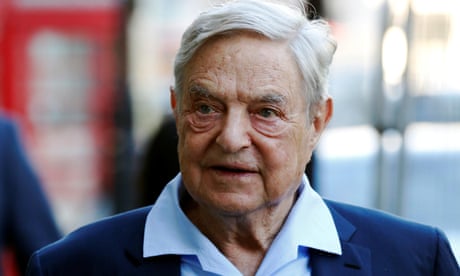
George Soros on the consequences of Brexit


George Soros in The Guardian

David Cameron, along with the Treasury, the Bank of England, the International Monetary Fund and others have been attacked by the leave campaign for exaggerating the economic risks of Brexit. This criticism has been widely accepted by the British media and many financial analysts. As a result, British voters are now grossly underestimating the true costs of leaving.

Too many believe that a vote to leave the EU will have no effect on their personal financial position. This is wishful thinking. It would have at least one very clear and immediate effect that will touch every household: the value of the pound would decline precipitously. It would also have an immediate and dramatic impact on financial markets, investment, prices and jobs.
As opinion polls on the referendum result fluctuate, I want to offer a clear set of facts, based on my six decades of experience in financial markets, to help voters understand the very real consequences of a vote to leave the EU.

The Bank of England, the Institute for Fiscal Studies and the IMF have assessed the long-term economic consequences of Brexit. They suggest an income loss of £3,000 to £5,000 annually per household – once the British economy settles down to its new steady-state five years or so after Brexit. But there are some more immediate financial consequences that have hardly been mentioned in the referendum debate.

To start off, sterling is almost certain to fall steeply and quickly if there is a vote to leave– even more so after yesterday’s rebound as markets reacted to the shift in opinion polls towards remain. I would expect this devaluation to be bigger and more disruptive than the 15% devaluation that occurred in September 1992, when I was fortunate enough to make a substantial profit for my hedge fund investors, at the expense of the Bank of England and the British government.

It is reasonable to assume, given the expectations implied by the market pricing at present, that after a Brexit vote the pound would fall by at least 15% and possibly more than 20%, from its present level of $1.46 to below $1.15 (which would be between 25% and 30% below its pre-referendum trading range of $1.50 to $1.60). If sterling fell to this level, then ironically one pound would be worth about one euro – a method of “joining the euro” that nobody in Britain would want.

Brexiters seem to recognise that a sharp devaluation would be almost inevitable after Brexit, but argue that this would be healthy, despite the big losses of purchasing power for British households. In 1992 the devaluation actually proved very helpful to the British economy, and subsequently I was even praised for my role in helping to bring it about.

But I don’t think the 1992 experience would be repeated. That devaluation was healthy because the government was relieved of its obligation to “defend” an overvalued pound with damagingly high interest rates after the breakdown of the exchange rate mechanism. This time, a large devaluation would be much less benign than in 1992, for at least three reasons.

First, the Bank of England would not cut interest rates after a Brexit devaluation (as it did in 1992 and also after the large devaluation of 2008) because interest rates are already at the lowest level compatible with the stability of British banks. That, incidentally, is another reason to worry about Brexit. For if a fall in house prices and loss of jobs causes a recession after Brexit, as is likely, there will be very little that monetary policy can do to stimulate the economy and counteract the consequent loss of demand.

Second, the UK now has a very large current account deficit – much larger, relatively, than in 1992 or 2008. In fact Britain is more dependent than at any time in history on inflows of foreign capital. As the governor of the Bank of England Mark Carney said, Britain “depends on the kindness of strangers”. The devaluations of 1992 and 2008 encouraged greater capital inflows, especially into residential and commercial property, but also into manufacturing investments. But after Brexit, the capital flows would almost certainly move the other way, especially during the two-year period of uncertainty while Britain negotiates its terms of divorce with a region that has always been – and presumably will remain – its biggest trading and investment partner.

Third, a post-Brexit devaluation is unlikely to produce the improvement in manufacturing exports seen after 1992, because trading conditions would be too uncertain for British businesses to undertake new investments, hire more workers or otherwise add to export capacity.

For all these reasons I believe the devaluation this time would be more like the one in 1967, when Harold Wilson famously declared that “the pound in your pocket has not been devalued”, but the British people disagreed with him, quickly noticing that the cost of imports and foreign holidays were rising sharply and that their true living standards were going down. Meanwhile financial speculators, back then called the Gnomes of Zurich, were making large profits at Britain’s expense.

Today, there are speculative forces in the markets much bigger and more powerful. And they will be eager to exploit any miscalculations by the British government or British voters. A vote for Brexit would make some people very rich – but most voters considerably poorer.

I want people to know what the consequences of leaving the EU would be before they cast their votes, rather than after. A vote to leave could see the week end with a Black Friday, and serious consequences for ordinary people.