With his slogan ‘Make America Great Again’, Trump is the first leader of recent times to attack American exceptionalism. In fact, he claims it is the opposite
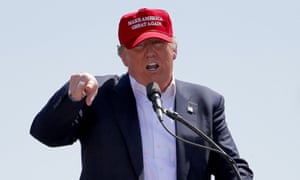
The slogan that changed the trajectory of American political discourse? Only time will tell. Photograph: Matt York/AP
Tom Engelhardt for Tom Dispatch
“Low-energy Jeb”. “Little Marco”. “Lyin’ Ted”. “Crooked Hillary”.
Give Donald Trump credit: he has a memorable way with insults. His have a way of etching themselves on the brain. And they’ve garnered media coverage, analysis and commentary almost beyond imagining.
Memorable as they might be however, they won’t be what lasts of Trump’s 2016 election run. That’s surely reserved for a single slogan that will sum up his candidacy when it’s all over (no matter how it ends). He arrived with it on that Trump Tower escalator in the first moments of his campaign, and it now
headlines his website, where it’s also emblazoned on an array of products from
hats to
T-shirts.
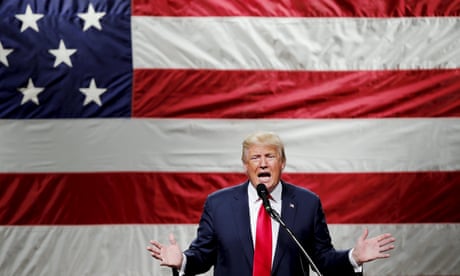
President Trump fills world leaders with fear: 'It's gone from funny to really scary'
You already know which line I mean:
“Make America Great Again!”That exclamation point ensures you won’t miss the hyperbolic, Trumpian nature of its promise to return the country to its former glory days. In it lies the essence of his campaign, of what he’s promising his followers and Americans generally – and yet, strangely enough, of all his lines it’s the one most taken for granted, the one that’s been given the least thought and analysis. And that’s a shame, because it represents something new in our American age. The problem, I suspect, is that what first catches the eye is the phrase “make America great” and then, of course, the exclamation point,
while the single most important word in the slogan, historically speaking, is barely noted: again.With that word, Trump crossed a line in American politics that until his escalator moment represented a kind of psychological taboo for politicians of any stripe and of either party, including presidents and potential candidates for that position.
He is the first American leader or potential leader of recent times not to feel the need or obligation to insist that the US, the “sole” superpower of Planet Earth, is an “exceptional” nation, an “indispensable” country, or even in an unqualified sense a “great” one. His claim is the opposite: that, at present, America is anything but exceptional, indispensable or great, though he alone could make it “great again”.
In that claim lies a curiosity that, in a court of law, might be considered
an admission of guilt. Yes, it says, if one man is allowed to enter the White House in January 2017, this could be a different country, but – and herein lies the originality of the slogan – it is not great now.
Trump, in other words, is the first person to run openly and without apology on a platform of American decline. Think about that for a moment. “Make America Great Again!” is indeed an admission, in the form of a boast.
As he tells his audiences repeatedly, America, the formerly great, is today a punching bag for China, Mexico ... well, you know the pitch. You don’t have to agree with him on the specifics. What’s interesting is the overall vision of a country lacking in its former greatness.
Perhaps a little history of American greatness and presidents (as well as presidential candidates) is in order here.
‘City upon a hill’
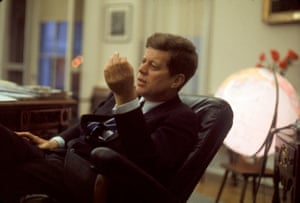
John F Kennedy simply assumed America was great. Photograph: Paul Schutzer/Time & Life Pictures/Getty Image
Once upon a time, in a distant America, the words “greatest”, “exceptional” and “indispensable” weren’t part of the political vocabulary.
American presidents didn’t bother to claim any of them for this country, largely because American wealth and global preeminence were so indisputable. We’re talking about the 1950s and early 1960s, the post-second world war and pre-Vietnam “golden” years of American power. Despite a certain hysteria about the supposed dangers of domestic communists, few Americans then doubted the singularly unchallengeable power and greatness of the country. It was such a given, in fact, that it was simply too self-evident for presidents to cite, hail or praise.
So if you look, for instance, at the speeches of
John F Kennedy, you won’t find them littered with exceptionals, indispensables or their equivalents.
In a
pre-inaugural speech he gave in January 1961 on the kind of government he planned to bring to Washington, for instance, he did cite the birth of a “great republic” and quoted Puritan John Winthrop on the desirability of creating a country that would be “a city upon a hill” to the rest of the world, with all of humanity’s eyes upon us.
In his
inaugural address (“Ask not what your country can do for you”) he invoked a kind of unspoken greatness, saying: “We shall pay any price, bear any burden, meet any hardship, support any friend, oppose any foe to assure the survival and the success of liberty.”
It was then common to speak of the US with pride as a “free nation” (as opposed to the “enslaved” ones of the communist bloc) rather than an exceptional one. His only use of “great” was to invoke the US-led and Soviet Union-led blocs as “two great and powerful groups of nations”.
Kennedy could even fall back on a certain
modesty in describing the US role in the world (which in those years, from Guatemala to Iran to Cuba, all too often did not carry over into actual policy), saying in one speech: “We must face the fact that the United States is neither omnipotent or omniscient – that we are only 6% of the world’s population – that we cannot impose our will upon the other 94% of mankind – that we cannot right every wrong or reverse each adversity – and that therefore there cannot be an American solution to every world problem.” In that same speech, he typically spoke of America as “a great power” – but not “the greatest power”.
If you didn’t grow up in that era, you may not grasp that none of this in any way implied a lack of national self-esteem. Quite the opposite: it implied a deep and abiding confidence in the overwhelming power and presence of this country, a confidence so unshakeable that there was no need to speak of it.
If you want a pop cultural equivalent for this, consider America’s movie heroes of that time, actors such as
John Wayne and
Gary Cooper, whose westerns and, in the case of Wayne, war movies were iconic. What’s striking when you look back at them from the present moment is this: while neither of those actors was anything but an imposing figure, they were also remarkably ordinary looking. They were in no way over-muscled, nor were they over-armed in the modern fashion. It was only in the years after the Vietnam war, when the country had absorbed what felt like a grim defeat, been wracked by oppositional movements, riots and assassinations, when a general sense of loss had swept over the polity, that the over-muscled hero, the exceptional killing machine, made the scene. (Think:
Rambo.)
Consider this then if you want a definition of decline: when you have to state openly (and repeatedly) what previously had been too obvious to say, you’re heading, as the opinion polls always like to phrase it, in the
wrong direction; in other words, once you have to say it, especially in an overemphatic way, you no longer have it.
The Reagan reboot
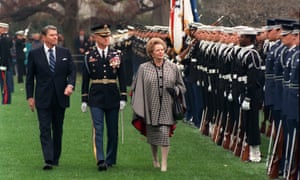
What better way to attest to America’s greatness than its military might? Photograph: Scott Stewart/AP
That note of defensiveness first crept into the American political lexicon with the unlikeliest of politicians: Ronald Reagan, the man who seemed like the least defensive, most genial guy on the planet. On this subject at least, think of him as Trumpian before the advent of the Donald, or at least as the man who (thanks to his ad writers) invented the political use of the word “again”. It was, after all, employed in 1984 in the seminal ad of his political run for a second term in office. While that bucolic-looking
TV commercial was titled “Prouder, Stronger, Better”, its first line ever so memorably went: “It’s morning again in America.” (“Why would we ever want to return to where we were less than four short years ago?”)
Think of this as part of a post-Vietnam Reagan reboot, a time when the US in Rambo-esque fashion was quite literally muscling up and over-arming in a major way. Reagan presided over “
the biggest peacetime defense build-up in history” against what,
referencing Star Wars, he
called an “evil empire” – the Soviet Union. In those years he also worked to rid the country of what was then termed “the Vietnam syndrome” in part by rebranding that war a “
noble cause”.
In a time when loss and decline were much on American minds, he dismissed them both, even as he set the country on a path toward the present moment of 1% dysfunction in a country that
no longer invests fully in its own infrastructure, whose wages are
stagnant, whose poor are a
growth industry, whose wealth now flows
eternally upward in a political environment
awash in the money of the ultra-wealthy, and whose over-armed military continues to pursue a path of
endless failure in the greater Middle East.
Reagan, who spoke directly about American declinist thinking in his time – “Let’s reject the nonsense that America is doomed to decline” – was hardly shy about his superlatives when it came to this country. He didn’t hesitate to re-channel classic American rhetoric, ranging from Winthop’s “
shining city upon a hill” (perhaps cribbed from Kennedy) in his farewell address to
Lincoln-esque (“the last best hope of man on Earth”)
invocations such as “here in the heartland of America lives the hope of the world” or “in a world wracked by hatred, economic crisis and political tension, America remains mankind’s best hope”.
And yet in the 1980s there were still limits to what needed to be said about America. Surveying the planet, you didn’t yet have to refer to us as the “greatest” country of all or as the planet’s sole truly “exceptional” country. Think of such repeated superlatives of our own moment as defensive markers on the declinist slope. The now commonplace adjective “indispensable” as a stand-in for American greatness globally, for instance, didn’t even arrive until Bill Clinton’s secretary of state, Madeleine Albright, began
using it in 1996.
It only became an indispensable part of the rhetorical arsenal of American politicians, from
Barack Obama on down, a
decade into the 21st century, when the country’s eerie dispensability (unless you were a junkie for
failed states and regional chaos) became ever more apparent.
As for the US being the planet’s “exceptional” nation, a phrase that now seems indelibly part of the American grain and that no
president or
presidential candidate avoids, it’s surprising how late it entered the lexicon.
As John Gans Jr
wrote in the Atlantic in 2011: “Obama has talked more about American exceptionalism than Presidents Reagan, George HW Bush, Bill Clinton, and George W Bush combined: a search on UC Santa Barbara’s exhaustive presidential records library finds that no president from 1981 to today uttered the phrase ‘American exceptionalism’ except Obama.”
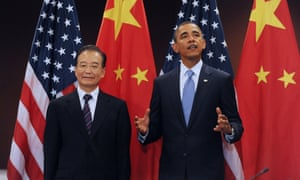
Barack Obama: the only president to use the term ‘American exceptionalism’, according to research. Photograph: Rex Features
As US News’s Robert Schlesinger has also noted, “American exceptionalism” is not a traditional part of the presidential vocabulary. According to his search of public records, Obama is the only president in 82 years to use the term.
And yet in recent years it has become a commonplace of
Republicans and
Democrats alike. As the country has become politically shakier, the rhetoric about its greatness has only escalated in an American version of “the lady doth protest too much”. Such descriptors have become the political equivalent of litmus tests: you couldn’t be president or much of anything else without eternally testifying to your unwavering belief in American greatness.
This, of course, is the line that Trump crossed in a curiously unnoticed fashion in this election campaign. He did so by initially upping the rhetorical ante, adding that exclamation point (which even Reagan avoided). Yet in the process of being more patriotically correct than thou, he somehow also waded straight into American decline so bluntly that his own audience could hardly miss it – even if his critics did.
Think of it as an irony, if you wish, but in promoting his own rise the ultimate American narcissist has also openly promoted a version of decline to striking numbers of Americans. For his followers, a major political figure has quit with the defensive BS and started saying it the way it is.Of course, don’t furl the flag or shut down those offshore accounts or start writing the complete history of American decline quite yet. After all, the US still looms “lone” on an ever more chaotic planet. Its wealth remains stunning, its economic clout something to behold, its tycoons the envy of the world, and its military beyond compare when it comes to how much and how destructive, even if not
how successful. Still, make no mistake about it – Trump is a
harbinger, however bizarre, of a new American century in which this country will indeed no longer be “the greatest” or, for all but a shrinking crew, exceptional.
Mark your calendars: 2016 is the year the US first went public as a declinist power, and for that you can thank Donald (or rather Donald!) Trump.