Saturday, 30 April 2016
An Economist's Guide to Debating Bhakts
A cheat-sheet for an intellectual argument with the Right. Warning—it's not pithy or witty enough for social media
SHAILESH CHITNIS in Outlook India

Like any good satire, it was funny because it was close to the truth.
India's liberals probably feel the same today. From the mundane to the sublime, every facet of our society is now a cultural battleground. Each week is a new fight, from the meat we eat to the size of our nationalism. The prevalence of social media has only served to amplify differences and harden opinions. If you can't say it in a witty sentence that neatly fits in a Tweet or a Facebook post, it's probably not worth saying.
I've frequently thought of engaging with people who are ardent BJP supporters. But the thought of defending against charges of being a Congress agent or a closet Pakistan supporter (the horror!) makes me keep my opinions to myself.
But what if there was a genuine discussion? What if you were able to get more than 140 characters across? Here's an attempt at imagining an intellectual argument to four assertions frequently trotted out by the right.
(BS = Bhakt says)
[BS]: India needs a strong, authoritarian leader to develop faster. Look at what Singapore and China has achieved.
The idea that a benevolent autocrat can transform a chaotic country into a disciplined economic engine is very seductive. Unfortunately it has no basis in fact. Data shows that autocracy is a gamble, the country could be governed by a Lee Kuan Yew or a Mugabe.
The economist William Easterly has shown that the chances for the latter scenario are much higher. He measured countries that had experienced big growth success and failure over a forty year period. Easterly found that the probability of sustained high growth under an autocracy are only 10 per cent, it's more likely that the country implodes or experiences sluggish growth. Democracy doesn't yield spectacular gains either, but it does limit the chances of total failures. Human fallibility assures that more centralised societies will have more volatile performances.
Given our history with leaders who experienced total power, we are better-off taking our chances in an imperfect democracy than a perfect autocracy.
[BS]: The minorities (i.e. Muslims) have been coddled for too long
This is an easy claim to refute. Successive government and independent agencies have found that the socio-economic indicators of Muslims are the lowest among all groups, only marginally better than SC/STs. The poverty rate among urban Muslims is 38 per cent compared to national average of 23 per cent. Only 24 per cent of Muslims complete high school, against a national average of 43 per cent.
It's not just human development indicators. A recent study found that even though Muslims constitute 13 per cent of the population, only 2.6 per
cent are senior executives at BSE 500 companies. And in the last 2 years, Muslims got only 2 per cent of the priority loans from public sector banks. What the statistics mask is that the dismal state of Muslims in India isn't a recent phenomenon. It reflects a steady decline since the country's independence relative to all other groups.
In light of these numbers, it's entirely fair to ask why aren't the country's Muslims angrier?
[BS]: Why can't they just respect the wishes of the majority?
This argument rests on the utilitarian idea of the greatest good for the greatest number of people. If a certain policy brings happiness to 80 per cent of the population, but leaves the rest 20 per cent worse-off, surely the society as a whole is better off. But this view isn't compatible with protecting everyone's rights.
The philosopher John Rawls proposed a fairer way to decide on justice and rights. He suggested that before deciding any rules, members of a society stand behind a veil of ignorance. Behind this veil no one knows their class, gender, race, wealth, religion or any other detail that gives them a hint of their place in society. The laws that this group decides will, by its very nature, be just and equal. Since no one knows their position in society once the veil is lifted, they'd want to make sure they were protected.
Rawls' veil is a thought experiment of course, but it does seek to illustrate the fallacy of using majority to determine rights.
[BS]: Reform takes time; it'll take time to see the results
On this issue, the Bhakt has a point. The pass-through benefits from structural reforms take time. India's growth rate surged in the 80s, with the loosening of a few regulations. But the big reforms of the 90s didn't lead to a corresponding burst of growth in that decade.
The economist, Arvind Virmani, has found a J-shaped growth curve. Following structural reforms, growth initially falls and then begins to rise. In the 90s, the removal of import restrictions and currency volatility were a shock to the protected industries, resulting in lower productivity. As firms learned to cope and then benefit from the new technologies, output improved dramatically from the 2000s.
But as we complete two years of the Modi government, we have yet to witness any meaningful reforms — no GST bill, no significant disinvestment of PSUs and no major labour market reforms. We aren't at the bottom of any J-curve, nor should we expect a growth spurt a few years later.
[You ask] While on the economy, it's a good idea to pose the paradox of BJPs economic ideology. Narendra Modi is a self-professed free-marketer, who believes in less government. Free markets are open; open to capital, open to ideas. And yet, the RSS continues to espouse the glories of Swadeshi economics that seeks Indian solutions to Indian problems. How can Mr. Modi reconcile such opposing views?
Now observe how the BJP defenders try to square their love of the "Gujarat model" with their fealty to the RSS.
If you have made it this far without being called sickular, AAP-tard or any such pejorative, stop and congratulate your Bhakt. You are speaking with a right-wing supporter who is respectful and is confident in their views. A rare species. May their tribe grow.
Next, pinch yourself to interrupt your musings. A discussion like this can only happen in your imagination.
SHAILESH CHITNIS in Outlook India
June 2004, deep in the heart of George Bush's presidency, the Onion, a satirical magazine, ran a story on how America's liberals were suffering from outrage fatigue. The article explained that liberals were overwhelmed with stories of abuses of civil liberties, unchecked military aggression and policies that ran roughshod over the environment. Most liberals were just exhausted from protesting and had decided to take a break. They couldn't sustain their anger anymore.
Like any good satire, it was funny because it was close to the truth.
India's liberals probably feel the same today. From the mundane to the sublime, every facet of our society is now a cultural battleground. Each week is a new fight, from the meat we eat to the size of our nationalism. The prevalence of social media has only served to amplify differences and harden opinions. If you can't say it in a witty sentence that neatly fits in a Tweet or a Facebook post, it's probably not worth saying.
I've frequently thought of engaging with people who are ardent BJP supporters. But the thought of defending against charges of being a Congress agent or a closet Pakistan supporter (the horror!) makes me keep my opinions to myself.
But what if there was a genuine discussion? What if you were able to get more than 140 characters across? Here's an attempt at imagining an intellectual argument to four assertions frequently trotted out by the right.
(BS = Bhakt says)
[BS]: India needs a strong, authoritarian leader to develop faster. Look at what Singapore and China has achieved.
The idea that a benevolent autocrat can transform a chaotic country into a disciplined economic engine is very seductive. Unfortunately it has no basis in fact. Data shows that autocracy is a gamble, the country could be governed by a Lee Kuan Yew or a Mugabe.
The economist William Easterly has shown that the chances for the latter scenario are much higher. He measured countries that had experienced big growth success and failure over a forty year period. Easterly found that the probability of sustained high growth under an autocracy are only 10 per cent, it's more likely that the country implodes or experiences sluggish growth. Democracy doesn't yield spectacular gains either, but it does limit the chances of total failures. Human fallibility assures that more centralised societies will have more volatile performances.
Given our history with leaders who experienced total power, we are better-off taking our chances in an imperfect democracy than a perfect autocracy.
[BS]: The minorities (i.e. Muslims) have been coddled for too long
This is an easy claim to refute. Successive government and independent agencies have found that the socio-economic indicators of Muslims are the lowest among all groups, only marginally better than SC/STs. The poverty rate among urban Muslims is 38 per cent compared to national average of 23 per cent. Only 24 per cent of Muslims complete high school, against a national average of 43 per cent.
It's not just human development indicators. A recent study found that even though Muslims constitute 13 per cent of the population, only 2.6 per
cent are senior executives at BSE 500 companies. And in the last 2 years, Muslims got only 2 per cent of the priority loans from public sector banks. What the statistics mask is that the dismal state of Muslims in India isn't a recent phenomenon. It reflects a steady decline since the country's independence relative to all other groups.
In light of these numbers, it's entirely fair to ask why aren't the country's Muslims angrier?
[BS]: Why can't they just respect the wishes of the majority?
This argument rests on the utilitarian idea of the greatest good for the greatest number of people. If a certain policy brings happiness to 80 per cent of the population, but leaves the rest 20 per cent worse-off, surely the society as a whole is better off. But this view isn't compatible with protecting everyone's rights.
The philosopher John Rawls proposed a fairer way to decide on justice and rights. He suggested that before deciding any rules, members of a society stand behind a veil of ignorance. Behind this veil no one knows their class, gender, race, wealth, religion or any other detail that gives them a hint of their place in society. The laws that this group decides will, by its very nature, be just and equal. Since no one knows their position in society once the veil is lifted, they'd want to make sure they were protected.
Rawls' veil is a thought experiment of course, but it does seek to illustrate the fallacy of using majority to determine rights.
[BS]: Reform takes time; it'll take time to see the results
On this issue, the Bhakt has a point. The pass-through benefits from structural reforms take time. India's growth rate surged in the 80s, with the loosening of a few regulations. But the big reforms of the 90s didn't lead to a corresponding burst of growth in that decade.
The economist, Arvind Virmani, has found a J-shaped growth curve. Following structural reforms, growth initially falls and then begins to rise. In the 90s, the removal of import restrictions and currency volatility were a shock to the protected industries, resulting in lower productivity. As firms learned to cope and then benefit from the new technologies, output improved dramatically from the 2000s.
But as we complete two years of the Modi government, we have yet to witness any meaningful reforms — no GST bill, no significant disinvestment of PSUs and no major labour market reforms. We aren't at the bottom of any J-curve, nor should we expect a growth spurt a few years later.
[You ask] While on the economy, it's a good idea to pose the paradox of BJPs economic ideology. Narendra Modi is a self-professed free-marketer, who believes in less government. Free markets are open; open to capital, open to ideas. And yet, the RSS continues to espouse the glories of Swadeshi economics that seeks Indian solutions to Indian problems. How can Mr. Modi reconcile such opposing views?
Now observe how the BJP defenders try to square their love of the "Gujarat model" with their fealty to the RSS.
If you have made it this far without being called sickular, AAP-tard or any such pejorative, stop and congratulate your Bhakt. You are speaking with a right-wing supporter who is respectful and is confident in their views. A rare species. May their tribe grow.
Next, pinch yourself to interrupt your musings. A discussion like this can only happen in your imagination.
Friday, 29 April 2016
Tony Blair: the former PM for hire
Randeep Ramesh in The Guardian
Emails show oil firm questioned complex structure of Blair’s company, and reveal his closeness to Chinese leadership
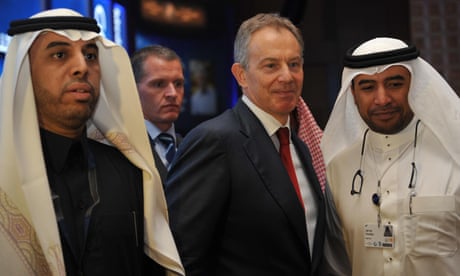
Tony Blair courted Chinese leaders for Saudi prince's oil firm
PetroSaudi executives warned in early September 2010 that they had “no contractual nexus with TB” and were anxious about “the lack of apparent employment or other involvement of TB in the corporate structure”.
To convince PetroSaudi that if it paid it would get Blair, his executives revealed for the first time how his complex web of companies worked. Blair’s businesses are split into two wings: Firerush, which was governed by the then City regulator the Financial Services Authority, and Windrush, which was not.
What bothered PetroSaudi was that it was paying roughly $55,000 to Firerush and about $10,000 to Windrush. Both firms trade as Tony Blair Associates (TBA).
From early on in their relationship PetroSaudi executives admitted they knew “very little” about Blair’s firms. In an email in August 2010, the company’s executives said they “would like to understand more about the structure and the relationship between Firerush, TB Associates and TB. In particular, the engagement letter mentions the provision of services by employees of Firerush which seems, like a number of concepts in the engagement letter, inappropriate given we are only looking to engage with TB.”
To allay concerns in November 2010, Varun Chandra, a former Lehman Brothers banker and director of TBA, told PetroSaudi that Blair was the “ultimate owner of all this and owns all the share capital” of all the companies. He told PetroSaudi it was not relevant which company got paid “given where the cash ultimately ends up”.
Chandra explained that Firerush executives handled the day-to-day conversations about “specific opportunities and making the arrangements to drive negotiations forward. Tony, procured by Windrush, is involved at higher level but on an ongoing basis, meeting with senior political leadership and business heads in order to discuss PetroSaudi at a strategic level and to speak highly of your management.”
PetroSaudi, he said, had already seen the benefit as “the man in charge of China’s economic policy is now supportive of working with PetroSaudi, and … he has spoken with CNPC [China National Petroleum Corporation] to ensure a proper working dialogue”.
By November 2010 TBA was hired and, according to the documents, Blair had found time to put PetroSaudi’s case to Lou Jiwei, the then chairman of the China Investment Corporation and now the nation’s finance minister.
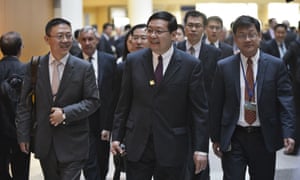
Lou Jiwei, centre, arrives for a G20 finance ministers’ and central bank governors’ meeting at the IMF on 15 April. Photograph: Mandel Ngan/AFP/Getty Images
Questions could be raised about why Blair was allowed to promote the interests of the son of the then ruler of Saudi Arabia in China while also working as the Middle East peace envoy for the Quartet – the US, UN, EU and Russia. Blair had also faced criticism for halting a Serious Fraud Office inquiry in 2006, while prime minister, into alleged corruption over a multibillion-pound arms deal with Saudi Arabia. He denies any conflict of interest.
PetroSaudi had made it clear it wanted to hire Blair. In an internal 2010 document entitled “story for Blair”, PetroSaudi sold itself as a “vehicle of the Saudi royal family” that could count on the “full support from the kingdom’s diplomatic corps” and was set up by Prince Turki bin Abdullah and Obaid, who hailed from a “prominent business family”.
PetroSaudi’s pitch in the document was that it claimed “many countries will get a company in but then bully it around once it is there and has sunk billions of dollars in the ground. This will not happen with [PetroSaudi] because these nations do not want to get on the wrong side of the Saudi royal family.”
But access to the legendary Blair contacts book does not come cheap. In July TBA’s then chief operating officer, Mark Labovitch, emailed Mahony to say he had “discussed your strategy and objectives with Tony and believe strongly that we can add value to PetroSaudi’s business development … We would propose a retainer fee of $100,000 per month.”
The documents reveal that even before Blair’s company was hired, he was already promoting the oil firm. In late July 2010 Blair was in Shanghai to celebrate the planting of 1m trees in north-west China to combat climate change. A few days later, Labovitch emailed the London-based oil firm to say: “Tony has just been in China and informally sounded out a number of people.”
Tarek Obaid and Blair did meet privately in early July 2010, and apparently discussed a working relationship. A month later Blair’s company was on a retainer fee of $65,000 and a “success fee equal to 2%” of any deal that TBA brought to the company – which PetroSaudi admitted could “potentially be a very large sum”.
In the following months a picture emerges of corporate bonhomie underwritten by spiky internal exchanges over the cost of hiring the former prime minister, his apparent obsession with privacy and a whirl of phone calls with global leaders.
By August 2010, according to documents, PetroSaudi raised concerns internally that TBA’s proposed contract was “more appropriate to an investment bank (eg they can record our phone calls)”. In an email, Mahony described the contract offered by Blair’s lieutenants as “a very aggressive first draft with almost total limitation of liability for TB”. He wrote: “I should note that the aggressive starting position of his engagement letter most probably is cynically reliant on counterparties taking a passive approach to secure his services.”
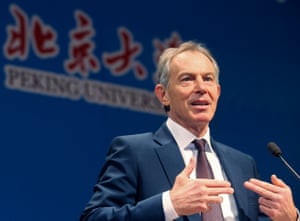
But at the end of the month Blair was in the Chinese capital for the signing of a partnership agreement between Peking University and his Faith Foundation, and managed to squeeze in some time with the Chinese oil giants CNPC and China National Offshore Oil Corporation, as well as China’s supreme economic council, the National Development and Reform Commission.
Emails show oil firm questioned complex structure of Blair’s company, and reveal his closeness to Chinese leadership
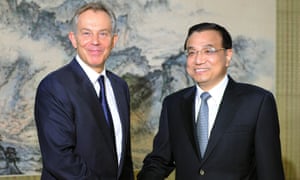
Tony Blair meets China’s then vice-premier, now premier, Li Keqiang in Beijing in 2011. Photograph: Rex/Shutterstock
When Jonathan Powell, the gatekeeper to the corporate empire of Tony Blair, sat down to lunch with the former Saudi intelligence chief Prince Faisal Al Turki in June 2010 he could not have known how lucrative it would turn out to be for the former British prime minister.
As the high-profile mediator of the stuttering peace process in the Israeli-Palestinian conflict, Blair had to be careful not to mix business with pleasure. However, one of those lunching with Powell at the annual “global mediator’s retreat”, organised by the Norwegian Ministry of Foreign Affairs, was looking to make a deal.
--------
-----
Nawaf Obaid, a security analyst who accompanied Prince Faisal, emailed Powell a week later, according to documents seen by the Guardian, with a suggestion to work with his brother Tarek’s company, PetroSaudi, which he “co-founded and co-owns with Prince Turki bin Abdullah, son of King Abdullah”.
“They have several projects that [they] are working [on] and I think it would [give] a very interesting perspective to see if we could establish a strategic partnership with former PM Tony Blair and yourself,” he wrote.
When Jonathan Powell, the gatekeeper to the corporate empire of Tony Blair, sat down to lunch with the former Saudi intelligence chief Prince Faisal Al Turki in June 2010 he could not have known how lucrative it would turn out to be for the former British prime minister.
As the high-profile mediator of the stuttering peace process in the Israeli-Palestinian conflict, Blair had to be careful not to mix business with pleasure. However, one of those lunching with Powell at the annual “global mediator’s retreat”, organised by the Norwegian Ministry of Foreign Affairs, was looking to make a deal.
--------
Bird and Fortune on Blair's socialism
-----
Nawaf Obaid, a security analyst who accompanied Prince Faisal, emailed Powell a week later, according to documents seen by the Guardian, with a suggestion to work with his brother Tarek’s company, PetroSaudi, which he “co-founded and co-owns with Prince Turki bin Abdullah, son of King Abdullah”.
“They have several projects that [they] are working [on] and I think it would [give] a very interesting perspective to see if we could establish a strategic partnership with former PM Tony Blair and yourself,” he wrote.
Tarek Obaid
Tarek Obaid was a former banker who styled himself as an adviser to members of the Saudi royal family and a director of a joint venture with Malaysia’s multibillion-dollar development fund, 1MDB. This fund had put $300m through PetroSaudi and as the latter’s chief executive, Obaid was on the lookout for deals.
On paper PetroSaudi looked impressive: its chief investment officer was a former Goldman Sachs banker, Patrick Mahony. The chief operating officer was listed as Rick Haythornthwaite, a City insider who was also chairman of Network Rail and MasterCard.
Blair’s team sold the former prime minister as someone who could help “unlock situations which might otherwise be blocked by political factors” in places such as China and Africa. PetroSaudi was interested in Beijing’s appetite for oil and how Blair’s firm could help.
The role assumed by Blair shows his influence in one of the most important areas of global economic cooperation this century: between the oil sands of the Middle East and hydrocarbon-hungry China.
While in office, Blair oversaw the handover of Hong Kong to China, but visited the latter just five times. His sixth visit in 2007 – when he earned £200,000 for a speech in the industrial city of Dongguan – marked a turning point in how he viewed the rising power.
Since then Blair has been back two dozen times and has built a reputation for befriending the rising stars of Chinese politics. In March 2010 he secured a meeting with Li Keqiang, now China’s premier.
PetroSaudi signed up Blair’s team to lobby Beijing in the summer of 2010 and internal PetroSaudi correspondence reveals there were questions raised about the apparently opaque nature of Blair’s businesses and the role he could play.
Tarek Obaid was a former banker who styled himself as an adviser to members of the Saudi royal family and a director of a joint venture with Malaysia’s multibillion-dollar development fund, 1MDB. This fund had put $300m through PetroSaudi and as the latter’s chief executive, Obaid was on the lookout for deals.
On paper PetroSaudi looked impressive: its chief investment officer was a former Goldman Sachs banker, Patrick Mahony. The chief operating officer was listed as Rick Haythornthwaite, a City insider who was also chairman of Network Rail and MasterCard.
Blair’s team sold the former prime minister as someone who could help “unlock situations which might otherwise be blocked by political factors” in places such as China and Africa. PetroSaudi was interested in Beijing’s appetite for oil and how Blair’s firm could help.
The role assumed by Blair shows his influence in one of the most important areas of global economic cooperation this century: between the oil sands of the Middle East and hydrocarbon-hungry China.
While in office, Blair oversaw the handover of Hong Kong to China, but visited the latter just five times. His sixth visit in 2007 – when he earned £200,000 for a speech in the industrial city of Dongguan – marked a turning point in how he viewed the rising power.
Since then Blair has been back two dozen times and has built a reputation for befriending the rising stars of Chinese politics. In March 2010 he secured a meeting with Li Keqiang, now China’s premier.
PetroSaudi signed up Blair’s team to lobby Beijing in the summer of 2010 and internal PetroSaudi correspondence reveals there were questions raised about the apparently opaque nature of Blair’s businesses and the role he could play.
Tony Blair courted Chinese leaders for Saudi prince's oil firm
PetroSaudi executives warned in early September 2010 that they had “no contractual nexus with TB” and were anxious about “the lack of apparent employment or other involvement of TB in the corporate structure”.
To convince PetroSaudi that if it paid it would get Blair, his executives revealed for the first time how his complex web of companies worked. Blair’s businesses are split into two wings: Firerush, which was governed by the then City regulator the Financial Services Authority, and Windrush, which was not.
What bothered PetroSaudi was that it was paying roughly $55,000 to Firerush and about $10,000 to Windrush. Both firms trade as Tony Blair Associates (TBA).
From early on in their relationship PetroSaudi executives admitted they knew “very little” about Blair’s firms. In an email in August 2010, the company’s executives said they “would like to understand more about the structure and the relationship between Firerush, TB Associates and TB. In particular, the engagement letter mentions the provision of services by employees of Firerush which seems, like a number of concepts in the engagement letter, inappropriate given we are only looking to engage with TB.”
To allay concerns in November 2010, Varun Chandra, a former Lehman Brothers banker and director of TBA, told PetroSaudi that Blair was the “ultimate owner of all this and owns all the share capital” of all the companies. He told PetroSaudi it was not relevant which company got paid “given where the cash ultimately ends up”.
Chandra explained that Firerush executives handled the day-to-day conversations about “specific opportunities and making the arrangements to drive negotiations forward. Tony, procured by Windrush, is involved at higher level but on an ongoing basis, meeting with senior political leadership and business heads in order to discuss PetroSaudi at a strategic level and to speak highly of your management.”
PetroSaudi, he said, had already seen the benefit as “the man in charge of China’s economic policy is now supportive of working with PetroSaudi, and … he has spoken with CNPC [China National Petroleum Corporation] to ensure a proper working dialogue”.
By November 2010 TBA was hired and, according to the documents, Blair had found time to put PetroSaudi’s case to Lou Jiwei, the then chairman of the China Investment Corporation and now the nation’s finance minister.
Lou Jiwei, centre, arrives for a G20 finance ministers’ and central bank governors’ meeting at the IMF on 15 April. Photograph: Mandel Ngan/AFP/Getty Images
Questions could be raised about why Blair was allowed to promote the interests of the son of the then ruler of Saudi Arabia in China while also working as the Middle East peace envoy for the Quartet – the US, UN, EU and Russia. Blair had also faced criticism for halting a Serious Fraud Office inquiry in 2006, while prime minister, into alleged corruption over a multibillion-pound arms deal with Saudi Arabia. He denies any conflict of interest.
PetroSaudi had made it clear it wanted to hire Blair. In an internal 2010 document entitled “story for Blair”, PetroSaudi sold itself as a “vehicle of the Saudi royal family” that could count on the “full support from the kingdom’s diplomatic corps” and was set up by Prince Turki bin Abdullah and Obaid, who hailed from a “prominent business family”.
PetroSaudi’s pitch in the document was that it claimed “many countries will get a company in but then bully it around once it is there and has sunk billions of dollars in the ground. This will not happen with [PetroSaudi] because these nations do not want to get on the wrong side of the Saudi royal family.”
But access to the legendary Blair contacts book does not come cheap. In July TBA’s then chief operating officer, Mark Labovitch, emailed Mahony to say he had “discussed your strategy and objectives with Tony and believe strongly that we can add value to PetroSaudi’s business development … We would propose a retainer fee of $100,000 per month.”
The documents reveal that even before Blair’s company was hired, he was already promoting the oil firm. In late July 2010 Blair was in Shanghai to celebrate the planting of 1m trees in north-west China to combat climate change. A few days later, Labovitch emailed the London-based oil firm to say: “Tony has just been in China and informally sounded out a number of people.”
Tarek Obaid and Blair did meet privately in early July 2010, and apparently discussed a working relationship. A month later Blair’s company was on a retainer fee of $65,000 and a “success fee equal to 2%” of any deal that TBA brought to the company – which PetroSaudi admitted could “potentially be a very large sum”.
In the following months a picture emerges of corporate bonhomie underwritten by spiky internal exchanges over the cost of hiring the former prime minister, his apparent obsession with privacy and a whirl of phone calls with global leaders.
By August 2010, according to documents, PetroSaudi raised concerns internally that TBA’s proposed contract was “more appropriate to an investment bank (eg they can record our phone calls)”. In an email, Mahony described the contract offered by Blair’s lieutenants as “a very aggressive first draft with almost total limitation of liability for TB”. He wrote: “I should note that the aggressive starting position of his engagement letter most probably is cynically reliant on counterparties taking a passive approach to secure his services.”
But at the end of the month Blair was in the Chinese capital for the signing of a partnership agreement between Peking University and his Faith Foundation, and managed to squeeze in some time with the Chinese oil giants CNPC and China National Offshore Oil Corporation, as well as China’s supreme economic council, the National Development and Reform Commission.
Tony Blair gives a speech at Peking University in Beijing in 2012. Photograph: China Daily/Reuters
“The latter effectively ‘blessed’ your engagement with Chinese companies, and the former were both very keen to meet you and work out how you might collaborate,” Blair’s then chief operating officer told PetroSaudi. “We clearly articulated the benefits of partnership with you to them, which they grasped immediately.”
In November, Blair was back in Beijing to give a speech for his Faith Foundation. He also had a meeting with China’s vice-premier, Wang Qishan, who Blair’s firm told PetroSaudi was “crucial – inter alia in order to highlight the wider benefits of a partnership with PetroSaudi in terms of putting Chinese companies in pole position for Saudi infrastructure tenders”. Wang is now a member of the Chinese Communist party’s politbureau, the country’s highest decision-making body.
Blair’s relationship with PetroSaudi appeared to give him access to the Saudi elite. In December 2010 an executive of PetroSaudi said the company could arrange a dinner for Blair with Prince Turki. Blair’s office say this never took place.
The next month Blair’s office emailed PetroSaudi because he was keen to meet the King of Saudi Arabia and Prince Bandar, the secretary general of the country’s national security council, before the February 2011 Quartet meeting to discuss Middle East peace after the Egyptian revolution.
“The latter effectively ‘blessed’ your engagement with Chinese companies, and the former were both very keen to meet you and work out how you might collaborate,” Blair’s then chief operating officer told PetroSaudi. “We clearly articulated the benefits of partnership with you to them, which they grasped immediately.”
In November, Blair was back in Beijing to give a speech for his Faith Foundation. He also had a meeting with China’s vice-premier, Wang Qishan, who Blair’s firm told PetroSaudi was “crucial – inter alia in order to highlight the wider benefits of a partnership with PetroSaudi in terms of putting Chinese companies in pole position for Saudi infrastructure tenders”. Wang is now a member of the Chinese Communist party’s politbureau, the country’s highest decision-making body.
Blair’s relationship with PetroSaudi appeared to give him access to the Saudi elite. In December 2010 an executive of PetroSaudi said the company could arrange a dinner for Blair with Prince Turki. Blair’s office say this never took place.
The next month Blair’s office emailed PetroSaudi because he was keen to meet the King of Saudi Arabia and Prince Bandar, the secretary general of the country’s national security council, before the February 2011 Quartet meeting to discuss Middle East peace after the Egyptian revolution.
Wednesday, 27 April 2016
Jeremy Hunt doesn’t understand junior doctors. He co-wrote a book on how to dismantle the NHS
Frankie Boyle in The Guardian
The health secretary’s name is so redolent of upper-class brutality he belongs in a Martin Amis book where working-class people are called Dave Rubbish
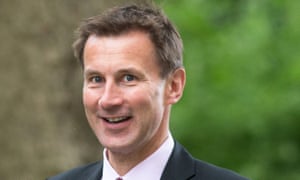
The health secretary’s name is so redolent of upper-class brutality he belongs in a Martin Amis book where working-class people are called Dave Rubbish
Jeremy Hunt: overtly ridiculous. Photograph: Mark Thomas/Rex Shutterstock
One of the worst things for doctors must be that, after seven years of study and then another decade of continuing professional exams, patients come in telling them they’re wrong after spending 20 minutes on Google. So imagine how doctors must feel about Jeremy Hunt, who hasn’t even had the decency to go on the internet.
Consider how desperate these doctors are: so desperate that they want to talk to Jeremy Hunt. Surely even Hunt’s wife would rather spend a sleepless 72 hours gazing into a cracked open ribcage than talk to him. Hunt won’t speak to the doctors, even though doctors are the people who know how hospitals work. Hunt’s only other job was founding Hotcourses magazine: his areas of expertise are how to bulletpoint a list and make dog grooming look like a viable career change.
Of course, the strikers are saying this is about safety, not pay, as expecting to be paid a decent wage for a difficult and highly skilled job is now considered selfish. Surely expecting someone to work for free while people all around them are dying of cancer is only appropriate for the early stages of The X Factor. Sadly, Tories don’t understand why someone would stay in a job for decency and love when their mother was never around long enough to find out what language the nanny spoke.
The fact that Hunt co-wrote a book about how to dismantle the NHS makes him feel like a broad stroke in a heavy-handed satire. Even the name Jeremy Hunt is so redolent of upper-class brutality that it feels like he belongs in one of those Martin Amis books where working-class people are called things like Dave Rubbish and Billy Darts (No shade, Martin – I’m just a joke writer: I envy real writers, their metaphors and similes taking off into the imagination sky like big birds or something). Indeed, Jeremy Hunt is so overtly ridiculous that he might be best thought of as a sort of rodeo clown, put there simply there to distract the enraged public.
I sympathise a little with Hunt – he was born into military aristocracy, a cousin of the Queen, went to Charterhouse, then Oxford, then into PR: trying to get him to understand the life of an overworked student nurse is like trying to get an Amazonian tree frog to understand the plot of Blade Runner. Hunt doesn’t understand the need to pay doctors – he’s part of a ruling class that doesn’t understand that the desire to cut someone open and rearrange their internal organs can come from a desire to help others, and not just because of insanity caused by hereditary syphilis.
The government believes that death rates are going up because doctors are lazy, rather than because we’ve started making disabled people work on building sites. Indeed, death rates in the NHS are going up, albeit largely among doctors. From the steel mines where child slaves gather surgical steel, all the way up to senior doctors working 36 hours on no sleep, the most healthy people in the NHS are actually the patients. This is before we get to plans for bursaries to be withdrawn from student nurses, so that we’re now essentially asking them to pay to work. Student nurses are essential; not only are they a vital part of staffing hospitals, they’re usually the only people there able to smile at a dying patient without screaming: “TAKE ME WITH YOU!”
The real reason more people die at weekends is that British people have to be really sick to stay in hospital at the weekend, as hospitals tend not to have a bar. We have a fairly low proportion of people who are doctors, don’t plan to invest in training any more, and are too racist to import them. So we’re shuffling around the doctors we do have to the weekend, when not a lot of people are admitted, from the week, when it’s busy. This is part of a conscious strategy to run the service down to a point where privatisation can be sold to the public as a way of improving things.
Naturally, things won’t actually be improved; they’ll be sold to something like Virgin Health. Virgin can’t get the toilets to work on a train from Glasgow to London, so it’s time we encouraged it to branch out into something less challenging like transplant surgery. With the rate the NHS is being privatised, it won’t be long before consultations will be done via Skype with a doctor in Bangalore. Thank God we’re raising a generation who are so comfortable getting naked online. “I’m afraid it looks like you’ve had a stroke. No, my mistake – you’re just buffering.”
When I was little, I was in hospital for a few days. The boy in the next bed was an officious little guy who took me on a tour of the ward. He’d sort of appointed himself as an auxiliary nurse and would help out around the place, tidying up the toys in the playroom, and giving all the nurses a very formal “Good Morning”, which always made me laugh. I got jelly and ice-cream one evening (I’d had my tonsils out) and they brought him some, too. Afterwards, he threw his spoon triumphantly into his plate and laughed till there were tears in his eyes. Then he tidied up and took our plates back to the trolley. What he meant by all this (we’d sit up at night talking and waiting for trains to go by in the distance) is that this was the first place he’d known any real kindness and he wished to return it. For most of us it will be the last place we know kindness. How sad that we have allowed it to fall into the hands of dreadful people who know no compassion at all, not even for themselves.
One of the worst things for doctors must be that, after seven years of study and then another decade of continuing professional exams, patients come in telling them they’re wrong after spending 20 minutes on Google. So imagine how doctors must feel about Jeremy Hunt, who hasn’t even had the decency to go on the internet.
Consider how desperate these doctors are: so desperate that they want to talk to Jeremy Hunt. Surely even Hunt’s wife would rather spend a sleepless 72 hours gazing into a cracked open ribcage than talk to him. Hunt won’t speak to the doctors, even though doctors are the people who know how hospitals work. Hunt’s only other job was founding Hotcourses magazine: his areas of expertise are how to bulletpoint a list and make dog grooming look like a viable career change.
Of course, the strikers are saying this is about safety, not pay, as expecting to be paid a decent wage for a difficult and highly skilled job is now considered selfish. Surely expecting someone to work for free while people all around them are dying of cancer is only appropriate for the early stages of The X Factor. Sadly, Tories don’t understand why someone would stay in a job for decency and love when their mother was never around long enough to find out what language the nanny spoke.
The fact that Hunt co-wrote a book about how to dismantle the NHS makes him feel like a broad stroke in a heavy-handed satire. Even the name Jeremy Hunt is so redolent of upper-class brutality that it feels like he belongs in one of those Martin Amis books where working-class people are called things like Dave Rubbish and Billy Darts (No shade, Martin – I’m just a joke writer: I envy real writers, their metaphors and similes taking off into the imagination sky like big birds or something). Indeed, Jeremy Hunt is so overtly ridiculous that he might be best thought of as a sort of rodeo clown, put there simply there to distract the enraged public.
I sympathise a little with Hunt – he was born into military aristocracy, a cousin of the Queen, went to Charterhouse, then Oxford, then into PR: trying to get him to understand the life of an overworked student nurse is like trying to get an Amazonian tree frog to understand the plot of Blade Runner. Hunt doesn’t understand the need to pay doctors – he’s part of a ruling class that doesn’t understand that the desire to cut someone open and rearrange their internal organs can come from a desire to help others, and not just because of insanity caused by hereditary syphilis.
The government believes that death rates are going up because doctors are lazy, rather than because we’ve started making disabled people work on building sites. Indeed, death rates in the NHS are going up, albeit largely among doctors. From the steel mines where child slaves gather surgical steel, all the way up to senior doctors working 36 hours on no sleep, the most healthy people in the NHS are actually the patients. This is before we get to plans for bursaries to be withdrawn from student nurses, so that we’re now essentially asking them to pay to work. Student nurses are essential; not only are they a vital part of staffing hospitals, they’re usually the only people there able to smile at a dying patient without screaming: “TAKE ME WITH YOU!”
The real reason more people die at weekends is that British people have to be really sick to stay in hospital at the weekend, as hospitals tend not to have a bar. We have a fairly low proportion of people who are doctors, don’t plan to invest in training any more, and are too racist to import them. So we’re shuffling around the doctors we do have to the weekend, when not a lot of people are admitted, from the week, when it’s busy. This is part of a conscious strategy to run the service down to a point where privatisation can be sold to the public as a way of improving things.
Naturally, things won’t actually be improved; they’ll be sold to something like Virgin Health. Virgin can’t get the toilets to work on a train from Glasgow to London, so it’s time we encouraged it to branch out into something less challenging like transplant surgery. With the rate the NHS is being privatised, it won’t be long before consultations will be done via Skype with a doctor in Bangalore. Thank God we’re raising a generation who are so comfortable getting naked online. “I’m afraid it looks like you’ve had a stroke. No, my mistake – you’re just buffering.”
When I was little, I was in hospital for a few days. The boy in the next bed was an officious little guy who took me on a tour of the ward. He’d sort of appointed himself as an auxiliary nurse and would help out around the place, tidying up the toys in the playroom, and giving all the nurses a very formal “Good Morning”, which always made me laugh. I got jelly and ice-cream one evening (I’d had my tonsils out) and they brought him some, too. Afterwards, he threw his spoon triumphantly into his plate and laughed till there were tears in his eyes. Then he tidied up and took our plates back to the trolley. What he meant by all this (we’d sit up at night talking and waiting for trains to go by in the distance) is that this was the first place he’d known any real kindness and he wished to return it. For most of us it will be the last place we know kindness. How sad that we have allowed it to fall into the hands of dreadful people who know no compassion at all, not even for themselves.
Subscribe to:
Comments (Atom)