Search This Blog

Tuesday, 12 April 2016

Smash the mafia elite: we should treat offshore wealth as terrorist finance

Paul Mason in The Guardian


Historical societies withered because the rich did not pay their taxes – we must not let the Panama Papers revelations pass without taking action
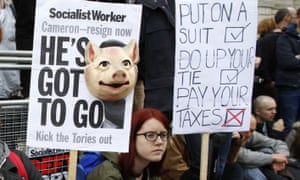
Panama Papers demonstration in Whitehall on Saturday. Photograph: Rex/Shutterstock


Amid the cobbled passageways and tumbling tenements of the Italian city of Perugia, it’s possible to daydream you are in the middle ages. You are surrounded by medieval art and architecture. And then you think: hold on, what happened to the Renaissance?

Sure, there are some imposing private palaces from the period 1300-1500, and sure Raphael left half a fresco in a tiny chapel. But it’s not Florence. The money was clearly here at some point but, some time after 1300, the artistic, cultural and scientific riches moved somewhere else. By 1500, the city was “smaller, poorer and politically narrower” than 200 years before, writes historian Sarah Rubin Blanshei.

Why? Because the rich did not pay their taxes. The Perugian elite became a closed stratum of mafiosi, earning their money from mercenary work abroad, jealously guarding their family inheritance, stifling social mobility. Sound familiar?

As David Cameron’s fiasco over the Panama Papers collides with George Osborne’s over the budget, the danger is that we frame these merely as political scandals.

In fact, the Panama Papers point to a deeper sickness. Globalised capitalism has become an organised and legalised form of corruption, in which the work of the manager, the inventor and the entrepreneur come second to that of people whose wealth “works for them” – preferably in a jurisdiction nobody can see.

If you listen to Cameron’s defenders, their logic follows three contours: he did nothing illegal, nothing unparliamentary and nothing wrong.

I do not doubt his decision to invest in an offshore fund was legal.

That he failed to register his shares in Blairmore on becoming an MP, and lobbied for the protection of offshore trusts while being an undeclared beneficiary of one, does merit investigation by Parliament.

But it’s the insistence by the apopleptic right that he should not be criticised over tax avoidance – that “everybody does it” – that we should register as a kind of collective Marie Antoinette moment for the UK’s social elite.

If someone walked into a pub and announced they had found a way to scam the benefit system, they would face opprobrium or a swift, anonymous call to the benefit cheats hotline.

But a large part of the UK financial industry is dedicated to scamming the rules whereby both individuals and companies pay tax on income. London is home to literally hundreds of advisory companies – many of them registered professionals in finance, accountancy and the law – whose purpose is to do only this.
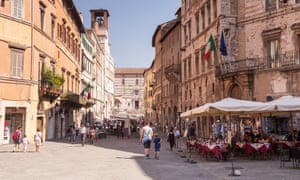


Governments today, like that of Perugia in the mid-1400s, are stuffed full of people who benefit from a legalised form of corruption. Photograph: Julian Elliott/Getty Images/Robert Harding Worl


The size of the missing tax take is disputed. If, as the Tax Justice Network estimates, the global wealth held offshore is $21tn, it might generate $188bn a year for cash-strapped governments.

Why don’t they act? Because, as with the government of Perugia in the mid 1400s, they are stuffed full of people who benefit.


Why doesn’t the populace revolt? Well, the problem with a globalised economy composed of nation states is that you can revolt all you like, beef up national tax systems, even expose the doings of the rich in newspapers ... but as long as the concept of “offshore” exists, so will the legalised corruption.

To the mature democracies of the world, the Panama Papers – as with the Lux Leaks, Swiss Leaks and numerous other data dumps before them – are a warning. If wealth equals power, then the doubling of ratio of wealth to income in the advanced economies since the 70s (see Piketty and Zucman 2014) could tilt power so far in the direction of a new hereditary elite that there is no return.

Last week, Costas Efimeros, the editor of a Greek investigative website, warned that the Panama revelations might be the “last chance” for leak-journalism. If a revelation does not provoke outrage, and the wrongdoers go unpunished, he wrote, “then the continuous revelation of scandals has the exact opposite result: defeatism, the feeling of weakness, the fatalistic acceptance of the rule of the powerful”.

If he is right, there are implications for all of us locked into this scrum around documents, reputations, professional codes and disputed facts.

First, this has to result in action. I am less concerned with taking down an already hapless British prime minister than with empowering him, or his successor, with the will to act unilaterally.

Britain could and should take direct rule of its tax-opaque dependencies. It should abolish non-domicile status. And it should create a taskforce within HMRC specifically designed to prosecute evaders and collect money from the aggressive avoiders.

Second, it has to result in words. I would settle for a prime-ministerial statement to be read out at Oxbridge colleges, public schools and in every bank, law firm and adviser registered with the FSA. It should say: “It’s over. There are no more respectable forms of tax avoidance and from now on offshore wealth will be treated the same way we treat terrorist finance.”

Third, it should be unilateral. The great lesson of the Italian city states in the high Renaissance was that if you will it, it can happen. You can will an economy where science, innovation, art and banking coincide: talented people get rich, inherited wealth soon evaporates; rulers listen to demands for social justice – and if they don’t, they burn.

Acting unilaterally goes against the DNA of the globalised elite. Their “nation” is the global system, and it’s seen as heresy for one country to act without others. “If we do, money will simply move offshore,” is the mantra. “Let it go,” should be the response.

Unilateral action by the UK would be powerful. It would disrupt the system of organised corruption and it would send a signal. We want to enjoy the best of what the next 20 years can offer our population – not the second best after a 1% elite has skimmed off the cream.

We don’t want to be a neo-feudal backwater, where inherited wealth and an unofficial mafia rules. We want to be the Florence, Bruges or Amsterdam of the coming century, not the Perugia.

Britain should deal with tax havens the way De Gaulle took on Monaco

Polly Toynbee in The Guardian


The prime minister has opened the floodgates, dragging the chancellor after him. Whatever David Cameron says, his example means all MPs will soon publish their tax returns: how dare any refuse? Feeding frenzies against politicians are not a pretty sight.

It’s a curious phenomenon that democracy is hailed as the highest human endeavour, yet its practitioners are always held in public contempt. “Elites” everywhere are in the pillory, but none more than the “elite” we elect and then despise.

Why single out politicians? The Times quotes a Conservative MP saying this will inevitably extend to “all those in public life” asking, “Where does it stop? BBC journalists, councillors, judges?” Indeed, there is no clear line between public and private people. Donors to political parties, journalists certainly, anyone in public office or with a public contract – and their partners too. There is no stopping these dominoes. Cameron in the Commons said he was against public officials having to publish tax returns, but he has broken the secrecy spell, and transparency always leads to demands for more.

Money is not a private matter. It may be almost as exciting as sex but exposing private wealth is not like publishing rude photos from private bedrooms. Who has what and from where is public because everyone must pay tax on it, even if a depleted HMRC can scrutinise very little. On death, light shines in as wills are published, but real transparency would make everyone’s tax return a public document.

The social shock would be seismic. At first people would feel as naked as if their clothes were stripped off in front of neighbours and work colleagues. Why else was Cameron so shy about revealing the scale of his wealth? He had done nothing unusual for families of his kind: it was the graphic exposure of his hundreds of thousands that made him blush. Why? Because people with inherited money know it’s not fair, they didn’t earn it and they are just lucky winners in life’s lottery.

The Daily Mail delivered a mighty full-page blast of anger against any questioning of Osborne’s £1m inheritance tax gift, which will cost the exchequer £5.8bn. Misleading as ever, they write of “most people”, and Downing Street talks of “millions of ordinary people” doing “proper tax planning” for inheritance. Yet as it is, only the super-rich pay inheritance tax, just one in 20 estates. Forget the seven-year rule, abolish this tax and instead tax recipients for all gifts they receive above a threshold over their lifetime.

The Mail warns that all this embarrassing exposure means “people with private means will no longer wish to go into public life, putting their advantages at the service of the less fortunate”. But that’s just it, these leaders with private means have harried the “less fortunate” mercilessly. They inflict billions of cuts on the poorest – in bedroom tax, benefit cap, child benefit freeze, two-child limit, and ruthless disability fit-for-work tests – while sanctions drive many into food bank destitution. The “less fortunate” may not be grateful to those with private means who rule over them. No wonder Cameron blanches at revealing his all.

Sheltering wealth, the right calls any protest against inequality “the politics of envy”. Most families still haven’t regained their pre-financial crash incomes, yet anyone with high-value property watches their assets inflate into the stratosphere. When unearned income such as Cameron’s soars but wages lag behind, anger at untaxed riches is inevitable.

Polls show people make a sharp distinction between genuine “wealth creators”, such as self-made entrepreneurs or superstars, and the trustafarians and rent-seekers who are enriched for no discernible merit. Resentment is often channelled into cynicism and sour trolling, not into political action. Will this start to change?

In Scandinavian countries, total tax transparency has helped create societies far more equal than ours. At the click of a mouse in Norway, people can find out what others own and earn, and everyone knows where they stand. Transparency stops women being paid less than men. Transparency makes employers more likely to pay themselves and their staff fairly. The culture of openness breathes an implicit belief in social justice.

But here, research from the London School of Economics’ professor John Hills shows how clueless most people are about the earnings of others, wildly underestimating British inequality. Both rich and poor delude themselves that they are far nearer the middle than they are. They know people who are better off and worse off, wrongly concluding themselves to be middling.

In my book Hard Work, I ran focus groups of the super-rich who refused to believe how much richer they were than the rest. Those with yachts envy those with a yacht and a crew, so they never feel truly rich. With the decline of unions, pay secrecy allows employers to divide and rule in the dark.

The disinfectant of sunlight makes shifty dealings and criminality much less likely, so it’s time for us to turn Norwegian. Don’t let’s strip public figures naked one by one, but let’s open the window and have every citizen’s tax return exposed. Tax works when everyone knows everyone else pays it too: I-will-if-you-will transparency is the same, all jumping in with one big splash, everyone’s income and wealth revealed together.

But don’t let gossipy obsession with personal wealth and inheritance distract from the main issue revealed in the Panama Papers. The prime task is to sweep away secrecy that allows our flotilla of tax havens to hide the world’s wealth from taxmen.

Cameron announces new rules obliging havens to answer HMRC requests for information on the beneficial owner of a company within an hour. But that’s bogus transparency, depending on occasional official requests. Tax experts say all beneficial ownership must be published openly so any investigator can check who owns what any time.

In the same way, all dealings between HMRC and companies must be published, so we can see how Google, Amazon, Facebook and myriad others escape paying what they owe. After deep cuts, HMRC needs assistance from the prying eyes of journalists, the public, company competitors and anyone who might investigate mega-avoiders.

Today Cameron’s promise fell far short of that genuine transparency. He needs to get tough with the treasure islands and follow Charles de Gaulle’s example. When Monaco refused a tax measure he requested, he forced them to surrender by surrounding the kingdom with soldiers and turning off their water supply.

Three cars with explosives seized near Puttingal temple

IGNATIUS PEREIRA in The Hindu


Two of the cars had registration numbers of Kollam district and one of Thiruvananthapuram district, say police.


Police said the cars, found parked in a suspicious manner, came to their attention on Sunday night after some nearby residents made complaints.

A day after the temple tragedy, in which the death toll rose to 109, three cars laden with explosives were seized by the police about 500 metres away from the Puttingal Devi temple at Paravur on Monday.

City Police Commissioner P. Prakash said the cars, found parked near the temple, came to the notice of the local people late on Sunday. They alerted the police. On Monday morning, the police cordoned off the area and examined the cars, which were found packed with explosives, some of which were of high intensity.

Since the State police did not have the expertise to defuse them, the task has been assigned to experts of the Petroleum and Explosives Safety Organisation camping at Paravur for the investigation into Sunday’s explosions. Mr. Prakash said two of the cars carried Kollam registration numbers and one Thiruvananthapuram. Their ownership was being verified with the Transport Department.

Meanwhile, three more persons succumbed to burns on Monday. Among the dead, 14 bodies are yet to be identified.

A total of 879 people were injured and 305 of them were under treatment in various hospitals, an official statement issued by the office of the Health Minister said. There are 61 persons being treated at the Thiruvananthapuram Medical College Hospital (MCH), 30 at Kollam District Hospital and the rest in various private sector hospitals in both districts. Union Minister for Health J.P. Nadda visited the MCH on Monday and reviewed the facilities there.

The highest number of deaths, 59, was at the Kollam District Hospital.Meanwhile, the Crime Branch CID, which took over the investigation from the Paravur police, has registered cases against six persons. Among those listed in the case are four members of the Puttingal Devi Temple Devaswom Committee, fireworks contractor Varkala Krishnankutty, who is in a critical condition after suffering burns, and Kazhakuttam Surendran. Five of the accused are absconding.

They have been charged under Sections 304 (culpable homicide not amounting to murder ) and 188 (disobedience to order duly promulgated by public servant) of the Indian Penal Code and Section 3 of the Explosives Act (unlawfully and maliciously causing explosion that endangers life and property).

(With inputs from C. Maya)

Monday, 11 April 2016

Even Amazon will be swallowed up by the free market – and there's nothing Jeff Bezos can do about it

Even the most successful companies are merely small boats bobbing on the surface of a great and treacherous ocean

Ben Chu in The Independent


“The Everything Store” sounds like a pretty brutal place to work. An in-depth report by the New York Times on Amazon last year exposed a culture of borderline harassment from line managers, stupidly long hours, vicious evaluation sessions, a high staff turnover rate and a cult-like atmosphere personally imposed by the internet firm’s founder Jeff Bezos.
“Purposeful Darwinism” was one word used to describe the Amazon culture by a human resources director. Amazon contested the bleak picture painted by the report. And yet Amazon’s boss Jeff Bezos sounds like he’s rather pleased with it.
“People self-select” he wrote in his letter to shareholders last week, in an indirect reference to the New York Times report. “Over the last two decades we’ve collected a group of like-minded people. Folks who find our approach energising and meaningful.” In other words, the unsuited get selected out of existence at Amazon.
There’s something about the idea of Darwinian natural selection as a description of the business world that people who lead companies (particularly those in the fast-changing world of consumer-facing technology) find compelling. And one can see why. They are often faced with an array of strong competitors; consumers can switch their spending easily and quickly; a company has to be better, perhaps more adaptable, than the rest of the pack if it wants to make a profit. Bosses must feel as if they are in a constant battle for survival.
Yet, as a metaphor for business activity, this is rather misleading. In Charles Darwin’s great hypothesis it was random phenotypical traits resulting from genetic mutations that gave certain creatures an advantage in the struggle for survival in their particular natural habitat. So, for example, if a finch happens to be born with a certain shaped beak well suited to cracking open nuts common on a particular island that bird will survive, reproduce and pass down its genes. And over the generations the island may, ultimately, become populated by a species of finch with that particularly useful shaped beak.
It wasn’t that original finch’s brains, or anything it had control over, that gave it an edge, or meant it got “selected” to pass on its physical traits to future generations. The idea that it is the smartest, or the most energetic, or those with the best culture, that thrive and survive owes more to the pseudo-science of “social Darwinism”, as outlined by 19th century sociologists such as Herbert Spencer, than anything from Darwin’s The Origin of Species.
Free markets are Darwninan in a truer sense, in that selection is often much more about luck than judgement. Andy Grove of Intel wrote in his book, Only the Paranoid Survive, that: “Most companies don't die because they are wrong; most die because they don’t commit themselves. They fritter away their valuable resources while attempting to make a decision. The greatest danger is in standing still.”
Grove, who died last month, was a truly exceptional businessman, but on this point he was wide of the mark. Most companies, over the long run, die because technology moves on and patterns of consumption shift – and there’s nothing their managements can really do about it. It’s story not so much about the quality of leaders or their innovative corporate cultures, but the inexorable disruptive power of markets.
Nothing a manufacturer of horse-drawn carriages had done upon the invention of the car would have saved the businesses (in its original form) from oblivion. Look at the composition of a stock market index of the world’s largest companies. It has changed almost beyond recognition over the decades.
Some firms are undoubtedly better run than others. Some are more innovative than others. But even the most successful are merely small boats bobbing on the surface of a great and treacherous ocean.
One day they will all be capsized. And others will take their place as new markets open. It will happen to Intel. It will happen to Amazon, too. And when it does, it’s unlikely to be a result of a lax corporate culture or employees who weren’t prepared to work weekends.
To be fair to Bezos, he readily admits in his letter that “luck plays an outsized role in every endeavour and I can assure you that we’ve had a bountiful supply”. He also stresses that Amazon’s culture is not the way all firms should be. It’s simply the one he believes will deliver the best results for Amazon.
Perhaps he’s right. He can certainly point to his company’s stunning rates of growth from zero in 1994 to today’s $275bn behemoth as evidence to support his methods. But he may well be wrong.
Perhaps different methods would actually produce better results. There’s evidence that workplaces in which people have a decent work-life balance are more productive and innovative. We can never really know.
The good news for those looking for a job in the technology sector is that the defining feature of competitive markets is diversity; meaning there are always lots of different firms and potential employers. It may feel like “The Everything Store” has become the everywhere store, but Amazon’s global workforce is still only 230,000. Compare that to the 1.5 million people who work for McDonald’s worldwide.
Thankfully, no one has to work at Amazon, or any place where the law of the jungle reigns.