Search This Blog

Sunday, 17 January 2016

Why are we looking on helplessly as markets crash all over the world?

Will Hutton in The Guardian

The imminent collapse of the Chinese Ponzi-scheme economy shows that we need to bring control to the international economy
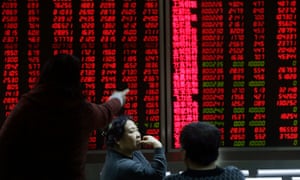

 
Chinese investors watch stock prices as a brokerage house in Beijing on 14 January, as prices continue to fall. Photograph: How Hwee Young/EPA


There has always been a tension at the heart of capitalism. Although it is the best wealth-creating mechanism we’ve made, it can’t be left to its own devices. Its self-regulating properties, contrary to the efforts of generations of economists trying to prove otherwise, are weak.

It needs embedded countervailing power – effective trade unions, law and public action – to keep it honest and sustain the demand off which it feeds. Above all, it needs an ordered international framework of law, finance and trade in which it can do deals and business. It certainly can’t invent one itself. The mayhem in the financial markets over the last fortnight is the result of confronting this tension. The oil price collapse should be good news. It makes everything cheaper. It puts purchasing power in the hands of business and consumers elsewhere in the world who have a greater propensity to spend than most oil-producing countries. A low oil price historically presages economic good times. Instead, the markets are panicking.

They are panicking because what is driving the lower oil price is global disorder, which capitalism is powerless to correct. Indeed, it is capitalism running amok that is one of the reasons for the disorder. Profits as a share of national income in Britain and the US touch all-time highs; wages touch an all-time low as the power of organised labour diminishes and the gig economy of short-term contracts takes hold. The excesses of the rich, digging underground basements to house swimming pools, cinemas and lavish gyms, sit alongside the travails of the new middle-class poor. These are no longer able to secure themselves decent pensions and their gig-economy children defer starting families because of the financial pressures.

The story is similar if less marked in continental Europe and Japan. Demand has only been sustained across all these countries since the mid-1980s because of the relentless willingness of banks to pump credit into the hands of consumers at rates much faster than the rate of economic growth to compensate for squeezed wages. It was a trend only interrupted by the credit crunch and which has now resumed with a vengeance. The result is a mountain of mortgage and personal debt but with ever-lower pay packets to service it, creating a banking system that is fundamentally precarious. The country that has taken this further than any other is China. The Chinese economy is a giant Ponzi scheme. Tens of trillions of dollars are owed to essentially bankrupt banks – and worse, bankrupt near-banks that operate in the murky shadowlands of a deeply dysfunctional mix of Leninism and rapacious capitalism. The Chinese Communist party has bought itself temporary legitimacy by its shameless willingness to direct state-owned banks to lend to consumers and businesses with little attention to their creditworthiness. Thus it has lifted growth and created millions of jobs.

It is an edifice waiting to implode. Chinese business habitually bribes Communist officials to put pressure on their bankers to forgive loans or commute interest; most loans only receive interest payments haphazardly or not at all. If the losses were crystallised, the banking system would be bust overnight. On top, huge loans have been made to China’s vast oil, gas and chemical industries on the basis of oil being above $60 a barrel, so more losses are in prospect.

Investors in China’s stock market took fright in the new year, with falling share prices only another turn of the screw. The only surprise is that nobody saw through it all earlier. China’s leaders are visibly frightened and at a loss, clamping down on any possible source of dissent as they flail to keep their Ponzi economy alive. As consumer demand falters in Europe, North America and Asia, so the demand for oil falls, even as Saudi Arabia, waging economic war against Iran and US shale producers, pumps oil out of the ground without limit. The whole structure of banking that was predicated upon higher oil prices gets more rickety still.

At just this crucially sensitive moment, the US Federal Reserve last month raised interest rates from their extraordinary lows, more concerned to signal its ardent desire to return to the normality of business as usual than to face the reality we live in abnormal times. There is no danger of inflation. If credit growth is out of hand, the tool central banks must use, as the Bank of England recognises intellectually by equipping itself with such tools but as yet not bold enough to use them, is direct quantitative controls to constrain the growth of credit. The system is not robust enough to withstand a rise in interest rates.

Indeed, further evidence of global disorder, as the Fed must have known when it raised interest rates, was the resulting acceleration of the flight of capital out of the so-called emerging economies in Africa and Latin America. Brazil, for example, is now in its worst recession since 1901. But the US central bank accepts no responsibilities for global economic management. Nor does anybody else.

It’s clear what needs to happen. There needs to be wholesale change in economic thinking. Forces in world labour markets – new forms of 21st-century trade unionism – need to be strengthened. The power of financial markets needs to be constrained. Credit growth needs to be managed by direct controls on the growth of bank balance sheets and banks need to be weaned off the financial casino they have built. Great companies need to be allowed to purpose themselves around creating value rather than dancing to the interests of disengaged shareholders.

There needs to be parallel change in how countries think of the international order: it has to be built and sustained rather than assumed to be someone else’s responsibility. We need to keep the EU together around open trade, open movement of peoples (notwithstanding the refugee crisis) and respect for political pluralism so menaced by new forces in eastern Europe. To keep the world open, there has to be international agreement on deepening and extending a framework for trade, and a new system of managed exchange rates to replace the tyranny of floating rates. Shia Muslims need to be befriended; Sunni Muslim helped to weed out poisonous Jihadism. Israel needs to be a genuine peace-seeker. China must be allowed to be convulsed by the coming regime change, vital to depoliticise its economy, without fearing foreigners are going to exploit the turmoil.

All this requires a new generation of political leaders prepared to throw off the categories in which thinking has been cast since 1980 – and remake our world rather as the world was remade in the years after 1945. Prosperity, peace, co-existence and recognition of mutual interdependencies are too easily taken for granted. The financial markets are signalling deep unease, not least at the world they themselves have helped build. It is a message that should be heeded.
Thursday, 14 January 2016

Amla's ideal

Mark Nicholas in Cricinfo


"I thought I could add value and I'd like to believe I have added value. I'm really surprised some people have suggested it was not my choice. You don't look like me in this world without being firm on what you want to do.- Hashim Amla, one week ago


There was something almost chilling about it: "In this world." An unfair world. A world where Muslims are mistrusted because a radical few threaten the perception of a beautiful faith. Amla's journey has long been challenged. The beard. The objection to wearing a beer sponsor's endorsement. Apartheid. That backlift! And more. Yes, a singular man.

To relinquish the cricket captaincy of your country is a painful thing. Many have shed tears. Many more have felt the sweat from their neck and the quiver of their lip. A lifetime's ambition tossed away out of choice.

But neither the many, nor the many more, have had as much at stake as Amla. He stands for an ideal. He speaks for the marginalised. He is hope. He is strength. He is faith. His elevation made all things possible. But he chose to give it away. He confirmed this invasive and weighty position was not for him.
Of course he added value. Each moment spent with Amla is valuable. His calm is an ever- present, a blessing. He speaks wisely and on an even keel. Amla will tell you that it is never as good as you think it is and it is never as bad as you think it is. In the age of confident youth, his counsel is worth its weight in runs.

The trouble was, no runs. A period of famine at a time of defeats withers the mind. For South Africa, the runs mattered most. Thus, on top of the sheer overload of responsibility came the fear of failure. It is a captain's bad dream. Silly, really. Years of dreams to get you there and then night after night with dreams that examine your ability to cope.

Probably - and this notion comes without evidence - Amla was the choice for a nation that needed his background to make a statement. Transformation comes in many forms but if the leader represents its credentials, the on-sell is more straightforward. AB de Villiers was one choice, Amla the other. If the choice is too difficult to call, go with the better messenger. Better still go with Amla, who is the message. In his heart he must have known this. What a burden.

He did just fine, representing his people with honour and commitment. He had some bowlers, though not the depth of attack given to his predecessors. He won some series and then came badly undone in India, a spill that cost his country the treasured record of not having lost away from home since 2006.

The clue to his mind was in the way it applied itself to batting. In India, all he could dare was frozen defence. Set free, few men have used a bat to express themselves so accurately. Amla has an untroubled rhythm and flow. He plays thoughtful innings that reach crescendos and then return to their foundations so that each part is rebuilt in the anticipation of overwhelming performance. These innings adapt to their environment and to the format for which they are intended. In them he unites South African discipline with Asian flair, and vice versa - the perfect hybrid. But in India there was none of this. Indeed, he appeared broken. Against the spinning ball on pitches of wretched bounce, block after rigid block tortured his soul.

He might have survived his own assessment had the first Test against England, in Durban, been less stressful, or simply had a better result. But no. He was back in India, fighting to survive something he knew was lost. And that something was his conviction that he could do the job better than the next man. Without it, the game was up. At the press conference announcing closure, he said as much.

It might seem odd that he stood down having made 200 in Cape Town and saved the game. But he made 200 because he had already released his mind. In a single decision he had come from unbearable weight to the lightness of being. No mask, no message, just an innings with clear purpose and a rewarding conclusion.

Much is asked of international captains. Some treat these questions lightly; Brendon McCullum for example. Others wear them better than imagined; Misbah-ul-Haq for sure. One or two close shop: MS Dhoni is a man of smoke and mirrors. A few bunker down and later emerge rebooted: Alastair Cook. Occasionally a heart is worn magnificently on its sleeve: think Graeme Smith.

Smith's part in the new age of South African cricket is a remarkable sporting story. By his own estimation, it took five years to be any good at the job. In that time he learned more about himself than he thought was there. He was utterly without prejudice and therefore above suspicion. He was able to separate political issues from performance; to forgive if not forget; to rally and to cry. He spoke comfortably of shortcomings and shrewdly of ambition. Perhaps most notably, he converted a suspect and awkward batting technique into a mechanism for sustainable and substantial run-making.

Amla must have wondered how on earth he did it all. But there was a difference. Smith represented something already there. Amla was the chosen face of something long fought for but still not achieved. About that there remains great bitterness. So much so that cricketers of the past - those who represented South Africa before and during isolation - are not recognised by the regime of the present. I'll wager Amla hates that every bit as much as Smith mourns it. In the world occupied by the two most recent out-going South African cricket captains, all men are equal.

While Haroon Lorgat, the CEO of Cricket South Africa, resolutely denies quotas at international level, the agenda is clear. But it is not organic. In a Machiavellian way, Amla was a ticket. De Villiers is not. South African cricket is at the crossroads. The next route taken may define its place at the top table of the game. Amla simply could not reconcile such a responsibility alongside the need to win tosses and take a gamble; give speeches; make life-changing decisions for and about players; hold catches; stop boundaries; score runs and sleep tight.

His decision was made for the greater good and for personal harmony. It is a brave thing to abandon a dream. And a smart thing. His stock has risen and his impression will hold firm. De Villiers is a wonderful alternative and his voice must be heard. South African cricket is lucky to have such men in their ranks. It would be wise to give them equal standing and a decisive say in the future.

Meanwhile, the former captain's resilience and clarity have made South Africa stronger than a week ago. England will be more than aware of this.

Wednesday, 13 January 2016

Beware the great 2016 financial crisis, warns leading City pessimist

Larry Elliot in The Guardian

Albert Edwards joins RBS in warning of a new crash, saying oil price plunge and deflation from emerging markets will overwhelm central banks, tip the markets and collapse the eurozone.


Are the doommongers right – are we heading for a big global economic fall? Photograph: Dennis M. Sabangan/EPA


The City of London’s most vocal “bear” has warned that the world is heading for a financial crisis as severe as the crash of 2008-09 that could prompt the collapse of the eurozone.


Albert Edwards, strategist at the bank Société Générale, said the west was about to be hit by a wave of deflation from emerging market economies and that central banks were unaware of the disaster about to hit them. His comments came as analysts at Royal Bank of Scotland urged investors to “sell everything” ahead of an imminent stock market crash.


Sell everything ahead of stock market crash, say RBS economists


“Developments in the global economy will push the US back into recession,” Edwards told an investment conference in London. “The financial crisis will reawaken. It will be every bit as bad as in 2008-09 and it will turn very ugly indeed.”


Fears of a second serious financial crisis within a decade have been heightened by the turbulence in markets since the start of the year. Share prices have fallen rapidly and a slump in the cost of oil has left Brent crude trading at barely above $30 a barrel.

“Can it get any worse? Of course it can,” said Edwards, the most prominent of the stock market bears – the terms for analysts who think shares are overvalued and will fall in price. “Emerging market currencies are still in freefall. The US corporate sector is being crushed by the appreciation of the dollar.”

The Soc Gen strategist said the US economy was in far worse shape than the country’s central bank, the US Federal Reserve, realised. “We have seen massive credit expansion in the US. This is not for real economic activity; it is borrowing to finance share buybacks.”

Edwards attacked what he said was the “incredible conceit” of central bankers, who had failed to learn the lessons of the housing bubble that led to the financial crisis and slump of 2008-09.

“They didn’t understand the system then and they don’t understand how they are screwing up again. Deflation is upon us and the central banks can’t see it.”

Edwards said the dollar had risen by as much as the Japanese yen had in the 1990s, an upwards move that pushed Japan into deflation and caused solvency problems for the Asian country’s banks. He added that a sign of the crisis to come was the collapse in demand for credit in China.

“That happens when people lose confidence that policymakers know what they are doing. This is what is going to happen in Europe and the US.”

Europe has shown tentative signs of recovery in the past year, but Edwards said the efforts of the European Central Bank to push the euro lower and growth higher would come to nothing in the event of a fresh downturn. “If the global economy goes back into recession, it is curtains for the eurozone.”

Countries such as France, Spain and Italy would not accept the rising unemployment that would be associated with another recession, he said. “What a disaster the euro has been: it is a doomsday machine in favour of the German economy.”

The warning from Edwards came as stock markets had a respite from the wave of selling seen since the start of the year. The FTSE 100 index rose by 57 points to close at 5,929, while the Dow Jones Industrial Average was up by 10 points in early trading in New York.

The mood in equity markets was helped by intervention by the People’s Bank of China overnight to support the yuan, with the Chinese currency moving higher on foreign exchange markets.


But the slide in the oil price continued, with Brent crude falling a further 3.5% to close in London at $30.45. Oil has not been below $30 a barrel since 2003.

Edwards joked that after years in which he has tended to be a lone voice, other institutions were also becoming a lot gloomier about global prospects.

He was referring to the RBS advice, which warned that investors face a “cataclysmic year” where stock markets could fall by up to 20% and oil could slump to $16 a barrel.

In a note to its clients the bank said: “Sell everything except high-quality bonds. This is about return of capital, not return on capital. In a crowded hall, exit doors are small.” It said the current situation was reminiscent of 2008, when the collapse of the Lehman Brothers investment bank led to the global financial crisis. This time China could be the crisis point, RBS said.

Monday, 11 January 2016

It’s time for Europe to turn the tables on bullying Britain

Joris Luyendijk in The Guardian


So far all the talk has been of David Cameron’s demands. But the EU would hold all the power in post-Brexit negotiations, so it should spell out how it would make an outgoing Britain suffer

 
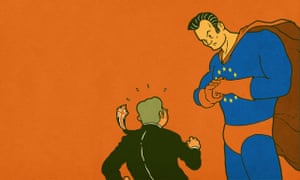
‘The best way forward for Europe is to threaten to hit the English as hard as we can.’ Illustration: Robert G Fresson

As the European Union faces the worst and most dangerous crisis since its creation, not only is Britain refusing to help, it is actually using this historic moment of weakness to extract “concessions” from its fellow members. This is the back story to the “Brexit” referendum, in which the government is threatening to leave the EU unless its demands for a “better deal for Britain” are met. Indeed, why merely kick a man while he’s down if you can go through his wallet too?

The negotiations in Brussels over this deal are entering their final stages: last week cabinet members were told they’d be free to campaign for an exit whatever the outcome of the talks. So this makes it high time for Europeans to take a cold and honest look at the British. Or rather, the English. Scotland is largely pro-EU while Wales and Northern Ireland, with their smaller populations and the less imminent threat of secession, have far less influence. How to deal with the English, then, over Brexit?

Step one is to ask if this referendum is actually a once in a lifetime opportunity to cut the English loose. Why not let them simmer in their splendid irrelevance for a decade or more, and then allow them back in – provided they ask really, really nicely. The English will still be in Nato, and what are they going to do? The United States values Britain as its proxy seat at the European table. With that seat empty, why would Washington keep its poodle?

Meanwhile half of British trade is with the EU, but only 11% of EU trade is with Britain. As the Oxford-educated Polish politician Radoslaw “Radek” Sikorski – one European who knows how to talk to the English elite – characterised the balance of power post-Brexit: “No prizes for guessing who would have the upper hand in the negotiations.” So if the English want to be a little Russia or mini-Turkey – former empires suffering from debilitating withdrawal symptoms – why not let them?

But then there is the unprecedented refugee crisis, the euro mess, the ever-growing terrorist threat, and the Russian invasion of Ukraine. Together they make this a really bad time for further instability. Yes, we would strangle or crush the English in the post-Brexit negotiations, the way any group of nations comprising 450 million people would to an opponent eight times smaller who has just tried to blackmail them.

But here’s step two. We must recognise that the English elite has chosen its moment well. Europe is vulnerable, and we just cannot afford another distraction from our real problems. Which means we must help the pro-EU camp in England.

One way to do this would be to meet at least some of the English demands. This is what David Cameron is clearly hoping for, but it would be a historic mistake. If the UK is rewarded for its cynical act of extortion there will be referendums all over the place, paralysing Europe for a decade.

This is why the best way forward for Europe is to threaten to hit the English as hard as we can. We must stop treating membership of the EU as a favour granted by England, and instead make the English feel their vulnerability and dependence.

First and foremost, this means a change of tone. For many mainland Europeans the EU offers the promise of freedom from the threat of nationalism. But the English have a different experience. They are taught to believe that nationalism is what saved them from Adolf Hitler and, as a consequence, they see no need for a post-national political entity. This is why for England, the EU is an economic rather than a cultural and political project. Read pro-Europe newspapers such as the Financial Times or listen to English pro-Europe politicians, and every argument is framed around the country’s national interest.

In other words, the English attitude towards the EU is transactional rather than transformational – therefore appealing to the European ideal or England’s better self is pointless. Instead we need to spell out all the ways in which we will make the English suffer if they leave. Using explicit threats may seem to be a very un-European thing to do, but think again: for nearly all England’s mainstream politicians and pundits, “un-European” is a compliment.

So let us start talking now, out loud in Brussels as well as in Europe’s opinion pages and in national parliaments, about the offer we are going to make to the Scots, should they prefer Brussels to London in the event of Brexit. Let’s also discuss in which ways we are going to repatriate financial powers from London to the European mainland. It is strange enough that Europe’s financial centre lies outside the eurozone, but to have it outside the EU? That would be like placing Wall Street in Cuba.


‘How electrifying it would have been if Cameron had demanded an end to the insanely wasteful practice of moving the European parliament back and forth between Strasbourg and Brussels.’ Photograph: Emmanuel Dunand/AFP/Getty Images

Clearly multinational corporations from China, Brazil or the US cannot have their European HQs outside the EU. So let’s have an EU summit about which European capitals these headquarters should ideally move to. Make sure the English can hear these discussions, and in the meantime keep an eye on how the value of commercial real estate in London plummets.

Or consider the UK-based Japanese car industry – would Greece, with its excellent port and shipping facilities, not be its ideal new home? Oh yes, and sooner or later, the 1.3 billion Indians will object again to not having a permanent seat on the UN security council when 55 million English do. Let’s work out what favours we want from India in exchange for our support.

The best way for the EU to prevent Brexit is to start preparing for it, loudly. But this is not enough. European politicians and pundits must not be shy of cutting England down to size. This is the chief problem for those in England trying to make the EU case: they must acknowledge first how irrelevant and powerless their country has become. Except that is still a huge taboo.

Seen from China or India, the difference between the UK and Belgium is a rounding error: 0.87% of world population versus 0.15%. But this is not at all how Britain sees itself – consider the popular derogatory expression “a country the size of Belgium”.
But alas, what a missed opportunity this referendum is. A child can see that the EU needs fundamental reform and just imagine for a moment that England had argued not for a better deal for Britain, but for all of us Europeans.

How electrifying it would have been if Cameron had demanded an end to the insanely wasteful practice of moving the European parliament back and forth between Strasbourg and Brussels. If he had insisted on a comprehensive overhaul of the disastrous common agricultural policy, on the long overdue reduction in salaries and tax-free perks for Eurocrats, and on actual prosecution of corrupt officials. Instead he has set his sights on largely symbolic measures aimed at humiliating and excluding European migrants, safeguarding domestic interests versus those of the eurozone and, no surprises here, guarantees for London’s financial sector.

Ultimately, as far as the EU is concerned, the English are only in it for themselves. All the more reason, then, for Europeans to stop imploring them to stay in, and begin using their strength in the negotiations.