Search This Blog

Wednesday, 19 August 2015

Hope for mature women?

'Female Viagra' approved by US drug agency 

Sprout Pharmaceuticals's tablet of flibanserin
Experts have said the effects of the libido-enhancing drug are "modest"
The US Food and Drug Administration (FDA) has approved a libido-enhancing drug for women that has been dubbed "Female Viagra".
Flibanserin, a drug produced by Sprout Pharmaceuticals, recently passed an FDA advisory committee meeting.
The pill is designed to assist premenopausal women regain their sex drive by boosting levels of certain brain chemicals.
The drug has been criticised as having marginal effects.
Versions of the pill, which will be marketed as "Addyi", have been submitted for approval in the past but never passed.
It was rejected by the FDA twice for lack of effectiveness and side effects like nausea, dizziness and fainting.
Women taking the drug reported between half and one more sexually satisfying event per month - results experts admitted were "modest".
Originally the drug was produced by German company Boehringer Ingelheim. Sprout bought the drug from that company after it was turned down by the FDA.
Sprout CEO Cindy Whitehead
Sprout CEO Cindy Whitehead gains approval for the first drug to boost sexual desire in women
Documents from the 4 June FDA advisory meeting describe the drug's purpose as "treatment of hypoactive sexual desire disorder (HSDD) in premenopausal women".
Women would take it each night.
A doctor would have to determine whether a woman seeking the pill was suffering from a disorder characterised by a lack of sexual fantasies and desire, causing the woman distress.
Currently, there is nothing on the US market approved for treatment of HSDD or another condition, female sexual interest/arousal disorder (FSIAD).
"This condition is clearly an area of unmet medical need," the FDA documents said.
Sprout stress ball which reads:
A brain-shaped stress ball at a Sprout employee's desk at their headquarters in Raleigh, North Carolina
Sprout only has 25 employees. Large pharmaceutical companies like Pfizer, Bayer and Proctor & Gamble have all studied female sexual desire disorder treatment but abandoned plans to pursue it.
Sprout's CEO, Cindy Whitehead, told AP they would promote Addyi carefully.
"We would never want a patient who's not going to see a benefit to take it and tell everyone it doesn't work," she said.
Lobbying by Sprout Pharmaceuticals was backed by the women's rights group Even the Score, which has accused the FDA of gender bias by approving a number of drugs treating erectile dysfunction in men without passing an equivalent for women.

Monday, 17 August 2015

Doomsday clock for global market crash strikes one minute to midnight as central banks lose control

China currency devaluation signals endgame leaving equity markets free to collapse under the weight of impossible expectations


The mushroom cloud of the first test of a hydrogen bomb
It is only a matter of time before stock markets collapse under the weight of their lofty expectations and record valuations. Photo: Reuters
By John Ficenec in The Telegraph
 

When the banking crisis crippled global markets seven years ago, central bankers stepped in as lenders of last resort. Profligate private-sector loans were moved on to the public-sector balance sheet and vast money-printing gave the global economy room to heal.


Time is now rapidly running out. From China to Brazil, the central banks have lost control and at the same time the global economy is grinding to a halt. It is only a matter of time before stock markets collapse under the weight of their lofty expectations and record valuations.


The FTSE 100 has now erased its gains for the year, but there are signs things could get a whole lot worse.


1 - China slowdown


China was the great saviour of the world economy in 2008. The launching of an unprecedented stimulus package sparked an infrastructure investment boom. The voracious demand for commodities to fuel its construction boom dragged along oil- and resource-rich emerging markets.


The Chinese economy has now hit a brick wall. Economic growth has dipped below 7pc for the first time in a quarter of a century, according to official data. That probably means the real economy is far weaker.


The People’s Bank of China has pursued several measures to boost the flagging economy. The rate of borrowing has been slashed during the past 12 months from 6pc to 4.85pc. Opting to devalue the currency was a last resort and signalled the great era of Chinese growth is rapidly approaching its endgame.

Data for exports showed an 8.9pc slump in July from the same period a year before. Analysts expected exports to fall only 0.3pc, so this was a huge miss.

The Chinese housing market is also in a perilous state. House prices have fallen sharply after decades of steady growth. For the millions who stored their wealth in property, it makes for unsettling times.


2 - Commodity collapse

The China slowdown has sent shock waves through commodity markets. The Bloomberg Global Commodity index, which tracks the prices of 22 commodity prices, fell to levels last seen at the beginning of this century.


The oil price is the purest barometer of world growth as it is the fuel that drives nearly all industry and production around the globe.

Brent crude, the global benchmark for oil, has begun falling once again after a brief rally earlier in the year. It is now hovering above multi-year lows at about $50 per barrel.


Iron ore is an essential raw material needed to feed China’s steel mills, and as such is a good gauge of the construction boom.

The benchmark iron ore price has fallen to $56 per tonne, less than half its $140 per tonne level in January 2014.


3 - Resource sector credit crisis

Billions of dollars in loans were raised on global capital markets to fund new mines and oil exploration that was only ever profitable at previous elevated prices.

With oil and metals prices having collapsed, many of these projects are now loss-making. The loans raised to back the projects are now under water and investors may never see any returns.


Nowhere has this been felt more acutely than shale oil and gas drilling in the US. Tumbling oil prices have squeezed the finances of US drillers. Two of the biggest issuers of junk bonds in the past five years, Chesapeake and California Resources, have seen the value of their bonds tumble as panic grips capital markets.


As more debt needs refinancing in future years, there is a risk the contagion will spread rapidly.


4 - Dominoes begin to fall

The great props to the world economy are now beginning to fall. China is going into reverse. And the emerging markets that consumed so many of our products are crippled by currency devaluation. The famed Brics of Brazil, Russia, India, China and South Africa, to whom the West was supposed to pass on the torch of economic growth, are in varying states of disarray.

The central banks are rapidly losing control. The Chinese stock market has already crashed and disaster was only averted by the government buying billions of shares. Stock markets in Greece are in turmoil as the economy grinds to a halt and the country flirts with ejection from the eurozone.

Earlier this year, investors flocked to the safe-haven currency of the Swiss franc but as a €1.1 trillion quantitative easing programme devalued the euro, the Swiss central bank was forced to abandon its four-year peg to the euro.


5 - Credit markets roll over

As central banks run out of silver bullets then, credit markets are desperately seeking to reprice risk. The London Interbank Offered Rate (Libor), a guide to how worried UK banks are about lending to each other, has been steadily rising during the past 12 months. Part of this process is a healthy return to normal pricing of risk after six years of extraordinary monetary stimulus. However, as the essential transmission systems of lending between banks begin to take the strain, it is quite possible that six years of reliance on central banks for funds has left the credit system unable to cope.


Credit investors are often far better at pricing risk than optimistic equity investors. In the US while the S&P 500 (orange line) continues to soar, the high yield debt market has already begun to fall sharply (white line).


6 - Interest rate shock

Interest rates have been held at emergency lows in the UK and US for around six years. The US is expected to move first, with rates starting to rise from today’s 0pc-0.25pc around the end of the year. Investors have already starting buying dollars in anticipation of a strengthening US currency. UK rate rises are expected to follow shortly after.


7 - Bull market third longest on record

The UK stock market is in its 77th month of a bull market, which began in March 2009. On only two other occasions in history has the market risen for longer. One is in the lead-up to the Great Crash in 1929 and the other before the bursting of the dotcom bubble in the early 2000s.


UK markets have been a beneficiary of the huge balance-sheet expansion in the US. US monetary base, a measure of notes and coins in circulation plus reserves held at the central bank, has more than quadrupled from around $800m to more than $4 trillion since 2008. The stock market has been a direct beneficiary of this money and will struggle now that QE3 has ended.


8 - Overvalued US market

In the US, Professor Robert Shiller’s cyclically adjusted price earnings ratio – or Shiller CAPE – for the S&P 500 stands at 27.2, some 64pc above its historic average of 16.6. On only three occasions since 1882 has it been higher – in 1929, 2000 and 2007.

Rahul Dravid and Sanjay Manjrekar on Batting

S Dinakar in The Hindu


Rahul Dravid.
Rahul Dravid.


Batting legend Rahul Dravid shared his thoughts on India’s troubles with spin and the dynamics of technique in an exclusive conversation with The Hindu.

Here is the first part of excerpts from the interview.


Q. Indian batting has become increasingly vulnerable to spinners over the last few years.

Playing spin was one of our big strengths. What can happen is that when you are with an international team you are not getting to play a lot of spin bowling in matches. Perhaps the pitches in India have changed.


Q. Does it boil down to the use of feet?

Good footwork certainly helps, but different players can play spin differently. Even in the team that I played, Laxman for example, would use his feet, but not that much. He had great reach and used the depth of the crease well. He didn’t have a sweep shot, but had a great on-drive.

Sehwag used his feet against spin a lot more than some of us.

Ganguly stepped down to the left-arm spinner whenever he could.

It always helps to have a sweep shot.


Q. The present day batsmen are playing too many shots too early against spin?

You need to be a bit more patient against spin. People now want to dominate the spinner from the beginning.

Sometimes we need to give the ball the respect it deserves.


Q. Batsmen rarely come across worthy spinners in domestic cricket these days.

You still have the odd good spinner in domestic cricket, but the numbers have dipped. The top four spinners are good but we had a lot more spinners in the domestic scene then.

Maybe, domestically, our batsmen are not getting exposed to quality spin bowling. Wickets have improved in India too. I have played on some absolute turners.


Q. International line-ups have become increasingly vulnerable on pitches doing a bit.

You are seeing a lot of results in Tests. People are playing more aggressively.

The flip side of that is, sometimes, on tricky wickets where there is seam and swing or turn, you get found out.

Generally, very rarely do you get seaming or turning wickets in international cricket these days. Most wickets are flat.

If you see a difficult wicket, you should have a certain level of personal pride to perform. If you have that you will practice for it.

To succeed in any form of the game, your game has to be built around your defence. It then expands from there.


Q. Do you believe the cash-rich T20 format has taken the cricketers’ focus away from Tests?

To be a successful Test cricketer was our primary focus then. Now you can easily make a living without being a Test cricketer. Maybe the incentive is not there anymore.

Then it boils down to personal pride, getting satisfaction in succeeding in all and the most difficult of conditions.


Q. What, in your mind, is good footwork?

Good footwork is being able to pick the length of the ball early, get to it as quickly as possible and get yourself into a good position. Good footwork is really about using the depth of the crease when you need to go back, and getting a good stride forward when you need to go forward.

You need to ensure that you are not stuck in the crease.


Q. As we saw with the Aussies in England recently, batsmen are increasingly vulnerable on or outside the off-stump.

The key is being balanced and knowing your head position. You need to be going towards the ball than across the wicket. The body weight is going down the wicket than across the wicket.

Once your head starts falling over and goes across the wicket, you lose [sense of] where your off-stump is. Your head has to be in the right position to know where your off-stump is.


Q. Sunil Gavaskar recently spoke about the alignment of right eye with the off-stump.

I thought that was a brilliant technical suggestion. If you are balanced, with your right eye guiding where your off-stump is, then there is a good chance that you go down the wicket, the weight is going towards the ball, and your head is still and in a good position. Anything outside the right eye-line you could leave.

But if you are going across the stumps, your right eye actually loses where your off-stump is. And you end up playing balls that are wide outside the off-stump.


Q. Do you believe the wide and excessive back-lifts are an issue too?

Typically, you want the bat to come from second slip, swing around and come down straight.

Hashim Amla picks up his bat, almost towards gully, but when it comes down it does so really straight. That’s what really matters.

The ideal way to pick it up will be between first and second slip. But there are cases of people who pick it up slightly wider but are able to align it straight.

I used to pick it up a lot wider than first or second slip, but generally I was able to get into good positions to bring the willow straighter.

When I was not playing well, that was an area that bothered me. If I wasn’t able to get the timing right of bringing the bat down, then balls, especially those coming back in, got me bowled or lbw, which happened towards the end of my career.

------

Sanjay Manjrekar on Playing Spin (from Cricinfo)


I think batsmen around the world are not playing spin too well these days.

We have seen it in the Ashes, seen Sri Lankan batsmen struggle against the legspin of Yasir Shah, and now India disintegrate against Rangana Herath to lose a Test match that was firmly in their grasp. All this is suggestive of the fact that international batsmen are not playing spin too well at the moment.

The focus is so much on playing pace and seam well that it seems there is no headspace left for them to try to be adept at spin too. Before India went to England last summer, how many of their batsmen tried to hone their skills against offspin? I am sure James Anderson and Stuart Broad would have been on their minds, not Moeen Ali. No wonder Moeen ended up getting 19 wickets in that series.

Historically, Indian batsmen have tended to take spin lightly. You just have to watch them bat in the nets - they bat with caution and respect against fast bowlers, but when they see a spinner come in to bowl they dance down the pitch to hit the ball for a six. They are not fussed if they miss a few; they basically look to have fun against the spinners before they put their heads down and get serious against the fast bowlers.

Then, in a tense match situation, when the ball is turning square and the batsman sees four fielders around the bat, dancing down the pitch and hitting the ball into the stands is not an option any more, but they do not know what to do instead. Now the batsman has to do something he has never done before: try and defend the spinner from the crease and make sure the ball rolls safely along the ground off the defensive bat, away from the close-in catchers.

This is a highly specialised skill, to defend confidently against the spinning ball, using only the bat, with catchers hovering four feet away. (With the DRS and umpires willing to give batsmen out lbw on the front foot, thrusting the pad at the ball is not an option any more, as it used to be in my time.)

It is a skill no one practises enough these days, and that is why you see a Rohit Sharma in defence planting his front foot on leg stump, to a turning ball from Herath that has pitched on middle and off stump.

The other critical defensive technique that has practically vanished from the game is a batsman trying to play a good-length ball and then letting it go at the very last minute, when he realises it has changed direction and is not going to hit the stumps any more. It's amazing to see how many batsmen get out - to seamers and spinners alike - while playing defensive shots to balls that are going to miss the stumps.

Mind you, in my time too, spinners were treated no differently in the nets. The advantage we had, though, was that we still played a decent amount of domestic first-class cricket as international players, so our skills against spin had not become dormant. But I remember, every time I came home to domestic cricket after travelling the world playing international cricket, it took some time getting used to playing spin well again.

In the first innings in Galle it was evident that the Indian batsmen were treating the Sri Lankan spinners with respect - they did not want to make the same mistakes they made against Moeen. But their defensive game against spinners is far from perfect.


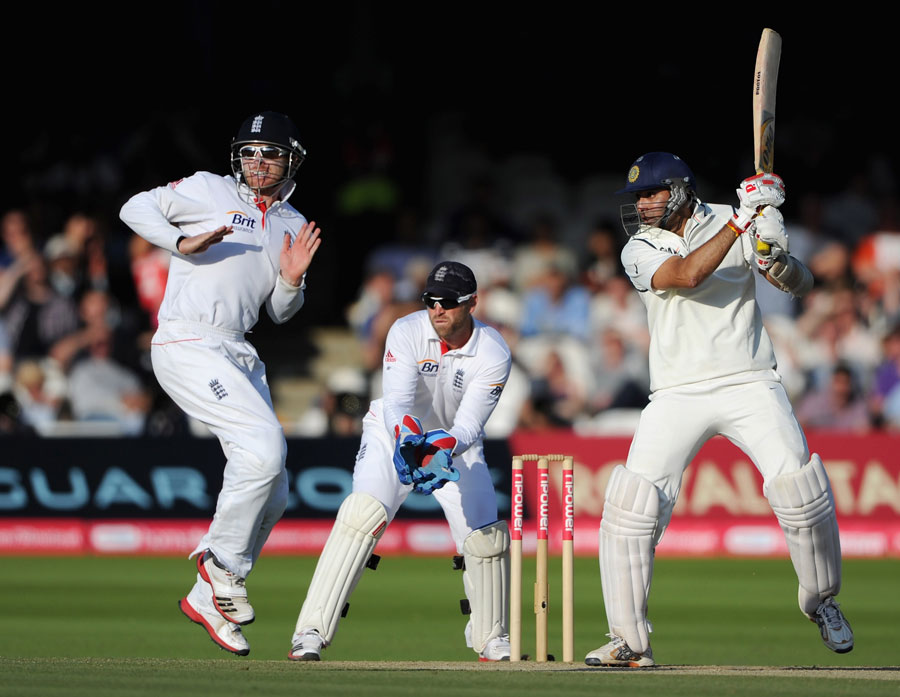
VVS Laxman set a worthy example of how to play on a pitch that takes turn: by scoring more off the back foot than off the front © Getty Images

Every time an Indian batsman decides to get on to the front foot to defend against spin, I cringe. They leave far too much distance between the bat and the spot where the ball has pitched. This is a recipe for disaster on a turning pitch. By leaving this space between the bat and the spot where the ball has pitched, you are allowing the ball to spin and bounce or straighten. You are giving the ball the space to behave mischievously. This is how Ajinkya Rahane got out in the first innings and Virat Kohli in the second - two big wickets.

The golden rule of playing spin is judging the length early, and then, when choosing to play on the front foot, getting right on top of the ball to smother its spin and whatever venom it carries.

If you think you can't reach the pitch of the ball with the front foot, go right back in the crease and watch the ball closely off the pitch. In fact, on turning pitches you should look to score more off the back foot than off the front, just as VVS Laxman used to do. When you are on the back foot, because the ball is turning so much, you get the width to play the cut and the pull or play it away for a single safely. Catchers around the bat are placed there mostly for errors arising out of front-foot defensive shots.

With all good intentions, domestic pitches have changed in India. There is more grass on the pitches now, and spinners don't rule the roost any more. The flip side is, this means less good practice against spin for Indian domestic batsmen. KL Rahul, very much a recent product of Indian domestic cricket, looked far more assured against pace than he did against spin in Galle. That is telling.

The fact is quite simple: your chances of surviving against spin increase if you practise for hours in the nets what you need to do in the match.

Sunday, 16 August 2015

England's Ashes Win - Despite, not Because

Maxie Allen in The Full Toss

England would not have won the Ashes had Kevin Pietersen not been sacked without explanation. Alastair Cook is the greatest captain in test history. Paul Downton is a national hero of rare prescience and foresight.
I need exaggerate only a little to make the point. History is being re-written. Scores are being settled. A sickly river of errant and retaliatory bilge is slithering its way through the media crickosphere.
Why does it matter? At the risk of coming over all Ed Smith, allow me to quote George Orwell:
He who controls the past controls the future. He who controls the present controls the past.
Newspapers write contemporary history. They set the agenda and become the accepted version of events. The press influence people whose opinions affect cricket followers – from the wider public, to politicians, sponsors, and sports administrators.
Who is the head of UK Sport more likely to read? Mike Selvey, or Being Outside Cricket?
The hacks have power, but some of them are distorting reality to serve a bizarre agenda.
Let’s get one thing straight. England did not win the Ashes because a masterplan came gloriously to fruition. England’s triumph over Australia did not reveal the decision-making of February 2014 to be an act of visionary, methodical genius.
England won despite what happened, not because of it.
Let’s remember the precise sequence of events. First, Peter Moores was hired with a mandate to re-build the England side. He was chosen even though he was the only candidate who’d already failed in the role, and to almost universal opposition. He promised more of the same micro-managing, data-driven, strait-jacket approach which by then had already been discredited under Andy Flower.
How did he get on? Moores took England backwards, not forwards: losing to Sri Lanka, crashing out of the World Cup at the group stage, and drawing with West Indies, a record only offset by the series win over a woeful India.
It was meant to have been Peter Moores who masterminded England’s Ashes campaign. At the last minute the ECB had no choice but bow to the inevitable, prompting a panicked sacking and replacement process. In dismissing Moores, Andrew Strauss managed to avoid doing the really stupid thing – not sacking him – but it was hardly act of remarkably prescient cricketing genius.
And what of the new materials around whom the side was re fabricated? Sam Robson and Gary Ballance have both since been dropped, as have Chris Jordan and Liam Plunkett. Chris Woakes, for reasons both of form and injury, has also fallen off the radar. Jos Buttler has yet to make a century and has scored only 79 runs at 13 in this Ashes series.
The ECB’s stated plan, eighteen months ago, was to build the New England around Alastair Cook. Since then he has scored two centuries in seventeen tests, the output of a supporting actor, not the lead. In the 2015 Ashes so far, Cook has made 223 runs in seven innings, at 31.85. In terms of England averages for the series, he stands sixth.
Has Cook’s captaincy improved England’s form? He’s now more prepared to try quirky tactics – if England are on top. He will declare, nine down, shortly before lunch – if England are already leading by more than 300. As Unhappy Hippy remarked on Twitter, “Cook’s captaincy capably managed matches we should win”.
If Cook has changed his approach, he waited until at least a year after the tour of Australia to do it. If Cook is made of the right stuff, why has he progressed at barely a glacial pace? In nearly three years at the helm, Cook has now led England captain in 37 tests. Only five men have ever captained England on more occasions.
Would England not have beaten Australia without Cook’s captaincy? What did he do in this series which turned sessions in England’s favour? Was this a case of his intrinsic virtues carrying the day, as they were inevitably destined to? Or an extension of the Collingwood Principle – that if anyone captains long enough, refusing to resign, they will eventually enjoy a series when things go their way?
The jury remains out on the most important dimension of Cook’s captaincy. He has always been prepared to rotate the bowlers – any idiot can do that – and try an offbeat field placing. Cook’s real weakness is his impotence in the face of adversity. When the batsmen are on top – as Australia’s were at Lord’s, or when England lose control in the field – as they did last year against Sri Lanka at Headingley and India – Cook retreats into his shell instead of taking the game by the scruff of the neck. These situations are the true test of a captain’s mettle, and Cook invariably fails – shrugging his shoulders at slip and ceding control to Anderson and Broad.
By retaining Cook as captain, were the ECB sagacious and far-sighted, or did they just get lucky? When they reaffirmed him, time and again, after each disappointing result, what were the qualities they saw in him which have now become evident this summer? And how did they influence the result?
Have England been better off without Kevin Pietersen? His replacements – in this series, Ballance and Bairstow (it is telling that a change was needed) – have scored 177 runs in six innings. Would Pietersen have scored fewer?
It is impossible to say with any confidence whether his absence helped foster a better team spirit, and if so, whether this atmosphere contributed significantly to England’s Ashes victory. Any assertion on this front is pure guesswork.
But no evidence has ever been presented that, when he played for England, Pietersen’s involvement proved detrimental to the team’s output. He was a member of England sides which won four Ashes series, beat India away, became world number one, and won the World T20. There is also ample testimony from younger players about Pietersen’s provision to them of support, advice, and help in the nets.
So if you return to England’s 2014 masterplan, and trace the narrative threads through to their victory at Trent Bridge, what do you end up with?
And why regard this Ashes series as the ‘end of history’? It is an arbitrary choice, which insults England’s other opponents. Why not draw the line at the West Indies tour in April, and take final conclusions from that result? Or extend the story to include the upcoming visits to UAE and South Africa. If England fare badly overseas this winter, where does that leave the narrative?
In beating Australia, England bowled extremely well, and batted well enough. Joe Root’s runs and Stuart Broad’s wickets were by far the most important individual contributions. Of the other players who materially affected the outcome, only Moeen Ali was an addition to the team since the Difficult Winter. You could add Mark Wood, at a push. Steve Finn, Ben Stokes, and Jonny Bairstow, all pre-date Paul Downton’s Brave New World.
England benefited greatly both from Australia’s appalling batting, and home advantage. All but one of the last eight Ashes series have been won by the hosts.
Another factor was England’s fresher and more liberated approach – their cricketers seemingly encouraged to play their natural games, on instinct, without hindrance from laptops and hypotheses. This cultural change is probably attributable to the influence of Paul Farbrace, acting coach during the New Zealand series, and Trevor Bayliss. Yet it had not been the advance plan for either man to take charge of the team. Had Peter Moores remained in post, as the ECB had intended, what would have happened?
None of this devalues the performance of the England players who scored the runs and took the wickets which beat Australia. Quite the opposite. They defied expectations. They outplayed their rivals. They won the Ashes. To those players – and to a minor extent their new coaches – is the credit due. To lay it at anyone else’s door is to denigrate their achievement.
Try telling that to what Mike Selvey might call the “vocal minority” of professional cricket writers hellbent on distorting reality to settle scores. Some are motivated by the redemption of their friends. What was regarded ‘below the line’ as the legitimate holding to account of people in power, they saw as the vulgar abuse of “good men”.
More acutely, for some, this their opportunity for revenge on what Ed Smith calls ‘the mob’. We had the temerity to challenge their judgment. We had the impudence to suggest that people who had neither played three test matches, nor once sat next to Kevin Pietersen on a plane, but had spent their whole lives following England, might still be able to form a valid opinion on cricket.
In both cases, we neglected to respect our elders and betters. And this is payback time. In yet another journalistic first for the English cricket media, this is a cue for an attack on their own readers.
If some in the press are exploiting the Ashes result to vindicate their actions, this is small fry compared to what the ECB will do, and what their supporters will say. In theory, everything the board has done, and everything the board will go on to do, can be justified by what happened this summer. The reclamation of the urn proves the soundness of their rationale, the goodness of their governance, and the righteousness of their moral code.
As Dave Ticker put it, on Twitter: "Giles Clarke selling out to Stanford doesn't look so silly now England have won the Ashes, does it."
Persecute, bully and betray England’s highest ever run-scorer? We won the Ashes. Extort spectators and test-hosting counties? We won the Ashes. Lock cricket behind a TV paywall? We won the Ashes. Hand the Sky windfall to the counties and bill Sport England for the grass-roots funding? We won the Ashes. Ruin the World Cup? We won the Ashes. Turn international cricket into a protection racket for the Big Three? We won the Ashes.
Dare not question our judgement. We know what’s best for you. Please move along.