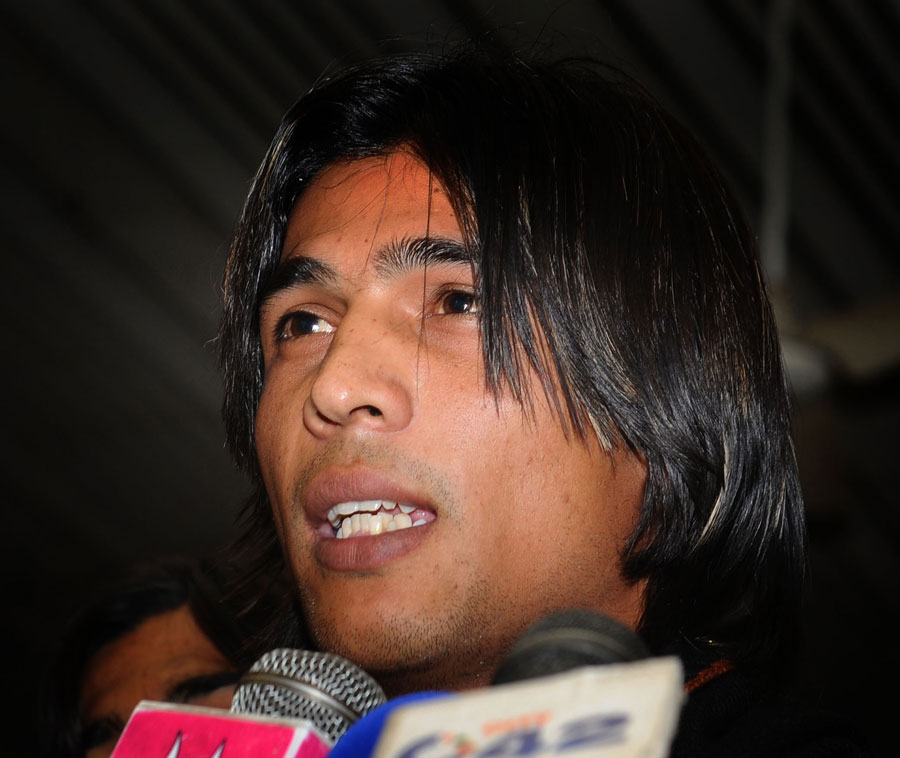
By Sriram Veera in The Indian Express
What lies ahead for a cricketer past his best? If you are Munaf Patel, the pacer from Gujarat undazzled by fame and riches, all you need is a village, and the art of chilling
What lies ahead for a cricketer past his best? If you are Munaf Patel, the pacer from Gujarat undazzled by fame and riches, all you need is a village, and the art of chilling
In a room, somewhere in West Indies, Sachin Tendulkar approaches Munaf Patel. It’s 2007, India has been evicted from the World Cup but they can’t go home yet. The Bermuda versus Bangladesh game is yet to be played and the players wait for a miracle. Back home, things have turned. Sachin Tendulkar’s and Sourav Ganguly’s restaurants have been attacked, Zaheer Khan’s house stoned, a wall of MS Dhoni’s house broken. Patel recalls the players downloading the public outrage from the internet. Tendulkar asks Patel: “Something or other is happening at everyone’s house. What’s on at your home, Munna?” “Paaji, jahan main rahta hoon na, udhar aath hazaar log hai and 8,000 mera security hai! (There are 8,000 people where I stay, and those are my security.)” Tendulkar laughs, “We might all have to come to your home from here.”
Couple of us journalists are at his home in his village Ikhar in the Bharuch district of Gujarat. Seven years down the line, Patel’s fortunes have swung the whole arc. He has been a part of a team that lifted the World Cup in 2011, and now, as the team heads for another World Cup, his name doesn’t even figure in the list of probables. But the 31-year-old remains a hero at Ikhar — and remarkably, for someone who has seen both fame and riches come and go, at peace with himself, in this village from where he started his dream run.
Hailed by India’s then bowling coach Eric Simons as the “unsung hero of the 2011 World Cup win”, Patel had ended the tournament as India’s third-highest wicket-taker, behind Zaheer Khan and Yuvraj Singh, with 11 wickets. He could have been the fastest Indian bowler ever but a shoulder injury in 2004 forced him to forsake pace. He played just 13 Tests but starred in 70 ODIs, picking up 86 wickets, and was indispensable to the team between 2009 and 2011. These days, when he is not playing Ranji Trophy for Baroda, he is at Ikhar, probably leaning against a well in a kheth (field) with his friends or lolling at the swing in his home.
It’s a fairly big house. A kilometre or two past a railway gate, beyond the cotton fields, it is caressed by a gentle breeze on a warm but pleasant day. A bike approaches from behind and Patel gets down. Dressed in track pants and a T-shirt, he welcomes us with an earthy smile: “I was chatting in the field.” We walk down the pathway, lined by trees and shrubs, to a small six-pillared portico with a swing. Patel understands and can speak English but we mostly converse in Hindi. Often philosophical, and with an ever-present smile even when talking about struggle, the man who says he just likes to have fun — “Masti chahiye bas” — opens up on his journey.
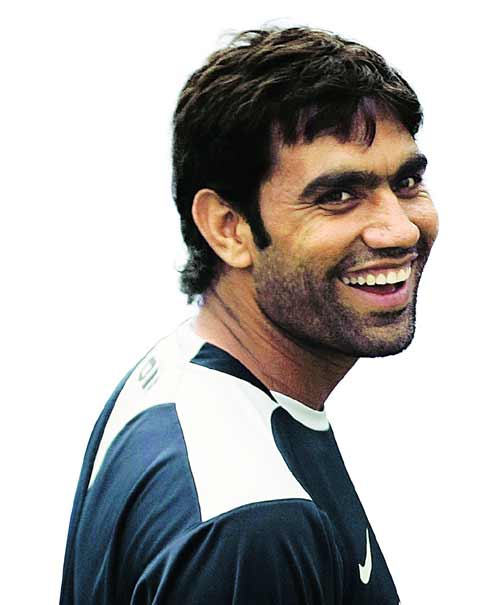
It’s the 1990s and Patel is in the ninth standard at the village school. He is already the fastest bowler but doesn’t want to play cricket anymore. Guilt is in the air. His father works on someone else’s farm, there isn’t much food at home. The children get new clothes on Id, but only in a good year. For the last couple of years, during vacations, young Munaf has been at a tile factory choosing the best “export-quality” tiles, packing them in boxes and going home with Rs 35 for an eight-hour shift. “Dukh hi dukh tha lekin jhelne ki aadat ho gayi thi. Kisi ko sunaon toh lagega kya din tha but when you are used to it, and there is no other option, then you feel kya yaar, yeh to roz ka kaam hai. Paisey nahi hai to kya kar sakte hain? Father akela kaam raha hai and we were in school. (It was a hard life, but it had become a habit. There wasn’t enough money, but what could we do? Father was the only one earning, and we were in school),” he says. A friend urges a teacher to intervene: “What’s your age? You can work once you get out of school. Now just play.”
A few years on, Patel receives his first ehsaan (favour), a constant theme in our chat. He requests a well-connected person in the village, Yusuf Bhai, to take him to Baroda to get his cricket career going. Yusuf even buys a pair of shoes for Patel, who used to play in chappals till then. “He bought me Rs 400-worth shoes, and introduced me to a cricket club. Ehsaan rahega zindagi bhar.” (Even today, whenever Yusuf comes down from UK, Munaf hops over to his house. “Kuch bhi kaam hai toh bata dena, bhai.”)
Meanwhile, his father isn’t happy. Every day, at dinner, young Munaf is asked to quit playing cricket and join him at work. And eventually go to Africa. “I would just stay silent; my mother would tell him to let me play.” For Ikhar, a village of poor cotton farmers, Africa was the passport out of poverty. Every year, a youngster or two would land up at a friend, relative or acquaintance’s house in Zambia, Mozambique, South Africa or Zimbabwe to find work in a factory or a shop. Patel had an uncle in Zambia and so his future seemed set in stone. “You can’t blame my father. No one here really knew that cricket had this kind of scope. That I can even earn money from this.”
But the doors kept opening, through the kindness of strangers who spotted talent in the gangly youth. Former India wicketkeeper Kiran More, “who hasn’t taken a single paisa from me and even bought me my first branded cricket shoes (Gunn & Moore)”, trained him at his academy in Baroda, also sent him to the MRF pace school in Chennai. A city where “they never spoke Hindi” and “auto drivers matlab fight” but a place close to his heart. He recounts a tale that captures his personality then. An English batsman, along with Sajid Mahmood and Simon Jones, had come down to the school. Patel can’t remember his name. “Gora tha (He was white), left-handed and the pitches were fast then. I bowled four-five bouncers; one hit his shoulder, one his helmet and other his gloves. He started to come towards me, saying something in English. Mujhe toh English aati nahi tab. But I see that he is angry. So I slip away quickly and dive into the swimming pool. I thought he will complain to Sir, who will throw me out of the academy!”
Patel started to learn the ways of the world at MRF. “I lived there for five-six months. I learnt how to wear good clothes, how to speak, kuch bhi nahi aata tha. Dennis Lillee (Australia’s legendary fast bowler who coached at MRF) would say something and I used to look at someone else’s face! Kya bol raha hai? Lillee Sir always used to laugh, and ask someone to translate.”
Around this time, Australian cricketer Steve Waugh dropped by the academy, saw Patel in action and was impressed. He told as much to Tendulkar, who convinced Patel to join the Mumbai Ranji team. “I learnt a lot about cricket but not its lifestyle,” he says. The Mumbai cricketers would invite him to parties but Patel wasn’t ready. Only later, on a foreign tour, did he go to a club. “I thought I had to drink if I go there. Only after Gautam Gambhir (Patel’s closest cricketing friend) told me that there is no need to drink, and that even he doesn’t drink, did I go. I still don’t drink to this day.”
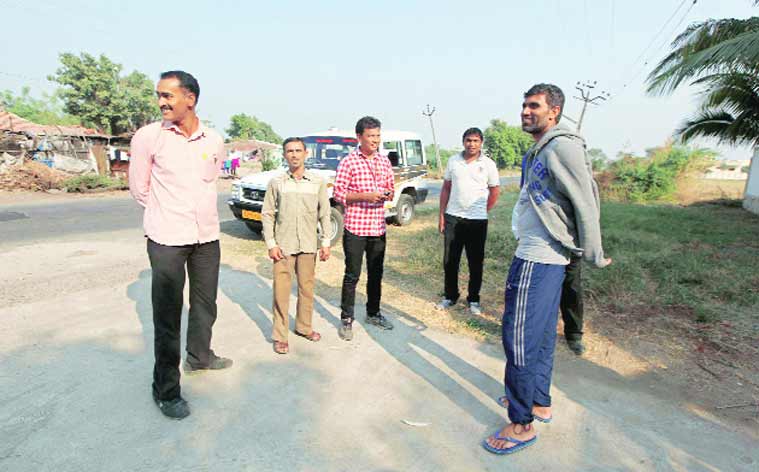 Patel with friends in his village, no one with a request is turned away from his house
Early on in his life, Patel had learnt to live with an unshakeable sense of right. Principled, unwilling to bend, quick on temper and willing to take seemingly rash decisions. Like in South Africa in 2009, when he shut the door on his captain Shane Warne and threatened to quit. Piqued at not being given any over in an IPL game, which the Rajasthan Royals eventually lost, he stormed to his hotel room and asked team owner Manoj Badale for his passport back. Soon, a knock on the door. Patel peeped through the eyehole to see Warne. “Please open the door”. ‘Shane Sir, I won’t’. “Let me explain.” “I don’t want to hear a thing. Bye.” Of course, he had admiration for Warne’s captaincy. “He was magic. He had the ability to get the best performances from everyone.”
Always frank, he once fobbed off a national selector because of perceived mockery. A day before a game after he was already selected, the selector asked him, “Are you fit?” Patel lost it. “How did you select me then? Tu khila raha hai toh cricket hi nahi khelna mujhe (If you think you are a doing a favour to me by selecting, then I don’t want to play).” The selector disappeared into the lift. “Tu yeda hai kya?” (Are you mad?) said Wasim Jaffer, who was with him then.
Patel was a man often criticised, at times even for his sartorial choices. A furore broke once about him not tucking in his shirt on the field with former players criticizing him on air. The dressing room too reflected the difference in personalities. Rahul Dravid, the captain, suggested he tuck in his shirt to end the controversy. “Voh ekdum sincere, padhe-likhe type (educated man) “ On the other side, Sehwag, Harbhajan, Yuvraj said, ‘Chodna yaar, hum bhi tuck in nahin karenge kal sey! ( We also won’t tuck our shirts in)’. I was not doing it on purpose. I hadn’t come from a school where kids wear white shoes, and tuck in their shirts!”
It set him off from the others, the straight talk, the no-nonsense attitude that anchored his feet to the ground. It would make him tick off young boys who would let fame get to their head— “Stop acting silly. Cricket hai bhai, anything can happen. Ek injury and sab khatam, finish. Then what will you do?” And it allowed him to look at the transformation of diffident young boys into celebrities with detachment. “See it’s the atmosphere you grow up. If you live in a city, are well-off, and more importantly, play for the country, your group will change. Where is an ordinary man, a poor man, going to be in that group?”
Here, in Ikhar, away from the adrenaline rush of victory and fame, the bright lights of the city and its lures, he knows that playing for India is many worlds away. “After the 2011 World Cup, I was injured for five-six months and by then, the selection approach had changed. They wanted to look beyond me and Nehra and give youngsters a chance. Which is fine. I will probably play for Baroda for two more years. Let’s see how long the body holds,” he says. But he also knows he is free of the favours and the ehsaan that has powered his run. “Bahut logon ka ehsaan mujh pey chada. I used to wonder how I shall pay them back. In between I thought I will even quit. Jitne logon ka ehsaan chadta hai, aap utne neeche jaate ho (The more people oblige you, the lower you slip).”
He has found a way now. The Patels never turn away a man who comes to their house, looking for help. It could be a request for Rs 50,000 for a wedding or money for hospital expenses. People come in, ask for the keys and take his cars for a ride. His father encourages him to do more. “If I ask any question to anyone who comes to home, my father will say, ‘Why are you asking questions? That won’t feed him. Just give him the money’.” The village has a trust which helps people in need. “We all know each other in the village. People always take care of each other.” And that’s why Patel doesn’t see himself leaving Ikhar. “Shaanti hai idhar, peaceful. Why will I go anywhere else?”