Prime Minister Sunak talks about the need for “compassion” from the government this winter. But how far do social security benefits have to fall before our welfare system descends into a form of cruelty?
Take a couple with three children whose universal credit payment is, in theory, £46.11 a day. However, when their payment lands they have just £35, because around a quarter of their benefit has been deducted to pay back the loan they had to take out on joining universal credit to cover the five weeks they were denied benefit. And an extra 5% has been deducted as back payment to their utility company. According to Department of Work and Pensions (DWP) rules, money can be deducted for repayment of advance or emergency loans, and even on behalf of third parties for rent, utilities and service charge payments.
With gas and electricity likely to cost, at a minimum, £7 on cold days like today, and with a council tax contribution to be paid on top, they find that they have just £25. 80 a day left over, or £5.16 per person, to pay for food and all other essentials. Even if the Scottish child poverty payment comes their way, clothes, travel, toiletries and home furnishings remain out of reach. Parents like them are just about the best accountants I could ever meet , but you can’t budget with nothing to budget with. And that’s why so many have had to tell their children they can’t afford presents this Christmas. No wonder they need the weekly bag of food they get from the local food bank. But they also need a toiletries and hygiene bank, a clothes bank, a bedding bank, a home furnishings bank, and a baby bank.
The DWP has now become the country’s biggest debt collector, seizing money that should never have had to be paid back, from people who cannot afford to pay anyway. In fact, the majority of families on universal credit do not receive the full benefit that the DWP advertises. More than 20% is deducted at source from each benefit payment made to a million households, leaving them surviving on scraps and charity as they run out of cash in the days before their next payment. In total, 2 million children are in families suffering deductions.
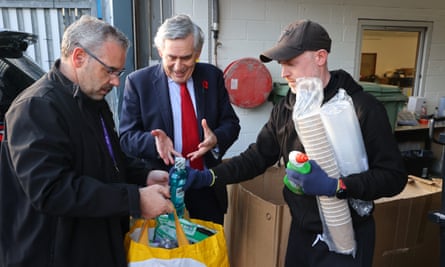
Gordon Brown with workers at the Big Hoose multi-bank project, Fife, 8 November 2022. Photograph: Murdo MacLeod/The Guardian
When the money runs out, and the food bank tokens are gone, parents become desperate and ashamed that their children cannot be fed, and fall victim to loan sharks hiding in the back alleys who exploit hardship and compound it, and prey on pain and inflame it.
The case for each community having its own multi-bank – its reservoir of supplies for those without – is more urgent this winter than at any time I have known. Since the Trussell Trust’s brilliant expansion of UK food banks, creative local and national charities have pioneered community banks of all kinds offering free clothes, furnishings, bedding, electrical goods and, in the case of the national charity In Kind Direct, toiletries.
In Fife, Amazon, PepsiCo, Scotmid Fishers and other companies helped to set up a multi-bank. It’s a simple idea that could be replicated nationwide: they meet unmet needs by using unused goods. The companies have the goods people need, and the charities know the people who need them. With a coordinating charity, a warehouse to amass donations and a proper referral system, multi-banks can ensure their goods alleviate poverty.
But the charities know themselves that they can never do enough. With the state privatisations of gas, water, electricity and telecoms, the government gave up on responsibility for essential national assets. But now, with what is in effect the privatisation of welfare, our government is giving up on its responsibility to those in greatest need – passing the buck to charities, which cannot cope. Just as breadwinners cannot afford bread, food banks are running out of food.
Charities, too,are at the mercy of exceptionally high demand and the changing circumstances of donors whose help can be withdrawn as suddenly as it has been given. And so while voluntary organisations – and not the welfare state – are currently our last line of defence, the gap they have to bridge is too big for them to ever be the country’s safety net.
According to Prof Donald Hirsch and the team researching minimum income standards at Loughborough University, benefit levels for those out of work now fall 50% short of what most of us would think is a minimum living income, with their real value falling faster in 2022 than at any time for 50 years since up-ratings were introduced. And still 800,000 of the poorest children in England go without free school meals.
When the money runs out, and the food bank tokens are gone, parents become desperate and ashamed that their children cannot be fed, and fall victim to loan sharks hiding in the back alleys who exploit hardship and compound it, and prey on pain and inflame it.
The case for each community having its own multi-bank – its reservoir of supplies for those without – is more urgent this winter than at any time I have known. Since the Trussell Trust’s brilliant expansion of UK food banks, creative local and national charities have pioneered community banks of all kinds offering free clothes, furnishings, bedding, electrical goods and, in the case of the national charity In Kind Direct, toiletries.
In Fife, Amazon, PepsiCo, Scotmid Fishers and other companies helped to set up a multi-bank. It’s a simple idea that could be replicated nationwide: they meet unmet needs by using unused goods. The companies have the goods people need, and the charities know the people who need them. With a coordinating charity, a warehouse to amass donations and a proper referral system, multi-banks can ensure their goods alleviate poverty.
But the charities know themselves that they can never do enough. With the state privatisations of gas, water, electricity and telecoms, the government gave up on responsibility for essential national assets. But now, with what is in effect the privatisation of welfare, our government is giving up on its responsibility to those in greatest need – passing the buck to charities, which cannot cope. Just as breadwinners cannot afford bread, food banks are running out of food.
Charities, too,are at the mercy of exceptionally high demand and the changing circumstances of donors whose help can be withdrawn as suddenly as it has been given. And so while voluntary organisations – and not the welfare state – are currently our last line of defence, the gap they have to bridge is too big for them to ever be the country’s safety net.
According to Prof Donald Hirsch and the team researching minimum income standards at Loughborough University, benefit levels for those out of work now fall 50% short of what most of us would think is a minimum living income, with their real value falling faster in 2022 than at any time for 50 years since up-ratings were introduced. And still 800,000 of the poorest children in England go without free school meals.
---
I’m so cold I live in my bed – like the grandparents in Charlie and the Chocolate Factory
Marin
---
When it comes to helping with heating, the maximum that any family will receive, no matter its size, is £24 a week emergency help to cover what the government accepts is the £50 a week typical cost of heating a home. From April, the extra payments will be even less – just £16 to cover nearly the typical £60 a week they now expect gas and electricity to cost. And then, as Jeremy Hunt says, help with heating will become a thing of the past.
One hundred years ago, Winston Churchill was moved to talk of the unacceptable contrast between the accumulated excesses of unjustified privilege and “the gaping sorrows of the left-out millions”. Our long term priority must be to persuade a highly unequal country of the need for a decent minimum income for all, but our immediate demand must be for the government to suspend for the duration of this energy crisis the deductions that will soon cause destitution.
Ministers have been forced to change tack before. In April 2021 the government reduced the cap on the proportion of income deducted from 30% to 25%. During the first phase of Covid, ministers temporarily halted all deductions. In April, they discouraged utility firms from demanding them, but deductions as high as 30% of income are still commonplace.
There is no huge cost to the government in suspending deductions, for it will get its money back later. But this could be a lifesaver for millions now suffering under a regime that seems vindictive beyond austerity. Let this be a Christmas of compassion, instead of cruelty.
I’m so cold I live in my bed – like the grandparents in Charlie and the Chocolate Factory
Marin
---
When it comes to helping with heating, the maximum that any family will receive, no matter its size, is £24 a week emergency help to cover what the government accepts is the £50 a week typical cost of heating a home. From April, the extra payments will be even less – just £16 to cover nearly the typical £60 a week they now expect gas and electricity to cost. And then, as Jeremy Hunt says, help with heating will become a thing of the past.
One hundred years ago, Winston Churchill was moved to talk of the unacceptable contrast between the accumulated excesses of unjustified privilege and “the gaping sorrows of the left-out millions”. Our long term priority must be to persuade a highly unequal country of the need for a decent minimum income for all, but our immediate demand must be for the government to suspend for the duration of this energy crisis the deductions that will soon cause destitution.
Ministers have been forced to change tack before. In April 2021 the government reduced the cap on the proportion of income deducted from 30% to 25%. During the first phase of Covid, ministers temporarily halted all deductions. In April, they discouraged utility firms from demanding them, but deductions as high as 30% of income are still commonplace.
There is no huge cost to the government in suspending deductions, for it will get its money back later. But this could be a lifesaver for millions now suffering under a regime that seems vindictive beyond austerity. Let this be a Christmas of compassion, instead of cruelty.