Search This Blog

Friday, 21 August 2020

Don’t rely on algorithms to make life-changing decisions


The shambles of UK exam grading caused distress to pupils and has a lesson to be learnt writesTim  Harford in The FT

The governments of England and Scotland have fed the hopes and dreams of students into a paper shredder, yanked out the tatters and handed them to university administrators with instructions to tape everything back together. 

The fiasco of algorithmically assigned exam grades is a nightmare for pupils, a huge embarrassment for those in charge and should be a cautionary tale for the rest of the world. With all too many classes cancelled in recent months, here, at least, is a teachable moment, with lessons that go far beyond education. 

To summarise the train wreck: with schools closed and exams cancelled, but grades needed to assign places at university, pupils were promised that results would be forthcoming. The final grades were assigned by a data-driven view of each school’s historical record. No student, no matter how outstanding, would be awarded top marks if the algorithm concluded that her or his school was not a top-grade-sort-of-place. Countless individual injustices resulted. 

To add insult, students sitting niche subjects in small classes were spared the harsh discipline of the algorithm. Because private schools benefited disproportionately from this selective indulgence it looked as though a government full of over-privileged dimwits was using an algorithm to favour the over-privileged dimwits of the future.

The U-turn part of the algoshambles was to wait until universities had reassigned their offers and only then cancel the downgrades in favour of the original school predictions, which were significantly higher. With many students suddenly entitled to university places that no longer existed, the entire rolling dumpster fire has now been pushed at university admissions offices.

The injustice and the incompetence here is palpable enough. But there is a deeper point about the intoxicating charm of algorithms. In March, when the government faced agonising choices about schools and exams, the algorithm promised fast, effective pain relief through the miracle of modern technology. 

 “When faced with a difficult question, we often answer an easier one instead, usually without noticing the substitution,” writes the psychologist Daniel Kahneman, in Thinking, Fast and Slow. 

 The difficult question here was: could we give students the grades they would have earned in the exams? The easier substitute was: could we make the overall pattern of exam results this year look the same as usual? 

That’s not hard. An algorithm could mimic any historical pattern you like — or ensure equality (within the limits of arithmetic) based on gender or race. But note the substitution of the easy question for hard. It is impossible to give students the right grades for exams they never sat — one would have to be infatuated with algorithmic miracles not to realise that. 

But infatuation with algorithmic miracles is not new. One of the first computer dating services was called Operation Match. In the mid-1960s, it promised that the computer would “scientifically find the right date for you”. In fact it mostly matching people who lived near each other. 

An algorithm might try to predict romantic compatibility, but a wise couple would not marry on that basis without meeting. An algorithm might try to predict who will commit crime, and we might focus support on that basis. But I hope we will never dare to jail people for algorithmically predicted pre-crimes. 

Neither should we make the life-changing decision to deny a university place for the pre-crime of presumptively missing a grade in a hypothetical exam. Perhaps the least bad option this year was to focus on maximising access to jobs, apprenticeships and higher education, cramming more students into universities rather than playing the game of fantasy grades. 

 Regardless, we would all be in a better position now if back in March the government had faced the truth rather than being dazzled by the sparkling promise of the algorithm.

Cartoon sourced from The Telegraph
Thursday, 20 August 2020

Economics for Non Economists 6 - The link between share price and true value of a company

by Girish Menon

Anandi, you have asked a fundamental question and my views will be like one of the blind men stating that an elephant is like a snake. In other words, it will be a partial truth and there maybe many parts of the elephant that I am missing.

The share price represents the money value at which an owner of a share is willing to give it to another person.

The true value of a share, if it can be determined at all, is what is universally acknowledged to be a ‘fair’ price for a share.

Let me start with a story which I use to start such a discussion. Suppose say that you find yourself in a situation where you are so dehydrated that if you don’t get some water to drink in the next few minutes you will die of thirst. At the time let’s say you pray to Laxmi and offer say Rs 1 lac (Rs. 100,000) for a bottle of water. Hearing your prayers Laxmi propitiates herself as an itinerant saleswoman who offers you a litre of water for Rs. 1 lac. You pay cash and after drinking the water you are now back to full form. At the time the true value of a litre of water to you was Rs. 1 lac.

The water bottle seller is like the seller of shares in that she is trying to get the best price for her goods. Your willingness to pay Rs. 1 lac for the bottle of water is the price a share buyer pays for the share. So the share price will go up when there are more buyers bidding up the price of a scarce share and vice versa.

Suppose say you reach home and narrate this incident to your family. Ashish, your CA brother immediately pulls out his calculator and computes the costs the water producer would have incurred in supplying the bottle of water to you. He informs you that at the most you should have paid maximum Rs. 1000 for the bottle of water. In other words he tells you that you have been ripped of by Rs. 99,000.

Just as Ashish computed the costs of supplying a water bottle to you, stock market analysts who focus on fundamentals use the firm’s balance sheets, P&L accounts and quarterly public statements to estimate the ‘true value’ of a share. However, this method also has its drawbacks in that it is like driving a car by looking at the rear view mirror. It assumes that the past performance of a business is an accurate predictor of the firm’s future prospects. Of course, there is the added risk of trusting the financial statements of any business. The list of auditing scandals will have raised sufficient questions in your mind on the reliability of financial statements. To quote my teacher, ‘It’s not the figures lying, but the liars figuring’.

Let me end with a story. Two learned friends were arguing in the presence of a third, when the third suggested that we go to Confucius to resolve the issue. The first man went in and Confucius told him that he was right. The second man who narrated his version also got the same Confucian reply. The third friend now went in and told Confucius how can it be that both are right and Confucius told him ‘You are also right’.

In other words there is no true value of a company, it is based on individual and often irrational perceptions of value.

--For other articles in this series


The Vulgarity of Today's Policies - The Stock Market Rises along with Unemployment


How the Muslim Ummah betrayed Palestinians


Wednesday, 19 August 2020

Algorithms have a nightmarish new power over our lives

The problems with this kind of decision-making are clear, yet such methods are increasingly used in opaque and frightening ways writes Arwa Mahdawi in The Guardian


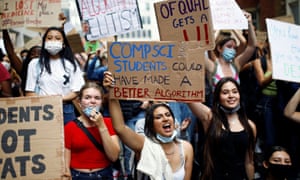
Living the nightmare ... A-level students protest outside the Department for Education in London this month. Photograph: Henry Nicholls/Reuters


Have you ever had a dream in which you are about to sit your final exams and you suddenly realise you did not do any prep and are going to fail? I have that anxiety dream a lot (it is always a maths exam), despite having left school a million years ago. And I am not the only one: it is a surprisingly common phenomenon.

While that dream is disturbing, it is nothing compared with the nightmare British students have just lived through. The pandemic meant school-leavers did not get to sit their Highers or A-levels; instead, algorithms determined their grades – and their futures. A lot of kids from poorer backgrounds had their final results dramatically downgraded from teachers’ predictions; pupils at private schools, meanwhile, were treated remarkably well by the algorithms. After enormous controversy, the Scottish and UK governments performed U-turns, saying exam results would be based on teacher-assessed grades. 

This is not the first time the UK government has suffered embarrassment by algorithm. Earlier this year, the Home Office decided to scrap a “racist algorithm” for visa applicants that was accused of creating “speedy boarding for white people” while making things harder for everyone else. And a security thinktank warned last year that predictive policing algorithms could amplify human bias and make it more likely that young black men would get disproportionately stopped and searched compared with people from other demographics.

Mysterious algorithms control increasingly large parts of our lives. They recommend what we should watch next on YouTube; they help employers recruit staff; they decide if you deserve a loan; they help landlords calculate rent. You and I may have aged beyond school exams, but it does not matter how old you are – these days, it is almost guaranteed that an opaque algorithm is grading and influencing your every move. If that does not give you nightmares, I am not sure what will.

I often have this dream - You’re at the final exam and never attended class


It’s an astonishingly common dream. Many of us have it, with numerous reruns throughout our lives writes Marlene Cimons in The Washington Post

“I never went to class. I never did the work. I never studied. Final is tomorrow. Terrible anxiety,” says Susie Drucker Hirshfield, 71, of Stockbridge, Mass., a friend from college. “Or, I’m a freshman. The campus is huge. I’m lost. I can’t find my classroom building. Seems like I walk around forever, and never find it. Or I find it, and the class is over.’’

Ben Goldberg, 28, a lawyer who was an A student of mine in the Philip Merrill College of Journalism at the University of Maryland, has his own version. “I wake up the morning of a final and realize I am completely unprepared for the exam,” he says. “I spend the day frantically trying to learn the material, but still walk into the exam hopelessly unprepared. Or I wake on the day of the final and realize that I’ve cut the class all year.” 

It’s a dream that apparently spans the generations and usually involves high school or college, sometimes both. And, oddly, it seems to haunt us decades after we last sat in a classroom.

For most people, including me, it goes like this: We’ve signed up for a course that we never attend, or we forget we enrolled in it. When final-exam day approaches, we are panic-stricken because we never went to any of the lectures, never took notes and never did the readings or assignments. (In one bizarre twist, some people report that they show up on final exam day naked — perhaps feeling vulnerable?)

For some, the course is one in which we did poorly in real life. Others dream of a subject in which they actually did well but had worried about failing.

“I’ve had these dreams during and since college,” Hirshfield says. “I even have them when I am not anxious about anything. It’s one of those universal dreams. I think everybody has them.”

I think she’s right. But why is the dream so common? I couldn’t find any research on the topic — surprising, because the dream seems like natural fodder for psychologists. I talked to a few experts who also were unaware of studies examining this dream. In the absence of peer-reviewed findings, however, they were willing to offer a few thoughts, stressing that their ideas were nothing more than opinion and speculation.

“I think those who have it tend to be professional and were successful students,” says Judy Willis, a neurologist and teacher who lives in Santa Barbara, Calif., and who wrote about the dream in a 2009 Psychology Today blog post. “These are people who have demanded a high performance from themselves. The recurrence of the dream correlates with times of stress and pressure, when people feel they have a challenge to achieve.’’

Gemma Marangoni Ainslie, an Austin psychoanalyst, agrees. The final exam, she says, “is likely representative of an occasion when the dreamer feels he or she will be tested or measured, and the anxiety is about not measuring up. The dreamer’s task in ‘awake life’ is to translate the final exam to a situation he or she is facing that stirs up concerns about potential failure.”

But why school? Why don’t we dream about current pressures — grant proposals that are due, impending legal briefs or oral arguments, or newspaper deadlines?

“Emotional memories and impressions made during high-stress experiences are particularly strong, and are further strengthened each time they are recalled and become the place the brain goes when the emotion is evoked,” Willis wrote in an email. “Since each new stress in the current day is ‘new,’ there is not a strong memory circuit that would hook to it in a dream. But there is that strong neural network of previous, similar ‘achievement’ stress. Since tests are the highest stressors. . . [it] makes sense as the ‘go-to’ memory when stressed about something equally high stakes in the ‘now.’ ’’

Ainslie theorizes that most of us have these dreams “as an attempt to disguise what it’s really about,” she says. “The part of yourself that is distressed wants to disguise it, and the easiest way to disguise it is to move backwards.”

Ainslie says the school dream is a common one, although it’s not the only one that reflects anxiety. “Another common one is being in a car and not being able to put the brakes on,” she says. “This one isn’t about not measuring up. It’s about not being in control, a matter of not being the driver in your life.”

Alma Bond, a retired New York psychoanalyst and writer, describes the school dream as a response to “an unconscious memory of an experience for which we were totally unprepared,” adding that it’s possible “we unconsciously remember a time when we did fail some test or other, and are afraid we will repeat the failure.”

My son, 26, is the only person I know who claims never to have had this dream, and he has a plausible explanation as to why. A serial class-cutter in high school, he says that “skipping classes has always seemed normal to me.”

But those of us who are Type A personalities — as well as anyone else with achievement-related stress — may be fated to have this anxiety-producing dream over and over.

Ed Hershey, 72, of Portland, Ore., who spent most of his career in academic communications, recently posted on Facebook of yet another “vividly familiar,” periodic, “I-won’t-graduate-from-high-school-on-time” anxiety dream. He noted that it struck just a few weeks before his 55th high school reunion.

Forty-seven “friends’’ responded, and a dozen of them posted examples of their own variations on the dream. “I guess they [the dreams] never stop, do they?” he says, adding: “At least I know I am not alone.”